
Few museums around the world manage to pack as much art storytelling into their walls as the National Gallery of Art in Washington, D.C. This is a space where saints share rooms with sailors, and where perfectly mundane domestic moments sit alongside exquisitely grand mythological feasts. If you were ever in search of a wide-ranging collection that proves art can speak volumes, here is where you’ll find it.
1. Leonardo da Vinci – Ginevra de’ Benci
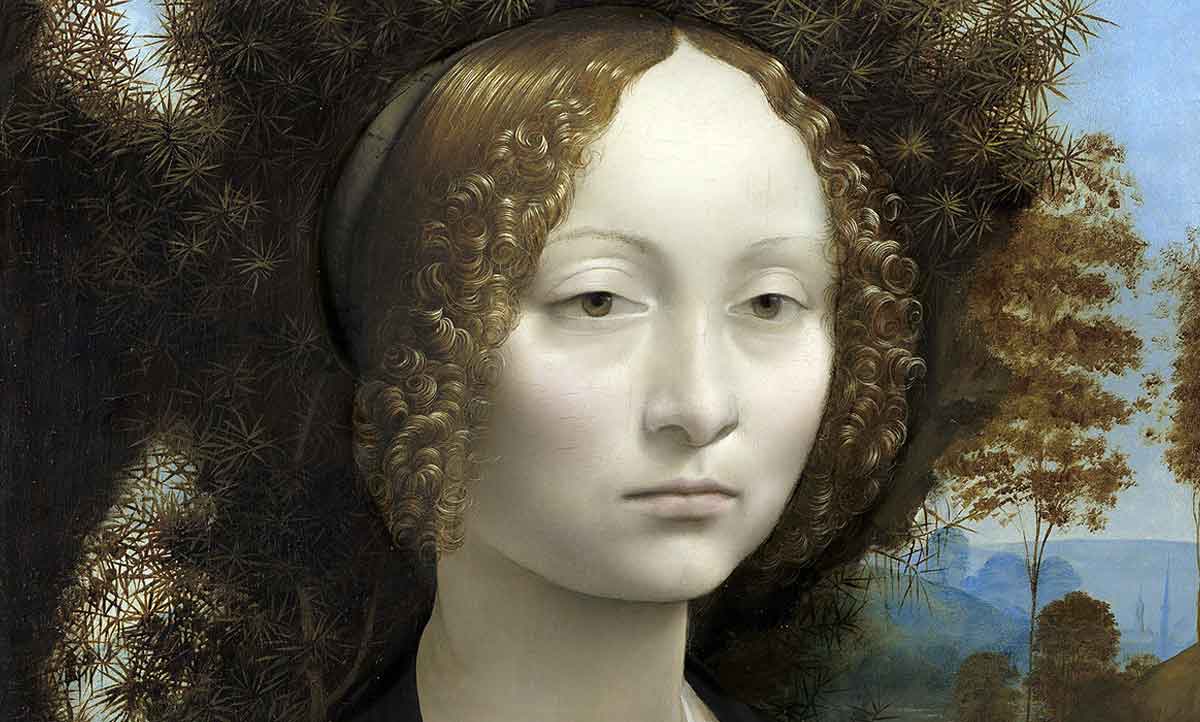
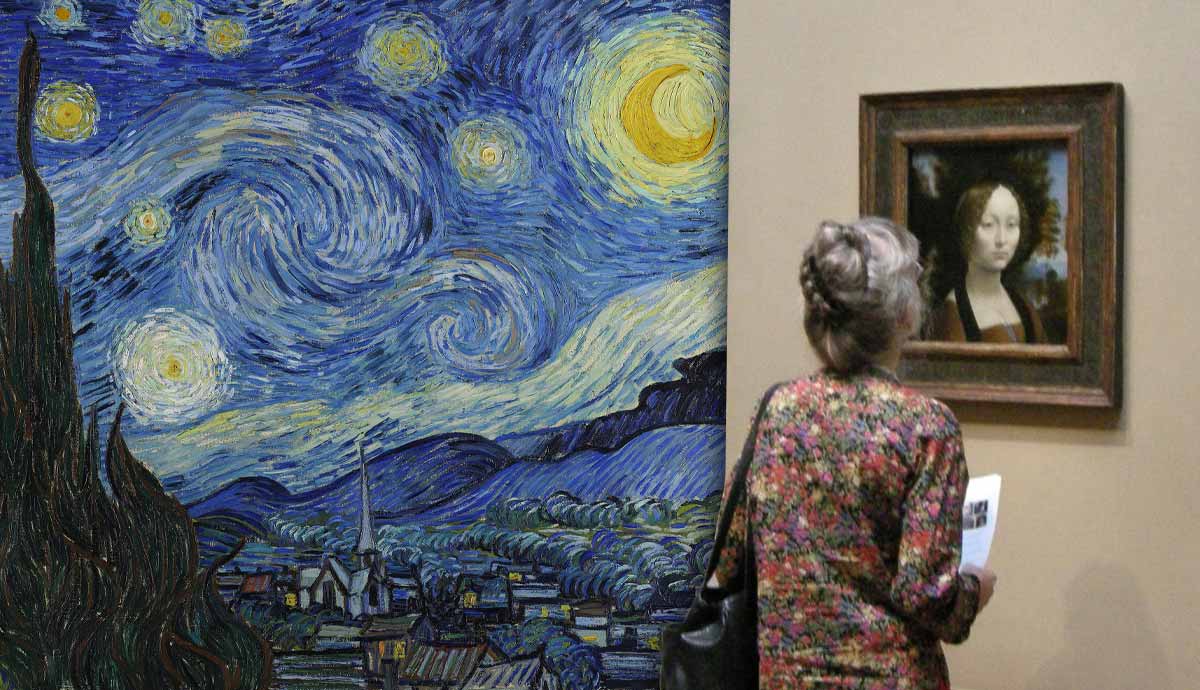
The year was 1474, and 22-year-old Leonardo da Vinci was already torn between sacred commissions and his growing fascination with real people. Ginevra de’ Benci was one of his first ventures into that new territory. A young poet from a wealthy Florentine family, she was admired as much for her wit and intellect as for her beauty. She was only about 16 when she posed for this portrait, and if her age isn’t obvious from her youthful appearance, it certainly is from that direct, slightly unimpressed stare.
It is the only Leonardo da Vinci painting in North America, and it is one of the first he created with oil paints, which dry slowly and allow for better layering of light and shadow. At the time, portraits of women were rather stiff, profile-only affairs, and usually painted indoors. But here we see Leonardo turning his subject slightly toward us, set against a lovely outdoor garden setting, a small but significant act of tradition defiance in itself.
The National Gallery bought the portrait in 1967 for an eye-watering five million dollars, then flew it first-class from Europe in a custom humidity-controlled suitcase, welcomed by much media fanfare. Ever the refined Florentine, Ginevra would most likely have approved of all the fuss.
2. Raphael – Alba Madonna
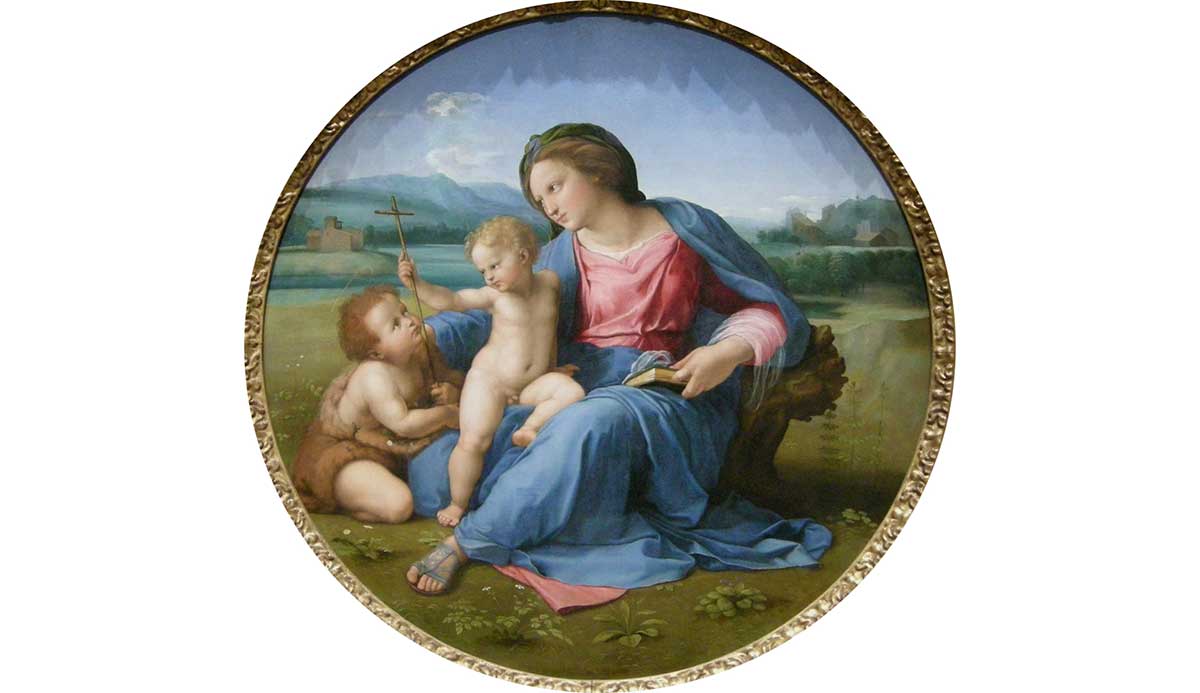
Raphael painted the Alba Madonna around 1510 when he was also barely in his mid-20s and already considered the golden boy of the Renaissance. It shows Mary sitting on the ground with baby Jesus and John the Baptist, all framed inside a perfect circle. Families loved these round paintings at the time, as they were considered elegant, harmonious, and calm, impressions the young Raphael nailed time and again.
The painting itself was infinitely more adventurous than the serene scene it aimed to capture. From Italy, it ended up in Catherine the Great’s collection in Russia, then was promptly sold off after the Revolution. Finally, it was snapped up by Andrew W. Mellon, former US Secretary of the Treasury and avid art collector, who donated it to the US Government in 1931.
Not only did Mellon spare the work from another round of European turmoil, but it became part of the founding collection that would fund the opening of the National Gallery of Art in Washington just a few years later.
3. Giovanni Bellini and Titian – The Feast of the Gods
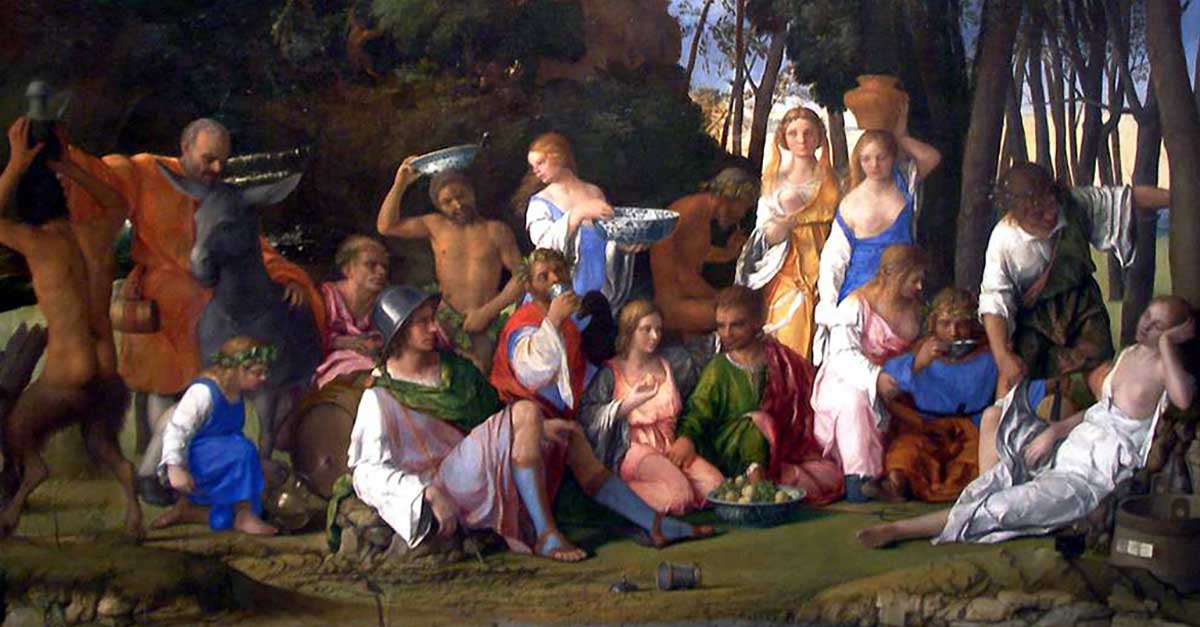
When the Duke of Ferrara asked Giovanni Bellini for a mythological party scene in 1514, one could only assume the Venetian master’s riotous laughter. Bellini was most famous for his Madonnas rather than tipsy gods flirting in the woods, yet he still magnificently delivered. The painting turned out to be the first large mythological scene ever to be made for a private collection, and it is all about wine and divine mischief.
Bellini died soon after completing the piece, leaving the young Titian to rework the background, injecting some of his famous play of light and shadows. Although the two never collaborated on the piece, their joint efforts and brushstrokes represent a time when two generations of genius broke from the humdrum of tradition to create something far more human and a lot more entertaining.
4. Johannes Vermeer – Woman Holding a Balance
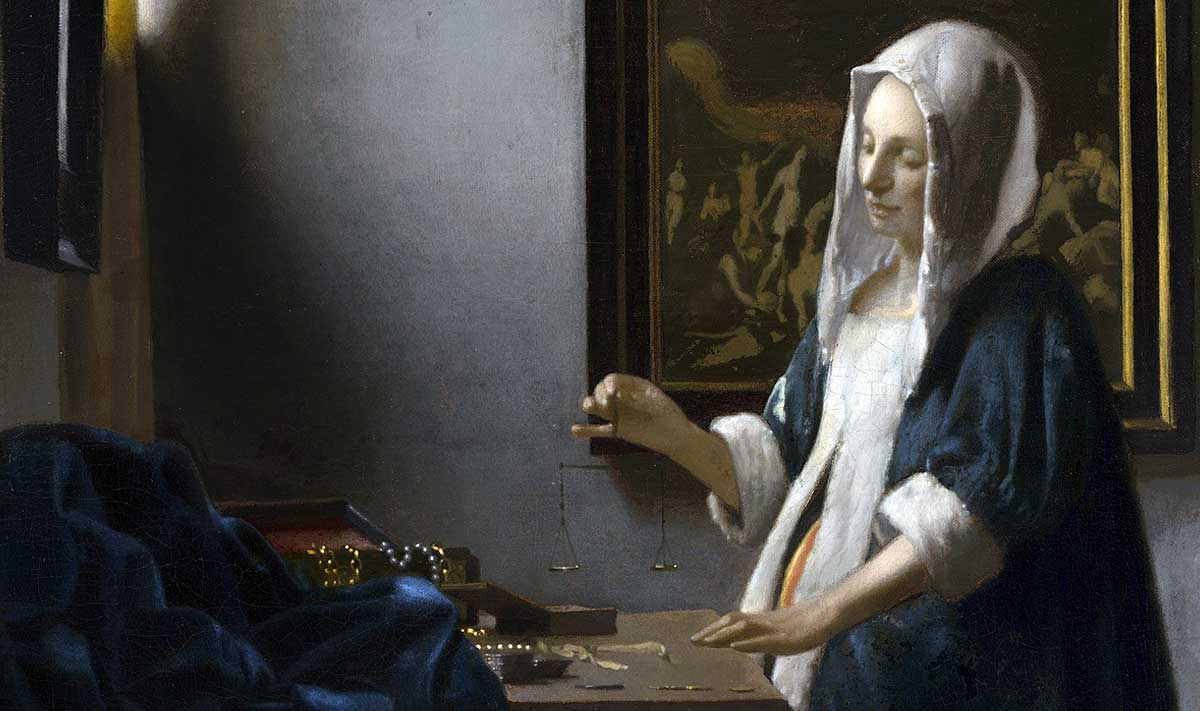
Vermeer’s Woman Holding a Balance, painted around 1664, is one of those Museum of Art highlights you could easily miss if you’re not paying attention. You see a woman standing by a window, weighing tiny objects on a delicate scale. Sunlight drifts beside her and, behind her, a painting of the Last Judgment is partly obscured by her figure.
Vermeer lived in Delft and liked to paint ordinary people going about their ordinary day. His subjects were often women, shown usually mid-thought or mid-task, be it writing a letter, pouring milk, or, in this case, taking her time to measure whatever is on that scale. Wide and wild interpretations abound, even though Vermeer never did explain what she is holding or what it represents. Could it be the auspicious balance between earthly treasures (are those gold coins or pearls?) and the eternal consequences of one’s actions?
Maybe. Or maybe it’s just Vermeer reminding us that a little mystery keeps things interesting.
5. John Singleton Copley – Watson and the Shark
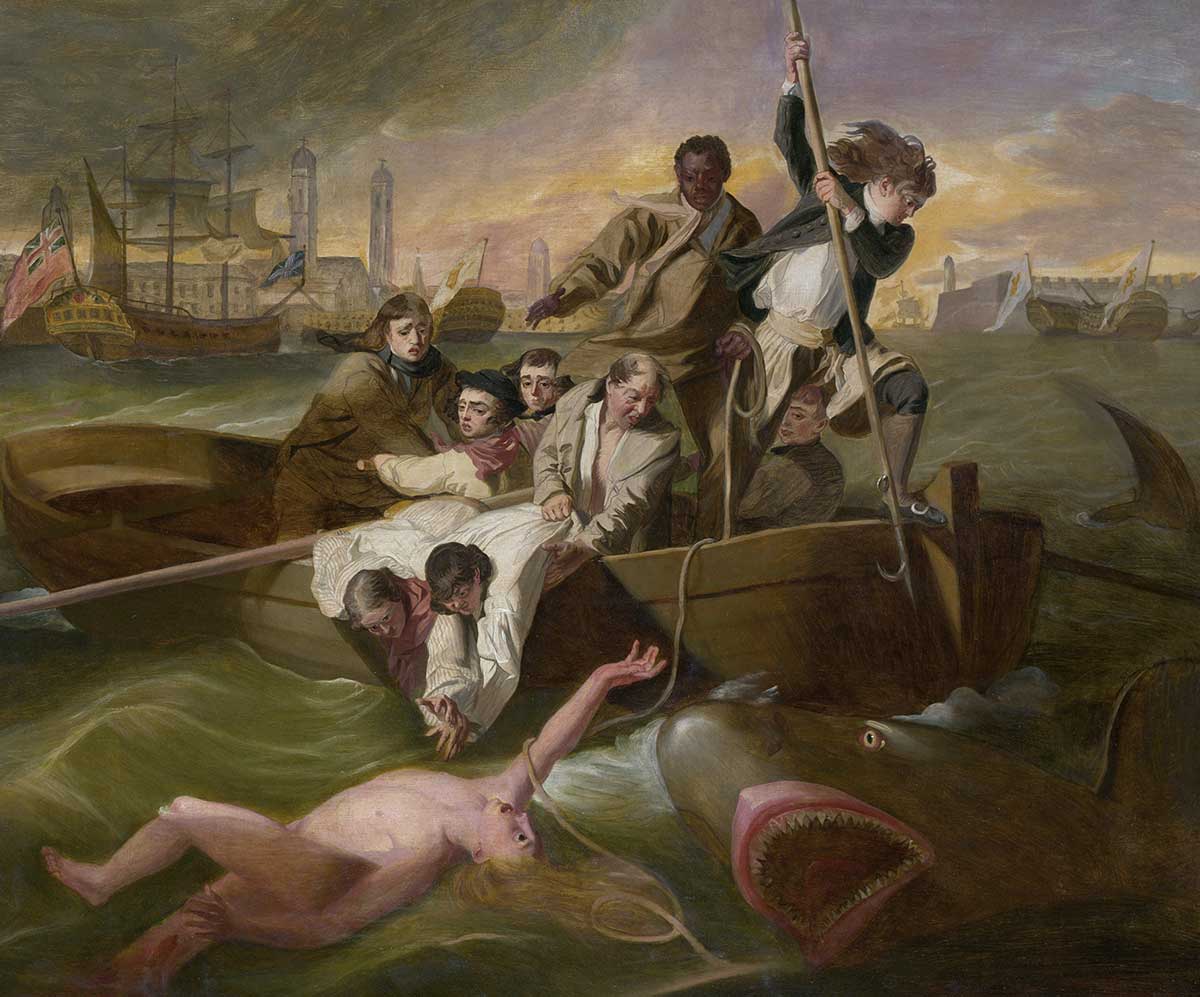
Copley’s Watson and the Shark (1778) shows the real-life moment a teenage boy named Brook Watson was attacked by a shark in Havana Harbor in 1749. Copley had never been to Havana, nor had he ever seen a shark (that one’s obvious, given how odd the animal looks), but he painted the panicked moment as if he had personally witnessed it.
We see Watson limp in the water, the shark’s jaws open wide, and two sailors leaning over the boat trying to pull him out while the captain tries to stab the beast with a hook. Watson survived the attack, minus one leg, and later became Lord Mayor of London. Years later, he commissioned this painting himself, turning his near-death story into a monumental story of man vs nature, bequeathing it to the Christ Hospital in West Sussex after he died. It was eventually sold to the National Gallery of Art in Washington in 1963.
6. Mary Cassatt – Little Girl in a Blue Armchair
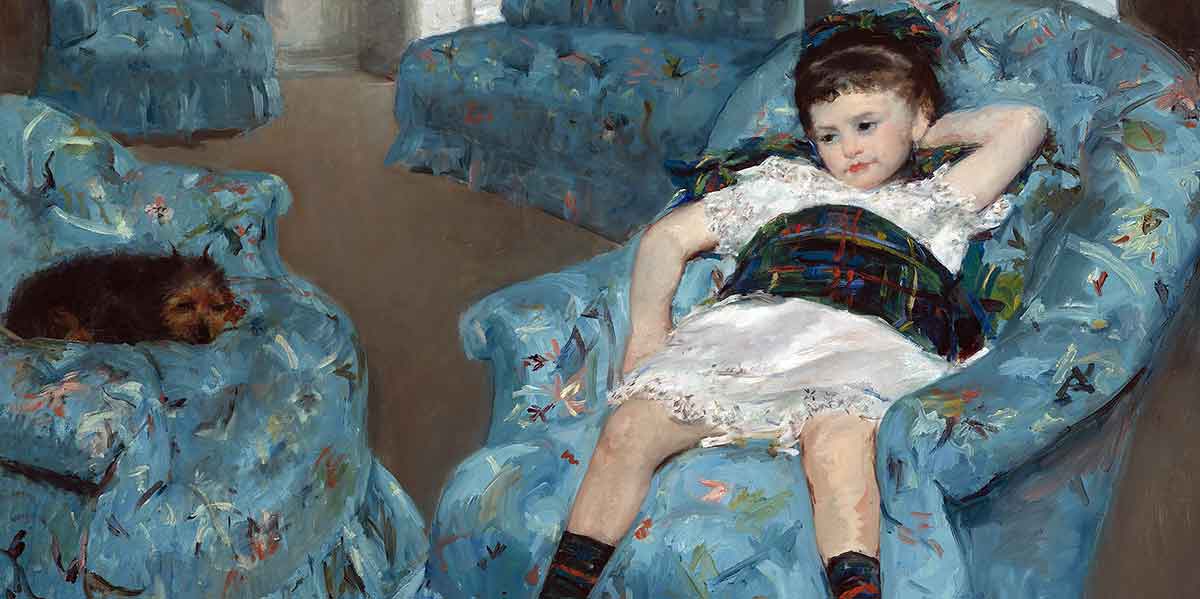
Mary Cassatt’s Little Girl in a Blue Armchair is probably the last thing any Victorian parent would have wanted in their parlor. The child is slouched sideways on a massive chair, socks sliding down, clearly over the idea of sitting still, her sweet terrier sleeping on an armchair beside her. Cassatt, an American living in Paris, didn’t care much for polite expectations either. One of the few women to exhibit with the Impressionists, she was far more interested in painting real life than the polished version.
Her close friend Edgar Degas helped with the background, but the mischief is all hers. Critics of the day didn’t quite know what to make of it, but Cassatt didn’t seem to be asking for their approval. She caught childhood exactly as it is: restless, messy, and wonderfully cheeky.
7. Claude Monet – Woman with a Parasol (Madame Monet and Her Son)
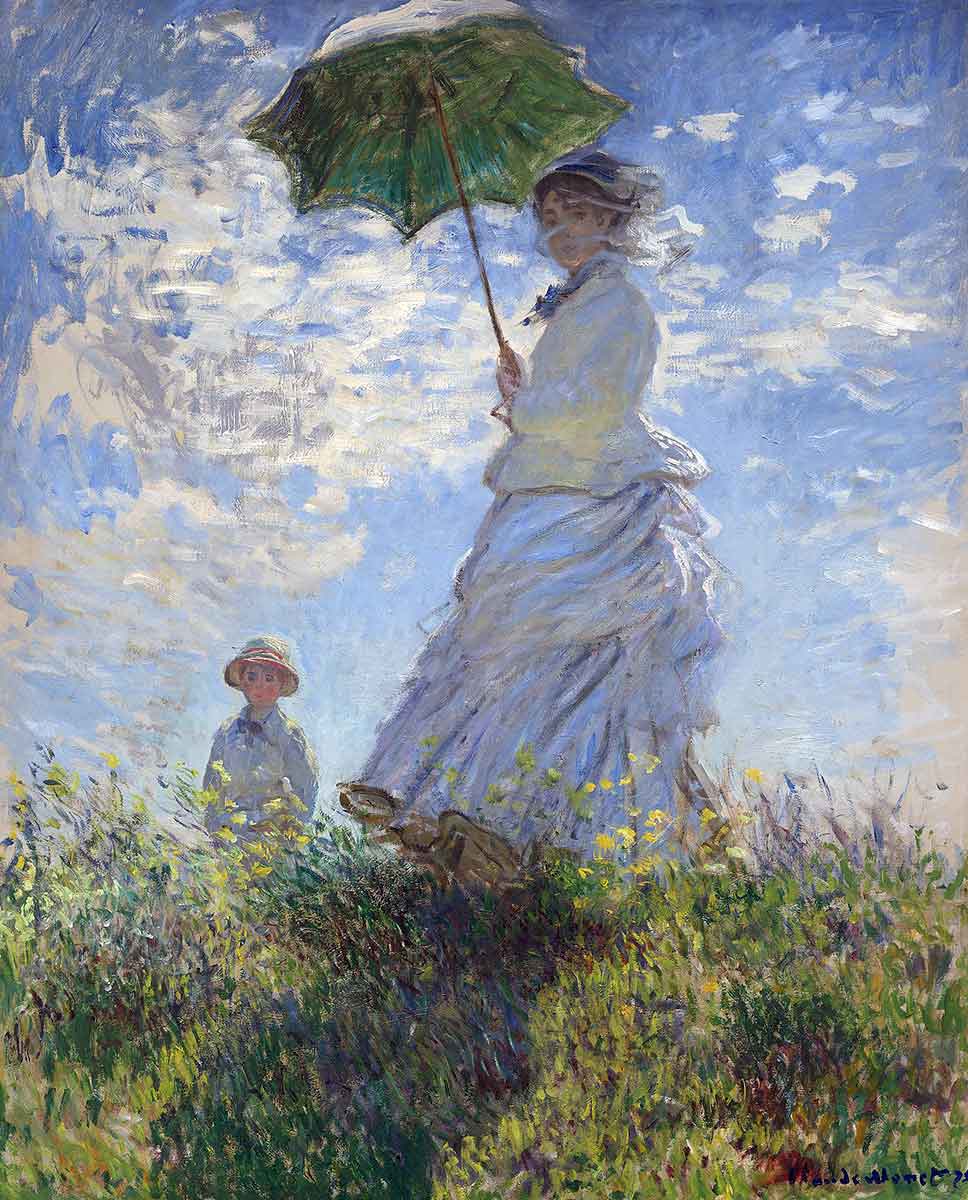
In 1875, Monet gathered up his young family and his easel and set off for a windswept field near Argenteuil. He painted fast, in just a single afternoon, working outdoors and chasing the light and movement of his wife and son as clouds drifted by. The whole thing was finished in a flurry of creativity.
Critics at the time called it unfinished, which for Monet was practically a compliment. Movement is what he wanted to capture, after all, not perfection. His son later recalled how his father laughed as the wind whipped his mother’s veil around.
8. Jan van Eyck – The Annunciation
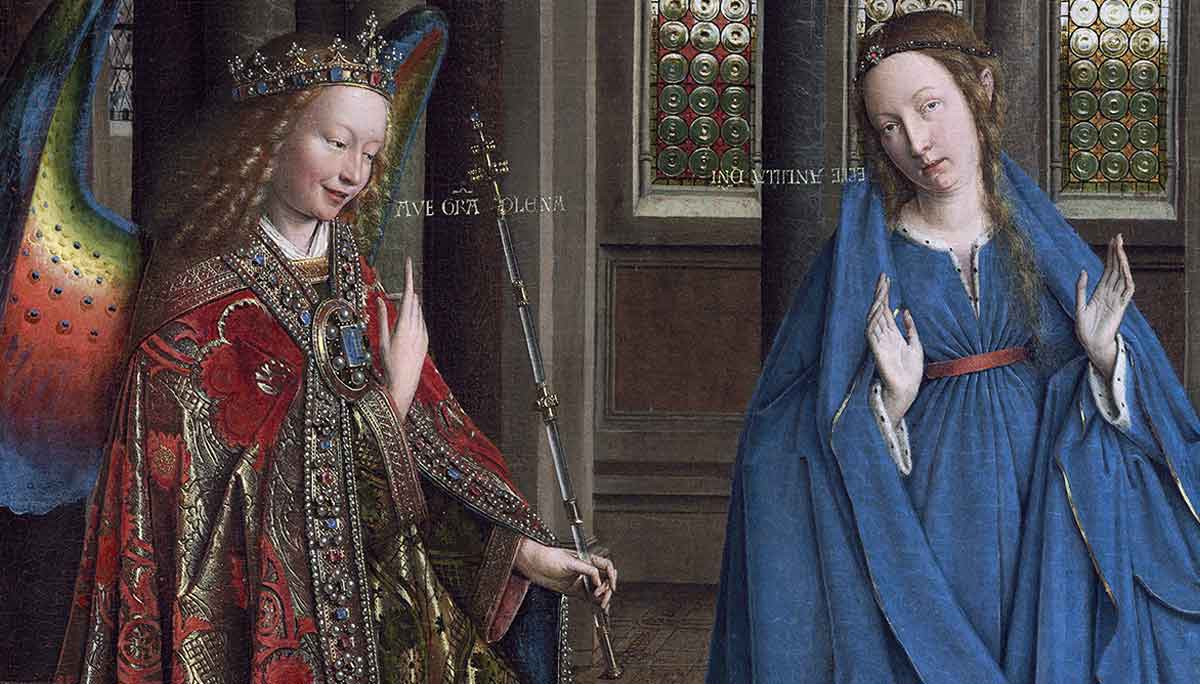
Jan van Eyck‘s The Annunciation was painted in the early 1430s. It shows the moment the angel Gabriel appears before Mary, with that monumental announcement. Every tiny detail here has meaning, from the lilies symbolizing purity to the dove representing the Holy Spirit, and even the tiny Bible scenes painted on the floor tiles. Mary’s reply, accepting her mandate, hands thrown in the air, is written in reverse so it can be read from the heavens.
The use of oil paint was quite groundbreaking, allowing for greater precision and depth of color than the ubiquitous tempera typically used at the time. The attention to detail here is remarkable, especially around the intricate windows. Art historians widely agree that this helped lay the foundations for the Northern Renaissance.