By mid-1945, the Empire of Japan was at its breaking point. Its navy had been all but destroyed, and the rest of the Axis Powers in Europe had been defeated. Over half of its four-million-strong army was bogged down in China, an ongoing campaign since 1937. In short, Japan was beaten but not yet willing to surrender. Historically, Japan finally surrendered after the atomic bombings and the Soviet invasion of Manchuria. However, before these developments, the United States planned to go through with a full-scale invasion: Operation Downfall.
The Pacific War and the War in China
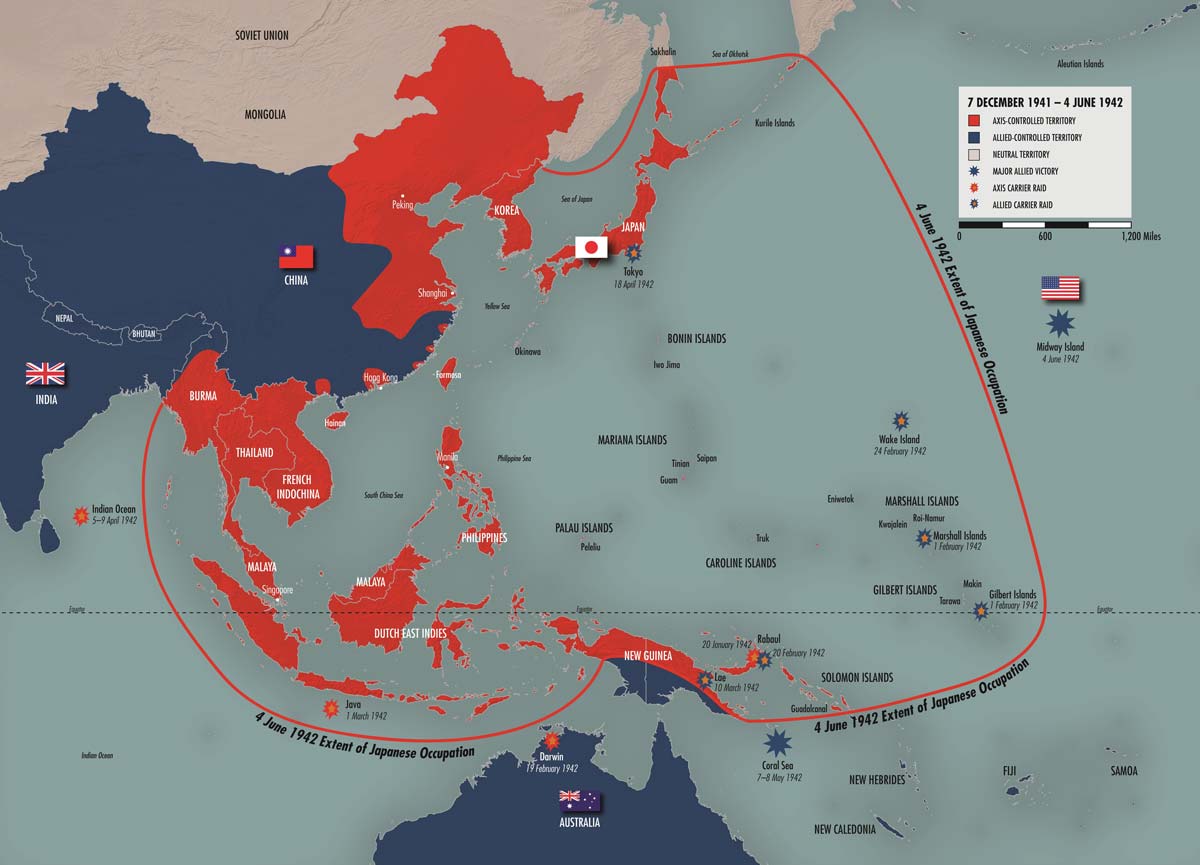
In 1937, the Empire of Japan launched an invasion of China. While initially successful, their conquests stalled in 1939, and the Second Sino-Japanese War became a bloody war of attrition. In 1941, Japan, taking advantage of the German victories in Europe, began its own lightning-fast series of campaigns across the Pacific. While the most famous of these attacks was the attack on Pearl Harbor, Japan also rapidly and successfully invaded American (Guam, Wake Island, and the Philippines) and British territories (Hong Kong, Malaya, and Burma) in the region.
Despite initial victories in the Pacific, the Imperial Japanese Navy’s gamble at Pearl Harbor did not pay off. Instead of scaring the US into negotiating peace and continuing its isolationism, the assault enraged the American populace and ensured that the United States would fight Japan to the bitter end.
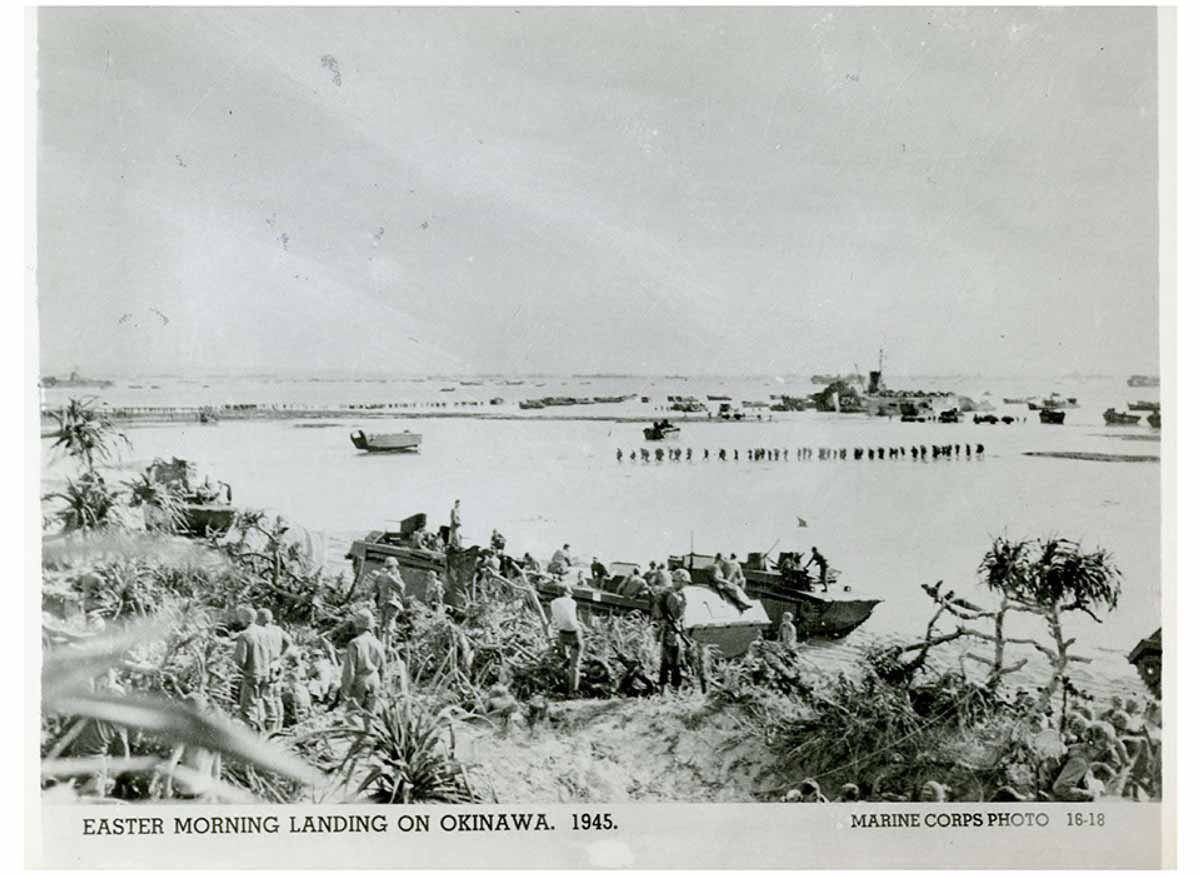
In the following years, the early Japanese gains in the Pacific were reversed as the US embarked on a naval and island-hopping campaign, defeating the Japanese at nearly every turn. By mid-1945, Japan had lost its grip on much of its occupied territories in the Pacific, with the American victory in the Battle of Okinawa placing the Allies within striking distance of the Japanese home islands. However, this battle proved bloody for the Americans, resulting in 12,520 Americans killed or missing, the bloodiest of the Pacific War. With each successive invasion of the Pacific War getting increasingly bloody, the planned final campaign would certainly be even worse.
The First Steps: Operation Olympic
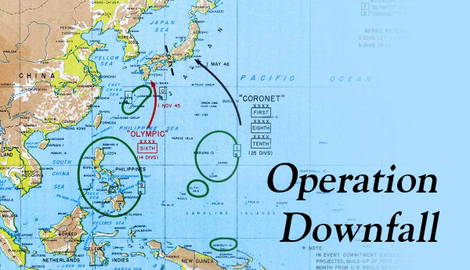
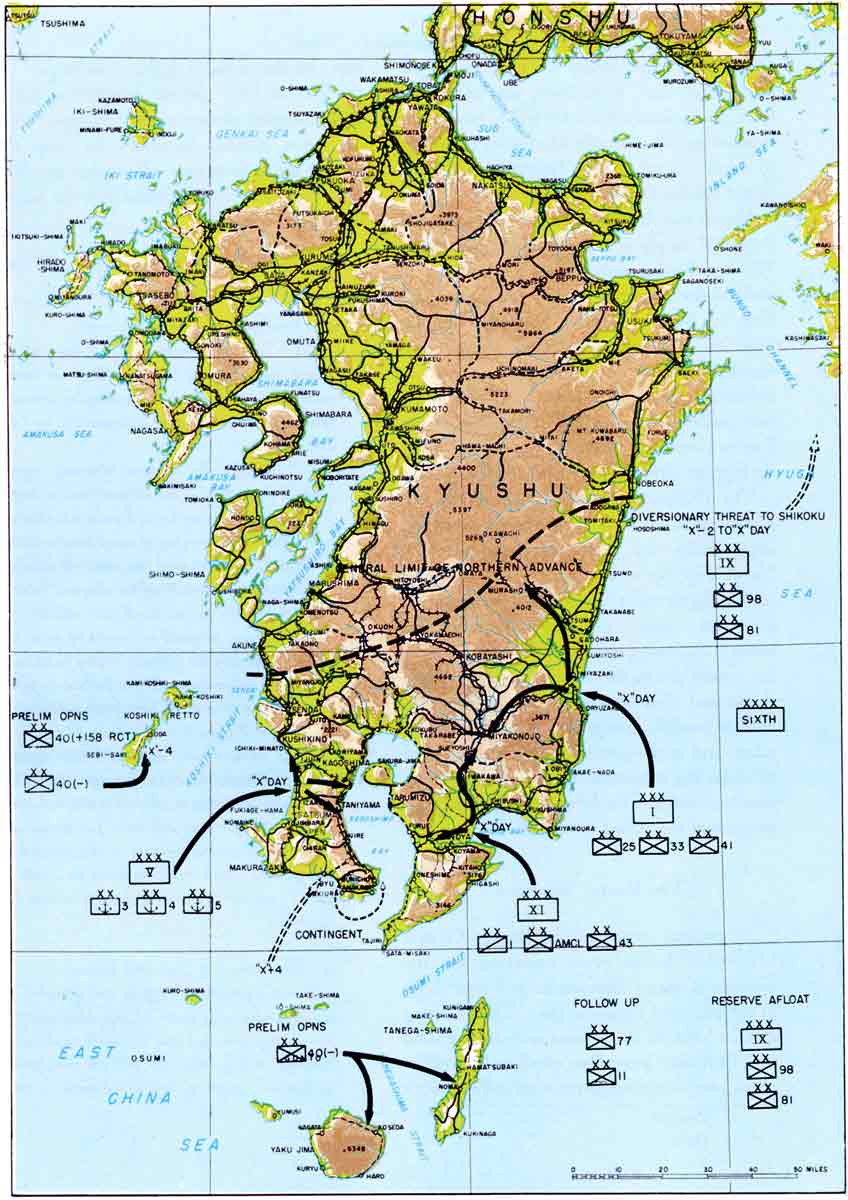
Operation Downfall was divided into two distinct phases, the first of which was Operation Olympic. Olympic was a plan to occupy Kyushu, the southernmost island of the Japanese home islands. Scheduled for November 1, 1945 (called “X-Day”), Olympic was to be an amphibious invasion of a scale never before seen in human history. For comparison, the initial landings of Operation Overlord (more commonly referred to as D-Day), the largest amphibious invasion in history, involved around 160,000 men. The initial landing of Operation Coronet called for 14 divisions, roughly 582,000 men.
Following the establishment of beachheads in Kyushu, several hundred thousand more Allied troops were scheduled to reinforce the first forces on the island. These reinforcements would bring the total Allied troops in Kyushu to around 767,000. Applying the same 35% casualty rate experienced on Okinawa, the planners of Operation Olympic expected around 268,000 casualties (killed, wounded, or captured). While Operation Olympic would have led to huge casualties, there is no reason to suggest that the invasion of Kyushu would have failed. With the battles of Normandy and Okinawa as models, one could expect heavy initial resistance from Japanese forces followed by months of heavy fighting that would likely last into 1946 until the end of the war.
Before the actual troop landings, Downfall called for increased bombing raids across the Japanese home islands, which were carried out using incendiary bombs. Large swathes of Tokyo were burned to the ground, and roughly 400,000 Japanese died in these bombing raids across the country.
In the ten days preceding X-Day, bombings would be increased and target important fortifications and bases across Japan. On the day before the landings on Kyushu, both air and sea forces would heavily bombard the landing beaches in hopes of softening the Japanese defenses.
Finally, on X-Day, US Marine and Army forces would land simultaneously in southern Kyushu on three separate landing sites, quickly moving to secure important objectives and clear the way for reinforcements to follow. However, the Imperial Japanese Army had anticipated an invasion of Kyushu and made its own plans to respond—plans that the Allies might not have been prepared to handle.
The Japanese Response: Operation Ketsugo
In 1274, Japan had fought off an attempted invasion by the Mongol Empire thanks to a “Kamikaze” (Divine Wind, a typhoon that sank the Mongol fleet). When the Mongols returned in another, even larger invasion attempt in 1281, it too was destroyed by a typhoon. This defeat was even more destructive for the Mongols, with some accounts even claiming 100,000 losses for the Mongol army.
While this might not seem relevant to Operation Downfall, the Japanese might have been greatly helped by another “Divine Wind.” The originally planned date for Operation Coronet, November 1, was amid a particularly terrible typhoon season, meaning Coronet would likely need to be postponed. Early December was the earliest, but 1946 was more likely to avoid the winter storms. This would have given Japanese forces even more time to prepare for the seemingly inevitable conflict.
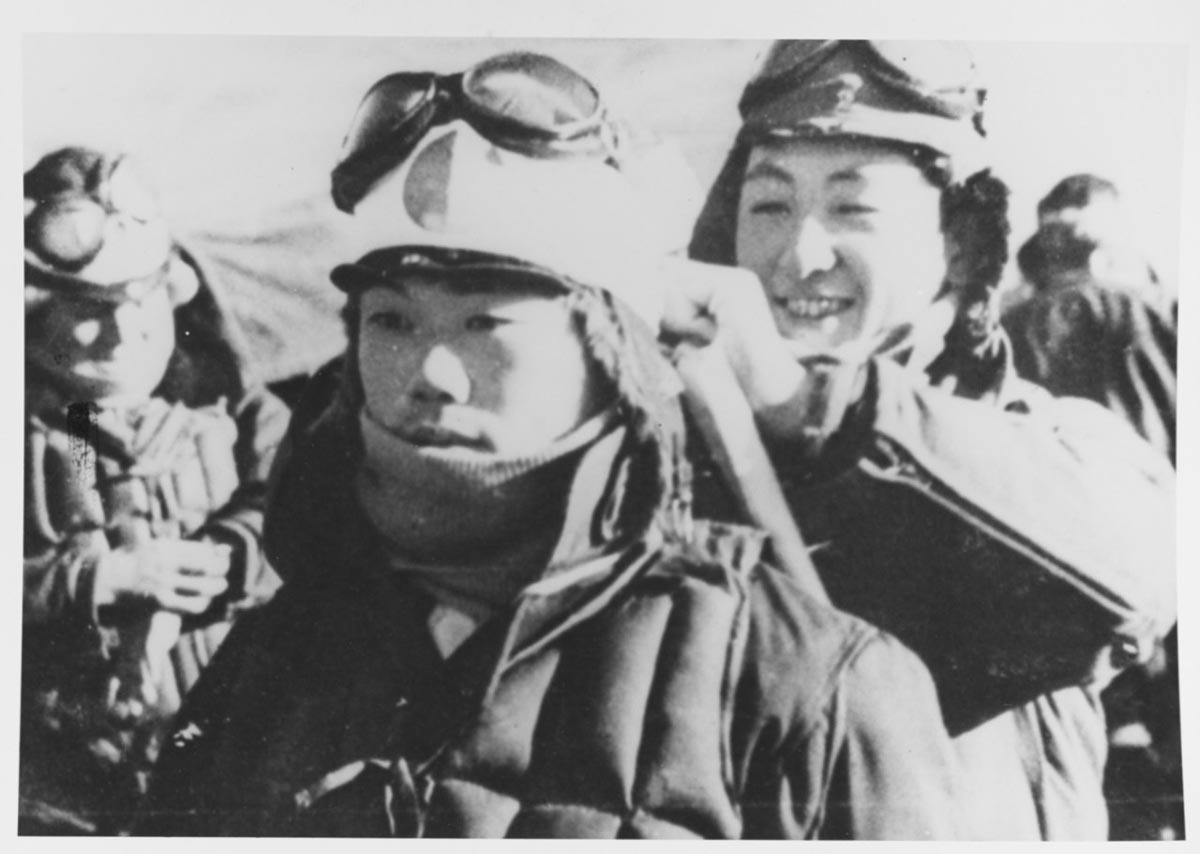
While Japanese forces overseas had suffered massive defeats across all fronts, the Imperial Japanese Army still had significant forces in the home islands. Knowing an American invasion would most likely land in Kyushu, it was the closest of the home islands to the now American-controlled Okinawa; the Japanese planned on confronting the invasion there. The Japanese defense plan, called Operation Ketsugo (translating to “Decisive Operation”), called for the construction of new airfields in Kyushu, primarily for use by kamikaze pilots. By the historical date of the Japanese surrender (August 14, 1945), the Imperial Japanese Army had amassed a force of over 900,000 troops for the defense of Kyushu, a number that likely would have ballooned even further given more time.
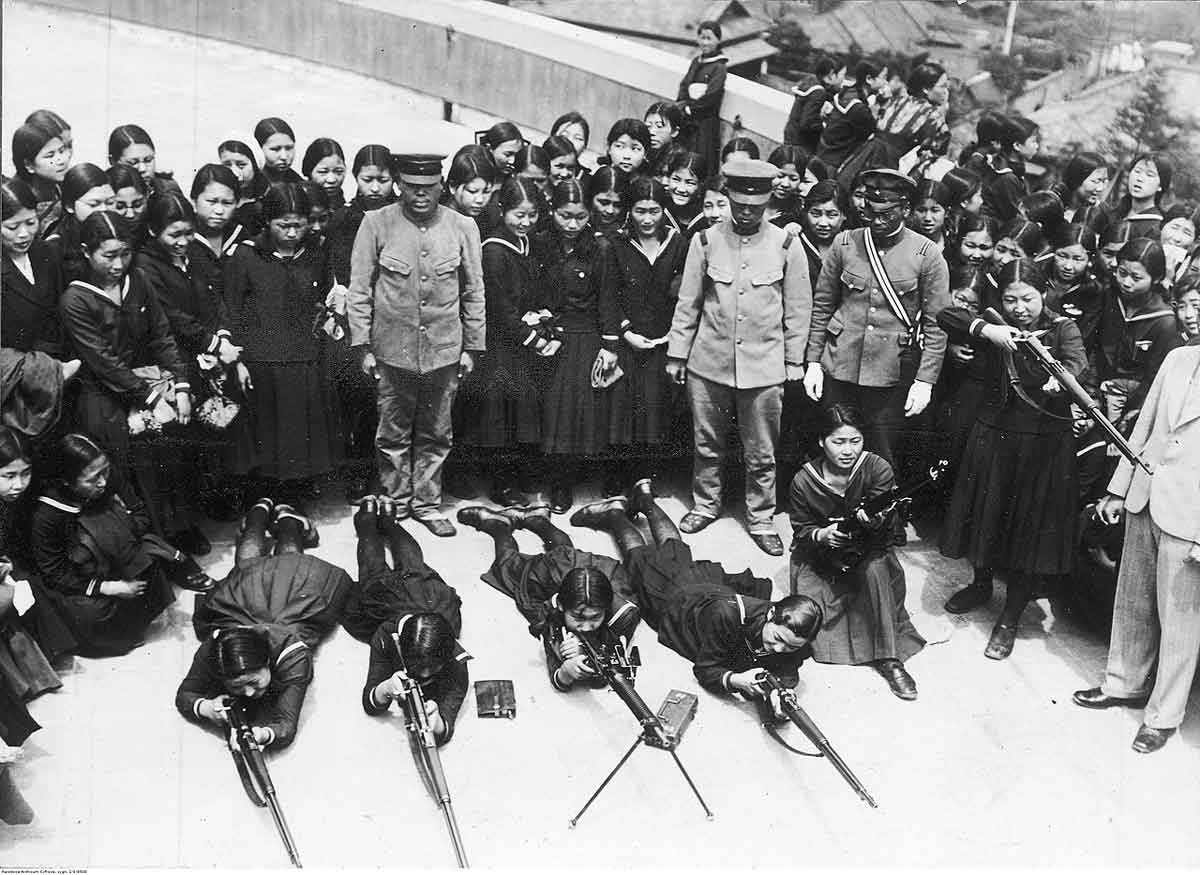
In addition to a massive wave of kamikaze strikes, the Imperial Japanese Navy also had several hundred two-man “midget submarines” to harass American ships, at least 800 suicide “Shinyo” motor boats assigned to Kyushu, and a planned 4,000 “Fukuryu,” suicide divers. The Japanese even planned to mobilize their “Civilian Volunteer Corps,” an army of conscripted civilians, both men and women, armed with hand grenades, swords, spears, and anything else they could use to inflict death. Approximately 2.4 million civilians lived in Kyushu, and many of them (men aged 15-60 and women aged 17-40) would be sent to die under the slogan “the glorious death of the 100 million.”
Ketsugo was not intended to stop the invasion; in fact, it relied on allowing American landings. Ketsugo was designed to cause as many American casualties as possible, no matter the cost to the Japanese people. The hope was that inflicting so many casualties on American forces would make the US public demand peace, thus avoiding a foreign occupation of Japan through a negotiated peace.
It was a desperate final gambit, not a serious chance at victory. However, this was not likely to work. The American public was still enraged at the Japanese attack on Pearl Harbor and fully committed to seeing the war to its end. In the eyes of the United States, Japan’s unconditional surrender was the only path to peace, and this was not likely to change.
The Final Blow: Operation Coronet
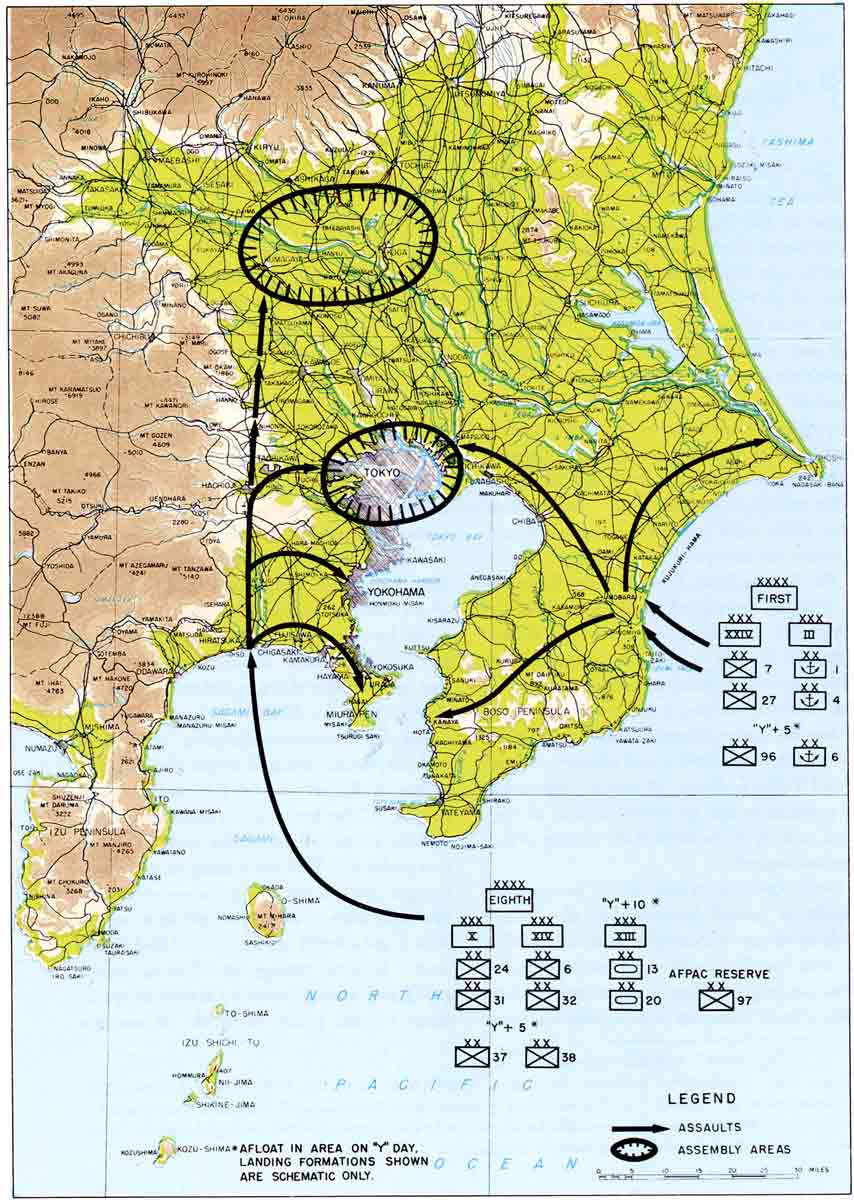
The second phase of Downfall, Operation Coronet, was intended to land on Honshu, the largest of the Japanese home islands. According to the plan, US forces would land on the Kanto Plain near Tokyo on March 1, 1946, called “Y-Day.” Theoretically, they would capture the Japanese capital, deal a knockout blow, and end the war. Coronet called for landing 25 divisions, a significantly larger force than that used in the Kyushu landings. Overall, Coronet was intended to include 1,171,646 American troops and Australian, Canadian, British, and French reinforcements following the initial landings in the Kanto Plain. Unlike Olympic, American forces would also include two armored divisions sent from Europe, which would have a significant advantage over weaker Japanese tanks. Like the invasion of Kyushu, Coronet would be preceded by major bombardments of the Kanto Plain by land and sea, with many planes taking off from airfields in occupied Kyushu.
Japanese defenses were significantly weaker near Tokyo than those in Kyushu, and they lacked sizable forces to defend the city. While Japanese forces were prepared to defend Tokyo to the last man, the Japanese military knew the region was indefensible due to the flat plains of the region. Instead of simply inflicting casualties as was planned for Kyushu, the defense plan of Honshu relied on driving the American forces into the sea and preventing them from establishing a beachhead. The Japanese understood that should a significant American force land in the Kanto Plain and successfully establish a beachhead, it would inevitably succeed in capturing Tokyo. Because of the more powerful Allied force planned for landing on Honshu and the weaker Japanese defenses, Coronet would likely be less bloody than Olympic and, should the Japanese high command or even the emperor himself be captured, a war-winning decisive battle.
Would Operation Downfall Have Succeeded?
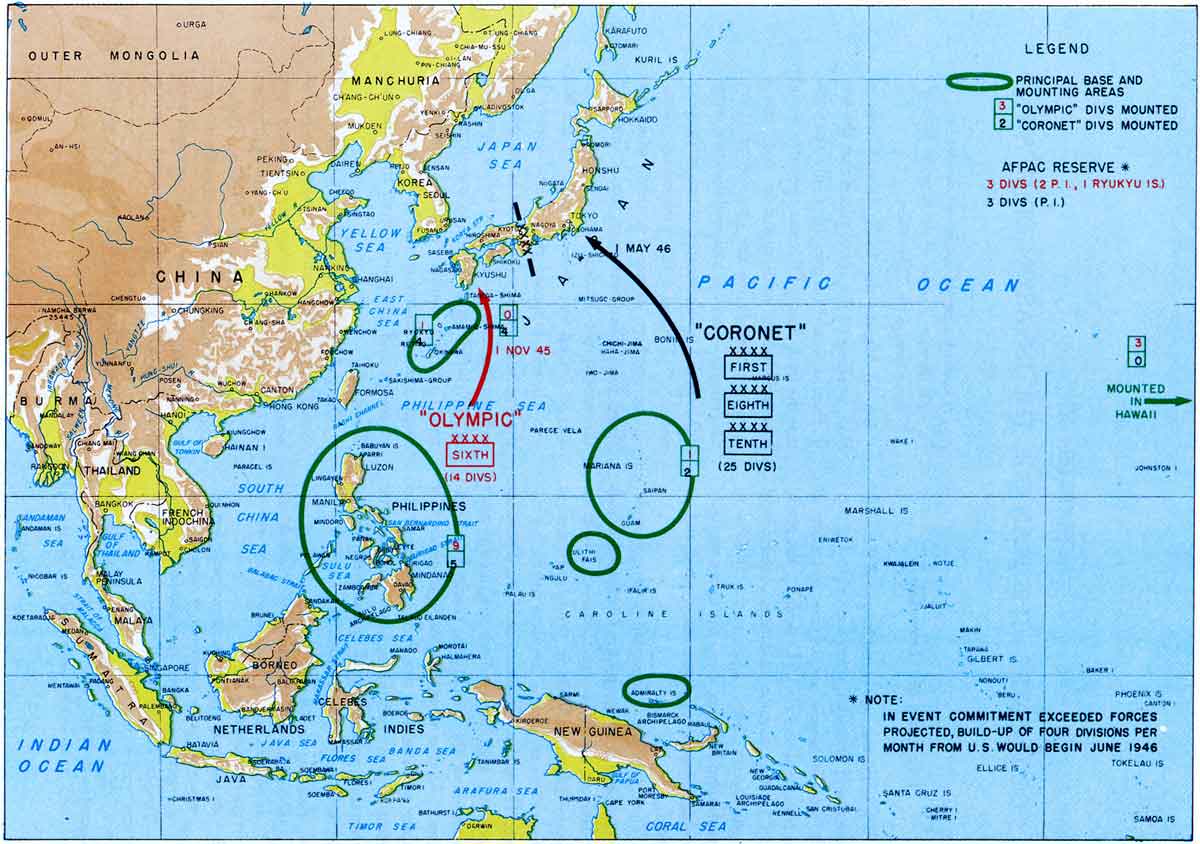
While an invasion of Japan would have been enormously deadly, American combat deaths in WWII would likely have more than doubled, and the Japanese population would have suffered even more, Downfall would almost certainly have resulted in an Allied victory. The United States massively outmatched Japan in population, industry, and resources, and the American populace was fully committed to seeing the war through to its end. The Allies were unwilling to allow anything less than Japan’s unconditional surrender.
Regardless of Ketsugo and the increased casualties it would undoubtedly cause, Japan’s defeat was inevitable. Of course, Operation Downfall was never carried out. Instead of months of brutal combat in a land invasion of Japan, the war ended only a few days after two atomic bombings and the loss of Japanese territories in mainland Asia to a Soviet invasion. While it is impossible to say for certain how Operation Downfall would play out, an American victory at enormous cost for both sides seems the most likely scenario.