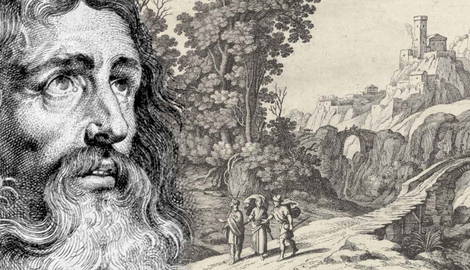
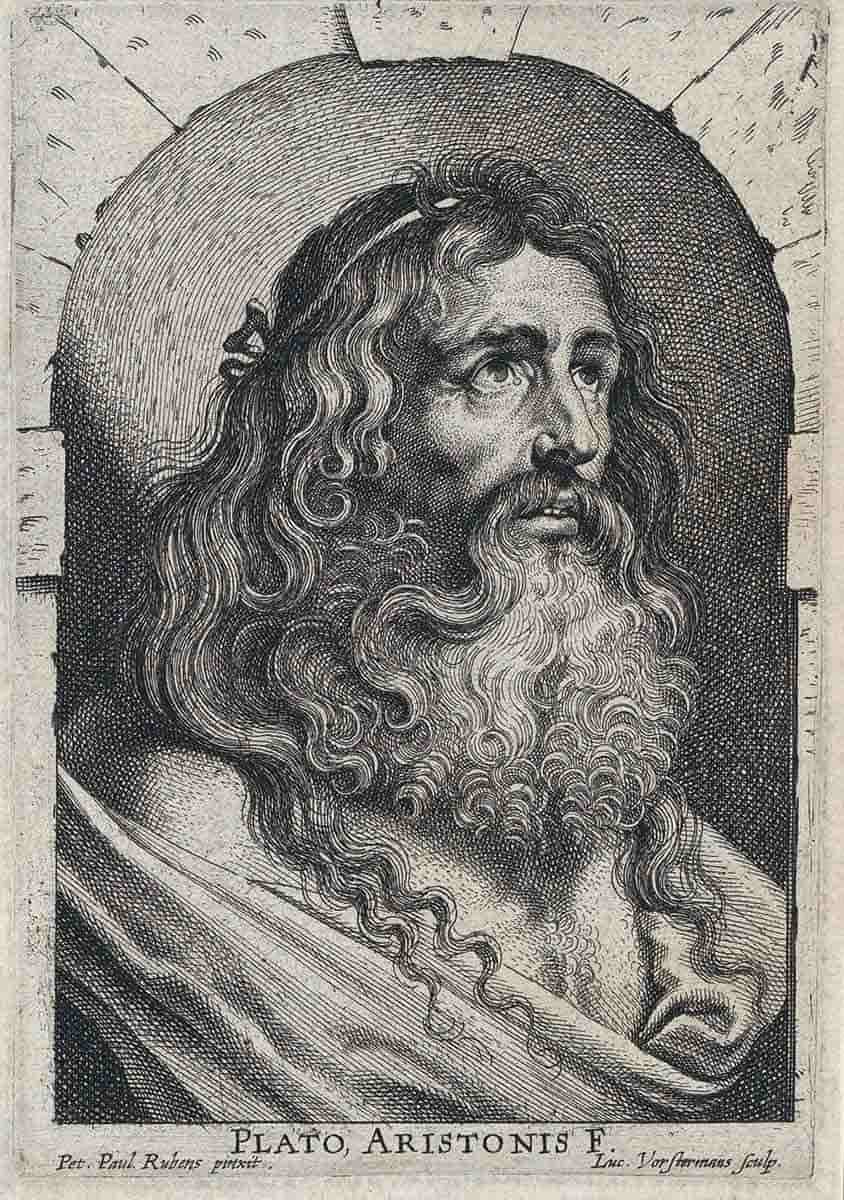
We think of ourselves as singular and unitary. But do we thirst, get angry at ourselves when we give in to our desire, and trace the logical structure of an argument with the same part of ourselves? This article will introduce you to Plato’s psychology as formulated in Book IV of the Republic. Plato uses the word psuche (ψυχή), which is translated as “soul.” However, it can be meaningfully understood as the mind today without committing to a non-material entity that survives death.
A Prefatory Warning: The Shorter of the Two Roads
Let us set the scene: Glaucon and Socrates have just established the virtues of each class of citizens in their ideal city: moderation, courage, and wisdom. Socrates further states that justice is the virtue of each person doing what is best suited to their individual nature. Glaucon is eager to accept this proposition without qualification. However, Socrates impresses upon him the need for further demonstration by turning our gaze from the city back to the individual. If they find the same forms in the individual soul that were found in the city, then they can be confident in their conclusions.
Before discussing the parts of the soul, Socrates warns Glaucon that they will never get a precise answer to this question through the current means of argumentation. He mentions a “longer and fuller road” that would furnish these answers, but notes their current methods do provide answers that satisfy their level of rigor thus far.
It is easy to take Plato’s discussion on the soul here as expounding a system. Comments like the one above remind us that the “answers” given here are not intended as a full picture. It is a fruitful inquiry that serves a purpose for the present, but requires a more rigorous methodology known as dialectic, as proposed in the section below, which discusses the divided line.
Why “Divide” the Soul?
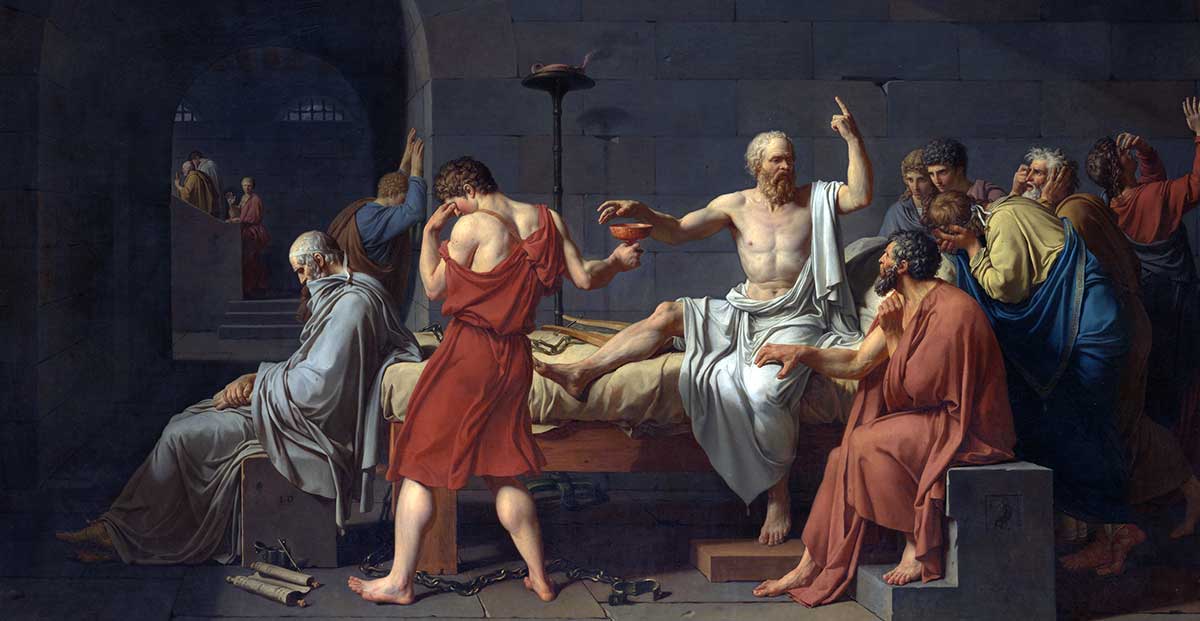
In a previous dialogue on the soul, the Phaedo, Plato paints a dualistic portrait. On the one hand, we have an incorporeal soul: rational and divine-like, and on the other, a corporeal body and its irrational desires. Death is a liberation of the immortal soul from its bodily prison. A philosopher is someone who goes as far as possible to purify themselves by turning away from the body and toward the soul.
In the Republic, this dualism is developed into a more complex form. The opposition between soul and body remains, but rather than the soul being fully rational, the soul is “divided” into three “parts”: the appetitive, which desires, the spirited, which is the source of passion, and the rational, which calculates. Irrational elements are now attributed to the soul itself. The philosopher’s purpose changes from denial of the body to harmony of the soul.
Why three and not one? In perhaps the earliest version in the Western tradition of the principle of noncontradiction (Adam, 1905), Socrates states we will never find the same thing acting or acted upon in opposite ways at the same time and in the same way. If it seems something is behaving in this way, then we can be certain that they are two separate things. He gives two very different examples to elaborate: a man and a top.
A man standing and moving his head or hands is not moving and still at the same time, but some parts are moving, and others are still. A top spinning in one spot is moving with respect to its circumference, and still with respect to its axis. The first example treats the soul as divisible parts, the second as abstractions of a continuum.
The Appetitive: To Epithumetikon (τὸ ἐπιθυμητικων)
The appetitive part of our soul is the largest and most powerful part; its size and scope are proportionate to the number of activities through which we seek gratification. This creates a certain difficulty in choosing just one name for all of them. In the end, Socrates chose appetitive (to epithumetikon) because its essential function is to desire.
It is tempting to say bodily desire, as in most cases it takes the form of physical gratification. However, as John Sallis notes: “In the entire discussion of the relation of the individual man to the city, Socrates treats man as though… he had no body” (Sallis, 1975). Plato has many chances to say “the body desires,” but always speaks in terms of the soul desiring. We will see later why he may have avoided using the body directly in this passage.
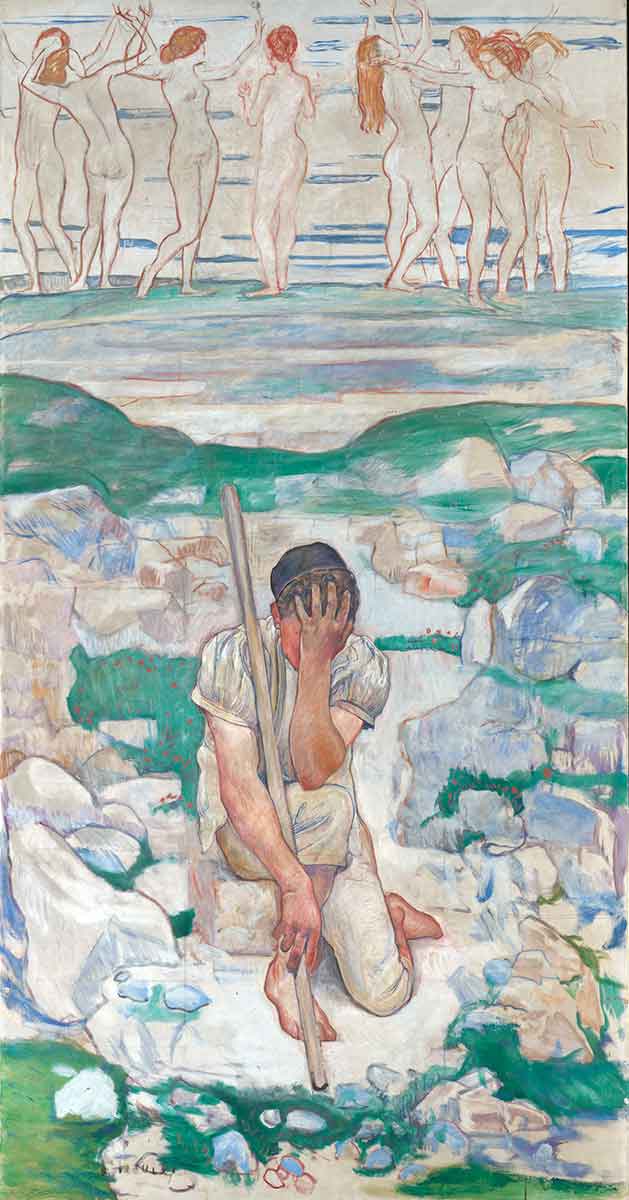
Socrates then establishes that where there is appetite, there is will, and where there is no appetite, there is no will. Using thirst as an example, Socrates draws from experience to say some thirsty people do not want to drink. From the principle of noncontradiction as formulated earlier, it cannot be the same part both wanting and not wanting to drink at the same time. One part of the soul wants to drink while another part forbids it. Socrates again draws from experience and claims the cause is the calculation of the consequences of drinking: an activity of our rational element.
The Spirited: To Thumoeides (τὸ θυμοειδές)
Socrates then turns to the spirited part of the soul. Throughout the Republic, Plato identifies it as a kind of energy or passion that gives rise to things like courage, honor, and anger. Is this a third, distinct part, or do these activities belong to one of the two just mentioned? Glaucon thinks it could belong to our appetitive nature, prompting Socrates to propose a counterexample quite odd to the modern reader.
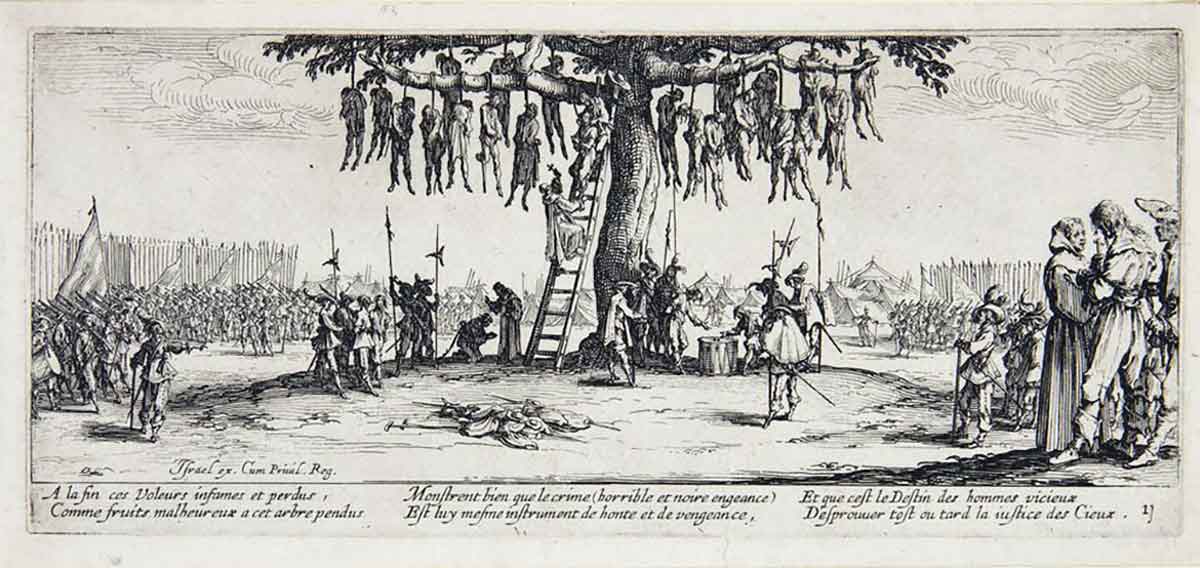
He recalls a story of a man named Leontius who saw corpses lying at the feet of an executioner. He desired to look at them, but at the same time felt repulsed and turned away. Caught between these conflicting impulses, he eventually gave in. He ran toward them and screamed: “Look for yourselves, you evil wretches, take your fill of the beautiful sight!”
He uses this story to propose that our soul is at war: the rational against desire, with the spirited allying with the rational. Our spirited nature is deeply connected to our moral beliefs. Leontius becomes angry and curses his eyes because he feels shame in violating a kind of moral obligation. He desired to look, knew that he ought not to, and his shame is in response to his giving in to his desire over his rationality.
An important feature of our spirited nature is its indignation toward injustice. Provided we have a good character, we understand the consequences we face as a result of wronging someone and do not get angry. However, if we believe ourselves to have been wronged, we become angry and endure pain or even death in the fight for justice.
The Rational: To Logistikon (τὸ λογιστικόν)
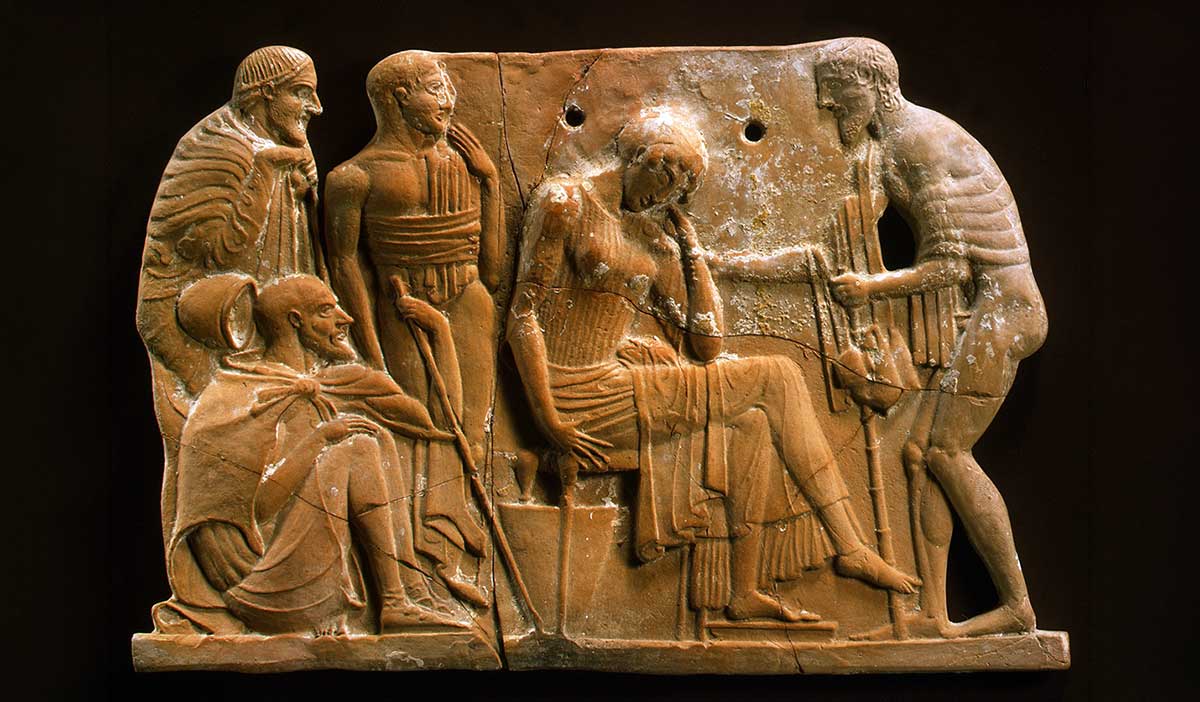
While our spirited nature is shaped by our moral principles, our rational nature is the source of these principles themselves. We know it is distinct from spiritedness from the examples Glaucon and Socrates provide. Glaucon notes that children become angry and aggressive, though they lack a developed rationality. Socrates uses an example from Homer raised earlier in Book III as exemplary of endurance. Odysseus is plagued by a burning passion for revenge, but quells his anger by reasoning with himself “in the division of mind and spirit” (The Odyssey, ca. 8th century BC/1967, Book xx, Lines 10-20). This shows spiritedness not only conflicts with appetite, like in Leontius, but also with rationality, though on its own accord, not on the side of appetite.
While both the appetitive and the spirited parts of us can be motivated to satisfy their own ends without regard for the other parts, rationality is incapable of operating in this way. It alone looks to the advantage of each part and the soul as a whole. In this way, Socrates and Glaucon have established that the structure of the ideal city they have created resembles the structure of the individual soul.
Both the city and the individual are tripartite and share the same virtues. With wisdom, the reasoning part governs with the good of the whole in view; with courage, the spirited part fights to protect the soul and the city under the guidance of its ruler; and with moderation, the appetitive desires within the limits set by its rulers. Externally, in the city, justice is a harmony of the three classes functioning according to their nature. Internally, in the individual, justice is a harmony of the three parts of the soul functioning according to their nature.
Tripartite Division or Continuum?
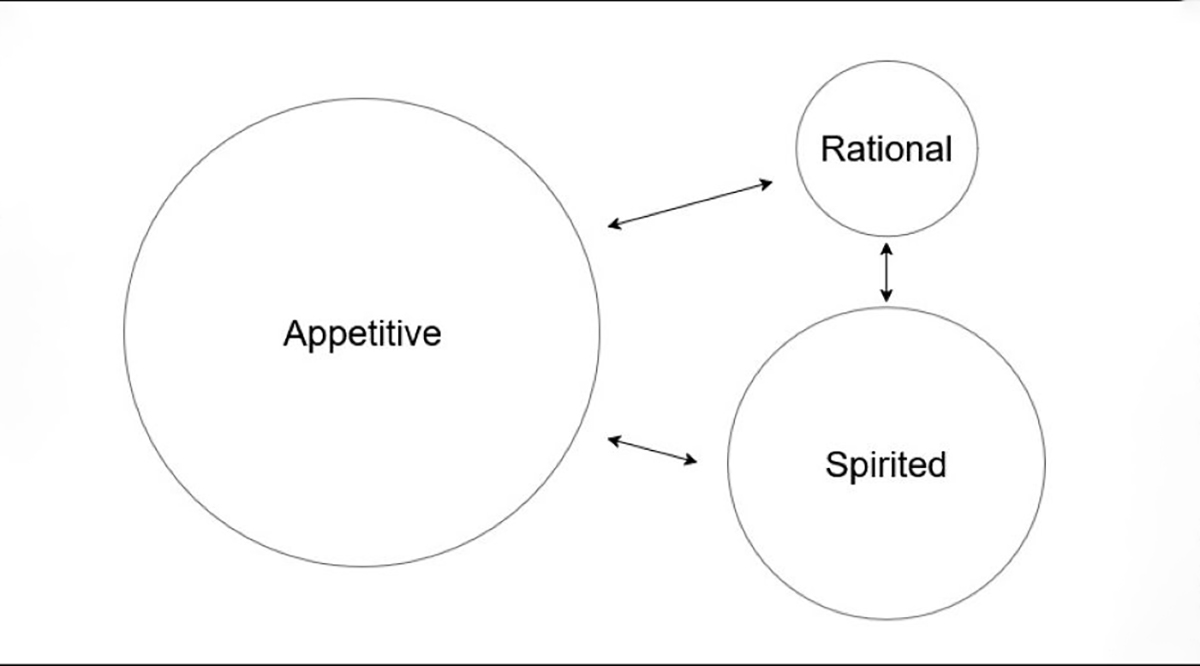
One possible misinterpretation from using words such as “parts” or “division” is to understand the rational, spirited, and appetitive as three separate entities (figure 1). However, they’re better understood as existing on a continuum beginning with appetite and culminating in reason (figure 2 below) (Dorter, 2006, p.116). Acts born out of desire often have elements of calculation (to attain satisfaction) or spiritedness (frustration from lack thereof). Spirited acts can be calculative (planning revenge) or appetitive (the feeling of satisfaction). Even rational acts contain elements of desire and spiritedness. Many scholars are driven by passion, a desire for learning. The phrase “a thirst for knowledge” describes the experience of a rational kind of appetite analogous but not reducible to bodily appetite. This may be the reason why Plato held off on qualifying the appetitive as “bodily” desire.
The Republic itself suggests the soul is continuous rather than containing distinct divisions. Socrates compares the three parts of the soul to the high, low, and middle registers of music. A person becomes a harmonious being by bringing them, and any others there may be in between, together and thereby becoming whole. Although we can easily identify some notes as belonging to one or another register, and despite the utility of a musical staff, we cannot ignore the fundamental continuity and ambiguity of music itself.
In the same way, Plato’s explanations provide a useful tool for analysis. Many acts recognizably originate from one or another point along the continuum. Thus, it makes sense to speak about the soul as if it contained three distinct parts, even though they are not divisible parts (the man), but essential abstractions of a continuum (the top).
Exemplars of the Just and Unjust Soul
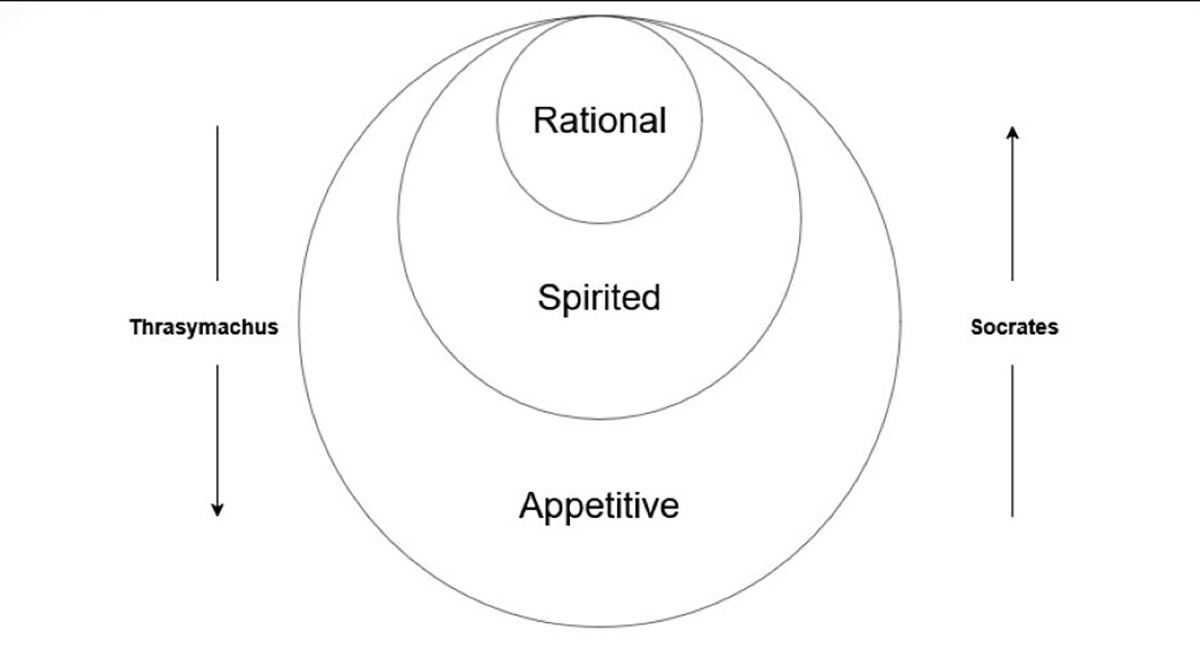
We’ve seen from this small introduction to Plato’s tripartite soul that he uncovers our threefold nature: a war within between our reason and insatiable appetite, with our spirit allying with reason. We’ve also noted how all three elements are present to some degree at every stage along the continuum of lower to higher conscious activity, from the appetitive to the rational. Lastly, Plato’s philosophy produces two corresponding archetypes of the soul: one in harmony and one in discord. Though by nature, reason is best suited to rule because of its interest in the whole, it can be enslaved by the appetite to serve its own ends without regard to the whole of the soul. Thrasymachus and Socrates can be seen as exemplars for each archetype.
In Book I of the Republic, Thrasymachus attempts many times to interrupt Socrates’s refutation of Polemarchus’s argument, but is barely kept silent by his companions. Eventually, he can be restrained no more and lets loose his anger upon Polemarchus and Socrates. As a sophist, Thrasymachus is driven by his appetite for money. His anger is uncontrollable because his spirited and rational natures are subservient to this desire, which knows no limit: subverting the entire structure of the soul.
Socrates, though quite passionate, possesses the internal harmony and self-control Thrasymachus lacks. He endures the insults and, despite being frightened by Thrasymachus, answers his call to debate. His body trembles, but his wisdom regarding what is and what is not to be feared (courage) allows him to speak. His dedication to looking toward the form by which things are what they are (wisdom) guides his speech. Lastly, placing his desires under the rule of his rational and spirited natures (moderation), he achieves an internal harmony (justice).
Sources
- Adam, J. (1905). The Republic of Plato. Cambridge University Press Warehouse. (1902)
- Dorter, K. (2006). Transformations of Plato’s Republic. Lexington Books.
- Homer. (1967). The Odyssey of Homer (R. Lattimore, Trans.). Harper & Row. (Original work published ca. 8th century B.C.E.)
- Sallis, J. (1975). Being and Logos: The Way of Platonic Dialogue. Duquesne University Press.
- Plato. (1961). The Republic. E. Hamilton & H. Cairns (Eds.), The Collected Dialogues of Plato, Including the Letters (P. Shorey, Trans.; pp. 575–844). Princeton University Press. (Original work published ca. 375 B.C.E.)