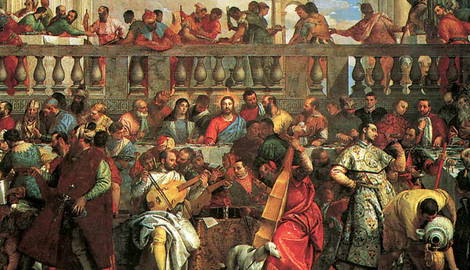
The largest painting in the Louvre, The Wedding at Cana by Paolo Veronese stuns at first sight. It’s overwhelming; there are over a hundred figures, and so much is going on that the viewer can easily feel confused when first looking at this larger-than-life masterpiece. However, don’t rush to dismiss this biblical painting as boring or moralizing. There’s a lot more to it than first meets the eye.
What Is Veronese’s “The Wedding at Cana” Like?
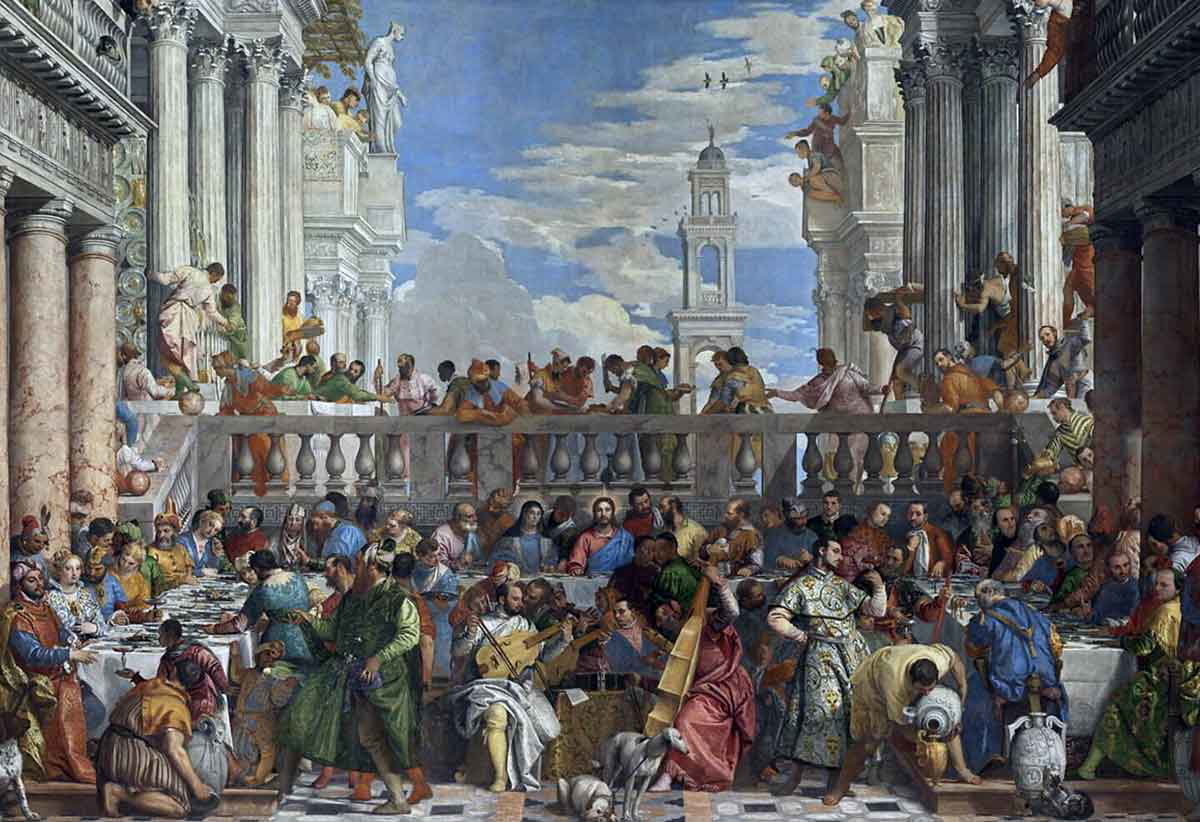
Veronese’s The Wedding at Cana resides in the largest room in the Louvre, the Salle des États, exactly opposite Leonardo’s Mona Lisa. The Wedding at Cana is an enormous painting, about 22 feet 2 inches high and 32 feet 7 inches wide. Commissioned for the refectory of the Benedictine monastery of San Giorgio Maggiore, it was captured and taken to Paris by Napoleon during his Italian campaign. It’s one of Veronese’s renowned “Feasts”—a series of large-scale paintings based on Biblical scenes. The artist used these festive subjects from the Bible to depict the wealth and sumptuousness of the Venetian society.
At the time that it was created, the three greatest Venetian artists were Titian, Veronese, and Tintoretto, who were rivals for orders from the aristocracy and the rich monastic orders of Venice. Paolo Caliari was born in Verona in 1528. He was known as Veronese, a nickname that derives from his city of birth.
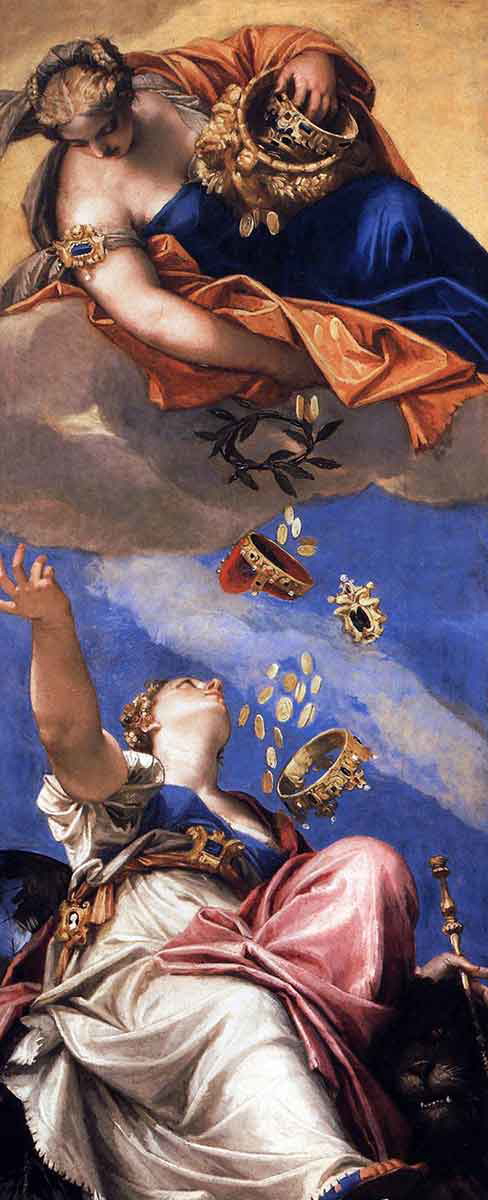
Veronese’s painting style was renowned for its palette of jewel-like colors and the grand scale of the works he completed for Venetian monasteries. His patrons included the clergy, Venetian aristocratic families, and even the Doge himself. Paolo Veronese was the author of numerous ceiling paintings, like the ambitious Triumph of Venice in the Doge’s Palace, painted in 1585. The large canvases with numerous figures allowed the artist to show off his mastery of composition.
Furthermore, Veronese made active use of the Venetians’ love of splendid architecture, often including it in his paintings. Paolo Veronese set The Wedding at Cana in a Classical, palatial courtyard. The main figure, Jesus, is depicted in the center of an elaborately constructed composition, formed by architectural details, sculptures, interacting guests, busy servants preparing and serving the feast, and even pets, such as the miniature dog on the table. All the elements combine to create a rich effect of pageantry and celebration.
Subject of Veronese’s “The Wedding at Cana”
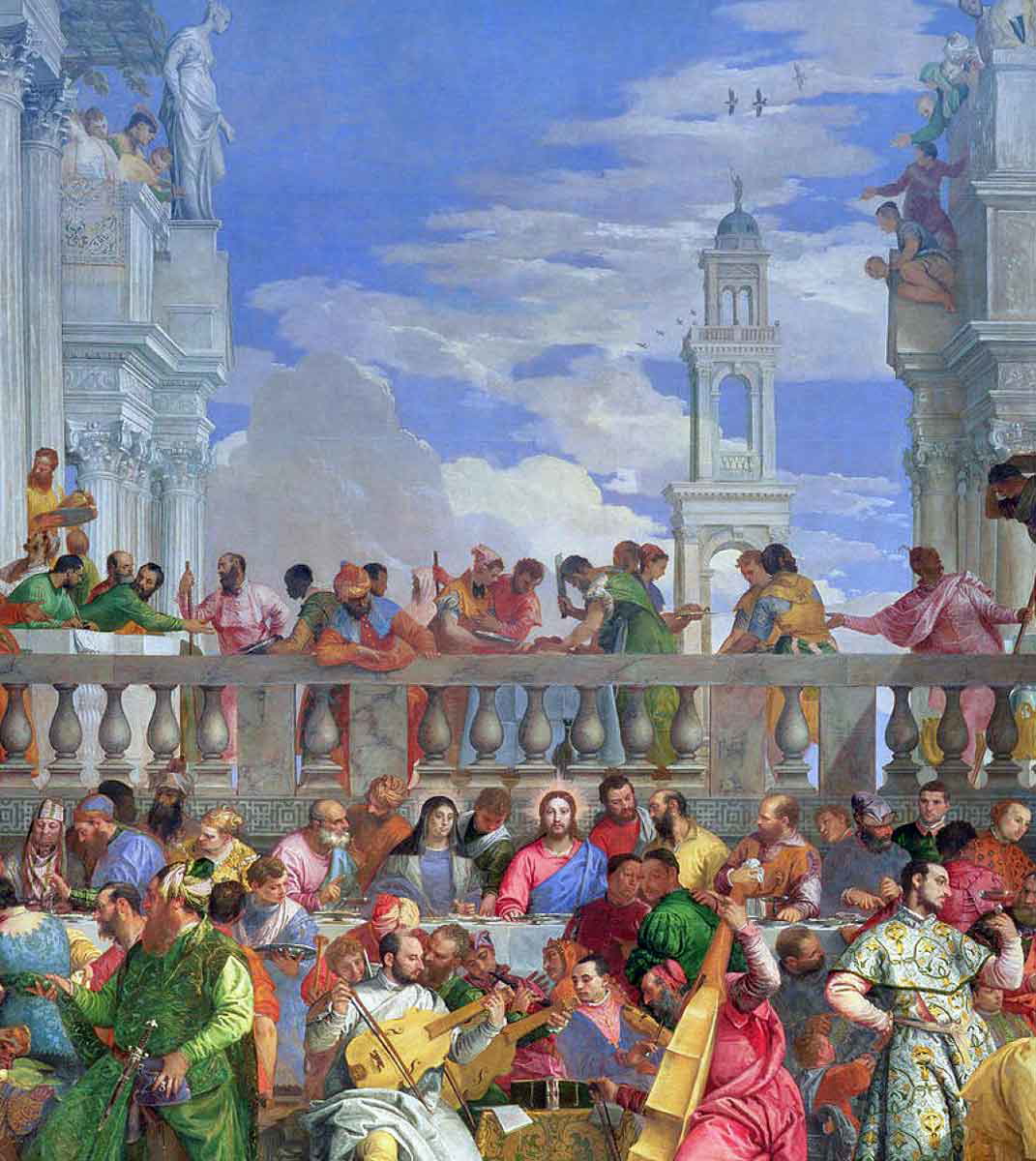
So, what happened at the wedding at Cana and why is it important? The subject of Veronese’s The Wedding at Cana comes from the New Testament, from the Gospel of John (John 2:1-11). It depicts Jesus’ first miracle: the turning of water into wine. In John’s account, Jesus was invited to a wedding, together with his disciples and his mother.
In the midst of the celebration, Jesus’ mother alerted him to the fact that the wine prepared for the feast had run out. Since wine played a prominent part in the traditional Jewish weddings, failure to provide enough for the guests was humiliating to the bride and groom’s families. Jesus’ miraculous intervention not only saved the celebration but also became the first of numerous miracles often portrayed in art, such as the healing of the leper or the raising of Lazarus from the dead.
What Is the Message of Veronese’s Work?
Veronese’s rendering of the wedding at Cana shows a spectacle of grand and magnificent proportions. The central position of Christ at the table references the typical composition of the Last Supper. This links the beginning of Christ’s ministry, his first miracle, with the end of it, the evening before his betrayal and arrest, which led to his subsequent crucifixion.
In addition to the theological meaning, however, Veronese also uses this subject to highlight Venice’s unique position in the Christian world. Instead of showing an ancient Jewish wedding festivity in a small village in Israel, Veronese chose to set the feast in a Venetian palace. The private family occasion becomes a sumptuous Venetian banquet. There are over 100 figures in the painting. As in most of Veronese’s Feasts, the figures are wearing contemporary fashions, featuring silks, stiff brocades, voluminous folds of fabric, and golden embroidery.
The rich materials depicted by the painter are matched by the expensive paints that the artist used. The bright blue in the painting is ultramarine, made from the mineral lapis lazuli. This gemstone was mined in Afghanistan, brought to Venice by traders, and the pigment had to be extracted through a difficult process. The most expensive of pigments, lapis lazuli was at one point prized higher than gold. That’s why during the Renaissance, the use of this pigment was specifically enumerated and sanctioned in the contract between painter and patron. Ultramarine appears on Christ’s robe and the sky, but lavish blue tones are also scattered generously throughout the painting, worn by the guests.
In The Wedding at Cana, Veronese doesn’t simply focus on presenting a biblical story. He uses the religious subject to show Venice as a highly cultured and wealthy society. The magnificence of the contemporary Venetian setting emphasises Venice’s power, prosperity, and sophisticated, cosmopolitan culture. Figures in the crowd are dressed in fancy silks and oriental robes, just as Veronese’s contemporaries would have seen them on the squares of the Republic of Venice.
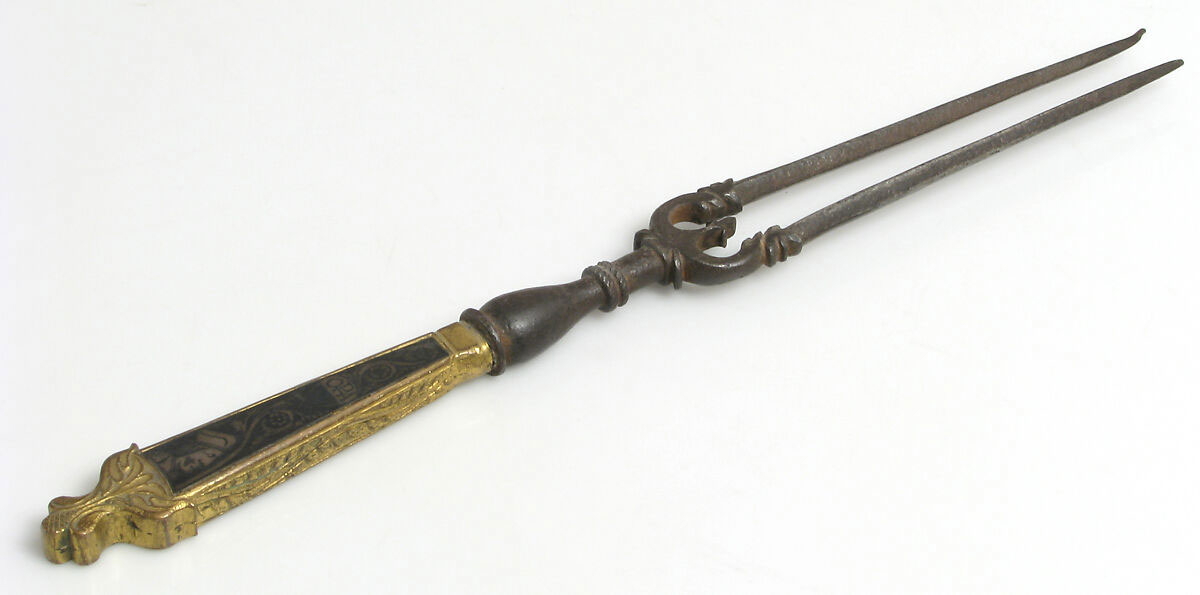
When most of Europe was still eating with hands and knives, Venice had already introduced forks. Venice’s sophisticated culture is shown to appeal to all the senses. There are the delicacies on the table to allure the sense of taste and smell, the rich velvets and silks make you want to touch the fine fabrics, and the musicians in the foreground are about to delight the guests’ ears with music.
The glass wine goblets depicted in the painting were also a rare commodity for which Venice was famous. At a time when glass was opaque and even then considered a rare luxury, Murano glassmakers invented a technique for the production of cristallo, a type of clear glass that resembled rock crystal.
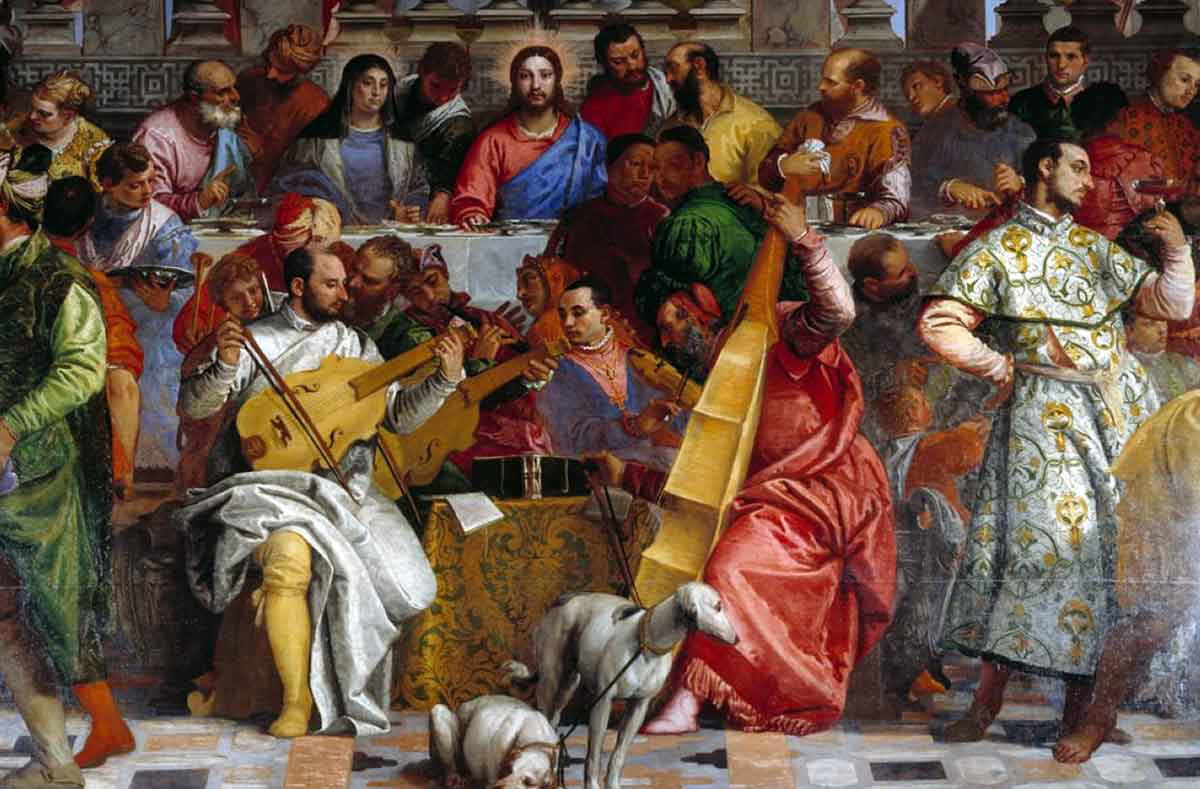
Venice was also one of the musical centers during the Renaissance, with many Venetian musicians finding employment at St. Mark’s Basilica. Veronese includes a group of musicians in the central foreground of the painting, right below Christ. The musicians are playing contemporary Renaissance instruments that haven’t been used in Israel. There are several types of violas, as well as a wind instrument, possibly a cornetto.
Many scholars agree that Veronese included a self-portrait and portraits of several other Venetian painters as musicians in The Wedding at Cana. The musician in white is Veronese himself, while the bearded musician in red may portray Titian, and the younger man in blue and red in the middle may be Tintoretto. Perhaps it was a way to include the three greatest Venetian painters of his time in the very midst of Venetian life, since The Wedding at Cana portrays the greatness of Venice, which would have been incomplete without a reference to its fabulous art.
The Prominent Role of Architecture in Veronese’s Art
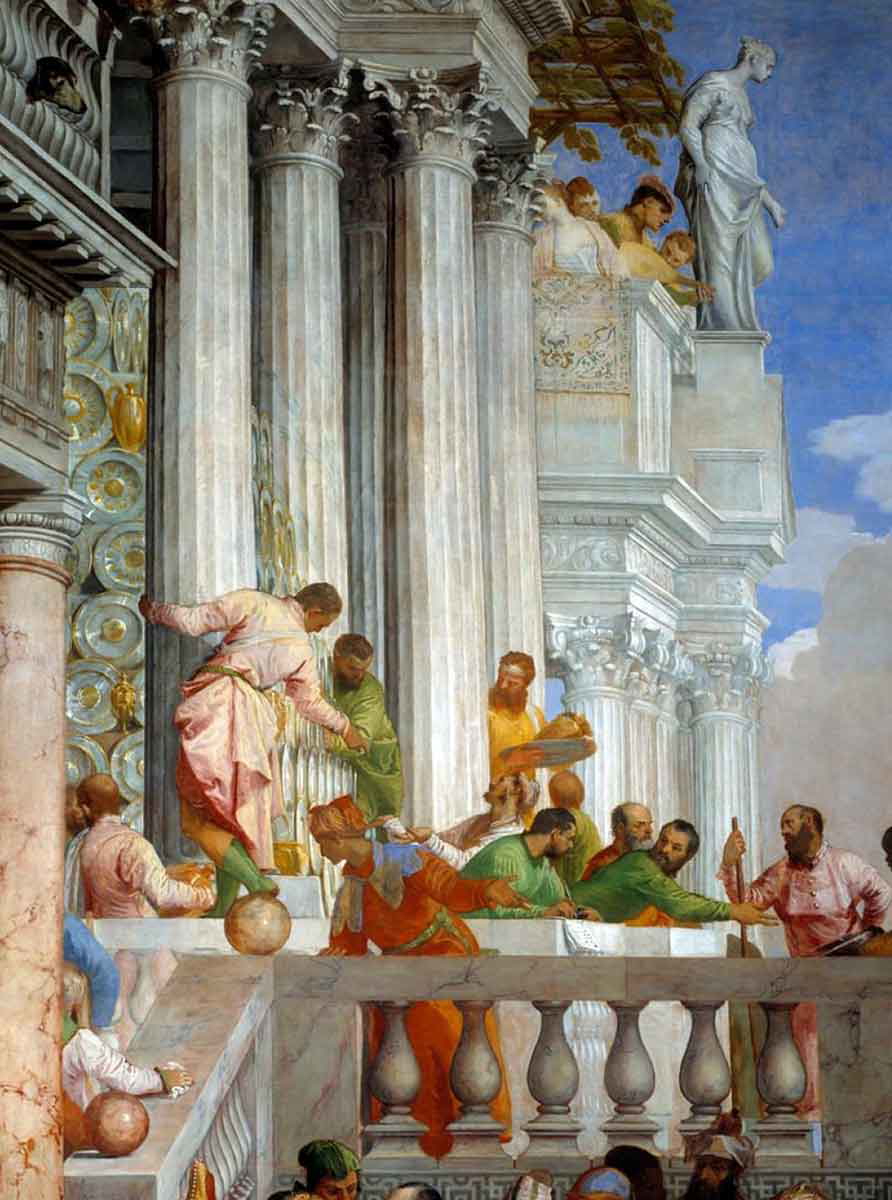
In The Wedding at Cana, the story of Christ’s first miracle unravels among stunning architecture. In the foreground, the table is flanked by colonnades crowned with balconies, upheld by elegant columns made from pink marble. In the middle ground, stately Corinthian columns frame the space on both sides, and a balustrade runs across the painting, neatly dividing the foreground and the background.
Veronese’s architectural setting is inspired by Antonio Palladio, one of the brilliant architects who shaped Venetian architecture in the 16th century. Apart from the numerous luxurious villas in the outskirts of Venice, built for the Venetian aristocracy, Palladio was also the author of the Teatro Olimpico in Vicenza. Built according to the principles of perspective outlined by Vitruvius, the theater shows incredible mastery of perspective in creating the illusion of space and far-off horizons.
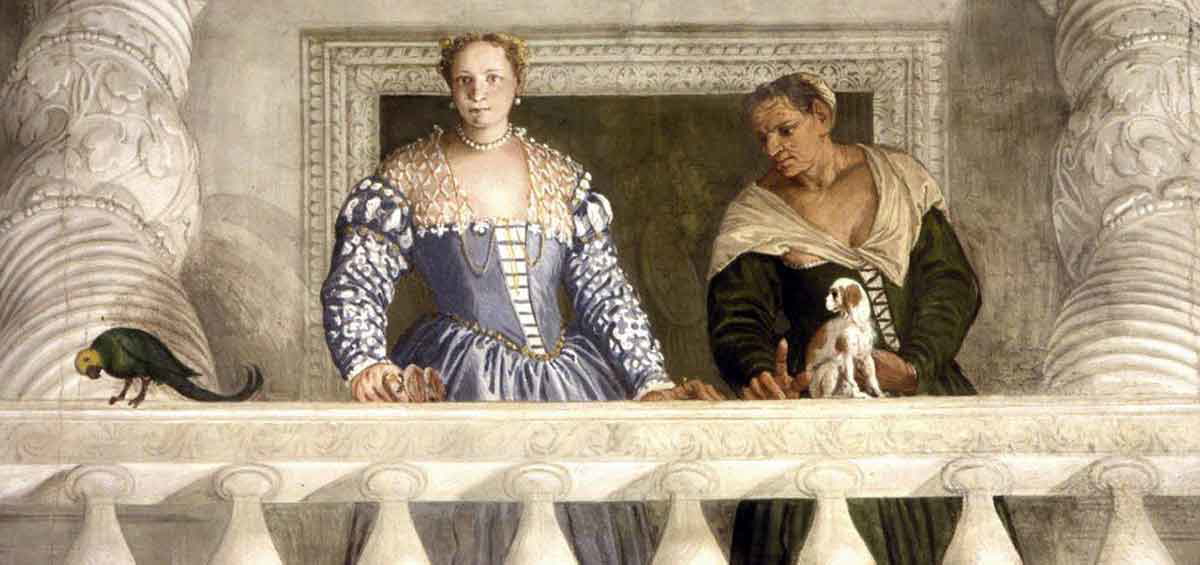
Palladio’s influence on Veronese’s art probably started in 1560-61, when Veronese completed frescoes for Villa Barbaro (Villa di Maser), one of the villas built by Palladio for Venetian nobles. These frescoes show a masterful blending of painting with architecture, with painted illusionistic effects forming a seamless continuation of the building’s structure.
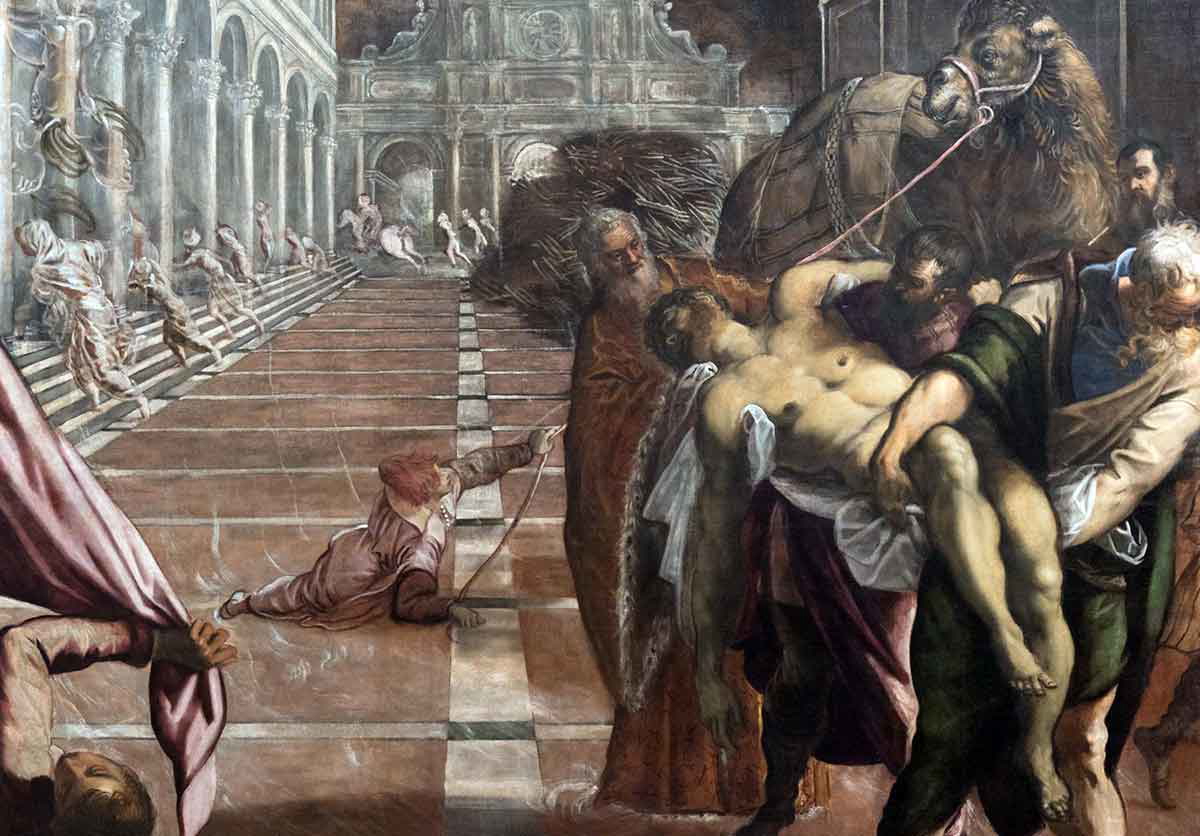
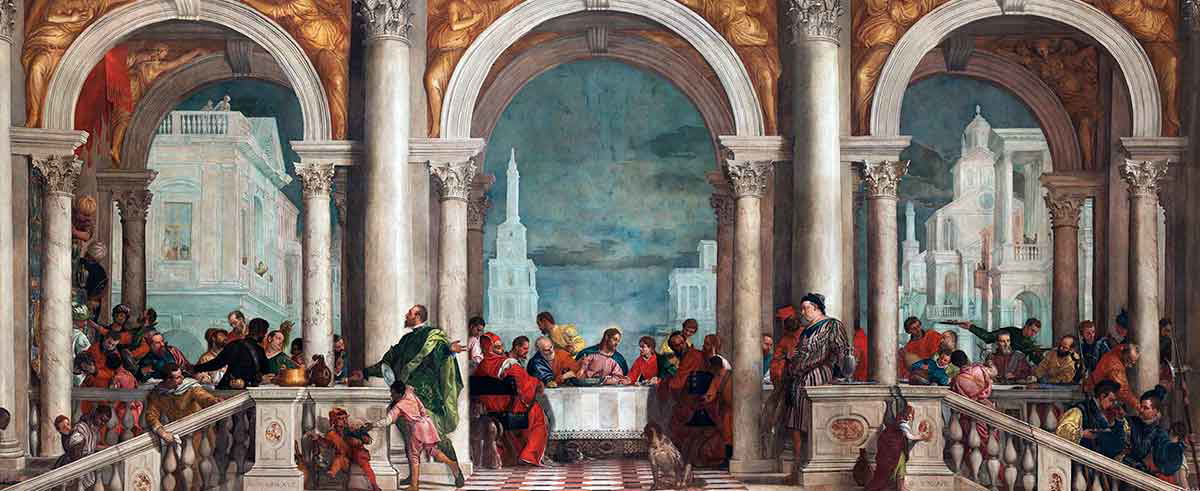
This connection to architectural and theatrical spaces is typical of Venetian art of the 16th century. Backgrounds rich in architectural ‘props’ can be found in the art of Tintoretto, for example, in his The Removal of the Body of Saint Mark (1562-66), and even in Paris Bordone’s earlier David and Bathsheba (1540-49).
In The Wedding Feast at Cana, Veronese constructs his composition in a manner similar to a theatrical setting. The background is divided from the foreground by a balustrade, allowing the viewer to glimpse the preparation of the feast by the servants, as well as the columned corners of the palace where the feast takes place, and a wide expanse of blue sky, disturbed only by towering clouds and a few birds circling a distant belfry.
The action of the story takes place in the foreground, where the elegantly set table takes up most of the space. The guests are arranged picturesquely on three levels: the table, with the central figures of Jesus and Mary, the upper balustrade where servants prepare the food, and the balconies above, filled with curious spectators.
The Wedding at Cana remains an imposing masterpiece, which, in addition to its biblical subject, relates the story of Venice’s cultural significance, political influence, and luxury enjoyed by its society. Veronese captures the very things that made Venice so powerful: its cosmopolitan population, connections with the East, production and trade of luxury items, the dazzling color and vibrancy of its Renaissance culture, and the high value it set on the development of the arts.