
Functionalism about the mind was motivated by the fact that a theory of mental states must be at a higher level of abstraction than either dualism or physicalism. Depending on our definition of mental states, these could also be attributed to machines and animals. This would, in turn, result in a more open-minded philosophy of mind, which also yields a more general, up-to-date, and elegant conceptual framework that could be coupled with cognitive science, psychology, cybernetics, and artificial intelligence. Who could possibly say no to that?
What Is Functionalism?

Although functionalism, as a view in philosophy of mind, entered the scene in the late 1960s and lasted throughout the 1970s, its roots run deeper. Functionalism’s two ancestors are Aristotle and, somewhat surprisingly, Thomas Hobbes.
Aristotle appealed to function as central to understanding the human soul. Thus, the human soul is defined through its fulfillment of function or purpose. He used the analogy of an axe and an eye to illustrate his point: if the purpose of the axe is to cut and the eye to see, then the purpose of the soul is to survive and flourish.
Nonetheless, for Aristotle, the soul is still inseparable from the body. In contrast, contemporary functionalists don’t see eye to eye with him, given that they minimize the role of physical realization of mental states. Moreover, his definition of function hinges on the role of a biological organism within the environment, while 20th-century functionalism is less strict in this regard. They consider a function as something far more abstract than a mere biological role.
On the other hand, Hobbes seems like a much better fit when it comes to the historical precursors of functionalism. He argued that our process of reasoning is much like a process of computing: the mind performs computations similarly to the calculator, which follows the rules of arithmetic. As long as these computations follow some rules, the systems of various physical properties can “reason.” This means that Hobbes believed that some mental states aren’t exclusive to humans with their specific anatomical constitution.
Contemporary functionalists formed three groups that endorsed and developed different variants of functionalism. Each variant adheres to the general idea conveyed by functionalism, but the devil is always in the details. Let’s quickly unpack each variant.
Machine-State Functionalism

Hilary Putnam pioneered machine-state functionalism, although he later abandoned it. According to this position, the human mind is a Turing machine that performs computations. If this sounds familiar, it amounts to the same point Hobbes was trying to make, albeit with a less fancy device. How does this comparison to the Turing machine play out? For Putnam, our mental states are akin to machine table states. Machine table states are states of a Turing machine whose transition in time depends on a prespecified list of rules.
For instance, the most general rule that can be applied is the following: If the machine is in a state S1, and an input X occurs in time T1, then the machine will transition to S2 in T2 and produce an output Y. Similarly, in our mental domain, the rule can take the following form: If the human being is in a mental state M1, and an input X occurs in time T1, then the human being will transition to M2 in T2, and produce an output Y. The applied rule obviously runs like a computer program but on different types of hardware—mechanical and biological alike.
Analytic Functionalism

David Lewis was among the proponents of analytic functionalism. Analytic functionalism is concerned with the semantic analysis of the terminology used to designate mental states without any further metaphysical ado. In other words, analytic functionalists want to understand how we use these terms in our ordinary communicative situations and whether these can be translated into functionalist lingo that relies on the notions of input, output, and the functional organization of inter-connected mental states.
David Lewis famously argued that any philosophical theory about pain must explain both mad pain and Martian pain alongside human pain experience. This may sound weird, but remember that Lewis is a philosopher, and philosophers are fond of curious counterexamples and spotlights. Mad pain involves cases when reaction to pain is at odds with our usual expectations. In Lewis’s example, a mad person would solve mathematical equations in situations where we would scream in agony. Martian pain is exactly what you guess. An alien creature could have a completely different anatomy than us. Lewis imagined a Martian with a hydraulic system instead of a nervous system.
This served to show that presupposing the functional organization of pain in humans as the only possible account of pain may be too chauvinistic. Furthermore, Lewis argued that pain is a functional designator, which means that the term “pain” refers to whatever state S in any physical system X fulfills the functional role typically associated with pain for X.
Psychofunctionalism

Finally, psychofunctionalism is most closely linked to science, specifically cognitive psychology. More precisely, psychofunctionalism is advertised as a conceptual backbone of the methodology of cognitive psychology. Thus, unlike analytic functionalists, who are focused on analyzing ordinary mentalistic terms, psychofunctionalists think that the functional characterization of mental states can proceed only in relation to psychological experiments and observation. Most importantly, this makes the ordinary experience of some mental states relatively unimportant. For example, everyday cases of frustration due to traffic are less relevant for developing a functionalist theory of mental states than depression, anxiety, and other scientifically described conditions.
What Does Functionalism Say About the Mind-Body Problem?
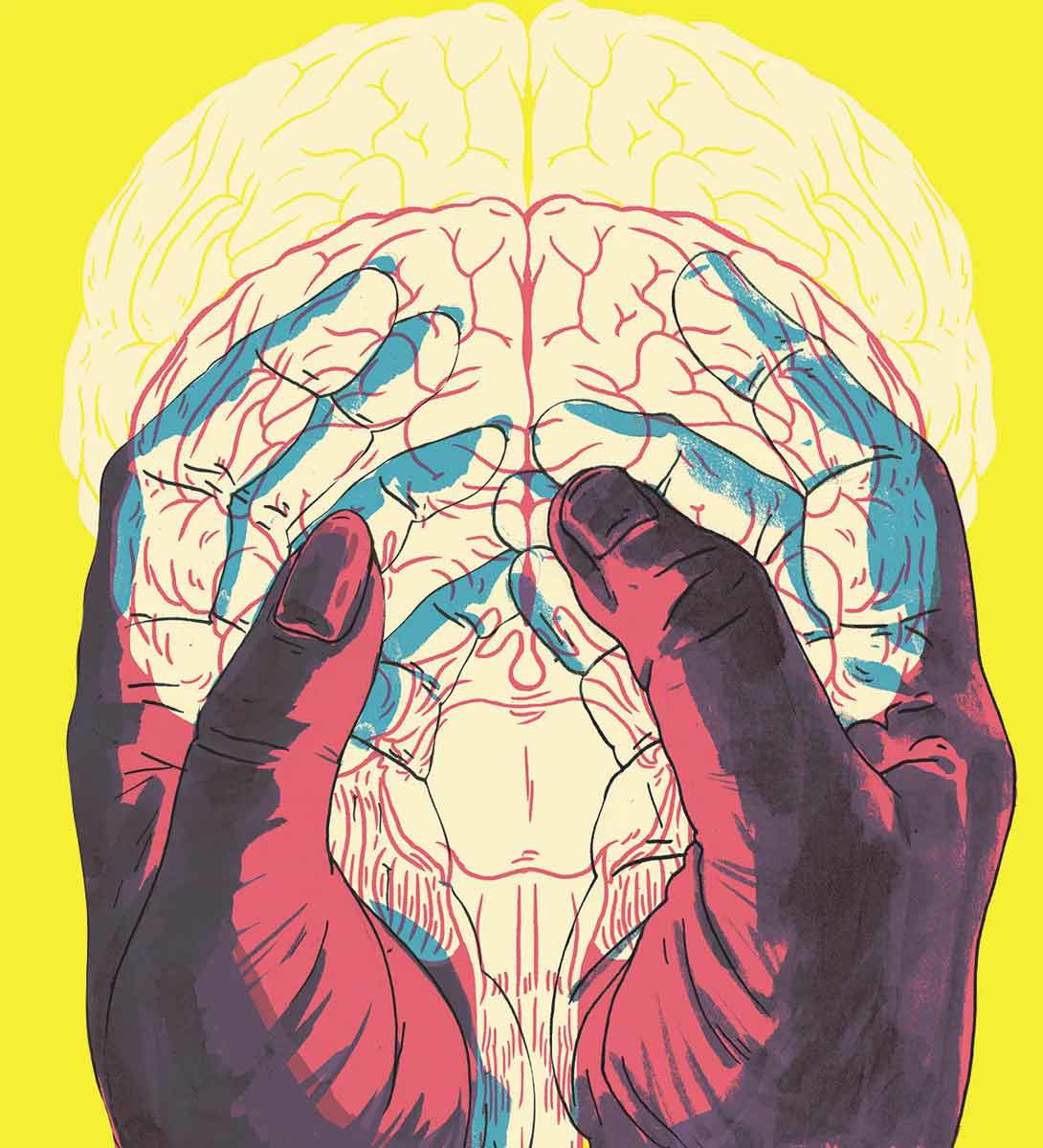
Regardless of the variant they endorse, all functionalists concur that the mind-body problem can be resolved by acknowledging that mental states are not fundamentally distinct from physical ones. Nonetheless, they don’t think mental states are physical states like physicalists. Instead, they conceive mental states as simply functions or processes that emerge from complex patterns of neural activity within the brain given specific stimuli and produce certain kinds of behavior.
In other words, functionalists argue that there is no need for a non-physical mind or soul that inhabits the physical body, as mental states can be explained by their causal roles within a neural system. This allows them to bypass both the metaphysical conundrums of dualism and overly simplistic pleas for a complete reduction of mental states to states of the central nervous system in physicalism.
Bear in mind, however, that functionalists would also probably say that the mind-body problem is misconstrued from the very start because it assumes the human mind and the human body are the only sources of a gap that needs to be bridged somehow. Functionalism is not limited to creatures with brains like ours. As we saw earlier, the other kinds of physical realization of mental states are also within its scope.
What Does Functionalism Say About Consciousness?

At first glance, functionalists have little to say about consciousness. Consciousness is what consciousness does. More specifically, mental states are not subjective or private; we are aware of them because of their causal interaction with each other, as well as with input and output. Conscious experiences are, therefore, functional states that serve as useful computational tools for navigating the world.
Any system that performs computations in causal relations to external stimuli and produces appropriate behavioral outputs can be considered at least minimally conscious. This perspective implies that conscious beings could potentially arise from suitably complex artificial systems, such as advanced computers, chatbots, or robots, which would possess functional equivalents of subjective experience.
What Are the Key Criticisms of Functionalism?

The first criticism is, of course, John Searle’s The Chinese Room Argument. Searle’s thought experiment involves a person who doesn’t speak Chinese and is locked in a room with rules and Chinese characters. The person can process the characters according to the rules, producing correct responses, but they don’t really understand the meaning of the Chinese characters. The person in the room, however, fulfills all functionalist criteria for being attributed the understanding of Chinese: the rules are input, the production of correct responses is the output, whereas the mere mapping of rules onto characters is presumably a type of functional organization inside one’s head. Searle argues that this thought experiment shows that functionalism is too narrow, focusing only on computations. Mental states are, for him, intentional. This means that mental states are about something, and they have content.
The second line of criticism takes the last point to another level. Mental states are intentional and have a qualitative character. Ned Block thus put forward The Absent Qualia Argument. Philosophers of mind often use the Latin term “qualia” to refer to subjective experiences or states with a distinctive qualitative character.
Block’s argument challenges functionalism by pointing out that imagining creatures with all the functional properties of human consciousness but lacking subjective experience or qualia is possible. Block offers the following thought experiment. Imagine a Chinese nation whose population almost mirrors the number of neurons in the brain and who receives inputs from the gigantic artificial body and passes information through a satellite. The states of a Chinese nation may be functionally organized. Nonetheless, such collective mental states would lack any qualia. For Block, functionalism misses the opportunity to explain what it is like to have the right kind of qualia that we presumably have.