
Like many marginalized groups in the United States in the 1970s, Chicanos organized a social, political, and cultural movement to protest a myriad of issues as well as celebrate their history and material culture. Artists were key to the movement, making murals in neighborhoods to bring people together and catchy posters to call attention to a range of topics. They also explored larger themes of race, gender, memory, and identity, committing themselves to furthering the movement’s aims but also refusing to limit their desire to explore all of art’s possibilities.
Judy Baca, The Great Wall of Los Angeles, 1977-present
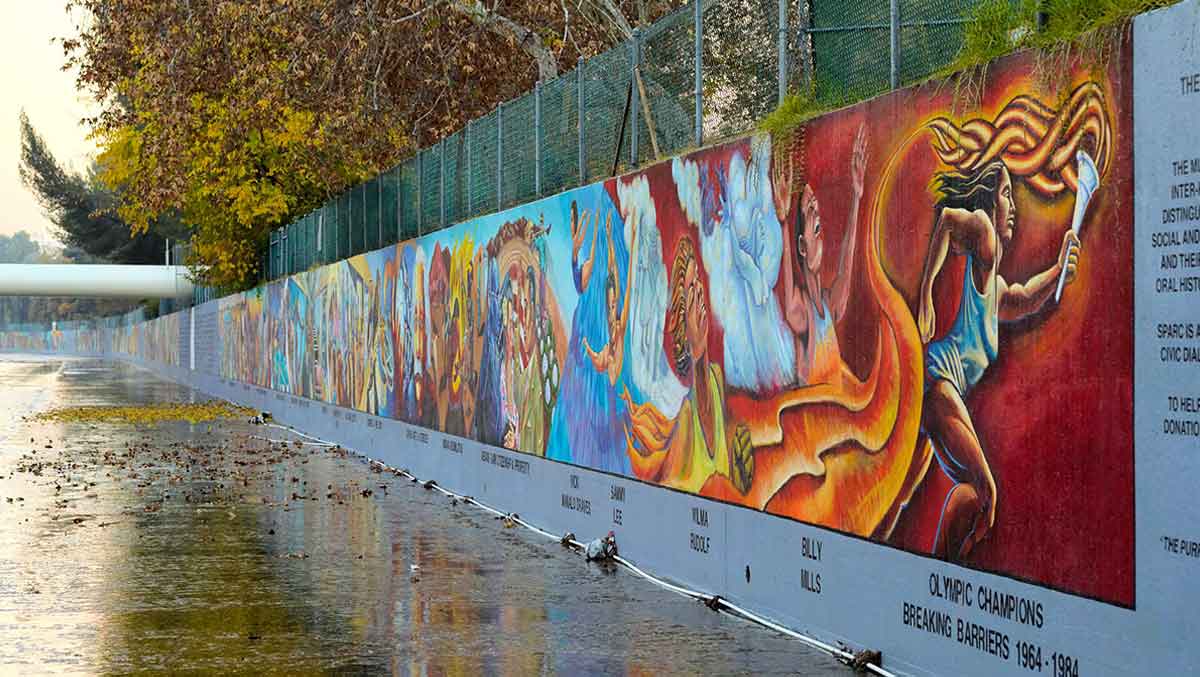
One of the most well-known and magisterial works of Chicano art, this wall spans half a mile in San Fernando Valley, depicting the history of ethnic peoples in California from prehistoric times to the present. Baca mused, “In 1975 when the Great Wall was still a dream, I never imagined it would lead me, the more than 400 young ‘Mural Makers’ and the 35 other artists on my team through such a moving set of experiences. Nor could I have imagined that 27 years from the date the first paint was applied to the wall that it would still be a work in progress.”
Baca was approached by the Army Corps of Engineers in the early 1970s to “beautify” the Tujunga flood control channel of the Los Angeles River. She co-founded the Social and Public Art Resource Center and started bringing together other artists and young people from the community to research, plan, and paint. She wrote that “the story of Los Angeles, like many great cities, begins on the banks of its river.” While “standing at the river’s edge, I saw the concreted arroyos as scars in the land. I dreamed of a ‘tattoo on the scar where the river once ran,’ and an endless narrative that would recover the stories of those who were disappeared along with the river.”
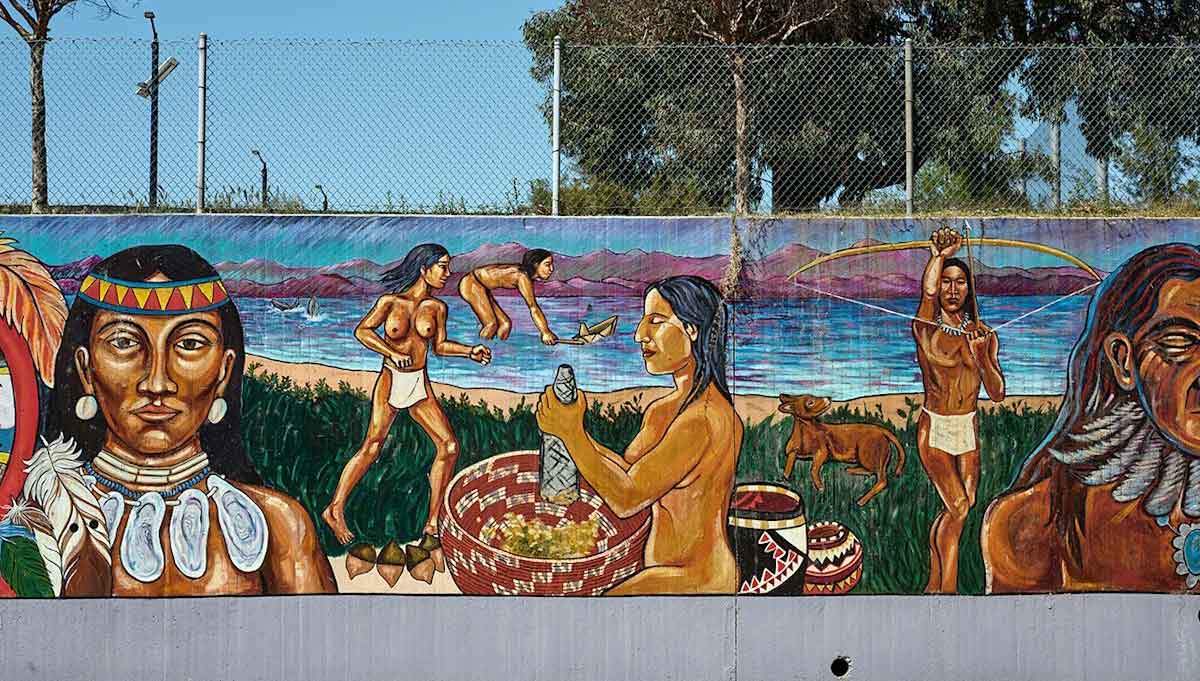
The scenes include southward migration through the Bering Strait; the development of Chumash culture; the cruelties of settler colonialism on indigenous populations; enslaved people’s experiences; the Chinese Massacre of 1871; the women’s suffrage movement; social and economic advances during WWI; Dust Bowl refugees; Black jazz music at the Dunbar hotel; Japanese internment; the Red Scare; highway construction and resident displacement; and notable Olympians of color in the mid-20th century.
Amalia Mesa-Bains, An Ofrenda for Dolores del Rio, 1984
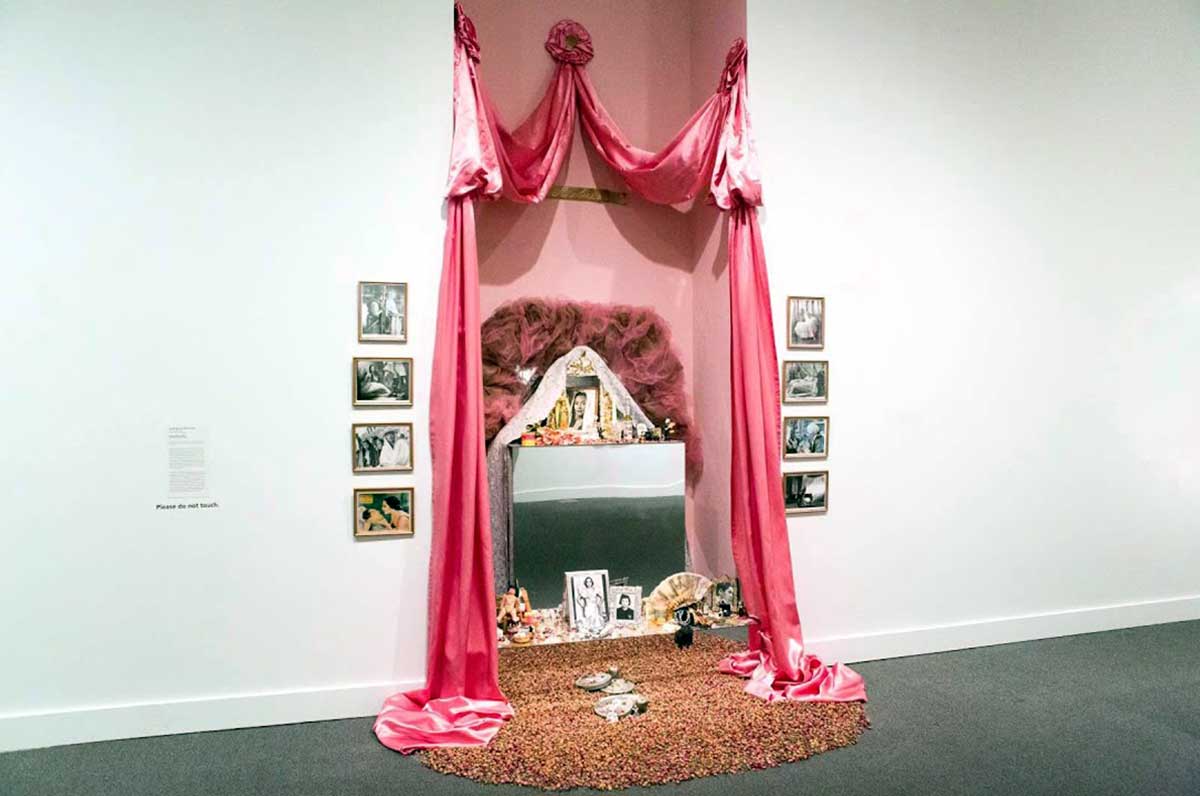
An ofrenda is an offering to the deceased, usually within someone’s home and as part of the Mexican Día de los Muertos (Day of the Dead) celebration. Mesa-Bains took the vernacular and thematic elements of the ofrenda—the objects, the evocation of memory, the celebration—and turned them into large-scale installations in art spaces. In this piece, Mesa-Bains creates a structure dedicated to the famous Mexican actress Dolores del Rio. Pink silk drapes cascade to the floor, framing the collection of objects and photographs. At the center, rose-colored tulle and delicate white lace protectively gather around the central photo of the actress. The top collection of objects consists of, among other things, dried roses, a statue of the Virgin de Guadalupe, a tiny cordial glass, and a statue of the Eiffel Tower; below, more photographs, a doll, silver fruit, and beaded jewelry rest on a glass shelf.
The mirrors used throughout the piece have a dual purpose—both to bring the viewer further into it and to connote a vanity, a traditional piece of women’s furniture. Mesa-Bains describes her works as domesticana. In an essay Mesa-Bains wrote in 1995, she explained the term: “Critical to the strategy of domesticana is the quality of paradox. Purity and debasement, beauty and resistance, devotion and emancipation are aspects of the paradoxical that activate Chicana domesticana as feminist intervention. . . . Moving past the fixation of a domineering patriarchal language, our domesticana is an emancipatory gesture of representational space and personal pose.”
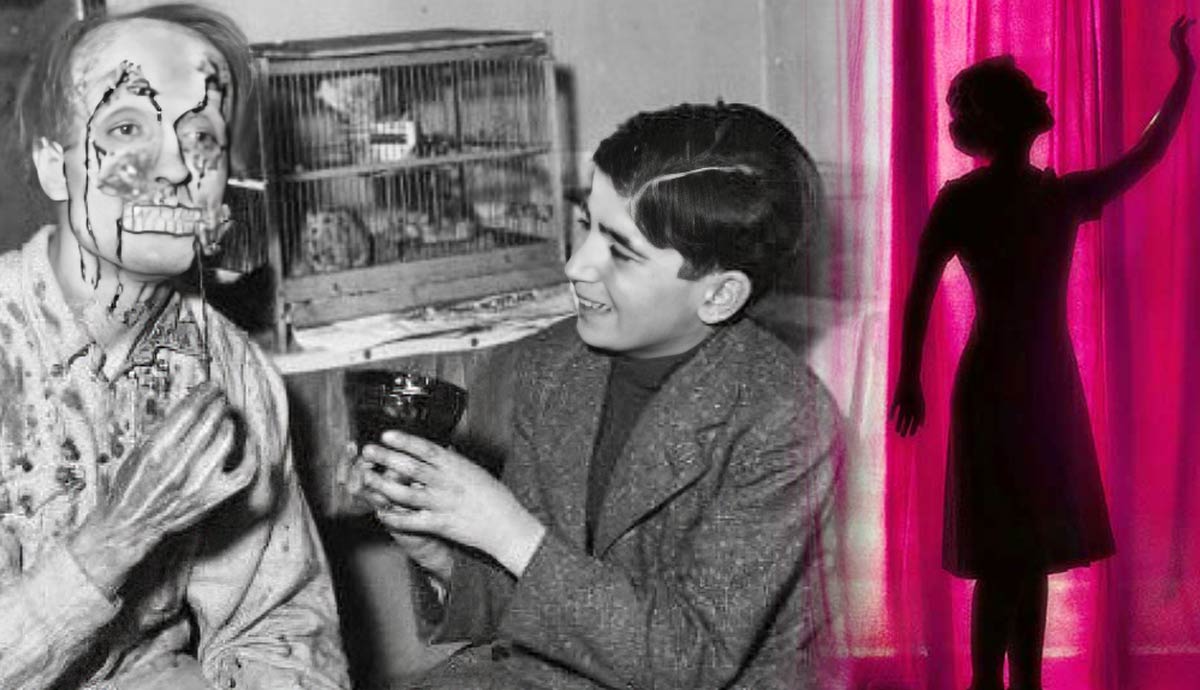
Asco, First Supper (After a Major Riot), 1970
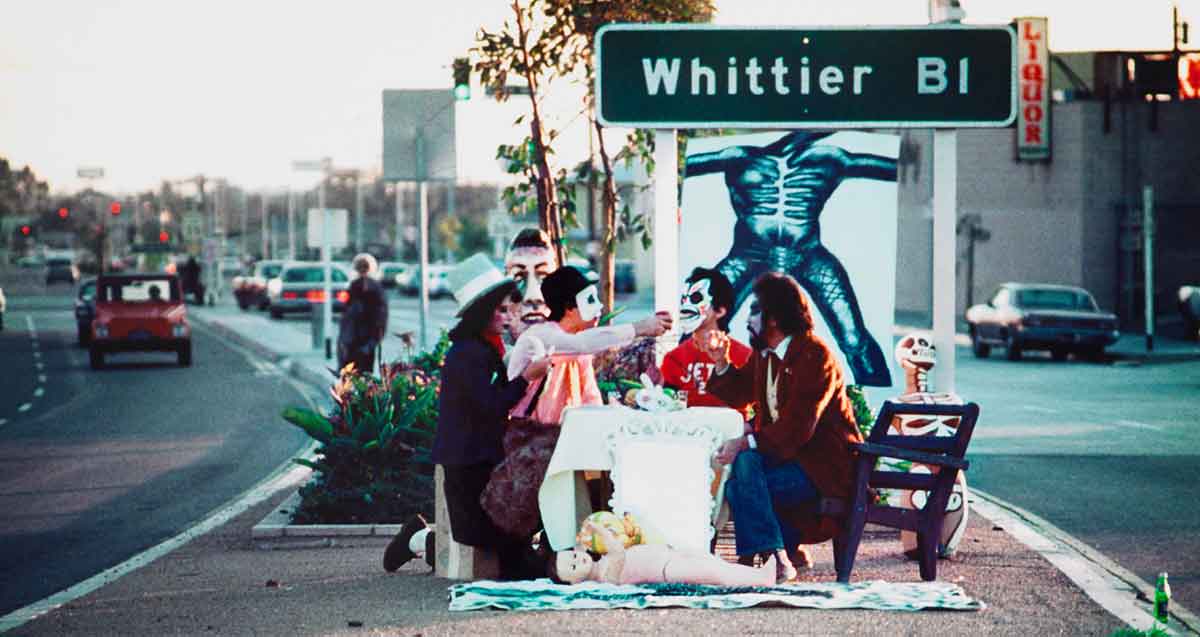
In 1970, the Chicano Moratorium, a peaceful protest calling attention to the disproportionate number of Chicanos being sent to—and dying in—Vietnam, was disrupted by police and turned into a violent riot. In the subsequent years, police continued to harass young Chicanos gathering in East Los Angeles. The avant-garde Chicano art collective Asco, which consisted of Harry Gamboa Jr., Willie Herron, Gronk, and Patssi Valdez, decided that they would “activate” the streets (in this case, the famous Whittier Boulevard) to stage a street performance calling attention to this discriminatory and demeaning practice.
The plan came together quickly. Gronk hung up a painting of his, The Truth of the Terror in Chile, and filmed the gathering as an intimate, eccentric dinner party. A friend, Humberto Sandoval, was the fourth human participant, with some of the other “guests” consisting of a mannequin painted as a skeleton and a mannequin of a giant baby Jesus. The artists were dressed eclectically and wore Mexican death masks and makeup. Critic Dena Yago notes that “To experience joy and self-expression, to lament the violence in their communities, to reclaim the street as a site of artistic creation—all of this amounted to a radical act of expression.”
The piece is commonly seen in its photographic form, but it was truly a performance. Gronk had to keep people who wanted to join from moving into the frame, and the artists knew they would have to be quick to avoid the ubiquitous law enforcement. Thus, while the photograph is still and serene, the actual event was madcap and rogue. Gronk remembered, “During the performance, people either honked their horns or cheered us on. But also in the back of our minds…at the time a phone call was ten cents, so we all had ten cents in our pocket just in case we had to make that phone call from jail.”
Ester Hernandez, Sun Mad, 1982
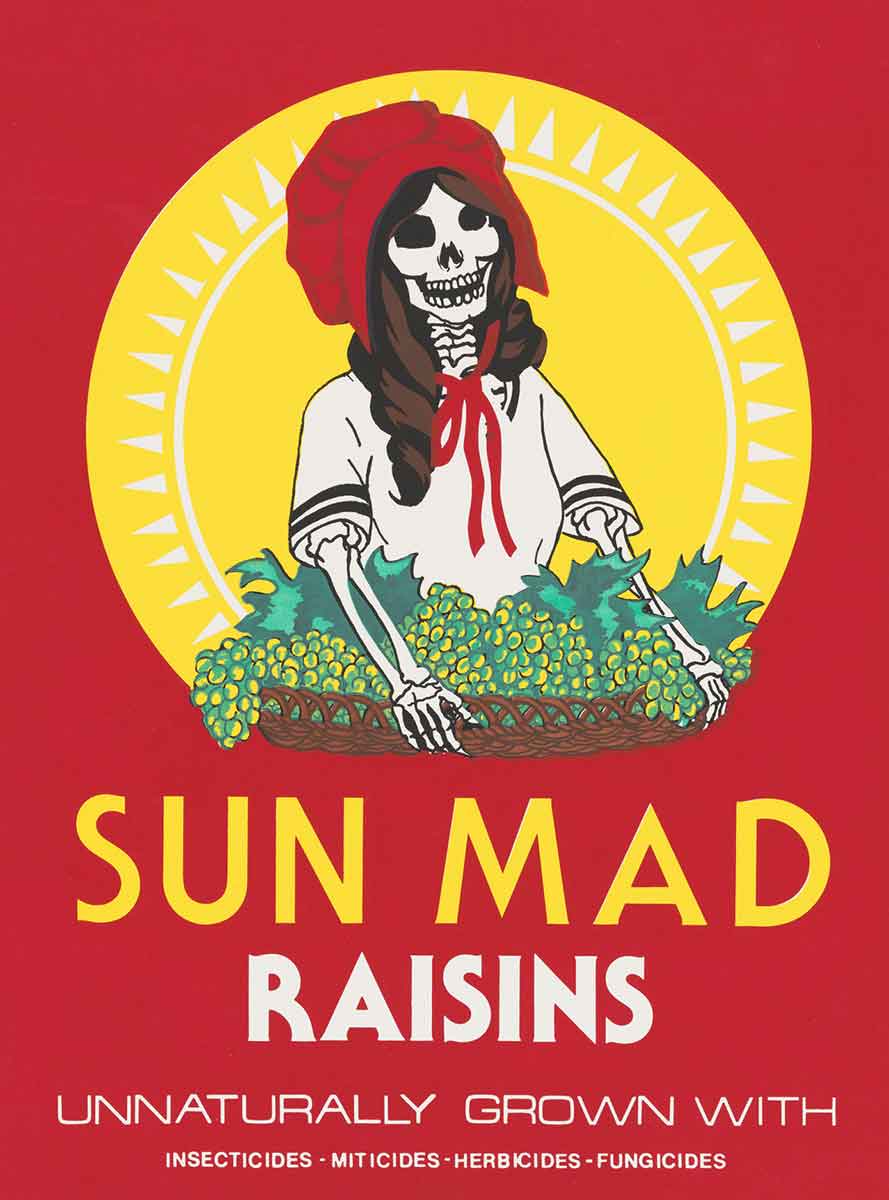
At first glance, this piece looks exactly like the famous red box of Sun-Maid raisins, a mainstay in American households. However, a closer look reveals a skeletal female figure at the center, the logo “Sun Mad” instead of “Sun-Maid,” and the unnerving subtext of “Unnaturally grown with insecticides, miticides, herbicides, fungicides.”
Hernandez wasn’t just making a political work—she was making a personal one. She explained that she created the print “as a very personal reaction to my shock when I discovered that the water in my hometown, Dinuba, California, which is the center of the raisin-raising territory, had been contaminated by pesticides for 25 to 30 years. I realized I had drunk and bathed in this water.” She’d been visiting her family and was surprised to see her mother boiling water even though it was over 100 degrees because they’d received a notice saying the water was contaminated. Hernandez knew she wanted to make a piece of art about this, but was unsure what to say. The idea for the poster finally came to her after she passed an advertisement for the Sun-Maid raisins on the highway back into Dinuba.
Mario Torero, We Are Not A Minority, Estrada Courts, 1978
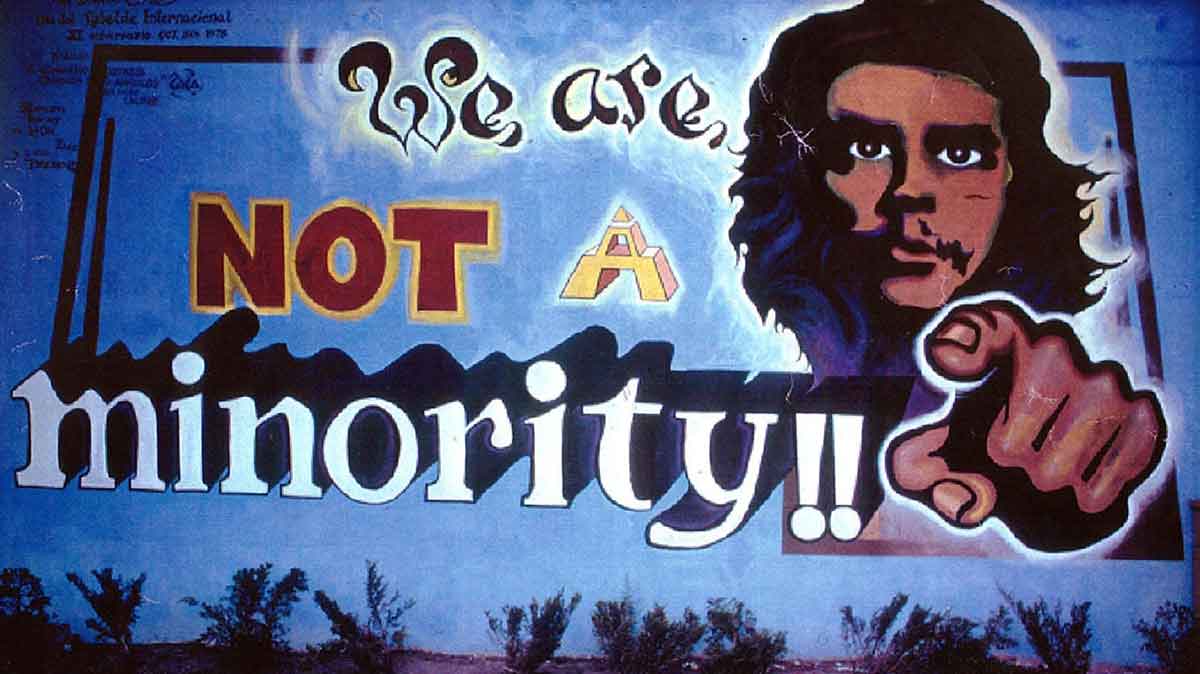
Murals were some of the most important types of Chicano art, as they were located in communities themselves, could be worked on collectively, and were able to easily convey political and social messages. This work is one of many murals at the Estrada Courts, a low-income housing complex in Boyle Heights. Constructed in 1942 and expanded in 1954, it provided housing for hundreds of people, most of them Chicano.
Torero and fellow artists Rocky, El Lion, and Zade created this mural after coming together in the Chicano Park struggle in San Diego (a successful effort to prevent the park from becoming a California Highway Patrol station). It is a tribute to the revolutionary Che Guevara, an important figure in the rights movements of the 1960s. Some of the other famous murals at this site include Willie Herron and Gronk’s Moratorium—The Black and White Mural (1973), Gil Hernandez’s The Sun Bathers (1973), and Daniel Martinez’s In Memory of a Home Boy (1973).
Torero explained his and his fellow artists’ interest in painting murals: “We started developing our own world. Painting murals made us different. You go out in the world in the United States and everything is brown, white, and pale. There is no color. It’s very Puritan. It was a very frightening thing for them to see colors. The police were definitely against colors. When we put colors on our walls in the Barrio, it was a defiance of 500 years of repression.”
Mel Casa, Humanscapes
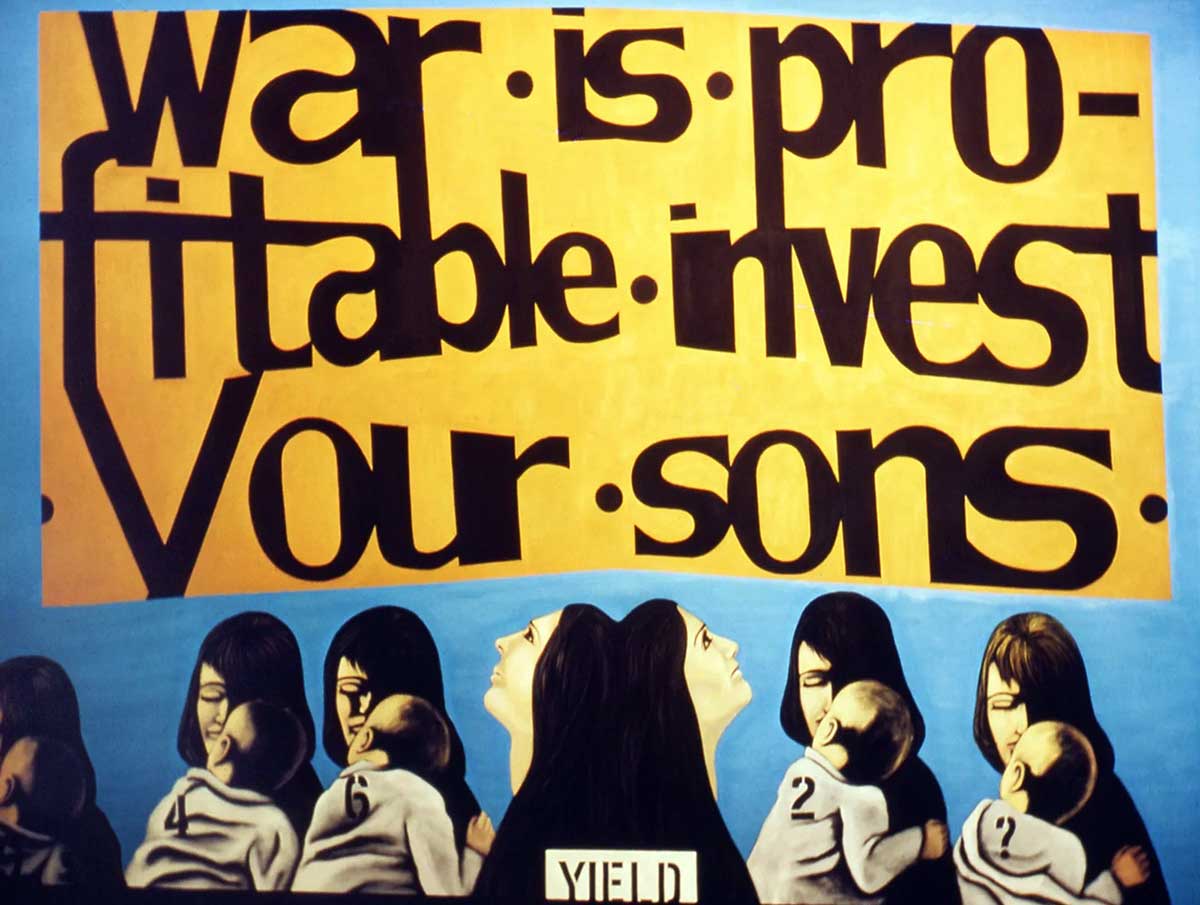
It is impossible to pick just one of Mel Casas’ Humanscapes works, given the fact that there are 150 of them and they are all aesthetically accomplished, politically and socially resonant, and astonishingly diverse in terms of subject matter even while being part of Casas’ stated goal of making “Chicano art relevant to everyone.” Curator Ruben Cordova traced the genesis of the series, accounting for their particular format: “Humanscapes [dates] to an epiphany Casas had in 1965 when he drove past the San Pedro drive-in movie theater… After several paintings of people in movie theaters, Casas arrived at an eight-by-six-foot format proportionately similar to a movie screen. The term ‘Humanscape’ may have come from his painting of a large female nude reclining on the screen. Next, Casas added stenciled captions to the bottom of his paintings, making conceptual wordplay an important aspect of his work.”
In Humanscape 41, Casas uses biting satire—suggesting that mothers “invest” their sons in the “profitable” Vietnam War—and poignant images of those mothers cradling young sons with numbers on their backs to comment on the large number of young Latino men being sent to Vietnam.
Casas was a painter even before the Chicano Movement began, influenced by the Mexican muralists of the 1930s, Abstract Expressionism, and Pop Art. Thus, critics see his work as rising up alongside, and being artistically inspired by, the Movement. He was a cofounder of Con Safo, one of the most renowned Chicano art groups of the 1960s and 1970s, and tirelessly advocated for Latino representation in art museums and cultural spaces. He was also a professor at San Antonio College for decades, mentoring young artists and contributing to the art world discourse.
Frank Romero, Death of Rubén Salazar, 1986
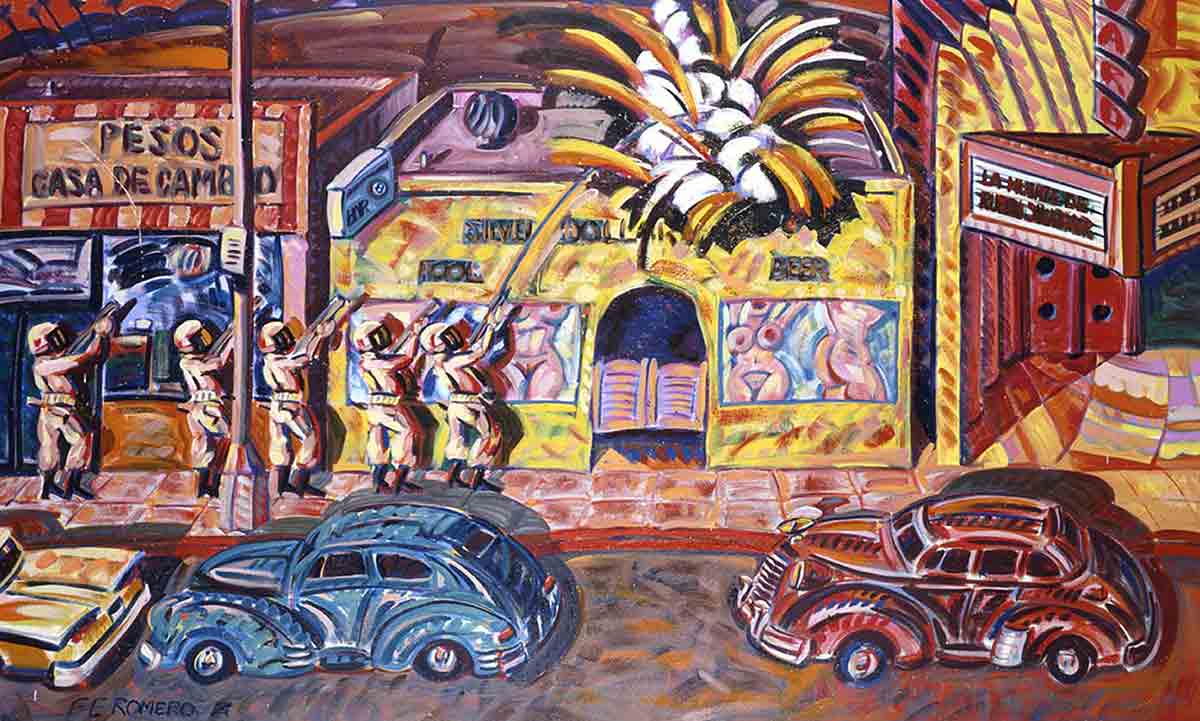
One of the most tragic events of the Chicano Moratorium was the death of beloved Mexican-American journalist Rubén Salazar, who worked for the Los Angeles Times and had earned his community’s respect and admiration. Salazar was covering the Moratorium and subsequent rioting and beating of peaceful protestors when he took a break in the Silver Dollar, a local bar, to grab a beer. Police fired tear gas canisters into the bar, claiming they’d seen a man with a gun enter, and killed Salazar immediately. The Chicano community was deeply distrustful of the police and believed that Salazar was targeted for his reporting.
Romero’s painting is simultaneously stylized and somewhat cartoonish as it comments on the insane juxtaposition between police in riot gear shooting military-style weapons into a homely neighborhood bar. The colors are luscious and the lines thick and dynamic. Romero told the Smithsonian that “People have told me that I use color very well. I love bright colors, and in fact, I’m fascinated with acrylic paint because the colors are so brilliant. In my training, I was told that purple is the opposite of yellow and all of that stuff, but I don’t use that as a theory, I just react instinctively to the way I feel… If you look at the paintings, they’re very beautiful. They’re in lovely pastel colors and so forth like that. So people are attracted to the image, with these, on an abstract level, and then they see what it’s about, then I hope somehow that they come away with the message.”