
Throughout the history of art, painters have gifted us impressive war scenes that make us feel as if we were in the thick of battle. These paintings belonged to the genre of history painting, and at one point, they were among the most prestigious works of art an artist could produce. But it is not the same to read accounts from history books as to experience the battlefield in person. The following nine famous artists served as soldiers, nurses, or war artists, and created masterpieces from their memories.
1. Otto Dix
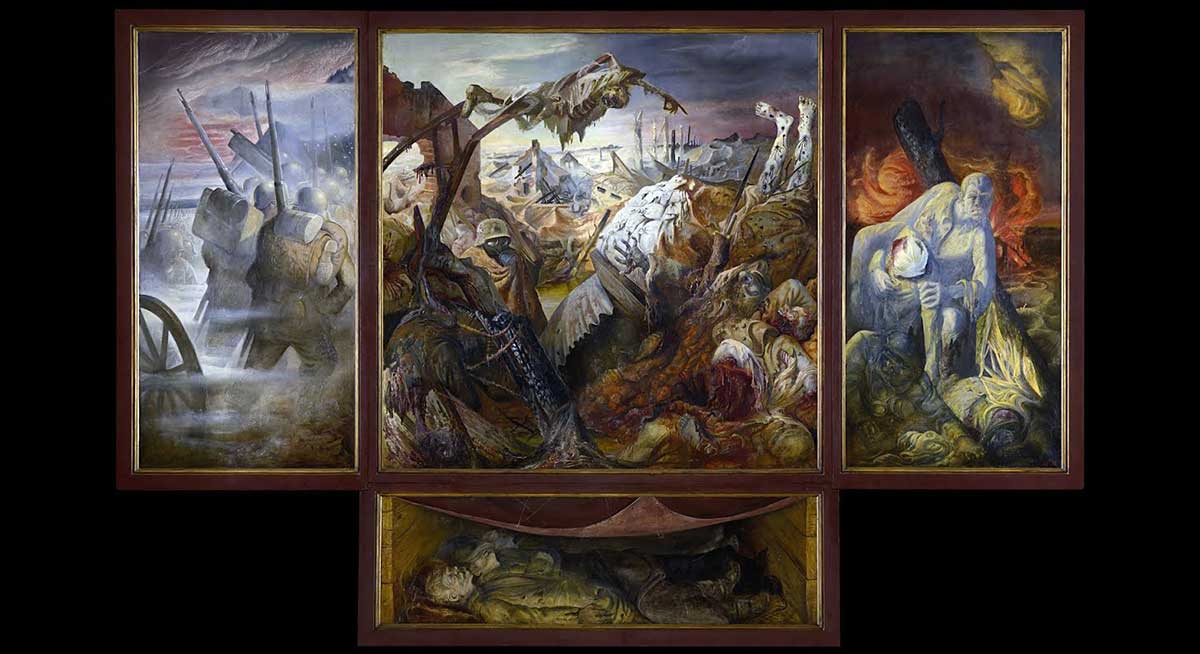
World War I accounted for approximately 40 million casualties between military and civilians (killed and wounded), making it one of the deadliest conflicts in human history. Those who survived dealt with everlasting scars and trauma; therefore, it is not surprising that painters who witnessed atrocities in the trenches used their art to show the world what they saw. Among them, Otto Dix (1891–1969) holds a prominent place for the crudeness of his war depictions. Like many young men caught by propaganda and the dream of bringing glory to their country, Dix enlisted to fight in Germany’s army. He was assigned to various spots from the Western to the Eastern front.
The War is a triptych with four panels that illustrate the experience of soldiers on a day of battle. The left panel shows soldiers setting off, while the central one depicts them amid the battle. The houses in the background are destroyed, while corpses are piled up in the trench. A single figure wearing a mask appears to have survived, but rather than hope, his presence gives an unsettling feeling to the composition. On the right panel, a soldier carries his wounded comrade out of the burning battlefield, as if they escaped hell. The predella (lower panel) features dead soldiers, buried together as there was no time or space for proper burial. It is the desolating reality of soldiers.
2. Louis-François Lejeune
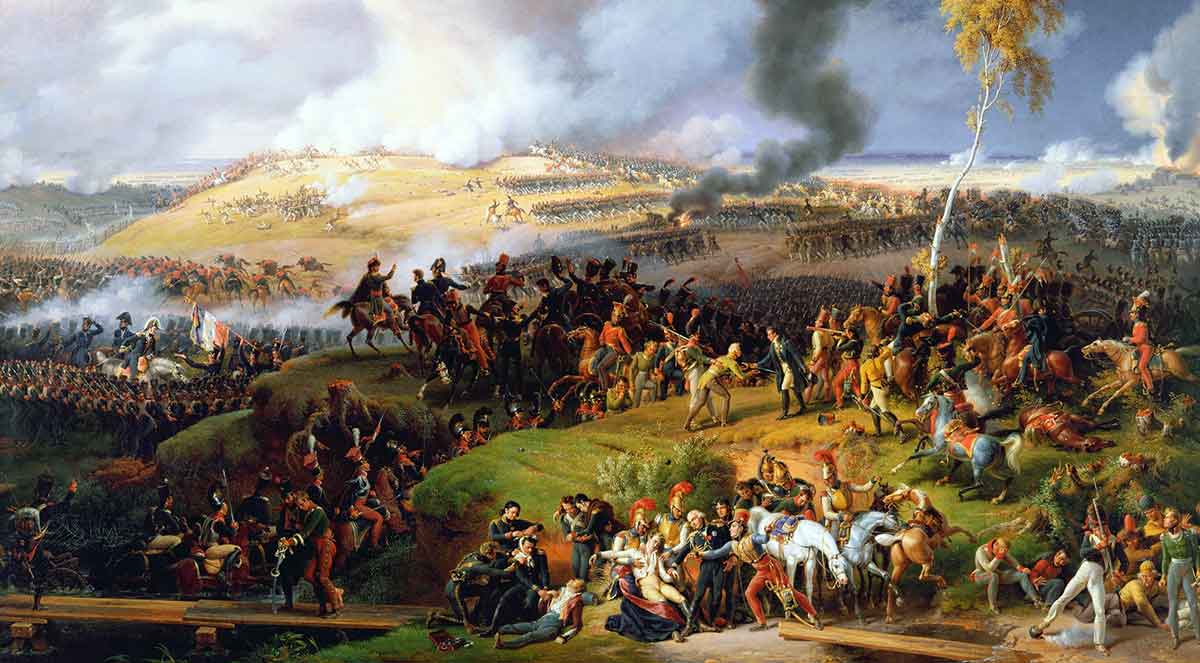
Louis-François Lejeune (1775–1848) was a painter and an officer of the French Army. In 1792, he volunteered in the Compagnie des Arts de Paris, a unit from the Louvre section formed by Law and Fine Arts students. His brilliant military career earned him numerous honors and awards, including the rank of Commander of the Legion of Honor. Through all his experiences, he kept his drawing tools close by, making sketches for later masterpieces. The Battle of Borodino (or The Battle of Moscow) represents Napoleon’s victory over the Russians in the town of Borodino, near Moscow. Lejeune served there as aide-de-camp to the Prince of Wagram, Marshal Berthier. It became the bloodiest single day in the Napoleonic Wars. In his memoirs, he expressed,
“The terrible struggle, so hotly contested, had won no results at all commensurate with the great losses sustained on both sides. […] Nothing could have been more melancholy than the appearance of the battle field covered with groups occupied in carrying away the thousands of wounded, and in taking from the dead the few provisions remaining in their haversacks.”
Louis-François Lejeune
This painting differs significantly from the more personal and emotional scenes by artists of World War I. A century earlier, Lejeune painted for a different public, one that attended the Salon de Paris and expected glorious panoramic views of epic battles. This one appeared in the Salon of 1824. Nevertheless, the triumph of his artworks resided in realism due to his presence on the battlefield. He chose moments throughout the battle to compose the painting, in which infantry, cavalry, and high-ranking officers engage in various activities. Lejeune depicted himself on the left side of the canvas.
3. David Alfaro Siqueiros
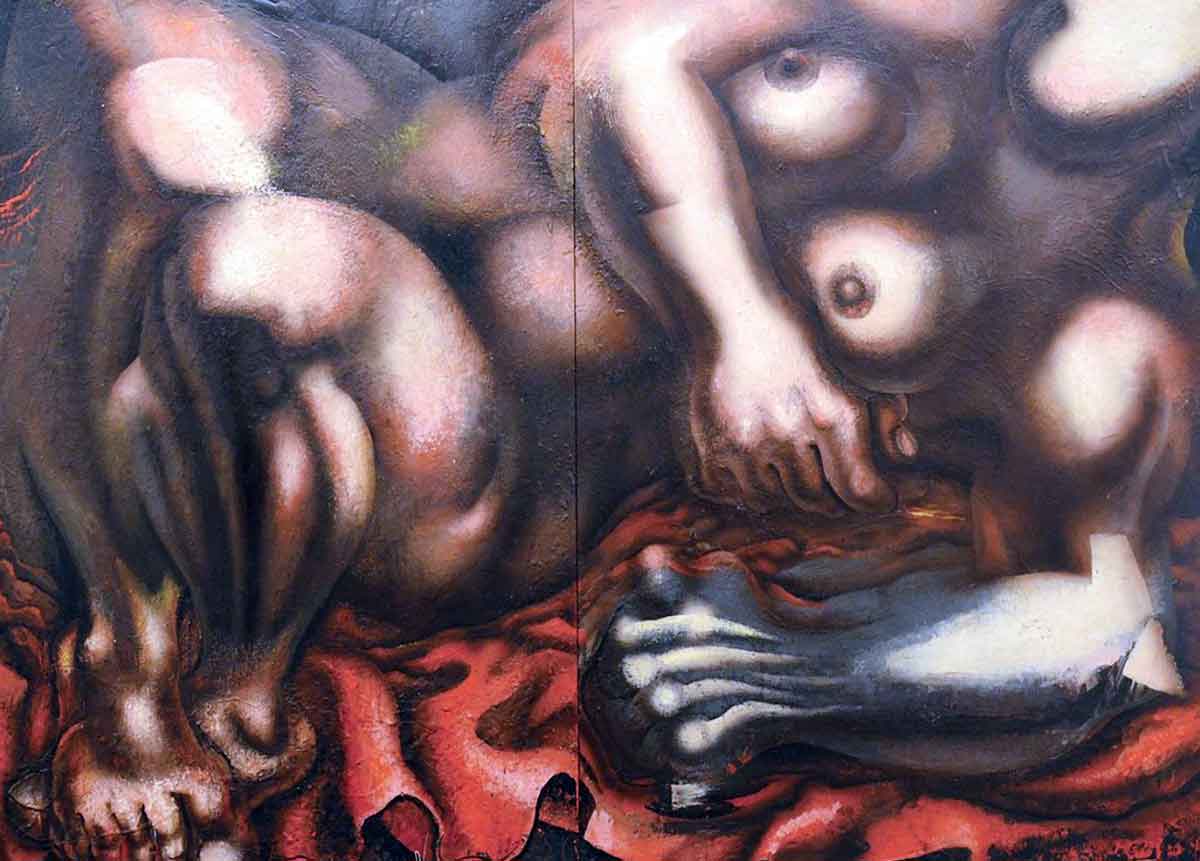
David Alfaro Siqueiros (1896–1974) was one of the “Big Three” Mexican muralists of the 20th century, next to Diego Rivera and José Clemente Orozco. He had a radical and revolutionary soul, which led him to support the Mexican Revolution from 1914 to 1918, as well as use his art to denounce injustices past and present. He traveled to Spain in 1937 and fought alongside the republicans during the Civil War. There, he received the nickname of “El Coronelazo,” due to his rank as Lieutenant Colonel. This painting, now in the Philadelphia Museum of Art, depicts a nude female figure with a muscular but disfigured body, accentuated by the chiaroscuro he employs to add volume. Siqueiros made it after coming back to Mexico.
4. Adriana Filippi
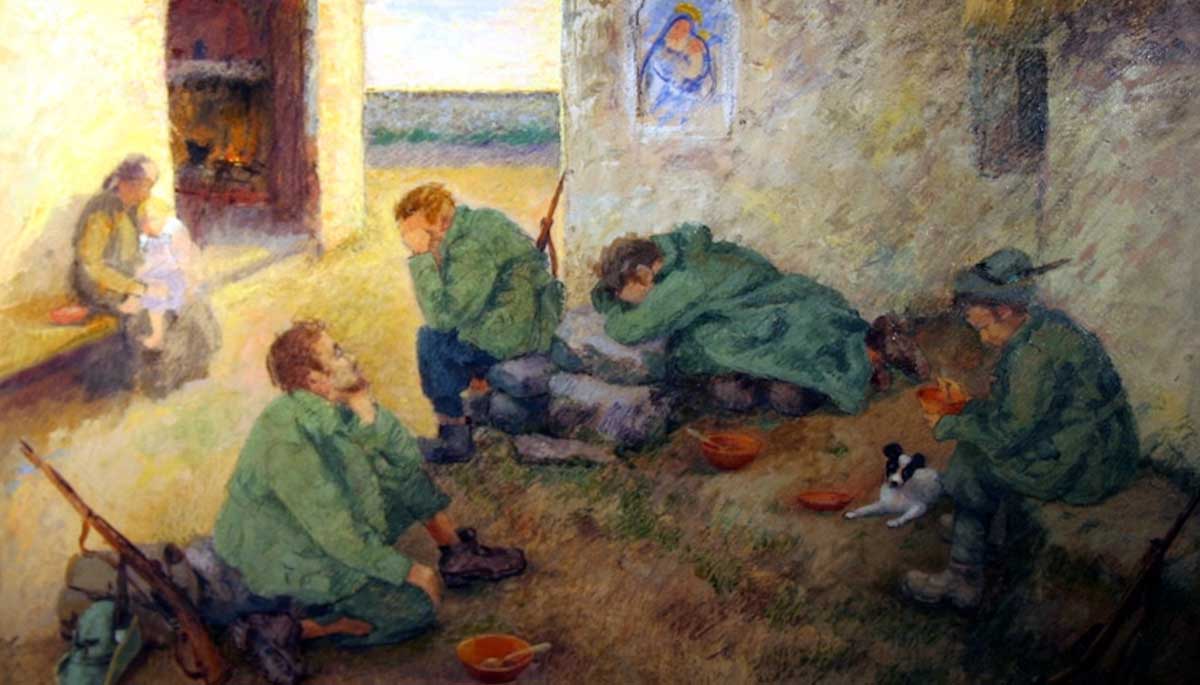
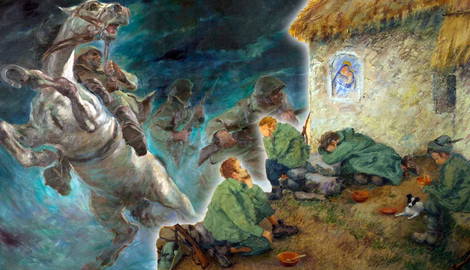
Adriana Filippi (1909–1982) was an Italian artist who lived in S. Giacomo di Boves, a commune in Cuneo in the region of Piedmont. When the partisans arrived there, she and her mother Mariangela offered their home as a rudimentary hospital where they acted as nurses. Filippi also helped send messages and packages and documented the war through their diary and works of art. Between 1943 and 1945, she produced dozens of paintings portraying the life and struggles of the partisans.
Grigioverdi adrift depicts a group of sbandati, soldiers who abandoned the Italian army after being defeated by the Germans. Grigioverdi (gray-green) is a reference to their uniform worn during World War I. The couple at the center seems particularly exhausted, maybe desperate. One of them kneels and lowers his head on rocks, while his companion sits and supports his head in his hands. To their right, a soldier eats from a bowl, while on their left, one looks at the Virgin and Child painting on the wall. In the background, a mother sits on a bench, holding her baby, imitating the holy image. Most probably, she provided the food, as dozens of women did for the sbandati who passed by their towns. In one frame, Filippi encapsulated the despair and hope of soldiers, as well as the goodwill of civilians who cared for these young men.
5. Mihailo Milovanović
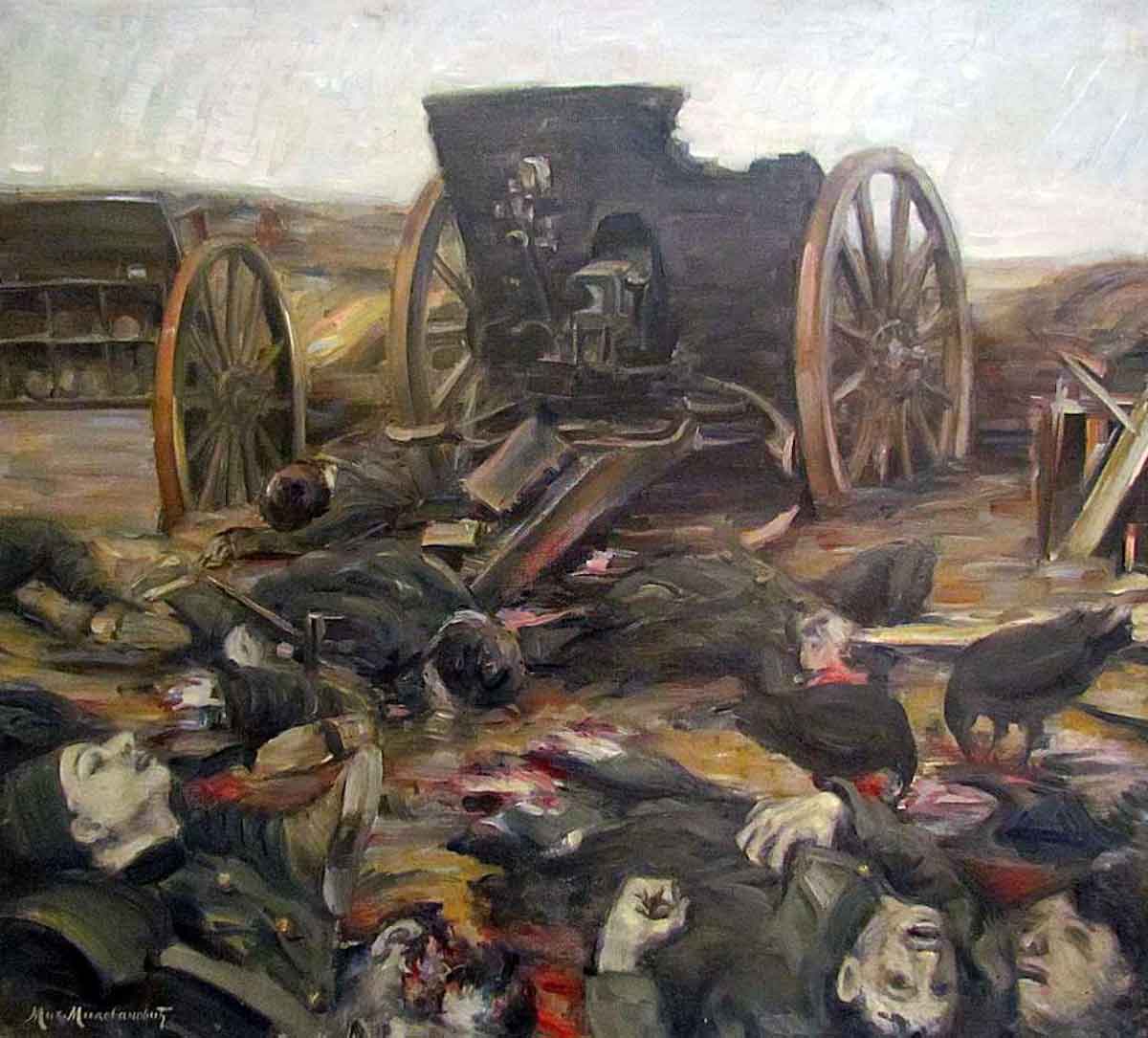
Mihalo Milovanović (1879–1941) was a Serbian painter and sculptor. He studied Fine Arts in Munich and became the first academic painter of the city of Užice, Serbia. He returned to his hometown in 1912 to volunteer in the army at the outbreak of the First Balkan War (1912–1913). The Turks in Kumanovo illustrates this period of his life. He painted the aftermath of the Battle of Kumanovo, in which the Serbs defeated the Ottoman Turks. It is a desolate painting. Not a single person remains alive; they are all corpses scattered around, some of them with visible mutilations. To add to the sinister atmosphere, a pair of birds appears to be eating someone’s exposed flesh.
6. Kubota Beisen
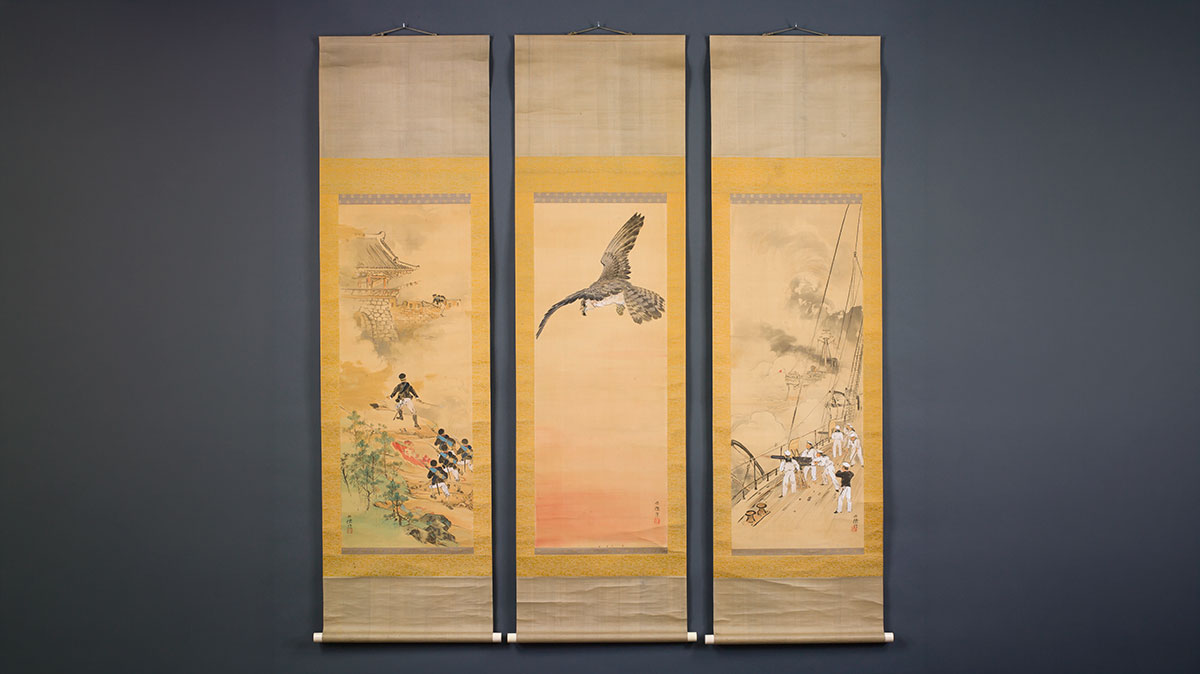
Kubota Beisen (1852–1906) was a Japanese artist from the Meiji Period (1868–1912). He worked as a war artist during the First Sino-Japanese War (1894–1895) with his sons. This extraordinary triptych of hanging scrolls, executed in ink and color on silk, evokes the Japanese victory over the forces of the Qing dynasty. One can notice the Western influence in the uniforms and ships; however, the emptiness in major parts of the scrolls, the diagonal direction of the composition, speak of the Japanese tradition.
7. Olive Mudie-Cooke
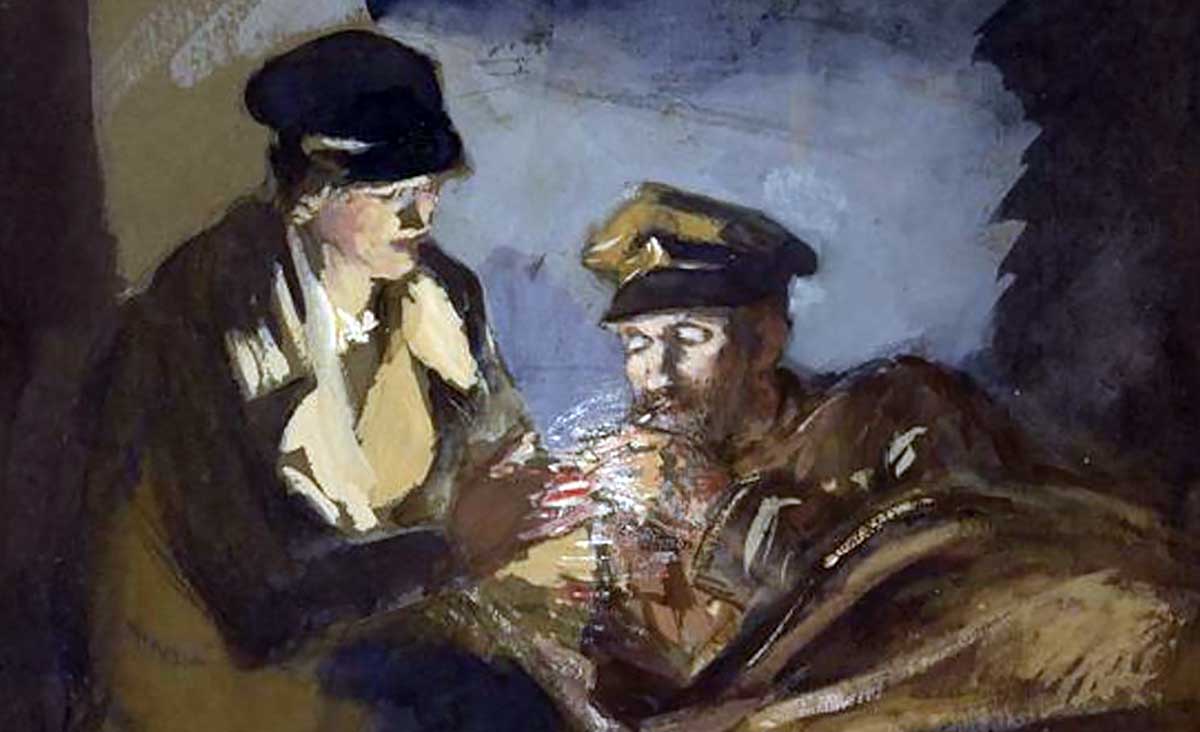
Fighting on the battlefield is not the only way in which artists served their nations. Olive Mudie-Cooke (1890–1925) volunteered as a British war nurse during the First World War. She worked in France and Italy as an ambulance driver for the First Aid Nursing Yeomanry and Voluntary Aid Detachment. Her works focus on wounded soldiers, such as the one portrayed in In an Ambulance. Mudie-Cooke captured a moment between a woman from the VAD (Voluntary Aid Detachment) and a soldier, as he sits up just enough to reach the cigarette. The lighter that illuminates their faces in an otherwise dark room accentuates the intimacy of the moment. This soldier may be suffering from wounds that prevent him from moving freely.
8. Alexandros Alexandrakis
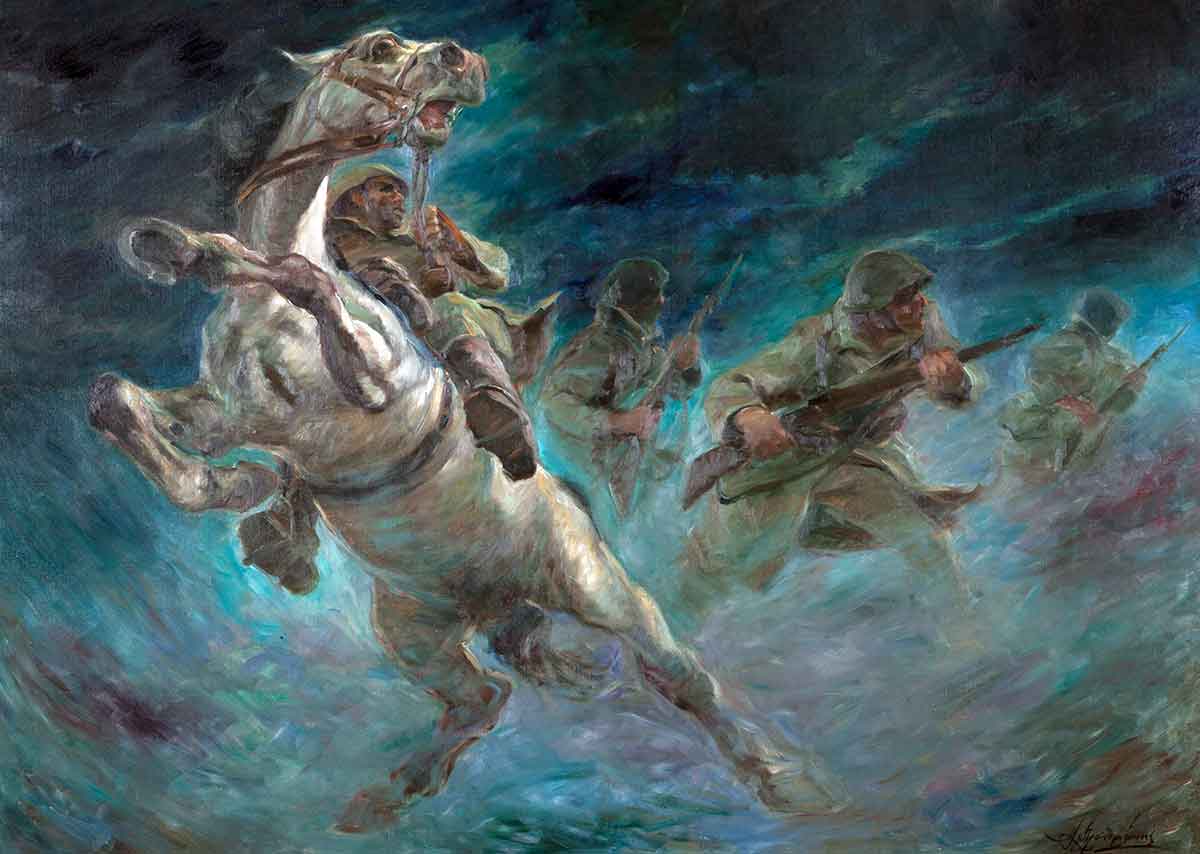
Alexandros Alexandrakis (1913–1968) did not choose to go to war, but when the Greco-Italian War (1940–1941) broke out, he and his five brothers were conscripted. He experienced the hardships of war firsthand, not just in battle but also in the difficult terrain where they fought. Suddenly Dark depicts a group of soldiers in the midst of a battle. The frightened horse in the frontal plane rears up and tries to turn away from the violence, but the rider does not allow this and pulls him back. The other three soldiers look beyond the right side of the canvas, prepared to fight.
Alexandrakis did not paint a detailed background; instead, he pictured an abstract environment. The boldness of the brushstrokes adds movement and intensity to the scene, as well as a sort of universality. Many soldiers, no matter where they were at the time, could identify with this work, its terror and uncertainty.
9. Urs Graf
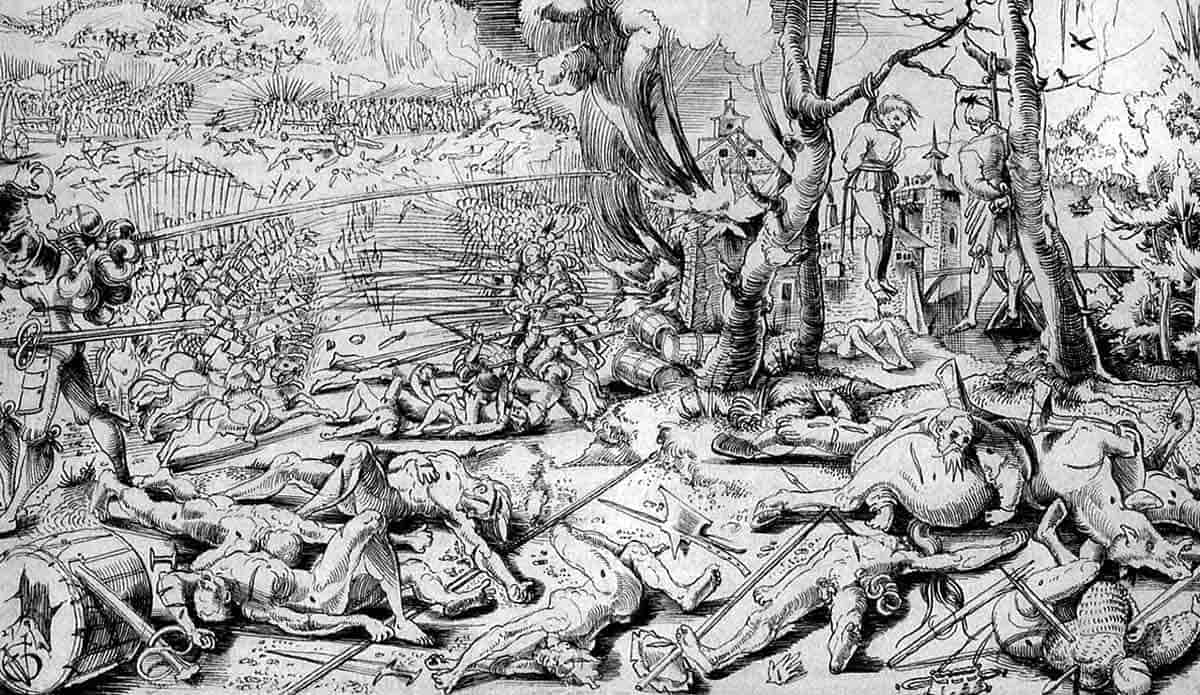
Not all soldiers are patriotic or heroic; some of them are in it for the money and excitement. Urs Graf the Elder (ca. 1485–ca. 1527) was a Swiss mercenary who often preferred to join the battlefield rather than enjoy a civilian life. This was not a rare occupation in Renaissance Switzerland; in fact, foreign armies coveted Swiss mercenaries for their effectiveness, availability, and brutality. Although there is no definitive evidence that Graf fought at the Battle of Marignano, it is widely believed he did so based on the bleakness of his engraving. The French, aided by German mercenaries called Landsknechts, defeated the Swiss in one of the bloodiest battles during the Italian Wars (1494–1559). Graf filled his artwork with corpses. If soldiers are not fighting, they lie on the ground or hang from a tree.