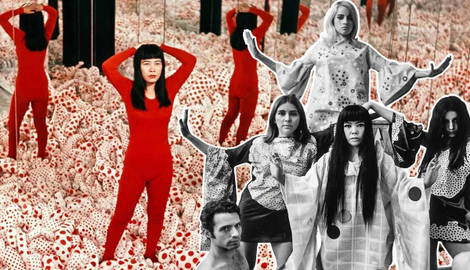

Yayoi Kusama, one of the most celebrated contemporary artists in the world, began using her signature polka dots long before gaining recognition. At the height of the Vietnam War, she organized over seventy anti-war Happenings across New York’s landmarks, using nude bodies as a form of protest and anticipating later examples of activist performance. Read on to learn more about Kusama’s performances!
Content Advisory: The following article contains nude black and white photography.
How New York Pushed Kusama Beyond Painting
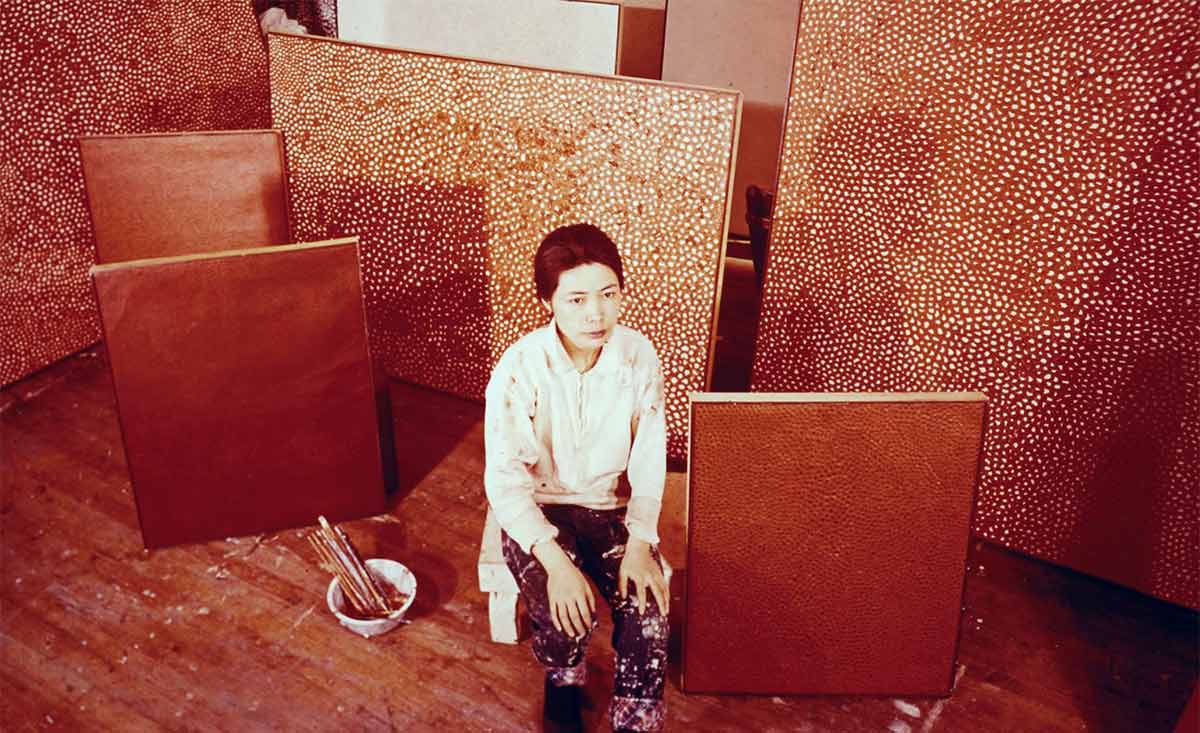
Yayoi Kusama was born in Matsumoto, central Japan, in 1929, into an affluent family that owned a plant nursery and seed farm. Although her family discouraged her artistic drive, after the end of World War II, she moved to Kyoto to study painting. Distancing herself from the Nihonga style, the artist began experimenting with abstract painting and made a name for herself by exhibiting her work in solo shows in her hometown and Tokyo, and eventually in a group exhibition at the Brooklyn Museum in the 1950s, soon before moving to the United States.
From 1958, the artist lived and worked in New York, initially struggling to adjust to such a culturally different environment where she knew no one and barely spoke the language. Soon after arriving, however, she began painting her Infinity Net series, monochromatic, mural-sized compositions made up of small, repetitive, intricate patterns that soon became her signature trademark. Repetition let the artist channel the hallucinations she had experienced since childhood, but also, as she later explained, served as resistance to the city’s pragmatism and the masculinity and aggression of Abstract Expressionism.

She first exhibited her Infinity Paintings in 1959, receiving considerable attention from critics and the public. However, from 1961 onward, she began experimenting with three-dimensional forms and developed her first Accumulation series, which consisted of everyday objects and pieces of furniture covered with countless hand-sewn phallic forms. Probably born from the need to work with cheaper materials and found objects, these sculptures have been interpreted as a way to explore her unconventional relationship with sex and her vision of the world as an organic whole. Furthermore, in an art scene almost totally dominated by men, representing the phallus in such a soft, feminine way was also seen as a way to resist and subvert male power.
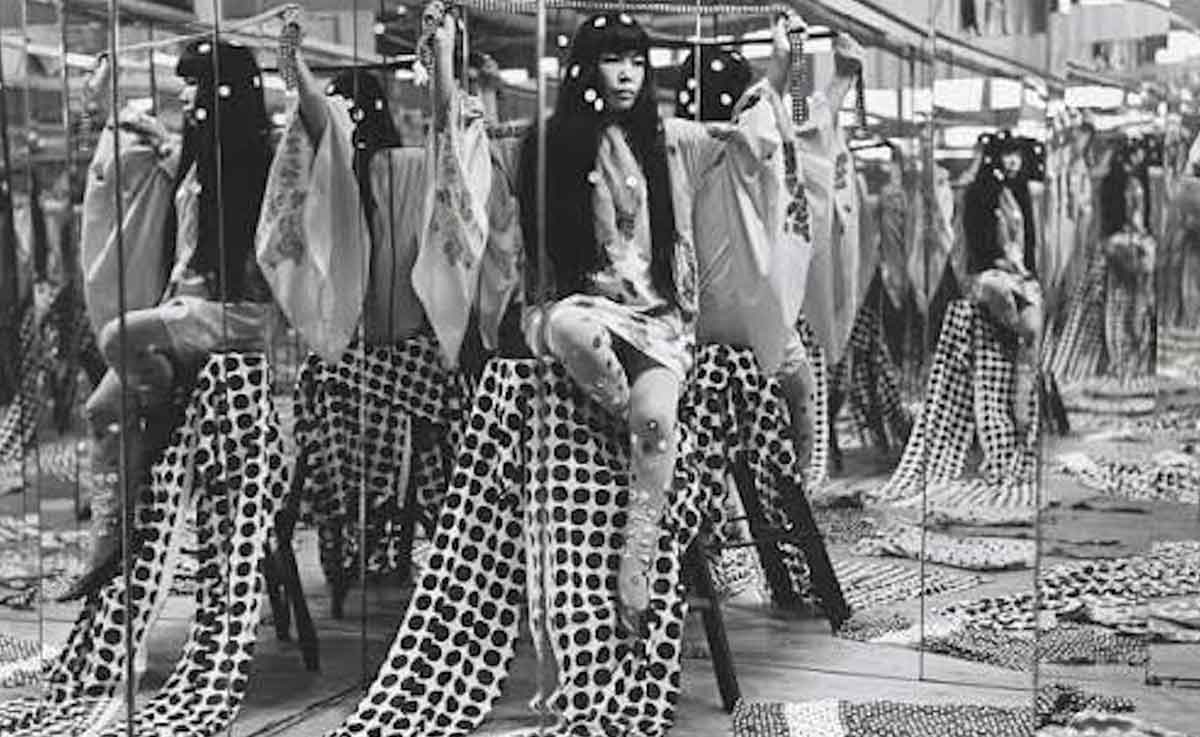
Aggregation: One Thousand Boats Show, presented at the Gertrude Stein Gallery in New York in 1963, combined the sculptural elements of the Accumulation series with spatial intervention. The installation, consisting of a rowboat covered with numerous white phallic forms and a pair of white high-heeled shoes at its base, was surrounded by walls papered with repeated images of the same vessel. This idea of multiplying the same image throughout the gallery space was pushed even further two years later, when the artist displayed Phalli’s Field at the Castellane Gallery in New York. The installation consisted of a mirrored room that multiplied the numerous red-dotted soft phallic sculptures and the viewer’s reflection infinitely, becoming Kusama’s first Infinity Room.
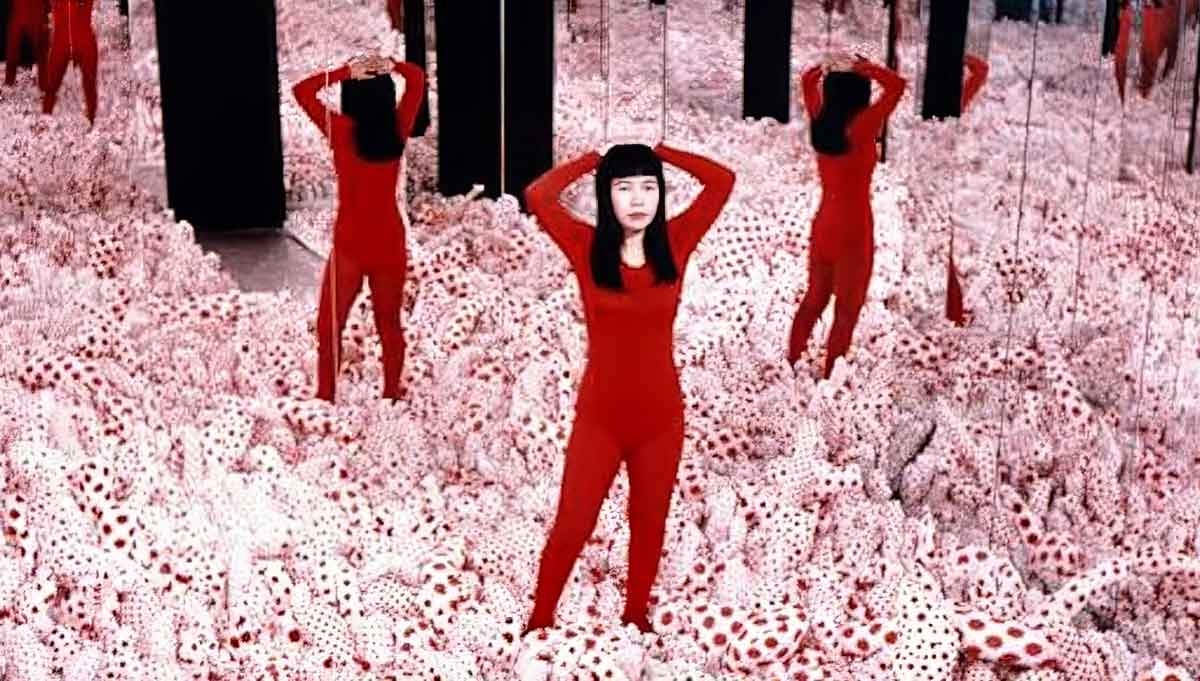
Although by the late 1960s Kusama was well known in the United States and abroad, she was still facing prejudice as a Japanese woman working in a Western-centric, male-dominated art world, while also struggling financially. Furthermore, she was dealing with an increasing sense of exclusion from established art circles, while witnessing some of her most innovative ideas being appropriated by prominent male artists of the time. By the mid-1960s, she had begun experimenting with political Happenings and protests.
Yayoi Kusama’s Radical Anti-War Happenings
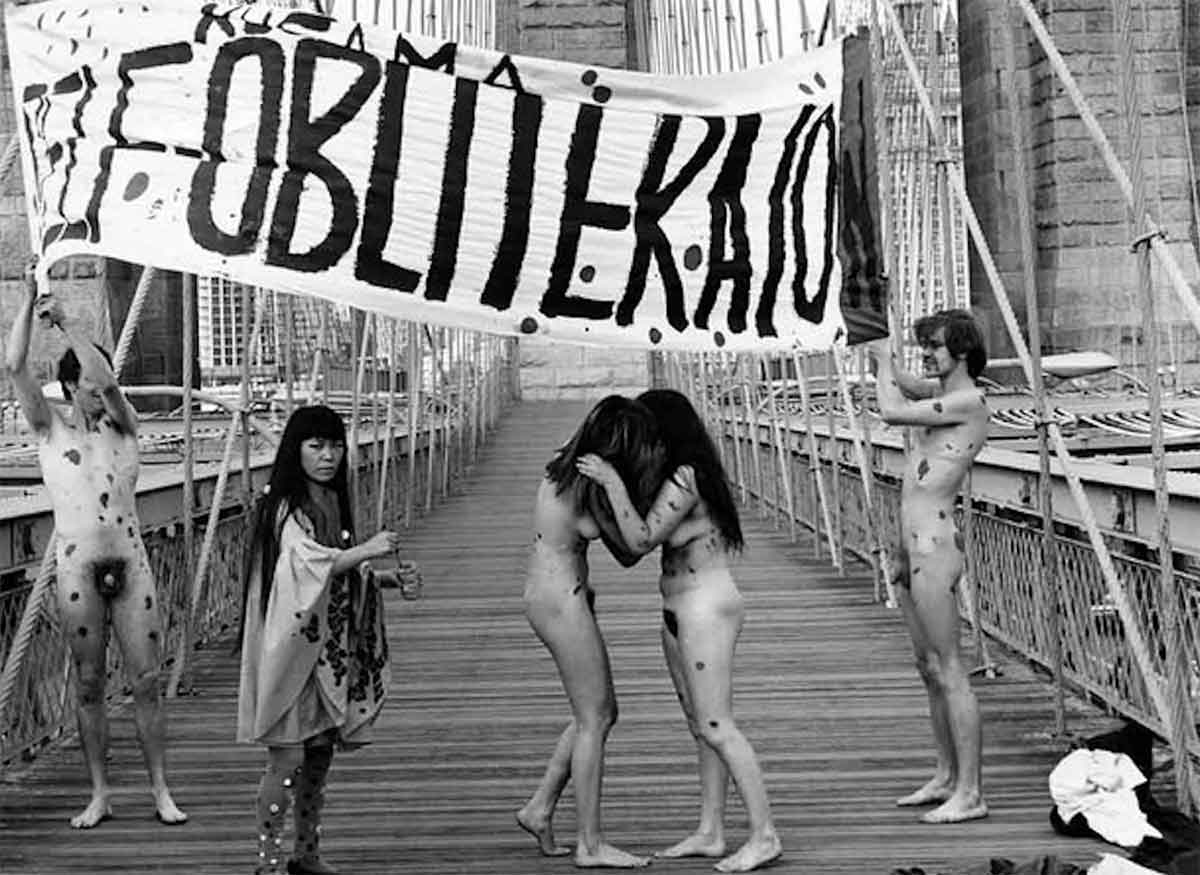
Happenings emerged in New York in the late 1950s and early 1960s as a response to Abstract Expressionism’s long-standing dominance. Allan Kaprow first introduced the term in 1958 to signal events initially held in galleries or art institutions in which viewers actively participated in the action, reversing their passive role as mere observers. Over time, they moved beyond art institutions and into urban spaces, inviting broader reflection on art and sociopolitical issues.
In 1967, Kusama started incorporating the participatory element of Happenings into the so-called Body Festivals. In these events, held in public spaces, performers danced naked while she painted polka-dots onto their skin. Following the social movements, the nude body expressed sexual freedom, but it also became part of Kusama’s anti-war language.
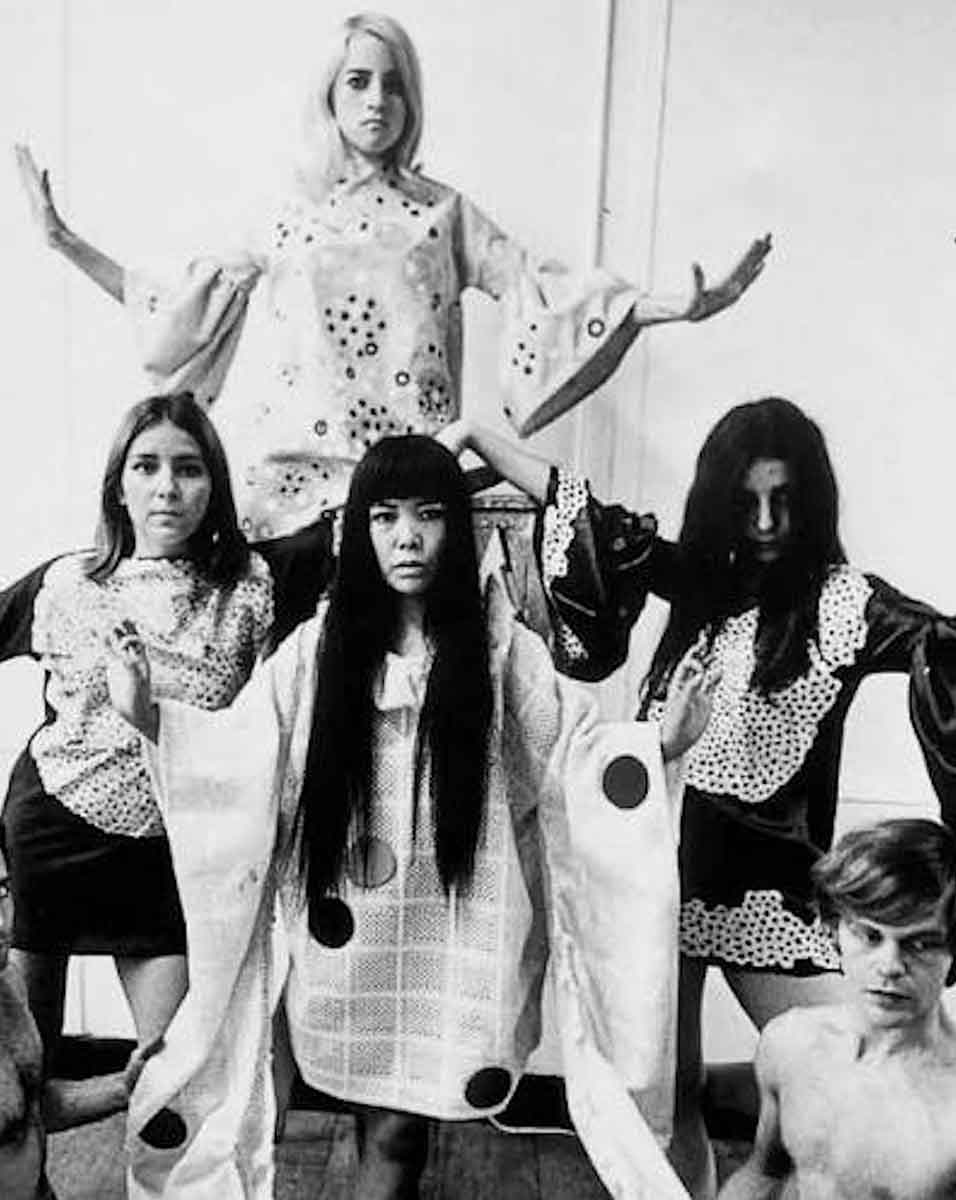
Around the same period, Kusama launched Kusama Enterprises, a commercial venture that brought together art and fashion. She began producing clothes featuring her distinctive polka-dot patterns and unconventional designs, some of which were also incorporated into her performances. At the same time, she established the Church of Self-Obliteration, which, in 1968, became the setting for a homosexual wedding officiated by the artist. Kusama’s Happenings were therefore expanding beyond opposition to war to address sexual freedom and imposed gender norms.
When Kusama Brought an Anatomic Explosion to Wall Street
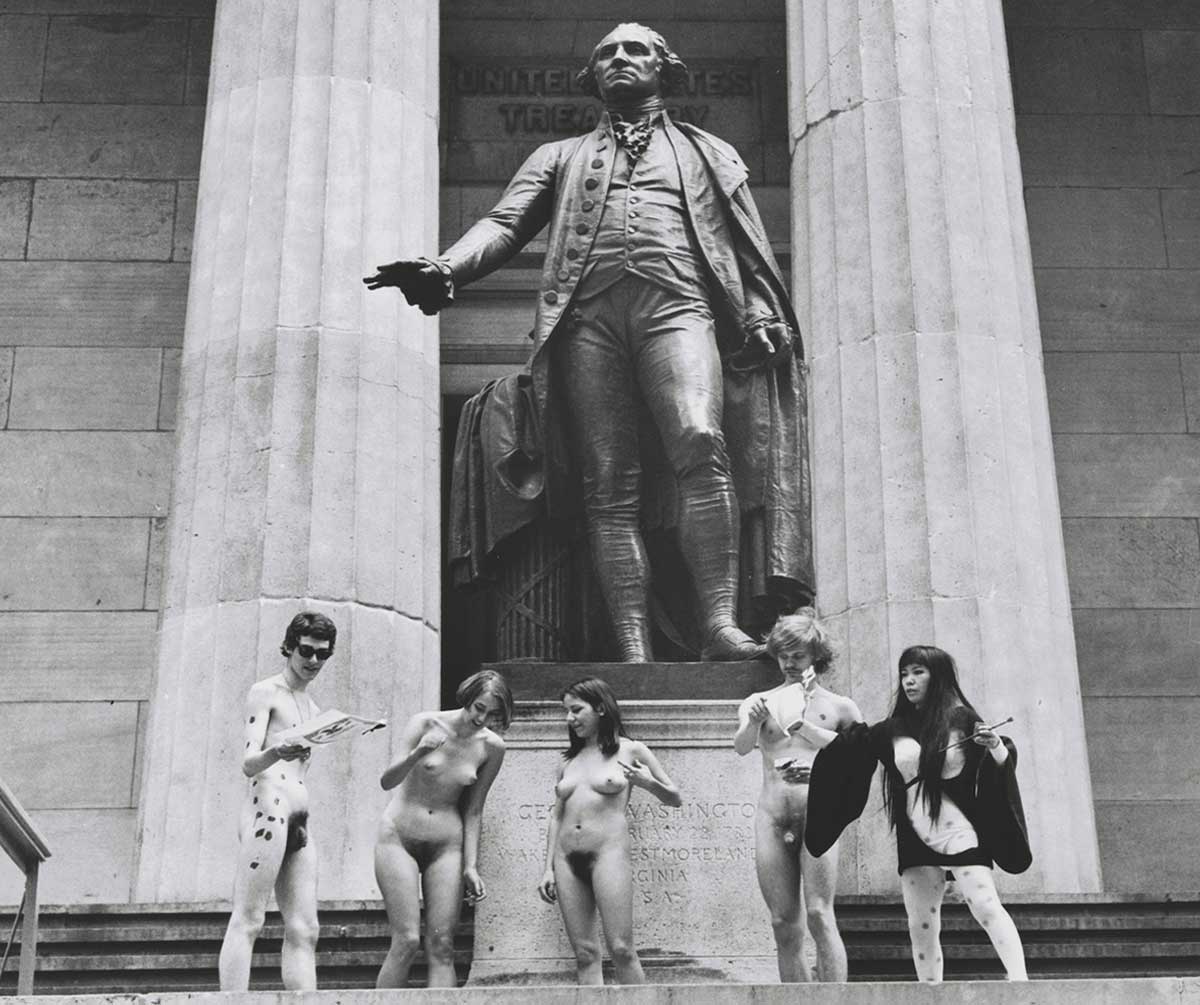
During the 1968 presidential campaign, Kusama staged several anti-war Happenings under the name Anatomic Explosions. The most famous one was held in front of the New York Stock Exchange, where four professional dancers stripped and danced to the rhythm of congas while the artist spray-painted polka dots across their bodies. The artist specifically chose that location to address Wall Street’s involvement in the Vietnam War, highlighting the relationship between corporate capitalism and the military system it sustained. The police stopped the performance after a few minutes. However, this did not prevent it from appearing in major American newspapers the following day. Other Anatomic Explosions happened at the Statue of Liberty, near the United Nations, and at the New York City Board of Elections on Varick Street on the evening of voting in November. On this occasion, participants wore masks of the candidates Hubert Humphrey, Richard Nixon, and George Wallace, claiming to spread the truth about themselves.
The Infamous Open Letter to President Richard Nixon
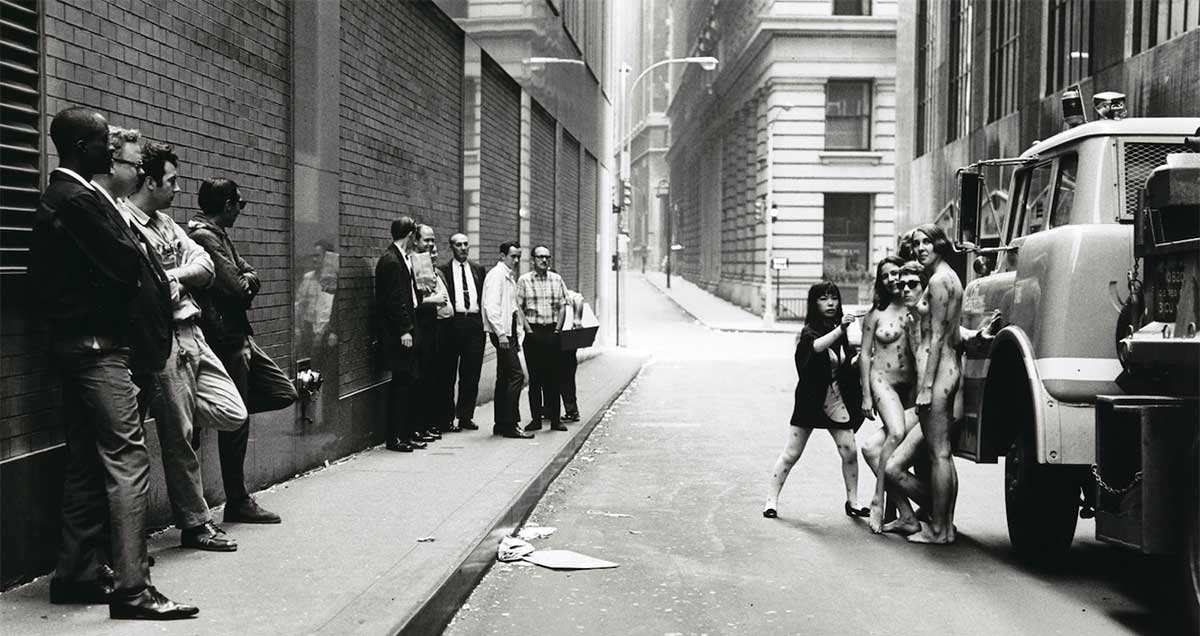
A week after the tumultuous presidential elections, Kusama held a public reading and distributed copies of an open letter to the president-elect in front of the election committee’s headquarters. Her famous piece, titled Open Letter to My Hero, Richard M. Nixon, read:
“Our earth is like one little polka-dot, among millions of other celestial bodies, one orb full of hatred and strife amid the peaceful, silent spheres. Let’s you and I change all of that and make this world a new Garden of Eden.
Let’s forget ourselves, dearest Richard, and become one with the Absolute, all together in the altogether. As we soar through the heavens, we’ll paint each other with polka-dots, lose our egos in timeless eternity, and finally discover the naked truth: You can’t eradicate violence by using more violence.”
The letter sparked controversy because it provocatively framed peace as an exchange for sexual intimacy. However, the controversy also helped Kusama bring her anti-war message to a much wider audience through her artistic intervention.
The Grand Orgy at MoMA That Shocked the Art World
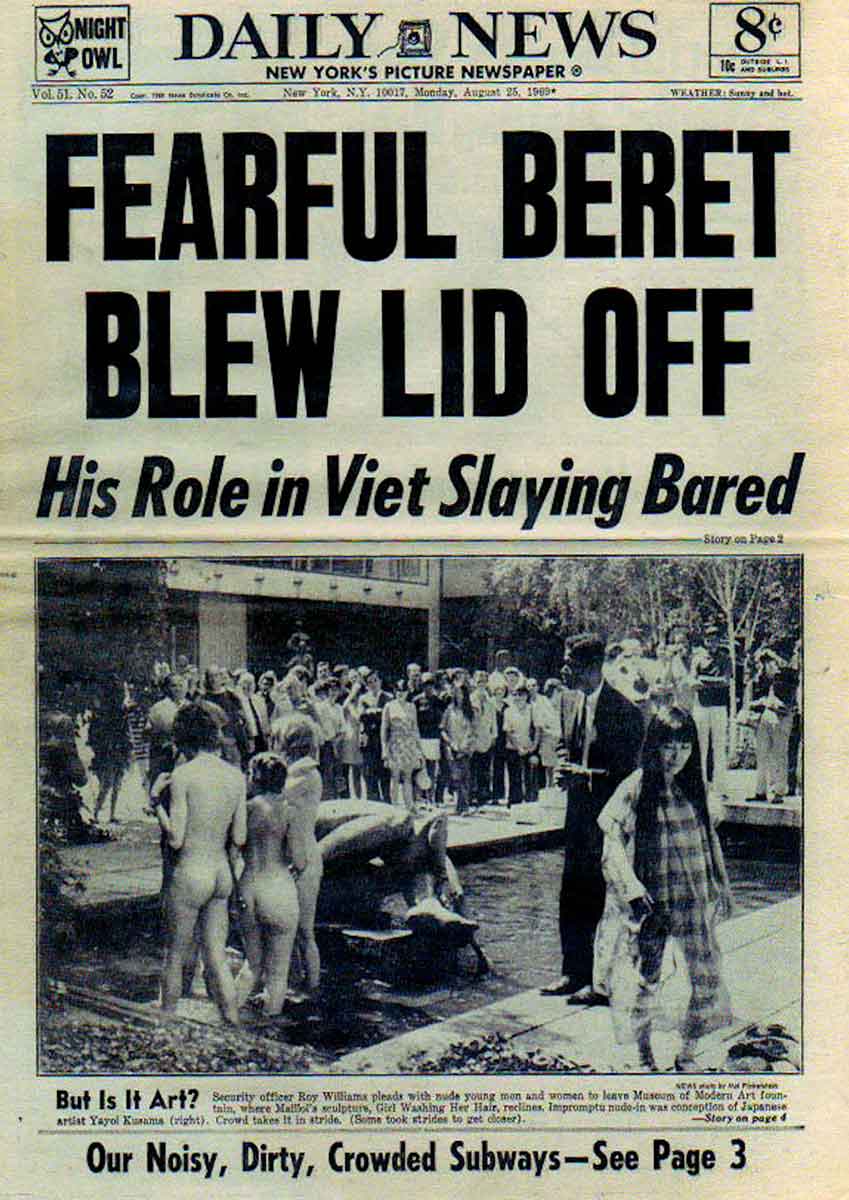
One of Kusama’s most scandalous Happenings was, without a doubt, her Grand Orgy to Awaken the Dead, held on August 24, 1969, in MoMA’s Sculpture Garden. During the unauthorized performance, Kusama painted polka dots on the naked bodies of the participants as they engaged in overtly intimate behavior among the sculptures in the garden. The performance lasted about 20 minutes, to the astonishment of passersby and a security guard, before the police intervened. Because of its explicit nature, the performance was immediately dismissed by critics as an attention-seeking stunt. However, it exemplified Kusama’s aim to criticize the institutional focus on canonical art at the expense of contemporary practices, while also raising awareness of the dehumanizing effects of war. Furthermore, as polka dots symbolized infinity and the universe as a whole, an orgy of naked, polka-dotted bodies was meant to convey the idea of abandoning the destructive individual ego and entering a collective, eternal whole.
The Political and Feminist Legacy of Kusama’s Happenings
Although Kusama’s work was widely known across the United States and beyond by the 1970s, her Happenings were still met with criticism, and she continued to struggle with financial instability and the lack of a support network. As her depression and hallucinations worsened, she decided to move back to Japan, where things were not easier because of the conservatism of Japanese society. In 1977, she voluntarily admitted herself to a psychiatric hospital, where she continued creating her signature works.
Kusama’s contribution remained largely excluded from dominant accounts of postwar art for decades. Her work was difficult to categorize because she moved freely between mediums, crossing the boundaries of Pop Art, Minimalism, Zero, and Nul without fully belonging to any of them. However, her work has gained significant recognition, particularly within contemporary feminist discourse.
Through her artworks, Kusama engaged with the relationship between the female body and gender constructs within a patriarchal society, using the body as both an artistic medium and a creative site. Although the artist never claimed to be a feminist, her installations and Happenings developed during the Second Wave of feminism, assimilating what has been described as a “proto-feministic artistic vocabulary.” Their significance remains especially relevant today, as contemporary artists continue to challenge patriarchal ideas about the body and sexuality and to reshape the social meanings attached to them. One might wonder whether Kusama’s visual language could still be used today to confront the wars devastating so many parts of the world.