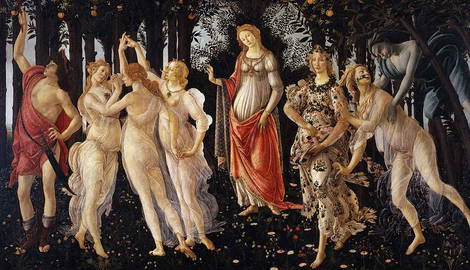
Sandro Botticelli’s Primavera has long been recognized as one of the most complex and debated allegorical paintings of the Italian Renaissance. Beyond its mythological narrative, the work presents a rich and carefully structured botanical setting. This article examines Primavera through both art-historical and botanical perspectives, focusing on the identification, distribution, and symbolic meaning of the plant species depicted. Let’s dive in!
Historical Context and Iconographic Overview of Botticelli’s Primavera
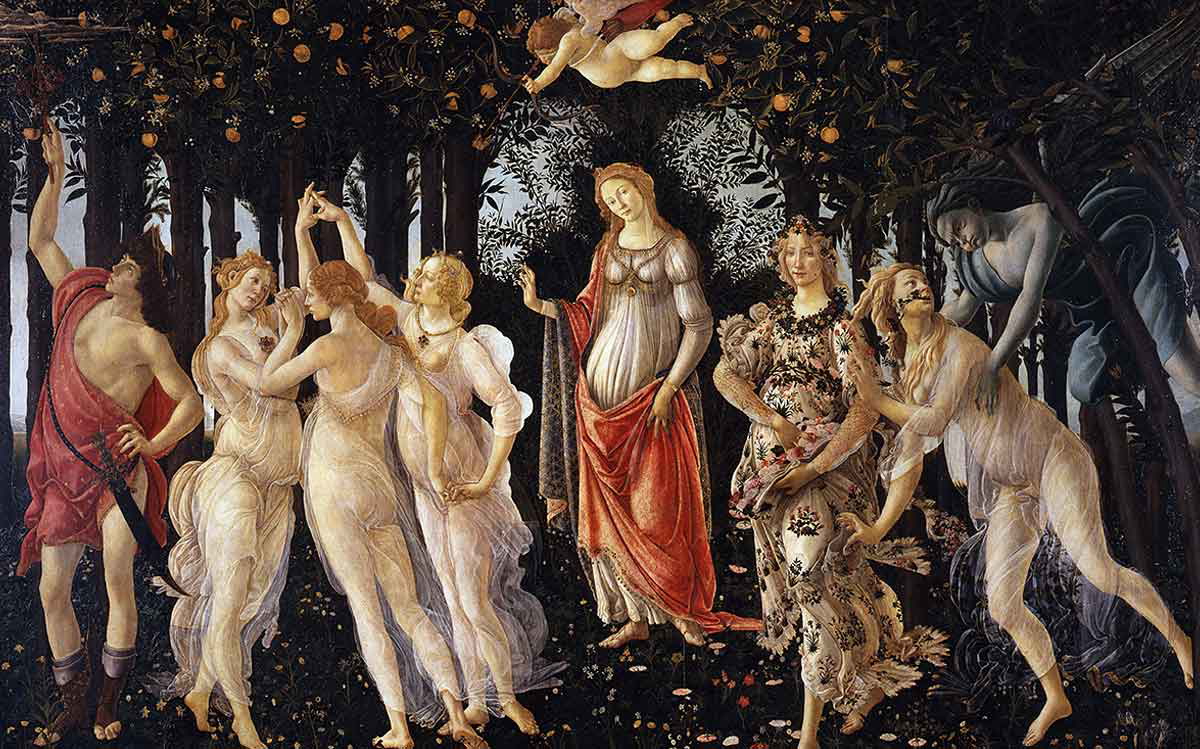
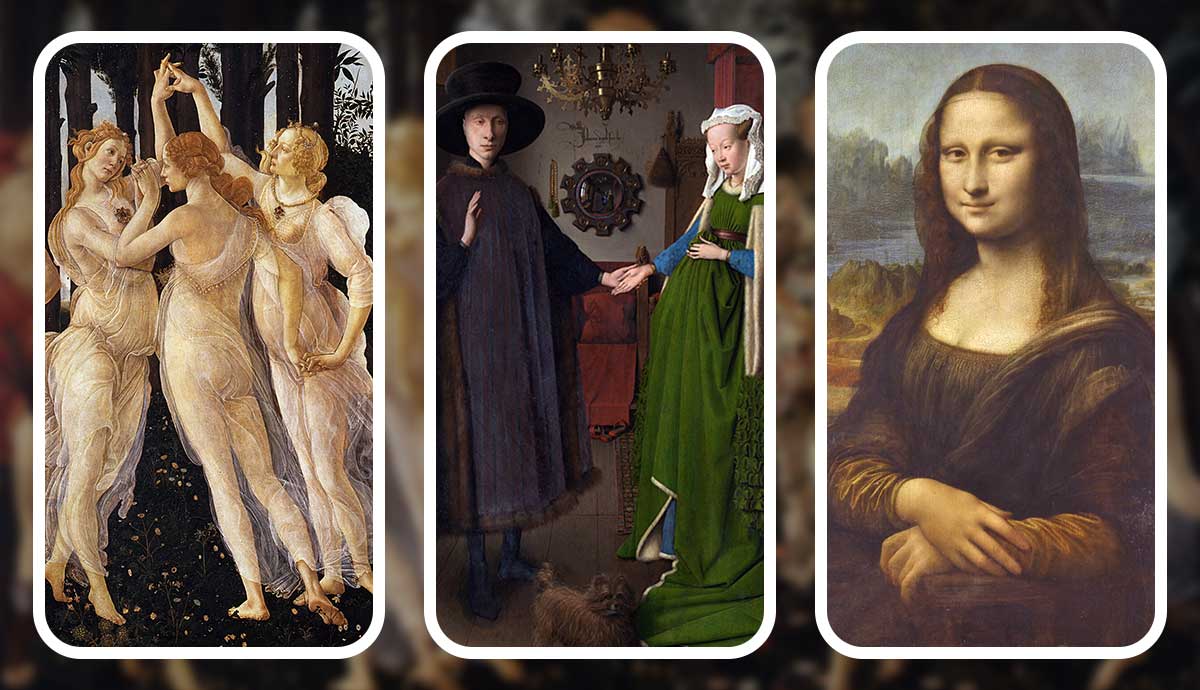
The famous work Primavera, or “Allegory of spring,” by the Florentine painter Sandro Botticelli, dates to approximately 1481–1482 and is currently exhibited at the Uffizi Gallery in Florence. The painter, described by the historian Giorgio Vasari as endowed with “eccentric genius,” created works that, over the centuries, have come to be regarded as archetypes of art history. Among these works, Primavera stands out as a unique composition, one that has generated numerous attempts at interpretation by the greatest art historians. It is by no means a coincidence that this painting enjoys such popularity and that it has been reproduced countless times, more than five centuries after the painter’s death.
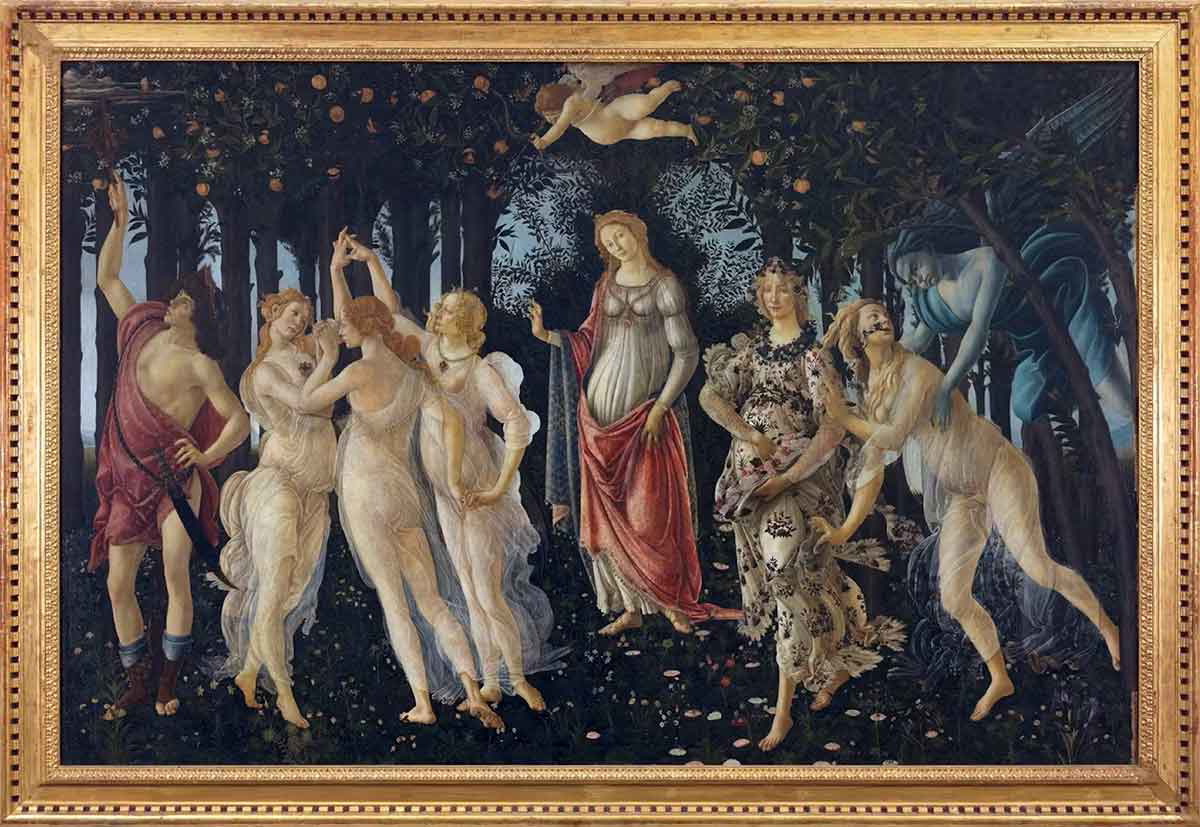
The scene depicted in the painting is set in a symbolically conceived, “secret, transcendental” garden, where mythological figures participate in what may be interpreted as a ritualized pagan setting. At the center stands Venus, in front of a myrtle tree (her sacred tree), indicating that the scene unfolds in her garden, a mythological paradise of eternal spring. Above her hovers Cupid, blindfolded, shooting one of his arrows at one of the Three Graces, who dance arm in arm in a rhythmic circle. On the right, Zephyrus, seizes the nymph Chloris in his embrace. Terrified, she turns away, trying to escape, while flowers emerge from her mouth, signaling her transformation into Flora, the goddess of flowers. Flora scatters blossoms from her hands with serene joy. To their left, Mercury raises his caduceus to dispel certain clouds, confirming his role as guardian of Aphrodite’s realm.
Behind the figures, a dense orange grove forms a decorative backdrop, while a carpet of grass, dotted with hundreds of meticulously rendered flowers, creates the impression that the figures are suspended. They appear to float lightly above the ground, while simultaneously conveying a sense of movement, as if they were dancing.
Primavera: The Garden of Aphrodite
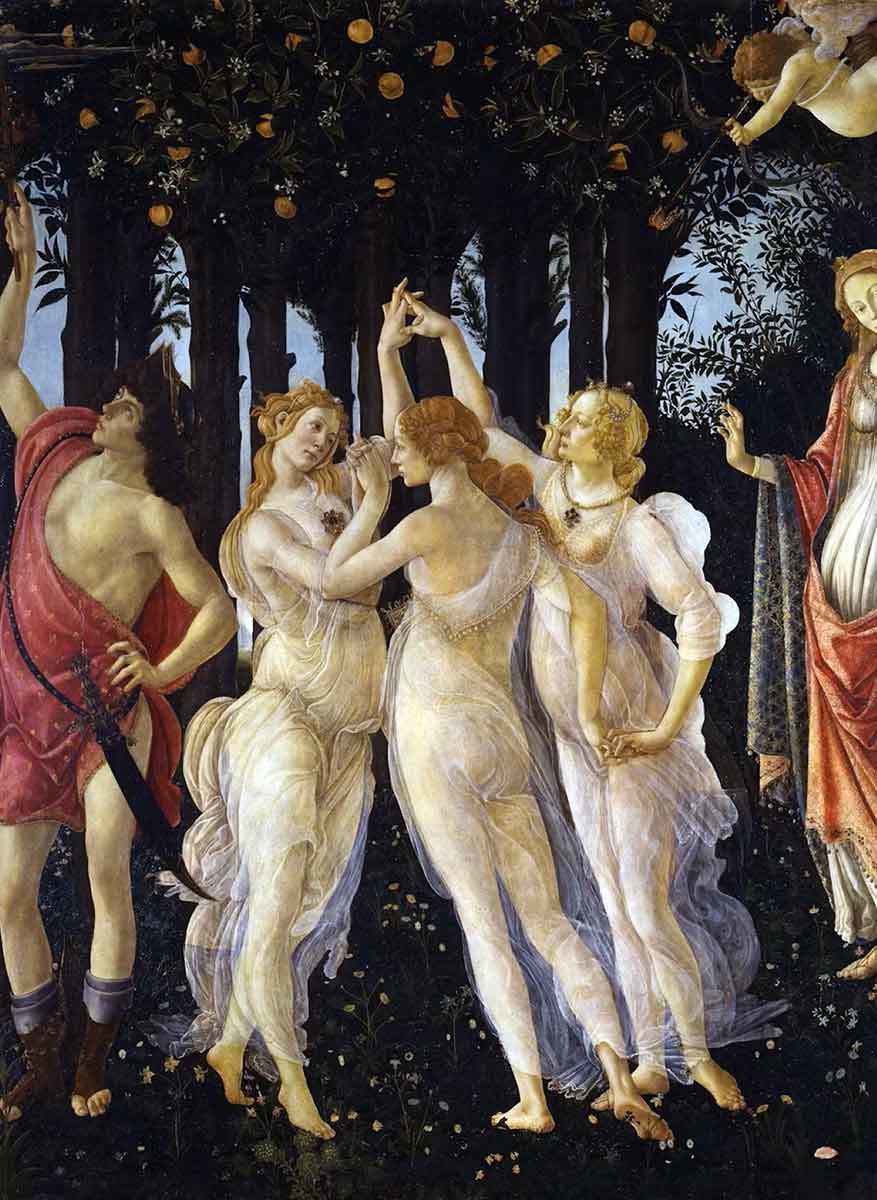
The title Primavera (“Spring”) was first used by Giorgio Vasari, who saw the painting at the Villa di Castello near Florence in 1550. During his visit, Vasari described the painting as a depiction of “Aphrodite adorned with flowers by the Three Graces, symbolizing Spring,” from which the modern title derives. One of the most significant elements of this painting is the wide variety of plants it presents, most of which are rendered with botanical accuracy, while others are more stylized or even imaginary.
Botticelli appears to have deliberately suspended the prevailing rules of linear perspective of his time. The garden lacks depth, and the figures seem to hover, with their contours sharply defined and their colors pure and luminous. This deliberate “flat” rendering of space, combined with the decorative rhythm of lines and patterns, has led some scholars to compare the composition to Flemish tapestries. Some researchers associate the setting with the Garden of the Hesperides, which, according to mythology, Gaia offered the golden apples to celebrate the marriage of Zeus and Hera.
The largest area of the lower part of the painting is covered by the meadow, which contains most of the plant species, clearly visible among the figures and beneath their feet. This zone extends approximately up to the mid-height of the figures. The upper part of the painting depicts trees, some of which bear fruit.
How Many Plant Species Are Actually Depicted in the Painting?
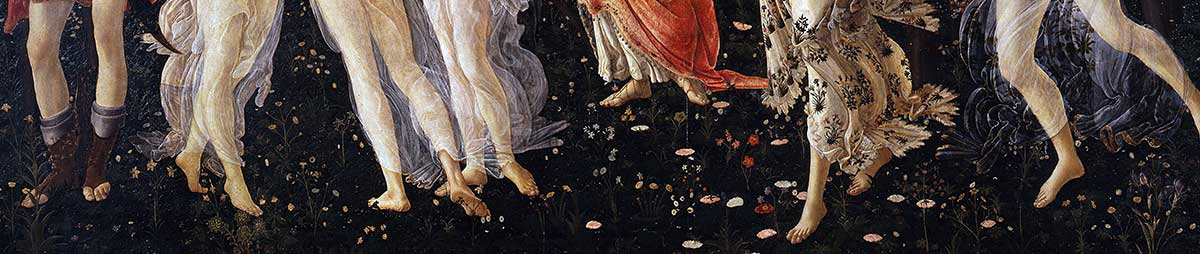
According to the systematic study by Levi d’Ancona, Botticelli’s Primavera: A Botanical Interpretation Including Astrology, Alchemy and the Medici, approximately 500 individual species are depicted in the work. The main categories of plant species include non-flowering plants, flowering plants, and grass species. The non-flowering plants, including leaf rosettes and ferns, number around 240. Of these, 31 can be identified, with some degree of certainty, as belonging to 14 different species or genera.
The flowering plants number 190, of which approximately 138 have been identified. Thirty-three specimens are either stylized or entirely imaginary, while the remaining 19 remain unidentified. Among the secure identifications, 28 flowering plants can be classified as angiosperms (flowers with seeds enclosed in ovaries). These, together with the 14 species of non-flowering plants, raise the total number of species or genera depicted by Botticelli that are still found growing wild today to approximately 42. Grass species (Gramineae or Cyperaceae) number between 60 and 70 and serve primarily to fill the space between the other plants.
Are the Plants in the Painting Real or Imaginary?
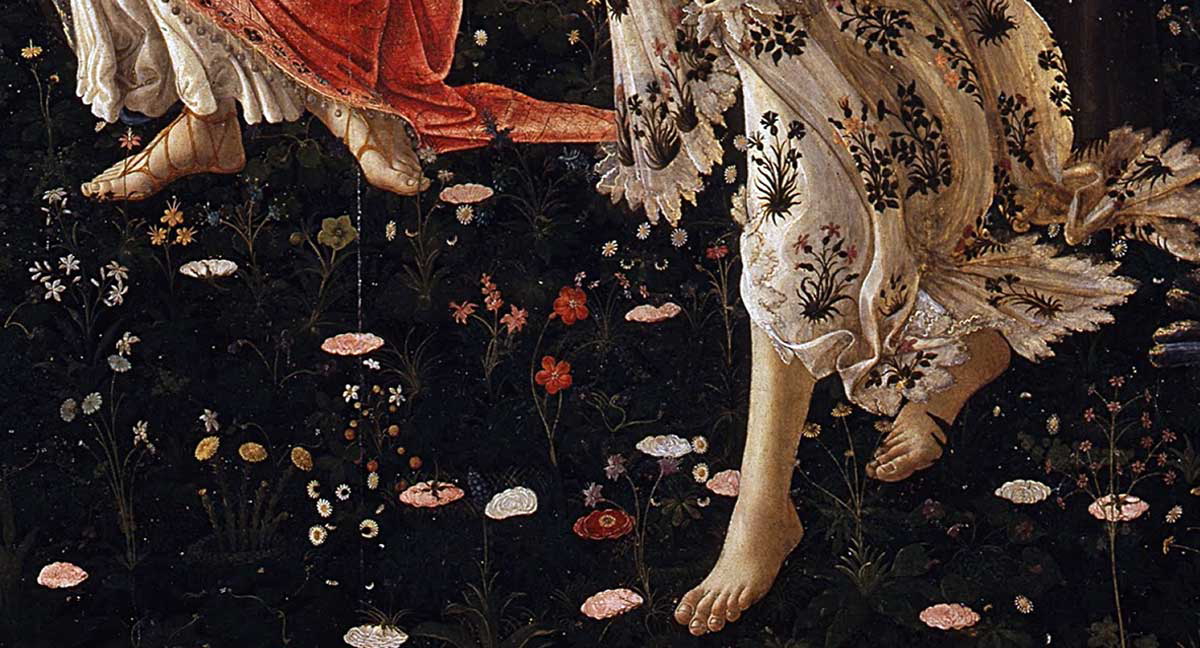
Botticelli clearly intended to render certain of these species as living plants, exactly as they appear in nature, with their flowers and leaves. It is evident that the painting features predominantly botanically faithful plant representations, rather than imaginary or heavily stylized forms. Even those that appear in clusters or have complex structures—such as Muscari, Viola, Centaurea, and Tussilago—are drawn with such precision that they are immediately recognizable. Accurate botanical identification is often possible.
Even when stylized, a plant or flower is usually recognizable, as it retains its basic morphological characteristics. The rarity of stylized or imaginary examples suggests that Botticelli intended to depict a real, living meadow, similar to those we might still encounter today.
Most of Botticelli’s flowers grew wild in the forests, fields, and slopes of central Italy, and many still bloom in the countryside around Florence. It is noteworthy, however, that quite often the flower and the leaf on the same stem do not match. A flower of one species may have leaves of another, or the leaves may be entirely imaginary. Botticelli may have combined flowers he himself collected—or that were collected for him—with foliage that he either invented or recalled from his observations of nearby meadows or fields. He often combines real flowers with imaginary leaves in order to achieve compositional balance in the painting. Thus, many plants are recognizable by their flowers but not by their leaves.
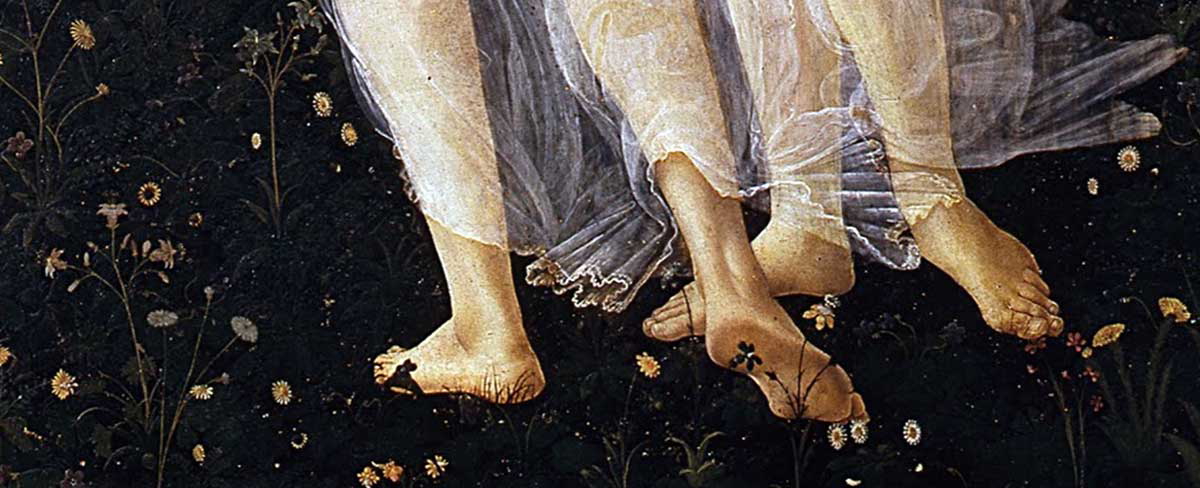
Plants and flowers are generally rendered at natural size, and this impression is reinforced by the evident absence of perspective, which makes them appear almost equidistant from the viewer at any point. Those located further back, on the second plane behind the figures, are less clear, appear smaller, and display more sfumato effects, making their botanical identification more difficult, if not impossible. It is also noteworthy that the flowers appear completely untouched. With seven figures in the meadow—five of whom are clearly in motion—one would expect to see several plants broken or bent, or flowers slightly crushed beneath their feet.
Which Plants Appear in “Primavera” and What Do They Symbolize?
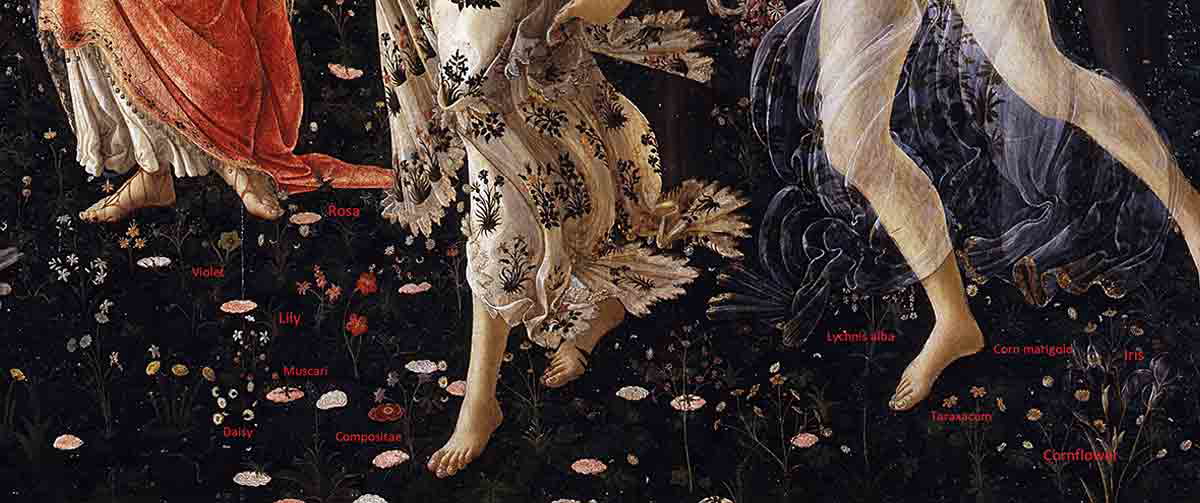
Most of the species bloom between March and May, confirming that the painting depicts a realistic spring scene near Florence. The daisy (Bellis perennis) and the sweet violet (Viola odorata) are the flowering species that appear most frequently in the work. They symbolize purity, love, and modesty. These were particularly beloved at the time. Other plants include the Compositae or bellflowers, with more than 100 specimens in the painting, and roses (rosa), which primarily adorn Flora’s garment. Cut roses also appear at the center of the meadow, at the feet of Aphrodite and Flora.
A faithful and abundant representation is also found for the flowering species Centaurea (cornflower), a type of wild carnation with intense blue flowers, slender stems, and a distinct radial flower head, commonly found in Mediterranean meadows. Botticelli’s detailed rendering makes this species easily recognizable. It symbolizes the beloved woman and is associated with romantic love. Alongside it appears the simple form of the carnation (pink), a traditional element of bridal bouquets of the period, and a symbol of marriage and happiness.
Lychnis alba, or white campion, near the feet of Chloris, was used in initiation rituals for Roman girls and is associated with virginity and coming of age. Another flowering species is the corn marigold (Chrysanthemum segetum), which the Greeks considered sacred to the goddess of virginity and wisdom, Pallas Athena.
The poppy and the daisy (Bellis perennis) were traditionally used to determine whether love was mutual, whereas spurge (Euphorbia) and dandelion (Taraxacum officinale) were considered aphrodisiac herbs. Jasmine, on the other hand, symbolizes elegance, grace, and nobility. The only flowering plant that also bears fruit is the wild strawberry (Fragaria), a symbol of temptation, pleasure, and sensuality, which we see in the mouth of Chloris.
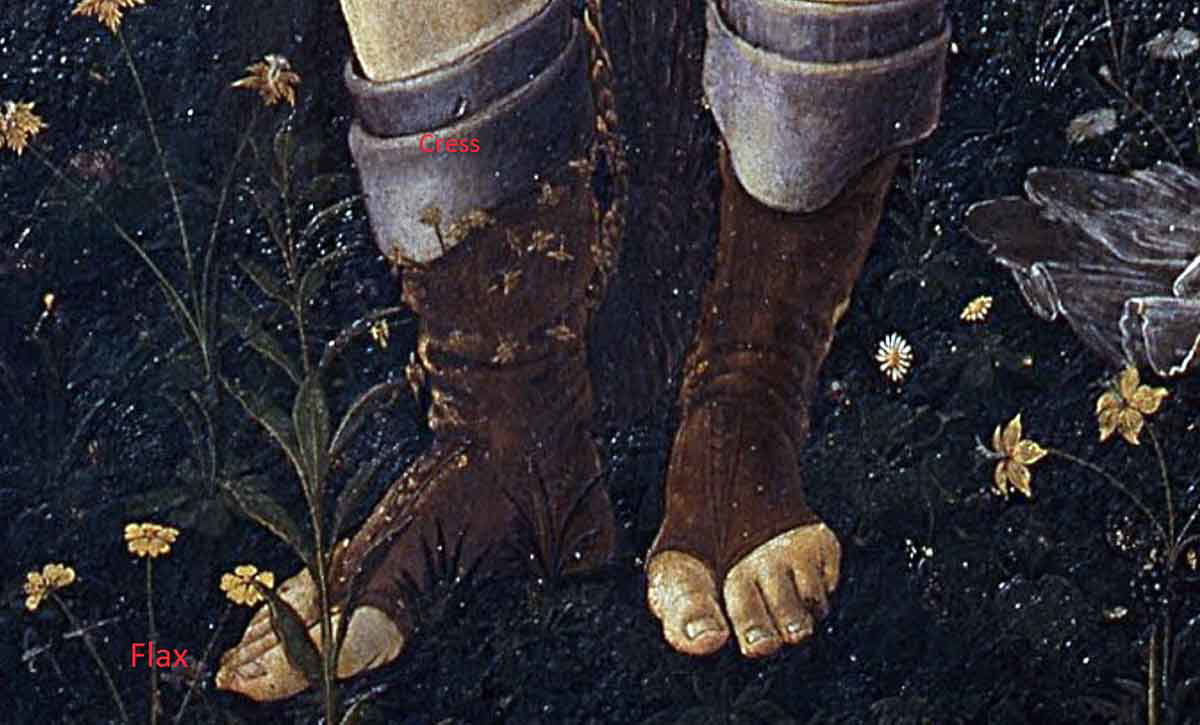
Plants associated with spirituality and knowledge include crocus (crocus), which according to Pliny was used by scholars to sharpen the intellect; the lily (lilium), a symbol of reason and knowledge of the true nature of things; and flax (flax), which appears at the feet of Mercury and which Marcilio Ficino (in De Amore, 1469) compares to love that draws the flame. Finally, the tiny flowering cress (cress) on Mercury’s shoes symbolizes growth and fertility in love.
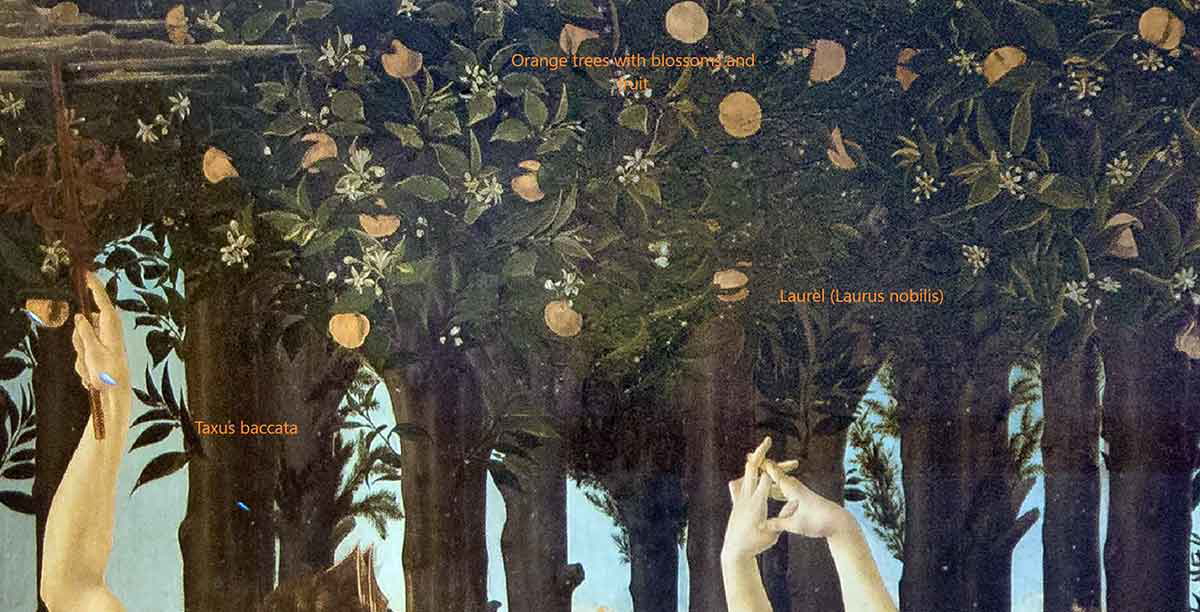
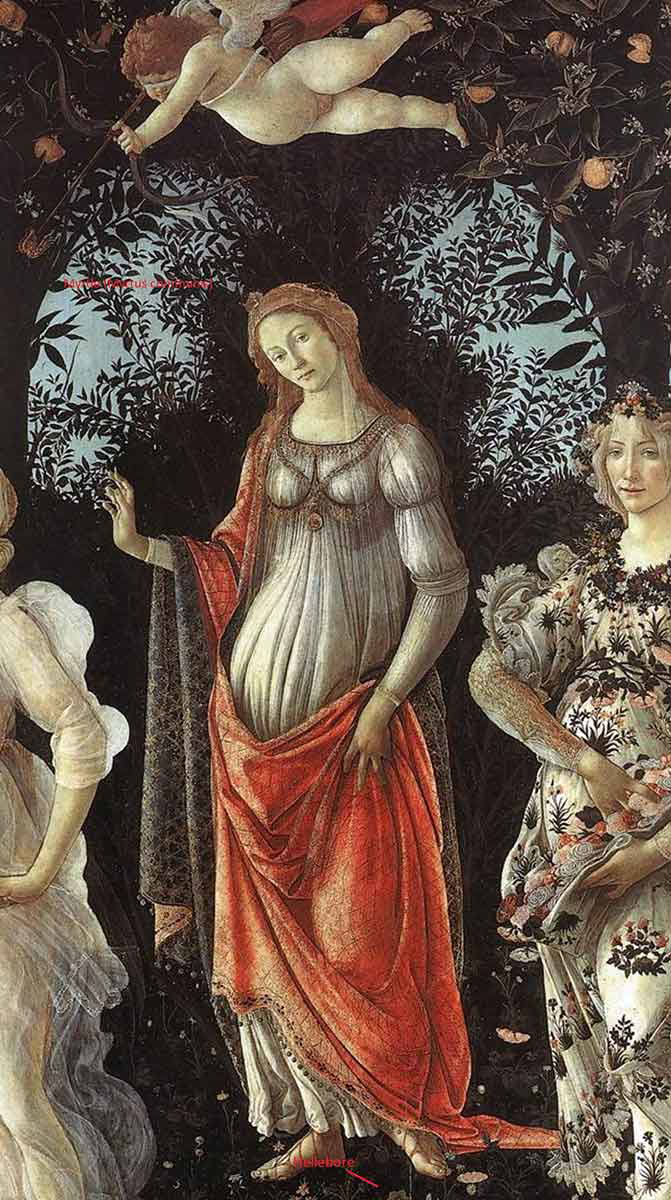
In the background, a real forest is depicted, composed mainly of fruit-bearing citrus trees (orange trees with blossoms and fruit). Some conifer trunks are also recognizable, possibly yew (Taxus baccata), which is very common in Italian forests and adds depth to the background. The large shrub at the center behind Aphrodite is the myrtle (Myrtus communis), her symbol. To her right, there are laurels (Laurus nobilis), symbols of virtue and enlightenment. Cypress cones or fruits (Cupressus sempervirens) appear behind Zephyrus in the upper right corner of the image. The meadow background is covered with common grass species of the Italian countryside (Gramineae/Cyperaceae), ferns (fern), and various wild herbs (leaf rosettes) that lend naturalism to the meadow and emphasize the realism of the scene.
“Dark” Plants and the Plants Adorning the Figures
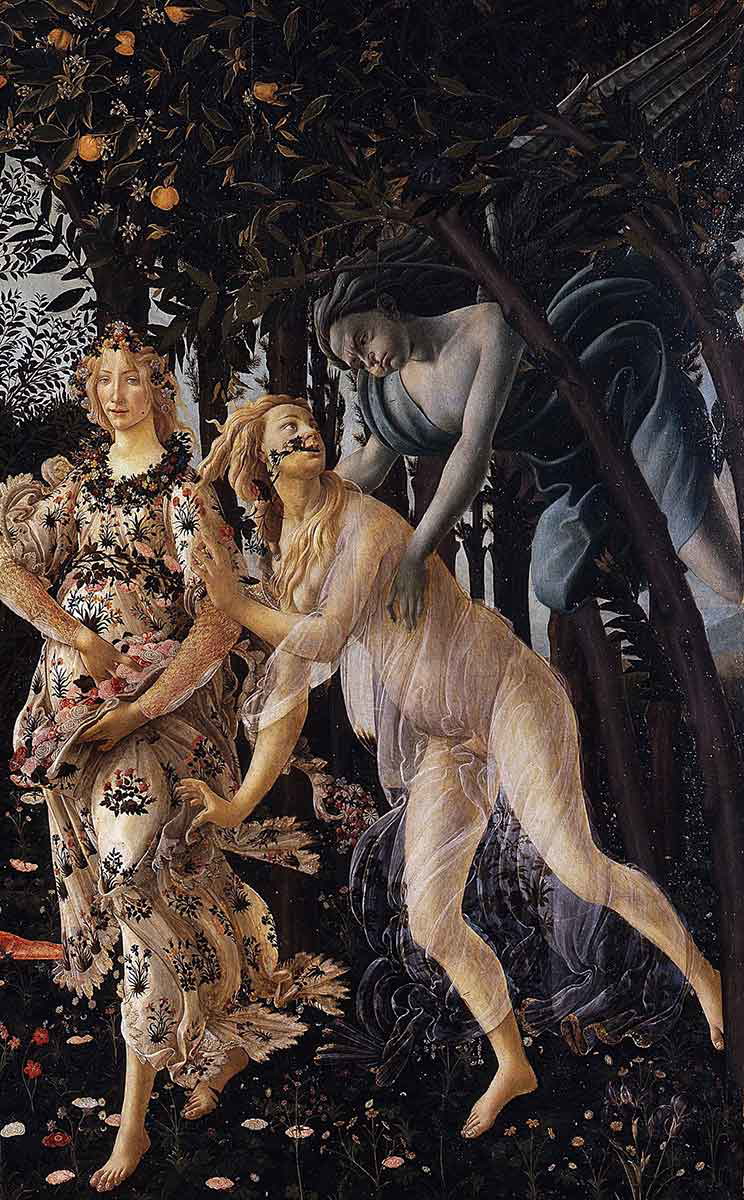
The majority of plants are traditionally associated, within Renaissance symbolic systems, with love, marriage, purity, spirituality, and knowledge. Three species have been interpreted by scholars as bearing comparatively negative symbolic connotations, as they contrast with the plants of love, emphasizing the transition from negative to positive elements. Scholars associate their presence with the scene of “transformation” and the triad of figures Zephyrus–Chloris–Flora, highlighting the transition from violence to harmony. These plants are the buttercup (buttercup), as a symbol of death; ferns (fern), as primordial non-flowering plants considered “unlucky”; and finally ragwort (ragwort), a plant with short-lived flowering that alludes to the transience of life.
A special case is the presence of hellebore (hellebore), which is identified beneath the figure of Aphrodite. It was believed to prolong youth and cure madness and is often associated with the “mad,” carnal love depicted in the painting by Chloris and Zephyrus. It constitutes a notable exception in terms of flowering period, as it appears to bloom in January, while all the other species flower between March and May.
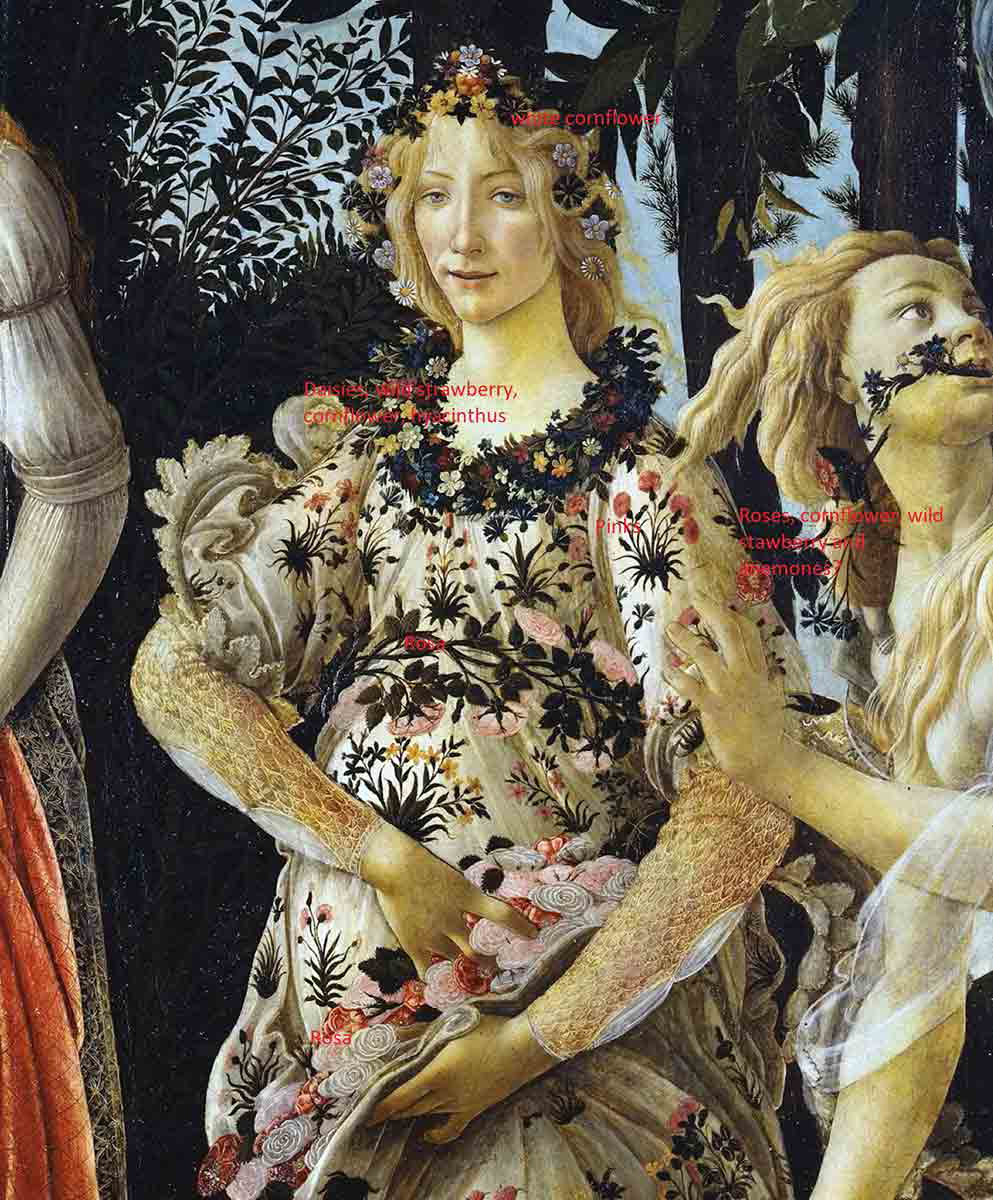
Flora’s garment appears to be decorated with approximately sixty individual flowering plants. These include recognizable species such as cornflowers (Centaurium), roses (Rosa), and carnations (Dianthus), while some more stylized forms are also identified, possibly periwinkles (Vinca), wallflowers (Cheiranthus), and violets (Viola). The cut flowers in Flora’s wreath and garland also appear stylized, though based on real plant forms. The roses she holds are not wild, single flowers, but cultivated centifolia varieties. Flora’s belt is a rich branch of multiple roses, and the fabric falling from her left hand ends in a cluster of flowers, among them the white cornflower and the wild strawberry (Fragaria). The wreath around her neck is almost entirely stylized and includes the daisy, wild strawberry, cornflower, and wild white hyacinth (Hyacinthus).
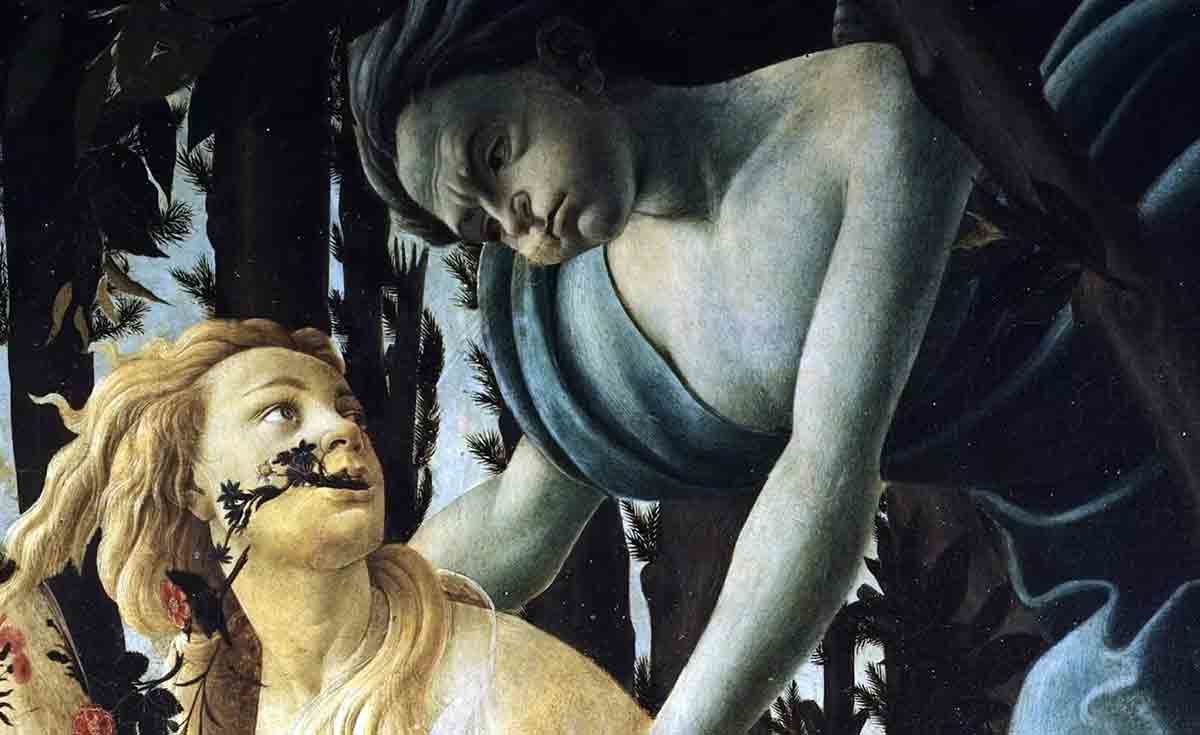
From the mouth of Chloris emerge two roses, three cornflowers, and one wild strawberry flower, as well as three unidentified blue flowers, which could be either gentians or anemones. The rendering of the flowers visible through Chloris’ veil is remarkable. They are certainly not patterns of the fabric, but real meadow plants, as they neither follow the folds of the cloth nor appear in front of the feet.
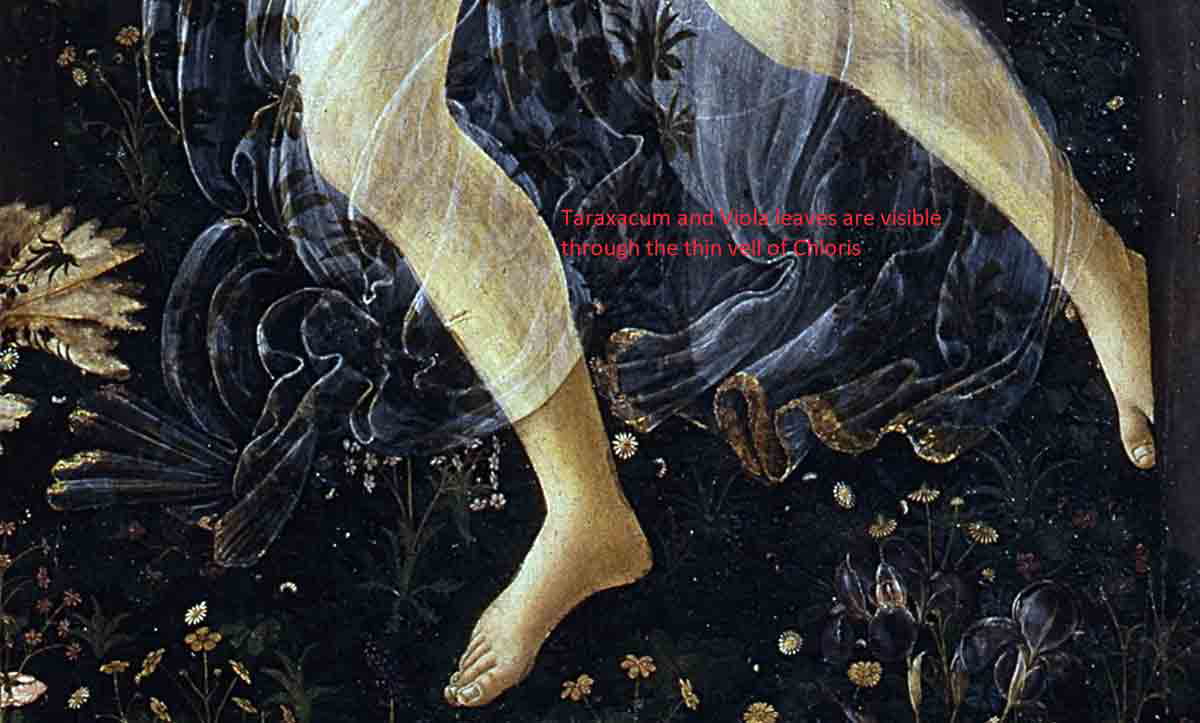
And while the leaves—including those of dandelion (Taraxacum) and violet (Viola)—are visible through the thin veil, the flowers are rendered colorless, as if the transparent fabric casts a shadow over them.
The Renaissance Ideal of the Flowering Meadow in Botticelli’s “Primavera”
During the Renaissance, the meadow and the garden became popular motifs for symbolism, hidden allegory, or narrative structure. Paintings often combine realistic depictions of plants with human figures, as in Primavera. There are numerous Renaissance works from the late 15th and early 16th centuries that depict gardens, meadows, or rural landscapes, combining nature, flowers, and anthropomorphic themes, such as Hugo van der Goes’ Portinari Altarpiece (1480s), Botticelli’s Adoration of the Magi (1475), Leonardo da Vinci’s Virgin of the Rocks (1483–1486), Piero della Francesca’s Madonna del Parto (1455–1465), and many others.
Plant observation is precise and often cross-referenced with botanical studies of the period. The depiction of plants allows for the coexistence of physiognomic observation and symbolism, characteristic of Florentine works of the late 15th century.
Botticelli’s Primavera is perhaps the most representative example of a harmonious prato del venziere (flowering meadow), within which the depicted figures animate their mysterious allegory. The many plant and tree species in the work are associated with symbolic meanings that have provided scholars with material for fascinating and sometimes imaginative interpretations. Nevertheless, the work constitutes a valuable visual document for the study of Renaissance botanical knowledge and its intersection with artistic practice.