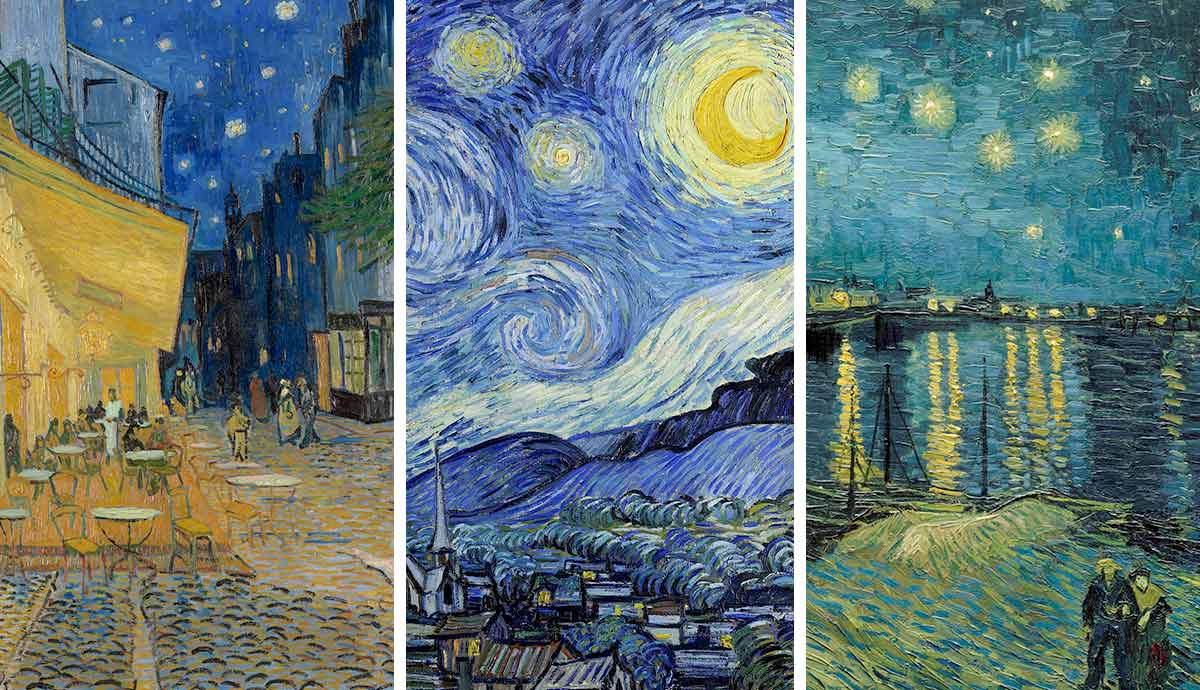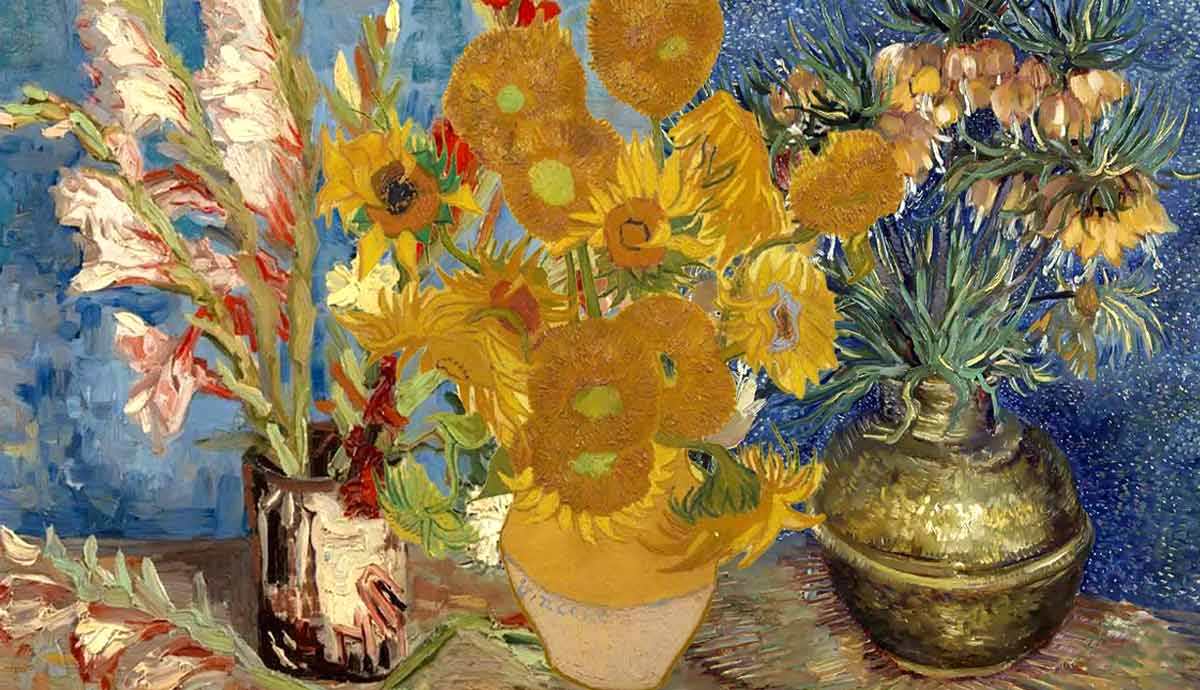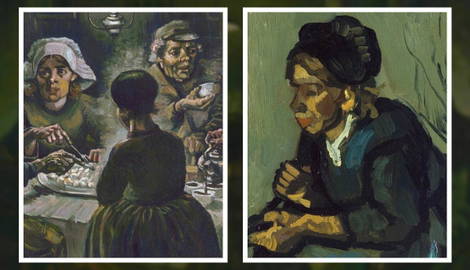

Vincent van Gogh is best known for his bright, colorful paintings showing the night sky, sunflowers, and landscapes. Long before these vibrant canvases came somber, muted paintings inspired by realists such as Rembrandt and Jean-François Millet. These paintings, mostly painted in 1885 in Nuenen, are in stark contrast to the paintings he created in the last five years of his life, when he was on a path toward becoming a colorist. These works marked the beginnings of his career and built his technical knowledge on light and shadows.
1. Van Gogh’s “Loom with Weaver,” 1884
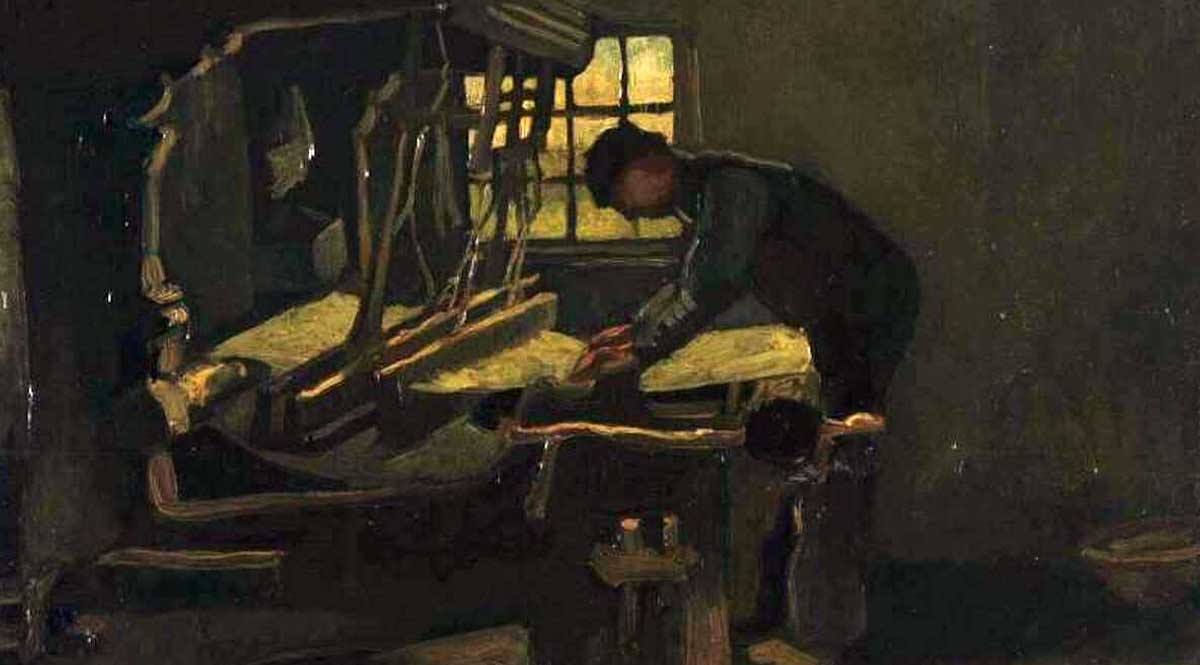
Van Gogh was familiar with several linen weavers in Nuenen and painted numerous works depicting them at work after 1883. One of the reasons for choosing this subject was to capture the complicated mechanism of the loom on canvas. This was especially difficult to do, as these weavers worked in small, dark rooms within their homes that admitted limited light. It was also not possible to stand at a distance to capture the machinery accurately.
Working with dedication on the looms in such cramped situations to earn a livelihood made Van Gogh see them with great respect and fascination. He would often visit their homes in Nuenen to study them. He made several drawings of weavers working, developing a strong connection with their community and an admiration for their technical and physical labor.
2. The Parsonage Garden at Nuenen in Spring, 1884
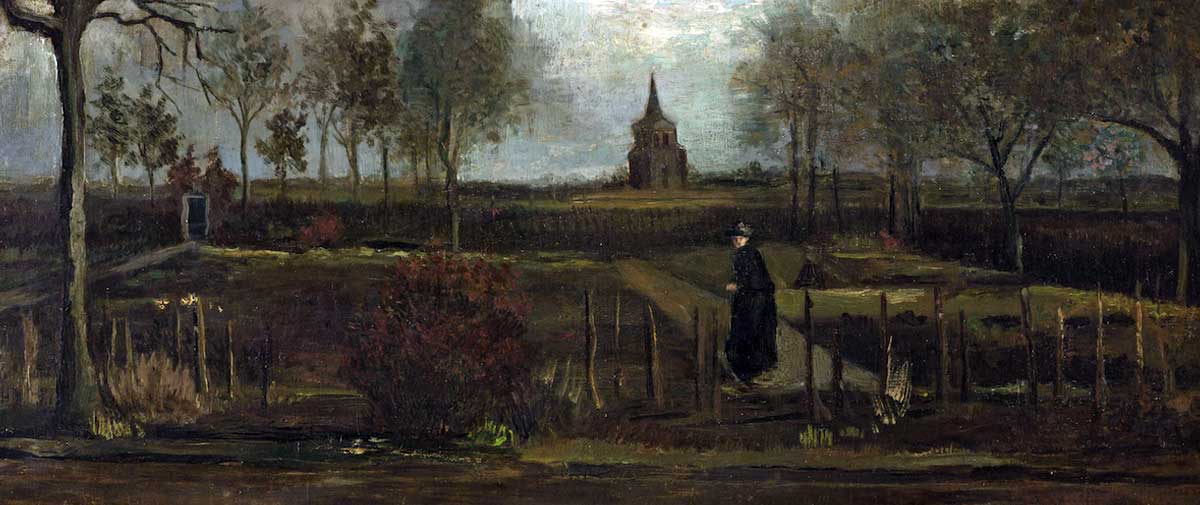
Most of Van Gogh’s early works were created in the Dutch countryside. The artist had learned from the style of the Old Masters and sought to emulate it in his work before he was introduced to avant-garde circles in Paris during 1886-87. While living with his parents in Nuenen, Van Gogh often went into the countryside to explore natural and peasant subjects. This painting depicts an old church tower, almost in ruins, in the background. Van Gogh paid special attention to it in 1885, as it appears as the central subject in The Old Church Tower at Nuenen. The artist made several paintings and sketches of this parsonage garden to capture the effect of changing seasons.
This painting, belonging to the Groninger Museum in the Netherlands, had an eventful history: it was stolen while on loan for an exhibition in 2020. It was retrieved in 2023 in fairly good condition but underwent a thorough investigation and restoration, and was finally displayed in an exhibition in 2024.
3. The Potato Eaters, 1885
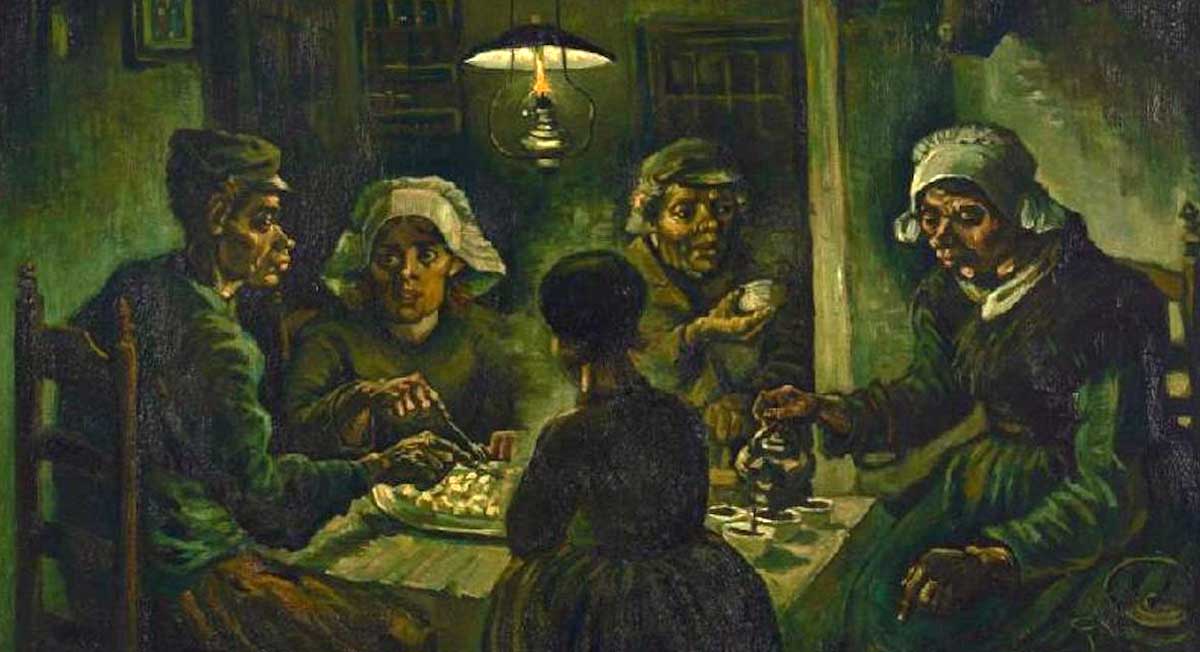
The Potato Eaters was one of Van Gogh’s first major projects that he considered a real success. This oil painting was made in Nuenen, the Netherlands, in April of 1885. It depicts a peasant family having potatoes and coffee after a long day’s work in the field. Van Gogh held deep admiration for peasant life and people who performed difficult physical labor.
This is visible in his depictions of the figures at the dinner table. They have bony faces and fingers, which are enhanced in the composition through harsh shadows with a single source of light on top of the table. A serving of steaming potatoes sits at the center of the table with a few cups of coffee next to it. One of his greatest inspirations, the French artist Jean-François Millet, was famous for his peasant paintings, and Van Gogh attempted to follow in his footsteps by depicting the reality of peasant life, albeit in his own style.
This painting was not only a symbol of life in rural Netherlands, but also a technical achievement for Van Gogh. This painting was particularly difficult to compose because it required depicting five figures under a single oil lamp, and Van Gogh made numerous sketches in preparation. The purpose of selecting such a subject shows Van Gogh’s intention to prove that he was developing into a serious artist who could be a successful figure painter. Still, he received harsh criticism for his manner of representing the figures. Today, The Potato Eaters is on display at the Van Gogh Museum as one of his most famous works and an excellent example of his early style.
4. Head of a Woman (Gordina de Groot), 1885
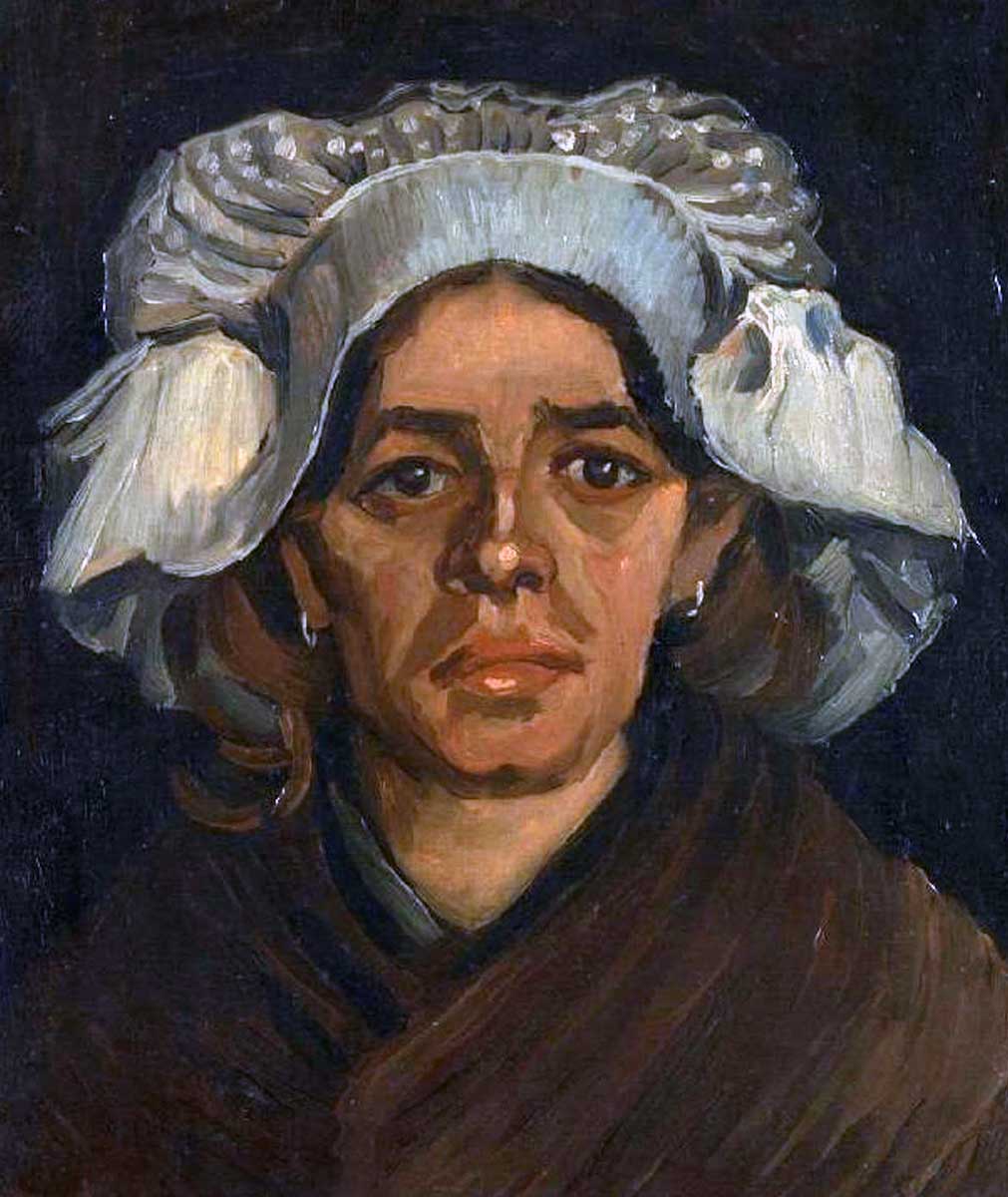
This woman, Gordina de Groot, belonged to the peasant family depicted by Van Gogh in The Potato Eaters. He painted several such portraits of the family members in the same manner, as they served as useful studies for him to practice figure painting, which he wanted to master. While many of his peasant paintings depicted people at work and documented the physical labor of their lives, these portraits with neutral backgrounds showed the simplicity of their clothing and the typical white headdresses worn by women.
In fact, these headdresses, worn by peasant women in the province of North Brabant in the 19th century, were one of the major compositional reasons Van Gogh was interested in making these portraits. The artist found that they formed a contrast that was both difficult to paint but looked beautiful against a dark, neutral background.
5. Still Life with Bible, 1885
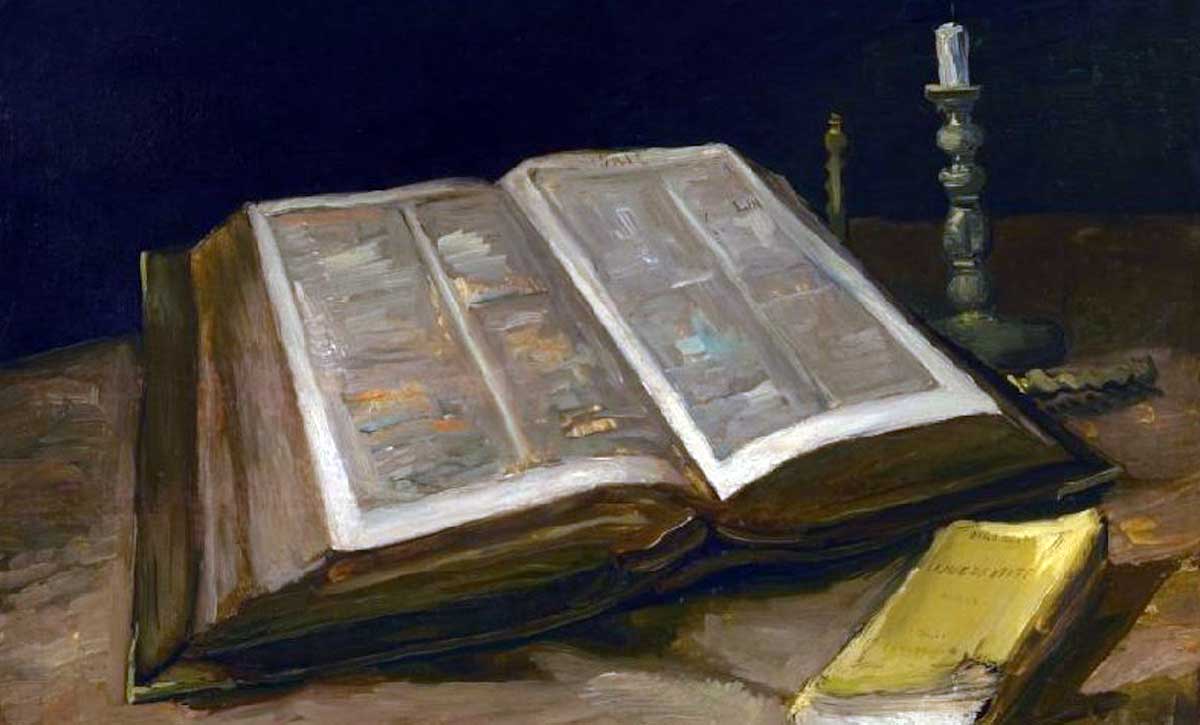
Van Gogh was introduced to religion at an early age through his father, Theodorus van Gogh, a Protestant minister. The Bible depicted in this still life belonged to his father and it was painted as a kind of portrait after his death. Next to the Bible lies another book, La joie de vivre by Émile Zola, creating a stark contrast, as it represents Zola’s views, which were considered progressive for 19th-century French society. Van Gogh valued both religion and avant-garde thought, and Still Life with Bible depicts the duality of his views and the contrast between him and his father. Their strained relationship did not resolve, as his father rejected his son’s career choice as an artist, deeming it an unstable profession.
In terms of composition, this still life is a great example of Van Gogh’s early color palette. He uses dark colors throughout, including black to cover the entire background, with the white pages of the open Bible in the foreground, which is highlighted due to the contrast. Compared to his still life paintings made in Paris that display a juxtaposition of bright blues, yellows, pinks, and greens, the colors in Still Life with Bible are dark and muted, representing a somber emotion.
6. Peasant Woman Cooking by a Fireplace, 1885
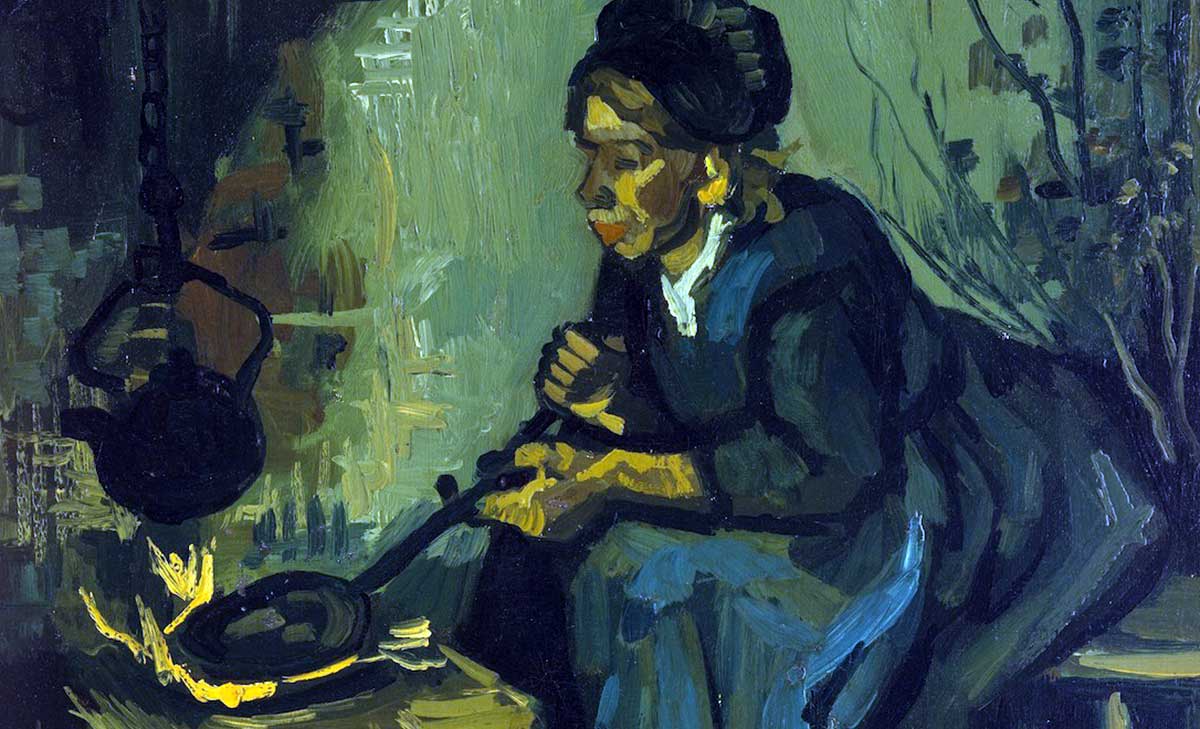
This intimate scene of a woman cooking after a day of working in the fields fits perfectly into Van Gogh’s series of peasant paintings depicting their daily lives. Inspired by life in the countryside, the artist sought to depict its reality, however harsh, rather than presenting an idealized image of peasants. He valued this life for its simplicity and honesty, which is reflected in his paintings of these subjects.
Painted in Nuenen in 1885, Peasant Woman Cooking by a Fireplace depicts a particularly mundane aspect of everyday life. While it was already a well-established tradition to paint everyday activities of private life among other Dutch artists, such as Rembrandt and Vermeer, their works rarely focused on capturing the lives of the poorest communities. This, along with a style that captured the essence of his subjects, made Van Gogh stand apart artistically. The posture of the woman, the blaze of the fire, and the utensils lying around on the floor make this scene dynamic and real in a manner that could not be captured by an accurate depiction of each detail.
7. Basket of Potatoes, 1885
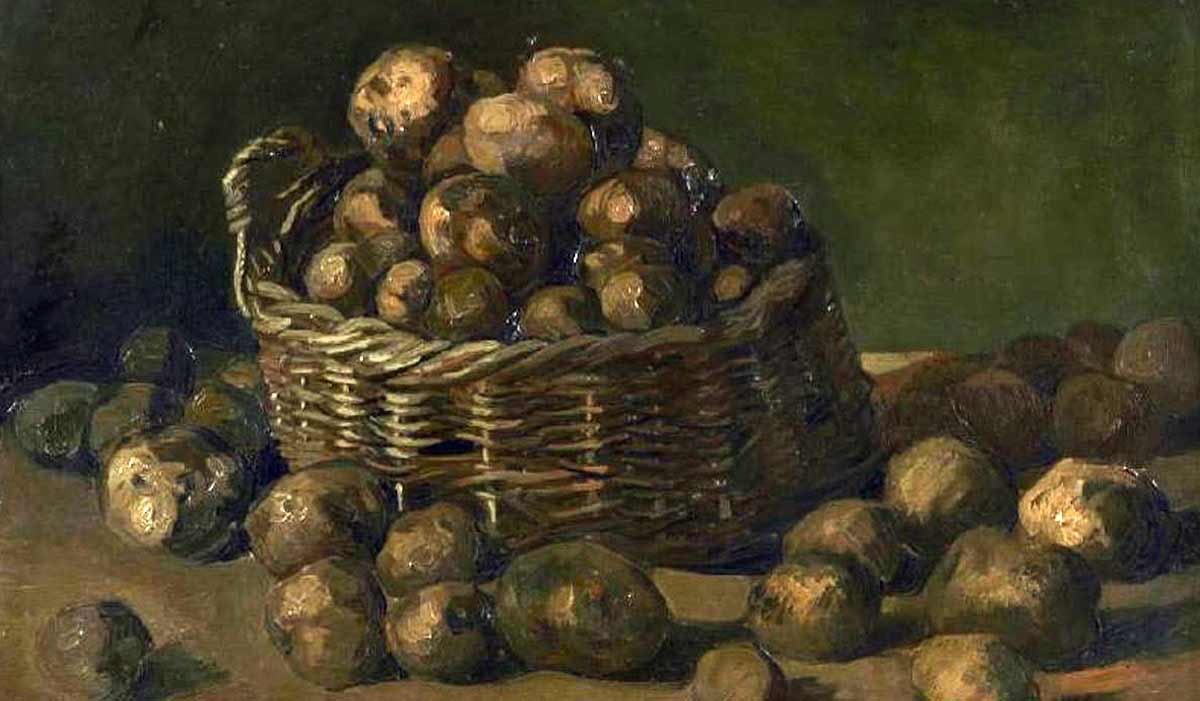
Van Gogh painted many still-life canvases. During his colorful phase, they mostly consisted of flowers, capturing the effect of bright colors placed next to each other. However, Basket of Potatoes is an example of how he captured a simple subject with great character. This still-life shows the use of multiple shades of brown. Van Gogh created the entire composition, including the surface, background, basket, and potatoes, using shades of the same color.
Van Gogh depicted light falling on the subject from above, with the potatoes’ shadows on the right side of the composition. The painting does not follow the traditional realist style, but Van Gogh still managed to capture small details, such as the imperfect weave of the basket, which brings the painting closer to the way reality is experienced. This is characteristic of the artist who intended to capture character and honest reality over an idealized image, regardless of the subject. Van Gogh continued painting the same subjects, depicting fruits and vegetables in baskets, plates, and bowls later in his career, but his approach to color and line shifted as he matured artistically.
8. Bird’s Nests, 1885
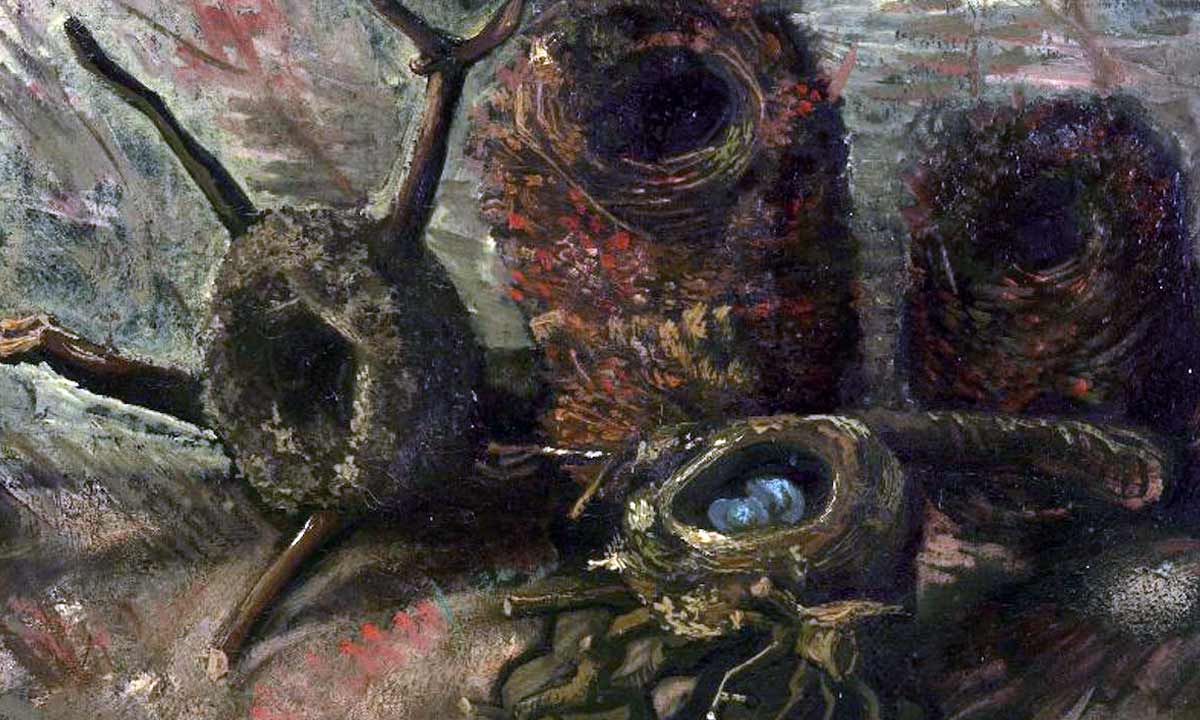
Even during his early phase, when Van Gogh was working with a darker, more somber color palette, his underlying desire to be a colorist was peeling through. He was particularly interested in painting Birds’ Nests, along with other compositions of the same subject, to capture the combination of natural colors, particularly the browns and greens. Being surrounded by nature all his life, first in the small town of Zundert in the south of the Netherlands and later in Nuenen and Etten-Leur in North Brabant, Van Gogh’s oeuvre at large revolved around it.
Even so, his works focused on the side of nature that was often overlooked. For example, in paintings of birds’ nests, rather than depicting young birds in the nest, he would gather nests around Nuenen that had been abandoned to avoid causing harm or disrupting the rhythm of nature.
9. The Old Church Tower at Nuenen, 1885
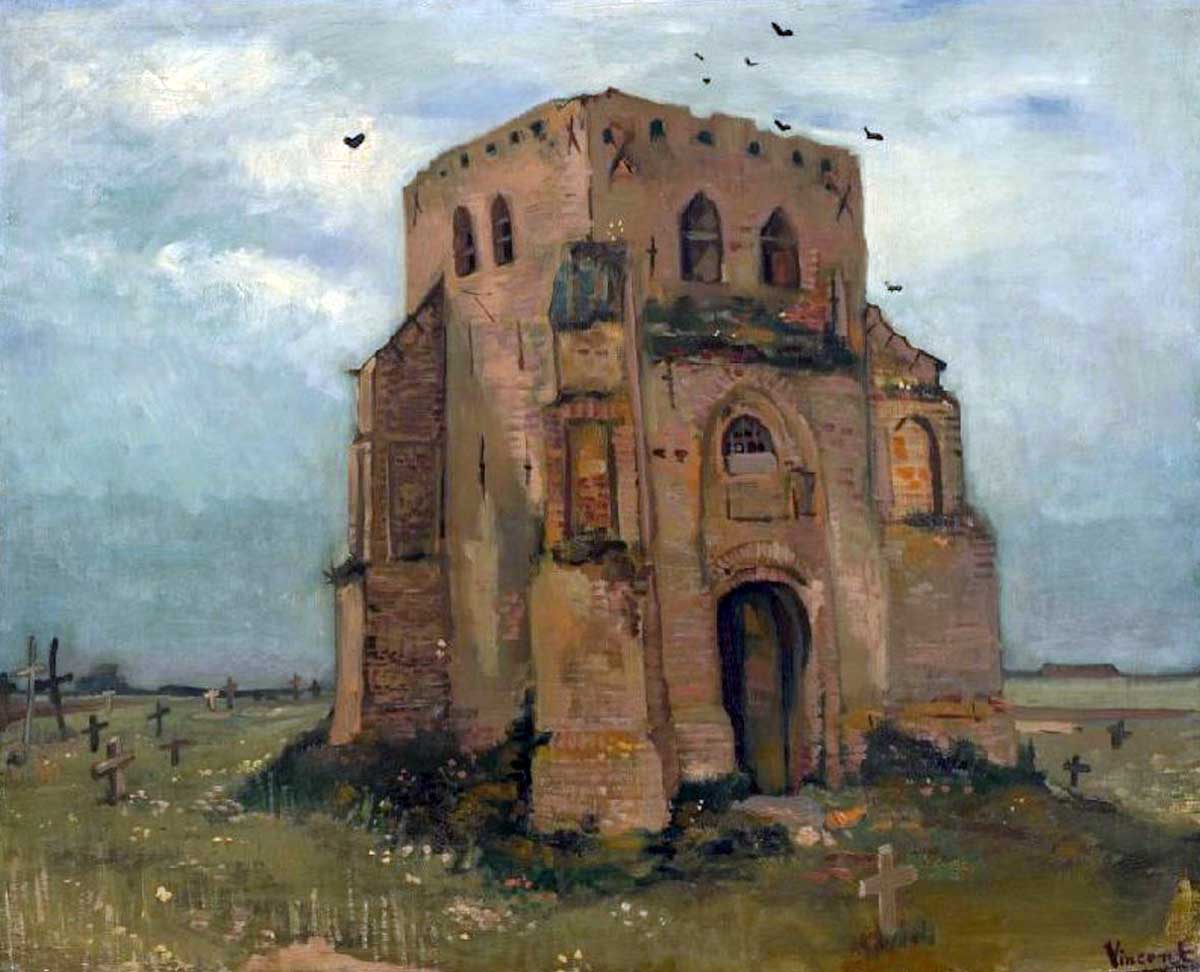
Before becoming an artist, Van Gogh aimed to join the church. He was deeply involved in religion and, as an artist, found ways to incorporate his faith into his work. Painted in June 1885, Van Gogh captures the essence of this old, abandoned church with gloomy colors, similar to the paintings of peasants whose connection to the earth was reflected in the dark palette of the composition. Next to this church tower lay a graveyard where peasants were buried. He had been planning to paint this tower since April of that year because it was scheduled for demolition.
This painting depicts the tower under a greyish-blue sky after its spire has already been removed. Van Gogh considered this painting successful enough to sign it, but was still unsure about its value. However, the artist composed this painting with colors that symbolize the fading of memory and life, embodied by the partially demolished church tower.
10. Van Gogh’s “Three Pairs of Shoes,” 1886-87
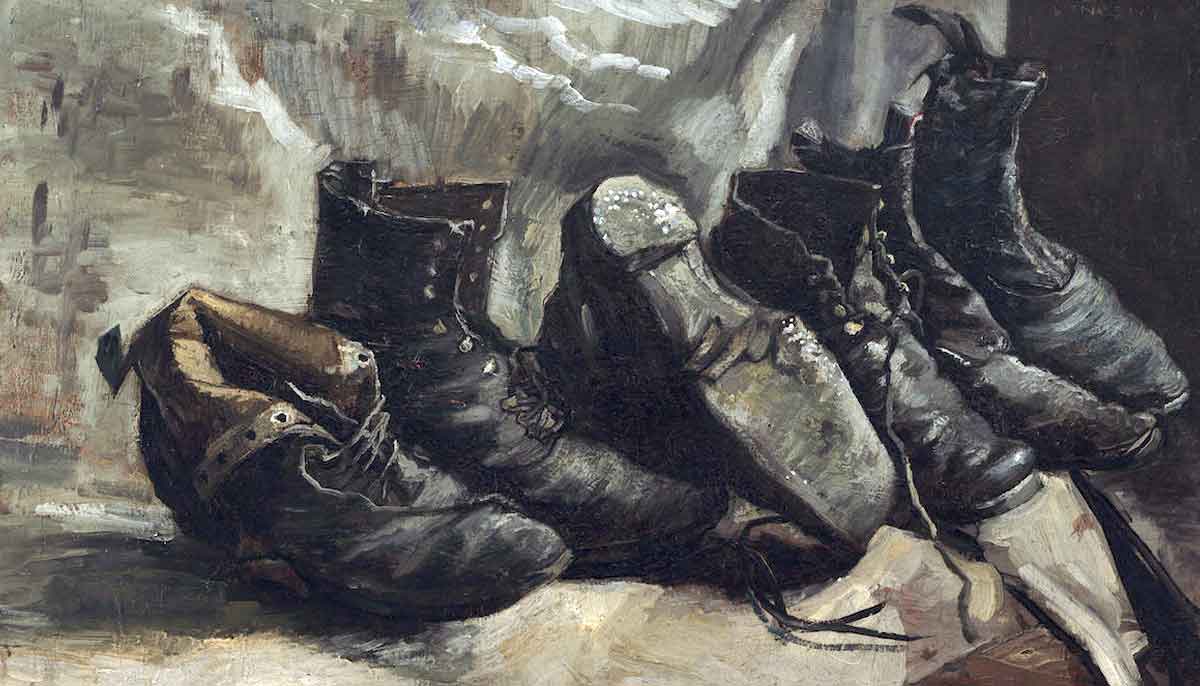
There are a total of six paintings of worn-out shoes that Van Gogh painted when he was visiting his brother Theo in Paris. He was particularly interested in painting still lifes from 1886 onward and used them to study color theory. Here, shoes that were worn by laborers in Paris act as their portraits, similar to how Still Life with Bible represents Van Gogh’s father.
Three Pairs of Shoes, depicting shoes arranged in pairs over a white cloth, is one of Van Gogh’s last paintings from his early phase, when he was still working in the traditional Dutch color palette. In Paris, after being introduced to Impressionists and other modern artists such as Georges Seurat and Paul Gauguin, he completely transformed his style to incorporate lighter and more vibrant colors.