
According to SIL International, there are over 7,000 languages spoken around the world. Most people have a single first language, and about 40% of people speak a second language fluently. This is more common in multicultural countries like Indonesia, where two-thirds of the population is bilingual, compared to about 20% in the United States. While some languages are clearly related, such as Spanish and Portuguese, other languages have completely different lexical and grammatical features. For example, English speakers often struggle with the tonal nature of Chinese and the unfamiliar written characters. How hard it is to learn a new language often depends on the languages you already know. What languages are considered the hardest for English speakers?
| Foreign Service Institute Difficulty Level (for English Speakers) | Languages included |
| Category I (24-30 weeks to learn) | French, Spanish, Romanian, Dutch |
| Category II (30 weeks to learn) | German |
| Category III (36 weeks to learn) | Malaysian, Indonesian, Swahili |
| Category IV (44 weeks to learn) | Russian, Hindi, Vietnamese, Finnish |
| Category V (88 weeks to learn) | Mandarin, Cantonese, Japanese, Korean, Arabic |
Understanding Language Families

Learning a language that is closely related to the learner’s first language is generally easier than learning an unrelated language. Therefore, for English speakers, many other European languages are easier to learn than, for example, Vietnamese, Nahuatl, or Navajo!
The closer a language is on the linguistic family tree to English, the easier it is for an English speaker to learn. English belongs to the Germanic group of languages, which also includes German, Dutch, Norwegian, Danish, Swedish, Icelandic, and Afrikaans.
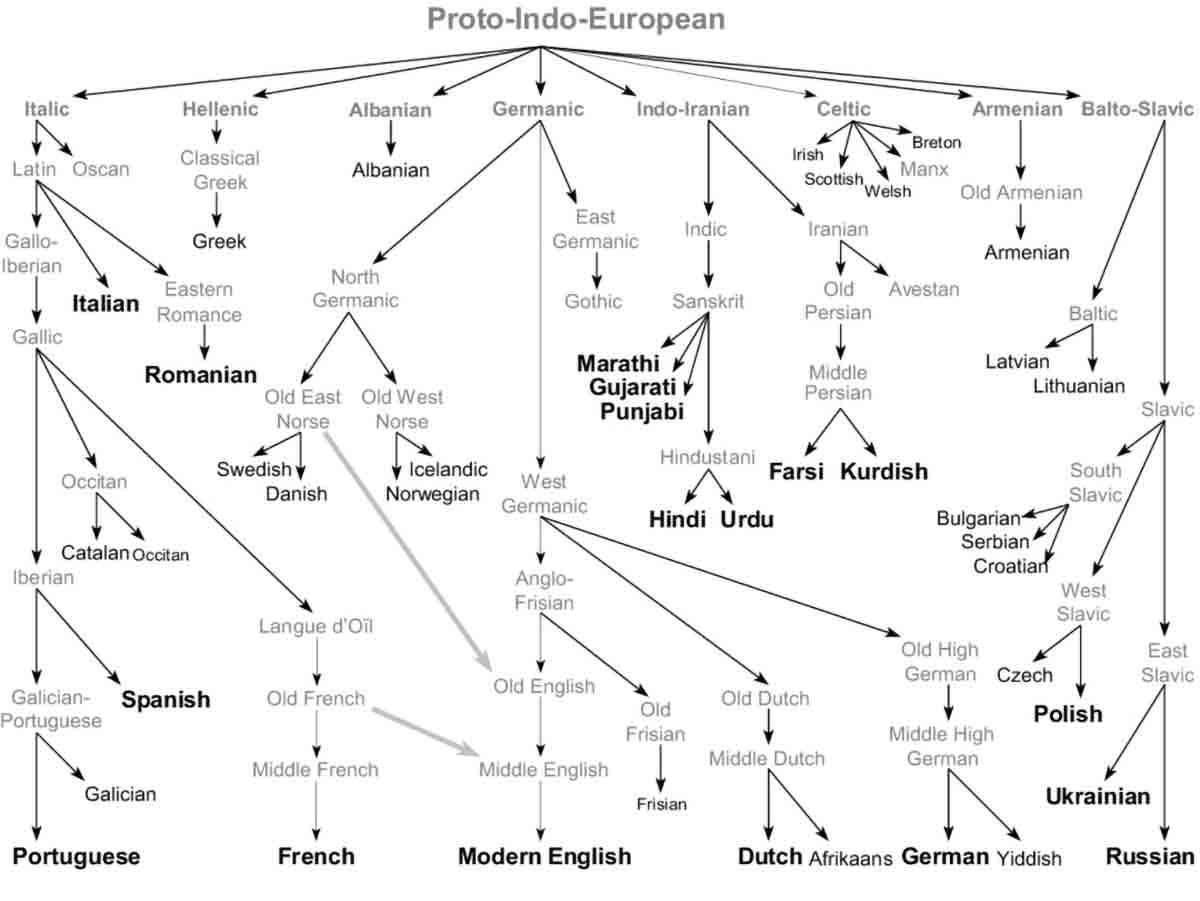
Germanic is part of the broader Indo-European family tree, and about 40% of the global population speaks Indo-European languages. Within this tree, Germanic languages are closely related to Romance languages, derived from Latin (spoken by the Romans), including French, Romanian, Italian, Spanish, and Portuguese. These languages will usually be easier for an English speaker to learn than a more distant language, such as Arabic.
Another major group of European languages is the Slavic group, which includes Russian, Ukrainian, Polish, Bulgarian, Serbian, and Croatian.
Other European languages, such as Finnish, Hungarian, and Estonian, belong to the Uralic Language group and are even further removed from English. Finnish and Hungarian have even gained reputations as being notoriously difficult to learn.
Foreign Service Institute Ranking

The Foreign Service Institute (FSI) is the United States’ primary training institution for members of the US foreign service community. As such, the FSI is responsible for helping professionals and other diplomats learn languages to promote US foreign policy. The FSI categorizes languages based on how easy they are to learn from an English perspective. Languages are ranked from Category I (easiest) to Category V (hardest). Category I includes languages that require 24-30 weeks (600-750 hours) to learn. Several Germanic and Romance languages fall into this category, and include Norwegian, Afrikaans, French, and Spanish.
Although German is closely related to English, it has significant complexities that differentiate it from English and make it a more difficult language to learn than Category I languages. It is a Category II language, and learners can expect to master the language only after 30 weeks (750 hours) of intense study. Moving into language groups unrelated to English, Malaysian, Indonesian, and Swahili are category III languages requiring 36 weeks (900 hours) of study.
Category IV Languages require at least 44 weeks (1100 hours) of study, and include Bulgarian, Hindi, Russian, Greek, Czech, Thai, Finnish, Estonian, Tagalog, Xhosa, and Zulu, among many others.
Category V: The Hardest Languages to Learn (From an English Perspective!)

Reaching Category V and requiring 88 weeks (2200 hours) to learn, there are a handful of languages that require intense study to master. These languages are Mandarin Chinese, Cantonese Chinese, Arabic, Korean, and Japanese. Of these languages, Japanese, with its differing syntax, three different writing systems, and complicated hierarchy of etiquette, is considered the most difficult.