
The early 1970s were a time of great political and social change. As society changed, many new art movements rose to prominence.
The New Topographics movement represented a huge shift in the history of photography. Named after the 1975 exhibition, New Topographics: Photographs of a Man-Altered Landscape at the George Eastman House, the exhibition featured ten photographers who rejected the traditional idea of landscape photography. Their style was in stark contrast to photographers such as Ansel Adams. They favored the new suburban sprawl, documenting industrial parks and empty street scenes.
The Rejection of Romanticism
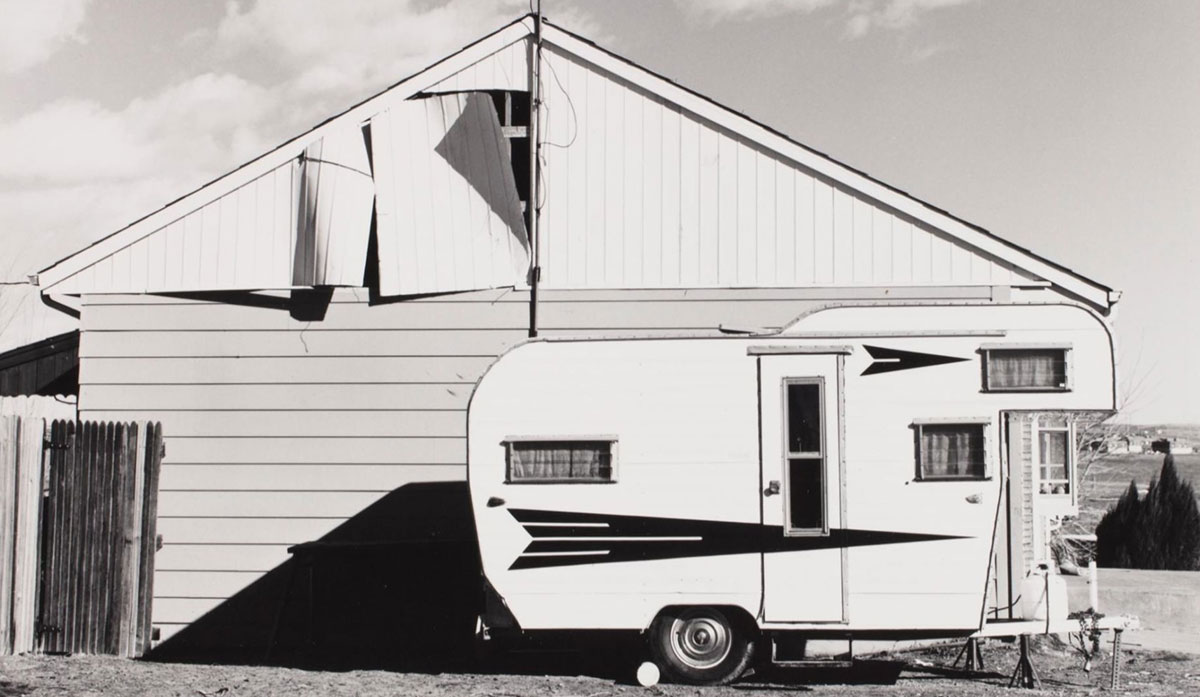
At its core, New Topographics adopted a clinical, almost anthropological approach to the environment. Photographers such as Robert Adams and Lewis Baltz aimed to document the landscape without the romanticism and emotional sentimentality that had previously defined the landscape genre. Rather than seeking untouched nature, they turned their lenses toward tract housing, shopping centers, and the sprawling grid of suburbia. This style was often described as deadpan: a neutral gaze that allowed the subject matter to speak for itself.
Mapping the Industrial Grid

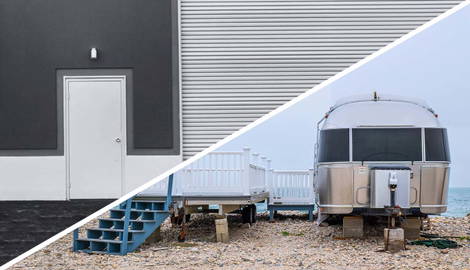
A main characteristic of the movement was its focus on the geometry of the modern world. In his series The New Industrial Parks near Irvine, California (1974), Lewis Baltz photographed the windowless stucco walls of industrial buildings. His work emphasized texture and flat planes, often presented in a grid format that mirrored the monotony of the built environment. This focus reflected the rapid post-war expansion of the American landscape, where nature was no longer a sublime force, but a resource to be paved and subdivided.
Typologies and Global Influence
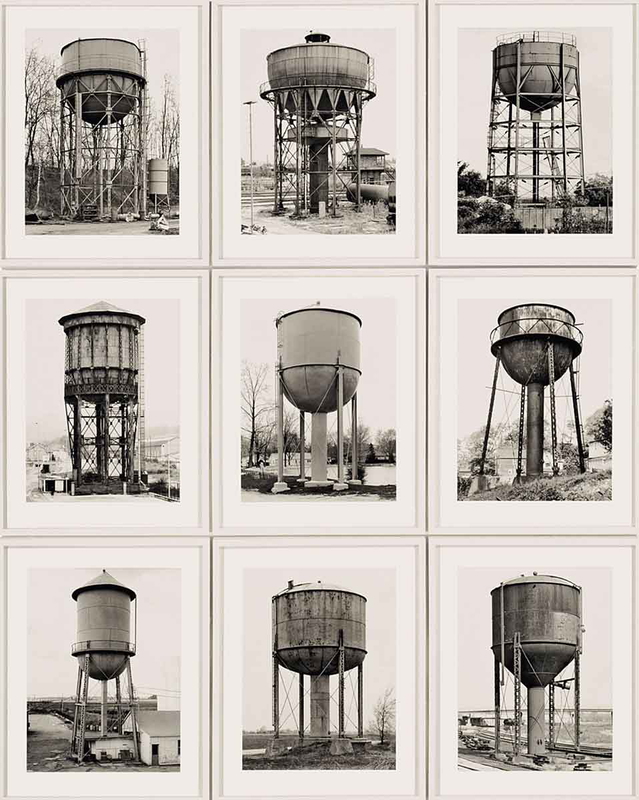
Although the movement was largely American, it also included the German duo Bernd and Hilla Becher. Their inclusion in the 1975 exhibition helped bridge American and European documentary photography. Their work used a systematic method known as typology to categorize their photographs. The Bechers spent decades documenting disappearing industrial structures— water towers, blast furnaces, and coal bunkers— photographing them from identical angles, under overcast skies to minimize shadows. By presenting their images in grids, they highlighted the variations in seemingly identical functional objects.
The Arrival of Color
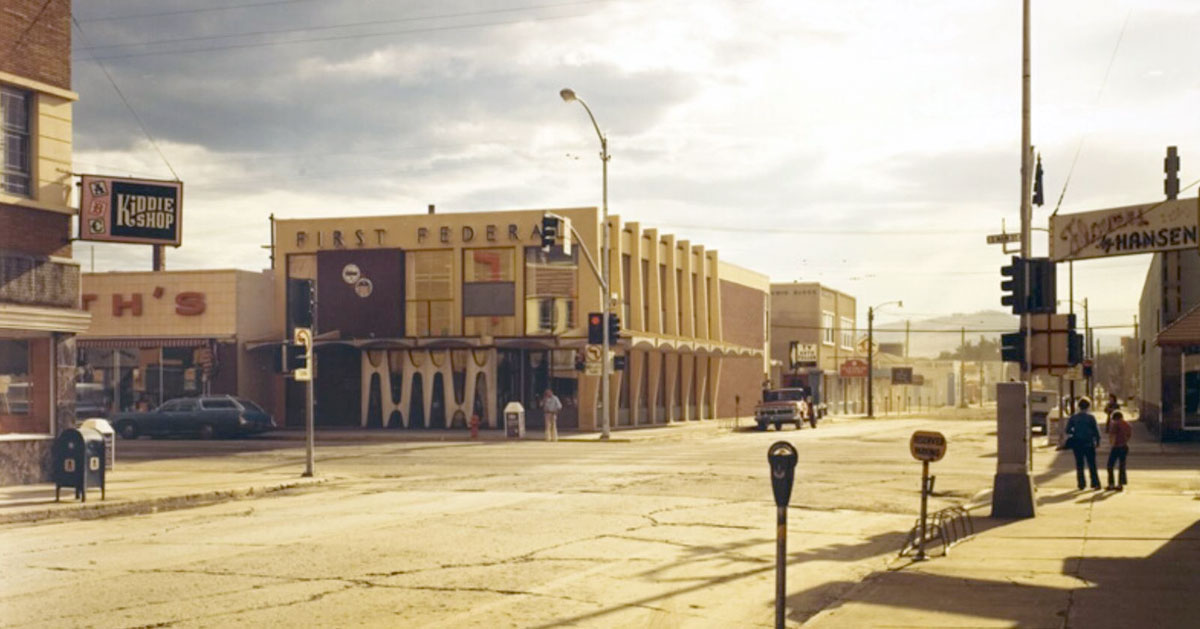
Although the exhibition was dominated by black and white photography, Stephen Shore offered a contrast through his use of color photography. At the time, color photography was largely dismissed as commercial, but Shore used a large-format camera to capture the mundane details of American streets and parking lots with remarkable clarity. His work demonstrated that the new landscape could be just as stark in vibrant hues as in monochrome. His contribution proved influential, eventually helping color images to be seen as fine art photography.
The Aesthetic of the Banal
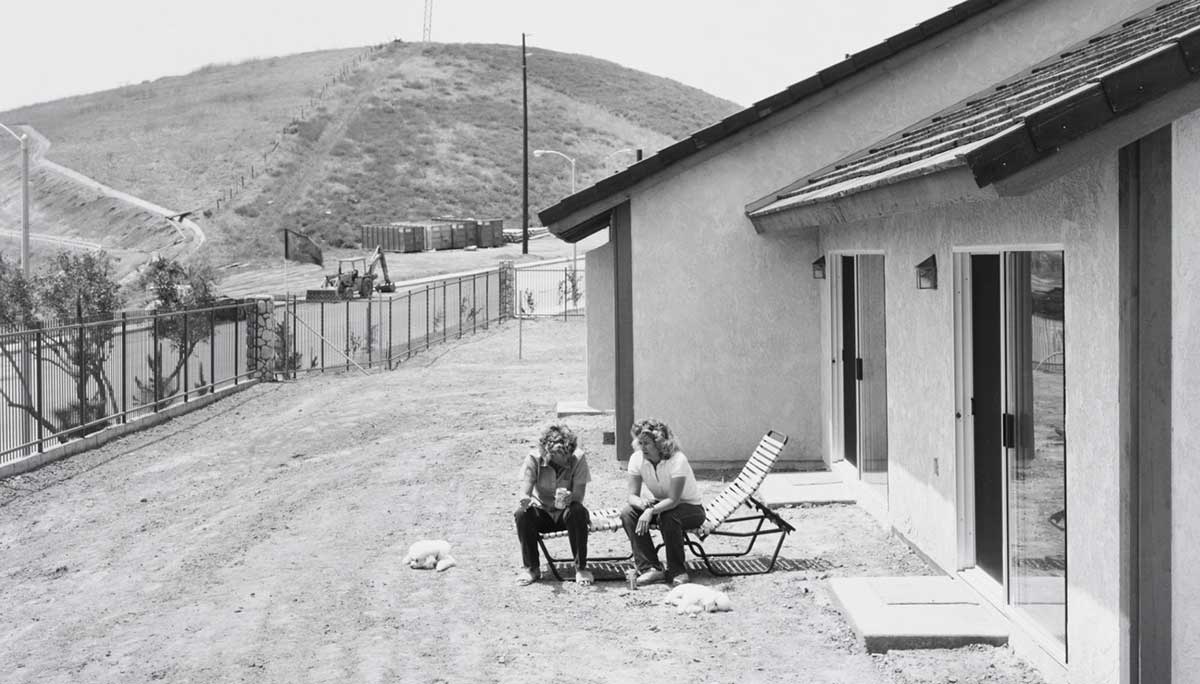
The power of the New Topographics elevated the banal. By focusing on gas stations, motels, backyards, and empty lots, photographers like Joe Deal and Frank Gohlke challenged viewers to find formal complexity in the everyday. This was not only a stylistic choice but also a political statement about the state of the environment. They confronted the reality of urban sprawl and the ecological cost of the American Dream. Their work served as a visual audit of the landscape, recording its homogenization with a clarity that felt both honest and unsettling.
The Legacy of Human-Altered Landscape

Today, the influence of New Topographics is readily visible in contemporary photography. The movement dismantled the myth of the pristine wilderness and forced viewers to confront the realities of their own environment.
It paved the way for the minimalist aesthetic seen in the work of the Düsseldorf School of Photography and it continues to inform how photographers document the effects of urbanization.
By treating the parking lot with the same attention once reserved for the mountaintop, these photographers changed not only what we see, but how we choose to look at the world around us.