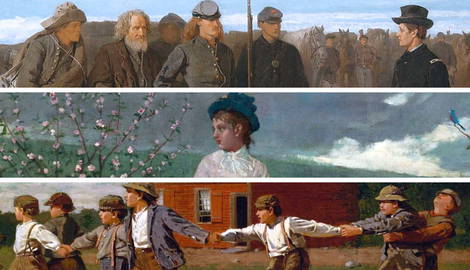
Winslow Homer is sometimes called America’s favorite artist. He is often regarded as the most important American painter of the 19th century. Because of the nostalgic yet realistic portrayal of 19th-century American values and lifestyles, Homer’s paintings have been repeatedly featured in books, postcards, stamps, and calendars. Homer’s works explored American post-Civil War identity and themes such as childhood and the future of the new generation, contrasting idyllic rural life with the rise of urbanization as cities expanded rapidly during the post-Civil War period.
Winslow Homer’s Paintings: Reporting the Civil War
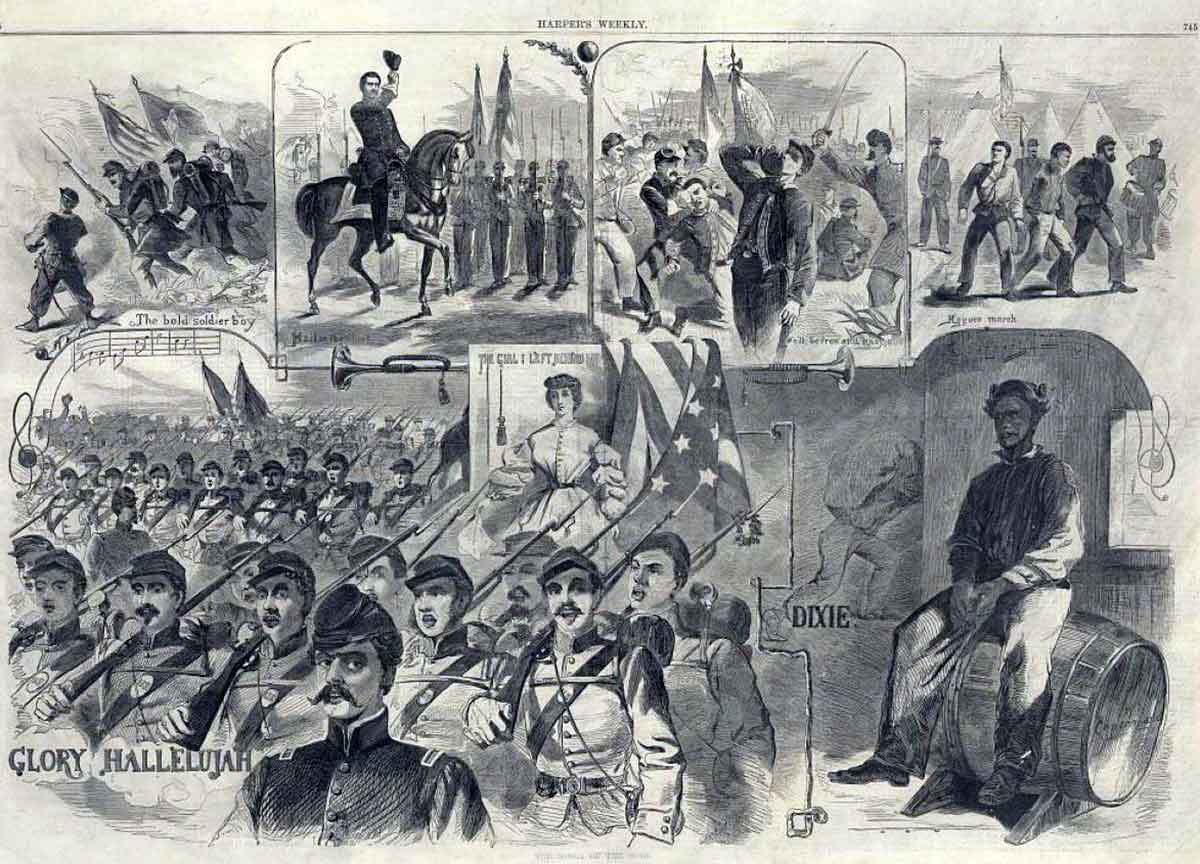
Winslow Homer was born in Boston in 1836. He began his artistic career as an illustrator for magazines and newspapers, which might explain his knack for capturing a scene’s most characteristic and significant details. Although early photographers were already documenting current events, the processes were too technologically complex to use these images in newspapers and periodicals. Newspapers and other printed media relied on illustrations to depict current events and problems in the lives of average Americans.
After the start of the Civil War, Winslow Homer reported on the events of the war as a journalist and newspaper illustrator. He witnessed war firsthand, painting battles for Harper’s Weekly, one of the country’s main periodicals. During this time, the artist’s subject matter ranged from fierce battles to mundane camp life scenes, often focusing on moments of uneasy peace even amid conflict.
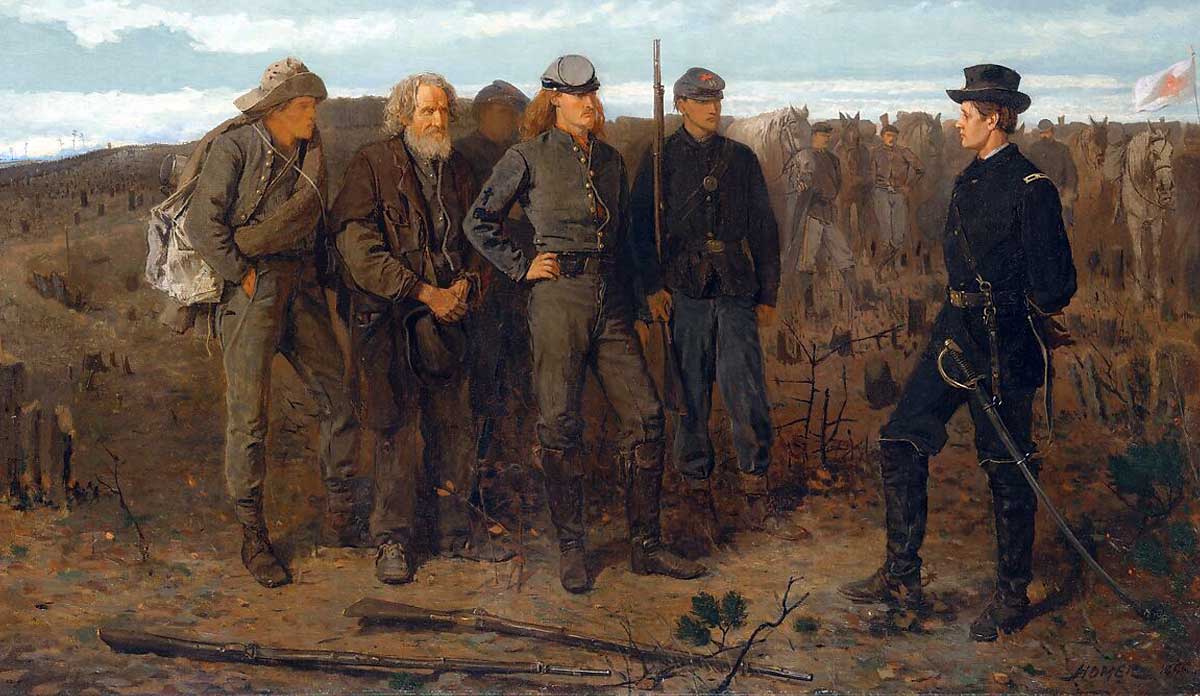
One of his most famous Civil War paintings is Prisoners from the Front, painted in 1866. The painting was inspired by a real incident during the war, when Homer’s friend, Francis Channing Barlow, a general in the Union Army, captured several Confederate soldiers. Homer portrays both sides with dignity. Although imprisoned, the Confederate prisoners look confident and even slightly defiant. He also subtly captures the class differences between the three prisoners. One of them is wearing an officer’s uniform, while the two other men are dressed in tattered and incomplete soldier uniforms.
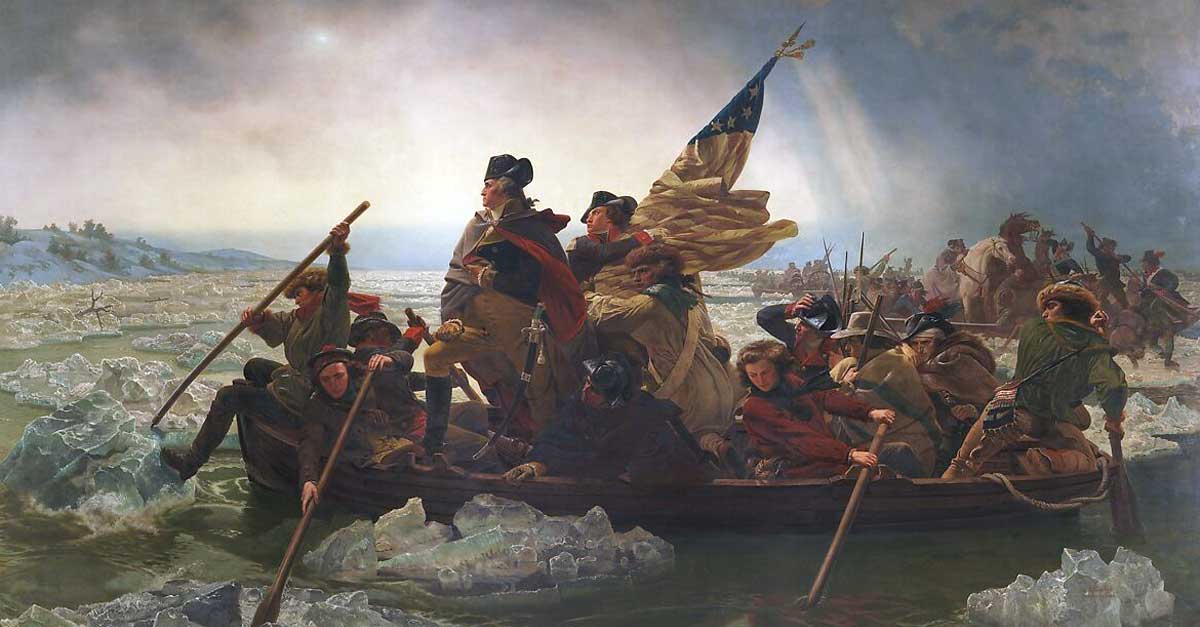
Unlike many other iconic American history paintings that focus on the leaders and famous figures, like Emanuel Leutze’s iconic Washington Crossing the Delaware, Homer’s paintings concentrate on the daily life of the soldiers, the common people living through the events of the war. Winslow Homer’s art doesn’t glorify the leaders, but rather documents the trials and struggles of the wartime experience. This humane and objective view of the war, along with Homer’s sympathetic representation of both sides, makes Homer’s paintings important witnesses of the inner conflict that divided the country in the middle of the 19th century.
Hard-Won Freedom: Winslow Homer’s Images of Post-War Life
The Reconstruction era, as the post-war period came to be known, brought change in both the North and the South as the country sought to rebuild. This period was characterized by increased industrialization and urbanization.
During his visit to the South in the 1870s, Winslow Homer saw firsthand how little change the Reconstruction was bringing into the lives of the freed slaves. They were still seen as inferior by the white population, and many still did the same work as before.
One important positive effect of the Reconstruction was that Black children finally gained access to school education. While not explicitly stated in the U.S. Constitution, this right was codified in the new Southern state constitutions drafted by biracial coalitions, establishing the region’s first systems of universal public schooling.
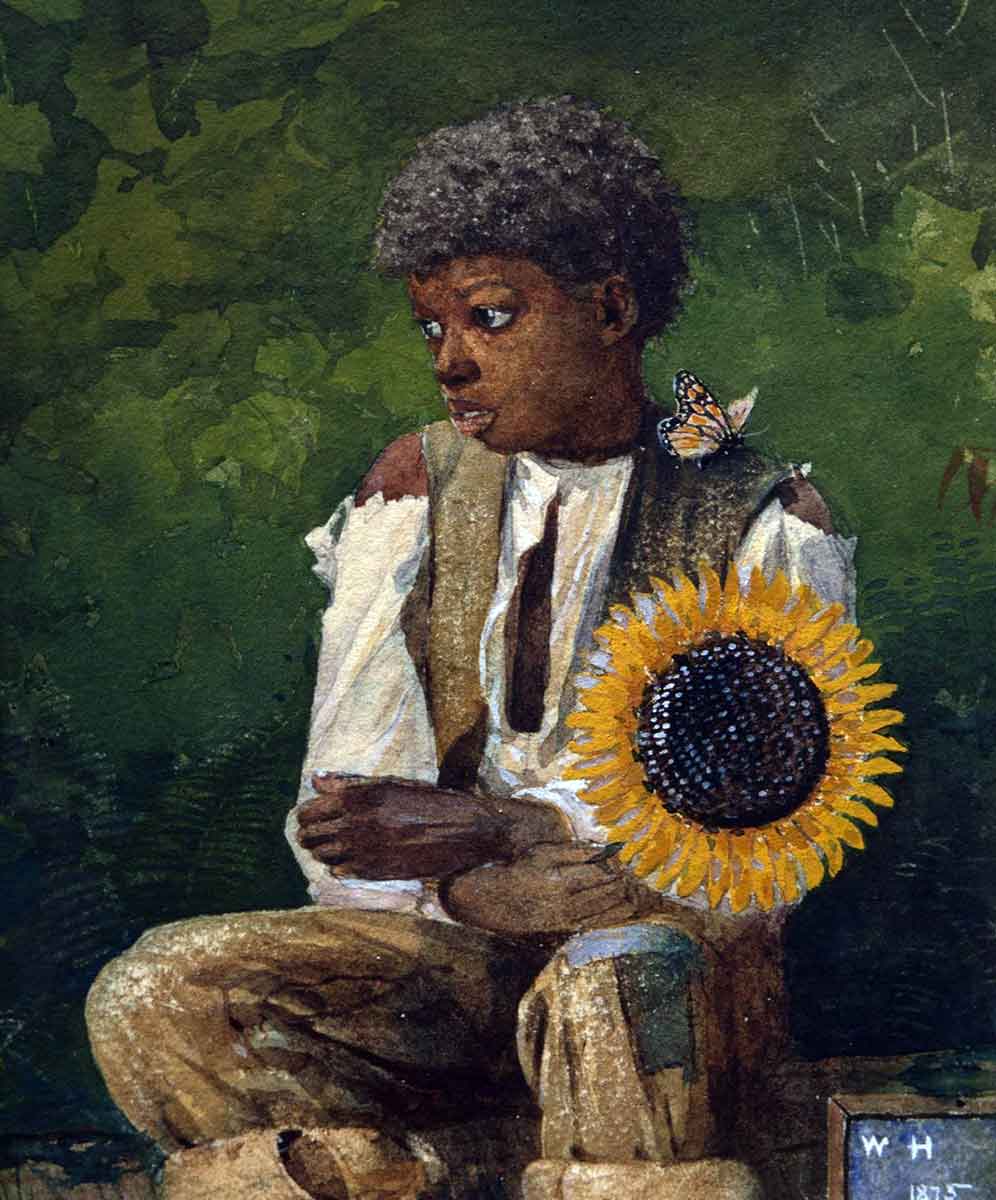
In Taking Sunflower to Teacher, Homer shows a small Black boy preparing for the first day of school. Wearing patched and torn clothing, the little boy holds a large, cheerful sunflower as a gift for the teacher. Homer signed his initials on the child’s slate board in the right-hand corner of the painting. The butterfly sitting on the boy’s shoulder could hint at the transformation awaiting the young student.
While images like that may seem sentimental today, in Winslow Homer’s time, they were revolutionary because of his empathy for his subjects, realistic approach, and immediacy. Homer’s decision to portray his African-American subjects as individuals showed a huge contrast to the standard pre-war depictions of Black people as caricatures or types. Rather than stereotyping or marginalizing them, Homer depicted Black people as the main figures in numerous paintings.
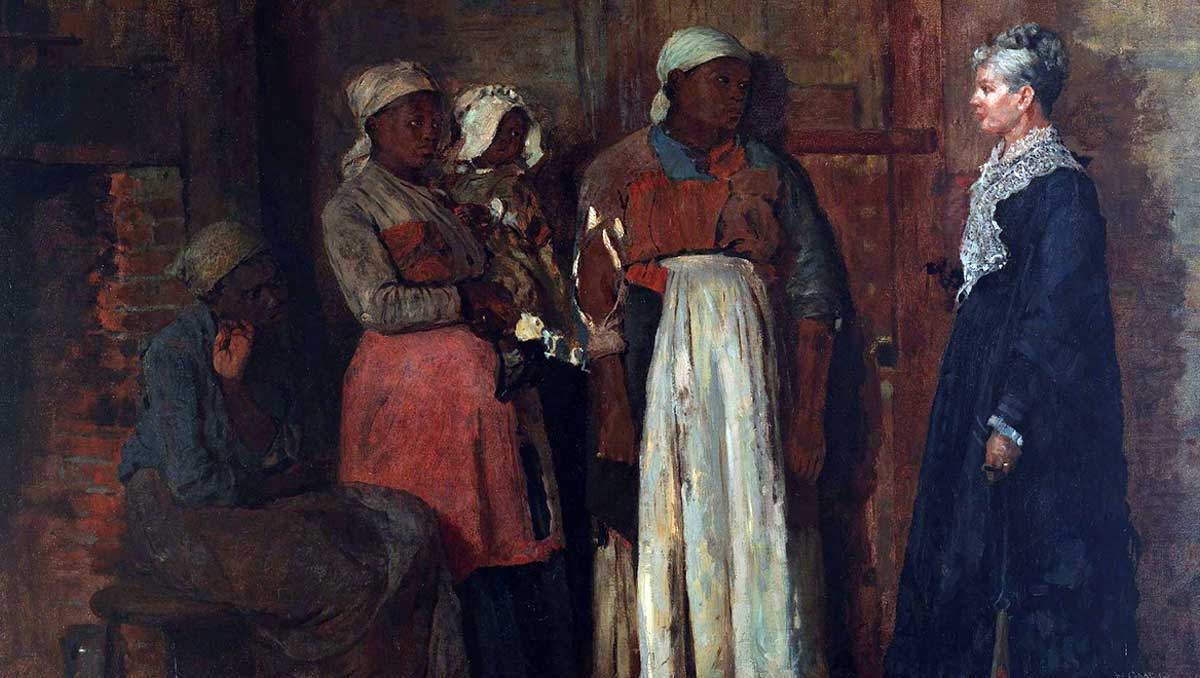
In A Visit from the Old Mistress, Homer expressively points out the changing dynamics in American society during the Reconstruction. The painting shows an intense moment as a family of former slaves receives a visit from their old mistress. The painter doesn’t resort to clichés and doesn’t water down the uncomfortable tension between the former slaves still struggling to survive, in spite of their newfound freedom. The still wealthy mistress is being given a rather cool reception. Homer allows the postures and facial expressions to tell their own story.
Leisure and Peace: Children and Women in Homer’s Art
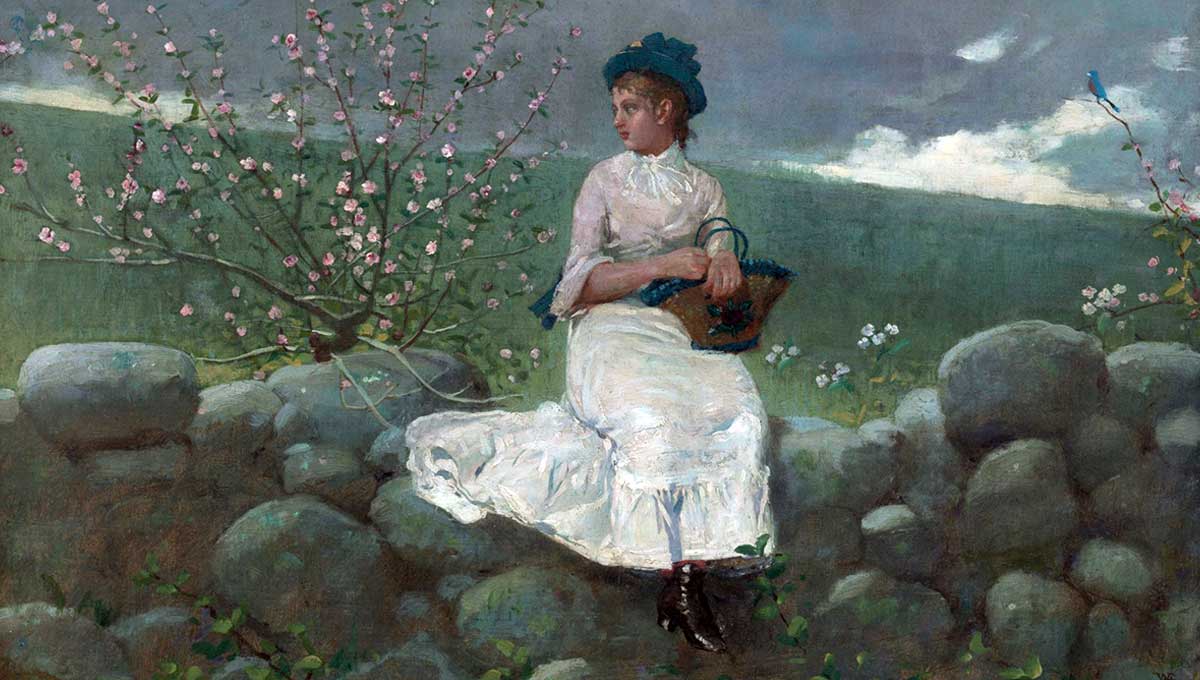
Despite living in New York in the 1870s, most of Winslow Homer’s art doesn’t focus on progress and industrialization. Instead, he portrays rural New England. Homer’s paintings of this period focus on farm life, games, leisure, and a happy country childhood. The lighter color palette and frequent use of outdoor settings and everyday subjects mirror the influence of the Impressionists, whose works Homer might have encountered during his travels, yet his interpretation is entirely grounded in his American surroundings. Winslow Homer often created watercolor studies that he later used as the basis for larger oil paintings. Although Homer never married or had children of his own, children were a major theme in his art. Homer seems to have enjoyed painting them, and their joyfulness made paintings of children a particularly optimistic and sought-after subject after the war’s deprivations.
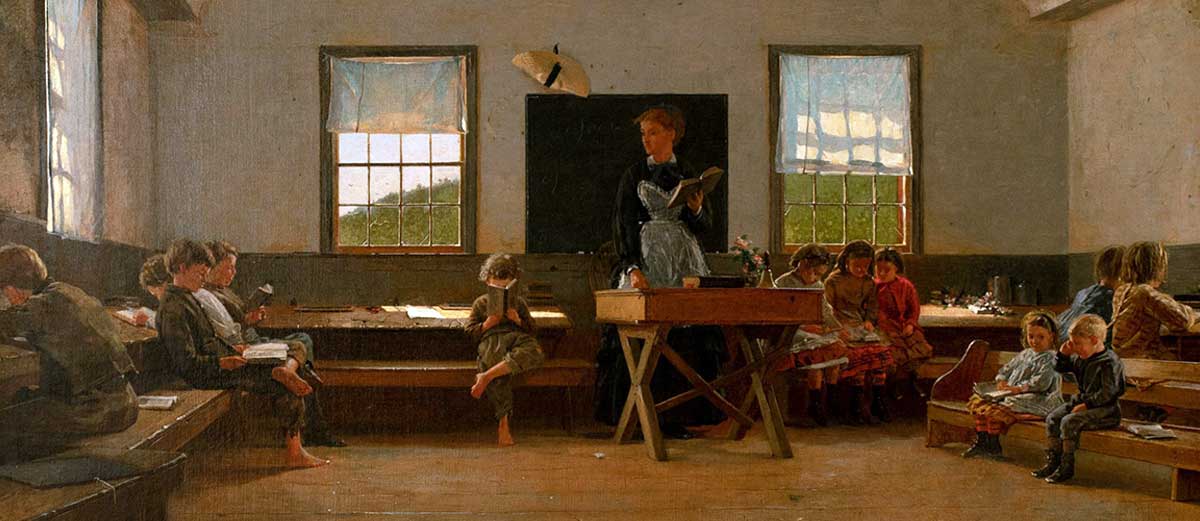
In The Country School, Homer shows a one-room schoolhouse, which was the standard mode of primary education before the Civil War. The luring, sunny landscape behind the window creates a sense of kinship with the children, who obviously find it hard to focus on their school tasks. The same longing for the innocence and happiness of childhood appears in another of Winslow Homer’s famous paintings. In 1872, Winslow Homer painted Snap the Whip, showing a moment of play during recess. The schoolboys’ bare feet, the wildflowers in the foreground, and the idyllic landscape mix to convey a sense of exuberance and joy.
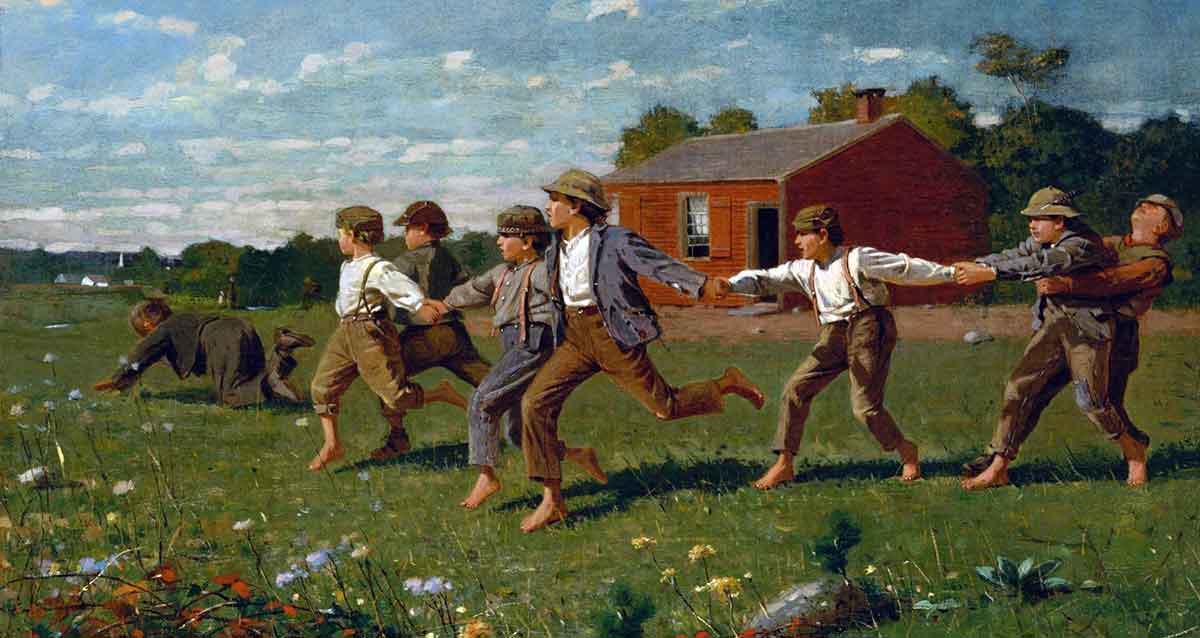
The theme of childhood allowed Homer to explore his own memories and the nostalgia that must have been prevalent in the rapidly changing post-war society. With the country’s rapid urbanization, many traditional ways of life that were seen as thoroughly American were gradually disappearing. The same nostalgic themes are mirrored in the literature of the time: Mark Twain published The Adventures of Tom Sawyer in 1876, while Louisa May Alcott’s Little Women was published in 1868-1869.
Winslow Homer also captured the gradual transformation of women’s roles in postwar society. The young teacher in The Country School reflects another indirect effect of the Civil War: after so many young men died in the war, many women were compelled to seek work to support themselves rather than focus on raising their families. Teaching was one of the first professions open for women in America, leading gradually to better female education and contributing to the beginning of the women’s suffrage movement.
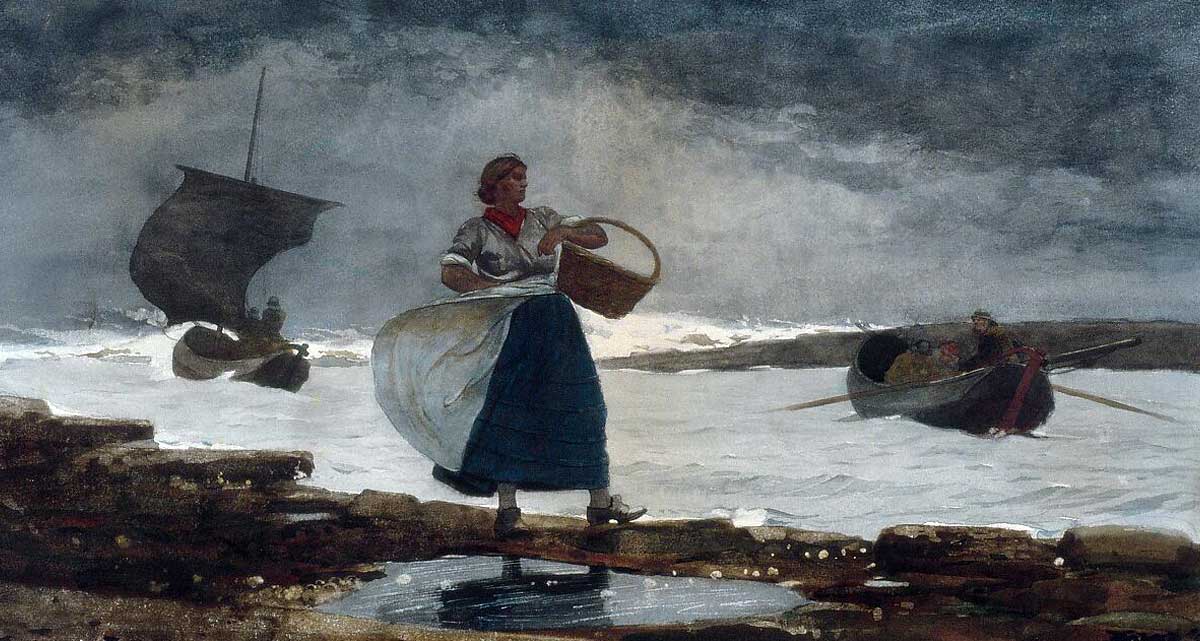
Homer’s Inside the Bar is another of his paintings that celebrates women’s resilience and hard work. A fisherwoman strides confidently by the shore, carrying a basket. Behind her, a storm is brewing, with men in boats returning from the sea. She’s shown as a figure of strength, stability, and support, standing tall in spite of the wind and waves.
Winslow Homer’s Paintings: Confronting the Forces of Nature
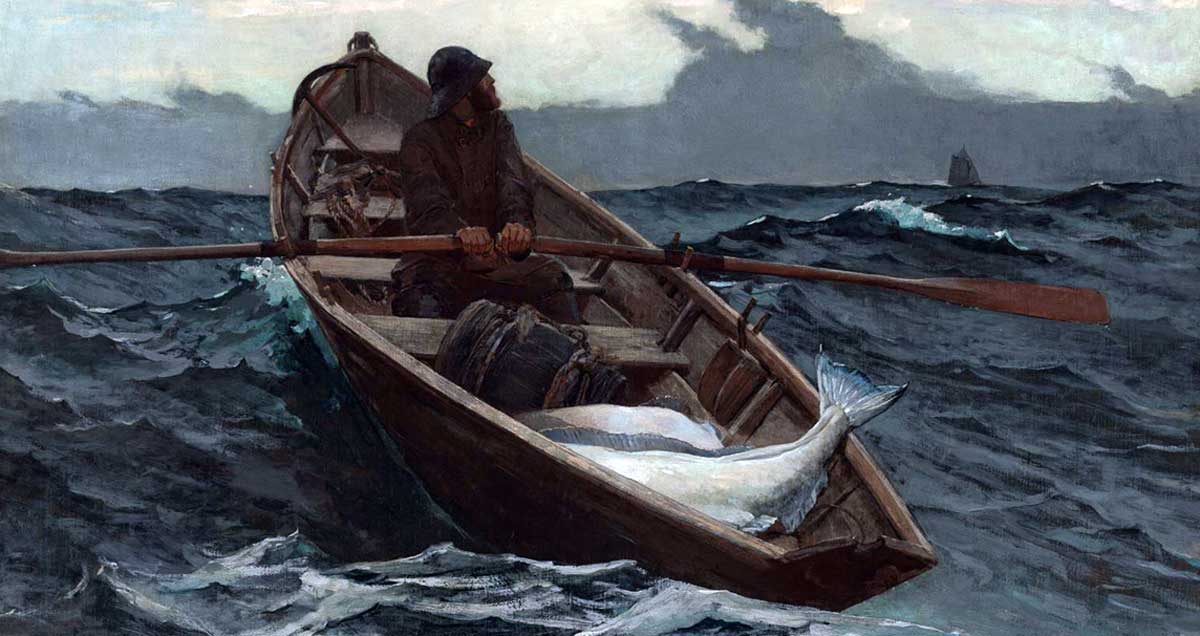
In his later years, Winslow Homer moved to Prouts Neck, Maine, where he created numerous paintings inspired by the seafaring life of the Northeastern Coast. His paintings of this period feature boats, harbors, ports, and beaches, exploring the way fishermen faced the forces of nature daily and uncomplainingly while trying to make a living from the sea.
Homer was no stranger to sea travel, sailing to England and traveling for several summers to the Bahamas, voyages that involved weeks aboard ships. The ever-present danger of life near the ocean seems to have fascinated the artist, and the struggle of humans against nature became a prominent theme in Winslow Homer’s art.
The sense of awe before nature’s immense power is known as the sublime in art, a concept that first appeared in art during the Romantic Movement. Homer portrays both the awe before the might of nature and the bravery of the people facing its dangers. Paintings like The Fog Warning or The Life Line show very real threats that people at sea faced in their daily routine. This clash with the forces of nature is expressed in a dramatic way in one of Winslow Homer’s most epic paintings, The Gulf Stream. This large-scale, enigmatic painting is the crowning masterpiece in Homer’s series of paintings showing humans courageously fighting against the odds.
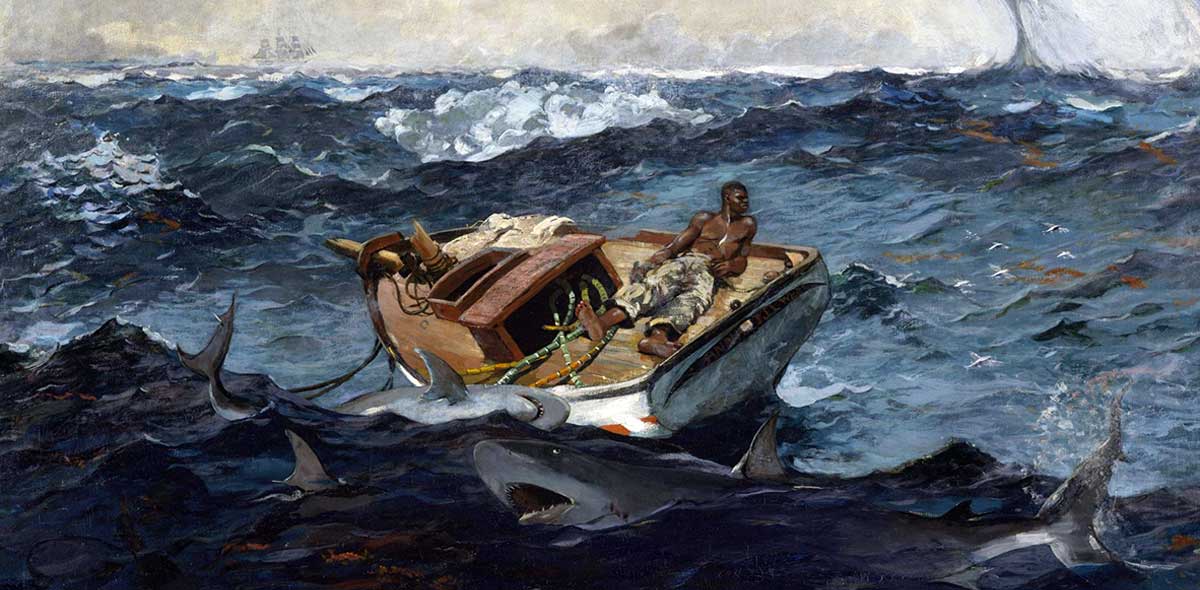
Winslow Homer crossed the Gulf Stream several times during his trips to the Bahamas, and the ocean he painted is harsh in its realism. The narrative of The Gulf Stream remains unresolved. We don’t really know who the Black man is, and how he came to be alone on a small boat in the middle of the ocean. He may have escaped slavery, or he may be the last surviving member of a small crew. The boat’s name can be deciphered as Anna of Key West, Florida.
Numerous details in the painting call for further interpretation. The scattered sugar cane stalks on the deck may allude to slavery. The Gulf Stream itself has been historically instrumental in facilitating the slave trade and the trade with the products of slaves’ labor, like sugar, tobacco, and cotton.
There are sharks circling the boat in the center of the canvas, the boat’s mast and rudder are gone, and, as if the man’s plight isn’t bad enough already, there’s a waterspout forming in the background. Although these details foreshadow a bleak end for the person on the boat, Homer doesn’t make the ending definite; there’s a sailing ship on the horizon, suggesting that rescue may be on its way.
Winslow Homer’s art encompasses many vital themes and developments of 19th-century America, from the Civil War to the changing role of women and the Black population’s first steps towards emancipation and equality. But it could be that one of the main reasons Winslow Homer remains popular today is that his quiet, honest paintings capture the courage, individuality, and contentment of his era’s lifestyle, which resonate with contemporary nostalgia for an idea of a simpler, less complicated way of life.