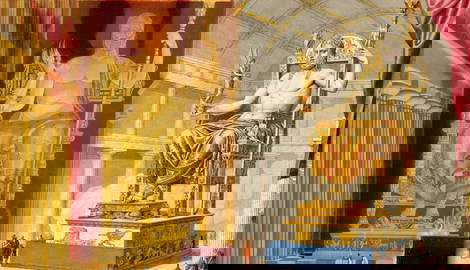

Alexander the Great’s extensive conquests made the world smaller, enabling Greek travelers to explore more distant lands from the oasis of Siwa to the Indus River. As Greek-speaking travelers wrote about their travels, it became popular to list must-see theamata (sights), and later thaumata (wonders). In the 1st century BCE, these would culminate in the Seven Wonders of the Ancient World, most famously compiled by Antipater of Sidon (c. 100 BCE) and Philo of Byzantium (2nd century BCE). These included distant wonders in Egypt and Babylon, but one of the most celebrated was closer to home: the enormous statue of Zeus at Olympia.
| Built | c. 430 BCE |
| Creators | Phidias |
| Location | Olympia |
| Overview | Enormous 42-meter-tall (when seated) statue of Zeus in gold and ivory |
| Destruction | Unknown, sometime after the 5th century CE |
Who Made the Statue of Zeus at Olympia?
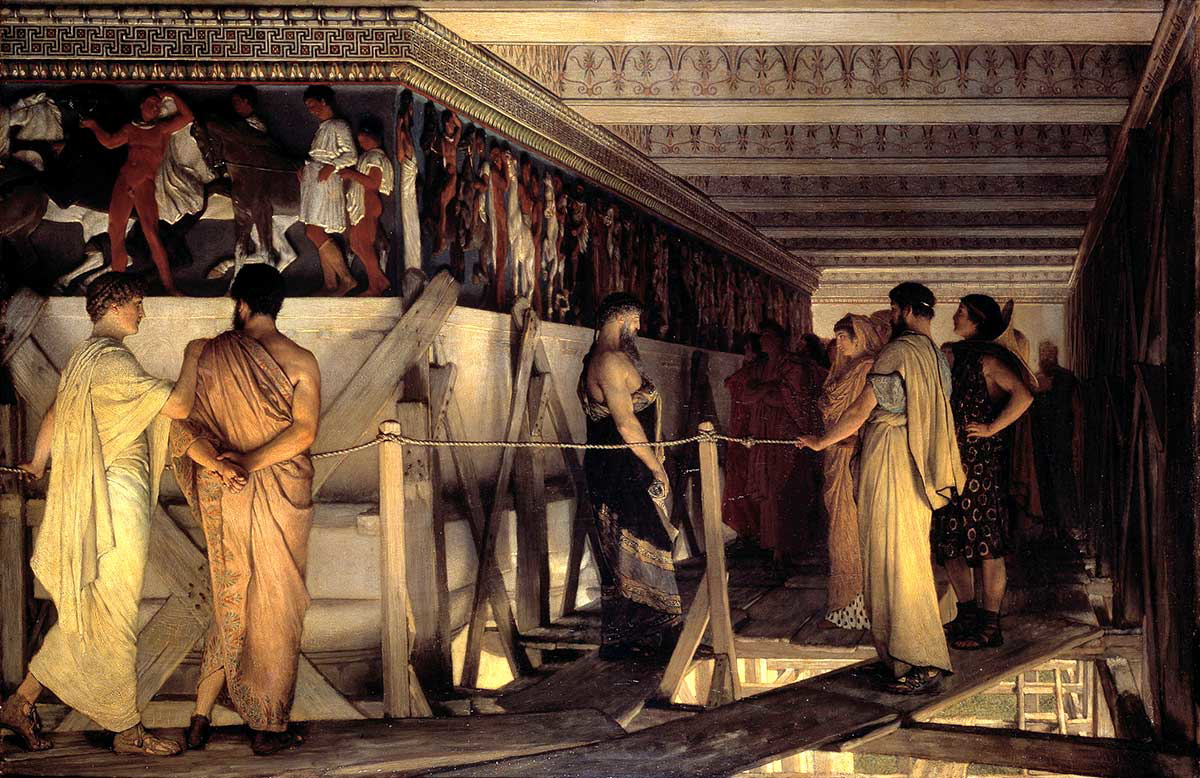
For the ancient Greeks, there was no greater sculptor than Phidias, who was active from the beginning of the 5th century BCE to around 430 BCE. He oversaw the construction of the Athenian Acropolis and created the Parthenon’s large chryselephantine (gold and ivory) statue of Athena. In fact, he was the first sculptor ever to dare represent the gods with gold and ivory.
Right after finishing Athena’s statue, Phidias was accused of embezzlement by the enemies of his friend and prominent Athenian statesman Pericles. In the end, Phidias was acquitted of this crime but was then accused of depicting himself and Pericles on the shield of the goddess, which was a great hubris. This time, Phidias had to leave Athens to save himself.
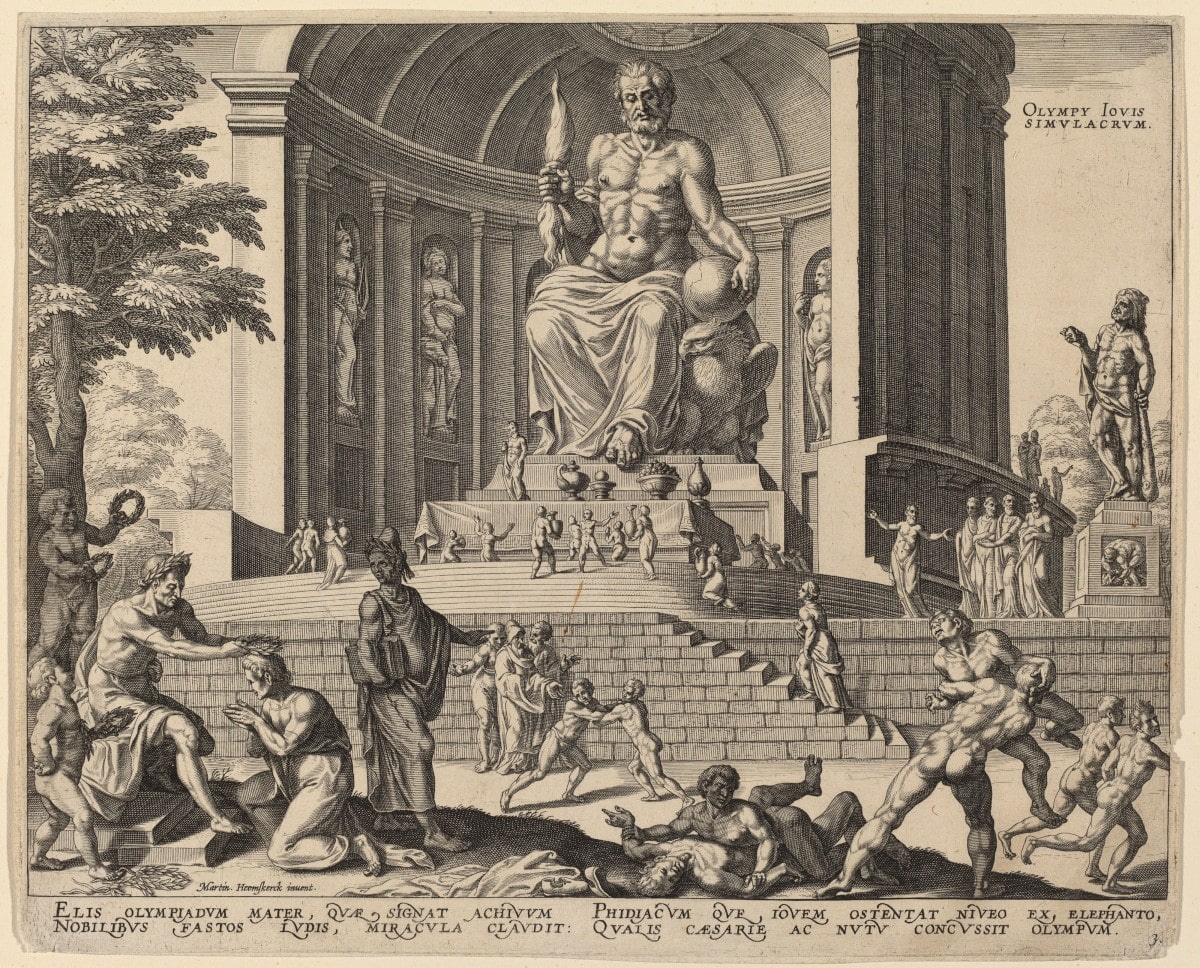
It was probably this misfortune that brought the sculptor to the sanctuary of Zeus in Olympia. The sanctuary was under the protection of the city of Elis. Seeing an opportunity, the Elians asked Phidias to create a statue of Zeus like no other.
There is also another version of this story, told by Plutarch, in which Phidias first visited Olympia to make the statue of Zeus and then embarked on his Athenian construction project, where he died in prison.
Phidias’ sculpture of Zeus was larger and more majestic than his sculpture of Athena. It became instantly famous in the 5th century BCE, and centuries later, Pliny the Elder would write that this was a work “which no one ever equaled.” If you visit Olympia today, you can even see the remains of the workshop where the sculptor built the statue.
| OTHER KNOWN WORKS BY PHIDIAS |
| Group of national heroes with Miltiades as the central figure (Athens) |
| Statues of Apollo and Athena (Delphi) |
| Athena Lemnia (Lemnos) |
| Athena Promachos, a colossal bronze statue visible far out at sea (Athens) |
| Athena (Pellene) |
| Athena (Plataea) |
| Aphrodite in ivory and gold (Elis) |
| Athena Areia (Athens) |
| Athena Parthenos (Athens) |
What Did the Statue of Zeus at Olympia Look Like?
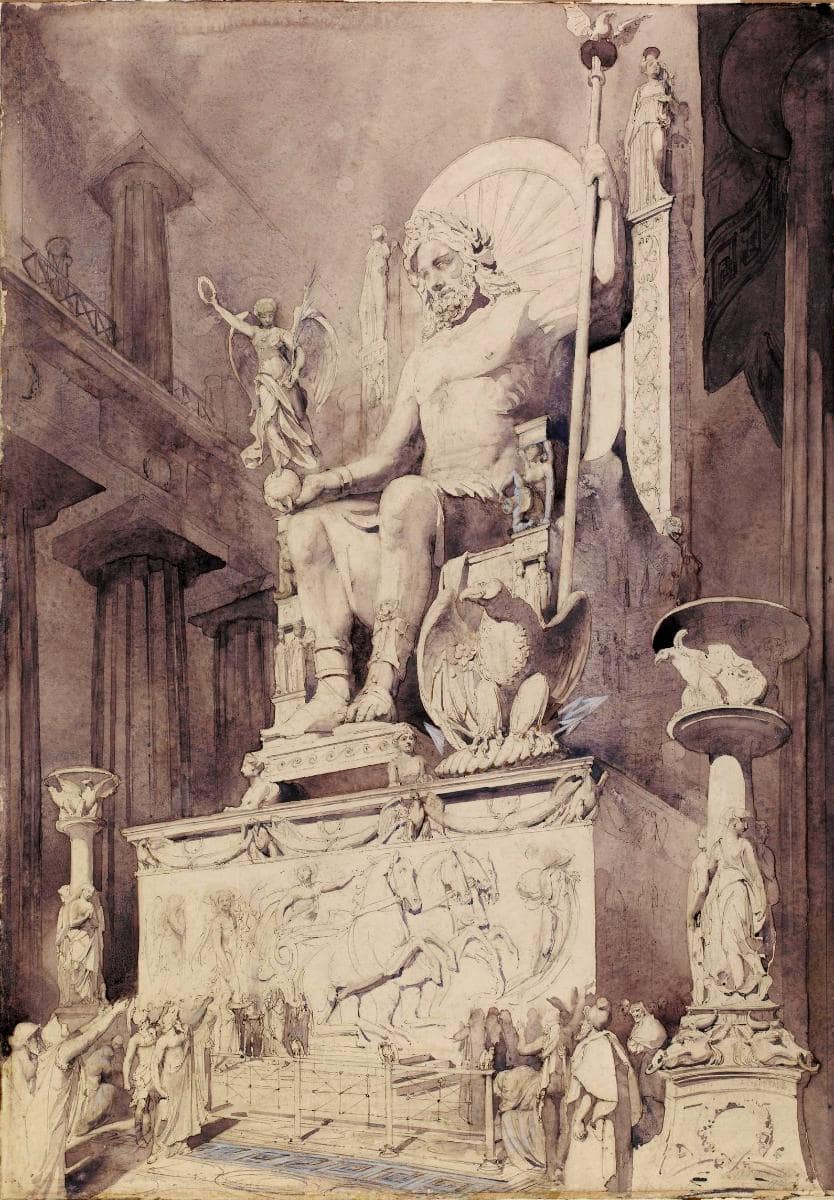
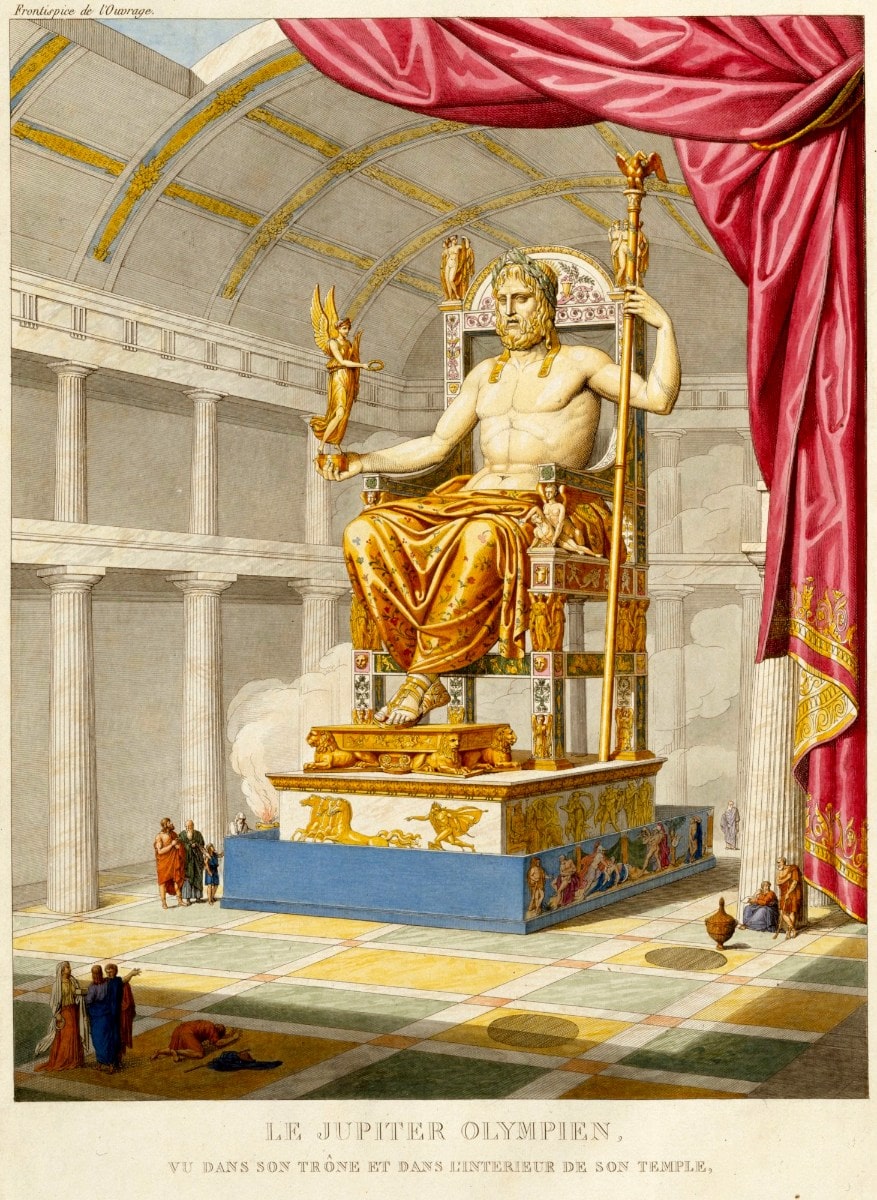
Pausanias saw the 12-meter-tall statue with his own eyes in the 2nd century CE and wrote about it in detail.
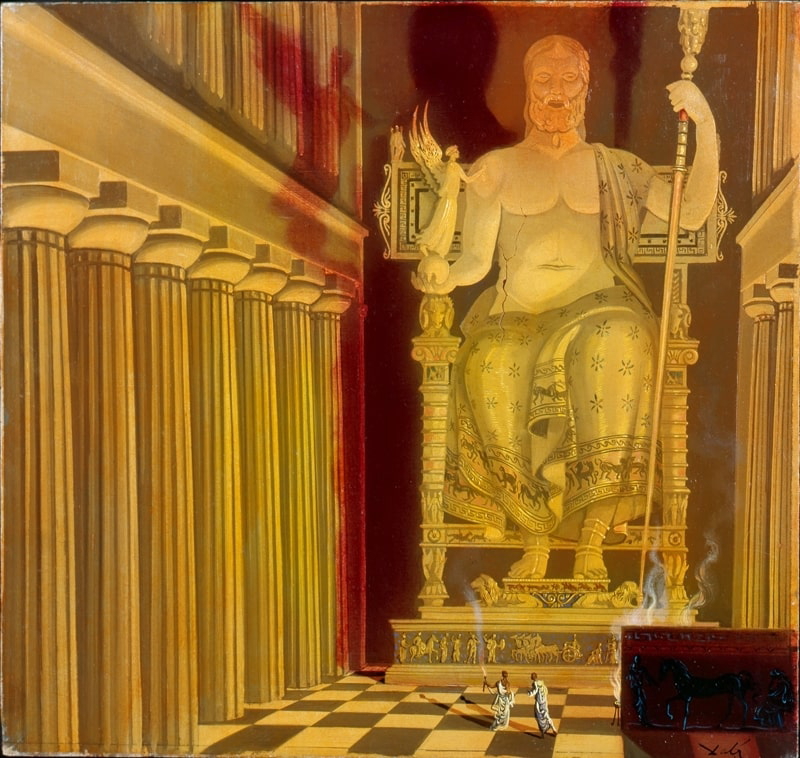
The god sits on a throne, and he is made of gold and ivory. On his head lies a garland which is a copy of olive shoots. In his right hand he carries a Victory, which, like the statue, is of ivory and gold; she wears a ribbon and—on her head—a garland. In the left hand of the god is a scepter, ornamented with every kind of metal, and the bird sitting on the scepter is the eagle. The sandals also of the god are of gold, as is likewise his robe. On the robe are embroidered figures of animals and the flowers of the lily.
What appears to have impressed Pausanias more than the god himself was his throne. He described it in extreme detail.
“…The throne is adorned with gold and with jewels, to say nothing of ebony and ivory. Upon it are painted figures and wrought images. There are four Victories, represented as dancing women, one at each foot of the throne, and two others at the base of each foot. On each of the two front feet are set Theban children ravished by sphinxes, while under the sphinxes Apollo and Artemis are shooting down the children of Niobe…”
In front of the throne, the Elians kept a pool filled with oil. The oil protected the statue from the moisture of Olympia and helped preserve it. Likewise, on the Acropolis of Athens, where the climate was dry, the Athenians used a pool of water to preserve the chryselephantine statue of Athena.
The Greek painter Panaenus, Phidias’ nephew, assisted in the creation of the statue “with respect to the colors with which it was ornamented, and particularly the drapery” (Strabo, Geography VIII.3.30). He also painted the panels that covered the front of the statue’s base.
According to legend, when someone asked Phidias what inspired him to make Zeus’ statue, the sculptor replied with the following verse from Homer’s Iliad (I.528-530):
“He said, and nodded with his shadowy brows;
Wav’d on th’ immortal head th’ ambrosial locks,
And all Olympus trembled at his nod.”
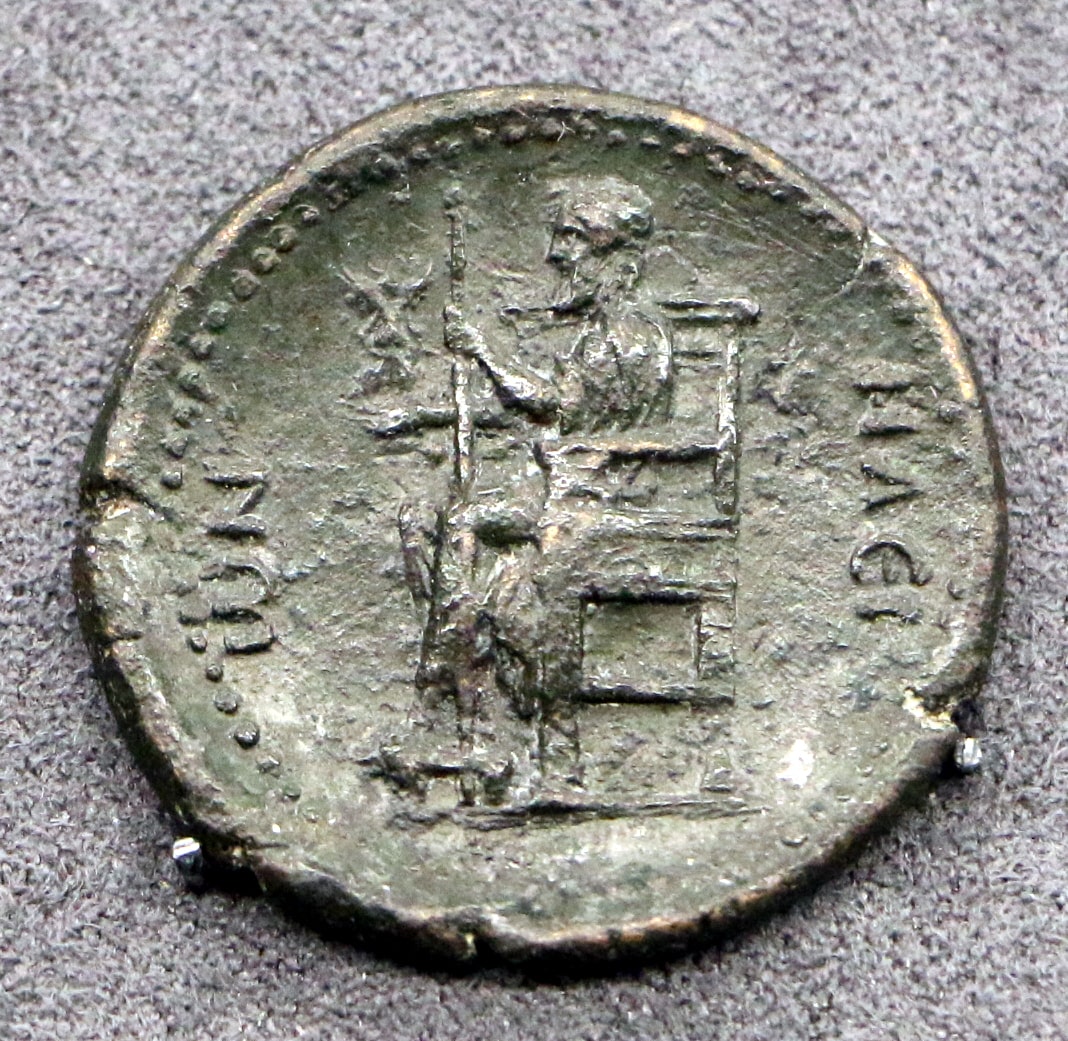
Even with Pausanias’ testimony and the words that inspired the sculptor, it is still not easy to imagine what the statue looked like. Luckily for us, its image appears on ancient Greek and Greco-Roman coins, gem and stone engravings, vase paintings, and sculptures.
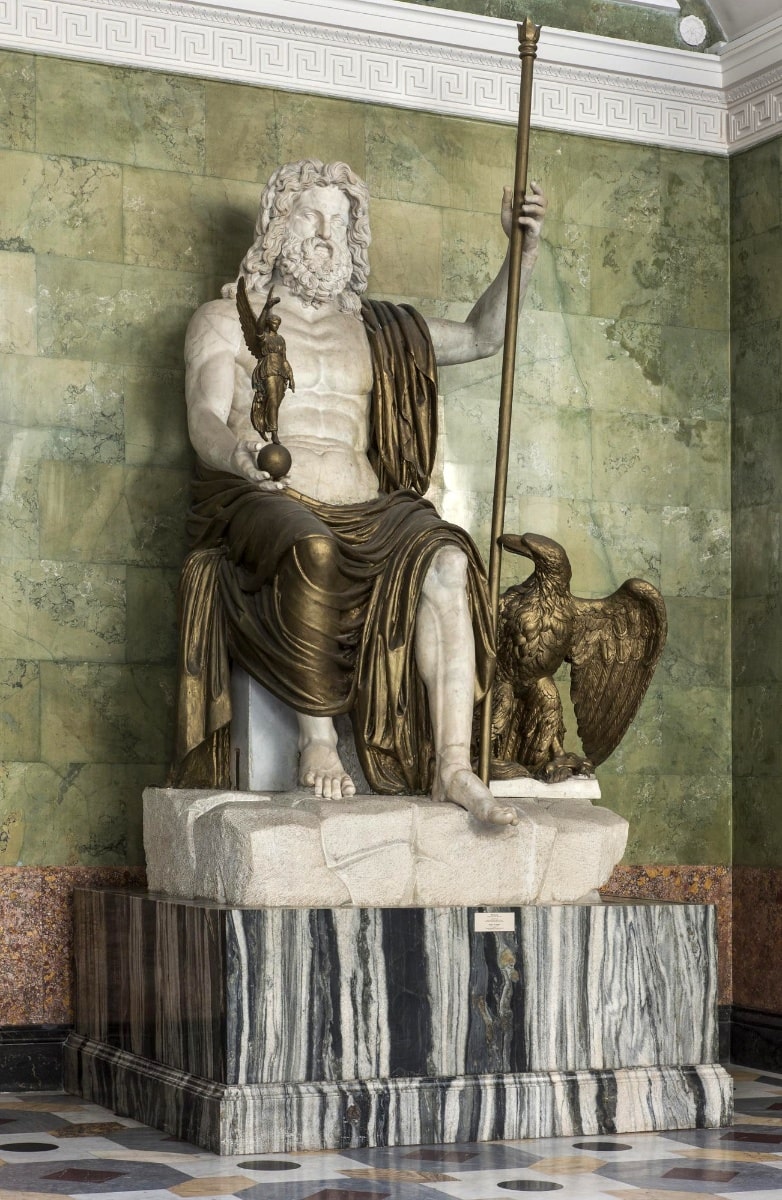
Interestingly, the statue served as a reference for later depictions of Zeus as an old, fatherly figure with a beard and long hair. We can find traces of this tradition in later Christian depictions of the Christ Pantocrator.
Pausanias shares some gossip relating to the statue. At the feet of the throne, there were four rods, each with sculpted figures. One of these figures, a young boy placing a ribbon of victory on his head, was said to have been sculpted in the image of Pantarces, who was said to have been the lover of Phidias. Clement of Alexandria (c. 150-215 CE) even claims that Phidias had written the phrase “Pantarkes kalos” (Pantarkes is beautiful/good) on Zeus’ finger!
Legends About the Statue
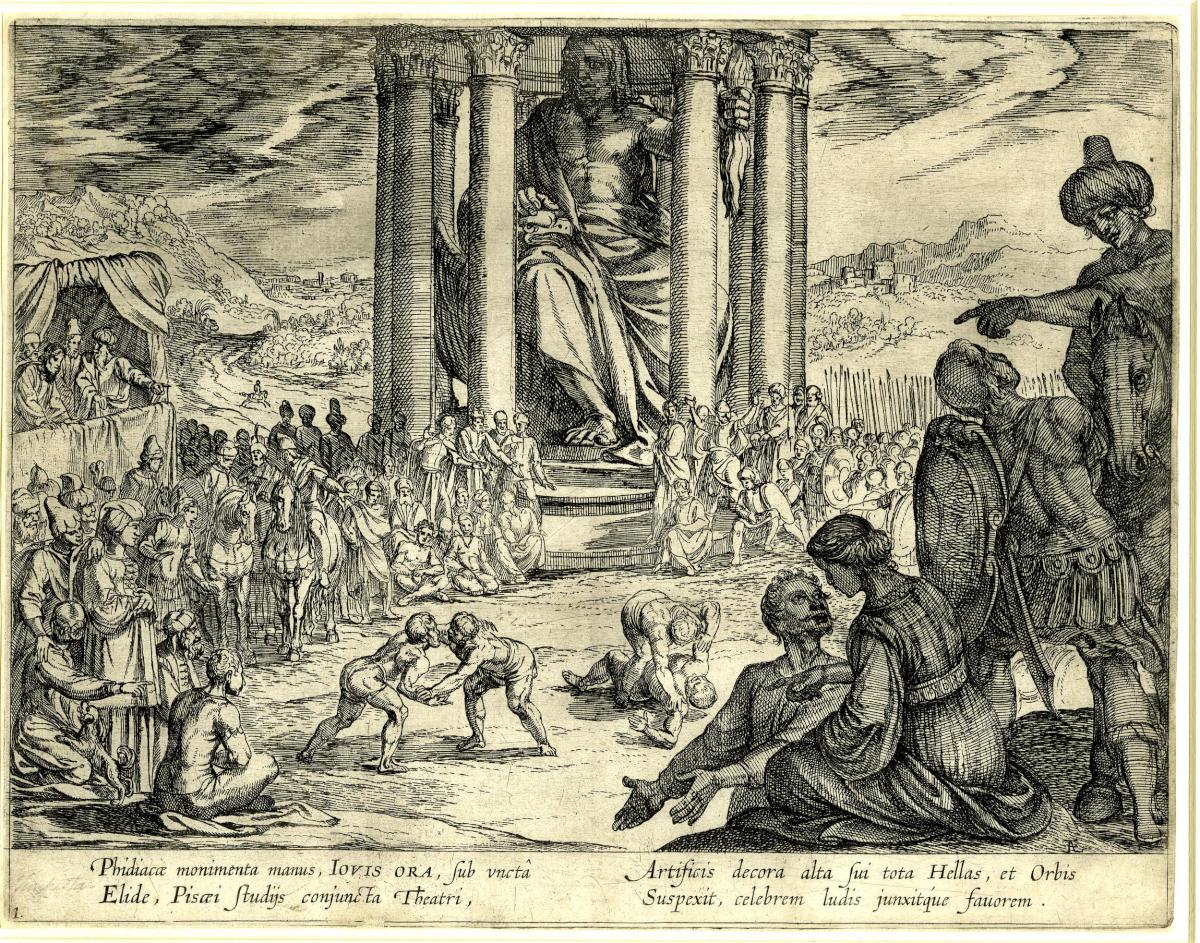
For the ancients, the statue of Zeus was more than just a statue, and more than one of the Seven Wonders of the Ancient World. For them, it was a version of the god on earth. It is no coincidence that Pausanias referred to the statue as “ὁ θεὸς” (the god) and not as “the statue” or “the image.”
Throughout the Greco-Roman world, sculptures of gods were thought to mediate between the realm of gods and humans. Talking to a statue of Artemis, for example, was a way to communicate with the goddess. However, the statue of Zeus had moved beyond that. It was thought to have captured the very essence of the divine. This belief was strengthened by legends such as the one recorded by Pausanias that claimed that when Phidias finished the statue, he asked Zeus if he was satisfied. As a response, thunder fell from the sky and opened a hole in the ground. Zeus approved.
“Nay, the god himself according to legend bore witness to the artistic skill of Pheidias. For when the image was quite finished Pheidias prayed the god to show by a sign whether the work was to his liking. Immediately, runs the legend, a thunderbolt fell on that part of the floor where down to the present day the bronze jar stood to cover the place.”
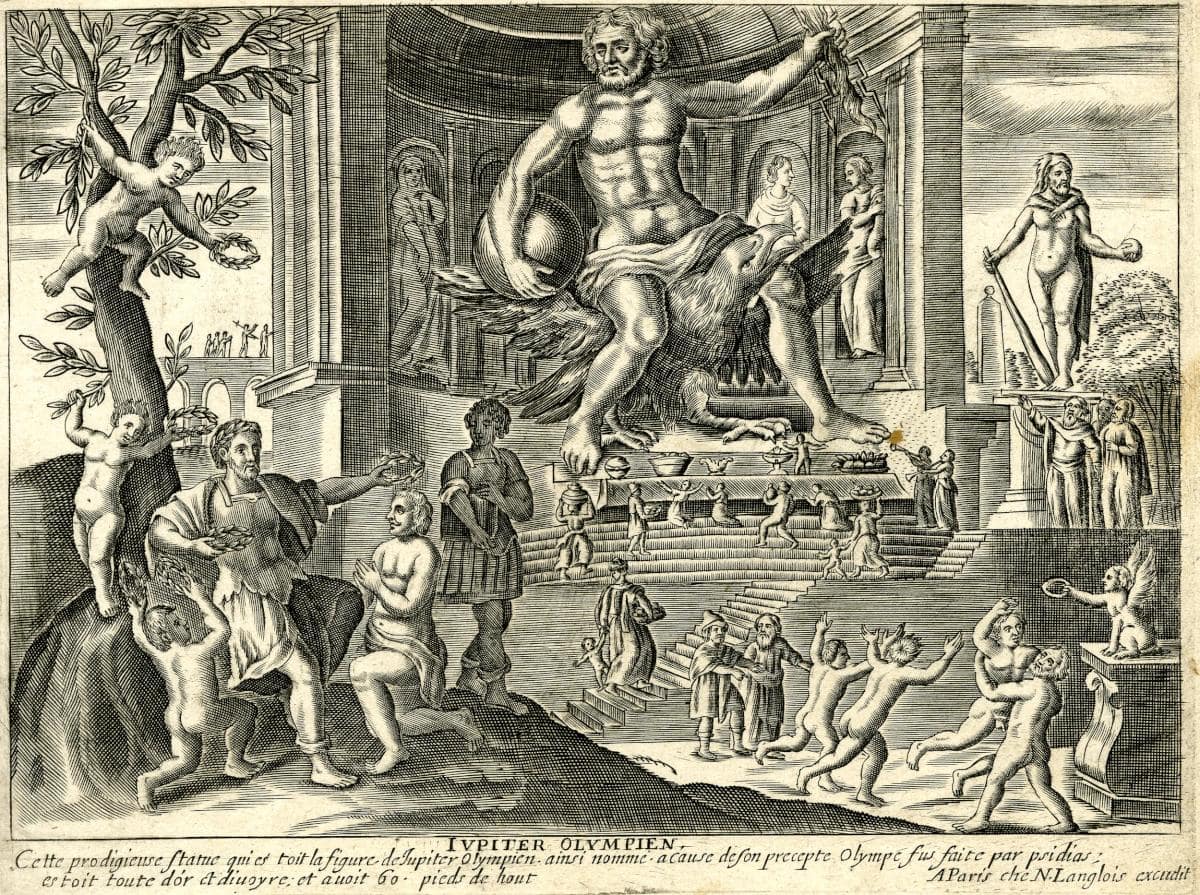
Livy relates that when the Roman general Aemilius Paulus visited Olympia, he saw the statue and “was stirred to the quick as he gazed on what seemed Jupiter’s very self.”
Dio Chrysostom, the Greek philosopher and orator of the 1st century CE, wrote that if animals could catch a glimpse of the statue, they would willingly submit themselves to a priest to be sacrificed to the god. Moreover, Cassius Dio claimed that whoever stood before the statue of Zeus “would forget all the terrors and hardships that fall to our human lot.”
Still, some found faults with Phidias’ creation. Strabo said that the statue’s size was not proportional to that of the temple. Phidias had presented Zeus seated with his head almost touching the roof. But what would happen if the god decided to leave his temple and rise? Strabo replies: “he would unroof the temple!”
Caligula Wanted to Bring It to Rome
According to the Roman historians Suetonius (Gaius 22.2; 57.1) and Cassius Dio (59.28.3), the Roman Emperor Gaius Caligula wanted to transport the statue of Zeus to Rome and replace its head with his own.
Suetonius claims that the only reason this did not happen was because of Caligula’s assassination. He even writes that while the statue was being prepared to be shipped to Rome, the statue foretold the emperor’s death, when it suddenly burst out laughing so loudly that:
“… the scaffoldings collapsed and the workmen took to their heels; and at once a man called Cassius turned up, who declared that he had been bidden in a dream to sacrifice a bull to Jupiter”.
Cassius Dio partially agrees with Suetonius. For him, it wasn’t the emperor’s death that prevented the statue’s removal, but the wrath of the god:
“… the ship built to bring it was shattered by thunderbolts, and loud laughter was heard every time that anybody approached as if to take hold of the pedestal; accordingly, after uttering threats against the statue, he set up a new one of himself.”
Obviously, these stories have more to do with legend than reality. In these narrations, the statue is clearly illustrated as a monument so holy that the very idea of transporting it was hubris.
What Happened to the Statue of Zeus?
In 391 CE, the emperor Theodosius forbade the cult of the pagan gods and closed all pagan sites. As the Olympic Games were also forbidden, Olympia diminished in importance. In 408 CE, new legislation asked for the removal of cult statues from their temples. The old world was not dying; it was getting destroyed! The statue of Zeus possibly survived this wave of destruction, but no one really knows what happened to it. Most scholars argue that it was moved to Constantinople, where it was lost sometime during the 5th or 6th century.
OTHER WONDERS OF THE ANCIENT WORLD
- Pyramids at Giza
- Lighthouse of Alexandria
- Hanging Gardens of Babylon
- Colossus of Rhodes
- Temple of Artemis at Ephesus
- Mausoleum of Halicarnassus
However, thanks to its status as one of the Seven Wonders of the Ancient World, Phidias’ statue remained alive through the art of the subsequent centuries. The statue of Zeus at Olympia changed the way the king of the gods was depicted, ultimately setting a visual precedent that even the Christian God would not fail to imitate. Modern imaginary reconstructions from Van Heemskerck to Quatremere de Quincy and Salvador Dali to Assassin’s Creed clearly indicate that the legend of the statue of Zeus is still alive and well.