
Science fiction. It’s one of the most popular movie and TV genres today—and one of the oldest. Even if the real “science” in a typical science-fiction film is rarer than Superman’s Kryptonite (or Black Panther’s Vibranium), it’s nevertheless no fiction to say that “sci-fi” is a universal audience favorite, especially among younger space cadets. Here are ten works of sci-fi cinema that you need to know.
Sci-Fi Cinema: Things to Know About the Film Genre
Of course, genre denotes a group of films that together have familiar settings, plots, and characters. The musical, romantic comedy, or gangster film, for instance. In sci-fi, those ingredients over the decades have shot to infinity and beyond: e.g., space travel, killer computers, and benign alien intelligence in 2001: A Space Odyssey, or time travel, killer robots, and evil artificial intelligence in The Terminator. Science fiction has been speculating wildly and wowing spectators with spectacle ever since the trailblazing French director Georges Méliès rocketed to success with his global hit A Trip to the Moon in 1902. While screen science fiction often morphs and mutates into its sister genre horror (and vice versa), it hardly takes an Einstein or Oppenheimer to calculate ten of the genre’s classic—pre-Star Wars—favorites. Here’s a countdown!
10. A Trip to the Moon (1902)
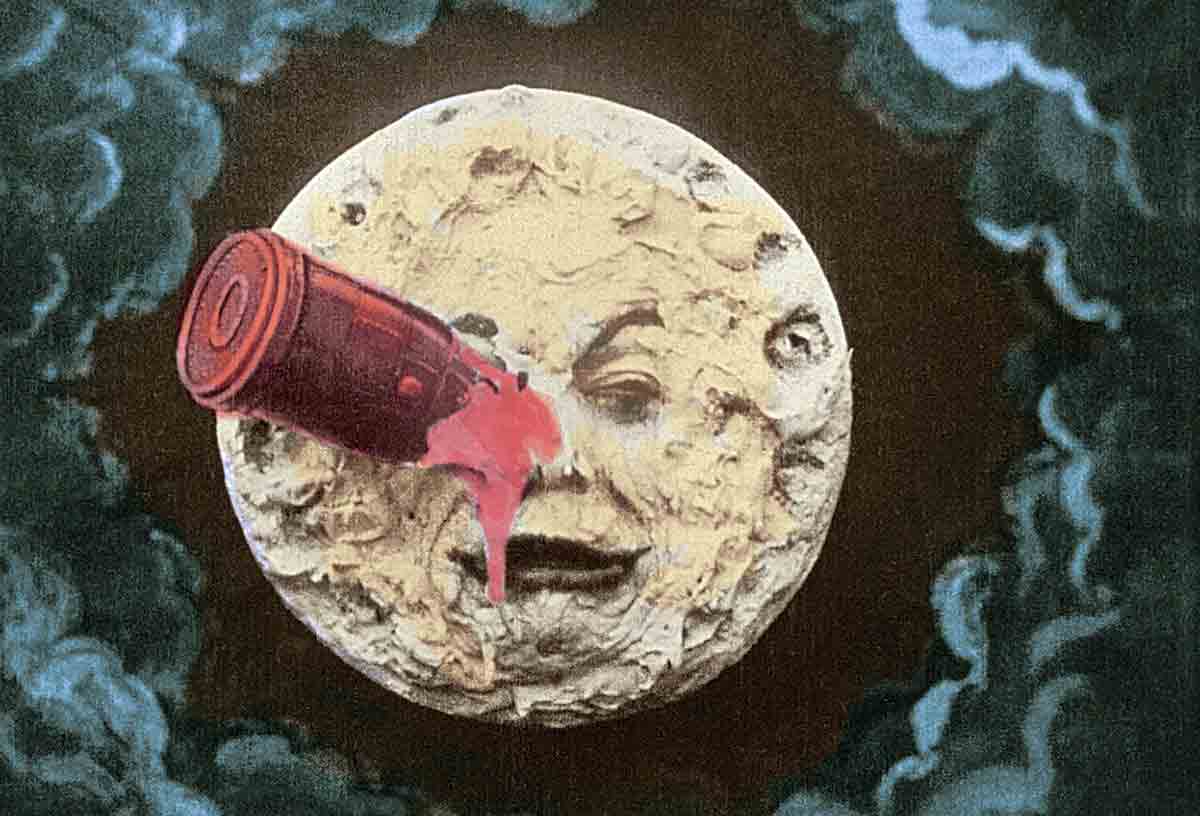
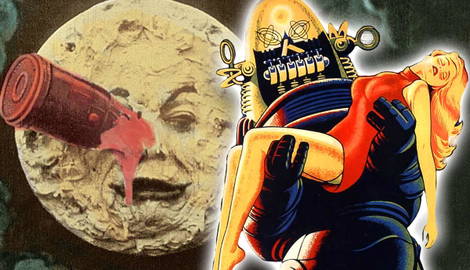
During an era of fantastic scientific and technological innovations—including the airplane and the automobile—Méliès hitched a ride from both authors Jules Verne and H.G. Wells to make likely his most important film, a “one-reel” (about 15 minutes) whimsical silent short that practically invented the genre for the screen. Released in both black-and-white and hand-tinted color, it tells the tongue-in-cheek story of a group of scientists who set out to first build a projectile spaceship, then climb aboard and shoot for the moon. Méliès was a true pioneer in exploiting the unique wizardry of cinematic special effects, especially “stop-action” that allowed him to make objects or people magically appear and disappear. Still popular in silent programs today (it was also featured in a 2015 music video by Cage the Elephant), A Trip to the Moon packs in such space oddities as Folies-Bergere acrobats cast as somersaulting moon creatures.
9. Metropolis (1927)
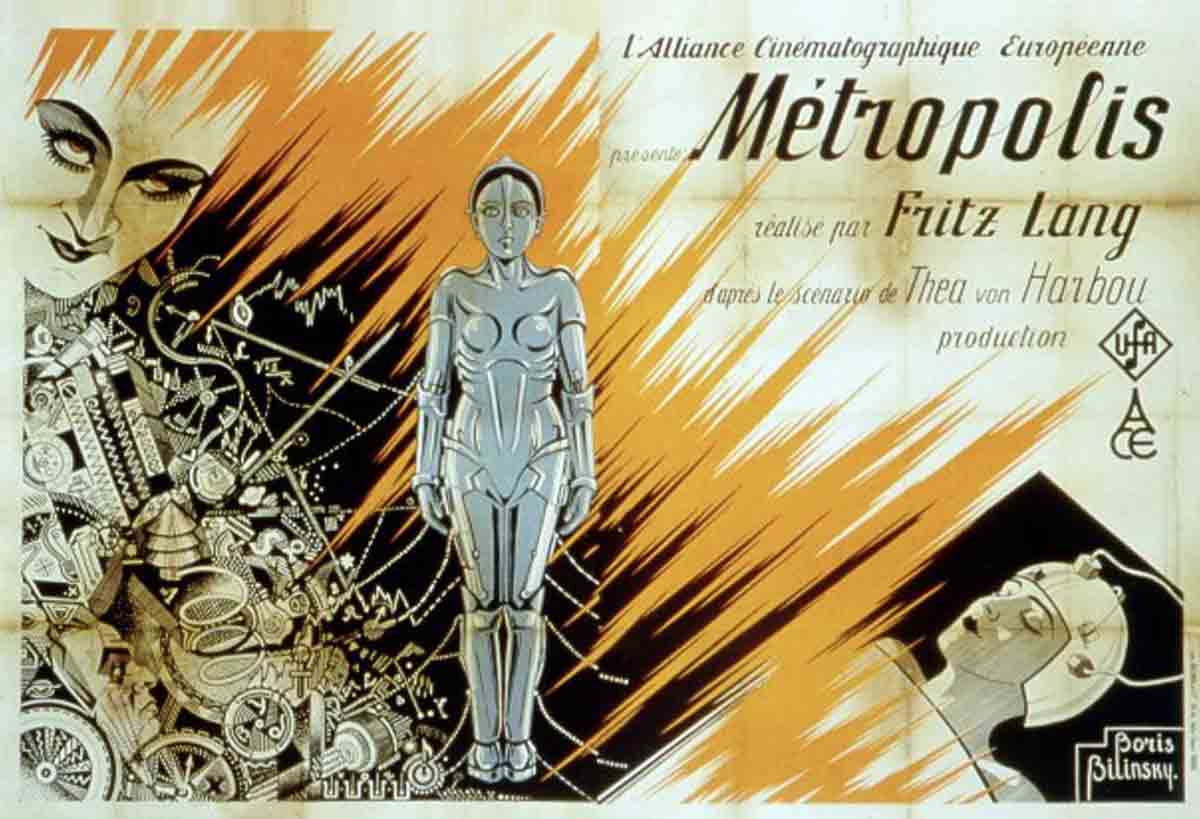
Utilizing the vast resources of Germany’s UFA studios and working from a script from his then-wife Thea von Harbou, director Fritz Lang created one of the towering sci-fi landmarks, however naïve if not preposterous in plot. In the not-too-distant future, masses of workers slave away in underground urban factories while the idle rich live and play high above in luxury skyscrapers. The city itself is controlled by a dictatorial business tycoon who’s likely some merger of Henry Ford and John Rockefeller.
While his diabolical plan is to have his wizardly inventor Rotwang build a female robot that will infiltrate and sabotage a worker uprising, Metropolis’ most electrically compelling story is visual, not narrative. From the oppressive subterranean factory with a huge clock-like machine at its center to the amazing creation of the sultry fem-bot (Brigette Helm) in Rotwang’s modern medievalist laboratory, Lang’s remarkably influential cinematic visions recur in future films from the original Frankenstein to Blade Runner.
8. The Thing from Another World (1951)
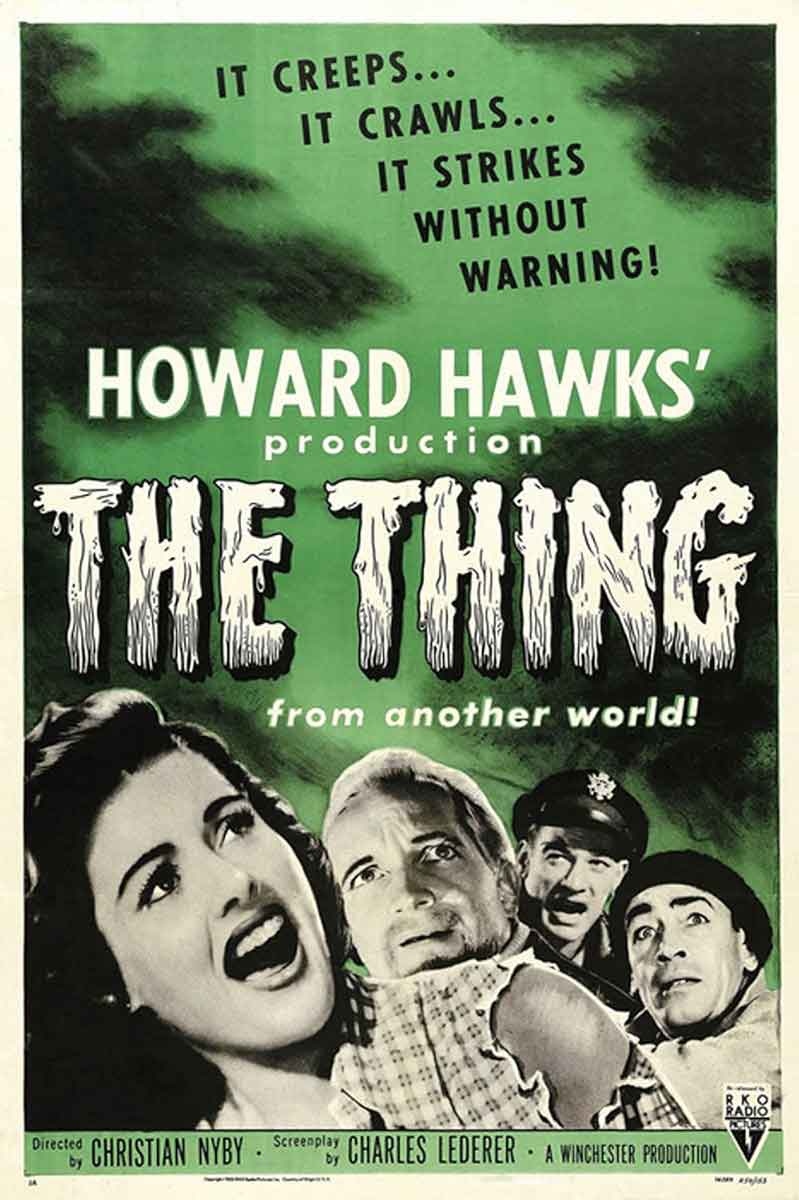
Remade by director John Carpenter in 1982 as a gory, outré creep show starring Kurt Russell, the original low-budget classic was one of the first to turn the prospect of an alien arrival on Earth into a close encounter of the monstrous kind. Feeding off well-publicized UFO sightings (and the US-Soviet Union Cold War) that reached near-hysterical levels in the late 1940s and into the 1950s, The Thing pits a hulking, blood-sucking humanoid vegetable against an Air Force flight crew and a cadre of sneaky scientists isolated on a remote base in the frigid Arctic Circle. Well-known Hollywood director Howard Hawks was originally tapped only to produce, but his tell-tale “auteur” fingerprints are all over the final product, from the snappy overlapping dialogue to the lone plucky dame who breaks into the ranks of the all-male circle of trust.
7. The Day the Earth Stood Still (1951)
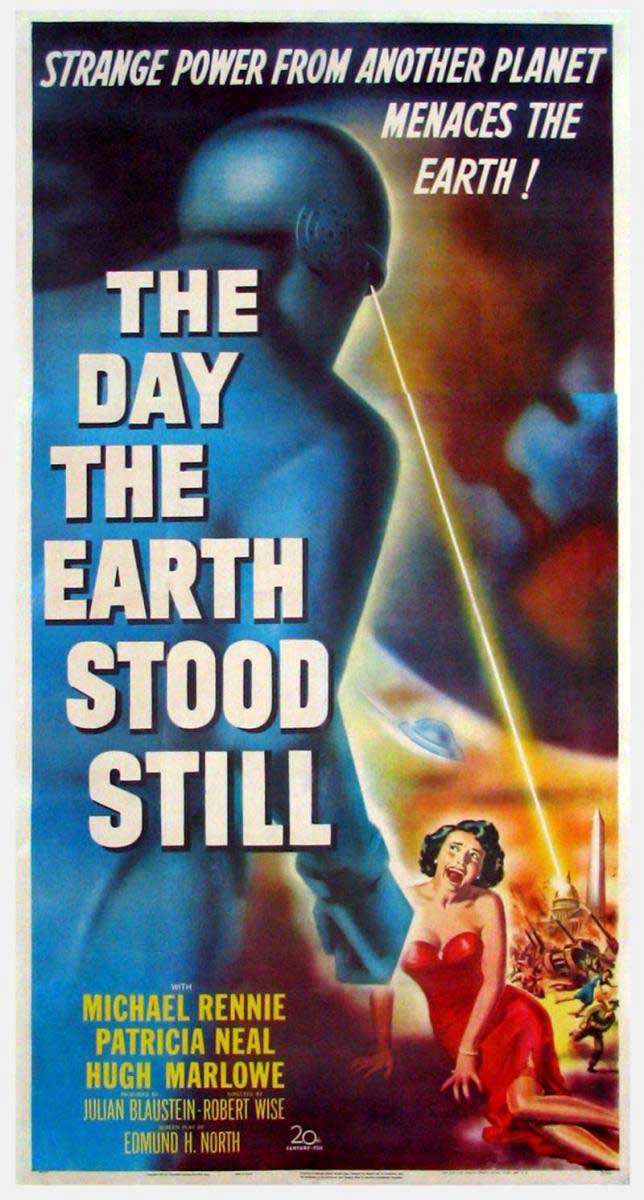
“Klaatu barada nikto.” Such were the words that launched a thousand Hollywood spaceships in director Robert Wise’s liberal-minded sci-fi rarity that gave audiences an eloquent, intelligent, handsome, and even Christ-like alien “invader” instead of a monstrously malevolent one. Freshly transported from the London stage, Michael Rennie stars as an emissary spaceman dispatched to warn Earthlings that they better cool it with nuclear warfare or risk annihilation by their intergalactic betters.
Rising star Patricia Neal plays a single mom who, together with her precocious son, believes that Rennie’s Klaatu should be listened to and not arrested as a dangerous extraterrestrial peacenik. The Day is not only enriched by the luscious night-time noir cinematography (when the giant robot Gort stalks Neal) but also by the great composer Bernard Herrmann’s creepy and otherworldly electronic Thermin score, which influenced the genre for years to come.
6. Godzilla (1954)
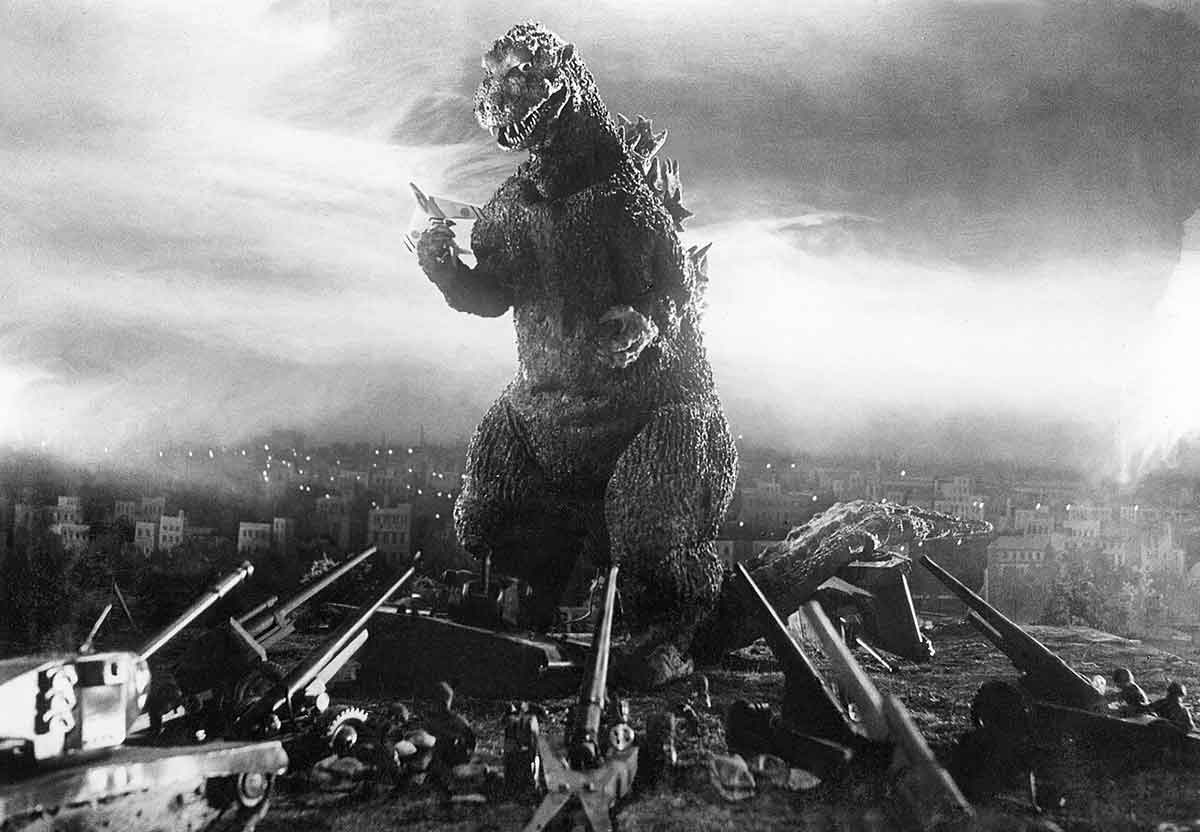
Titled Gojira in its native country, Japan’s super-sized entry in the global sci-fi sweepstakes stirs in a drop or two of real science since the colossal sea creature that surfaces to trash Tokyo is spawned from US nuclear tests in the Pacific Ocean. Though charmingly campy in its seriousness and rubber-suited actor(s) stomping a miniature Tokyo, the original Toho studio version (without Raymond Burr cut-and-pasted in for Western audiences) radiates a palpable level of Japanese anguish and dread only a few years removed from the cataclysms of Hiroshima and Nagasaki. Partially cloned by director Ishirō Honda from Hollywood’s 1953 The Beast from 20000 Fathoms, Gojira is no doubt the mother of all Japanese monster movies, as well as several monstrously overproduced US knock-offs, like 2019’s Godzilla, King of the Monsters.
5. Invasion of the Body Snatchers (1956)
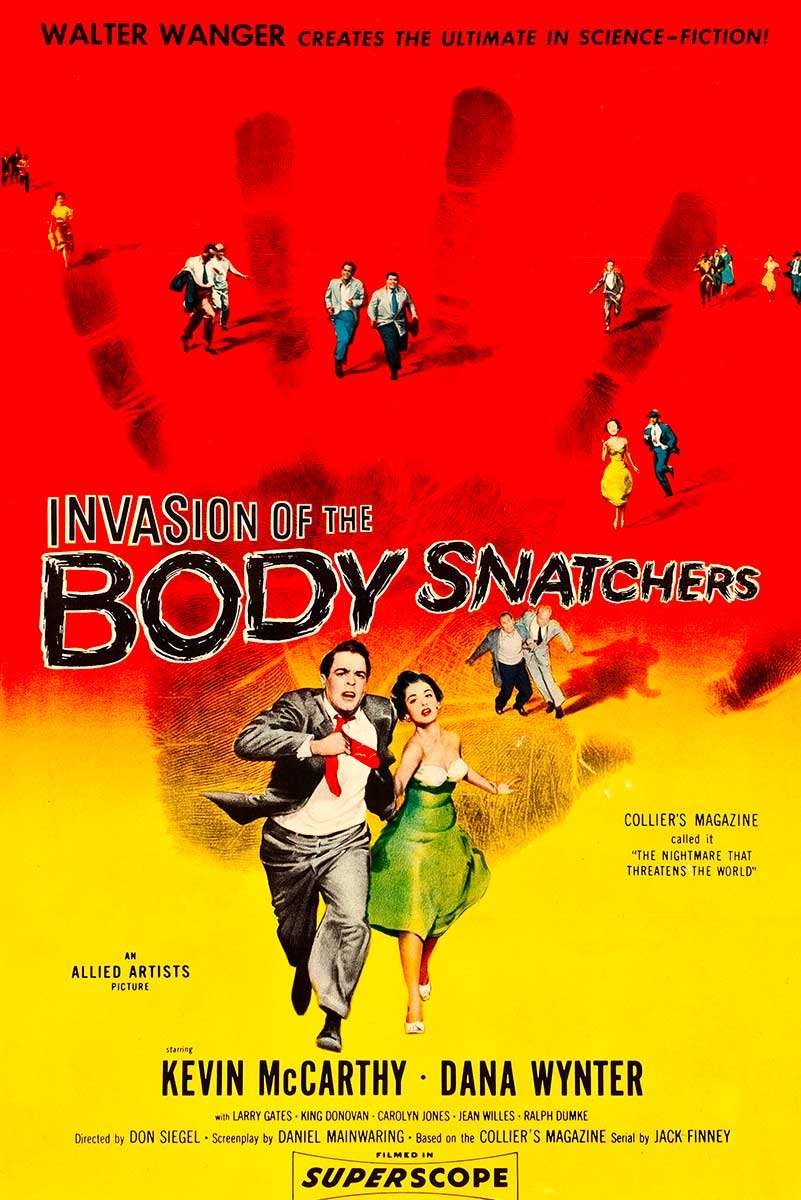
“You’re next!” If the number of remakes (three and counting) attests to a movie’s staying power, director Don Siegel’s noir-colored alien-invasion allegory grabs at sci-fi greatness. Made at the height of anti-communist Cold War paranoia, it’s a cautionary tale of how residents of an idyllic California town are replaced one-by-one by their cold, unfeeling lookalike doppelgangers—all hatched and grown from alien plant pods. Kevin McCarthy memorably stars as a local doctor who’s called in to investigate the cases of family members who start acting distant and strange. Hamlet’s “sleep … there’s the rub” doubly applies here since after a good night’s rest, you might awake as a totally different person, one of an army of robotic aliens determined to replace the human race.
4. Forbidden Planet (1956)
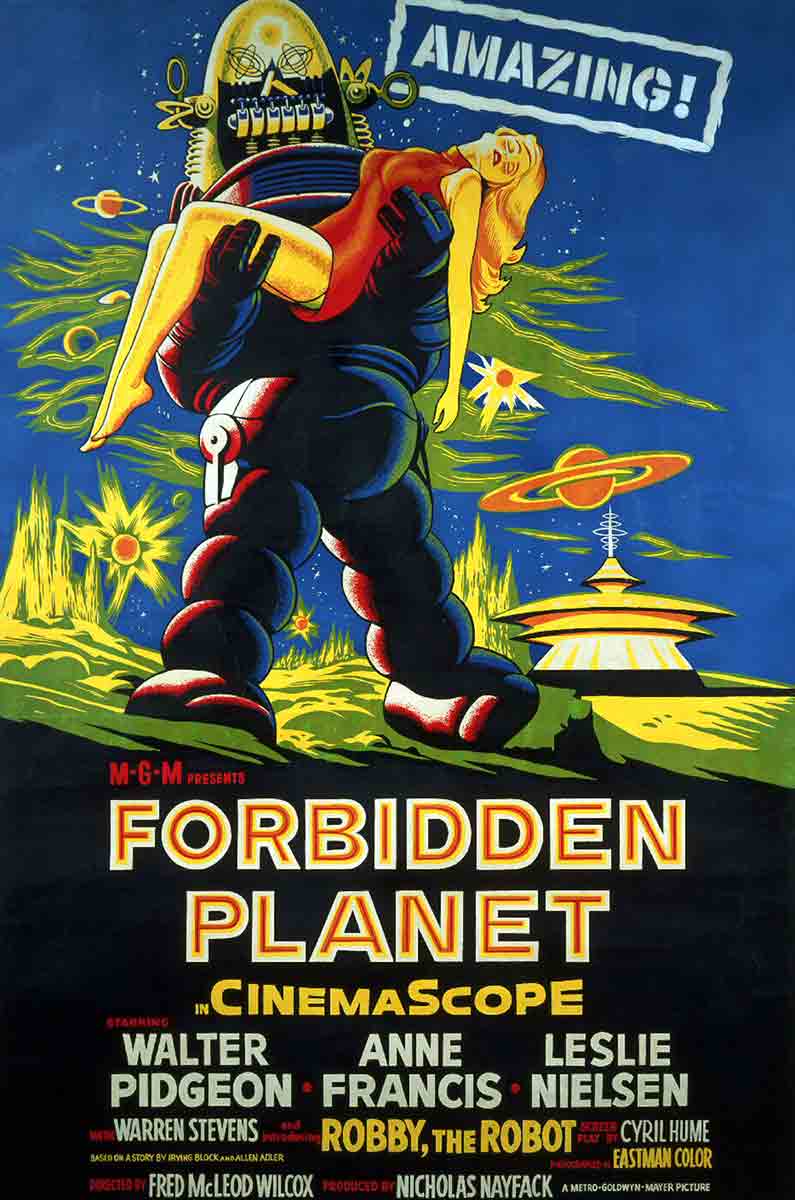
The M-G-M studio’s lavish color excursion into the 1950s sci-fi universe shot for higher ground, starting with a pop plot loosely beamed up from Shakespeare’s The Tempest. A pre-Airplane, proto-Captain Kirk Leslie Nielsen stars as the intrepid skipper of an Earth-based space crew that lands on the Edenic planet Altair-4 to evacuate its only remaining colonizing humans—an arrogant, uber-brainy scientist (Walter Pidgeon) and his naïf mini-skirted daughter (Anne Francis). A noisy but invisible monster makes its presence known, providing more than a few hints to the unwanted visitors that they should forget about phoning home and just leave.
M-G-M farmed out the special effects to the Disney studio, and it responded with a payload of stellar sight-and-sound fireworks, starting with the monster’s nocturnal assaults on the spaceship’s protective force field. Destined, if not programmed, for Hollywood fame, “Robby the Robot” makes his scene-stealing debut.
3. The Incredible Shrinking Man (1957)
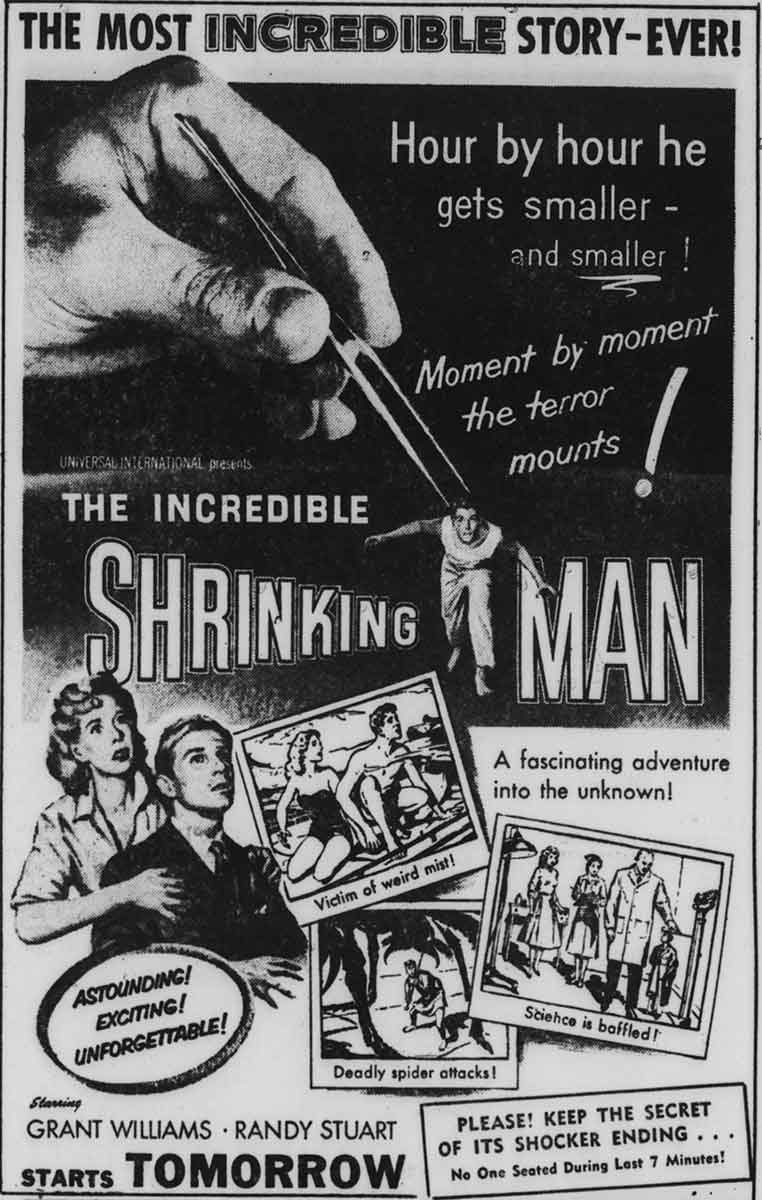
The story may be on the “small” side, but director Jack Arnold and writer Richard Matheson think big, expanding the plight of their disappearing hero into a weighty contemplation of human existence in the face of both mortality and a hostile, overwhelming universe. Exposed to a radioactive fog while sailing with his wife, Scott (Grant Williams) almost immediately notices he’s losing weight fast, and not because of any crash diet. If his doctors find his condition incredible, what is credible is his day-by-day diminishment.
Far from living large, he has to move into a model playhouse, where he’s terrorized by his own darn cat. Then he’s trapped in the basement, where he must battle what’s now a man-eating spider armed with a sewing needle acting as his harpoon. One of the few consistently interesting auteurs in 1950s sci-fi, Arnold takes this weird little tale of a downsized man and makes it a sizable (even existential) sci-fi statement.
2. Planet of the Apes (1968)
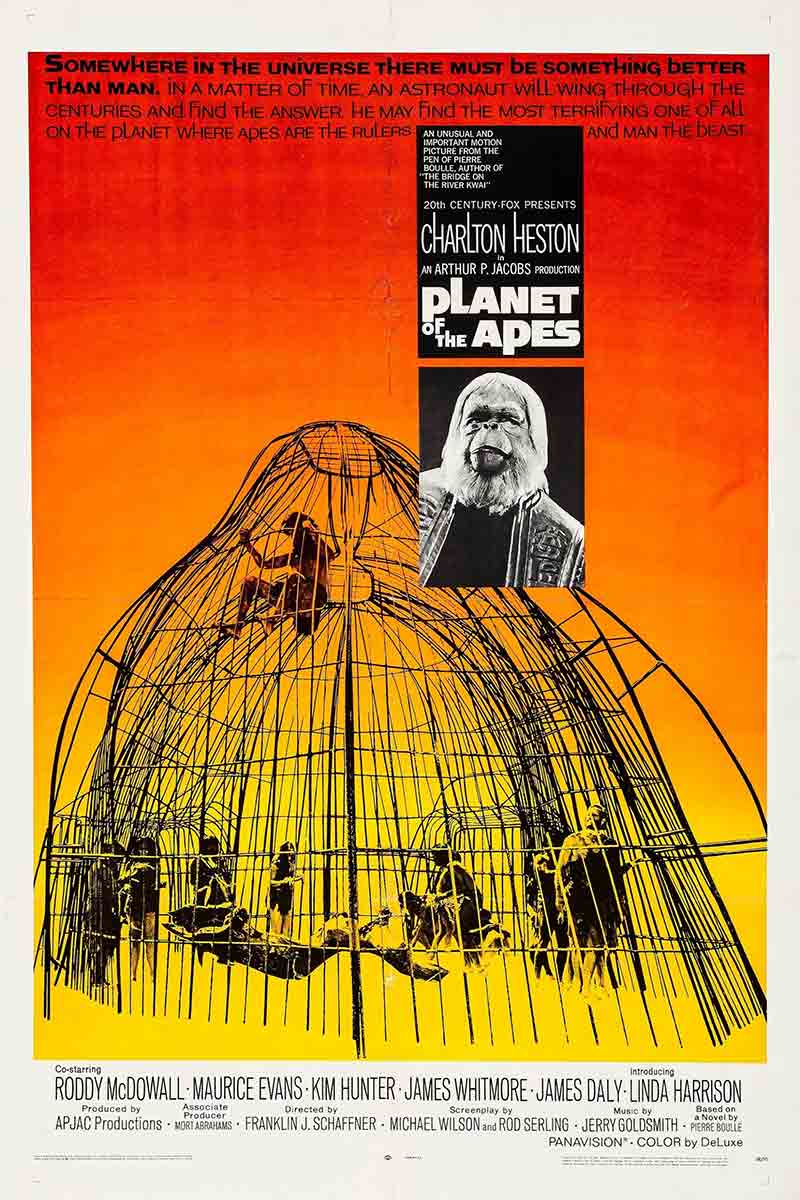
Evolved from a script by Michael Wilson and TV’s Rod Serling (The Twilight Zone) from Pierre Boulle’s 1963 French novel, director Franklin Schaffner’s box-office smash turned what might have been bottom-of-the-barrel movie monkey business into the cash-cow sire of several generations of simian-themed screen and TV sequels. Along with the one-two punch of the Oscar-winning makeup and costumes, there’s the two-fisted acting from macho Hollywood Homo Sapien Charlton Heston, playing an astronaut who crash lands on a planet brutally ruled over by a society of brainy apes. Smart observers, however, may be less shocked than Heston at the famed final reveal, especially if they noticed that all those “damn, dirty apes” Heston battles speak curiously good English.
1. 2001: A Space Odyssey (1968)
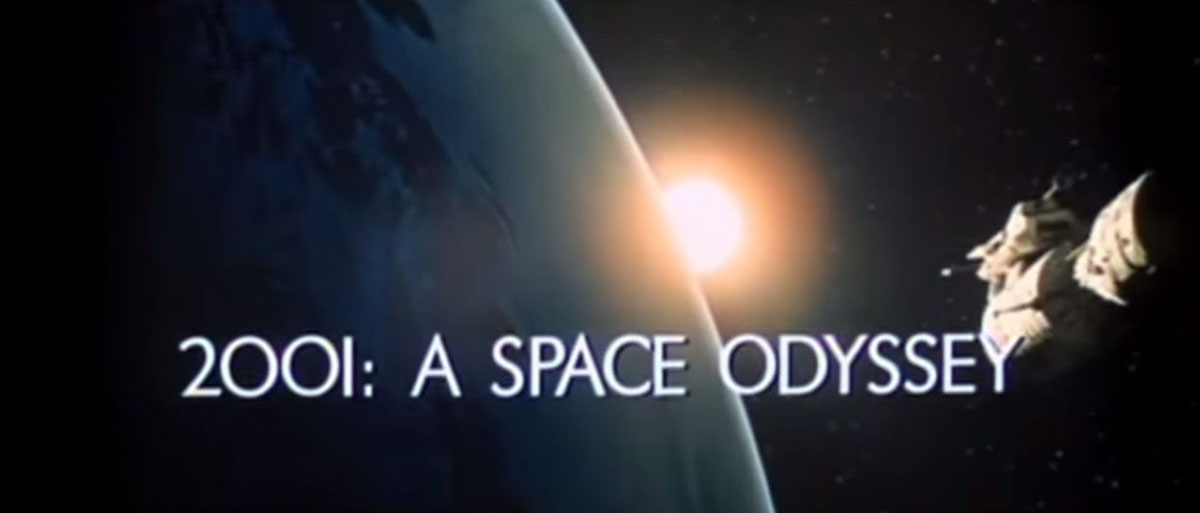
The “ultimate trip” or the ultimate bore? When director Stanley Kubrick’s watershed science-fiction hit first landed in press previews, most critics bailed out in baffled dismay. But once the 1960s counterculture generation turned on and tuned in to Kubrick and writer Arthur C. Clarke’s far-out extraterrestrial speculation, 2001 boomeranged from lost in space and into thousands of packed theaters, many for the ultra-wide Cinerama showings.
Before 2001, that is, before 1968, science fiction films were almost exclusively low-budget, low-status studio entries with few expectations of conquering the box office. All that changed in the decades after, most astronomically with the 1977 dynamic duo sensations of George Lucas’ Star Wars and Steven Spielberg’s Close Encounters of the Third Kind, closely followed in 1980 by Lucas’ Star Wars sequel The Empire Strikes Back and Spielberg’s own E.T. The Extra-Terrestrial two years later. The sci-fi space race—and the Hollywood box-office race—were on.