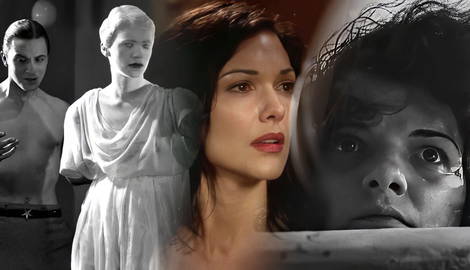

Surrealism is an art movement dating back to the 1920s. A permutation of Dada, which is characterized by chaos and nihilism, Surrealism applies the random, destructive energy of Dada constructively to explore the unconscious mind. Heavily inspired by psychoanalytic theory, surrealism challenges the very structure of rational reality. Surrealism has been vividly brought to life in cinema, but how have surrealist artists brought their visions to the screen? Discover 10 surrealist movies that define the genre.
| Title | Year | Director |
| The Seashells and the Clergyman | 1928 | Germaine Dulac |
| Limite – 1931 | 1931 | Mário Peixoto |
| The Blood of a Poet | 1932 | Jean Cocteau |
| Rose Hobart | 1936 | Joseph Cornell |
| Meshes of the Afternoon | 1943 | Maya Deren |
| Spellbound | 1945 | Alfred Hitchcock |
| Last Year at Marienbad | 1961 | Alain Resnais |
| Daisies / Sedmikrásky | 1966 | Věra Chytilová |
| The Discreet Charm of the Bourgeoisie | 1972 | Luís Buñuel |
| Mulholland Drive | 2001 | David Lynch |
10. The Seashell and The Clergyman – 1928, dir. Germaine Dulac
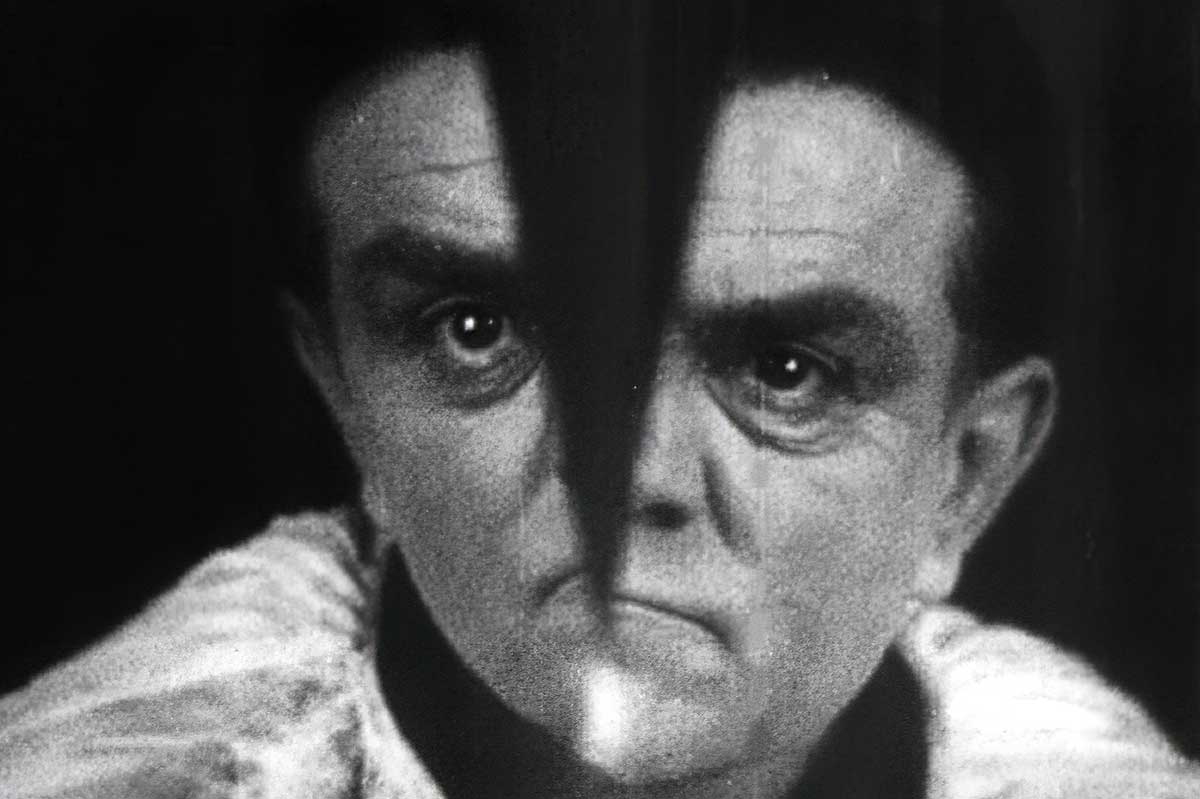
Groundbreaking female director Germaine Dulac’s adaptation of the original work by Antonin Artaud, The Seashell and the Clergyman, is considered the first surrealist film. It is a twisting, unreliable descent into the psyche of a priest constantly lusting over a woman of his church, who is married.
Upon its release, the film was censored in Britain, with the claim that “it is so cryptic as to be almost meaningless. If there is a meaning, it is doubtless objectionable.” Surrealist themes of eroticism, the tortured subconscious, shame, and desire, are coupled with criticism of the church and a proto-feminist upending of objectification of women. Dulac presents these themes in an unreliable manner, with no clear definition of narrative or differentiation between reality and unreality.
9. Limite – 1931, dir. Mário Peixoto
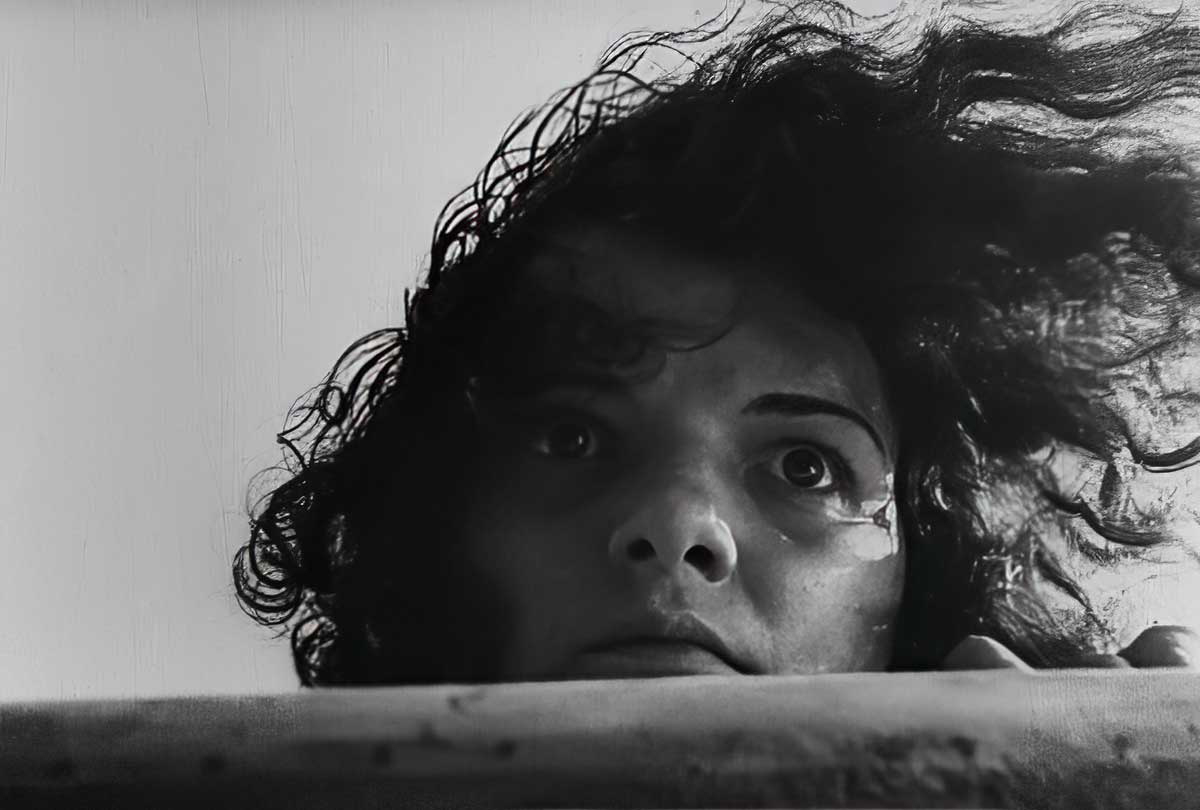
Limite is a 1931 movie with a mythology almost as spellbinding as the film itself. The only feature poet Mário Peixoto ever completed, it was a commercial bust in 1931, but won over passionate (and famous) fans, such as writer Vinicius de Moraes. With prints heavily degraded by 1959, the only known copy of the film was taken to be restored, then confiscated by the Brazilian military dictatorship in the 60s, then restored once again. Part of Martin Scorsese’s World Cinema Project, it is now also part of the Criterion Collection, but with one scene lost forever.
The film follows a man and two women, stranded on a boat. As they drift off at sea, not even attempting a rescue, their backstories are visited through flashbacks. Limite, aptly named, works in the hazy limits of physicality and intangibility, memory, and fantasy. The flashbacks of each unnamed character bleed into each other and are pulled in and out of the present like the tide.
8. The Blood of a Poet – 1932, dir. Jean Cocteau
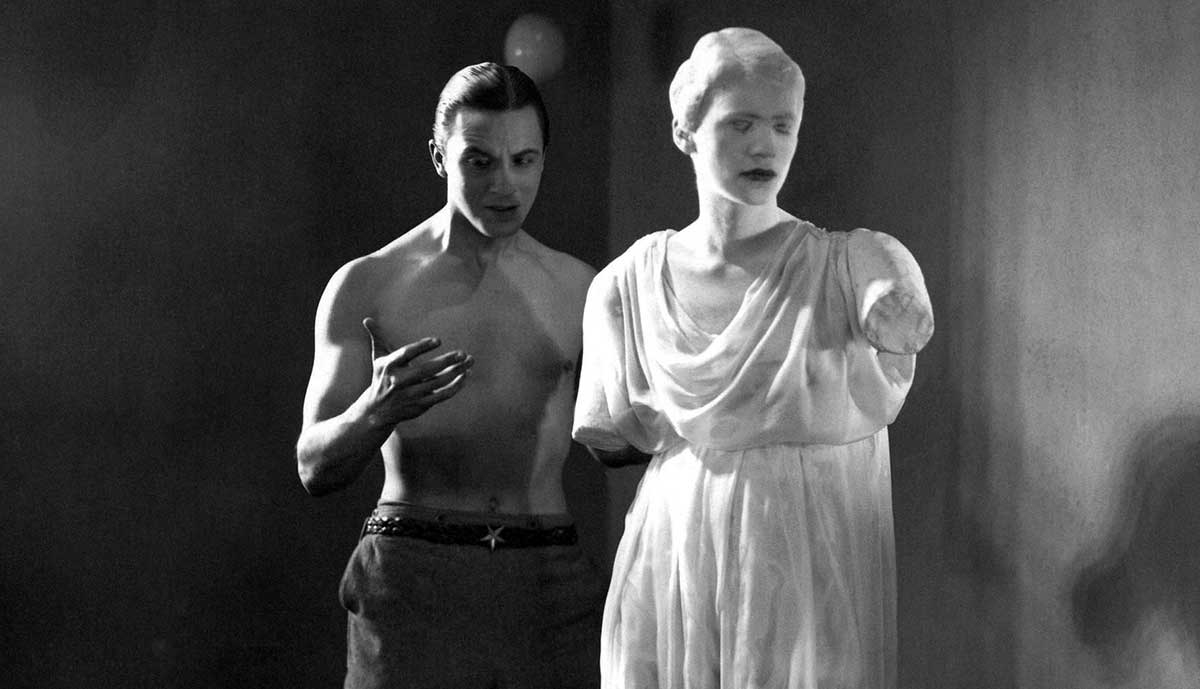
The first installment of Jean Cocteau’s classic Orpheus trilogy, The Blood of a Poet explores the labyrinths of the inner mind. Not just any mind, but the mind of an artist. With a higher production value than most early surrealist films, Cocteau’s film feels like a quasi-fantasy. The artist enters other worlds through looking glasses, encounters stranger and stranger creatures and places, mostly his own creations. He destroys them, reaches far corners, and travels into the unknown. He is taken inside himself through his art as Alice is taken by the story to Wonderland.
Seeking to tap not into the unconscious, but into the in-between spaces of consciousness, irrationality, and instinct, The Blood of a Poet is the visual translation of the inwards of an artistic process, the inverse of creativity.
7. Rose Hobart – 1936, dir. Joseph Cornell
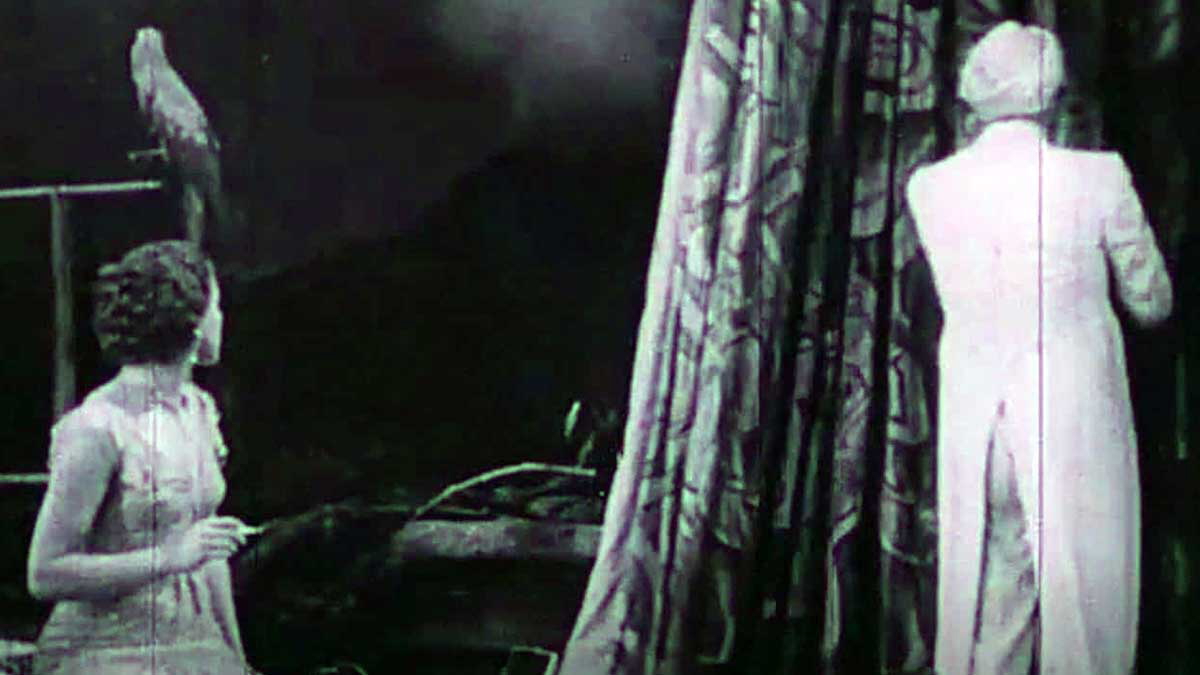
Joseph Cornell was one of the most prominent American Surrealists, well known for his shadow box sculptures and his love for starlets. Cornell made Rose Hobart in 1936 by painstakingly cutting and re-editing the adventure flick East of Borneo to mostly actress Rose Hobart’s parts. This is one of the earliest versions of a fan video.
Rose Hobart shaves the Hollywood blockbuster down to character shots of Hobart, intercut with a documentary solar eclipse. By reordering the footage and focusing on the character’s reactions instead of the narrative action, Cornell completely deconstructs the narrative of the original. He inverts the entire logic of mainstream movies and makes a work of surrealist, sensory, and affective automation.
6. Meshes of the Afternoon – 1943, dir. Maya Deren
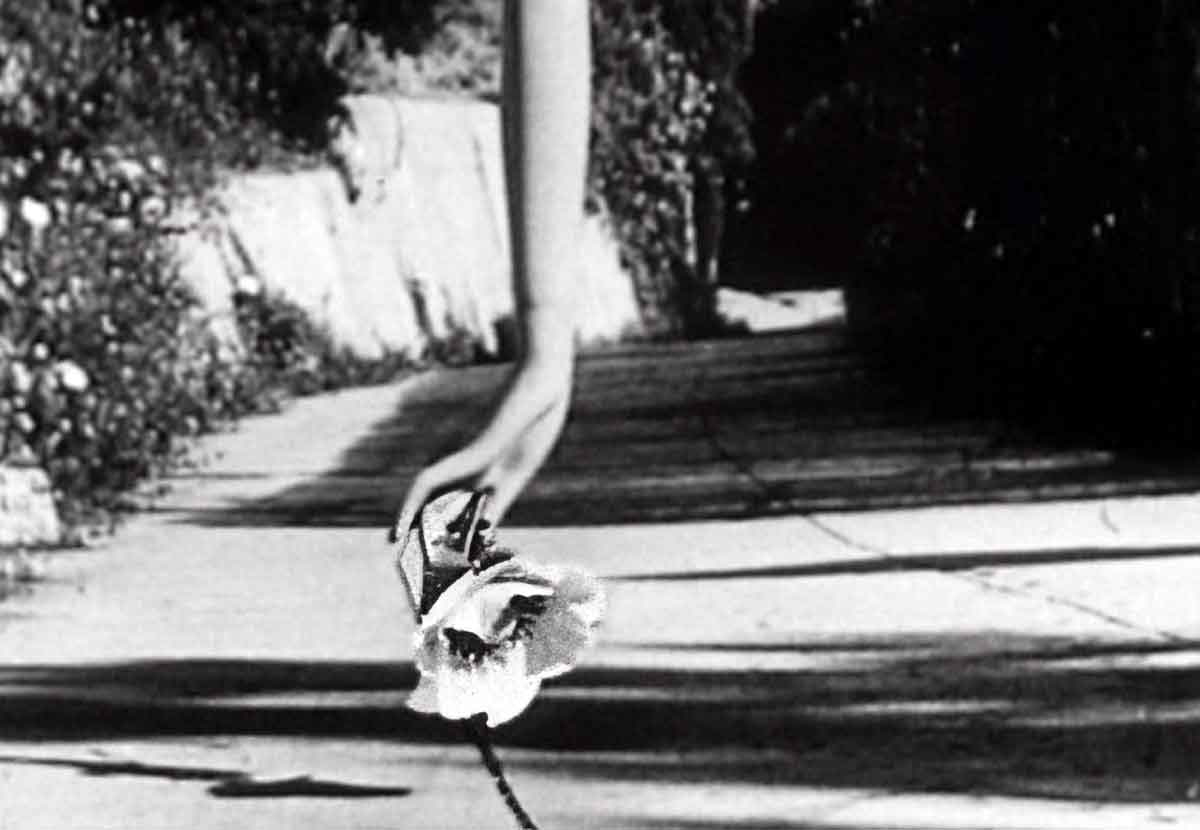
Meshes of the Afternoon doesn’t simply explore dreams; it is a moving picture nightmare. A young woman, played by director and writer Maya Deren, comes home after seeing a figure in the street. She falls asleep on the couch and dreams of hooded figures, keys, flowers, knives, mirrors, and mirror faces. Death, self, and angst are evoked by the oneiric, circular pace of the film.
Meshes of the Afternoon was an impactful film in the experimental cinema of post-war America. It has been linked to Film Noir as well as to Surrealism. It was written and filmed with Deren’s then-husband, Alexandr Hackenschmied, and in 1959, it was especially scored by Deren’s third husband, Teiji Ito.
5. Spellbound – 1945, dir. Alfred Hitchcock
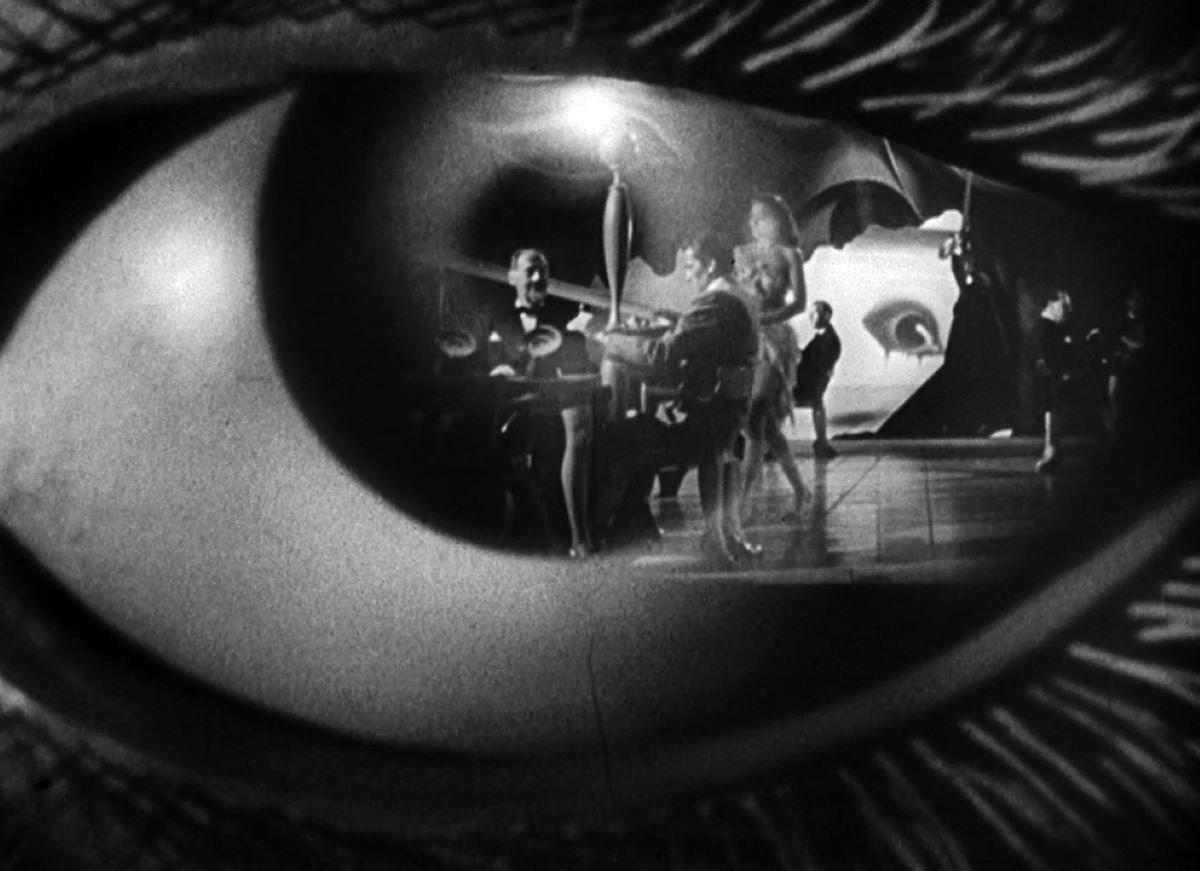
Spellbound is not a surrealist movie; it can’t even be called a post-surrealist film. It is, however, a movie that works almost as a meta-commentary on Surrealism, and the perfect example of how Hollywood absorbed bits of Surrealism into its mainstream films. Spellbound is a thriller/romance starring Gregory Peck and Ingrid Bergman as psychologists working in a mental clinic.
Spellbound deals directly with the early-1900s fascination with psychoanalysis and the theories that influenced Surrealism (which includes a great deal of psychobabble). It deals with themes such as amour fou, insanity, amnesia, guilt complex, dreams, identity, and the subconscious. Like many Hollywood films at the time, particularly film noirs, it features a fully surrealist dream sequence, this one painted by Salvador Dalí.
4. Last Year at Marienbad – 1961, dir. Alain Resnais
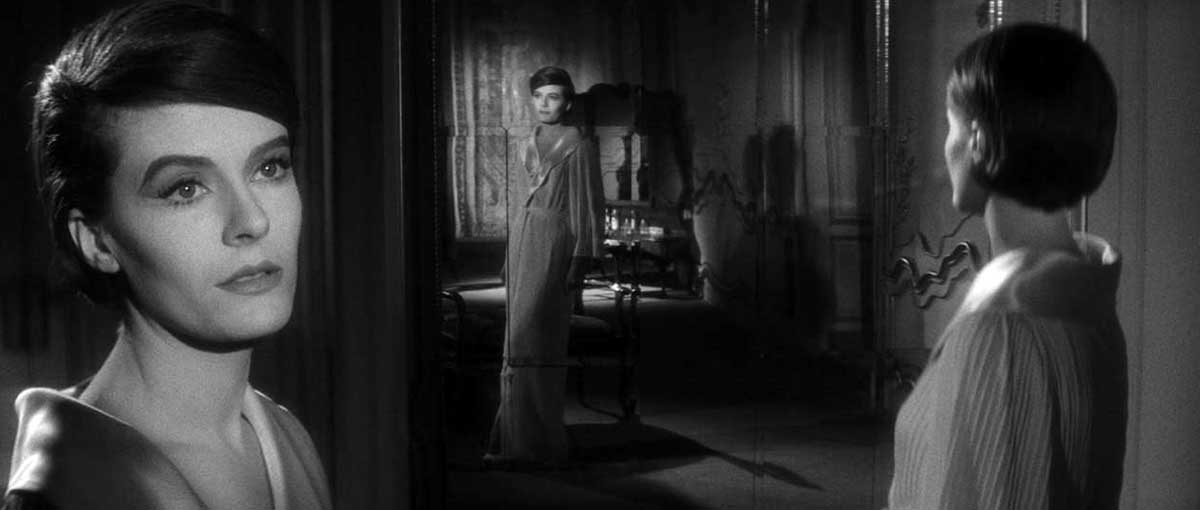
Alain Resnais’ Last Year at Marienbad is a twisting tour inside the labyrinths of time, mind, memory, and self-delusion. In a luxury hotel, a man approaches a woman claiming they had an affair in a similar location a year before. The woman denies knowing him at all, and the two of them, alongside a third man who might or might not be her husband, explore what the nature of their relationship really is.
Last Year at Marienbad blurs the lines between memory, fiction, and reality, between time and place, and between the physical location and the mind. Marienbad has a quality of meditative, nearly oppressive silence. In a cyclical narrative, memories contradict and over-impose on each other as the camera tracks the opulent halls of the hotel. Marienbad was inspired by psychological dramas of the silent era. This is reflected in the direction, makeup, and dramatic, unrealistic shadows. The clothing in the film was designed by Chanel, and combined with the singular direction, this helped make the film the most elegant of all surrealist movies.
3. Daisies / Sedmikrásky – 1966, dir. Věra Chytilová
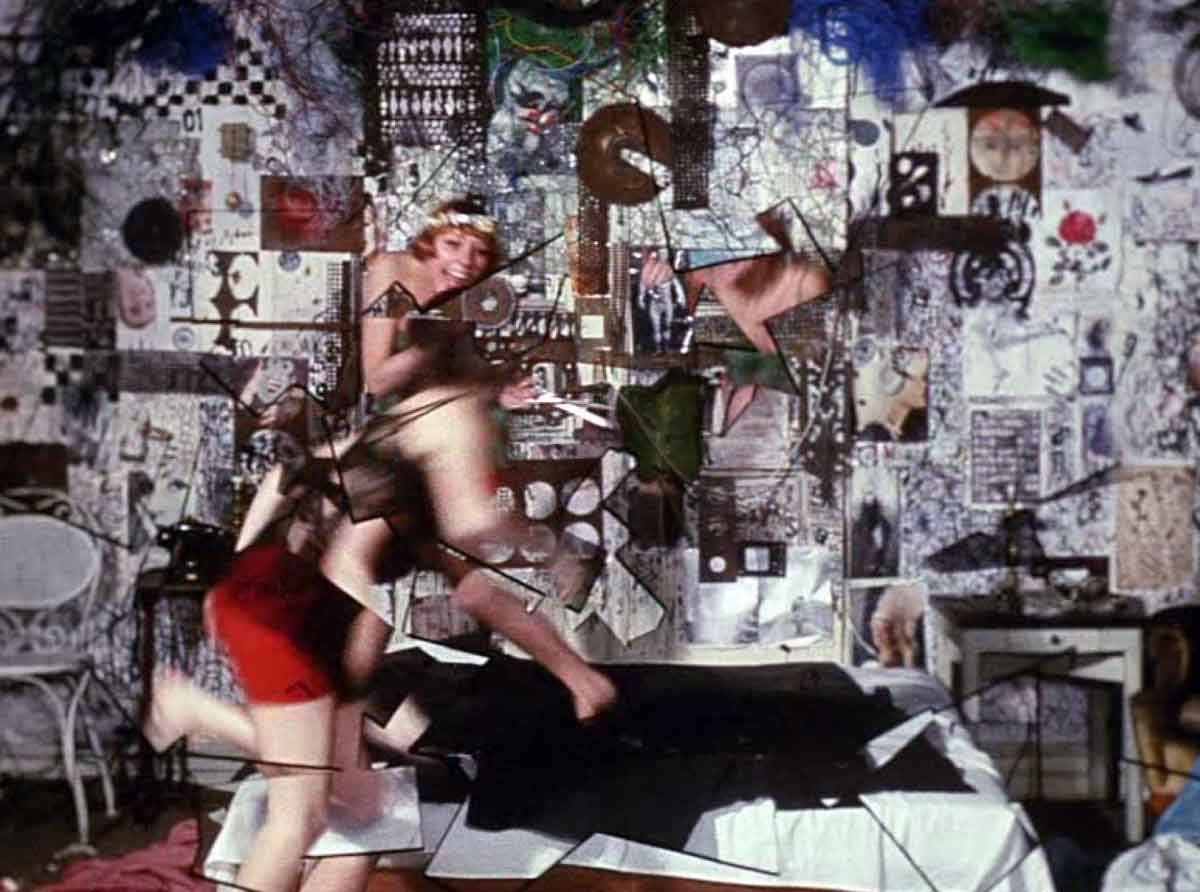
Věra Chytilová’s surrealist, provocative, comedic extravaganza Daisies is a foundational film of the Czechoslovakian New Wave. The film follows two girls, Marie I and Marie II, who decide that “if the world is spoiled, they will be too.” Foregoing morality and rational living, the Maries engage in hedonistic, gluttonous, and nonsensical desires. They drink, party, scam men, play pranks, eat and fight with food, dance on tables, and destroy phallic-looking ingredients. There is a lot of food in this work, so much so that the film was censored by the Soviet government for promoting wastefulness.
Daisies is stylistically and narratively submerged in the sensual and the sensory. The audience is taken on a journey into pure ego, a cinematographic feast that fills you up until you feel sick. The film can, and has, been read in contradictory ways. It has been seen as a criticism of excess, consumerism, authoritarianism, war, institutional values, patriarchy, and the objectification and infantilization of women in art.
2. The Discreet Charm of the Bourgeoisie – 1972, dir. Luís Buñuel
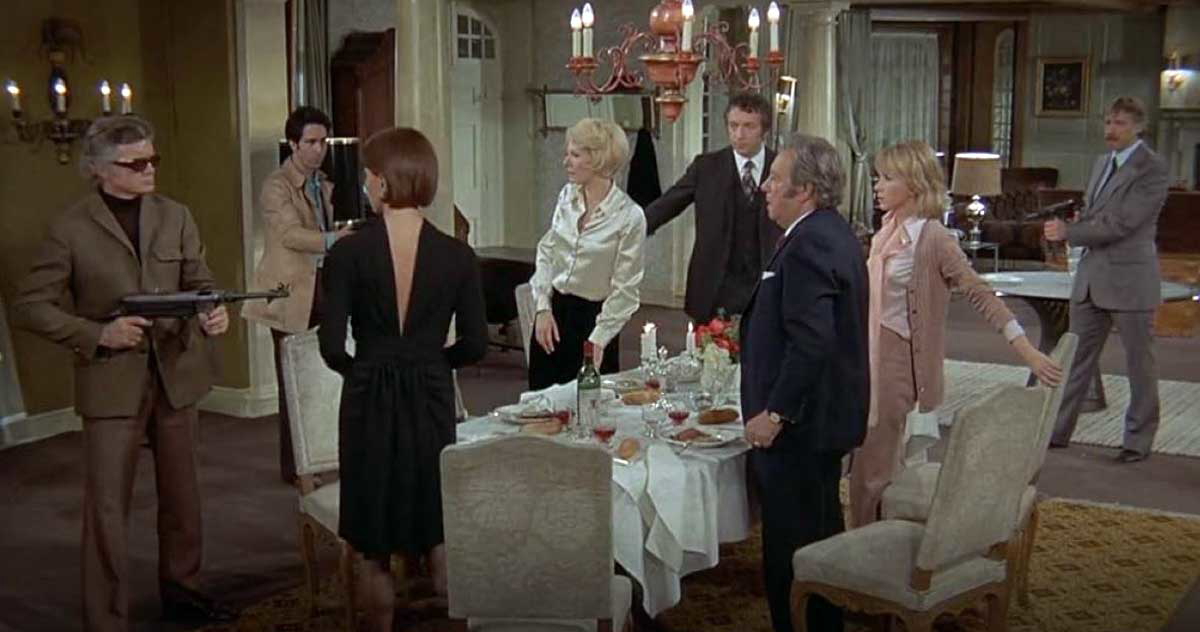
Luís Buñuel is a name practically synonymous with surrealist cinema. His early films, including Un Chien Andalou (1929) and L’Age D’or (1930), established the paradigm of surrealist films and still deliver some of the most shocking images ever put on screen.
Fifty years after those, Buñuel was still turning out gems. In 1972’s The Discreet Charm of the Bourgeoisie, Buñuel’s surrealism is more mature but no less biting. Critiques of inequality, the church, and bourgeois institutions continue to be present. In beautiful color and superbly acted and edited, the film follows a group of bourgeois people attempting to have dinner. They are constantly interrupted by things like the attendants’ own dreams, which in turn mesh back in with their reality.
1. Mulholland Drive – 2001, dir. David Lynch
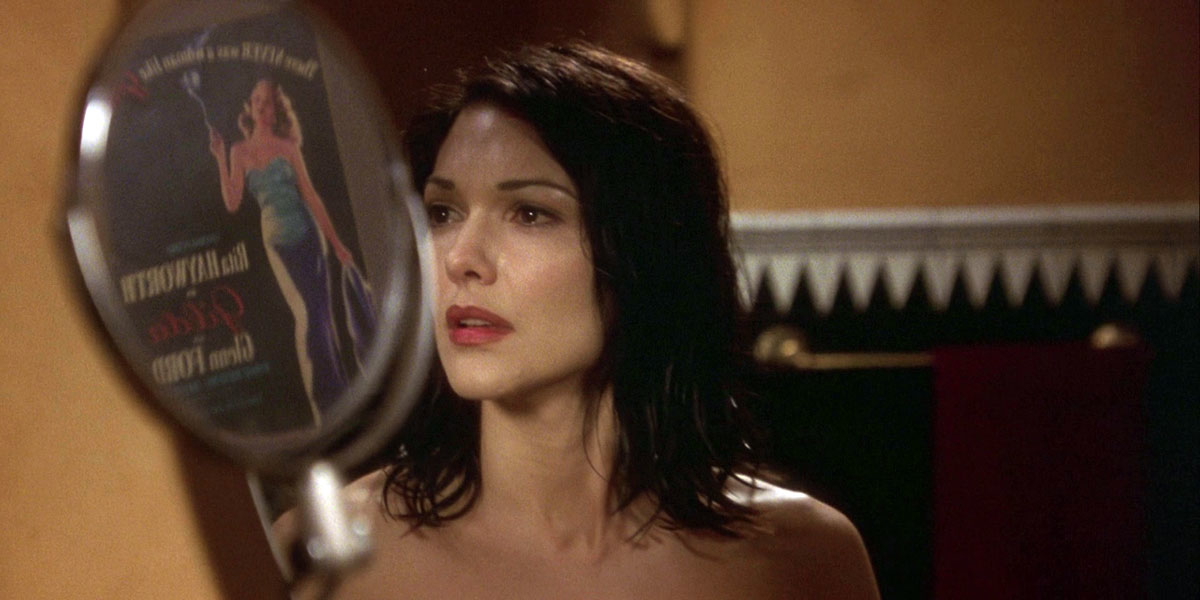
David Lynch’s work can safely be categorized, perhaps more than any other contemporary director, as post-surrealist. The 2001 Mulholland Drive is considered one of his masterpieces. The film follows aspiring actress Betty Elms and Rita, a woman suffering amnesia after surviving a car crash, as they attempt to piece together what happened to her.
Similar to his famous series Twin Peaks, Lynch inverts the genres of mystery and crime thriller through surrealist horror. The investigation and mystery are twisted around into something that evades logic and explanation. Similar to Deren’s Meshes in the Afternoon, Mulholland Dr. has a nightmarish quality and a cyclical, oneiric approach wherein reality melts into the mysteries of the subconscious.