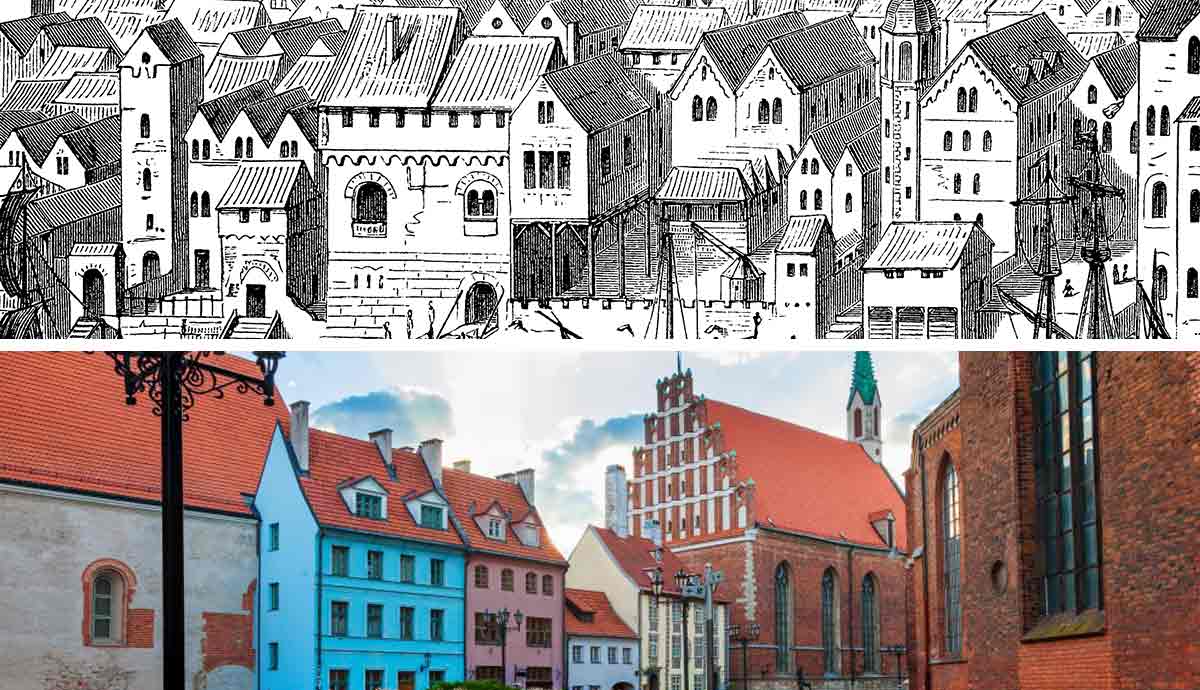

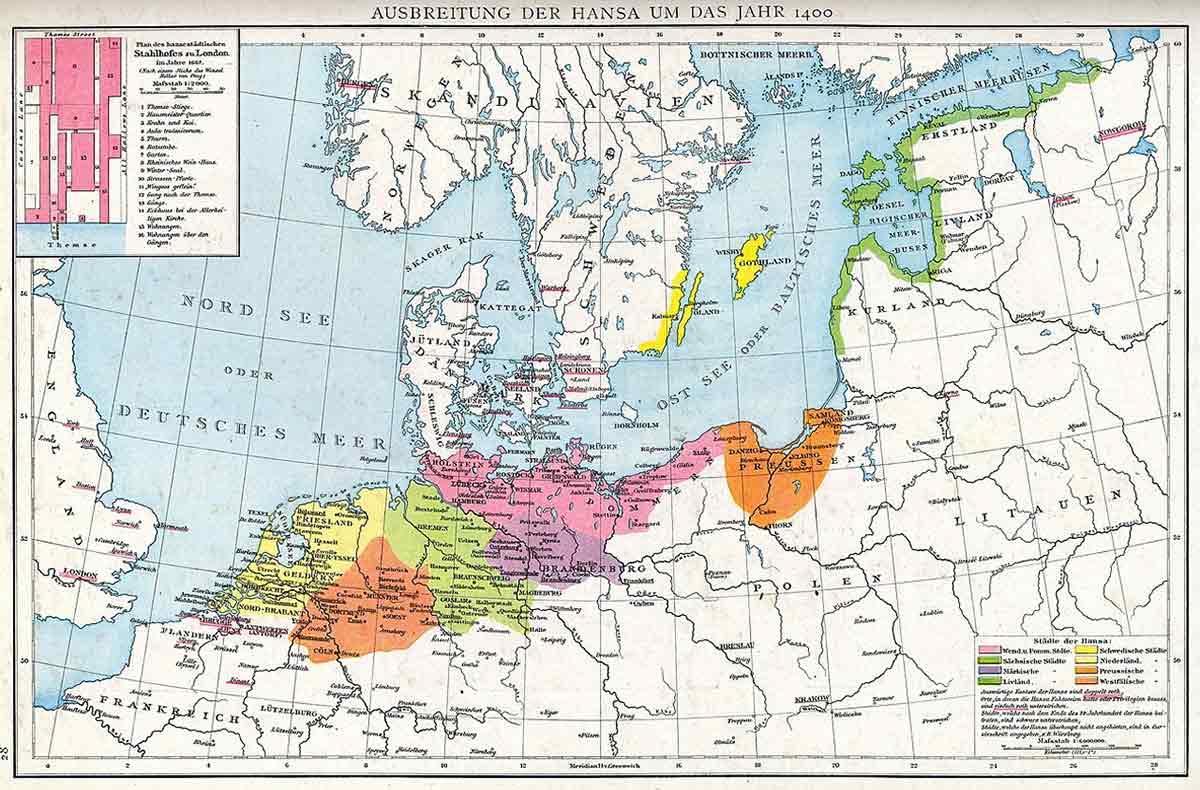
As regional leaders in Northern Europe fought over feudal boundaries in the 1100s, a new power began to emerge along the coasts of the North and Baltic Seas. Known as the Hanseatic League, it was made up of a network of merchant guilds, market towns, and cities. It helped North German towns gain greater autonomy from local lords and went on to become one of the most formidable economic forces of the medieval era. At the zenith of its power in the 14th century, the Hanseatic League was made up of nearly 200 towns and cities and held enough wealth and power to intimidate kings.
How Two Coastal Cities Built a Medieval Trade Monopoly
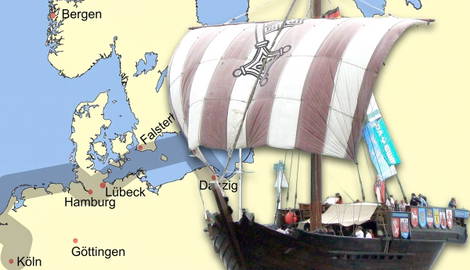
The foundations of the league were laid following the rebuilding of Lübeck, a critical port city in northern Germany, by Henry the Lion, the Duke of Saxony, in 1159. During that time, however, there was significant political instability within the Holy Roman Empire. The situation compelled trading centers across the Baltic and North Sea regions to form alliances for mutual defense against pirates and predatory local lords.
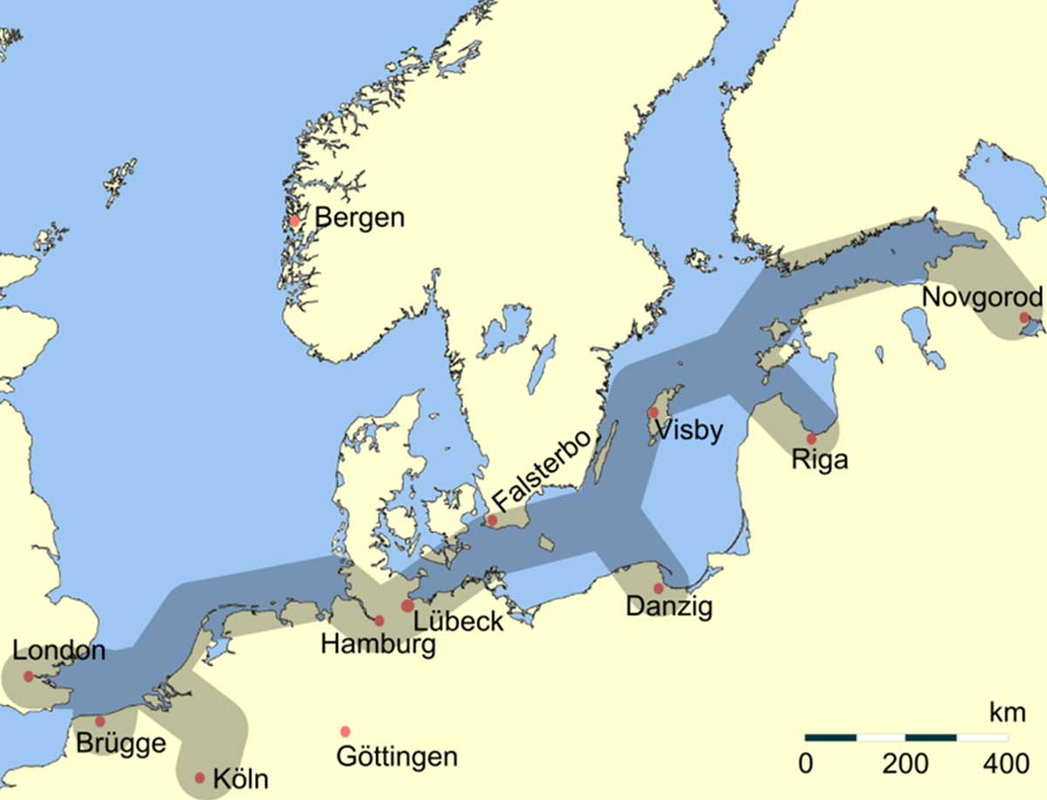
The group’s first major agreement was made in 1241 when Lübeck and Hamburg officially joined forces. The geographical locations of the two cities were ideal for forming a trade network, as Hamburg controlled access to the North Sea via the Elbe River, while Lübeck’s access to the Baltic Sea enabled it to control the flow of trade items between the two seas. Lübeck also maintained a vital trade route known as the Alte Salzstraße (Old Salt Road) that connected its harbor to the salt-mining town of Lüneburg. An overland road between Hamburg and Lübeck also allowed merchants to move lighter goods quickly between the North and Baltic Seas.
Beyond these advantages, the cooperation gave the two cities control of trade in herring fished from the seasonal fishing grounds off the coast of Scania. Because the medieval Church mandated meat-fasting (abstaining from eating red meat and poultry) for nearly 150 days a year, salted fish was an essential dietary staple across Europe. The cities also dominated the salt trade. Salt was the “white gold” of the time and was required to preserve the herring during transportation. Monopoly over the trade of these and more items gave the alliance immense leverage and power.
How Strategic Outposts Gave Hanseatic Merchants Total Control
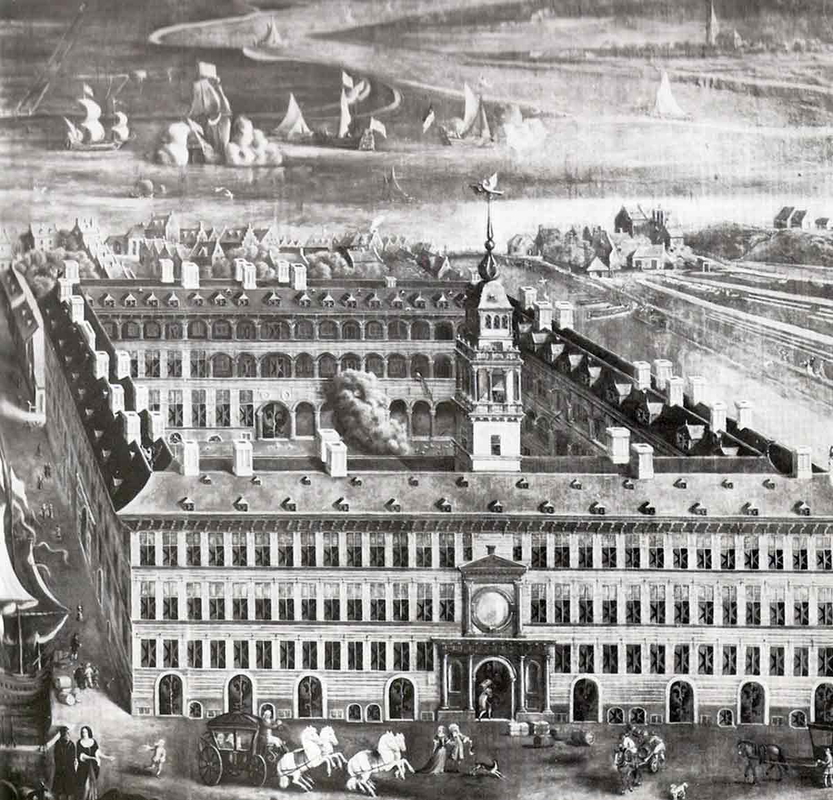
As the association grew, foreign trading posts called Kontore were set up in cities such as Bruges, London, Bergen, and Novgorod. The posts were used to control maritime trade throughout the Baltic and North Sea regions. In Novgorod, Hanseatic traders sold salt and cloth to local merchants and cornered the trade in items such as flax, leather, and fur. They also dominated the trade in wax, which was used to make church candles and official seals.
Amidst this growth, the first Hansetag (Diet of the Hanse), a general assembly to create policy and discuss common business interests, was held in Lübeck in 1356.
Revolutionary Ships and a Fleet That Outmatched Kings
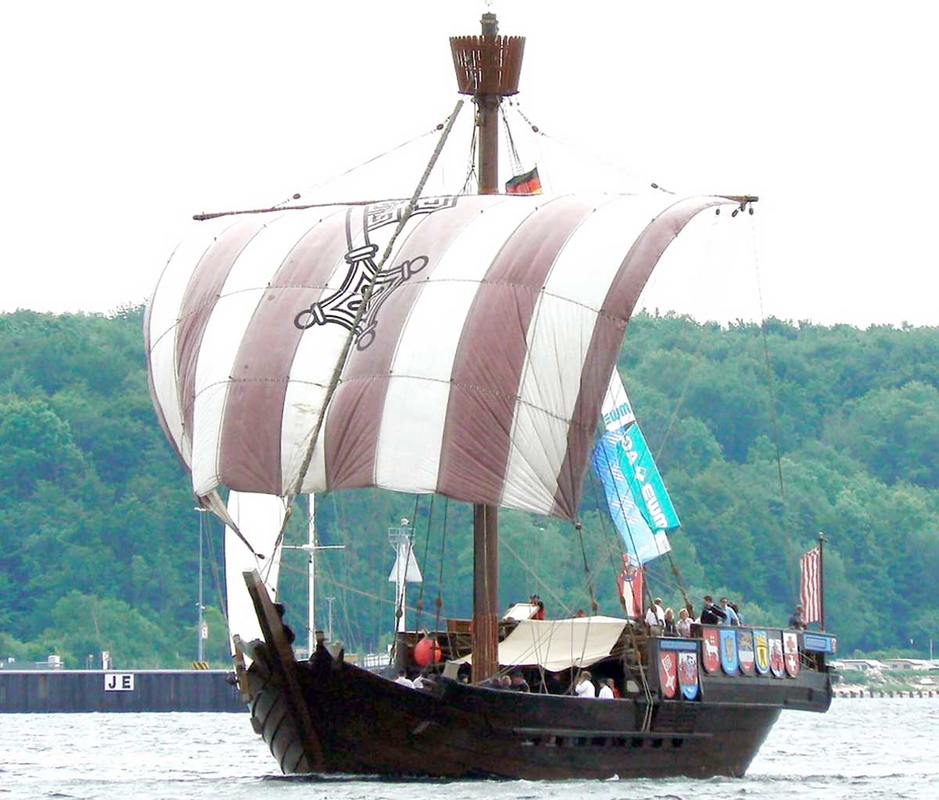
The Hanseatic League invested heavily in better ships and naval protection. One of the most unique types of ships used by the League was the cog. While earlier cargo ships carried smaller loads, cogs featured tall sides, wide beams, and flat-bottomed midsections. Along with a stern-post rudder, these features allowed the ships to transport over 200 tons of heavy cargo into shallow coastal waters. By the 1300s, the large vessels enabled the League to ship bulk commodities to their ports, unload at Lübeck (on the Baltic side) or Hamburg (on the North Sea side), and then transport them overland across the narrow German isthmus via the Old Salt Road.
The League also wielded formidable military power. For example, when Denmark’s King Valdemar IV attempted to restrict Hanseatic influence by attacking the trade hub of Visby on Gotland in 1361, the League responded by forming a coalition called the Confederation of Cologne in 1367. The alliance, which included Dutch towns, allied with the Kingdom of Sweden. With a jointly financed fleet, the Confederation defeated the Danish navy. The resulting Treaty of Stralsund in 1370 gave the Hanseatic League important trade privileges, control over key Scanian fortresses, and two-thirds of the customs revenues from those castles for 15 years.
Why Europe’s Greatest Economic Power Finally Crumbled
Over time, changing trade routes and growing competition from foreign maritime powers, chiefly Dutch and English merchants, weakened the Hanseatic trade network. Moreover, the emergence of strong new monarchies in England and France, as well as the devastation of the Thirty Years’ War in Central Europe, reduced the ability of the remaining towns to contribute financially to the league. Consequently, foreign powers soon took military control of trade routes in regions once dominated by the League and taxed Hanseatic vessels.
When the last official Hanseatic Congress (Hansetag) was held in Lübeck in 1669, only nine cities participated.