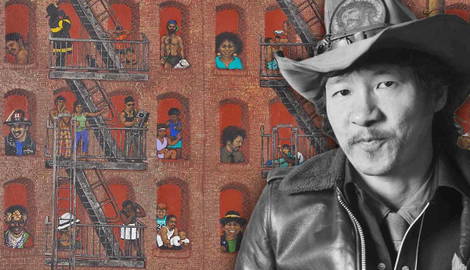

Martin Wong, a gay Chinese-American artist, was committed to exploring the vicissitudes of urban life in a city that was only barely pulling itself out of bankruptcy. His paintings were unabashedly queer and avowedly multicultural, as he spent his New York years in the Loisaida neighborhood with his Nuyorican friends and lovers. A dedicated collector of graffiti art, a member of several performance art groups, and a frequent exhibitor in the downtown gallery scene, Wong is a voice who deserves to be heard more frequently.
Wong’s Early Life
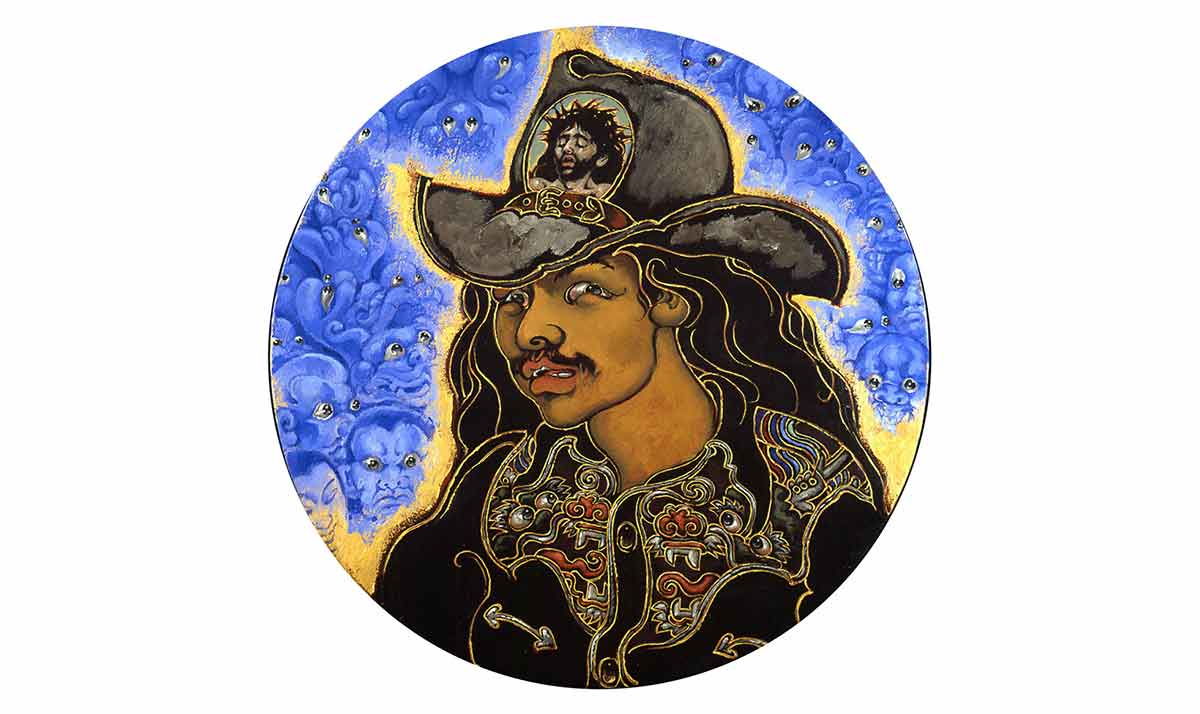
Martin Wong was born in Portland, Oregon in 1946 and raised in San Francisco, California to Chinese American parents. Since his father also had Mexican heritage, Wong labeled himself Chino-Latino. He studied ceramics at Humboldt State University and graduated in 1968, but decided to turn to painting after his inclusion of glitter in his ceramic pieces led to his rejection from an exhibition at the de Young Museum in San Francisco.
Wong then spent time as an itinerant in Eureka, California, doing work as a street portraitist and labeling himself the “Human Instamatic.” He studied art history, joined the gay street performance troupe the Cockettes, traveled to Asia and Europe, and immersed himself in circles of sexual and artistic liberation. Despite frequently joining various circles, he told a friend in 1967 that he was “always the outsider wandering the edges.”
Wong’s New York Life
In 1978, Wong moved to New York, where he took a room in the dilapidated Meyers Hotel near the South Street Seaport in exchange for cleaning wrecked rooms and working as a night porter. He eventually moved to the Lower East Side, which had an enclave of Puerto Ricans who called the area “Loisaida.” There, he began frequenting art spaces such as the Nuyorican Poets Cafe and ABC No Rio, where he met the poet Miguel Piñero. Wong and Piñero were lovers for a time and collaborated on some of Wong’s art pieces. Wong was deeply immersed in his community and once said that, “Everything I paint is within four blocks of where I live, and the people are the people I know and see all the time.”
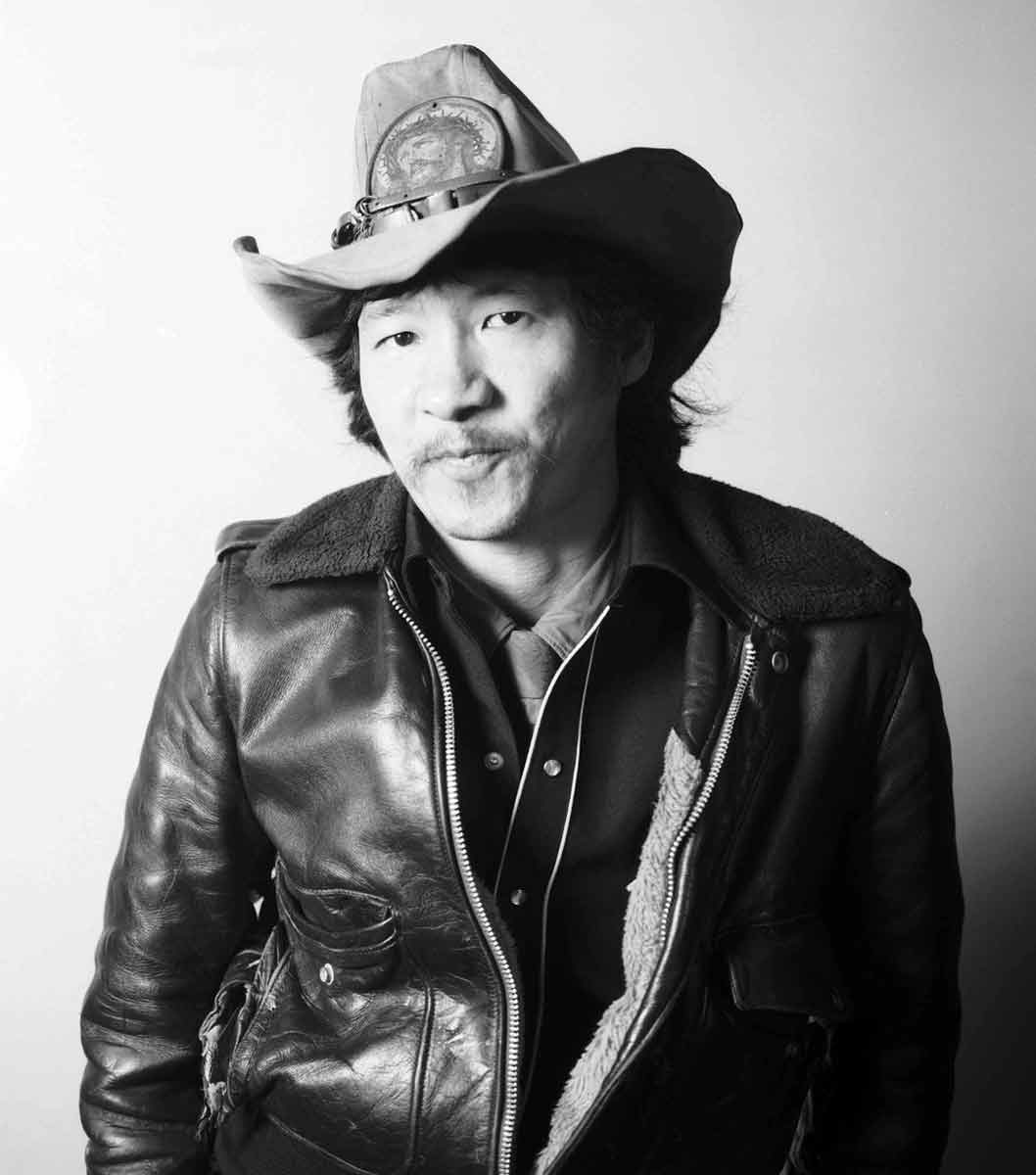
Wong, with his Fu Manchu mustache and cowboy hat, became a fixture in the downtown arts scene, working alongside Kiki Smith, Keith Haring, and David Wojnarowicz. He was a fervent collector of street art, amassing over 300 pieces and co-creating the Museum of American Graffiti on Bond Street. He later donated the collection to the Museum of the City of New York when he realized he had AIDS and wanted to make sure the pieces were not lost.
Wong’s work mixed the real and the fantastical, the gritty and the sublime. He painted his immediate environs of crumbling tenements, piles of detritus, crowded streets, handball courts, and empty streets, as well as the people who lived there—families, artists, the unhoused, the underclass. In a 1984 artist’s statement, Wong wrote, “Taking down to street level this time, I wanted to focus in close on some of the endless layers of conflict that has us all bound together… Always locked in, always locked out, winners and losers all…”
Wong’s Later Life
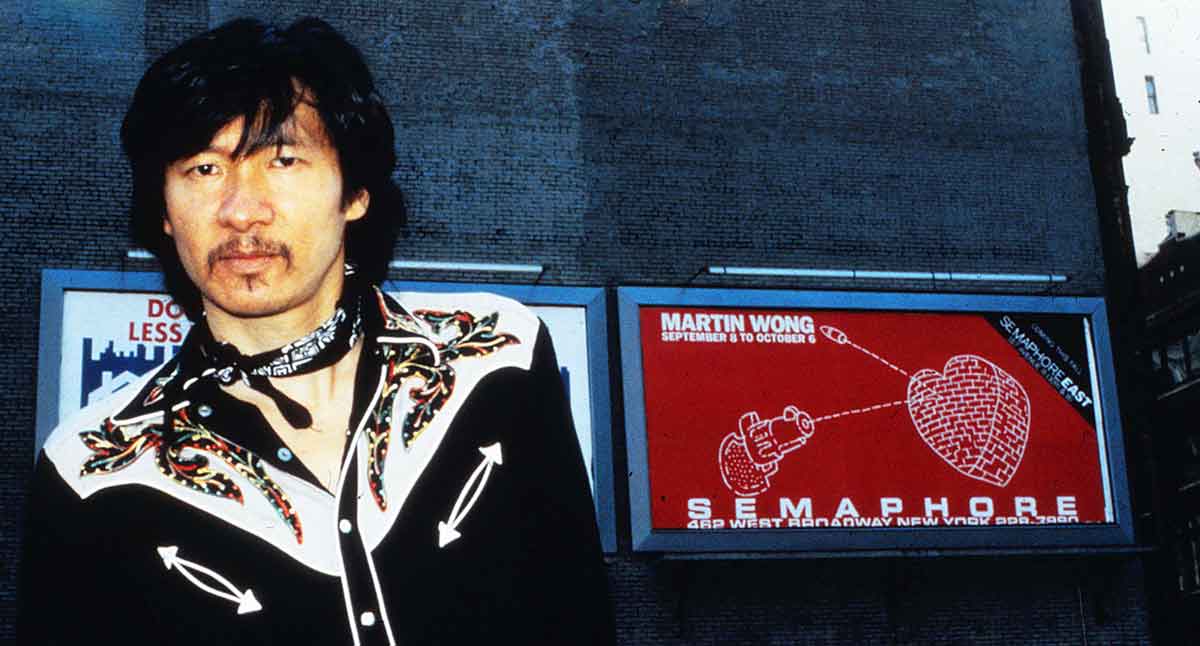
Wong returned to San Francisco, where he was cared for by his mother, with whom he shared a love of art and collecting—some of his last works were of the cacti in her garden. Wong died of AIDS-related complications at age 53 in 1999. After he died, Carlo McCormick wrote in the “Passages” column in Artforum that there was an immediate outpouring of grief from friends and family. McCormick tried to sum up the artist, concluding that there was no one version of Wong:
“The curious reality is that there wasn’t a single Martin so much as countless Martins: a perversely encyclopedic collector of cultural artifacts, from lunch boxes to plaster mammies; the single greatest patron of the graffiti-art movement at the nadir of its public and institutional popularity; a pathologically prevaricating provocateur-raconteur and troublemaking gossip; a wise old man of many lives and at the same time one of the most irrepressibly juvenile kids in a scene where most were half his age; and, above all, a profoundly idiosyncratic artist whose obsessively social representations of Manhattan’s Latino Lower East Side remain as visionary testament to and haunting document of a time and place renovated and sanitized into oblivion. Martin Wong was such an outrageous character that no one person’s memories could ever completely capture his irrational spirit.”
Four Key Works of Art From Wong’s Portfolio
1. Psychiatrists Testify: Demon Dogs Drive Man to Murder, 1980
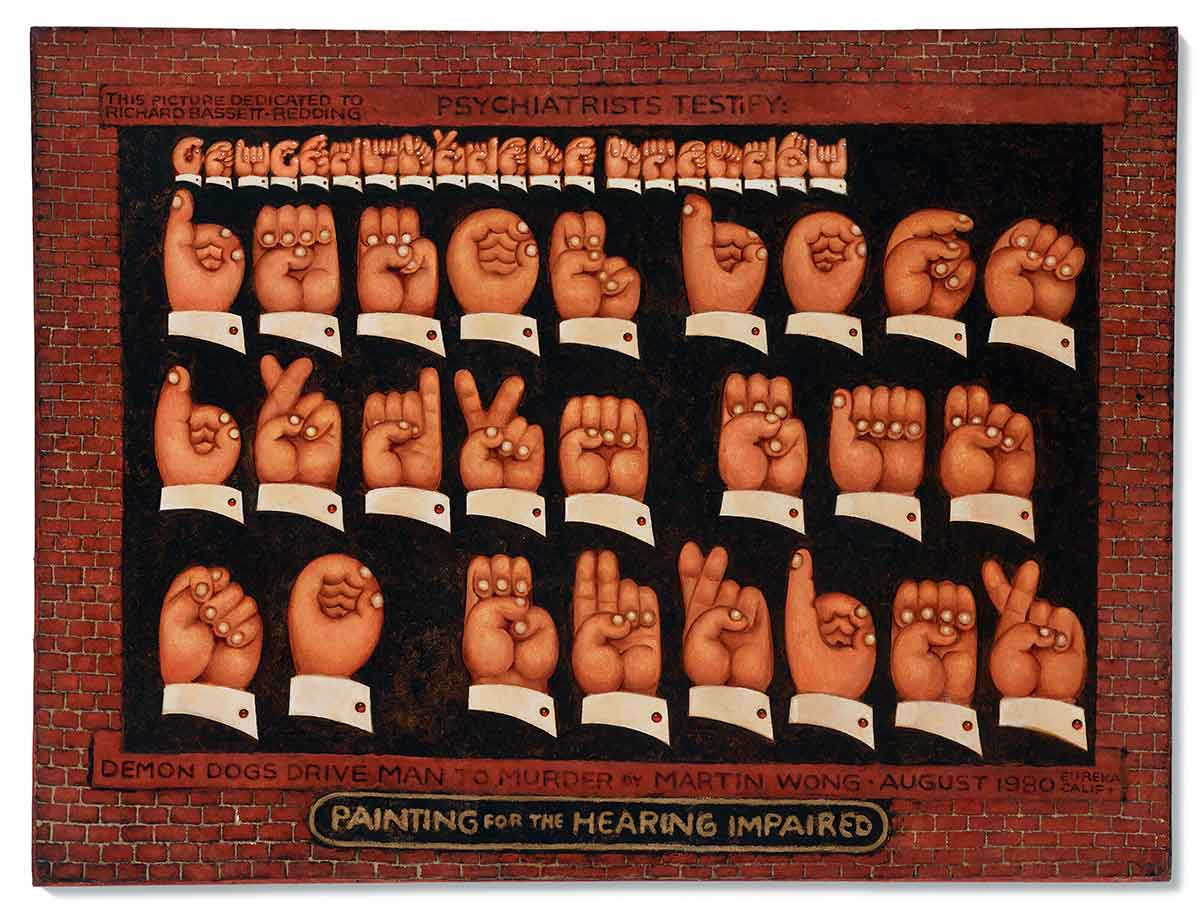
In this piece, Wong weaves in references to the notorious Son of Sam murderer, American Sign Language, the built environment of New York, the media, and the prurient predilections of the American people. The title of the painting is taken directly from a Weekly World News article about the infamous serial killer who terrorized New Yorkers in the hot summer of 1977. The killer, David Berkowitz, murdered seven people and left mocking letters for the police as he eluded their manhunt. When he was finally caught, he said he was obeying the orders of a demon, a fantastical tale that mesmerized the public. Wong was troubled by the lionizing of this figure while others, queer people in particular, were shunned and scorned.
Most of the canvas is taken up by fleshy hands finger-spelling out the title in American Sign Language (some critics suggest that the use of the fingers also alluded to gang signs or secret codes used by homosexuals). They are against a brick background, a familiar image in Wong’s New York works. The presentation of the hands on a black square affixed on the wall suggests one of the ubiquitous posters tacked up on fences, walls, and scaffolding throughout the city, intended for fading and obsolescence—the only thing not fading, in this case, the pain caused by Berkowitz’s actions.
2. La Vida, 1987
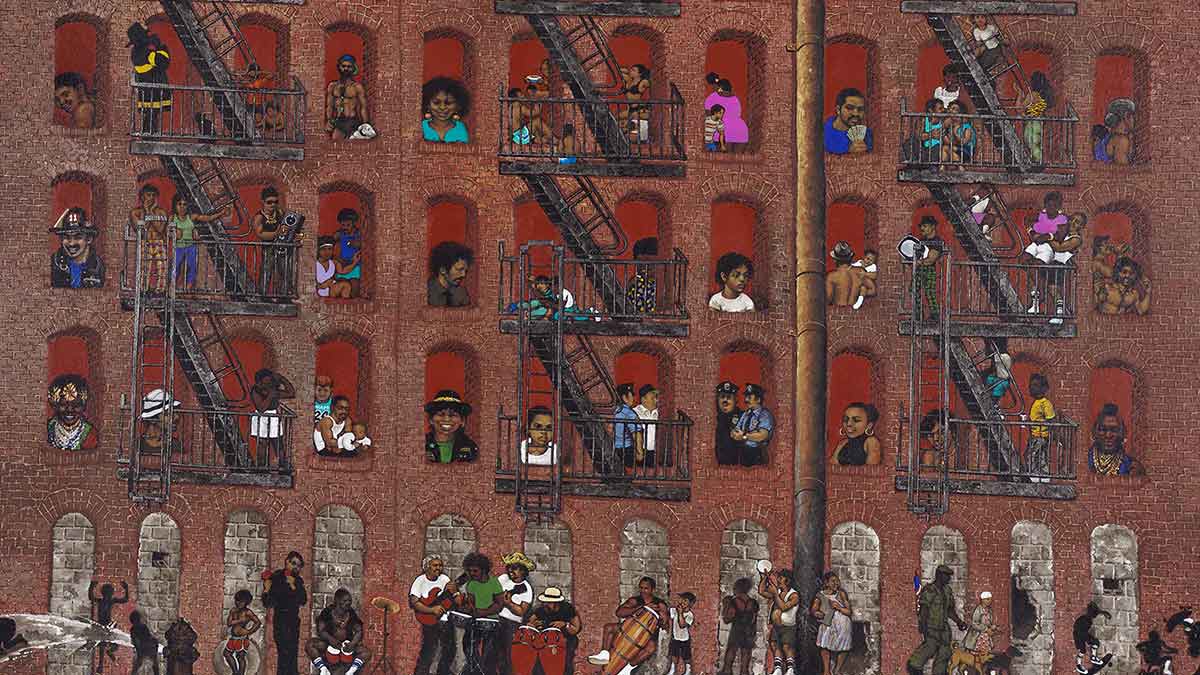
La Vida is an ambitious piece: the entire canvas is filled with the brick façade of a tenement building and dozens of its residents. It is almost reminiscent of a triptych in its division into three sections, each with a central fire escape, three rows of four arched windows, and a street-level arcade with the arches closed off by cement blocks.
Variety is the defining characteristic of this lively, dynamic painting. There are babies and boomboxes, smiles and smolders. Firemen, cops, the graffiti artists Daze and Sharp, the poet Amiri Baraka, and the actor Mr. T, while multiple versions of Piñero populate the windows. At street level, children leap into a gushing fire hydrant, a military veteran walks dogs, and a group of men joyfully play live music. The pastiche of celebrities, neighborhood regulars, and invented characters clearly indicates this isn’t a real place or a distinct moment in time but rather a broad celebration of the neighborhood’s people and culture.
3. Big Heat, 1986
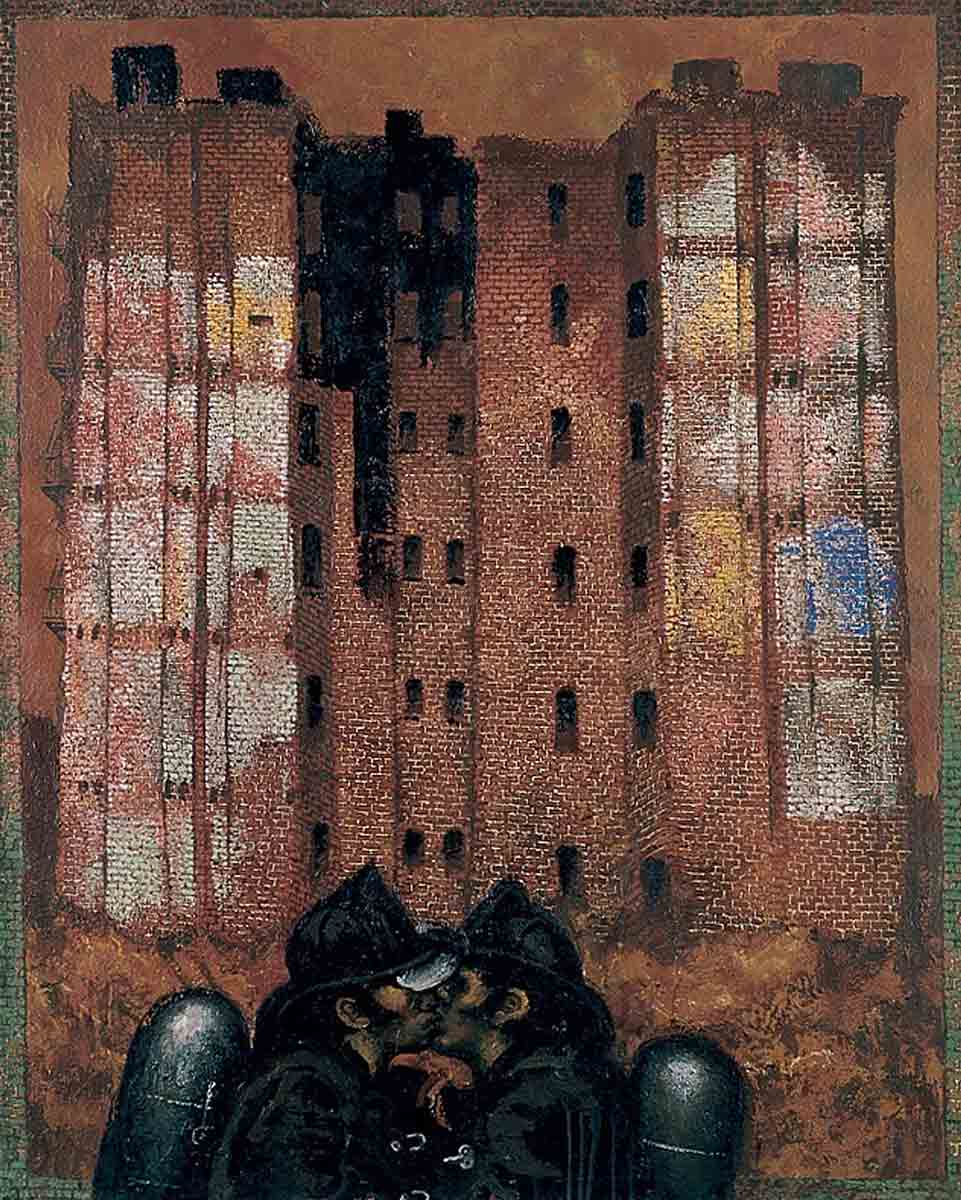
Wong had a self-professed predilection for firefighters, writing in one work that “I really like the way firemen smell when they get off work. It’s like hickory smoked rubber and B.O.,” and wearing FDNY gear his friends gave him around the neighborhood (even though doing so was a felony).
Big Heat puts this fetish on full display. In an almost apocalyptic scene, two firemen embrace in the foreground of the canvas while tall brick buildings loom behind them, silhouetted against an iron sky. The buildings are burnt-out, falling down, uninhabited, but there is love here regardless. The Whitney Museum of American Art calls this piece a “utopian vision of hope, love, and redemption within the crumbling environs of what was once one of New York’s poorest neighborhoods.”
The piece has a complicated history. It was featured on the show People Are Talking, in which host Bill Boggs asks a panel of artists to defend a work of art (using the absurd question “is it art or is it diarrhea?”) while the studio audience jeers. Wong was hidden in the audience and revealed himself in his strange outfit at the end, confusing the audience. He said cryptically, “I don’t know why everyone assumes they’re kissing. They just happen to be Siamese twins joined at the mouth.” He noted in his sketchbook that the work was “an allegory for the age of AIDS representing Hypnos and Thanatos, sleep & death.”
4. Canal Street, 1992
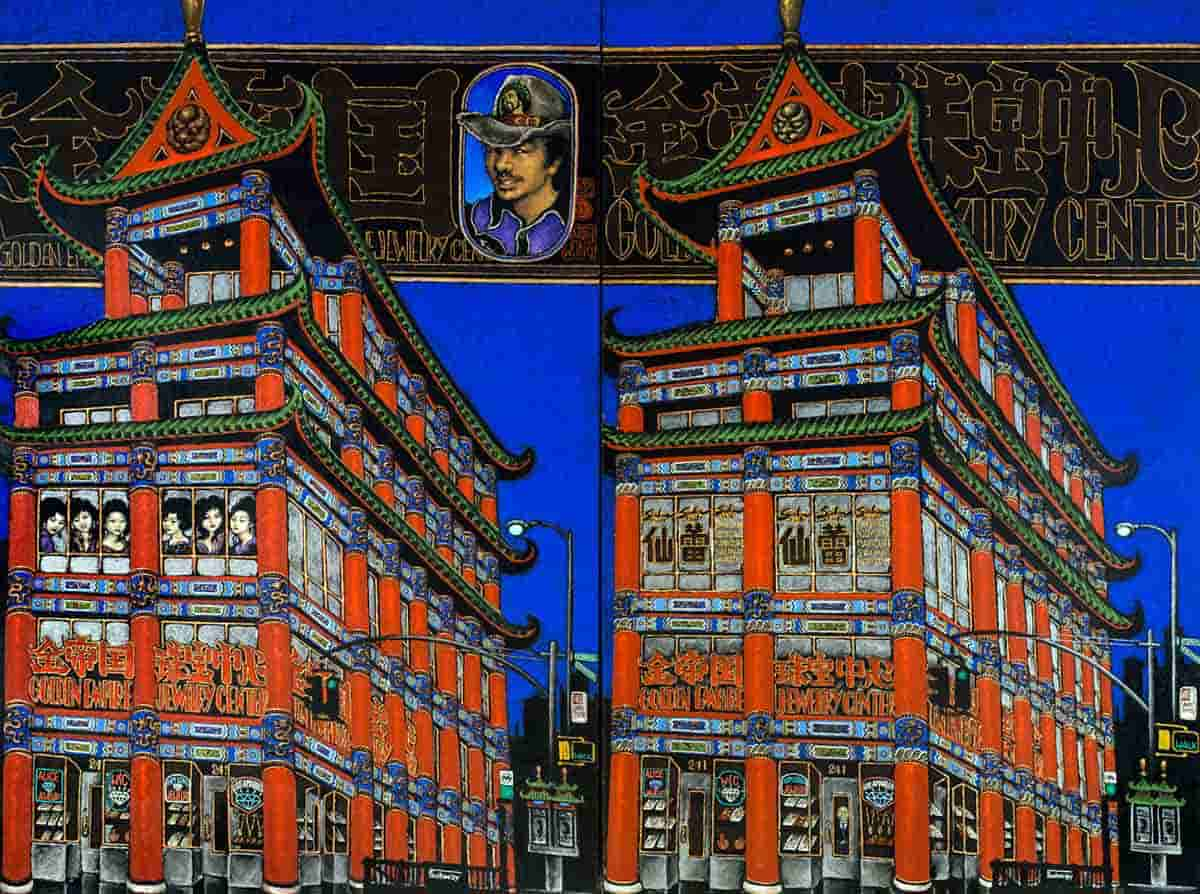
Wong was initially wary of venturing into New York’s Chinatown with his art, fearing himself an outsider. But he eventually did explore the neighborhood and, in his later years, made both the New York and San Francisco Chinatowns the subject of some of his paintings. In this painting, he duplicates a building—the Golden Empire Jewelry Center on the corner of Canal and Center Streets—but incorporates a few differences between the two, such as the six elegant women in the windows on the left and a single man on the bottom level of the edifice on the left. A black banner stretching across the top of the canvas features gold-bordered letters and characters spelling out the name of the building in English and Chinese, and in the middle of the banner is a self-portrait of the artist, grinning affably and wearing flashy cowboy attire. Scholar Richard G. Mann suggests that “located midway between two differently gendered versions of a stereotypically Asian structure in America’s largest city, Wong is ideally situated to construct a distinctive identity, composed of diverse cultural and sexual elements.”