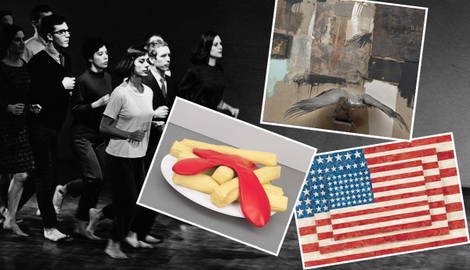

Although Abstract Expressionism, with its capacious, splattered, and stained canvases and its heroic, larger-than-life artists wielding their brushes like their lives depended on it, was still the most famous art movement of the 1950s, and painting was certainly the most esteemed medium, a few artists such as Robert Rauschenberg and Jasper Johns challenged its sway over the art world, offering subversive and oftentimes amusing works that refused to identify themselves as painting or sculpture. Neo-Dada artists also collaborated with dancers and composers, finding inspiration in the dialogue between the disciplines.
What Is Neo-Dada? A Primer
To understand what “neo-dada” means, it’s necessary to first understand “Dada.” Dada art was a style that originated in Europe during and just after the WWI years, flourishing in cities such as Zurich, Paris, and Berlin. (Although in German “da da” is translated to “there, there” and in French it means “hobbyhorse,” the term “dada” as used here is nonsense; it was simply intended to be as anti-art a name as possible.)
Hugo Ball, its founder, stated, “Revolted by the butchery of the 1914 World War, we in Zurich devoted ourselves to the arts. While the guns rumbled in the distance, we sang, painted, made collages and wrote poems with all our might.” Dada was flamboyant, irreverent, nonsensical, and piquant, offering critiques of its bellicose and soulless society through performance, sculpture, poetry, and text.
Neo-Dada, then, was the label given to the 1950s American artists who also eschewed traditional boundaries between the mediums of painting and sculpture and who refused to jettison real life from their works like the Abstract Expressionists endeavored to do. Rauschenberg claimed that he worked in the “gap between art and life,” and Johns, for example, included real beer cans and images of maps and flags, while Cy Twombly evoked the scrawls of graffiti in his pieces.
Neo-Dada artists found inspiration in the quotidian and the commonplace, the base and the banal. They were experimental, and their work was often challenging to the lay viewer, who struggled with symphonies of silence and paintings of pure white. Nevertheless, their works permeated the consciousness of the art world and facilitated important conversations about art’s telos.
Robert Rauschenberg (1925-2008)
Rauschenberg is perhaps the most famous of the Neo-Dada artists. A prolific, dexterous, and endlessly inventive creator, his “combines” challenged the traditional separation of mediums. Critic Brian O’Doherty wrote of the combines in 1963, “For many years Mr. Rauschenberg has been pointed steadily towards an annihilation of conventions in a new freedom. His main characteristic is a conquest of common, everyday reality from a bridgehead of abstract expressionism. He is trying to materialize an ambiguous limbo between high art and low life.”
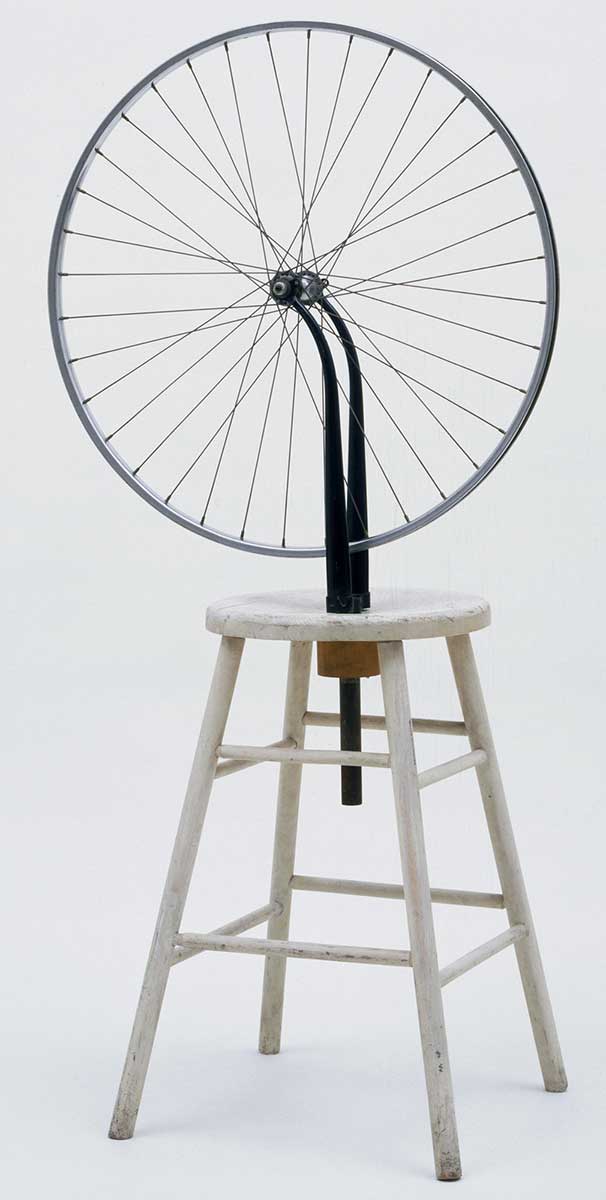
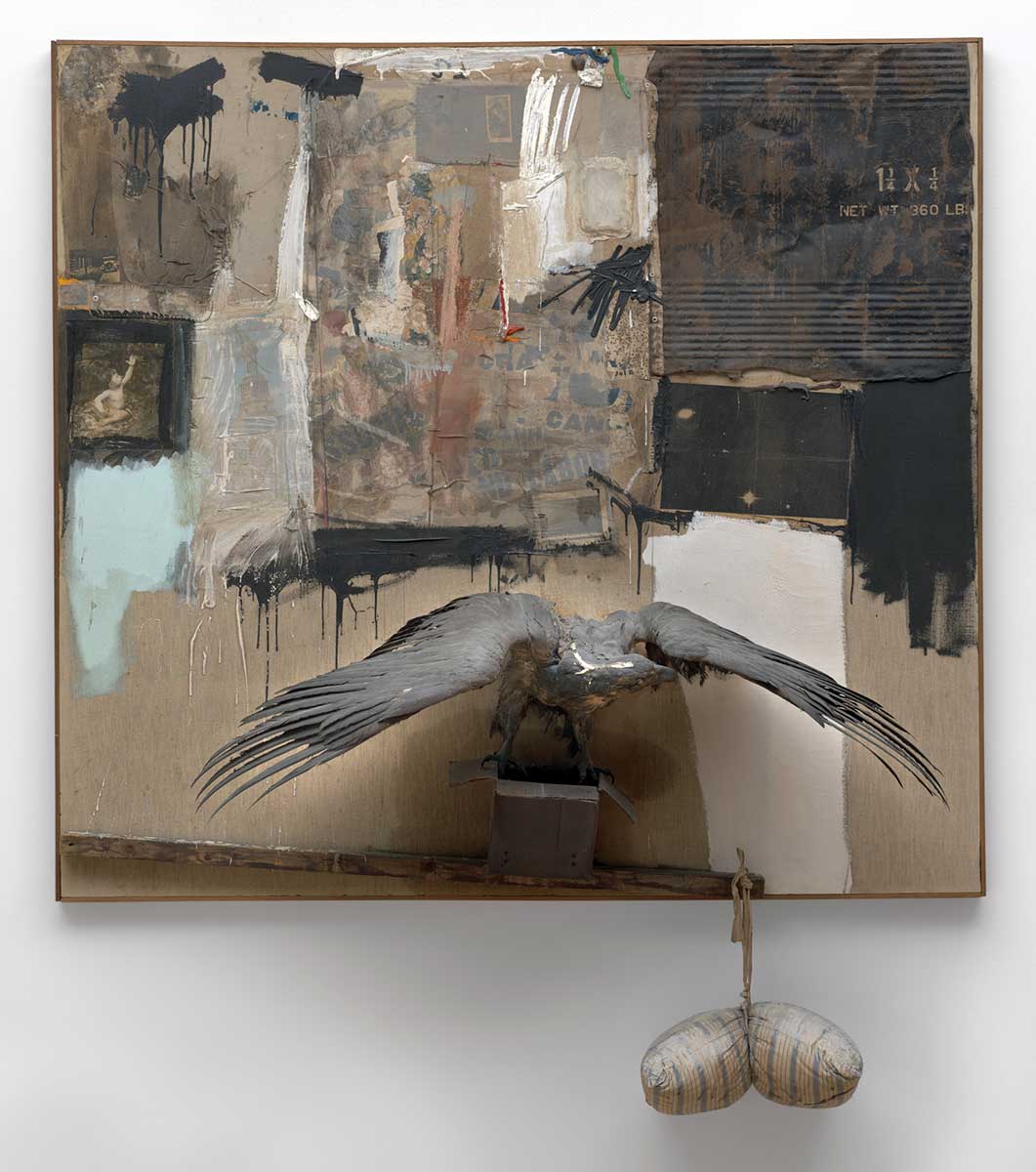
In these works, such as Monogram (1954-1959), he combined found objects in the mode of the “readymade”—Dada artist Marcel Duchamp’s term for the found object that became a work of art when activated by the artist and the exhibition space—painted surfaces, and collage. In Canyon (1959), he combined a taxidermied eagle his friend found in the trash, paintings, a photo, and other printed matter. In Bed (1955), he took an actual bed with a wooden frame, sheets, and a pillow, scribbled and splattered paint on it, and then hung it from the wall like a traditional painting.
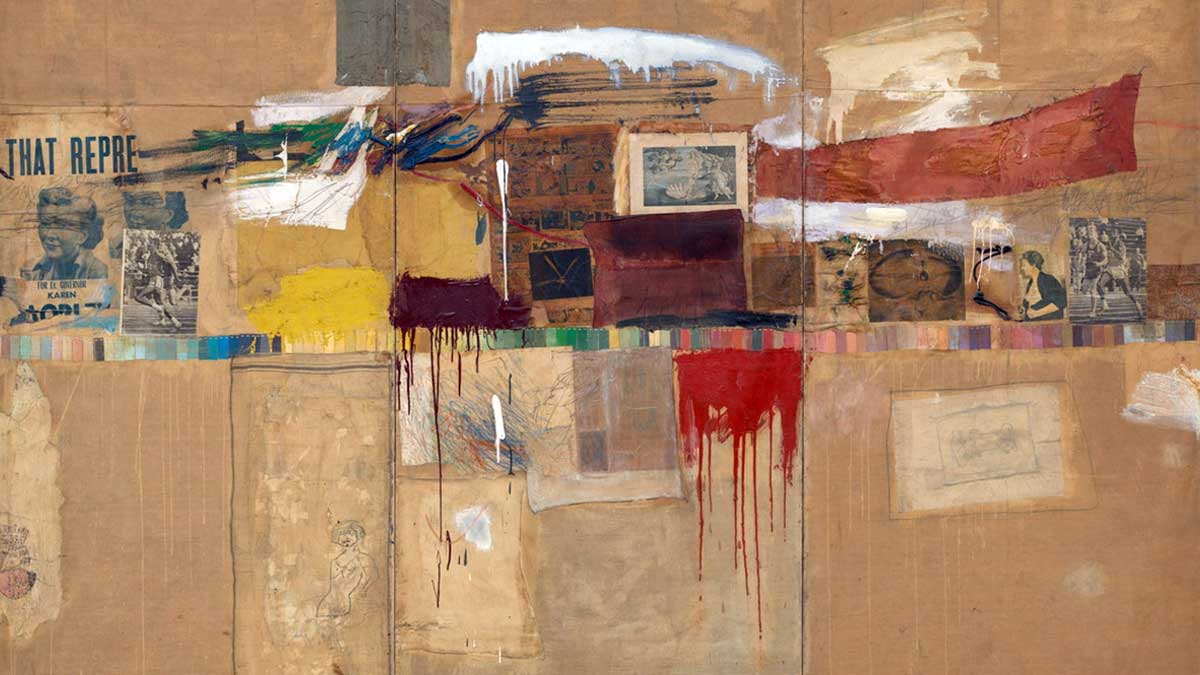
Rauschenberg refused to be confined by any label or fall prey to the assumption advocated by the Abstract Expressionists that an artist must be cerebral, stoic, and removed from the vicissitudes of life. Rather, Rauschenberg said, “I always wanted my work—whatever happened in the studio—to look more like what was going on outside the window.” This meant that he was also engaged in other avant-garde scenes, such as music and dance.
Scholar Brandon Joseph wrote, “Throughout his career, Rauschenberg was most inventive when in intense, dialogic, and collaborative contexts, from Black Mountain to the Merce Cunningham Dance Company (for which he provided sets, lighting, and costume design) to the Judson Dance Theater (which he lit and performed with) and beyond.” Joseph claimed that “none of Rauschenberg’s contemporaries…would maintain the artist’s multiplicitous and inherently deconstructive interest in combining mediums (and media) into amalgams that would exist simultaneously within all of the media they straddled—and at the same time none.”
Jasper Johns (1930-)
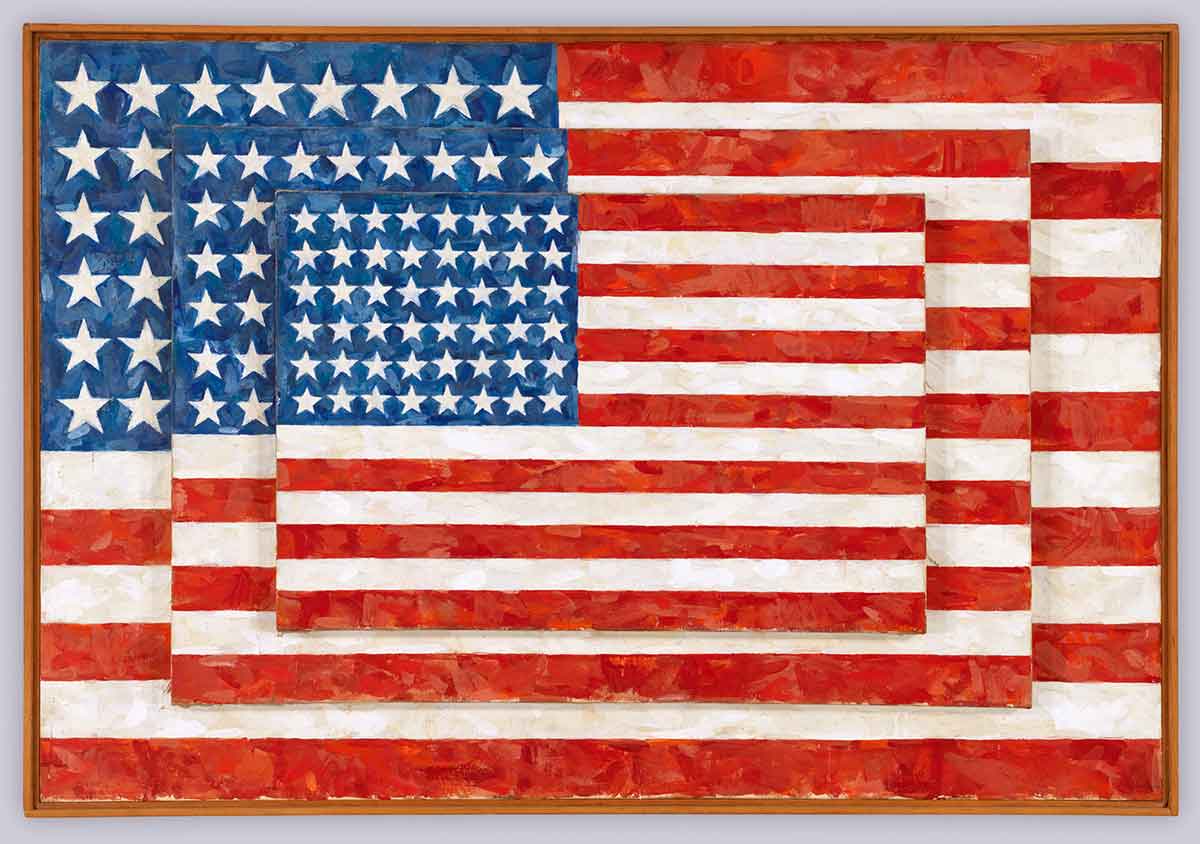
If there is a figure who came close to Rauschenberg’s inventiveness, it was his friend, lover, and collaborator Jasper Johns. It’s hard to even sum up his oeuvre, and anyone hard-pressed to name his most famous piece would have to choose between the flags, the maps, the numbers, the cross-hatch paintings, the beer cans, the plaster heads, and so on. Johns was an erudite, serious, and accomplished artist, but he chose to incorporate quotidian objects and imagery, “things the mind already knows,” as he put it.
Johns had started off as a painter but struggled with the legacy of Abstract Expressionism. He destroyed all his previous work and moved into recognizable objects like the flag and the alphabet. He preferred to use primary colors and while he did use paint, he mixed it with encaustic to create a quick-drying material that had almost sculptural qualities.
The Broad Museum says of Johns’ early encaustic paintings that “Johns presents images that move into the realm of objects and wrestle with the validity of representation as a philosophical concept. The targets and flags, in the words of critic Leo Steinberg, were ‘co-extensive’ with their canvases, existing somewhere between a symbol and a thing in the world. Not only did these paintings begin Johns’s successful dismantling of modern art through his ironic analysis of structures and rituals, but they also became the innovative new ground on which a generation of painters and sculptors made their work.”
Claes Oldenburg (1929-2022)
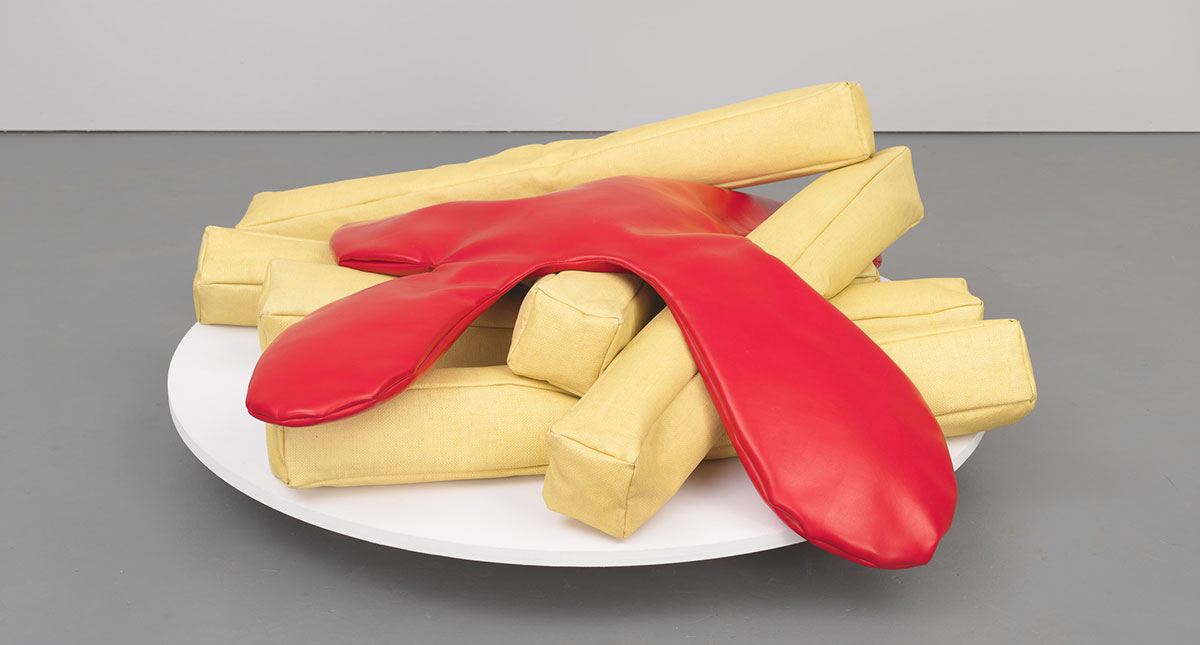
Claes Oldenburg made the case, as emphatically as Warhol with his soup cans, that food could be art. A hamburger, a piece of pie, french fries and ketchup—Oldenburg took American comfort food and made it into rather uncomfortable art. The pieces were grotesquely large, made of either plaster or vinyl. The vinyl pieces, or the “soft sculptures,” flopped, sagged, and sighed, while the plaster pieces maintained a brittle rigidity.
Oldenburg opened The Store in 1961, recreating the look and feel of neighborhood shops but with a spin. He had numerous small art pieces displayed like normal wares, but they were made of plaster-dipped muslin over wire and covered with garishly bright paint and had something uncanny about them. Like Rauschenberg and Johns, as well as the Pop artists, Oldenburg was interested in the banal, in the disposable, in the detritus of late-capitalist society.
In a 1961 artist’s statement, Oldenburg elucidated his feelings about art: “I am for an art that is political-erotical-mystical, / that does something other than sit on its ass in a museum. / I am for an art that grows up not knowing it is art at all, an art given the chance of having a starting / point of zero. / I am for an art that embroils itself with the / everyday crap and still comes out on top. / I am for an art that imitates the human, that is / comic, if necessary, or violent, or whatever is / necessary.”
Cy Twombly (1928-2011)
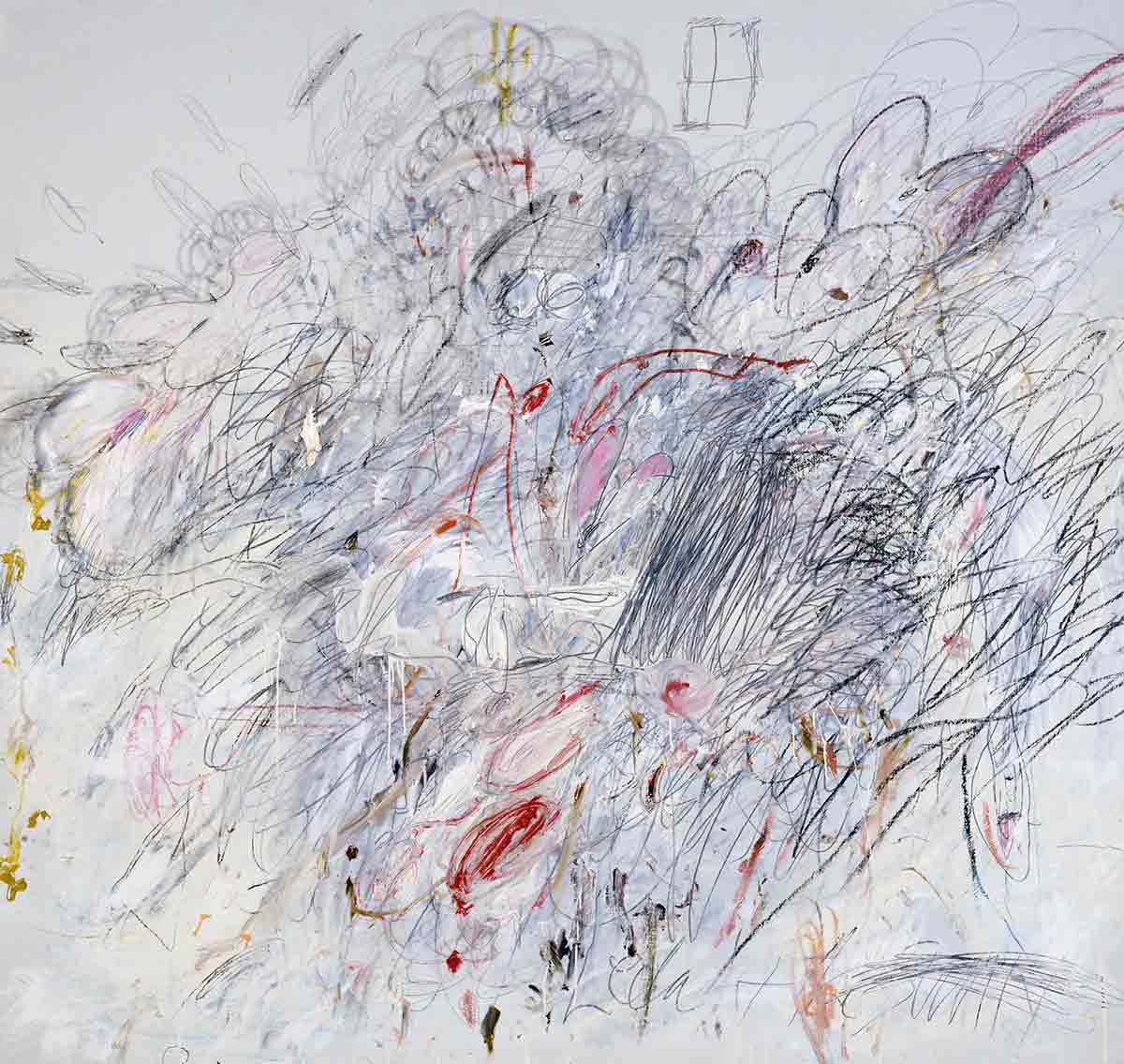
Cy Twombly’s scrawls and scratches represented a new type of gesture in visual art. Gagosian Gallery explains that “he produced works that [were] simultaneously personal and mythological, allowing narrative, language, and inner visions to erupt from his intimate, abstract notations,” doing so through painting’s traditional tenets, such as using canvas and hanging works from the wall, but ultimately deviating from many of the medium’s other characteristics.
He made marks and then erased them, referenced calligraphy and graffiti, left gaps and fragmented lines, traversed centuries, and conflated civilizations. He brought in sex, dirt, and violence, dialoguing between the ancient and the contemporary.
In 1962’s Leda and the Swan, he took the ancient myth of Jupiter turning into a swan and raping Leda and abstracted it into a cacophony of line and splotch and smear. The violent assault of Leda comes across through the violent assault on the canvas by crayon, pencil, and paint. The colors suggest semen, blood, feathers, and feces; the few discernible images of a window, heart, and phallus suggest the outlines of the story, but it is the feeling produced by the piece that gives it its power. Academy (1955) is sparser, using oil-based house paint (which Twombly smeared with his fingers), pencil, colored pencil, and pastel on canvas to create what looks simply like gray pencil scrawlings on canvas.
Critic Ann Temkin remarked that for Twombly, “the canvas was a field for mark-making that shouted and whispered, surged and slowed, swirled and skittered. The approach harked back to the automatism of the Surrealists…but now it had traded biomorphic elegance for a seemingly untutored rawness.” Temkin concluded that “Academy alludes to a tradition, a school, a set of accepted practices. Yet it is attached to a painting that writes itself out of art school and finds instead a territory unoccupied by official precepts or proscriptions,” and indeed, Academy is certainly something that its namesake would not have (initially) accepted.
John Cage (1912-1992)
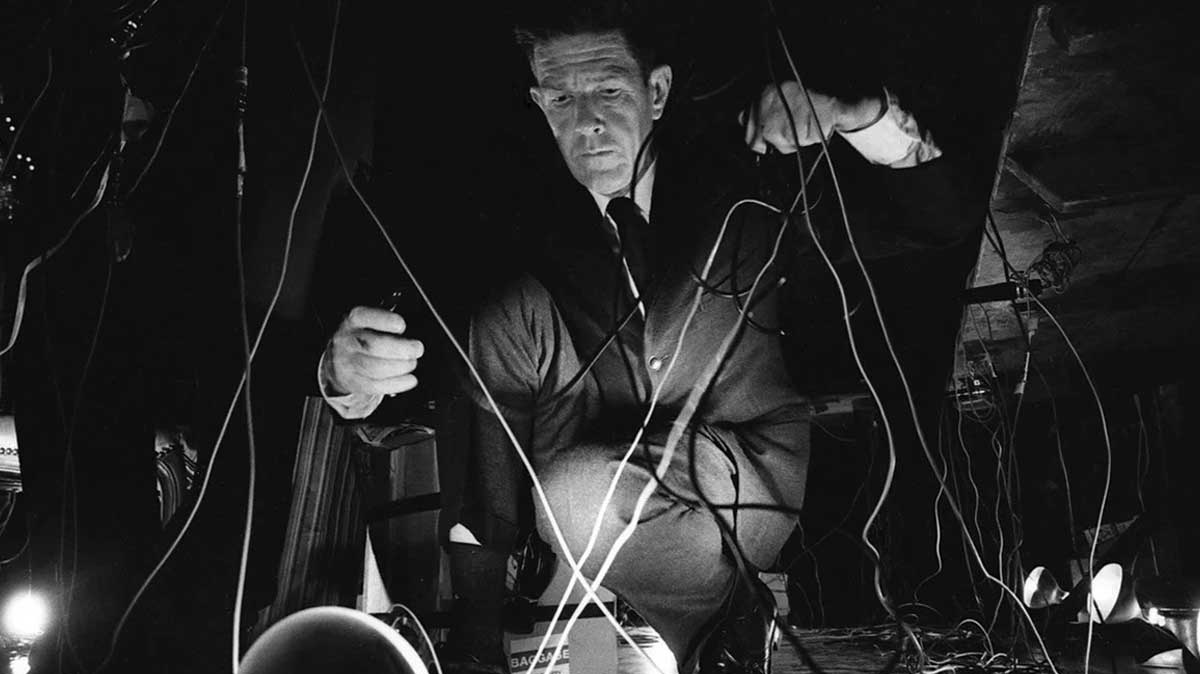
John Cage was a composer who studied with modernist, atonalist composer Arnold Schoenberg. Like all composers, he sought to communicate through music, but he abandoned hierarchy and order in his pieces, not to mention the heroism and ego that came with being a composer. He valued the senses, chance, and spontaneity, and was also inspired by Duchamp’s readymade, looking for ways to interpret that pulled from real life in music. Cage said of Duchamp’s famous The Bride Stripped Bare by Her Bachelors, Even (The Large Glass) (1915-1923) that the thing he liked so much is that “I can focus my attention on wherever I wish. It helps me blur the distinction between art and life and produces a kind of silence.”
And it was silence for which Cage became famous (or infamous). In his piece 4’33, a piano player sits down on the bench before the instrument but does not touch the keys for four minutes and thirty-three seconds. In that time span, what seems to be silence is instead filled with sounds—people coughing, shuffling their feet, whispering to their companions, moving their chairs, tapping their heels. The first time this was staged, the audience’s consternation was palpable, but Cage didn’t care; he was asking his audience what music really meant—what the limits of silence and sound really were.
The composer and scholar Kyle Gan suggested that the piece “begged for a new approach to listening, perhaps even a new understanding of music itself, a blurring of the conventional boundaries between art and life.”
Judson Dance Theater: Yvonne Rainer, Trisha Brown, and More
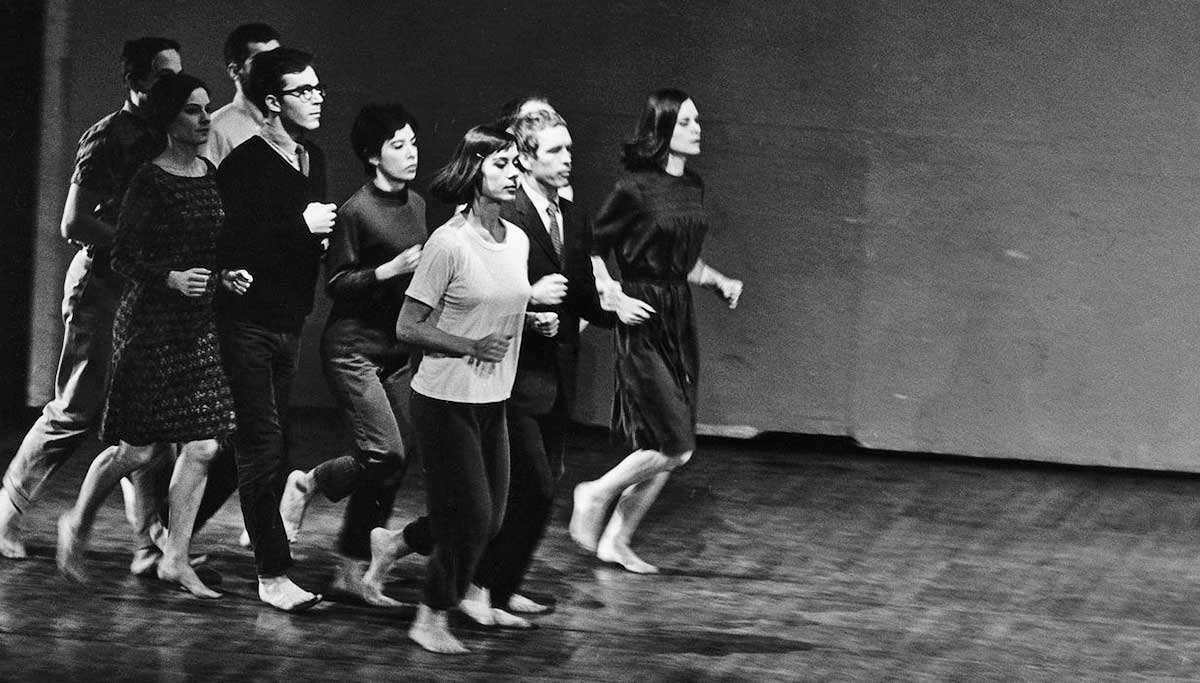
The Judson Dance Theater was a collective of dancers, choreographers, and visual artists headquartered at the Judson Memorial Church in Manhattan’s West Village. The Church was a well-known performance space where Judson staged numerous works that challenged prevailing notions of dance. The main figures, including Yvonne Rainer (1934-), Trisha Brown (1936-2017), Lucinda Childs (1940-), and Simone Forti (1935-), wanted to democratize dance by emphasizing “task movement”—the commonplace, anti-expressionistic gesture.
The New York Times said of the movement in 1982, “following their own creative hunches, the Judson dancers experimented with structures ranging from the most rigid to the most improvisatory and incorporated many kinds of movements into compositions. To simplify what resulted, it could be said that these choreographers tended to emphasize the physical reality of the here and now and to maintain that any kind of movement can serve as a dance movement.”
We Shall Run, a 1963 piece, consisted of dancers simply running across the stage. They wore ordinary clothing and did simple, repeated actions. In Trio A, Yvonne Rainer’s 1966 masterpiece, there was a solo performer with no music—another thing Judson wanted to do was separate dance from music, the former being usually subordinated to the latter—who performed everyday movements. It was an exploration of action, not storytelling, and avoided any dramatic gestures like leaps or pirouettes. Though it was a difficult piece for a dancer to perform, it looked deceptively simple.
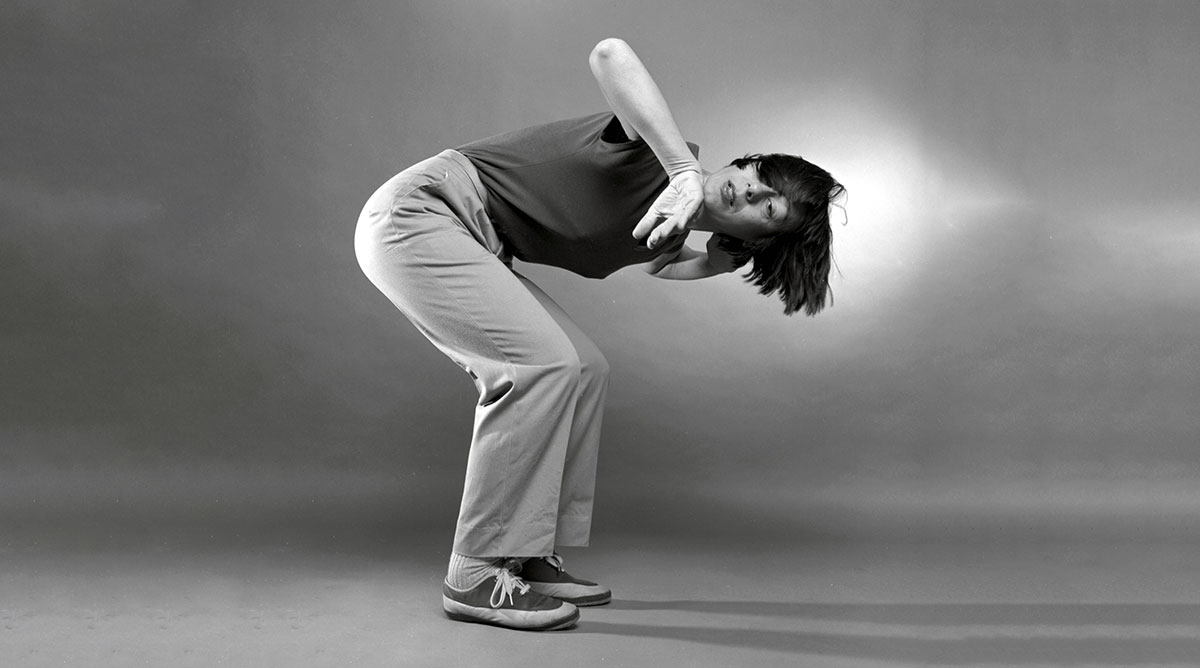
Rainer’s 1965 “No Manifesto,” a text she penned to articulate the new type of dance she promulgated, can describe much of neo-dada art as a whole:
“No to spectacle. / No to virtuosity. / No to transformations / and magic and / make-believe. / No to the glamour / and transcendence / of the star mage. / No to the heroic. / No to the anti-heroic. / No to trash imagery. / No to involvement of / performer or spectator, / No to style. / No to camp. / No to seduction of / spectator by the wiles / of the performer. / No to eccentricity. / No to moving or being / moved.”