
While most people know the name Pablo Picasso, how many of his artworks can you name? Did you know that across his 70-year career, he produced more than 50,000 works, including paintings, drawings, sculptures, ceramics, and more? The Spanish master manipulated mediums, forms, and genres, never ceasing to experiment and never settling on one style for too long. Consequently, he has left behind an eclectic portfolio from the melancholic depths of his Blue Period to the radical geometric fragments of Cubism and the agonizing protest of his political murals. Start your exploration of Picasso with 12 of his most iconic masterpieces that every art lover should know.
1. Self-Portrait, 1900
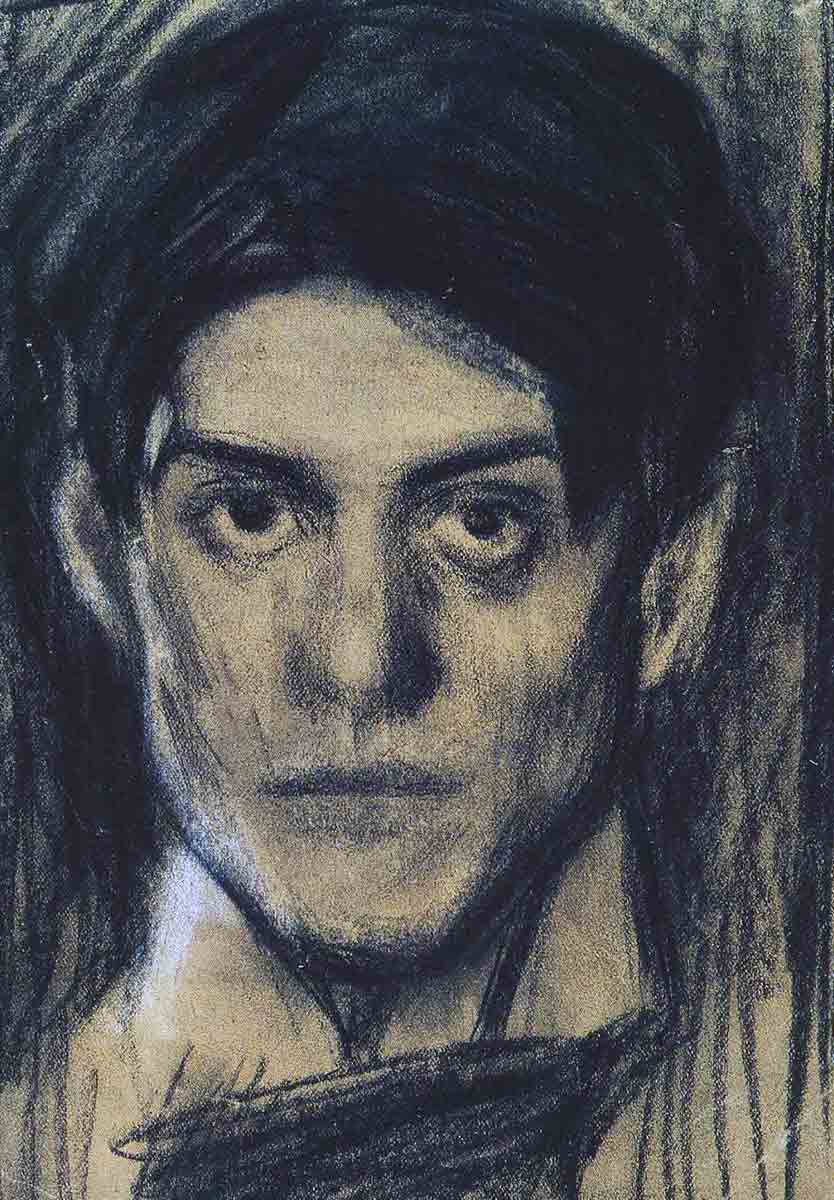
Pablo Picasso began his artistic training quite conventionally, with the Old Masters and Roman Antiquity as the key source materials. However, by his early 20s, he had already begun experimenting with modernist techniques. Picasso created this self-portrait when he was only 18 years old, a year before he moved from Barcelona to Paris. He already demonstrated immense technique and command of his medium, working in a Post-Impressionist style that is still quite realistic but already departing into experimentation. Over the years, Picasso created countless self-portraits that would evolve with him and his artistic styles.
2. The Life, 1903
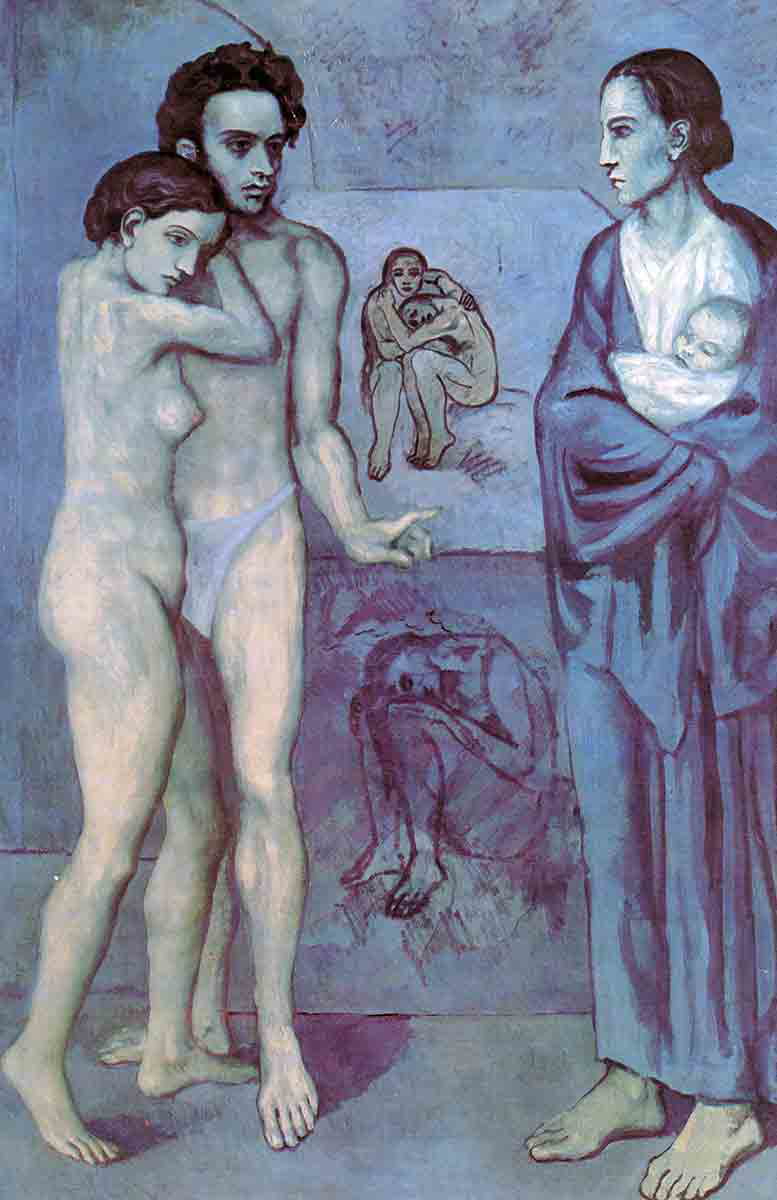
The Life was one of the most important paintings from Picasso’s Blue Period that came after the suicide of his friend Carles Casagemas. Casagemas suffered from depression and shot himself in a Parisian cafe in front of his friends. Traumatized by his death, Picasso started painting in blue and green tones, usually on subjects of loss, poverty, and despair. The Life features a portrait of Casagemas, almost nude, embraced by the woman who rejected him not long before his death. Curiously, an X-ray of the painting showed that originally the work was a self-portrait, later repainted to resemble Casagemas.
3. Acrobat on a Ball, 1905
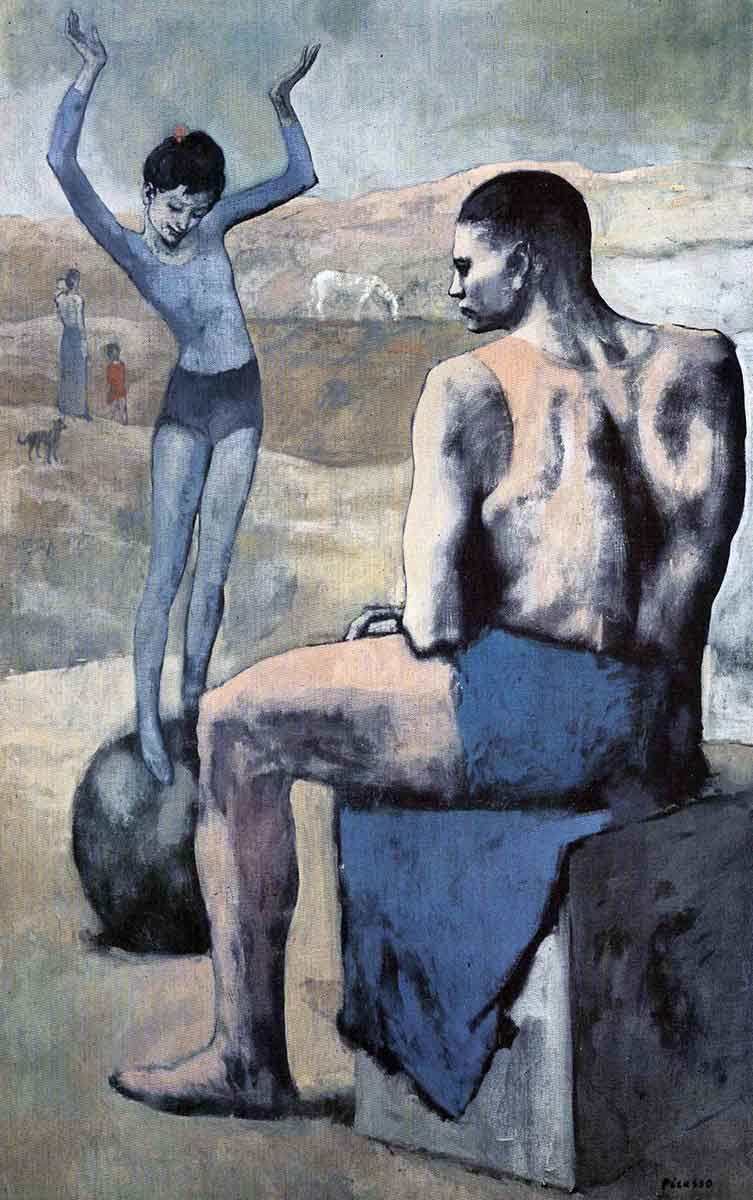
In 1904, Picasso fell in love with Fernande Olivier, a French artist and model who became his first long-term partner and major muse, easing the deep depression of his Blue Period. He gradually shifted tones and moved towards pinks and oranges. This stage of his life is usually called the Rose Period. He often painted groups of traveling performers and acrobats with whom he felt affinity. At the time, he lived in an artists’ commune called Bateau-Lavoir, sharing space with artists like Amedeo Modigliani and Georges Braque. Bateau-Lavoir was a former factory building, almost ruined and squatted by artists, poets, and failed actors.
4. Portrait of Gertrude Stein, 1905-06
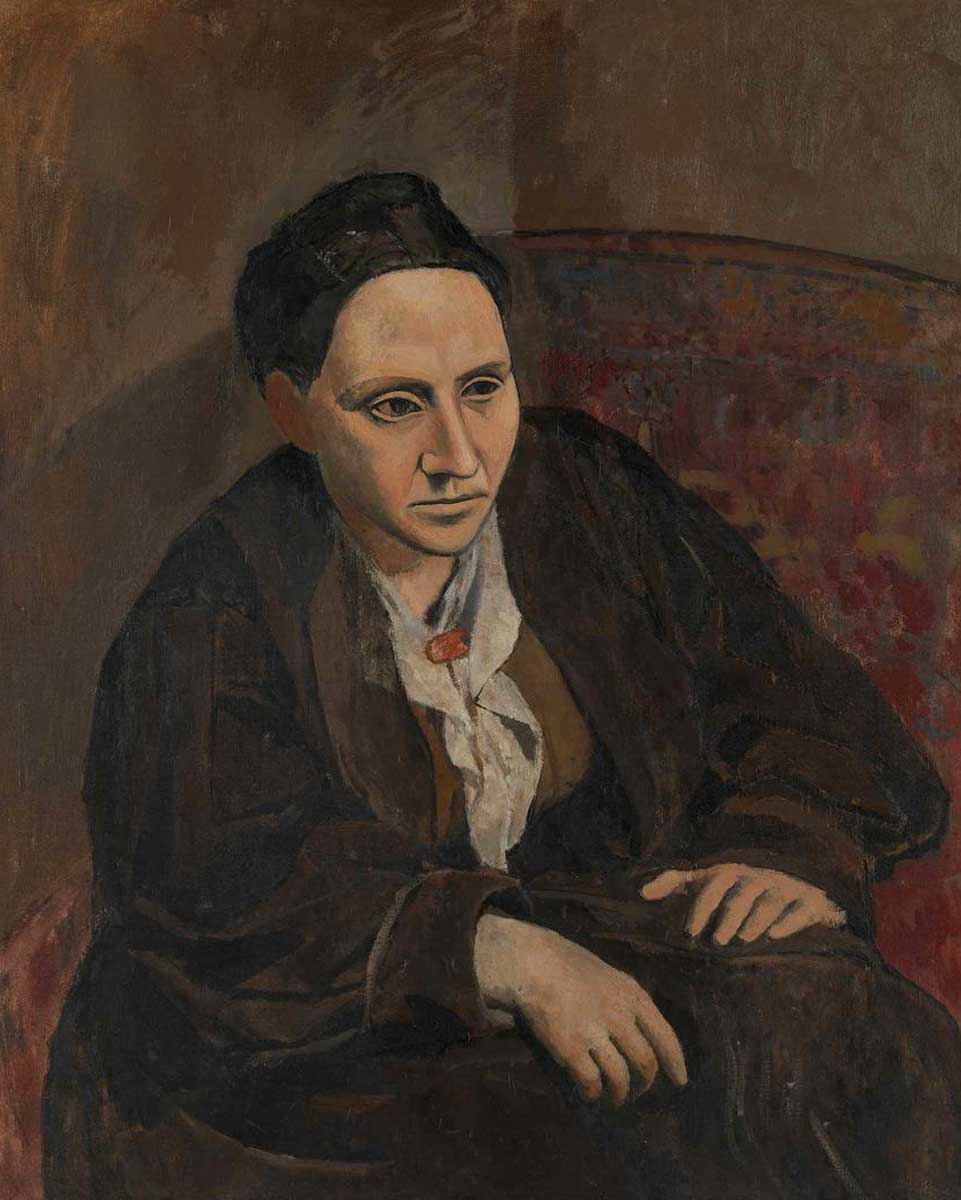
One of the most famous portraits of Picasso’s pre-Cubist era was of Gertrude Stein. Stein was a prominent art collector and writer whose influence, in many ways, defined the culture of her era. Picasso’s work on the portrait was far from easy, with more than 90 painstaking sittings producing almost no result. The artist was dissatisfied with his work on the face of his model and even thought of abandoning the work altogether. At some point, he erased part of the image and left his studio for several weeks. The break forced Picasso to rethink his relationship with the painted image. Instead of relying on the physical accuracy of the face and body, he decided to focus on the impression Stein created as a personality: confident, substantial, and observant.
5. Self-Portrait, 1907
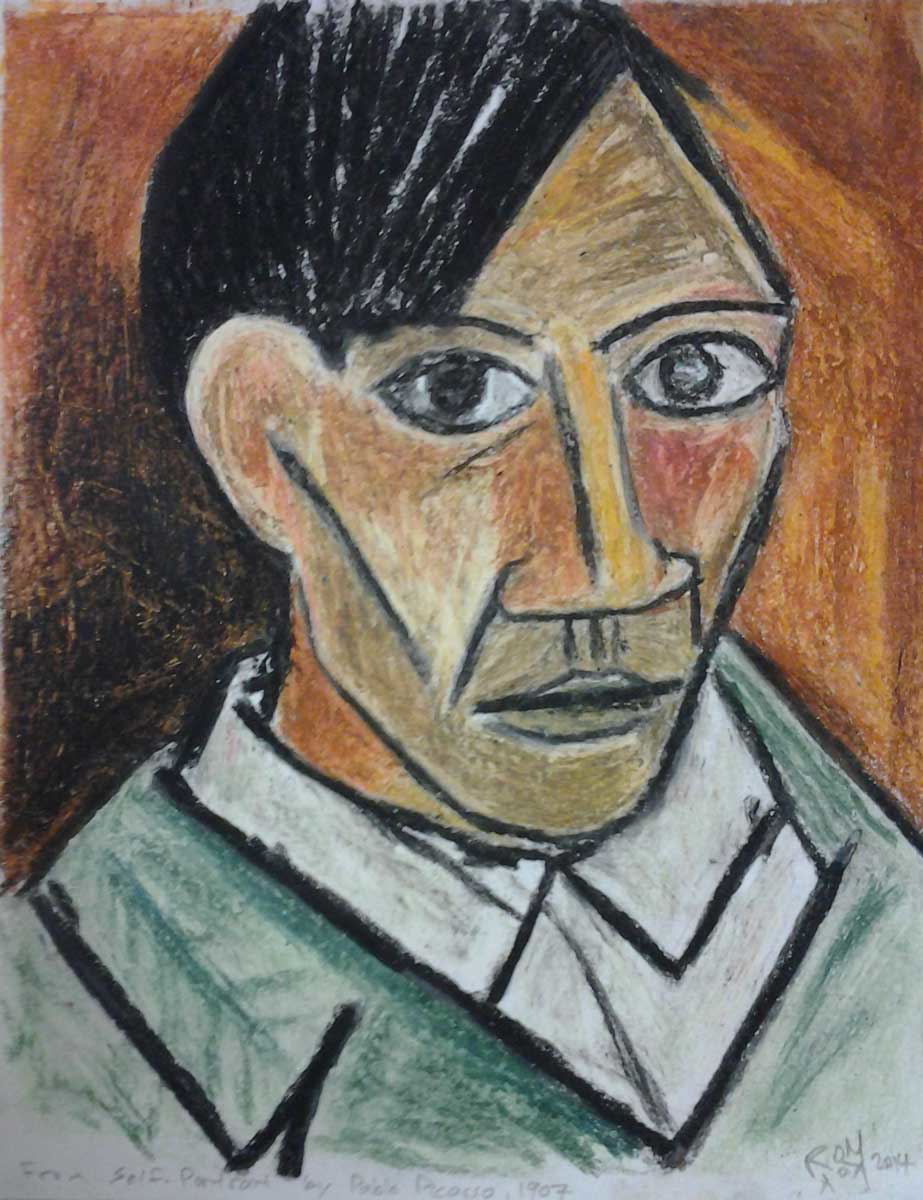
Another self-portrait, this time at the age of 25, reflected Picasso’s obsession with African and Romanesque art. At the time, he was looking for alternatives to traditional Western visual language and found them in African sculpture. In May 1907, he visited the dusty, poorly lit Ethnographic Museum of the Trocadéro in Paris. He later described seeing traditional African ceremonial masks and sculptures for the first time as a spiritual awakening. His images were already being simplified to straight lines and geometric forms, but they did not exactly reach the mathematical complexity of Cubism.
6. Les Demoiselles d’Avignon, 1907
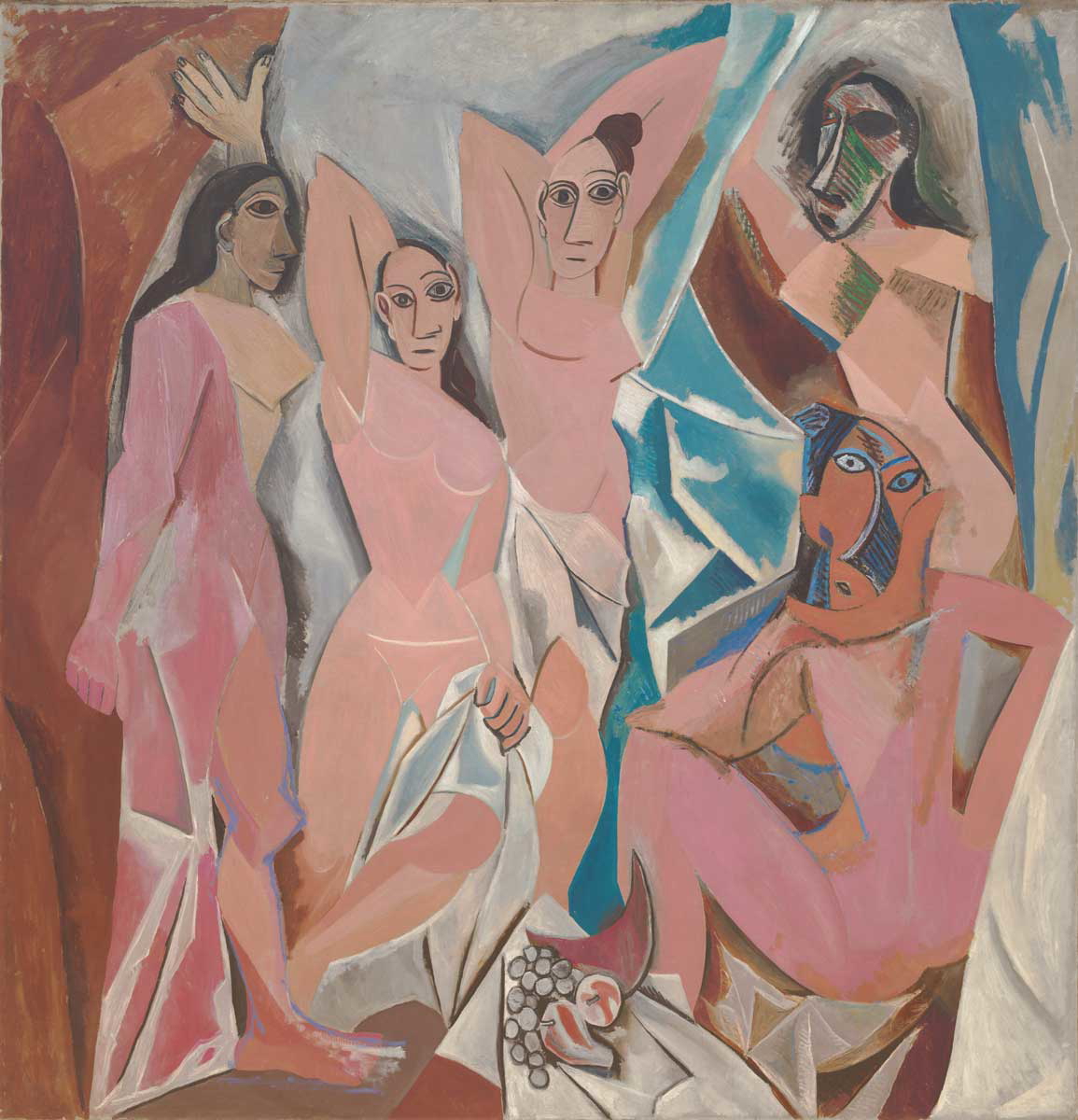
Les Demoiselles d’Avignon was one of Picasso’s most radical works. It shook the art world and launched an aesthetic revolution that would lead to the birth of Cubism. In this work, Picasso’s obsession with African art reached its peak. Picasso painted a group of sex workers; at the time, these women often earned extra by posing for artists. According to some art historians, the shocking and threatening faces and curves of their bodies were dictated by Picasso’s experience of venereal disease caught in a Parisian brothel. Suffering from symptoms, the artist channeled his suffering into the fear of women he felt were responsible for his state.
7. Ma Jolie, 1912
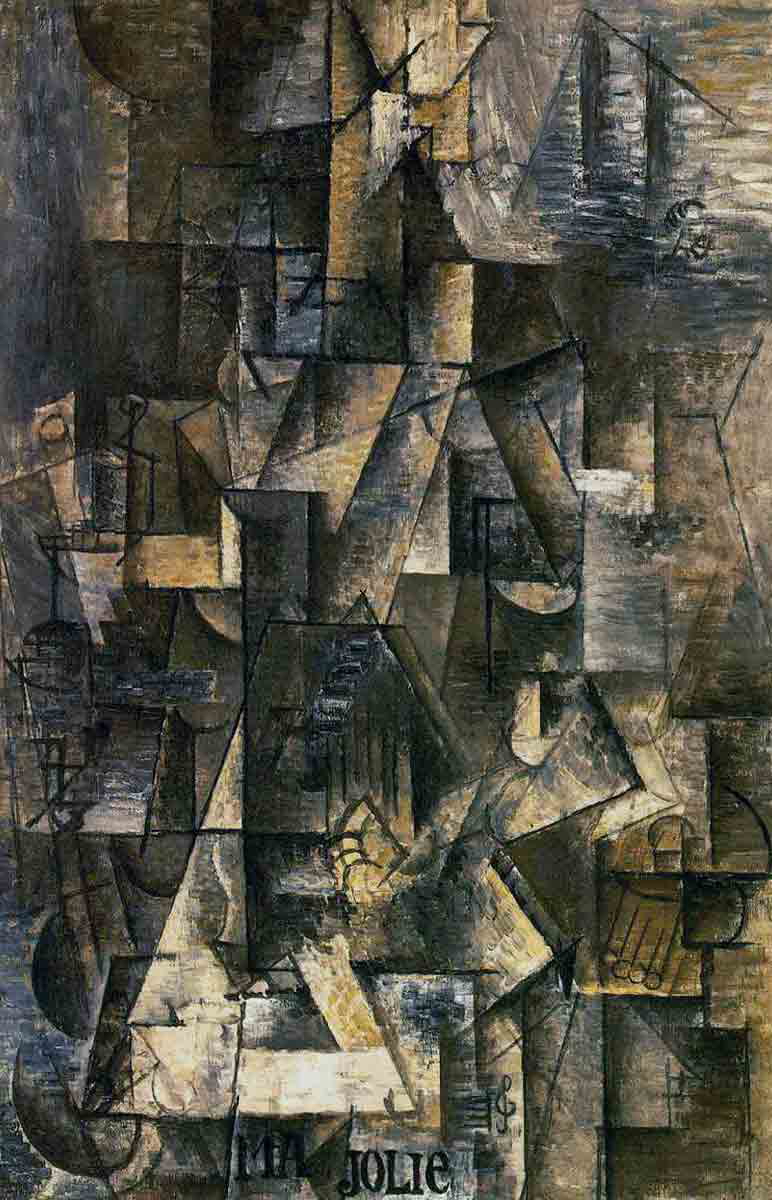
After Les Demoiselles, Picasso focused on the invention of Cubism. Cubism was a highly intellectual form of art that required dissecting and analyzing objective reality, turning it into a collection of planes, forms, and angles. To focus on the analytical aspect, Cubists like Picasso and Georges Braque simplified the color palette to grays and browns. Ma Jolie was one such bold experiment, representing Picasso’s then-partner, Eva Gouel, playing the guitar.
8. Portrait of Olga in an Armchair, 1917-18
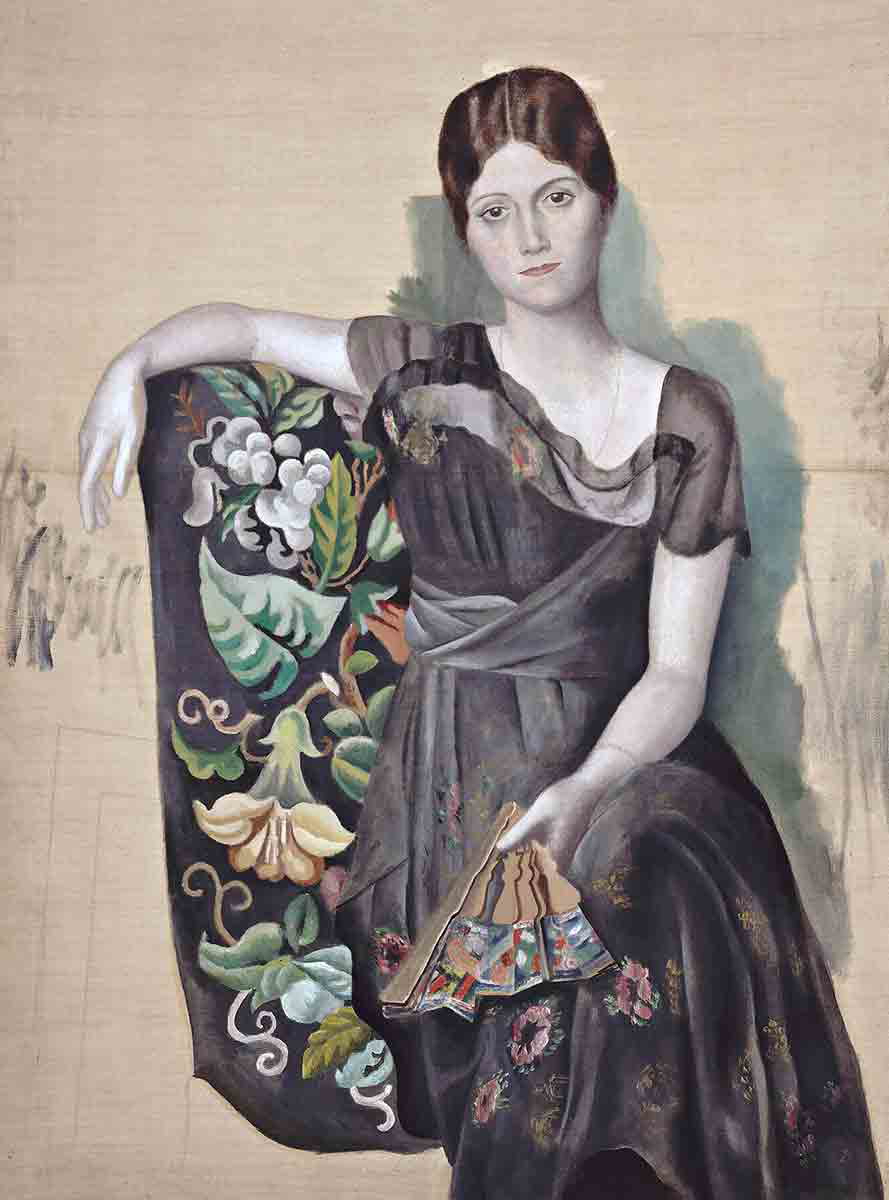
After World War I, many Western artists took a step back from their radical experiments and returned to more traditional art forms. Picasso was one of them, temporarily moving to the Neoclassical style. One of the most famous works of that period was the portrait of Olga Khokhlova, a Ukrainian dancer who came to France with Sergei Diaghilev’s dancing company Ballets Russes. Picasso painted it to celebrate their engagement. Even though he painted Olga in a conventional style, he still added his signature experimental element by leaving most of the canvas blank. The marriage lasted for 17 years but was rarely a happy one due to Picasso’s infidelity.
9. Guernica, 1937
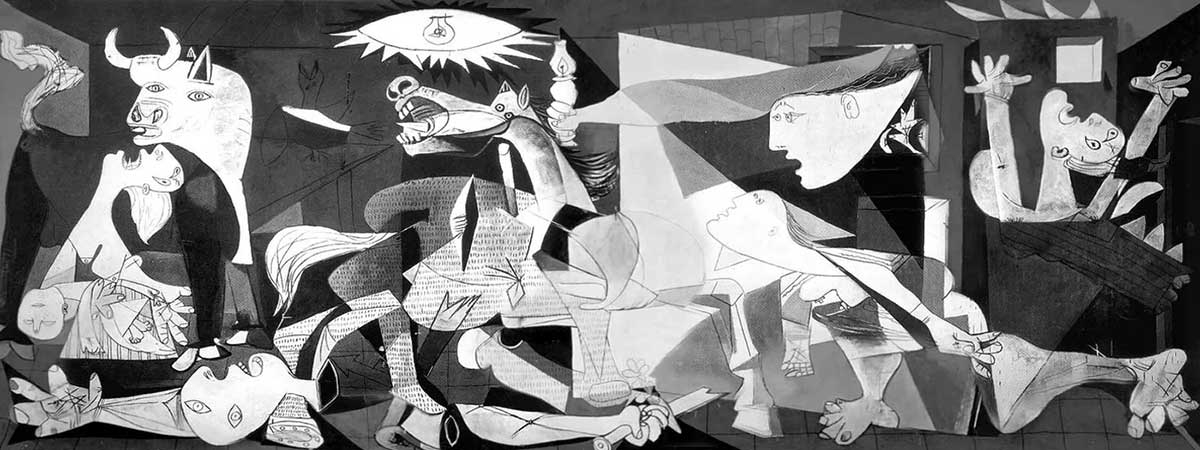
Guernica is perhaps the most famous anti-war painting ever painted. In 1937, German forces bombed the Spanish town of Guernica at the request of right-wing dictator Francisco Franco. Spain at the time was going through a bloody civil war, and the left-wing Republican government tried to gather support in Europe. Picasso painted the shocking image of the city in chaos for the Paris World Fair as an attempt to raise awareness about the conflict.
10. The Weeping Woman, 1937
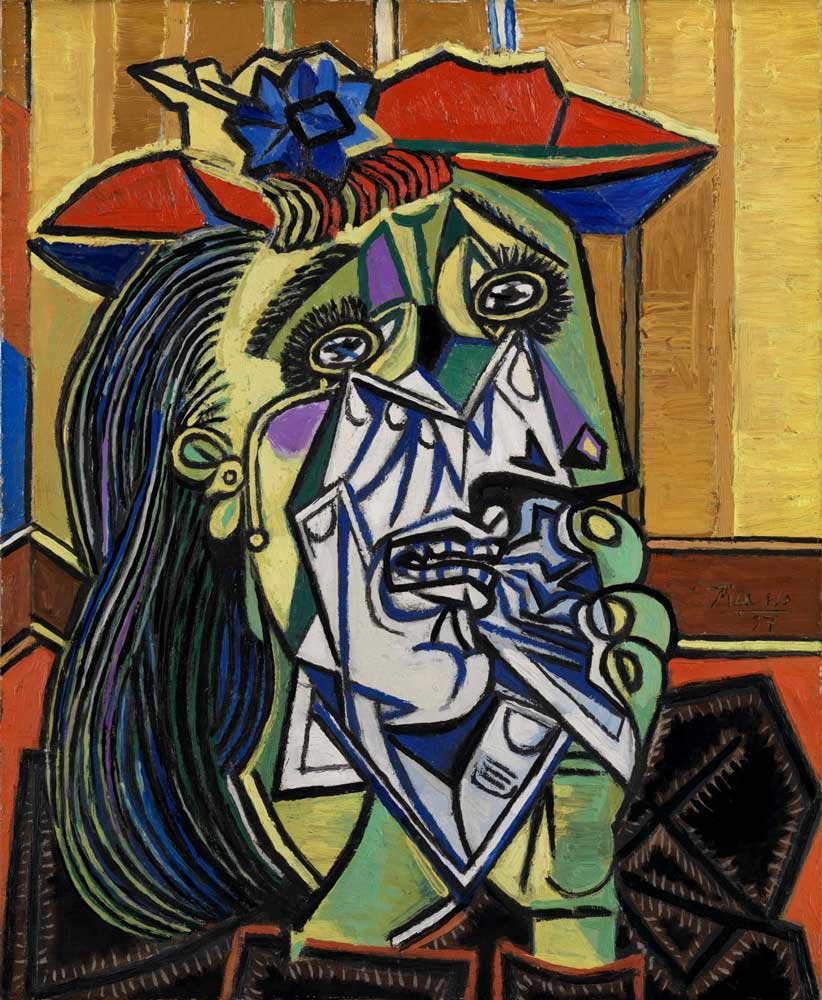
The Weeping Woman was one of the most famous paintings by Picasso and one of the ugliest illustrations of his behavior towards women. Starting a relationship with Dora Maar, he did not care enough to break up with his previous lover, Marie-Thérèse Walter. Amused, Picasso openly pitted both women against each other and even tried to force them to physically fight each other. Dora Maar’s distressed image became the basis for The Weeping Woman. Picasso turned a talented and sharp-witted woman into a hysterical mess during an ugly breakdown. This was not the type of gesture one would expect from a caring partner.
11. Bull’s Head, 1942
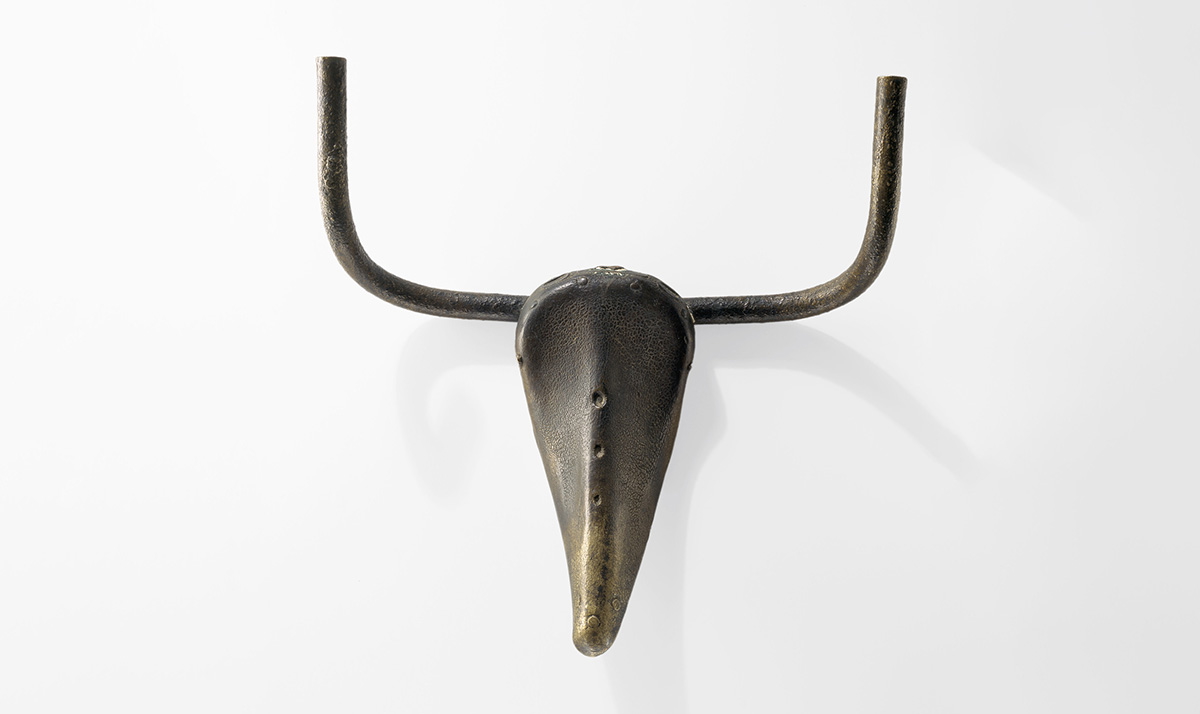
Although the work of Pablo Picasso is most frequently discussed in relation to his painting, he was a multi-faceted and curious artist who enjoyed experimenting with mediums. He worked with costume design, architecture, ceramics, and, of course, sculpture. One of his most famous creations was a Dada-like assemblage, Bull’s Head, made out of a seat and handlebars of a broken bicycle. Famous Parisian photographer Brassai, who was a close friend of Picasso and had recorded conversations with the two in the painter’s studio, once asked him about the work. Picasso told him that the idea of combining these objects came to him in a flash, without conscious thinking.
12. Ecce Homo, 1971
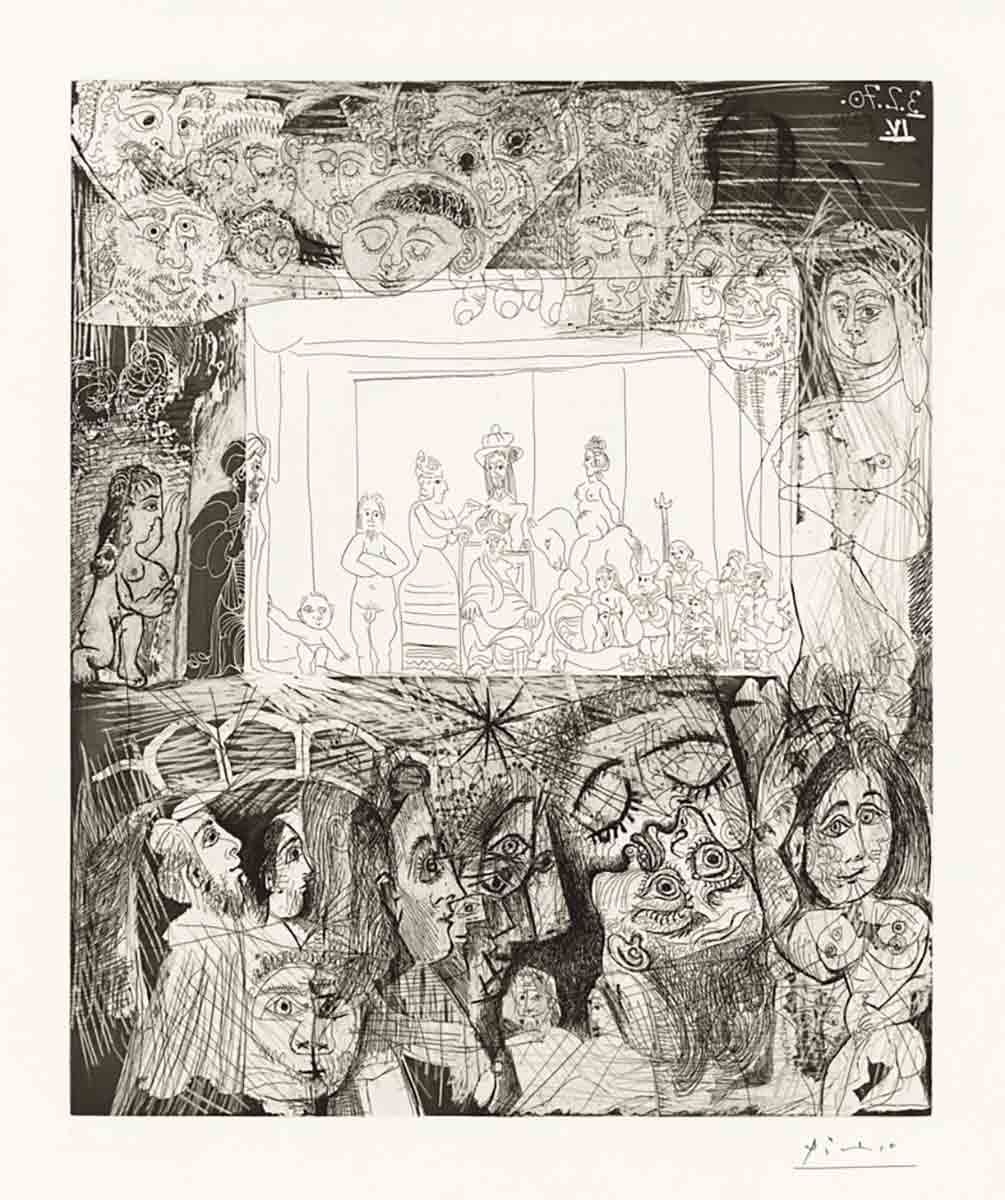
One of Pablo Picasso’s last works was a strange image based on an etching by Rembrandt van Rijn. The original image illustrated the Biblical scene of Jesus being presented in front of the crowd just before his execution. Picasso was not religious, but he revered Rembrandt, and thus, he reimagined the scene into a secular image of a theatrical play and its audience. The chaotic crowd featured familiar faces: fellow artists, ex-partners, and other significant figures in Picasso’s life. For the artist who died less than two years later at the age of 91, this work was, in a way, the final bow at the end of his career.