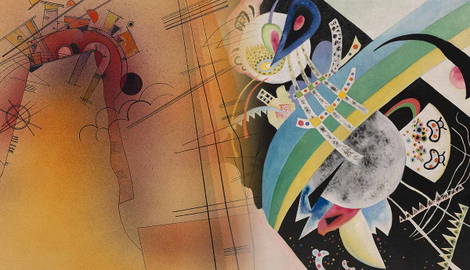

Wassily Kandinsky’s path toward abstraction was a complex one. He decided to become a painter at the age of thirty and, for several years, searched for his own expressive language. He found it at the intersection of science and spirituality, studying Theosophy, religious texts, and recent scientific discoveries. Kandinsky saw abstract art as the necessary tool to develop humanity’s spiritual consciousness and elevate their souls to a new state of being. Read on to learn more about Wassily Kandinsky’s thoughts on the spiritual power of abstract art.
Wassily Kandinsky & the Impressionists: First Steps Toward Abstraction
An important event that moved Wassily Kandinsky towards abstract art was his first encounter with Impressionist painting, particularly, a work by Claude Monet. In 1891, Moscow had its first exhibitions of the Impressionists, which included one of the paintings from Monet’s Haystack series. Later, Kandinsky remembered how unnerved he was with the composition at first, believing that he would not have guessed the work’s subject without the aid of a wall text. He felt acute discomfort because the painter chose to work in a way that was so unclear and confusing.
However, confronted with an unfamiliar experience, he soon realized that the painting, so vague and messy at first, appeared in his mind again and again, in every small detail. Looking at the Haystack, Kandinsky realized that the subject matter as the supposed core of every painted work was already compromised, with the painterly qualities and emotional effect taking charge of the viewer’s experience instead.
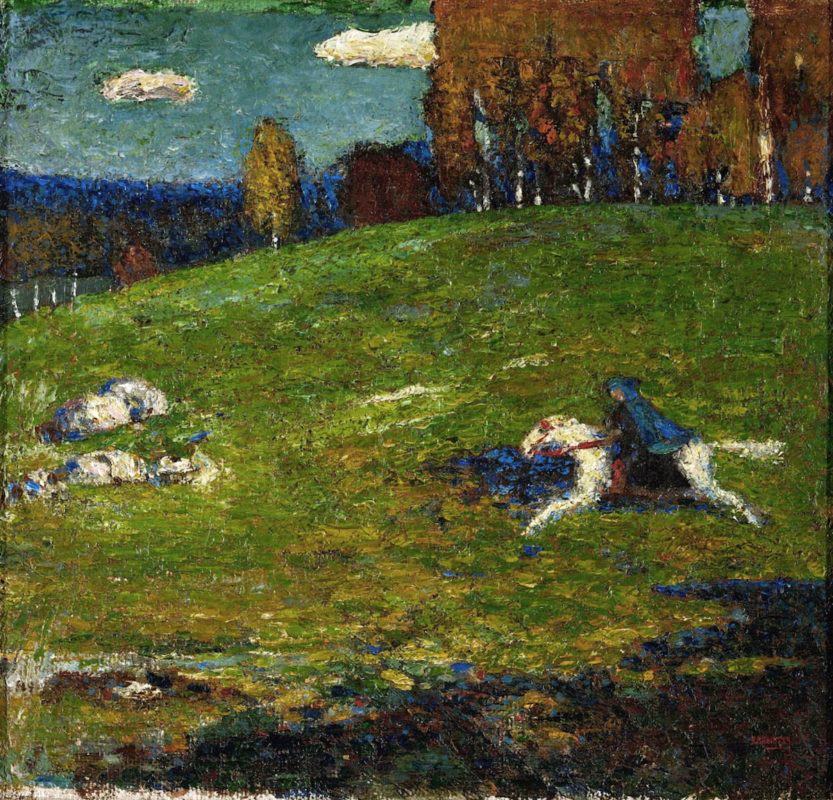
Kandinsky believed his generation was living in a time of profound cultural shock and a crisis of outdated values, and he believed it was the perfect time to direct one’s gaze from the phenomena of the material world toward aspects of the invisible inner life of every being. By skipping the imitation of the physical world, art could have launched a spiritual transformation, affecting the complex system of the human soul.
Kandinsky and Rudolf Steiner
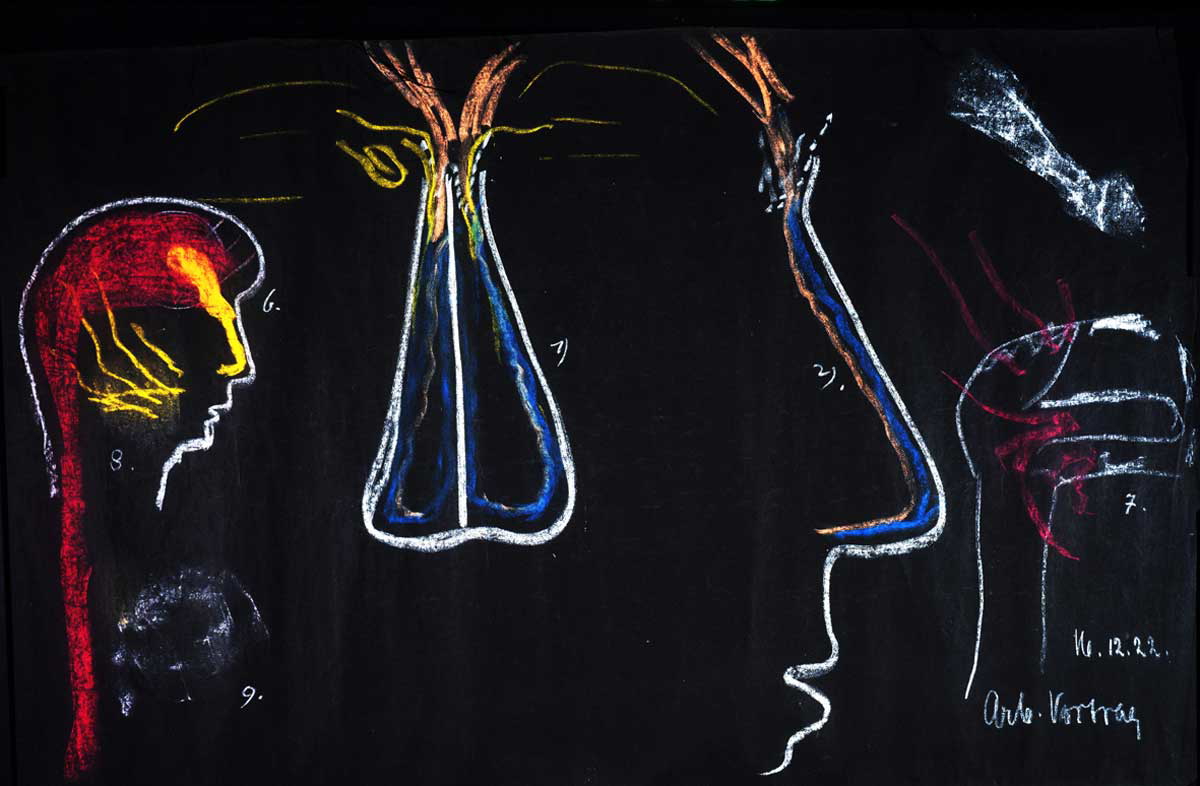
Among the figures that left the most lasting effect on Wassily Kandinsky’s oeuvre was the German philosopher and spiritualist figure Rudolf Steiner. At the time of their first encounter, Steiner was the leader of the German branch of the Theosophical Society, a philosophical movement aimed at bridging the gap between art and science through the exploration of the spiritual. Theosophists based their ideology on the idea that all world religions had a single set of basic world principles ingrained into them. Still, most of them relied on Hinduism and Buddhism as the main sources for their conceptual framework. Steiner was more Western-centered, insisting that Christianity already had all the necessary answers. He frequently toured Europe with lectures on the transformative power of art, the underexplored aspects of natural science, and highly questionable theories on the spiritual evolution of human races.
Theosophy was immensely popular in Kandinsky’s time, with many famous artists attending Steiner’s lectures or even meeting him personally. Apart from Kandinsky, two other pioneers of abstract art Hilma af Klint and Piet Mondrian met Rudolf Steiner. It is possible that Hilma af Kint even played a decisive role in the development of Kandinsky’s abstraction. Although there is no direct proof of a link between the two artists, it is possible that Steiner shared at least part of his experience in Stockholm, potentially influencing Kandinsky’s own exploration of the non-figurative.
Concerning the Spiritual in Art: Kandinsky’s Theoretical Oeuvre
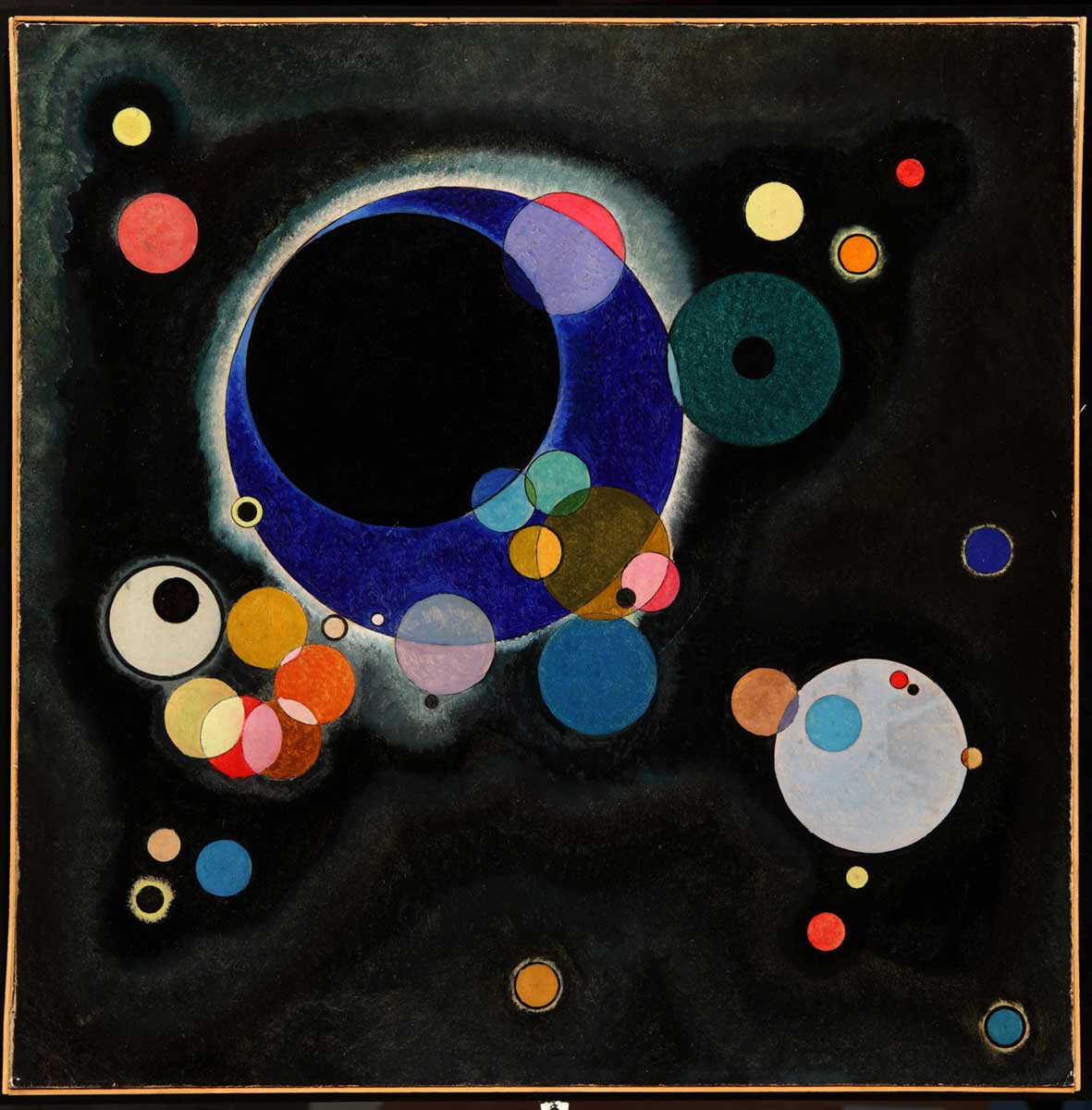
Apart from being a prolific painter and talented musician, Kandinsky was an outstanding writer. His years of thorough and diverse education, as well as his law practice, developed his habit of putting thoughts into verbal form. His occupation as a lawyer allowed him to theoretically justify his artistic practice, building it within a certain theoretical and practical framework. The work that expressed his ideas the most thoroughly was his famous essay Concerning the Spiritual in Art.
Kandinsky explained that every work of art was a product of its time that carried unique aesthetic, emotional, and spiritual connotations that characterized its era and both expressed and shaped the perception of its contemporaries. That being said, by mindlessly imitating the principles of art of previous eras, artists created works that are dead and dysfunctional, even if technically successful. For Kandinsky, the era of post-Renaissance materialism had a detrimental impact on both the art and the souls of his contemporaries. Instead of focusing on emotions, feelings, and spiritual experiences, art turned towards imitating nature, either in its entirety or through certain aesthetic interpretations. As an example of such interpretations, Kandinsky cited Impressionism, which, despite its progressive visual form, remained committed to the supposedly accurate reflection of reality.
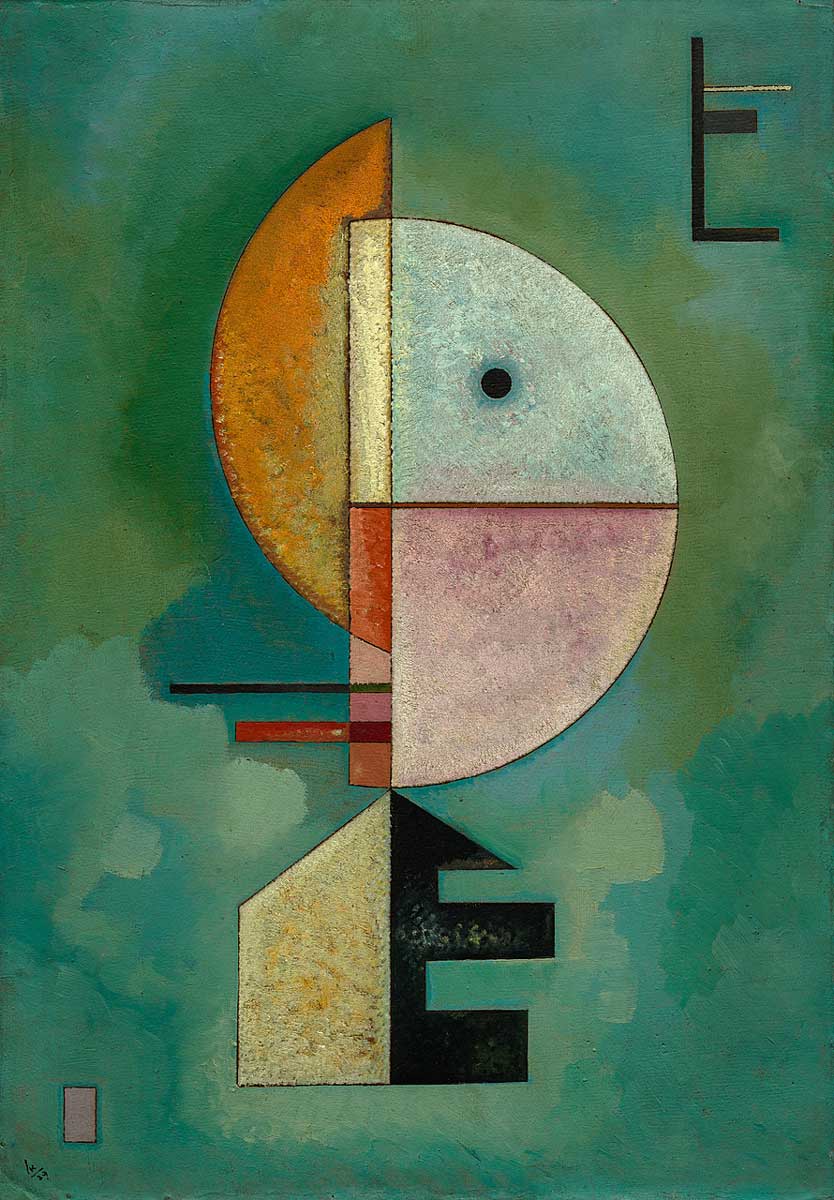
In that environment, art lost its transformative power and turned into a decoration and a commodity to be discussed only in the context of its material value. To find its way out of the deep creative crisis caused by the materialist worldview, the art of Kandinsky’s era had to abandon any attempts at legitimizing itself through theories and reason (which is ironic, given Kandinsky’s own way of expressing and justifying his ideas), and focus on uplifting the spirit of its audience. To find that focus, artists had to learn from their predecessors whom Kandinsky called the primitives—the artists who worked before or outside the dominant artistic tradition of the Western world. Instead of imitating these people, contemporary artists had to study the expressive and spiritual potential of their lines and colors.
The Spiritual Triangle
Kandinsky envisioned spiritual growth as an acute triangle constantly moving upward. Its upper section was reserved for progressive thinkers, artists, and creatives, who led entire generations toward new spiritual heights, despite often being misunderstood by their contemporaries. The lower sections were inhabited by less talented and progressive souls. Gradually, these individuals learned to appreciate the intellectual and spiritual ideas from the top and passed them down. In this way, the triangle continually ascended, even though the majority of its inhabitants remained unaware of the process.
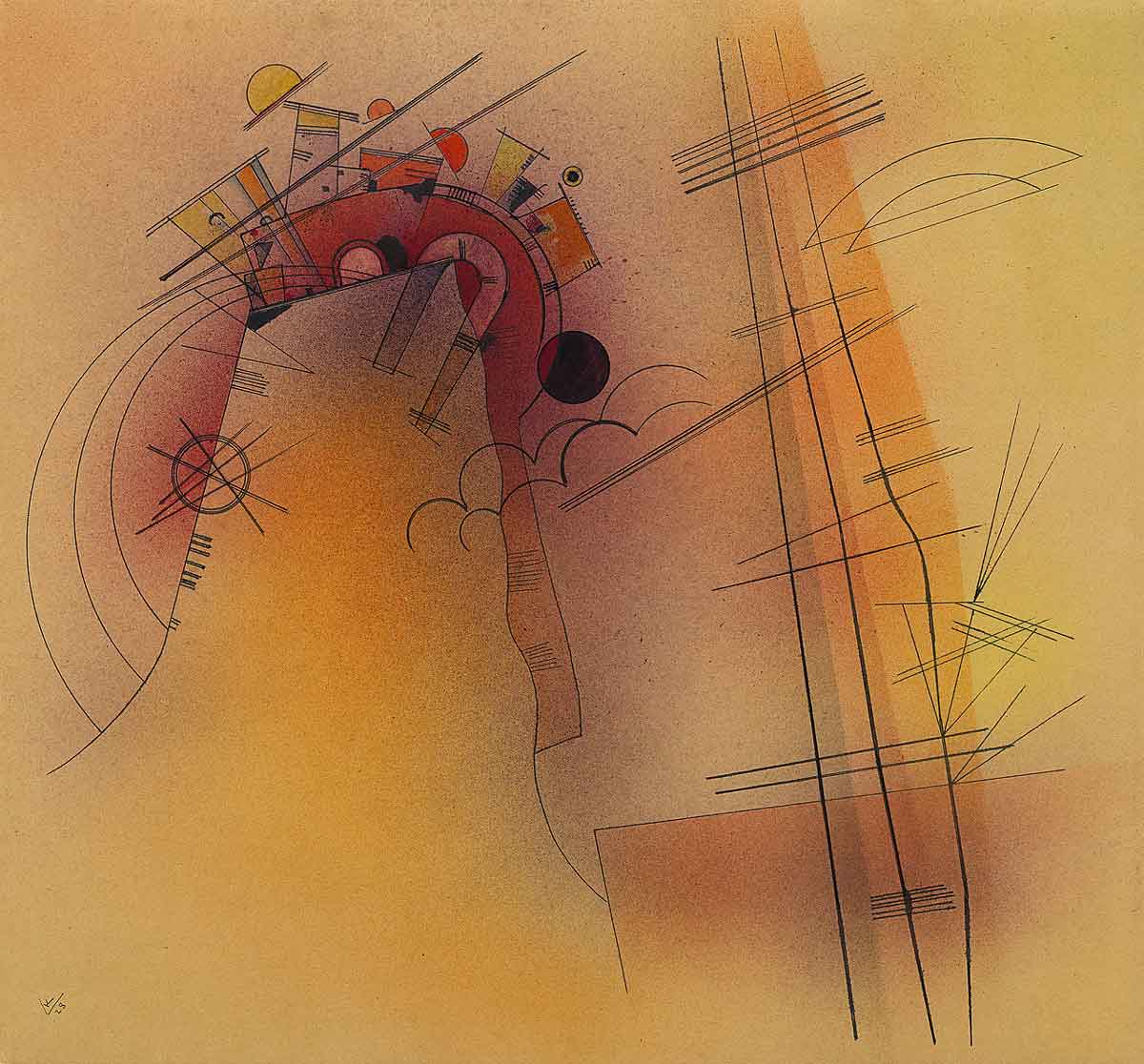
In Kandinsky’s mind, the unpopular yet necessary idea from the triangle’s top of his time was to leave behind figuration in images and focus entirely on the properties of color and form. He insisted on the search for the inner objective beauty that was not tied to any natural object or event. Moreover, he believed that this inner beauty sometimes contradicted the conventional visual one and thus provoked outrage among the public. As an example of an artist producing exactly that kind of beauty, Kandinsky named the famous composer Arnold Schoenberg. Schoenberg was known for rejecting the traditional rules of musical composition and tones. Instead of relying on perfect harmonies, he extracted the emotional potential of dissonance. Despite public criticism of Schoenberg’s work, Kandinsky and his peers saw the ways in which he expanded traditional notions of musical beauty and turned them from purely acoustic into psychological.
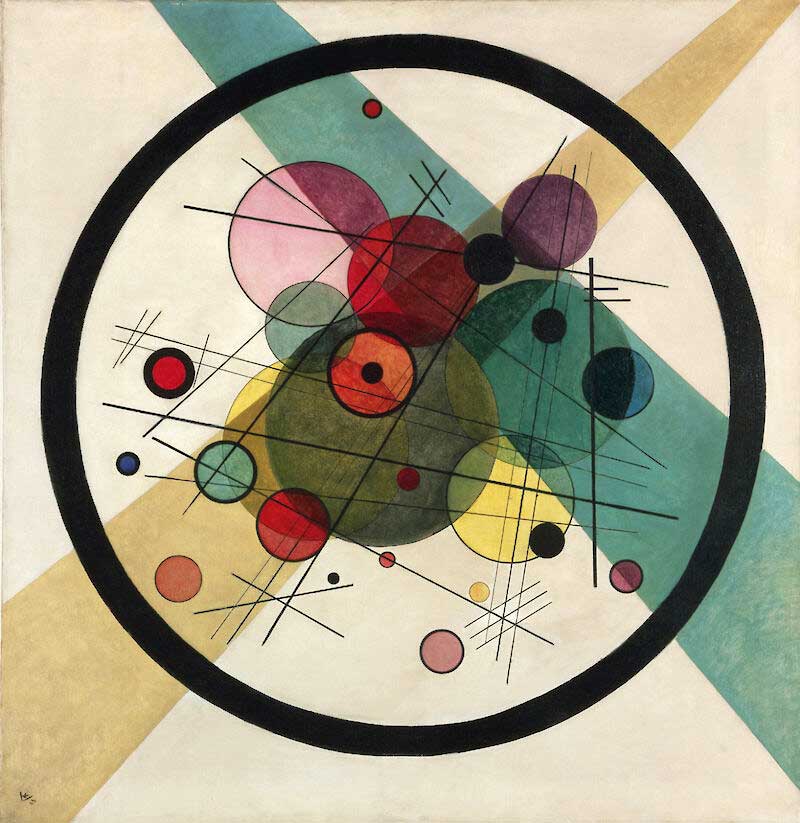
According to Kandinsky, the cultural and intellectual state of the era called for a thorough and radical transformation of all forms of art. Visual artists particularly needed to find new forms and leave the figurative imitation of reality behind. The required instruments for it, in his opinion, could be found in another form of art—music, which was the least of all connected to physical reality. Like composers using sounds of music, painters had to learn to reach their audiences’ perception with form and color. Such transformation, wrote Kandinsky, was required by the inner necessity of both a single soul and humanity to progress spiritually.
Wassily Kandinsky & the Spiritual Power of Abstraction
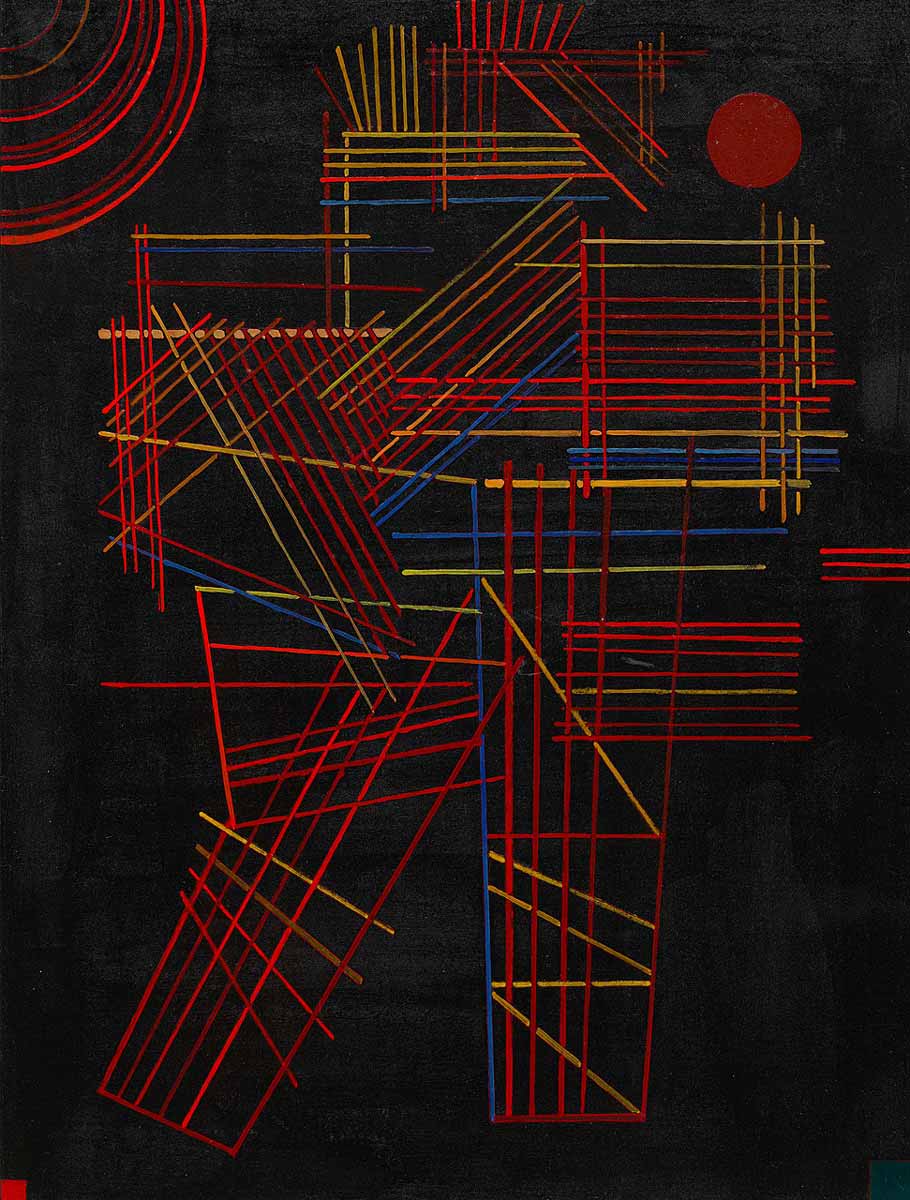
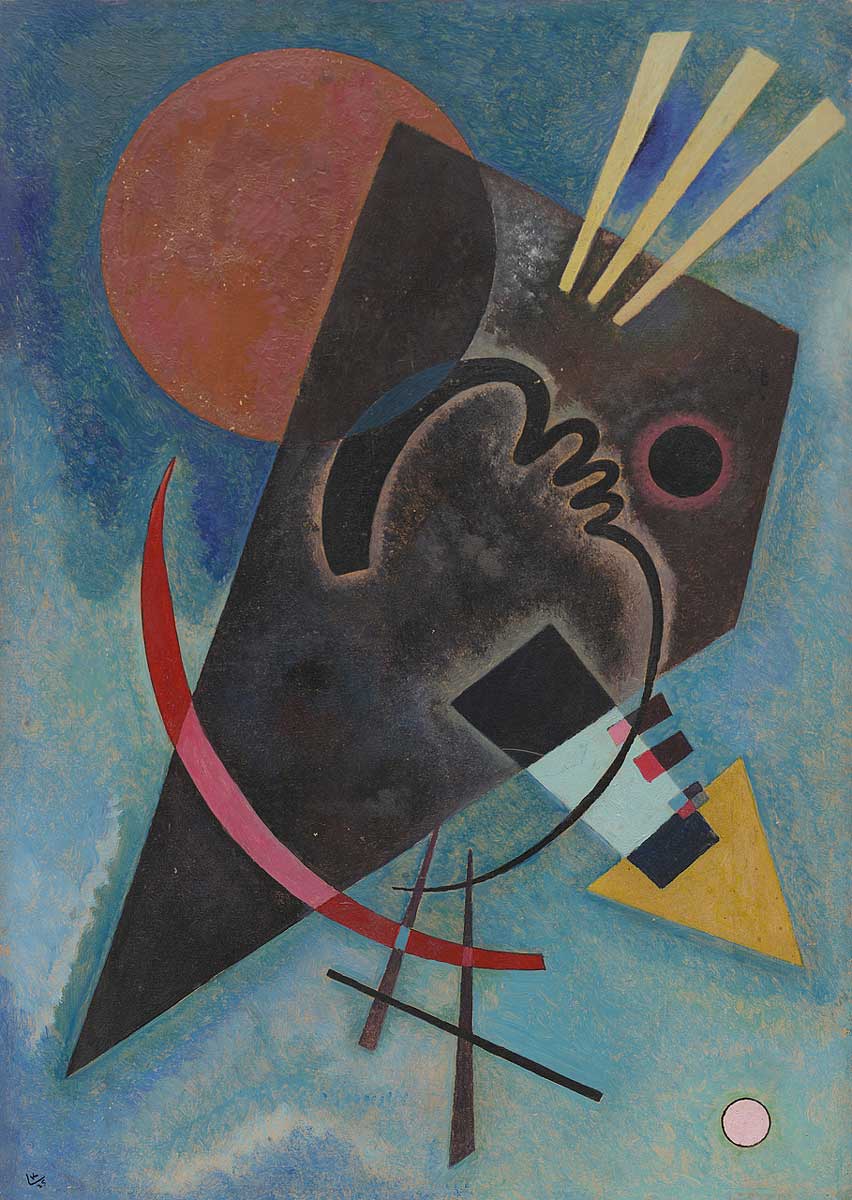
Abstract art for Kandinsky was akin to ritualistic movement with no apparent practical purpose: its inexplicable mystery created a sense of grandeur and attracted attention to something that would otherwise be ignored. In the artist’s opinion, the human soul, compassion, and creative potential would progress when fueled by such mystical experiences. Particularly, in his writings Kandinsky paid extensive attention to the correspondence of color and form, and how one could diminish or elevate another. For example, he described a yellow triangle and a blue circle as the two opposing forces that balance each other.
Abstract painting was supposed to develop humankind’s empathetic and spiritual potential by triggering various emotions in its audience as if calibrating its settings. Kandinsky compared the human soul to an intricate piano in need of tuning, colors to keys, and human eyes to hammers. In that context, artists acted as piano players, forcing the whole instrument of the soul to vibrate and produce inspiring sounds.