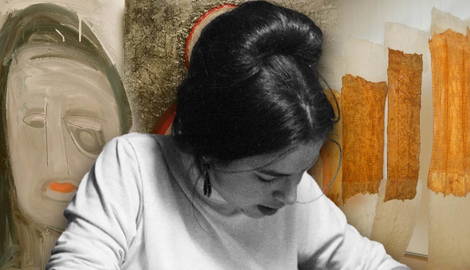

Eva Hesse was one of the most prominent post-minimalist artists. While her sculptures resembled the minimalist artists’ “specific objects,” geometric shapes at roughly human scale that were usually devoid of referent and produced by factories, they were weirder, more playful, and more interested in making visible the artist’s process and her abiding interests in the body, memory, and the tactile delight of working with unconventional materials. Though her life was tragically cut short at age 34, Hesse’s oeuvre remains one of the most impressive of her era.
Who Was Eva Hesse?
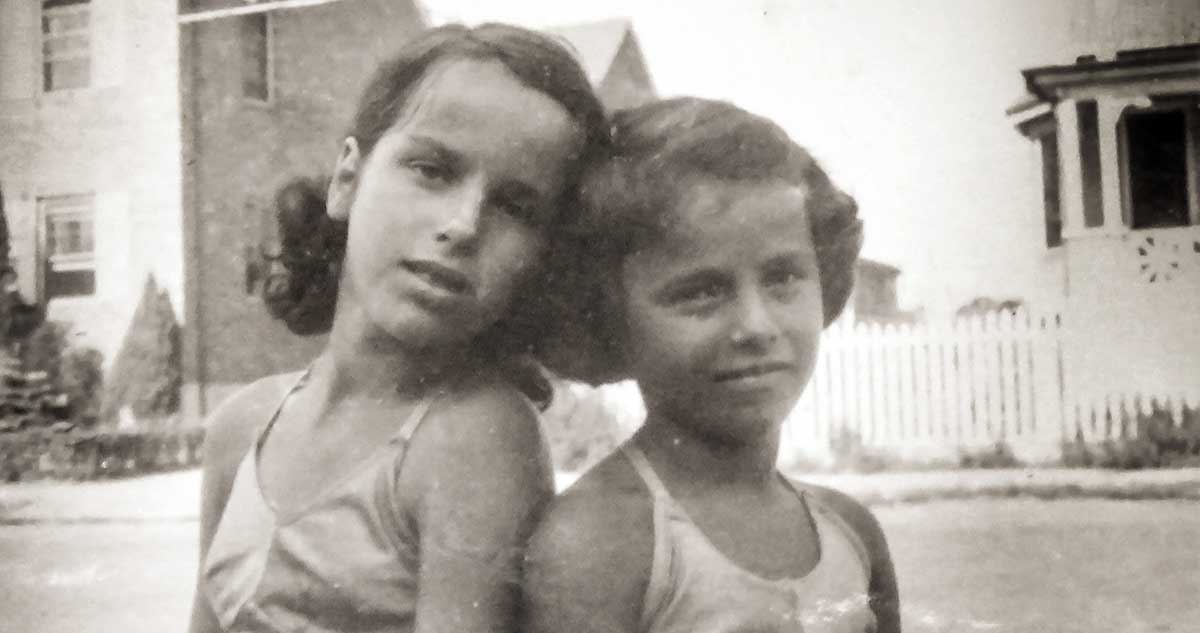
Eva Hesse was born in Hamburg, Germany in 1936. When she was only two years old, she and her sister Helen were sent on a children’s train to Holland to escape Nazi persecution of the Jews. They stayed in a Catholic children’s home until their parents came, then stayed with relatives in London, and finally made it to New York in 1939. Life was not easy for Hesse’s parents, Wilhelm and Ruth, and they separated and divorced. Ruth took her life a few years later. Wilhelm remarried, and the family continued to live in Upper Manhattan.
Hesse knew she wanted to be an artist from a young age. After attending high school at the School of Industrial Arts, she enrolled at Pratt Institute. She didn’t care for her courses, her advertising design class in particular, and dropped out. Needing a job that had at least something to do with art, she interned at Seventeen Magazine and took classes a few days a week at the Art Students League. In September 1954, she entered Cooper Union, having passed the entrance exam, and received a stipend from a Jewish agency. Most of her work during this time was rather conventional, adhering to the figure-drawing expectations of her classes.
After three years at Cooper Union, Hesse received a scholarship to Yale, where she studied with the renowned artist Josef Albers. She chafed under the rigidity of his teaching and became very frustrated with her painting. Nevertheless, she graduated with a BFA and claimed that her years there were filled with “the greatest changes inside myself.”
Hesse’s Early Years as an Artist
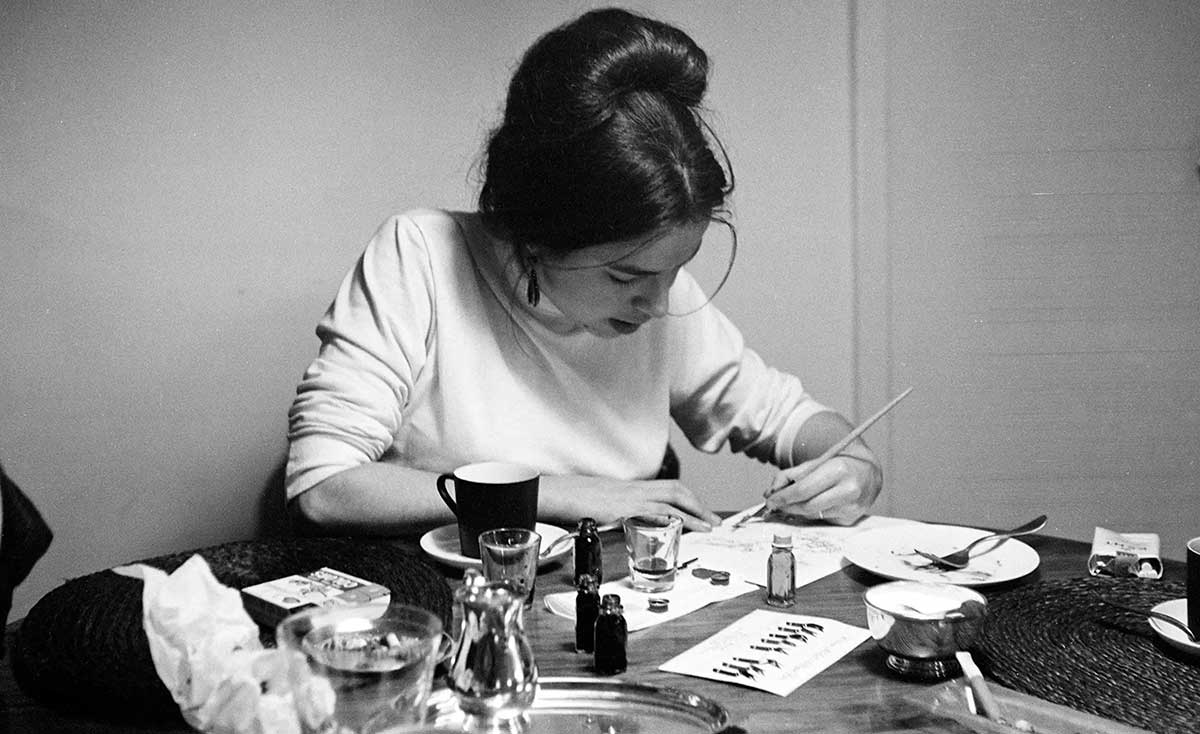
Hesse wanted to attend graduate school at UCLA but it did not work out, and she stayed in New York. She procured a studio space and began to make a conscious effort to be “in” the art world. She made friends with notable artists such as Sol LeWitt and Robert Smithson, attended gallery shows, and kept painting. In 1961, she met sculptor Tom Doyle, and the two quickly married and moved into a loft where they both set up studios. During these early years of marriage, Hesse admitted that since Doyle was a more mature artist, “I shouldn’t say I went backwards, but I did because he was a more mature artist and was developed and I would unconsciously be somewhat influenced and he would push me in his direction.”
She moved away from painting into drawing, and although critics viewed the work as good, they were still evidence of Hesse trying to navigate the established style of Abstract Expressionism and the new style of Pop Art. Her pen-and-ink drawings did, though, gain some attention.
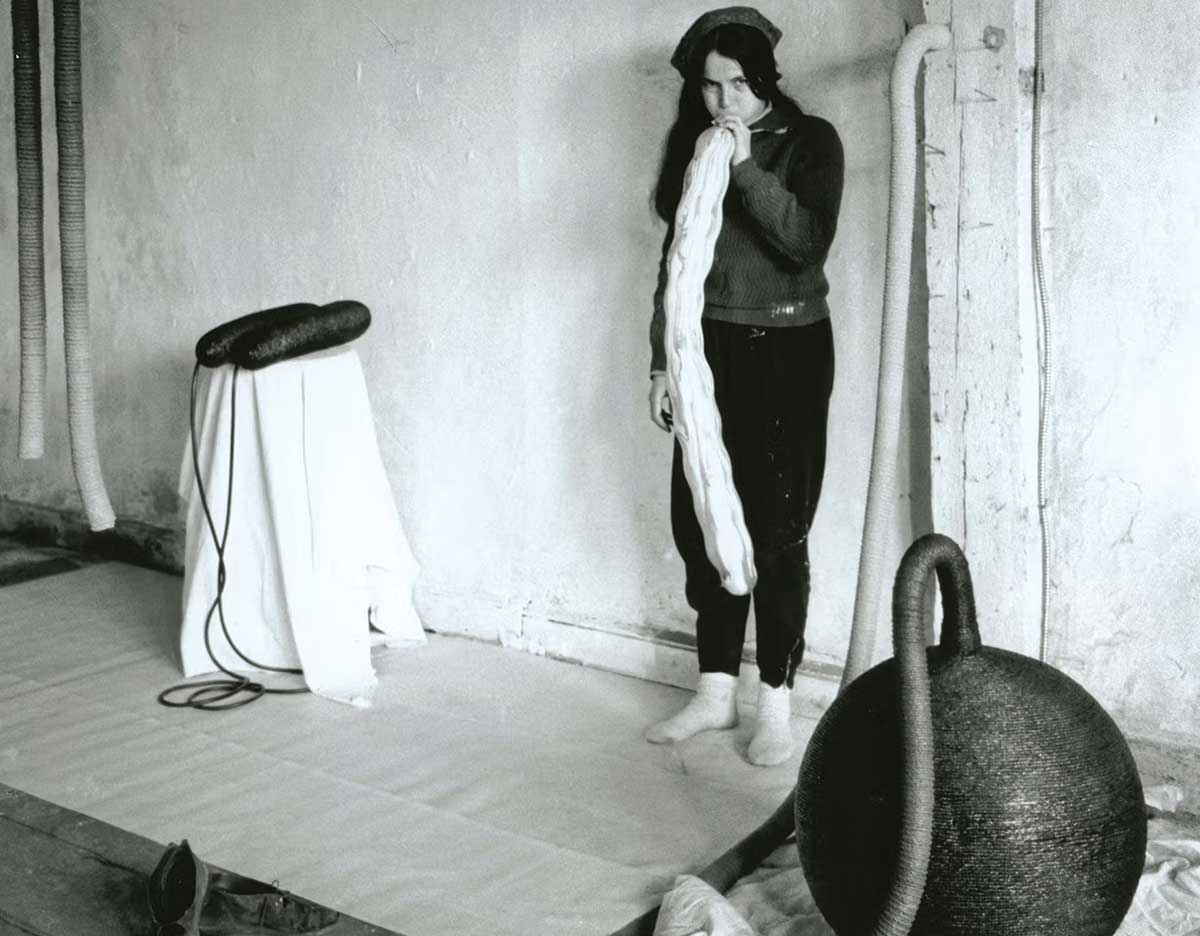
An interesting patronage opportunity presented itself in 1964. A German industrialist collector had seen Doyle’s sculptures and asked him to come work for a year in an abandoned factory in Kettwig-am-Ruhr. Doyle and Hesse went, though Hesse was trepidatious since she had not been back to Europe since her perilous childhood flight.
Germany ended up being a profoundly impactful time for Hesse as an artist. Her pen-and-ink works became weirder, more mechanized, yet also organic. Critic and biographer Lucy Lippard says of these works that they “demonstrate an impressive combination of loose and fluid, obviously automatic free forms with a line that is absolutely straightforward and devoid of modulation. It is the line that is mechanical rather than the mage, but the punning play between the two, and between hard and soft, is at the core of the drawings.” She started a series of funky reliefs that featured gluing and twisting and attaching things, of which Doyle remembered thinking, “this is it, all that tying and everything, it’s really her.”
Later Years: Eccentric Abstraction
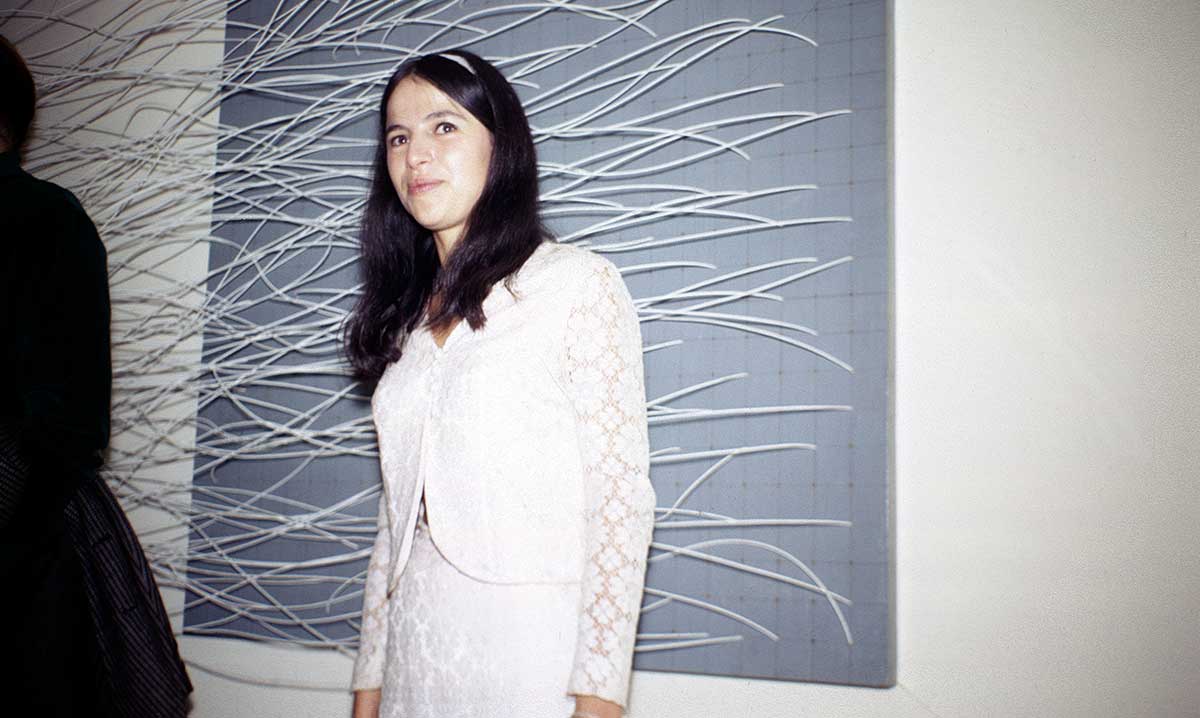
Hesse integrated herself into the New York art world, showing her drawings at the Fischbach Gallery in solo shows and participating in numerous group shows. One of the most important was Lucy Lippard’s Eccentric Abstraction at Fischbach, which featured works that “refuse to eschew imagination and the extension of sensuous experience while they also refuse to sacrifice the solid formal basis demanded of the best in current non-objective art.” Hesse’s works perfectly fit this description, as by now she was making mostly three-dimensional works that casually utilized geometric forms that were then subverted, eroticized, and rendered tactile in an almost fetishistic way.
Though Hesse was doing well professionally, her body was starting to fail. She was eventually diagnosed with a brain tumor, and doctors operated right away. Thinking her tumor was benign, she felt mentally invigorated, albeit still physically tired, and ready to make more art. She wrote in her diary that “the lack of energy I have is contrasted by a psychic energy of rebirth. A will to start to live again, work again, be seen, love.” Unfortunately, she began feeling ill again and had to have a second operation. She kept working, but had a third and final operation on March 30, 1970. She died just over two months later, on May 29.
1. No Title (from the Spectres series), 1960
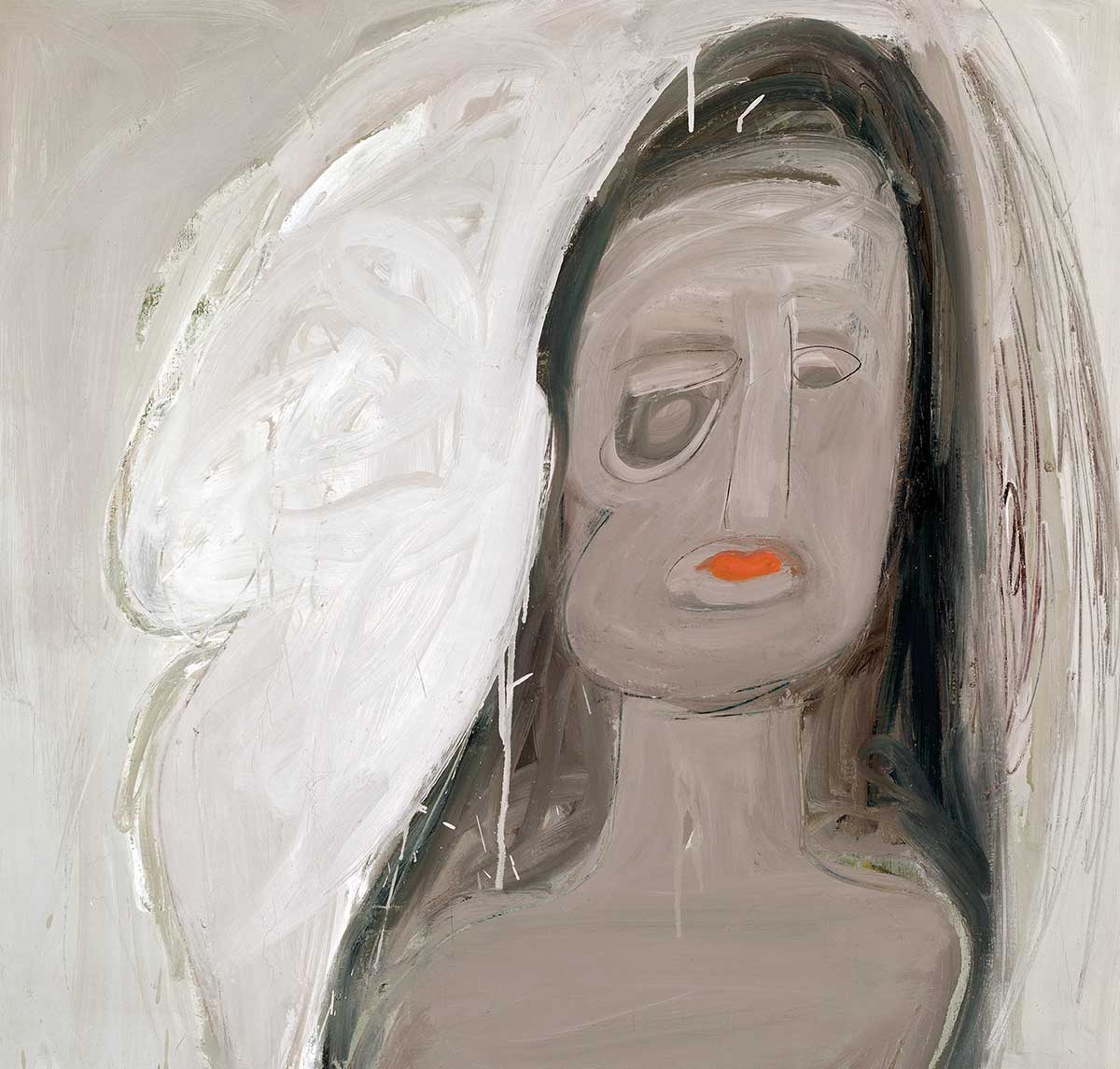
Hesse painted throughout her early years, and although she would eventually abandon the medium, some of the works from 1960 are very accomplished for a young artist. In that year she wrote in her diary: “I want to feel I can and should sell paintings. What I am doing now might not be the peak of mature painting; but they are good, follow an idea, and they are the work of a young, active developing painter…Only painting can now see me through and I must see it through.”
One of the themes of Hesse’s early painting was the figure, or more specifically, a version of her face. In the self-portraits, which one critic has called the “spectre series,” Hesse uses muted colors and varied brushstrokes—some swirling, some flattened, some ragged—to depict her visage. The works are amalgams of the abstract and the figurative, as the subject is clearly a woman, but the facial features are distorted and simplistic.
2. Ringaround Arosie, 1965
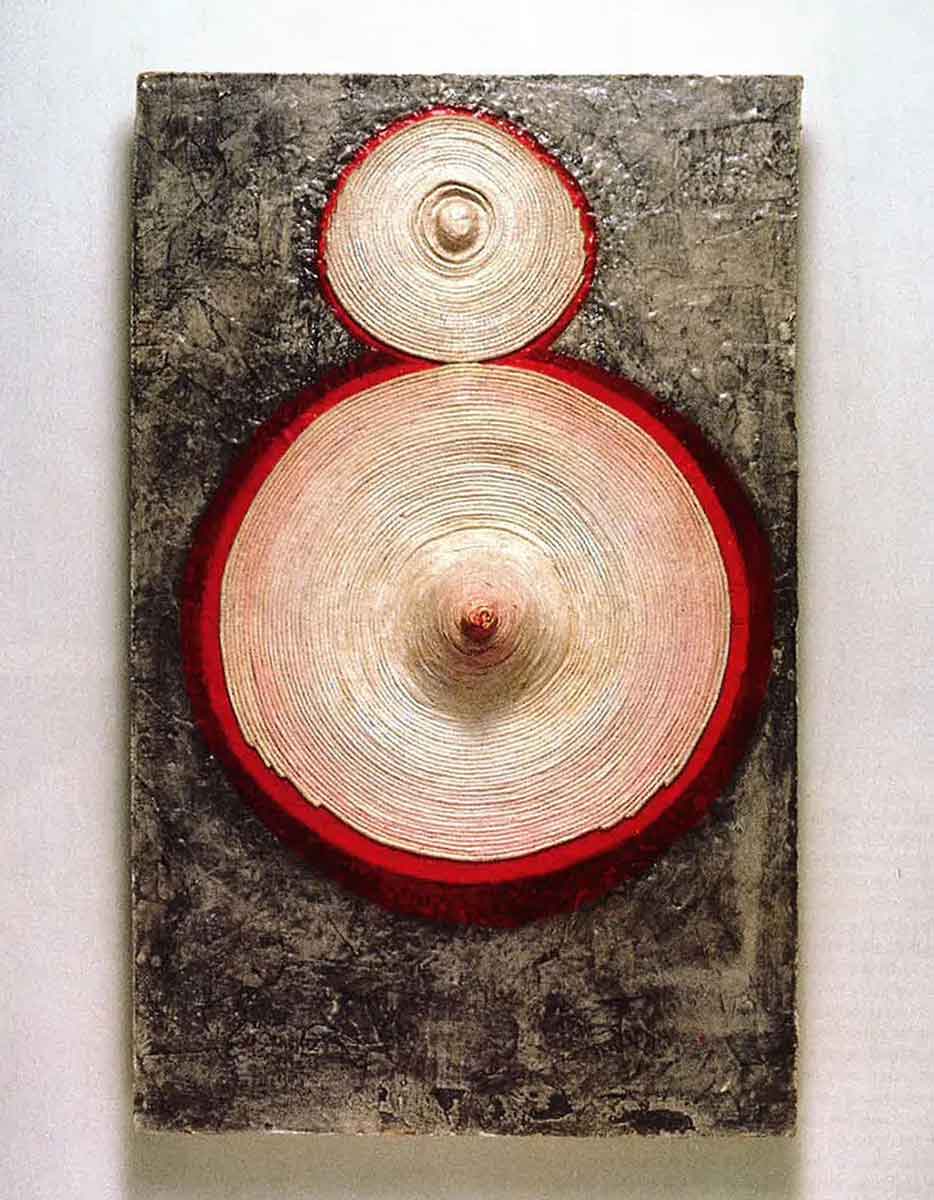
One of Hesse’s most famous reliefs from her year in Germany, Ringaround Arosie resembles a small breast on top of a larger breast. She created raised forms from papier-mâché and glued cloth-covered electrical cord in concentric circles, finishing it off with enamel and ink to give it its pops of color. Affixed to a masonite board, it is nonsensical but rooted enough in the body to, on the other hand, actually make anthropomorphic sense.
The reliefs are all clever and all odd. Their titles, such as An Ear in a Pond (1965) or Oomamaboomba (1965), elicit laughs or upraised eyebrows; their colors are usually vibrant; their forms are an amalgam of the organic and the mechanical, much like the drawings that preceded these three-dimensional pieces. Critics see the reliefs as early evidence of what her later, more mature work would be, and suggest that the time in Germany was crucial for her because she nourished her creativity, intellect, and selfhood away from the competitive New York art world and the dominant voices of fellow artists, critics, and friends.
3. Hang-Up, 1966
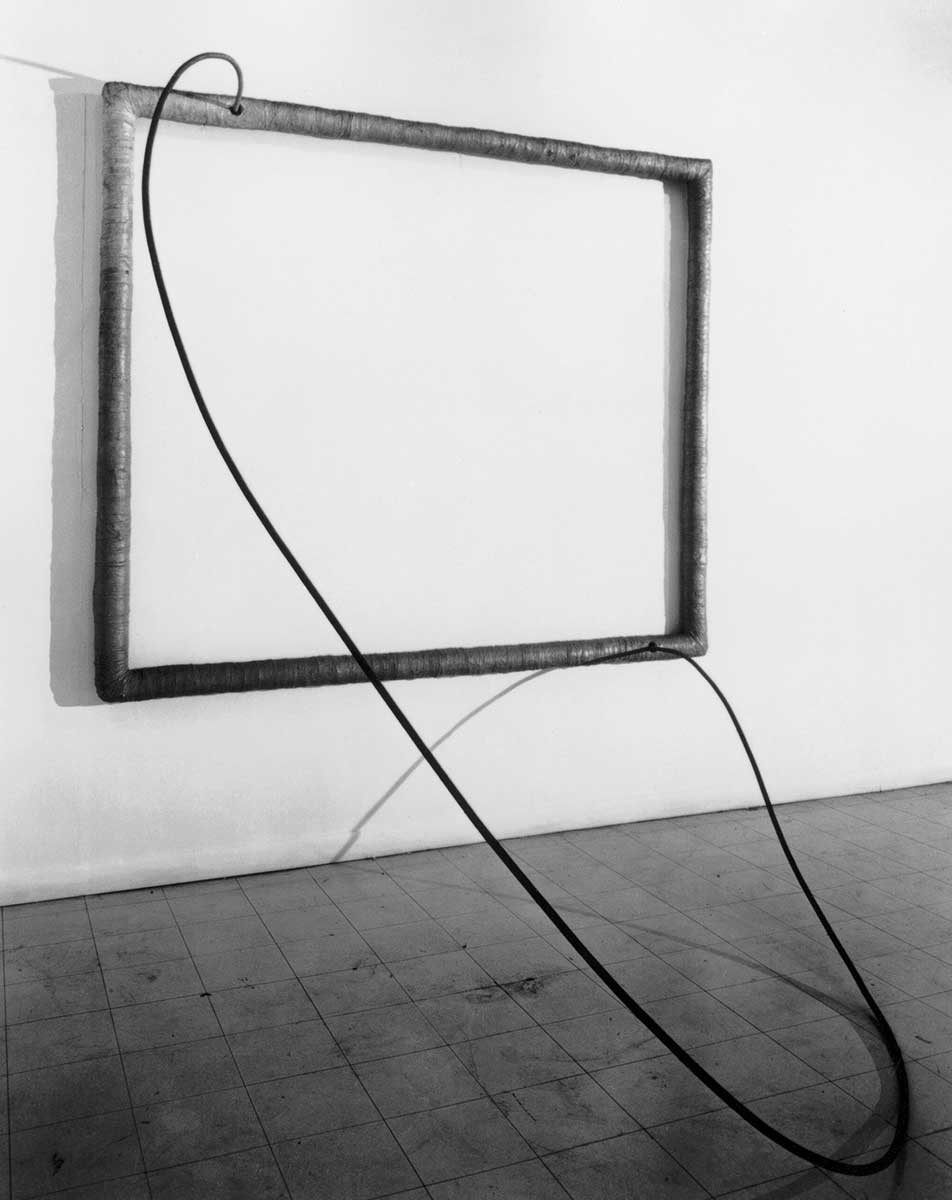
By 1966, Hesse’s marriage was in shambles, but she was becoming more and more confident in her abilities as an artist. Hang Up is, according to Hesse herself, “the most important early statement I made. It was the first time my idea of absurdity of extreme feeling came through.” The piece is ostensibly a large frame constructed of only cord and rope, six by seven feet, but it doesn’t actually frame anything except for the wall on which it’s hung. A curved rod extends out into space from the bottom right of the frame and connects at the top left.
The tension here is between the two-dimensionality suggested by the frame (along with the whole history of painting and the way it is exhibited and perceived) and the three-dimensionality of the rod sticking out into the gallery space right where the viewer would normally stand to regard a painting. It’s funny and evocative, simple in its construction and complex in its allusions.
4. Accession II, 1969
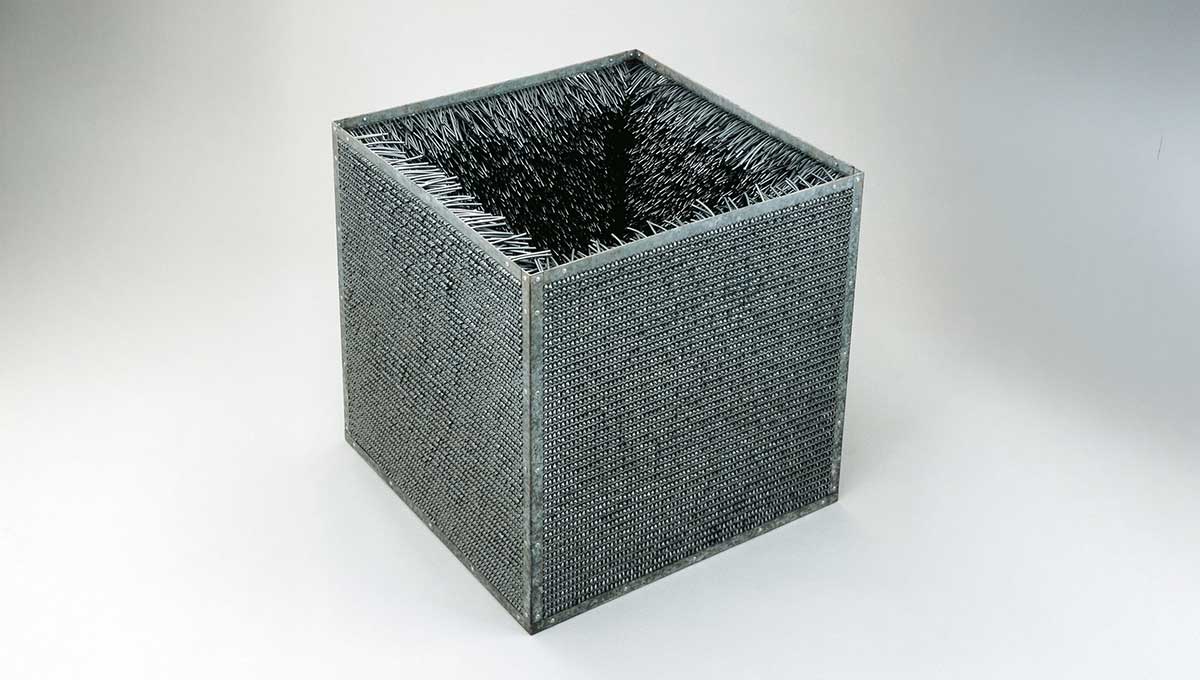
Accession II is essentially a box made of five screens of galvanized steel, which Hesse had constructed at Arco Metals in Manhattan. She then threaded vinyl extrusions through 30,670 holes, a laborious and satisfying process for her. There is a contrast between the relatively simple, smooth exterior of the box and the extremely tactile interior with its thousands of soft rubber tubes.
Like many of the minimalist sculptors’ works, such as those of Donald Judd, Robert Morris, Anne Truitt, and Tony Smith, the piece requires active participation from the viewer. What this means is that although a viewer can intuit the shape of the object from a single vantage point and form an image of that object in their mind, they actually need to circumnavigate the object to officially grasp its shape. As many minimalist works were on the ground, hanging from the ceiling, or plunked right in the middle of a room, the viewer was constantly reorienting themselves to the piece; they were made acutely aware of their own body as an object in space just like the artworks were.
Hesse was grouped with the post-minimalists, meaning she played around with similar conceits as the minimalists but ultimately deviated from them. Though some of her works were factory-produced, they all had the artist’s hand on them in some capacity (and in many cases, such as Accession II, the artist was clearly interested in painstaking, banal, and repetitive processes for their own sake). And though she used familiar geometric shapes, she loved altering and complicating them. Accession II is a square, yes, but it’s a funky, almost alive piece literally bristling with energy.
5. Repetition Nineteen III, 1968
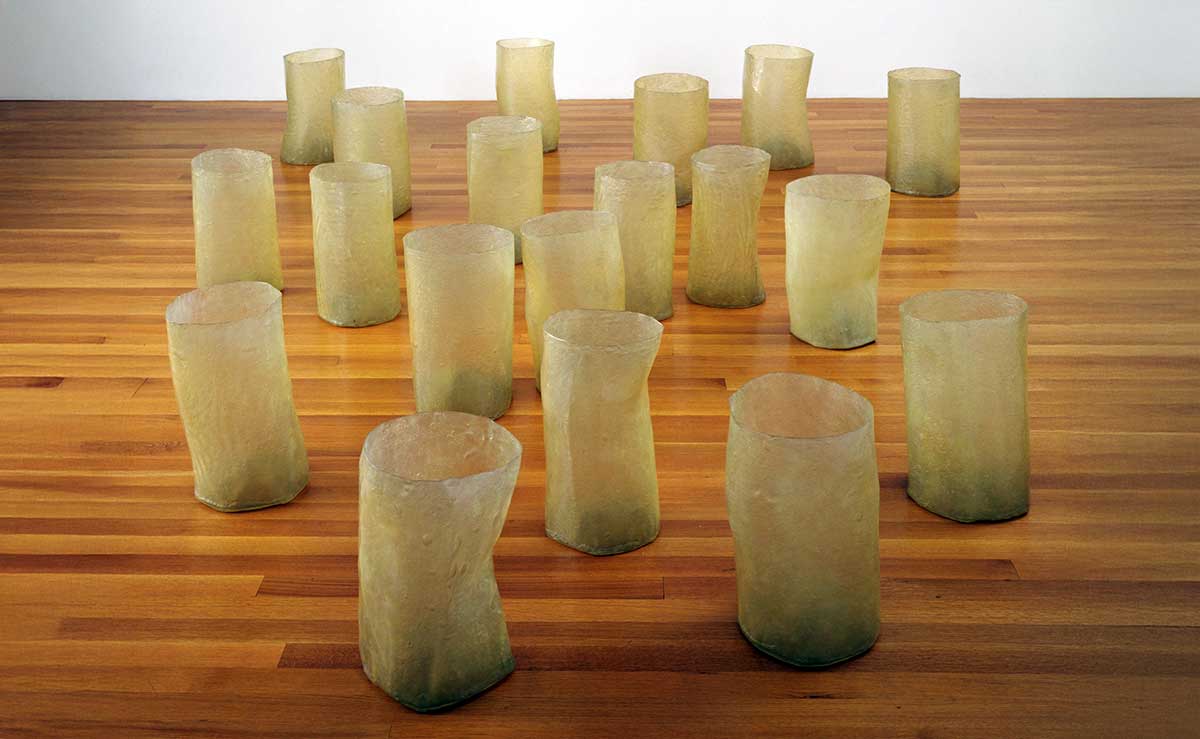
In the late 1960s, Hesse discovered new materials, primarily latex and fiberglass. Repetition Nineteen III was made of the latter, though she initially conceived of it in metal and then in latex. It consists of nineteen cylindrical pieces and is exhibited on the floor. The pieces are 12” x 20” and sit in a loose grouping, which Hesse wasn’t particularly strict about, so each exhibition of this piece in a new space may have slightly different placement.
The lack of uniformity in their placement is mirrored in the lack of homogeneity in their physical characteristics; Lucy Lippard writes that each one “has been battered into a different configuration. One is very nearly perfect, while another seems about to crumple. Like schoolchilden in uniforms, or prisoners, or young trees in a nursery, they carry within them their exuberant individuality.”
6. Contingent, 1969
By the late 1960s, Hesse was firmly ensconced in the art world. She’d been a part of Lippard’s seminal Eccentric Abstraction group show and had her own one-woman show in 1968. Critics wrote positively of her work, even if they still occasionally had a tone of bemusement. She was often grouped with other artists doing similar work but chafed at the limitations a label could engender. She told interviewer Cindy Nemser in 1970 that she didn’t care about “truth to materials” and that she didn’t want to “keep any rules; I want to sometimes change the rules.”
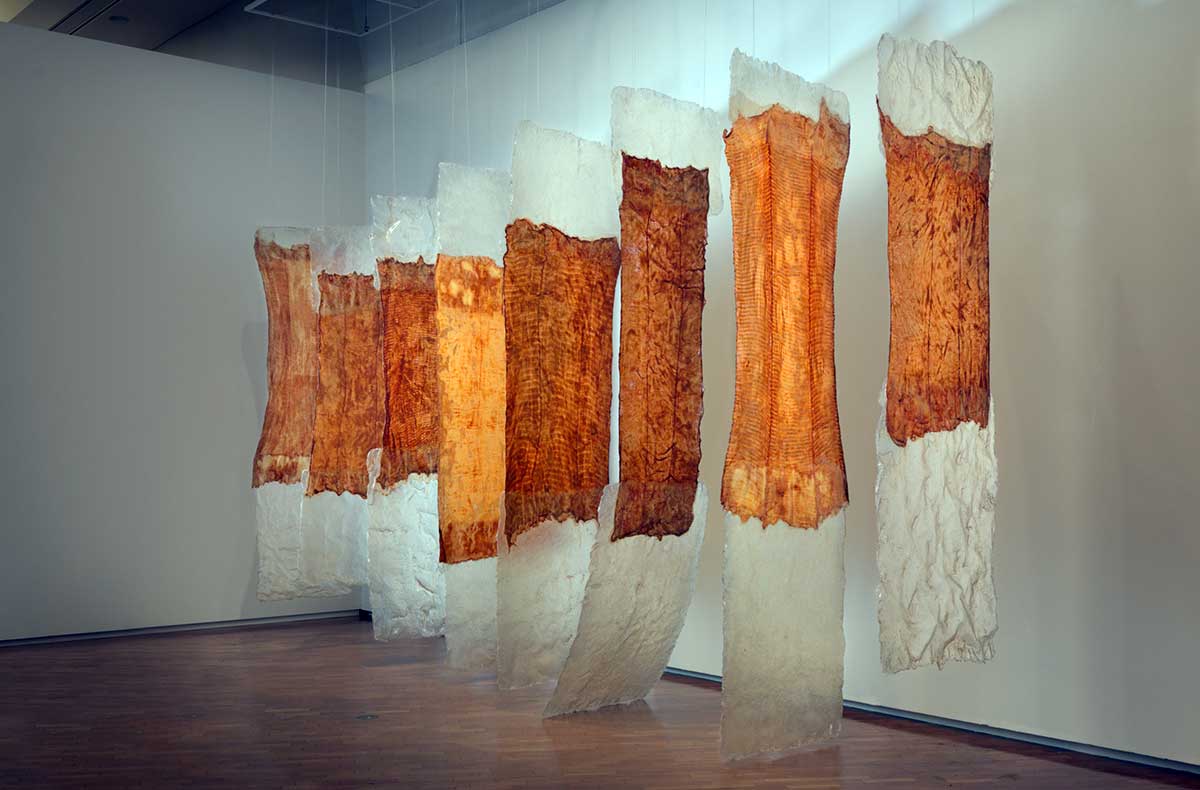
Hesse began Contingent in November of 1968 and finished it with the help of assistants in 1969. It consists of eight luminous sheets of cheesecloth and fiberglass hanging from hooks on the ceiling. The pieces appear fragile, crumbling at times, but then, at other times they appear weighty and substantial as they descend heavily into the space of the room.
In the late part of her career Hesse was indeed choosing to work with materials that were more ephemeral, more prone to decay. Many of her pieces cannot be exhibited anymore or are drastically altered from what they originally looked like. Oftentimes, critics read into this choice of fragile material, suggesting that Hesse either deliberately or unintentionally did this because her own body was breaking down, but that approach is countered by other critics who say a conflation of Hesse’s art and life is reductive and does not allow for Hesse as an artist deeply interested in the qualities of materials for their own sake.
7. Untitled (Rope Piece), 1970
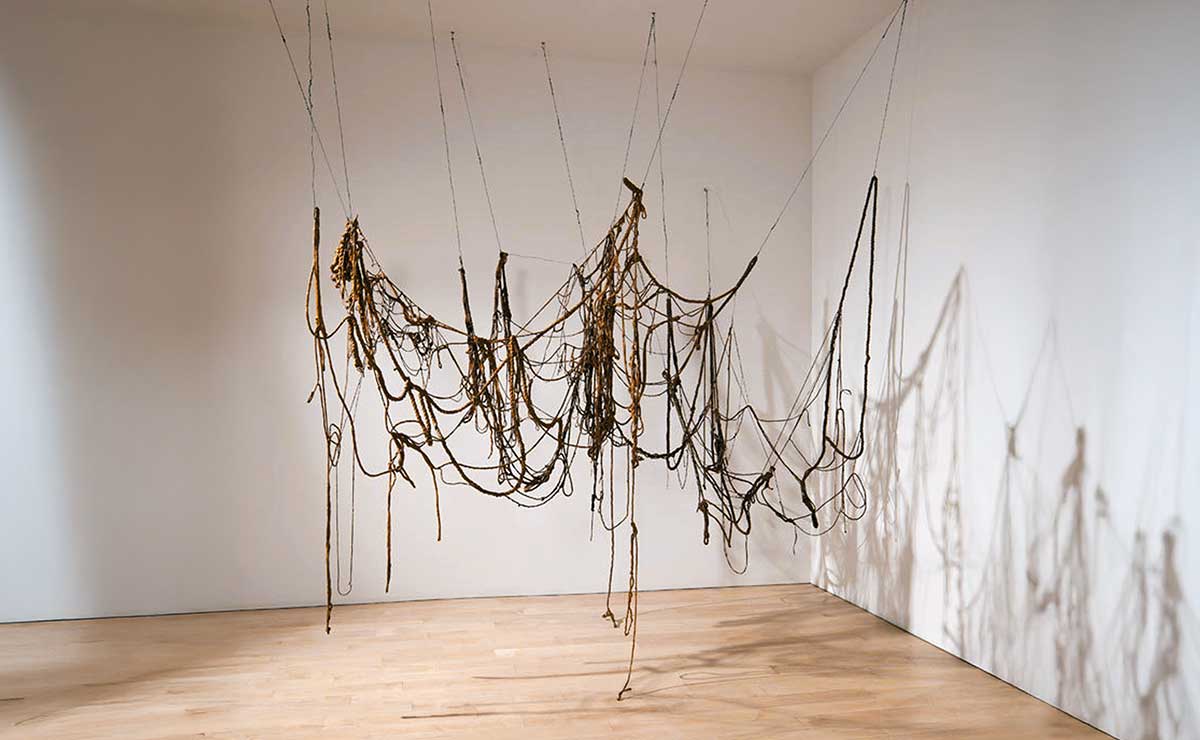
Untitled (Rope Piece), one of the last handful of pieces Hesse created before her death, is comprised of two strands of latex-covered rope, hanging from wires and pinned by nails to the ceiling and the walls. It is considered unfinished because, as Lippard notes, the installation is half the work and can only be done by someone very familiar with Hesse’s work. It is large in the amount of space it takes up, but the fact that it is rope means that the space is porous, airy, and light.
The tangled skeins of rope remind many of the tangled skeins of paint in a Pollock painting, and Hesse wrote, “This piece is very ordered. Maybe I’ll make it more structured, maybe I’ll leave it changeable. When it’s completed its order could be chaos. Chaos can be structured as non-chaos. That we know from Jackson Pollock.”
Bibliography
- Lippard, L. (1992). Eva Hesse. De Capo Press.