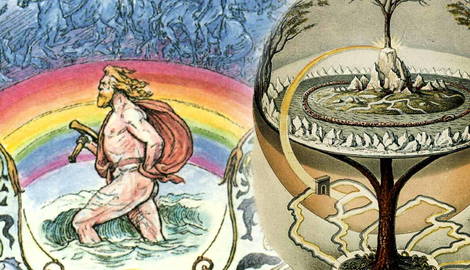

According to Norse cosmology, there were nine realms in the universe, held together by the great world tree Yggdrasil. However, nowhere in the surviving sources is a definitive list of the nine worlds given, and how they were organized within Yggdrasil, among its roots and branches, is also open to speculation. But based on the information we do have, what were the nine Norse realms, what did they look like, and how was the Norse cosmos organized around Yggdrasil?
The Upper Tier: Homes of the Divine
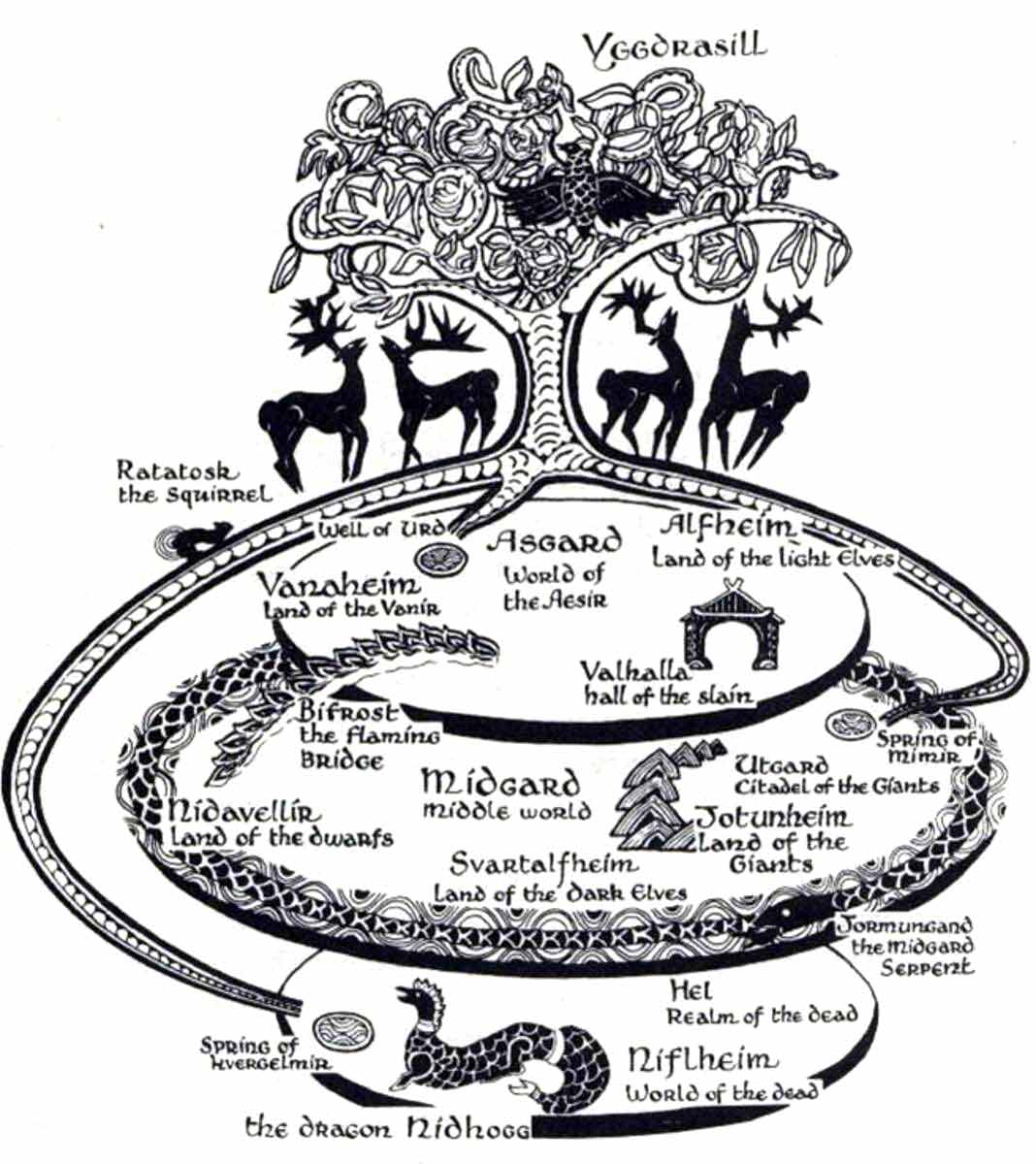
Asgard, the realm of the Aesir gods, is often assumed to be among the high branches of Yggdrasil because our main source, the Icelandic writer Snorri Sturluson, often describes it as “heaven.” But Sturluson was a Christian, writing more than two centuries after the Icelandic Vikings converted to Christianity. He is likely projecting his own Christian understanding of the cosmos onto the Norse cosmos.
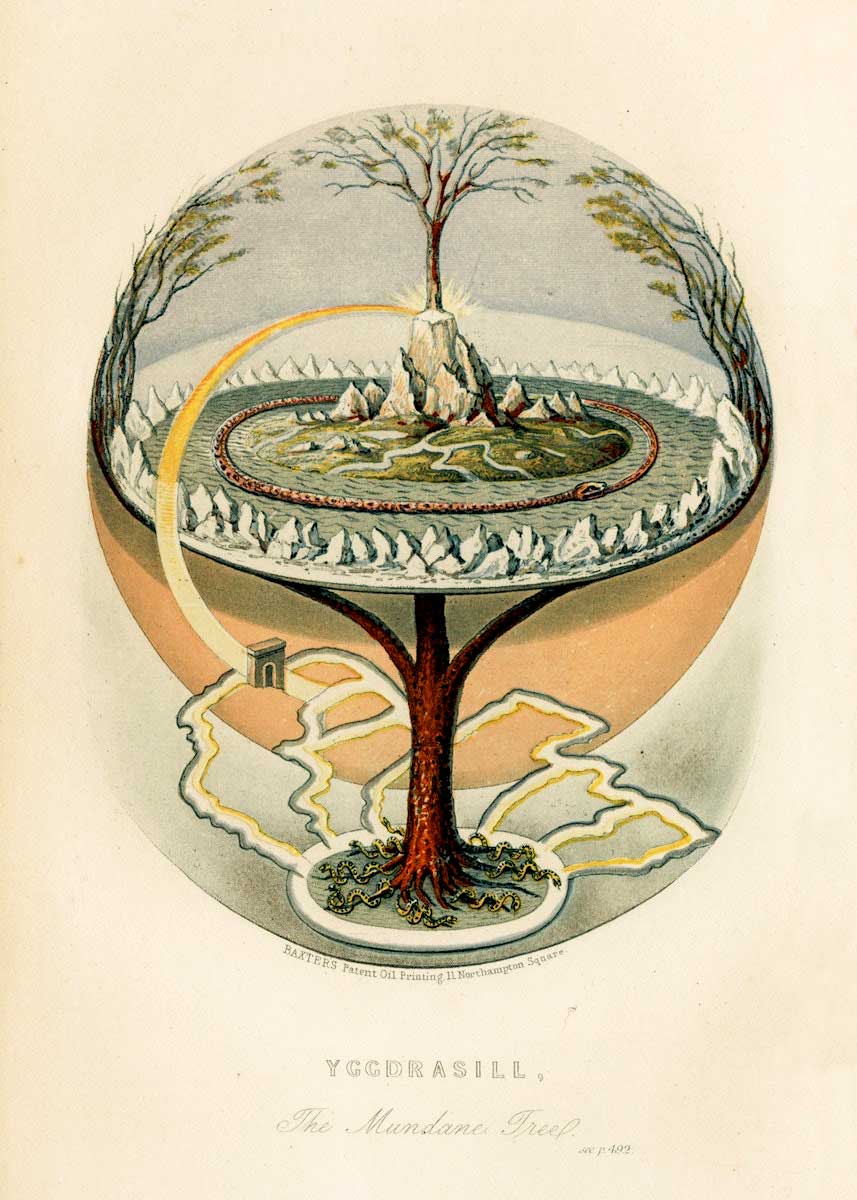
In the very same text, the Gylfaginning, Sturluson also states that one of the roots of Yggdrasil runs through the realm of the gods. This suggests that all nine realms lie beneath Yggdrasil. Because the sources are open to interpretation, there are many varied depictions of the Norse cosmos.
1. Asgard – Stronghold of the Aesir Gods
Asgard, which means “stronghold of the Aesir,” is the home of the principal Norse gods, the Aesir. These are the most important gods, including Odin the All-Father and Thor the protector, but they aren’t the only gods in Norse myth.
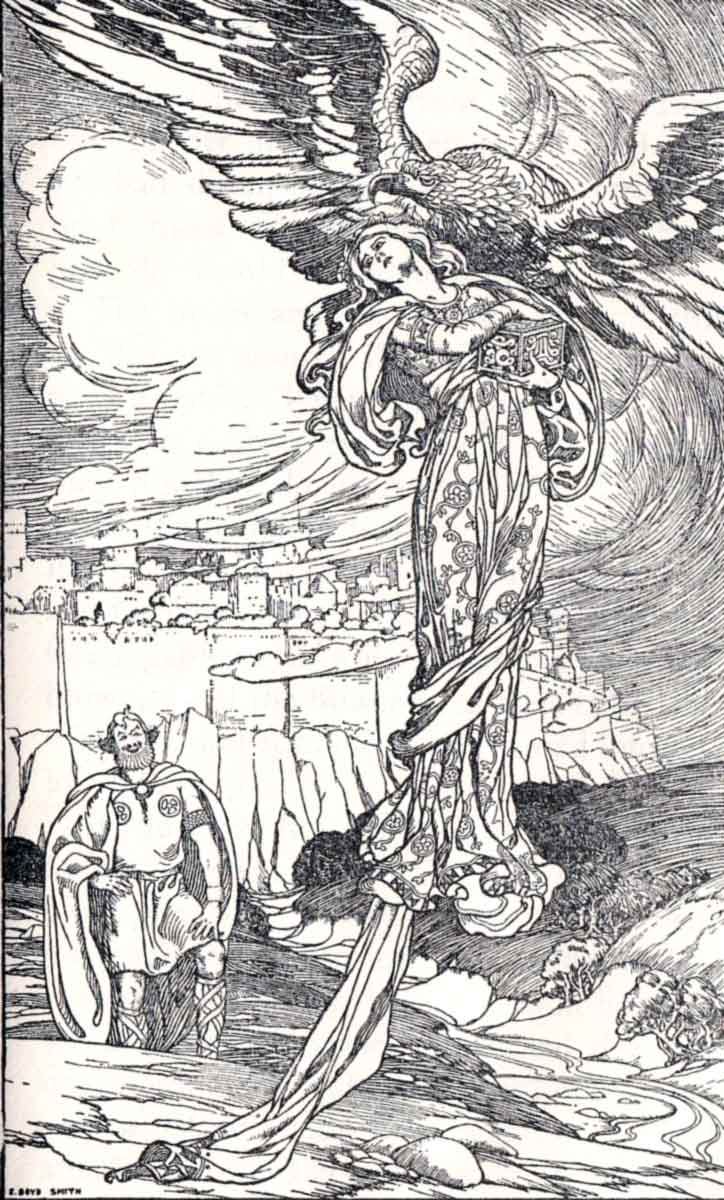
The realm is described as enclosed by a great, but incomplete, wall. One of Loki’s tricks meant the walls were never fully completed (Gylfaginning 42; Völuspá 25-26), but they were functional. In the story of the kidnapping of Idunn, Loki flies over the wall in the form of a hawk to safety, but the Aesir stop his pursuer, the Jotun (giant) Thjazi, as an eagle, by lighting a fire above the wall at exactly the right moment. Loki is also a Jotun, but he is allowed to live in Asgard among the gods because of a blood brotherhood pact with Odin.
Asgard is described as divided into twelve realms, each ruled by a different god, suggesting a political organization that reflected the petty chieftainships of the early Viking Age. Some of these halls are described in the Grímnismál.

Principal among them is Odin’s realm called Valaskjafl (shelf of the slain). Here he could sit on his throne, Hlidskjalf, and see everything happening across the nine realms. This is also the location of his great hall, Valhalla, thatched with golden shields. This acts as one of the Norse afterlives, as he chooses the bravest fallen warriors to dwell there. It is not the only Norse afterlife, or even the only one in Asgard. The goddess Freyja rules over a realm called Folkvangr, with a hall called Sessrumnir. She also chooses the bravest fallen warriors to dwell there.
Other halls include Fensalir, the hall of Odin’s wife Frigg. Thor rules Thrudheim, which has 540 rooms. Odin’s son Balder rules Breidablik, into which nothing unclean can pass. Balder’s son Forseti, the god of Justice, rules Glitnir, which features gold pillars and a silver roof. Heimdall has a hall called Himingjörg, where the Bifrost Bridge enters Asgard.
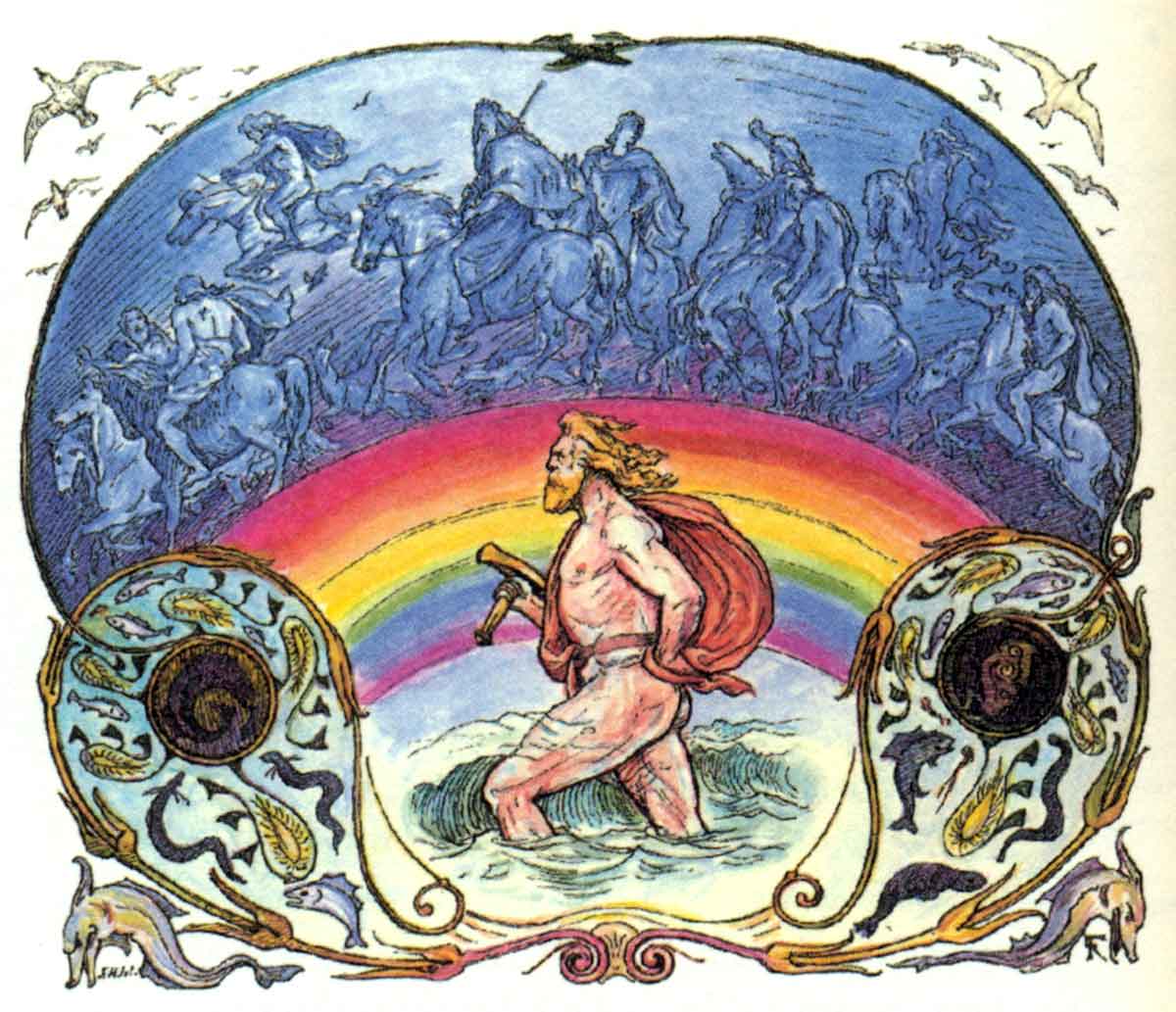
The Bifrost Bridge connects Asgard with Midgard. It appears like a rainbow, but it is three colors. The red is fire, to ensure the Jotnar cannot cross the bridge and ascend into Asgard. The gods ride across the bridge daily on their horses to visit Urdarbrunnr, the Well of Destiny. It is unclear whether this is in or near Asgard. This is where the Norns, the Norse Fates, dwell, writing destiny into Yggdrasil with the runes. Only Thor does not ride, as he wades through the boiling water of the rivers Kormt and Ormt underneath.
Idovall is the central plain in Asgard, used as a meeting place. It has a great hall, Gladsheimr, with thirteen high seats for the most important male gods, and Vingolf, with seats for the goddesses. This is where the surviving gods will regroup following the final apocalyptic battle of Ragnarok.
2. Vanaheim – Field of the Vanir

Vanaheim is the home of another race of gods, the Vanir. While the Aesir gods were authoritative, responsible for elements such as war and justice, the Vanir gods were linked to nature, fertility, and magic. The Vikings viewed the Vanir as “wild,” with “uncivilized” practices such as incest. This led to conflict with the Aesir and the Aesir-Vanir War.
It seems that the Vanir were winning the war. Notably, the Vanir witch Gullveig made her way to the center of Asgard, where she was pierced by spears and burned three times, but was also magically reborn three times. Nevertheless, the war ended in a truce, including an exchange of hostages. Njord and his twin children, Freyr and Freyja, were sent to live among the Aesir. The twins were married and were forced to separate and marry others.
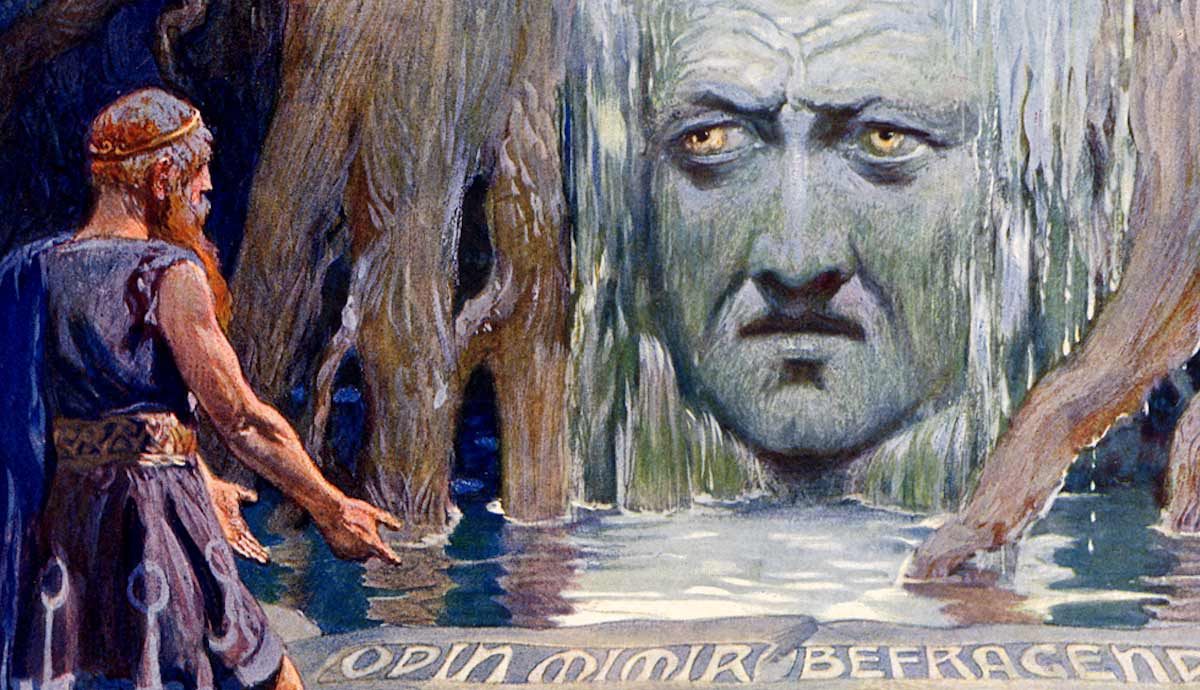
Hoenir and Mimir were sent to live among the Vanir. They elected the charismatic Hoenir as their leader, and he relied on Mimir, known for his intelligence, as his advisor. The Vanir soon grew suspicious that Hoenir could make no decisions on his own, and they eventually killed Mimir and sent his head to Odin. Not wanting to lose Mimir’s wise counsel, Odin magically reanimated his head and installed it at Mimisbrunnr, the Well of Wisdom, located in Jotunheim. Odin also sacrificed an eye for a drink from the well.
Few details survive about Vanaheim itself. According to a passing comment in the Lokasenna, Njord sailed east to arrive in Asgard. The only other clue is that while Asgard is described as a gard, meaning “inside realm,” Vanaheim is a heim, meaning an “outside realm.” This can be interpreted literally: Asgard has fortifications, and Vanaheim does not. However, it could also be metaphorical: the laws of the Aesir rule in Asgard, but not in Vanaheim.
3. Alfheim – Home of the Light Elves

Alfheim, or Ljosalfheim, is the realm of the Ljosalfar, or light elves. But who are the elves? Descriptions of them vary greatly. They are sometimes ethereal supernatural beings, sometimes divinized ancestors, and sometimes gods. Norse texts often use the phrase Aesir ok Alfar (Aesir and Elves) when referring to divine beings, making it challenging to distinguish between them.
Of their realm, the only pertinent information provided is that it was a tooth gift given to the Vanir god Freyr, suggesting he ruled the realm. This is a gift commonly given to infants when they cut their first tooth, so Freyr received it before he became a resident of Asgard, suggesting this “heim” was also not under the control of the Aesir. However, this assumes that the Vikings were concerned about consistent timelines in their mythology.
The Middle Tier: Land of Men and Monsters
The middle realms are the ones we know the most about, since these are the realms that the Vikings understood themselves to live in, and which were most closely linked to their own.
4. Midgard – The Middle Earth
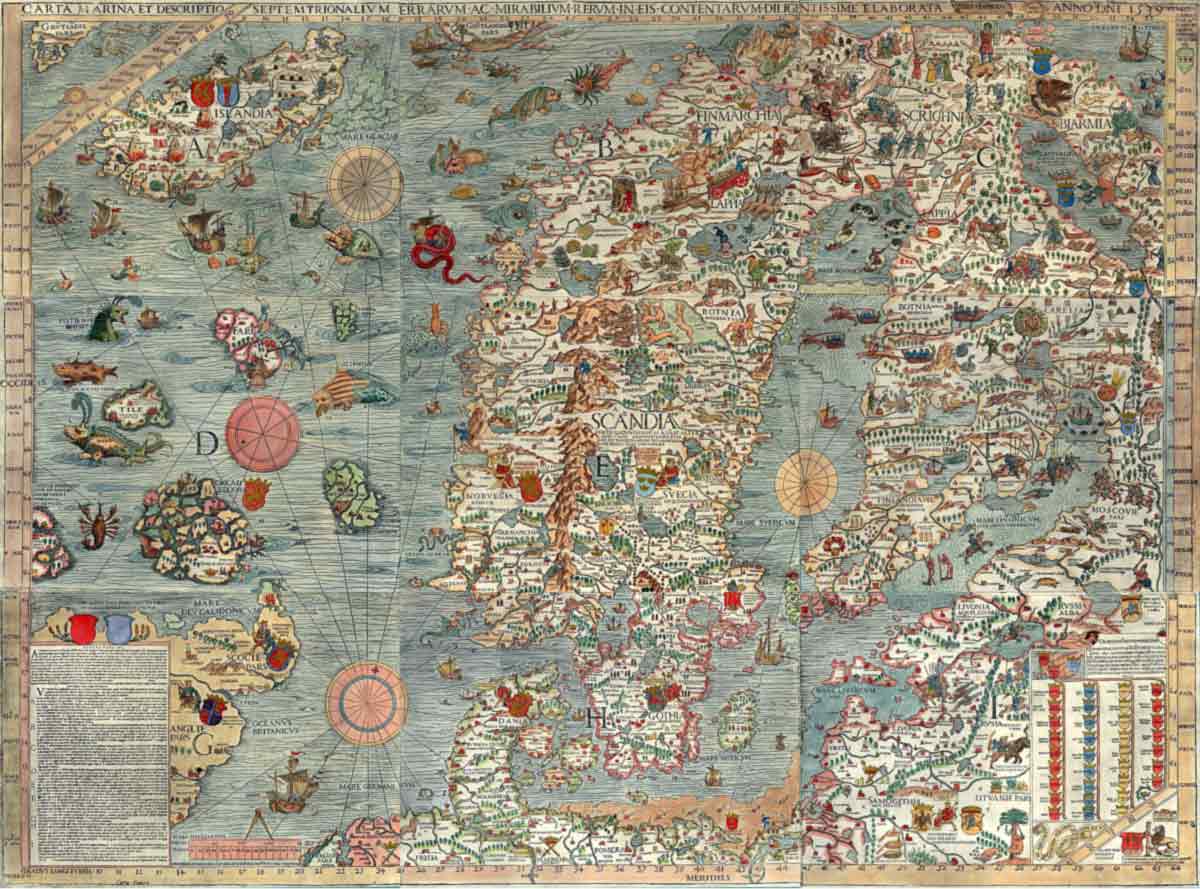
Midgard means Middle Earth, suggesting that it is in the middle of the cosmos. It was created by the gods. According to the creation myth, Odin and his two brothers, Vili and Ve, killed the first primordial Jotun, Ymir, and used his body to create Midgard.
They used Ymir’s flesh to make land and blood the oceans. His bones became mountains, his teeth cliffs, and his hair trees. His brains were scattered over the new world to create clouds, and his skull hung over the world to create the sky, held up by four dwarves. The sun, moon, and stars were made from scattered sparks of Muspelheim.
After they made the world, the gods made mankind by breathing life into an ash tree and an elm tree, creating the first man and woman, Ask and Embla. They realized that men would not be able to protect themselves in such a dangerous universe, so the gods used the eyelashes of Ymir to create a fence between Midgard and Jotunheim, the realm of the Jotnar. They also connected Midgard to Asgard via the Bifrost Bridge.

Despite their apparent efforts to protect mankind, the gods also put them at risk. When they discovered the serpent Jormungandr, the son of Loki and the giantess Angrboda, they were so concerned about his potential threat that they threw him into the water surrounding Midgard. There, the serpent grew to such an enormous size that it now encircles the entire world and holds its own tail in its mouth. This serpent is mighty enough that it will fight to the death with Thor at Ragnarok, yet the gods placed it on mankind’s doorstep.
5. Jotunheim – Land of the Giants

Jotunheim, or Utgard (world beyond the fence), is the world of the Jotnar or giants. Descriptions of the Jotnar suggest that they were very similar to the gods in terms of their abilities. They were certainly compatible, as indicated by constant interbreeding. Odin himself is half Jotun, being the son of the Aesir god Borr with the giantess Bestla. He had Thor with the giantess Jord, making Thor three-quarters Jotun, in theory. But the Vikings did not think of them that way. The Aesir were the gods who provided order to the universe, and the Jotnar were the source of chaos.
Jotunheim is described as separated from Midgard by the river Iving, which never freezes over, preventing the Jotnar from crossing into the realm of men. It also sits near the sea surrounding Midgard. Snorri Sturluson says that after the gods made Midgard, they gave the Jotnar the shores around their new world to settle. It is also described as east over the deep sea, as when Thor visits the Jotun Hymir, they fish in the sea where Jormungandr dwells.
Jotunheim is often described as a grim world of deep forests and stark mountains. There is no fertile land, and the Jotnar live by hunting and fishing, suggesting that they are “uncivilized.” The Jotun Angrboda is specifically described as living in the Ironwood, where she is the mother of wolves.

Much like Asgard, the Vikings imagined Jotunheim to be a world very much like their own, with strongholds ruled over by chiefs. Several of their halls are mentioned in the surviving sources. Thrym lives in Thrymheim, where he hosts a Viking-style wedding. But he is richer than any human chief: he holds his dogs with golden leashes, his cattle have golden horns, and he has many jewels.
Most famously, traveling via Midgard in his goat-drawn chariot, Thor, Loki, and two human companions visited the stronghold of Utgard-Loki. Throughout the story, nothing in Jotunheim is as it seems, and the group is constantly tricked by illusions. This is also the only account to suggest that the Jotnar were giant in stature. This story is very strange and reads a bit like Alice’s Adventures in Wonderland. Many believe that the story is a later invention, recasting a now-lost Norse myth as a fairy tale.
The Lower Tier: Realms of the Primordial Forces
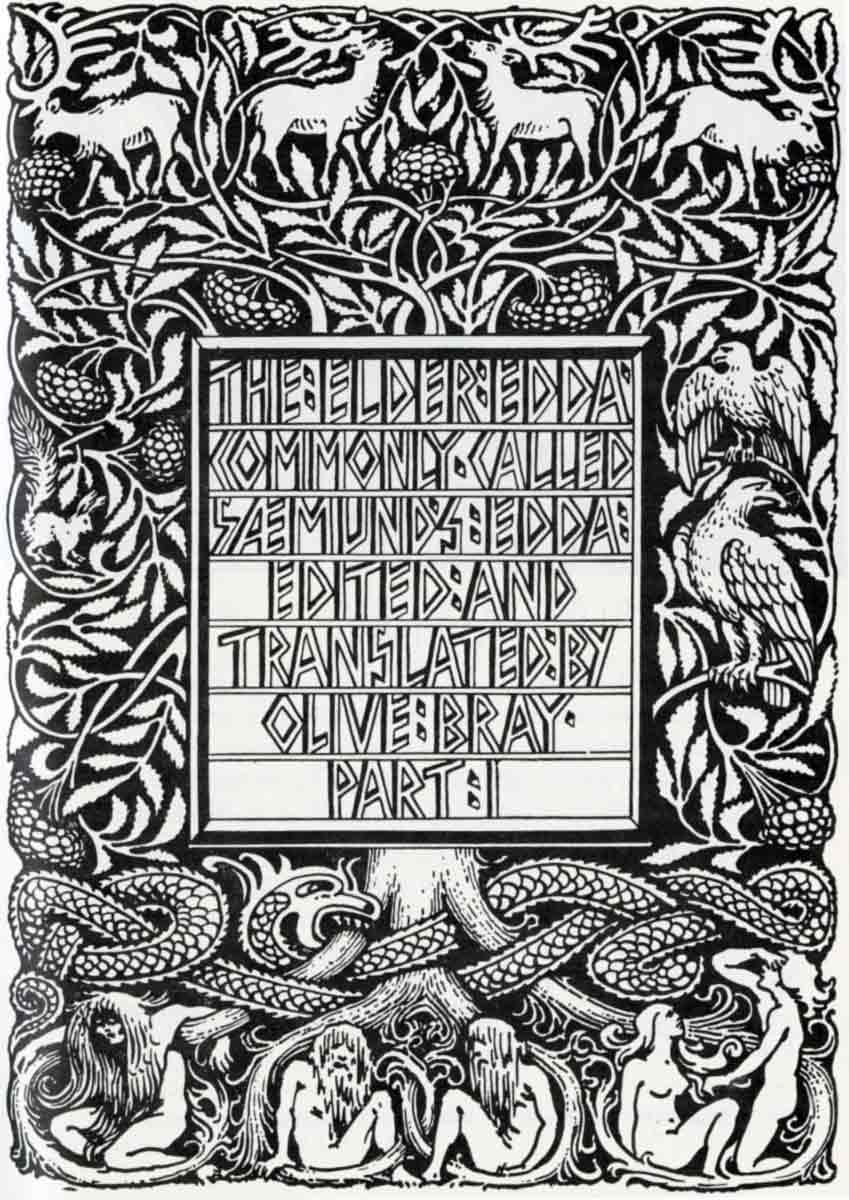
The darker and more inhospitable realms are located at the very bottom of the cosmos. They are the primordial worlds and at least one underworld.
6. Svartalfheim – Forges of the Dwarves
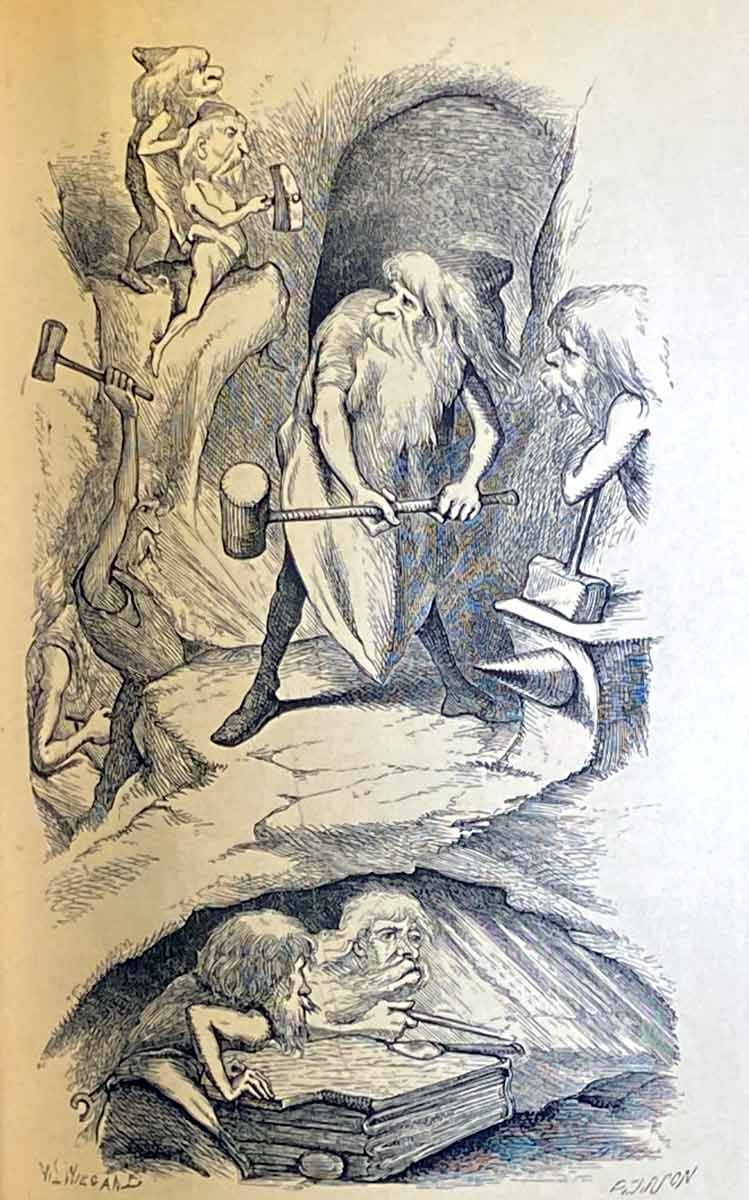
Svartalfheim is the world of the dark elves, which we often just call dwarves, as they are described in very similar terms to the dwarves we meet in Tolkien. It is also sometimes called Nidavellir (dark fields) or Myrkheim (dark realm), though these names are sometimes considered to refer to a different realm. Nidavellir might be another candidate for the ninth realm, a dark realm, perhaps where the sun and moon set.
Svartalfheim is said to be north of Midgard, which means down in Old Norse. It is described as a labyrinth of subterranean mines and forges occupied by the dwarves, who work in small groups. The dwarves are said to be pitch black in color, either born from Ymir as maggots or made from the blood of the giant Brimir (fire) and the bones of the giant Blainn (death). This suggests that the dwarves were associated with death and the Jotnar, while the light elves were linked to the gods.
The dwarves are the master craftsmen of the cosmos. We mainly learn about their world when others visit to obtain treasures. Loki famously visited the dwarven craftsmen to get treasures for the gods, including Thor’s hammer Mjolnir. Freyja visited to acquire the golden necklace Brisingamen, paying by spending a night with each of the craftsmen. The gods visited when they needed an unbreakable chain to imprison the wolf Fenrir. When Kvasir went there, he was killed by two dwarves, and his blood was used to make the Mead of Poetry. The giant Suttungr then visited and took the drink from them, which was later stolen by Odin.
7. Muspelheim – Prison of the World Destroyers
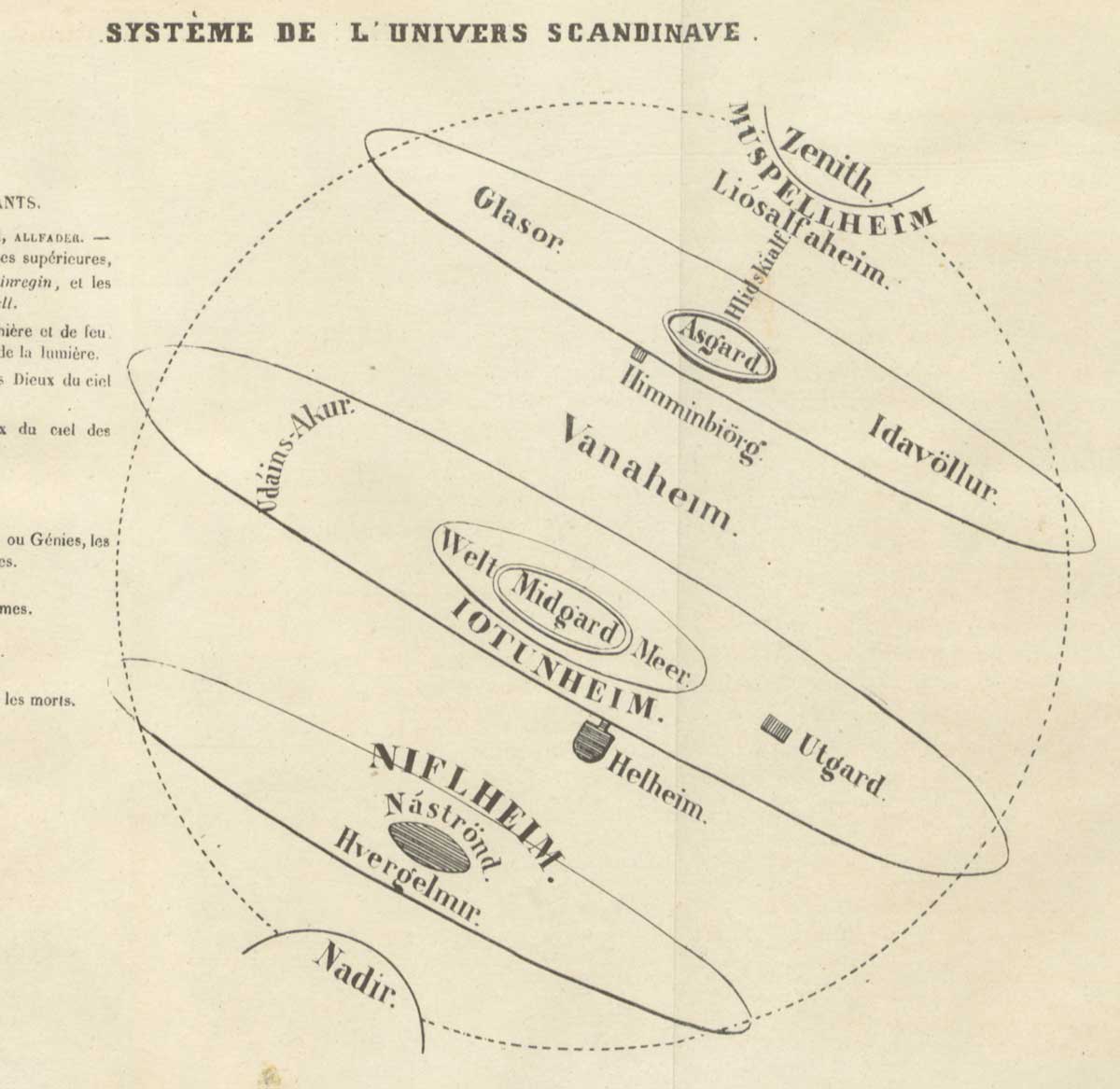
Muspelheim is the primordial realm of heat and fire. According to the Norse creation myth, in the beginning, there was a great void called the Ginnungagap. Muspelheim was at one end of the void, and Niflheim, the realm of cold and mist, at the other. Eventually, heat from Muspelheim and mist from Nifheim made their way into the gap and combined into the primordial goop from which life emerged. Muspelheim is described as located in the south, so up, but is rarely shown there in depictions of the Norse cosmos.
Muspelheim is described as hot and bright. It is not named for its heat, but for its occupants, the fire giants, as muspel means “world destroyers.” The fire giants are trapped in Muspelheim, unable to enter other realms. Their leader, Surtr, is described as sitting at the gate of Muspelheim, looking out, waiting for his opportunity. The disturbances that precede Ragnarok will allow the fire giants to emerge. Surtr will carry a burning sword and set much of the universe on fire before fighting to the death with Freyr.
8. Niflheim – Primordial World of Ice and Mist
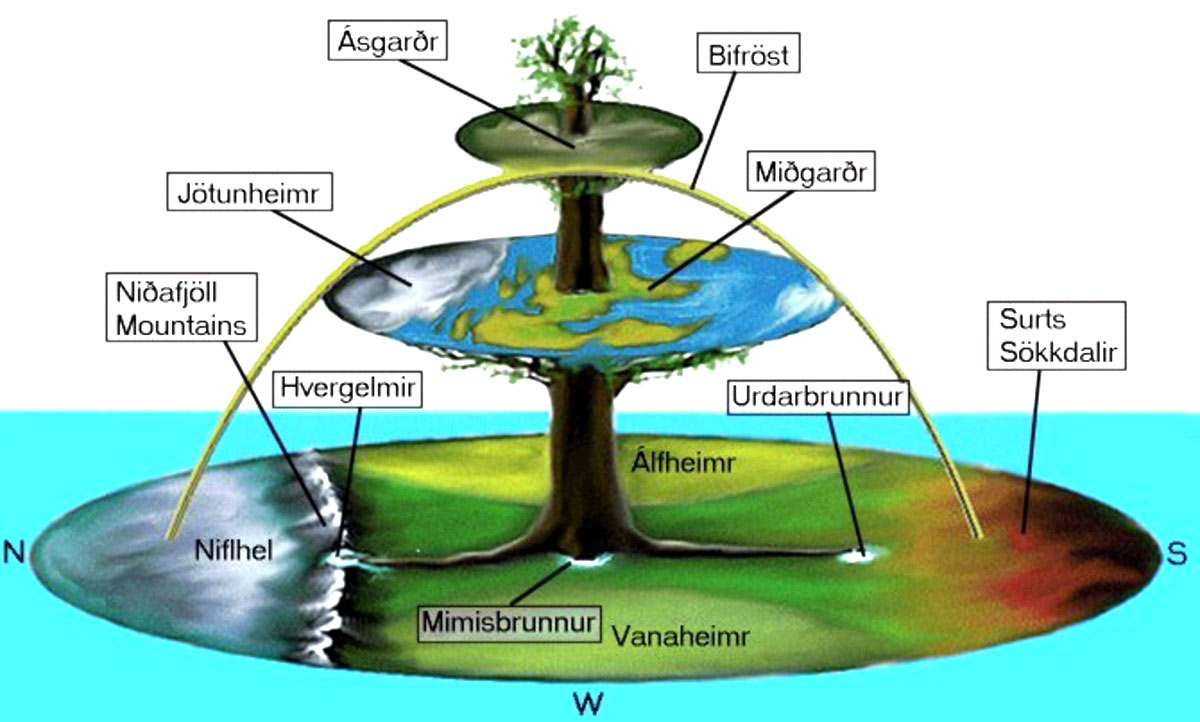
Niflheim is the world of frost and mist that played an important role in creation. It is certainly located among the roots of Yggdrasil. It is specifically described as under one of its roots and has the well Hvergelmir (bubbling boiling spring), from which all rivers in the world flow. This is also where we find Nidhoggr (malice striker), the great dragon that gnaws on the roots of Yggdrasil.
9. Helheim – Underworld of Hel
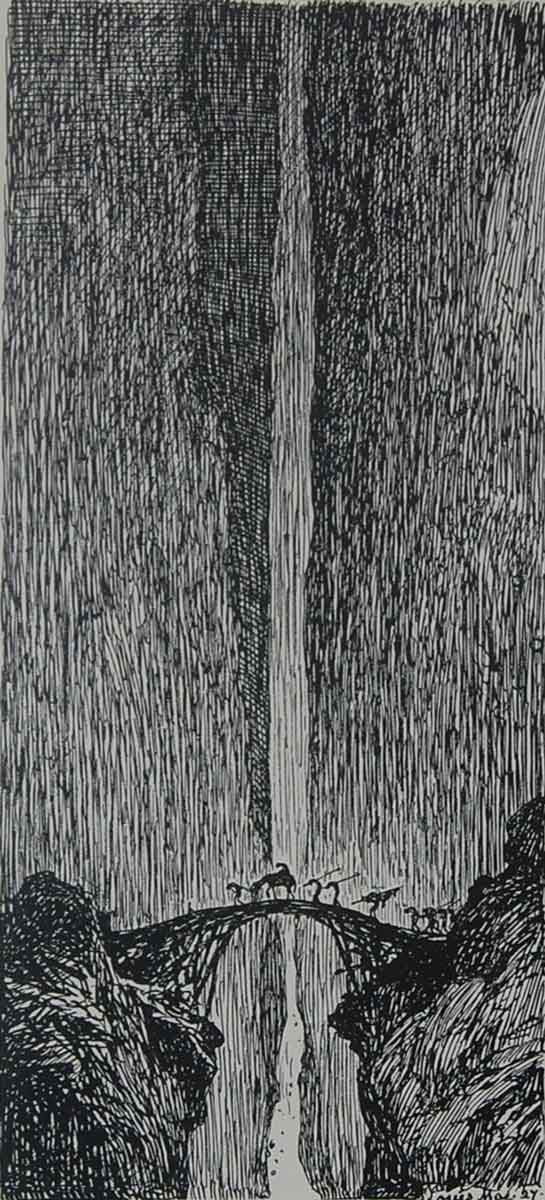
While Helheim is usually listed as the ninth realm, it may not be a separate realm, but rather a place within Niflheim. In the Gylfaginning, it specifically states that the gods sent Hel, the daughter of Loki and Angrboda, to Niflheim to rule over the underworld there, which became known as Helheim. In various places, the dead are described as being sent to Niflheim or Niflhel. Adding to the confusion, Helheim is said to contain a place called Niflhel, where the wicked dead are tormented. Niflhel probably does not exist in the original Norse cosmology but was added by Christian authors trying to make sense of Helheim within their own cosmology.
While there are a couple of lengthy descriptions of Helheim in the sources, these again are probably influenced by Christian ideas of what a “hell” realm should be like. These descriptions start with the road to Helheim, called Helvegr. In Snorri Sturluson’s account, the god Hermodr makes the journey of Odin’s eight-legged steed Sleipnir. He travels for nine nights through dark valleys to reach the river Gjoll (loud noise). He crosses a bridge and meets a gatekeeper Jotun named Modgudr (furious battle), who lets him pass. He then reaches the walls of Helheim, which are protected by Hel’s guard dog Garm. Because he is on Sleipnir, he can jump the wall.
The Danish historian Saxo Grammaticus describes a similar journey made by the hero Hadding, guided by a mysterious figure, possibly Hel herself. She takes him through a dark and misty land, then a sunny and fertile land where herbs grow year-round. They eventually reach a raging torrent flowing with weapons, cross a bridge, and see armies of fallen warriors locked in an eternal, furious battle. They come to the same protective wall.

Returning to Snorri Sturluson’s account, Helheim has a dark and dreary hall called Elvidner (misery) where the goddess of death eats from a dish called hunger, with a knife called famine, and sleeps in a bed called sick bed. This suggests that there is no relief for the dead in Helheim.
Again, this probably does not align with the original conception. Sturluson says that the god Balder was considered the noblest of the gods, but when he died, because he did not die in battle, he still found himself in Helheim. Clearly, it was not an underworld exclusively for the wicked. Moreover, when Hermodr visits Helheim, he finds Balder seated in a place of honor in Hel’s hall, suggesting that it might not have been much different from Valhalla. Nevertheless, it was clearly a place of no return. Even Odin cannot order Hel to release Balder.
Yggdrasil: Backbone of the Universe
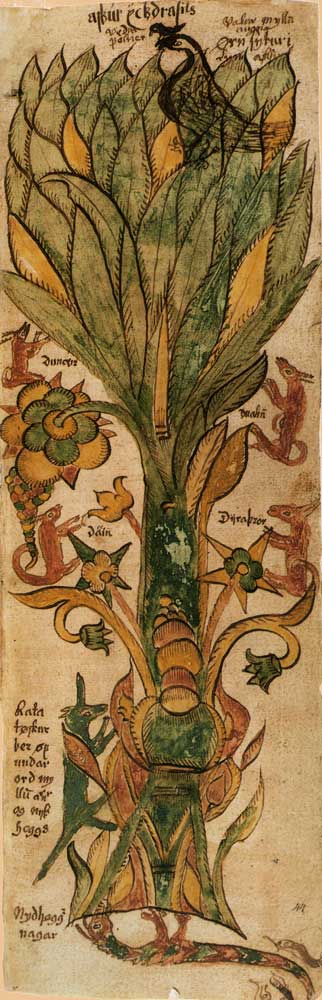
While the nine realms populate the Norse cosmos, Yggdrasil is its backbone. It is described as an enormous, evergreen ash tree. Exactly how the tree came into being is not specifically mentioned in the creation myth. Presumably arose from the primordial goop, as the volva seeress who recounts the prophecy of Ragarok in the Voluspa says she remembers when Yggdrasil was still a seed.
It is more than just a backbone; Yggdrasil is the mystical heart of the cosmos. This is reflected by the fact that Odin, as described in the Hávamál, hung himself from Yggdrasil for nine days and nights, pierced by his spear, to learn the secrets of the runes, magical tools capable of shaping reality.
As well as the dragon Nidhoggr, who gnaws on the roots of Yggdrasil in Niflheim, several other creatures live in Yggdrasil. The stag Eikthyrnir feeds on Yggdrasil’s leaves, which causes water to sprout from its horns and replenish the wells. The goat Heidrun, who lives in Asgard, also feeds on Yggdrasil. This allows her udders to flow with endless mead for Odin’s fallen warriors. An unnamed eagle, with a hawk named Vedrfolnir (storm pale) between his eyes, lives at the top of the tree. A squirrel named Ratatoskr (drill tooth) runs up and down the tree carrying messages between the eagle and Nidhoggr, who are bitter enemies. Another four stags, representing the four winds, eat the tree’s buds.
All this activity explains why Odin claims that Yggdrasil lives in more pain than anyone can comprehend (Grimnismal 35). The health of Yggdrasil is also directly linked to the health of the universe. According to the Voluspa, before Ragnarok, Yggdrasil, scarred and tired, groans and shivers. This shaking of reality allows for the changes in the cosmos that cause Ragnarok.
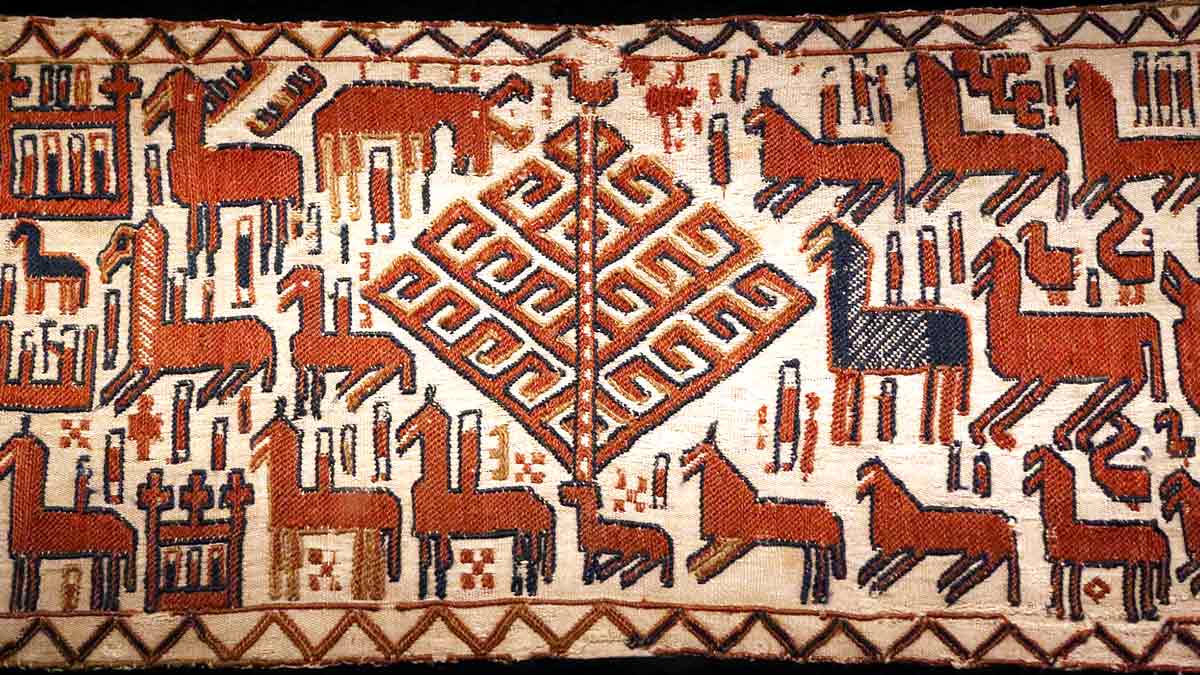
While Yggdrasil is of central importance to Norse cosmology, few depictions of the tree survive from the Viking Age, though twisting branch themes common in Norse art may reference Yggdrasil. However, the Viking Age Överhogdal tapestry, discovered in Sweden in 1910, shows multiple depictions of Yggdrasil surrounded by familiar characters from Norse mythology in processions. It suggests that Yggdrasil was considered the highway of the Norse cosmos. Recently, textiles restored from the Oseberg ship burial have been discovered to show similar images of Yggdrasil.