
Brilliant colors seen in Renaissance art helped viewers separate the mortal from the immortal, the fantastical from the ordinary. The Medieval use of colors, compared with the Renaissance, reflects changes in style, new techniques, and materials. These differences would help artists imbue works with more symbolism in a naturalistic and humanistic way than previous generations did. From rainbow thrones to peacock angel wings, read on to learn how using rainbow color gradients and colorways helped Renaissance artists learn and understand the world around them.
A Renaissance Doorway Into the Divine: The Moulins Triptych
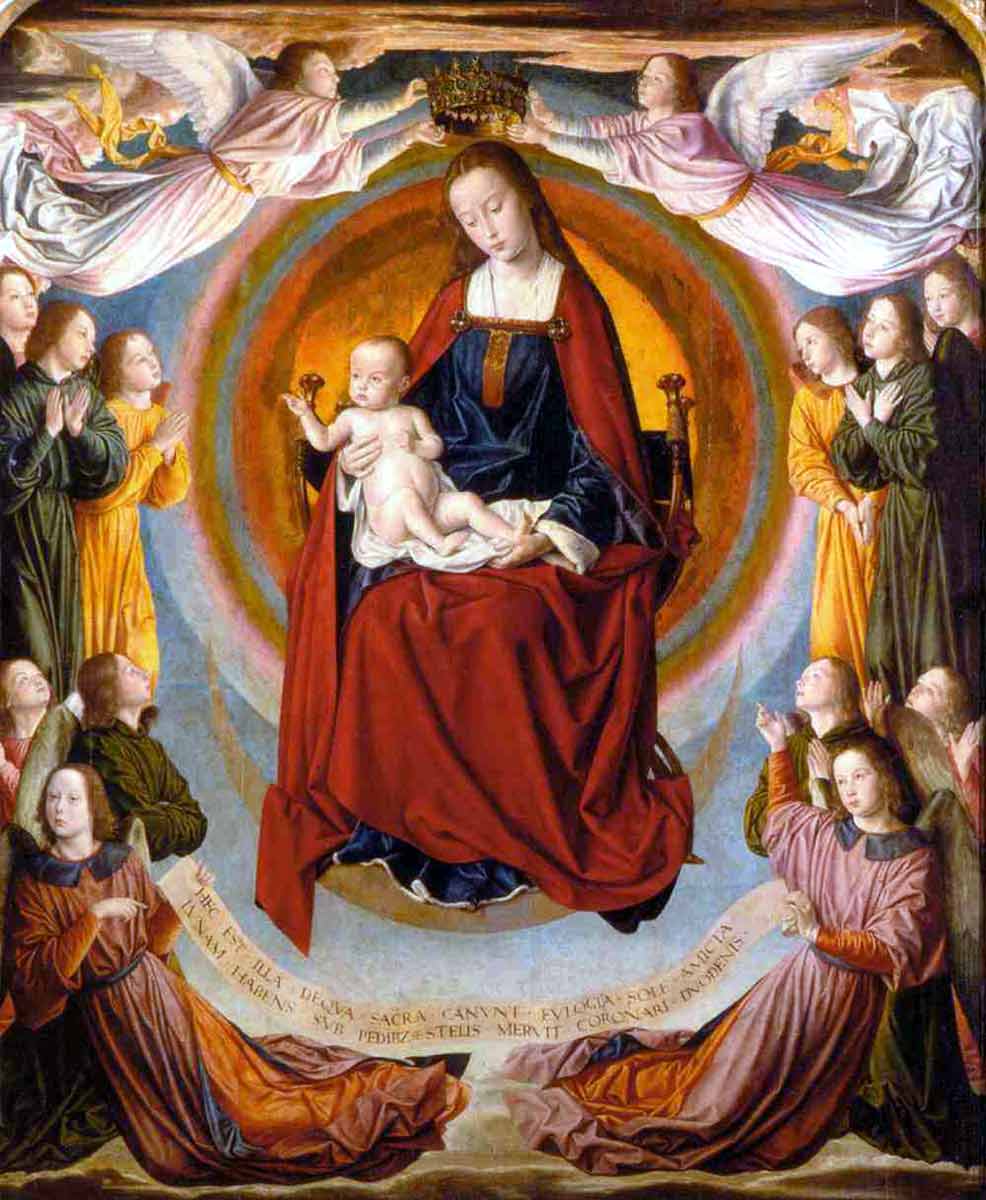
From Ancient to Medieval times, mandorlas, or almond-shaped orbs, were a popular way to distinguish the heavenly world from the earthly one. They represented a doorway from one world to the other, and surrounded a divine figure in a protective glow. With the mandorla, there is a clear separation between heaven and earth, with the globe of color strictly dividing the figures from the rest of the scene.
Stepping further away from Medieval techniques, the Renaissance would be a time for artists to explore new ways of showcasing depth and space. Jean Hey’s Moulins Triptych instead incorporates multiple rings of color that radiate outward from the center focal point of Mary and Baby Jesus. They are throned at its center, with the colorful orbs pulsating outwards, giving it an illusion of spatial depth. Mary also extends slightly outside of the rings, with the folds of her gown cascading past the rainbow rings while her feet rest upon a crescent moon, adding even more depth and dimension. It gives a less strict and confined interpretation of a mandorla than seen in Medieval or Ancient times.
Using Color for Storytelling: The Beaune Altarpiece
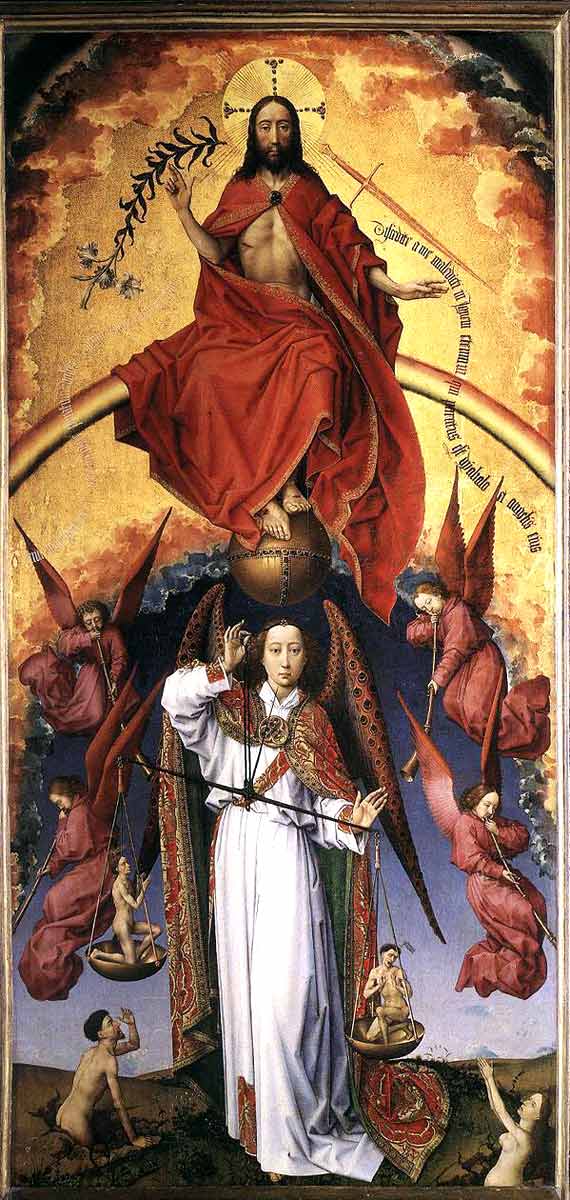
Incorporating a wider range of colors helped artists in storytelling. In Rogier van der Weyden’s Beaune Altarpiece we see the Last Judgment that would have been seen by the dying patients at the Hospices de Beaune. It shows Jesus sitting on an arched rainbow throne, asserting Jesus’s ascension into Heaven, and his hierarchy within it. The gradient clouds resemble the setting sun, rather than an enclosed space, compared to previous Mandorlas. It further advances the artist’s technique of showing both a three-dimensional space and character.
The Archangel Michael, seen with his scale in hand, stands out as another central figure in this piece. His multicolored cape and wings stand in stark contrast against the backdrop of the suffering and beauty that surrounds him. His radiant and colorful wings and attire show his hierarchy amongst the other monochromatic winged angels in this scene. His peacock-like wings can signify that he is endowed with the gift of omniscience as he is judging souls. By composing color in a variety of different ways, Rogier van der Weyden captures a stirring scene of possible redemption or damnation.
The Divine Existing in the Natural World
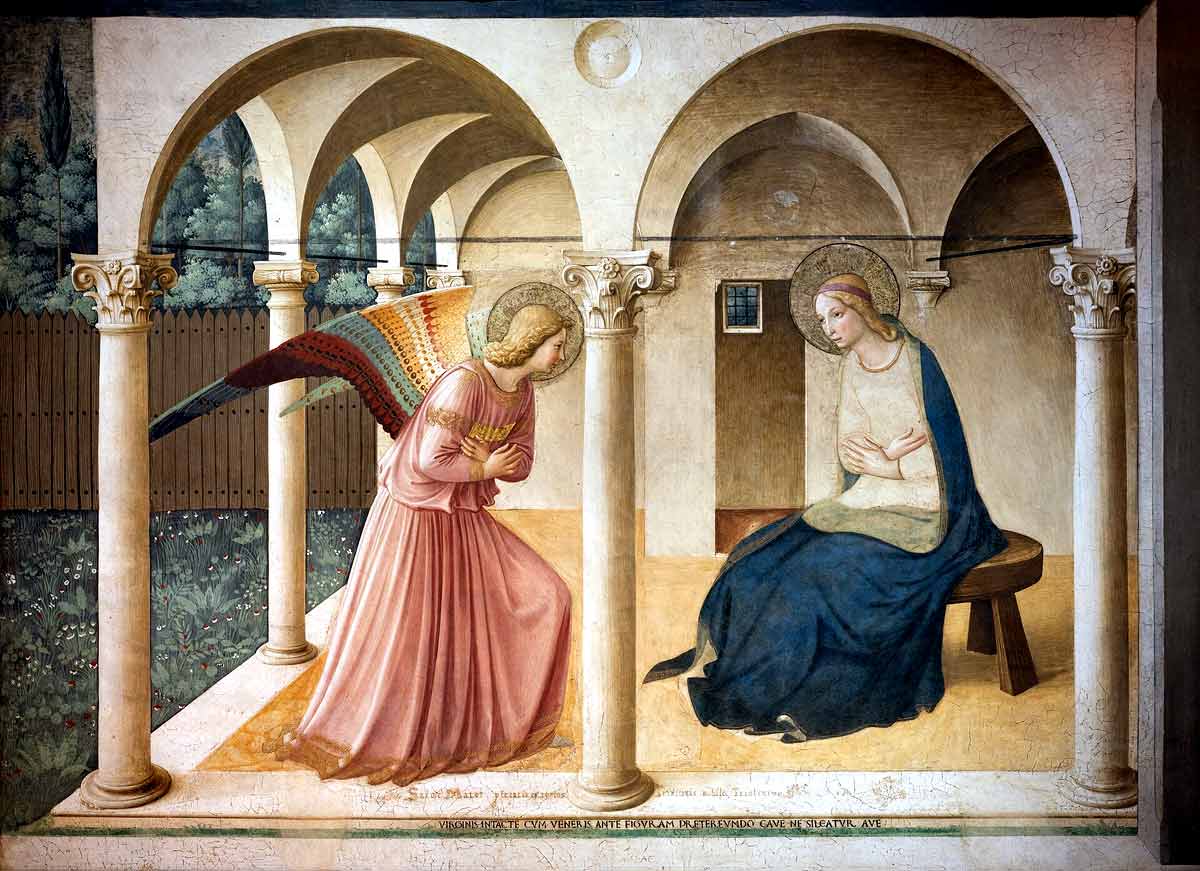
Renaissance artists also depicted celestial beings in natural, real-world settings. They used architecture and landscape similar to that of their own surroundings, rather than depicting a heavenly one.
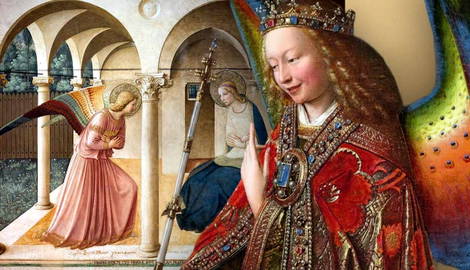
Fra Angelico’s Annunciation, the San Marco fresco, features Archangel Gabriel with a set of rainbow wings. The viewer’s eyes often focus on these wings, as their unique pattern stands out as a central focal point. They are used as symbols of Gabriel’s divinity and grace. Fra Angelico’s depiction of Gabriel’s wings is meant to be seen as luminous and radiant, not just because of the multi-color scheme, but because of his use of mixing silica within the paint itself. His layering of distinct rows of color helps to signify that Gabriel’s wings are like those of a rainbow, divine and mystical.
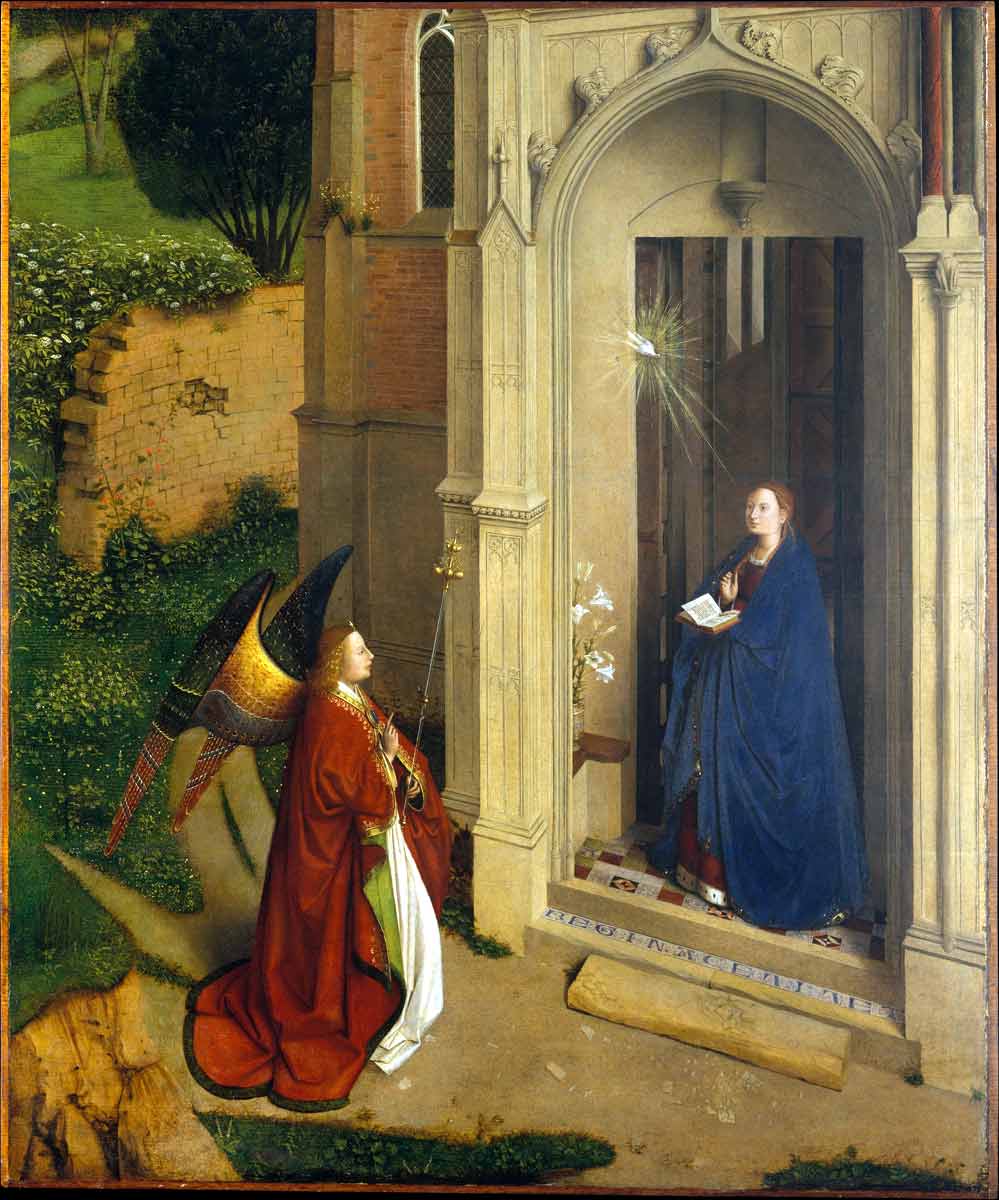
The artist Petrus Christus also used multi-colored angel wings in scenes where the divine was present, such as the Annunciation or the Nativity. Christus’s The Annunciation painting features Gabriel visiting Mary, and his wings are adorned with a variety of different colors. Christus’s glazing technique gives a soft, radiant, sheen-like glow, built upon layers of underpainting and meticulous application of oil paints. These different techniques help to establish which figures are divine, and which still exist in a realistic landscape.
Both Petrus Christus’s and Fra Angelico’s Annunciations show Gabriel’s wings as the most colorful and the least realistic. However, the positioning and shape of these wings are in harmony with the portrayed landscape and architecture. Here, the size is proportional to both the bodies of the angels and their surroundings, so they feel like a natural fit within the scene.
Rainbow and Color Symbolism: Jan van Eyck’s The Annunciation
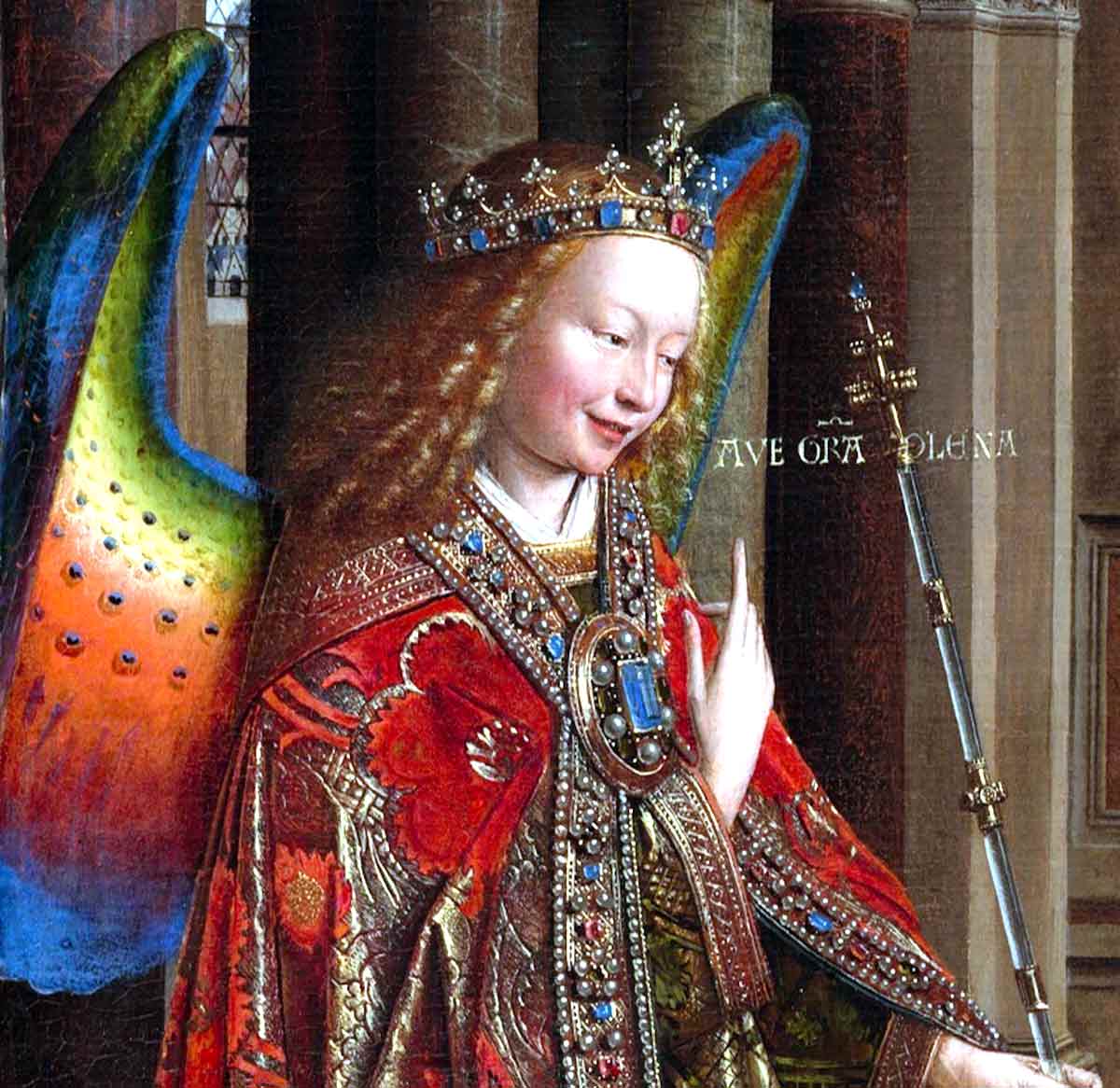
Patrons, from the nobility to the high-achieving merchant, could showcase their wealth and devotion by supplying their artists with the latest pigments and materials from across the globe. The trade of precious stones not only had an impact on artists who were now able to create richly pigmented paints, but also imbued the art with deep symbolism.
Jan Van Eyck’s use of jewel-toned pigments, such as ultramarine or vermillion, creates one of the most vivid and rainbow-like angel wings during this time. The deep blue sapphires, fiery rubies, and luminous pearls give The Archangel Gabriel a royal-like appearance, and complement the colors used for his peacock-patterned wings. Peacocks also have symbolic associations with fertility in Ancient Greek and Roman mythology. Colors symbolized certain attributes that people were taught to strive for: blues for virtue or humility, reds for charity or repentance, yellows for divine light, greens for rebirth and eternity, and oranges for fertility and abundance. These colors represent the characteristics that would have been considered desirable, and heavenly beings, such as the Angel Gabriel, would possess these traits.
The Royal Treatment: Hugo van der Goes’s Portinari Triptych
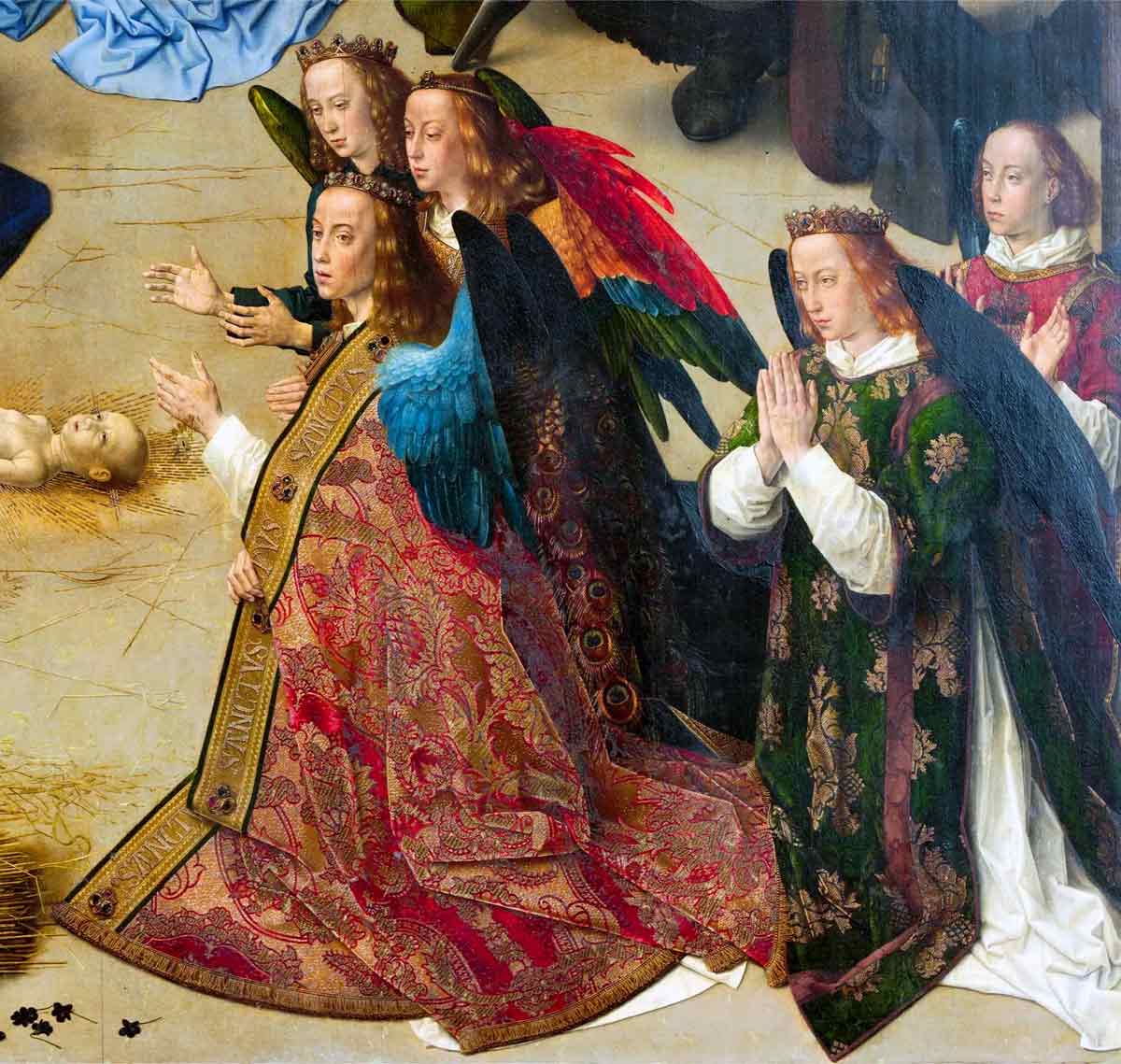
The Portinari Triptych by Hugo van der Goes is another example of Flemish artists embracing color and enhancing realism in Religious works of the time. Compared to other figures in this scene, this trio of angels is the most lavishly decorated. They are shown in elegant garments, featuring fine cloth and decadent gems. Similar to how noblemen or royalty would wear elaborate feather headpieces and the finest jewelry to showcase rank and status, the wings and accessories on these angels also reflect their high positions. These heavenly figureheads are not to be out-dressed, and while they aren’t specifically named, we can tell that they hold a higher rank in the divine social order.
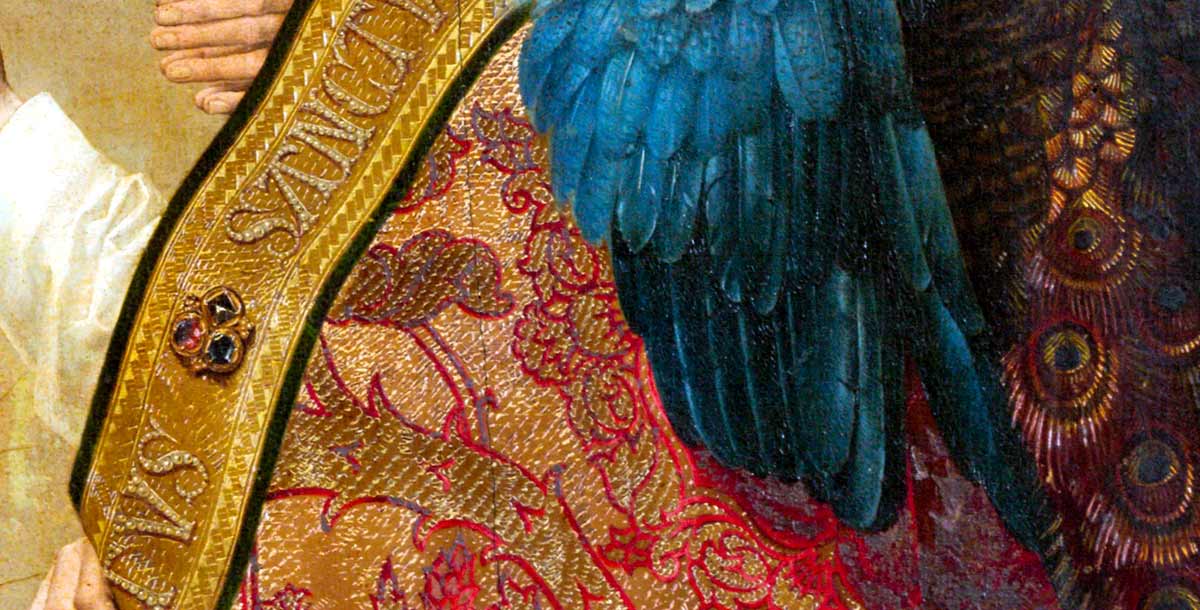
Van der Goes rendering and use of color for these angels’ wings make them appear more elevated and fantastical, compared to a typical bird seen in everyday life. Van der Goes’s interpretation of angel feathers appears three-dimensional, using meticulous oil glazing techniques in order to achieve the luscious look of these feathers. The peacock feathers are also lifelike, with the distinctive “eye” pattern, the barbs sticking out, and a shimmering rainbow of colors. From the Ancient Greeks to the early Christians, it was believed that a peacock’s flesh did not decay, thus leading to its symbolism of immortality and resurrection.
Individualism and Virtue: Signorelli’s and van Eyck’s Last Judgment Scenes
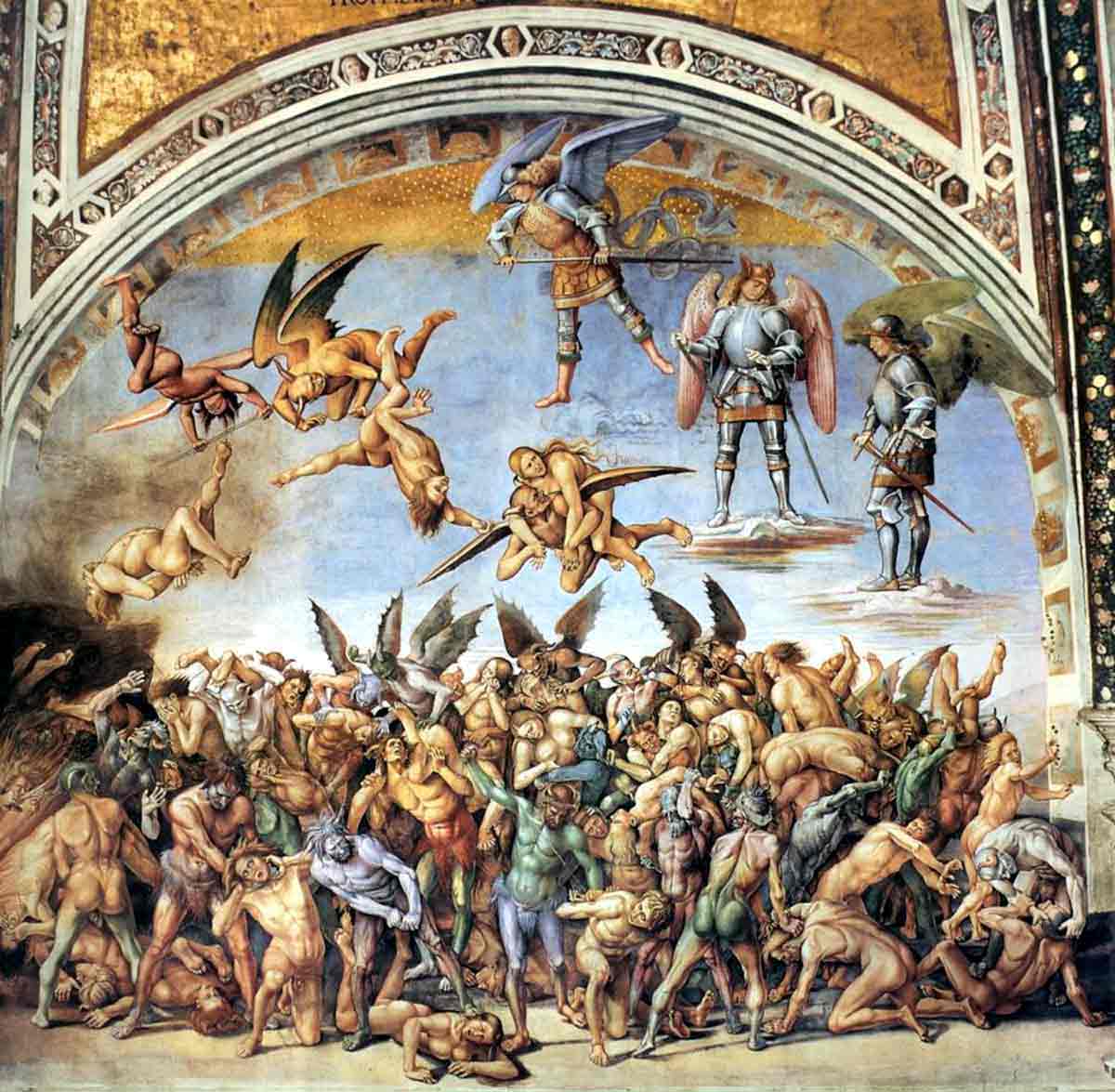
We’ve seen how artists used color gradients to portray heavenly beings, but what about the opposite? An example of this can be seen in a scene from Luca Signorelli’s fresco called The Damned Cast into Hell. Throughout the tangled mess of bodies, the creatures stick out amongst the damned humans because of their multicolored wings and bodies. The difference here is in the tone. Compared to artists like Van Eyck and Van der Goes, who used rich jewel-like tones or Fra Angelico’s ethereal glow-like quality, Signorelli uses discordant colors. Meant to make you feel uncomfortable, this intensifies the chaotic scene. The combinations of the various colorways heighten the musculature of these creatures and the depiction of their contorted, contoured bodies.
There is no more luxury or opulence allowed in this scene, and all earthly possessions are stripped away. Besides individual expressions, there’s no other way to identify who these people were. Even though peacocks, with their rainbow-like array of feathers, were associated with attributes such as immortality and beauty, they were also seen as representing negative qualities, such as pride or vanity.
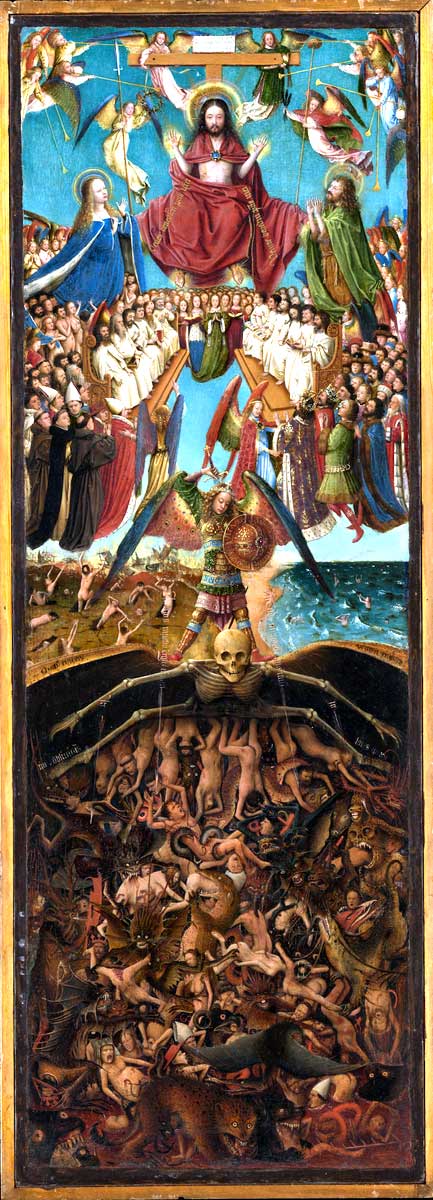
Another one of Jan Van Eyck’s works, The Last Judgment, shows how he again reserves the elaborate dress and rich colors for those who’ve already ascended into Heaven. The Archangel Michael’s jewel-encrusted warrior-like attire corresponds with his magnificent rainbow wings. His stance, between the damned and saved, is a point of visual contrast. The position of the skeleton of death, both balancing and barricading the two worlds, has a wing-like appearance with the two lines stretching out and extending from its back. This is symbolic, as Michael stands on the precipice between these two worlds. Above him is a mirage of colorful rainbow colors, and below him is a collage of beasts and lost souls in the darkness.
Compared to Signorelli, the damned people in this scene are barely distinguishable from the monsters, almost blending into one another. But similarly, there are no identifying traits left of these lost souls, and thus it shows that they lack the morality and spirituality of the saved ones.
Renaissance Movement Through Color: Bartolomé Bermejo
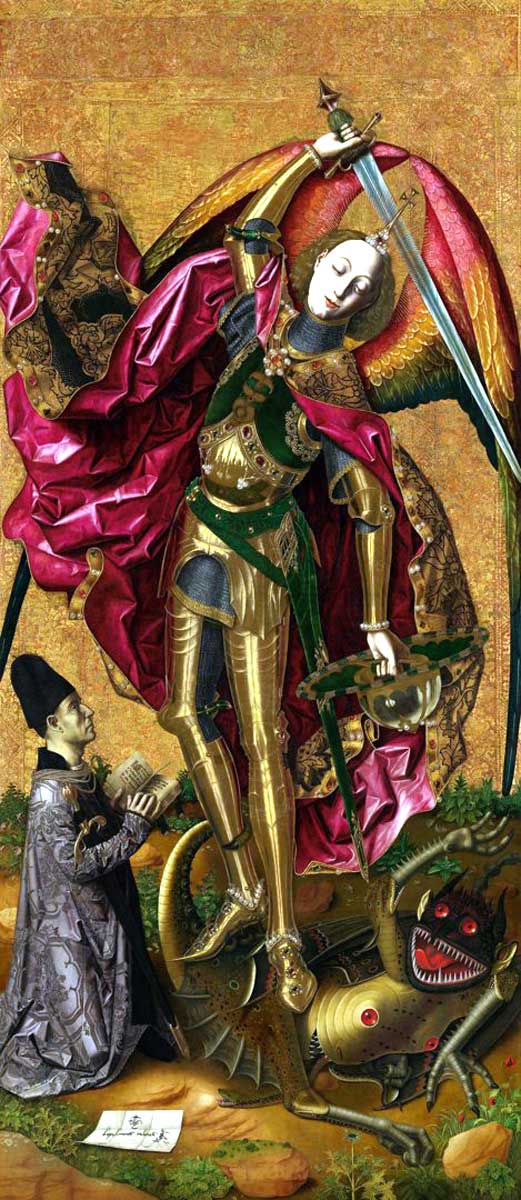
While other interpretations of angel wings have a linear, or even geometric design, this painting by Bartolomé Bermejo shows how colorful angel wings were not only used for symbolic or aesthetic purposes, but also in order to convey motion.
Saint Michael, depicted as the Archangel Michael, has dramatically colorful wings that transition from red, gold, green, and blue. They extend all the way down, past the edges of the canvas, and are almost full length for Michael. Unlike previous examples, where the Angels sit in peaceful repose, this scene is full of action. The elaborate brocaded cape flings backward, conveying a dramatic moment that is full of movement. His wings also depict movement because they’re in an arched position, and are raised so high up above his shoulders that the tips are almost touching one another. It’s as if he is ready to leap up and deal the final blow. Adopting the Flemish style, Bermejo uses color to create harmony within the figure of the angel. All of Michael’s goodness and angelicness is seen through the use of rich, jeweled tone colors, compared to the rest of the scene.