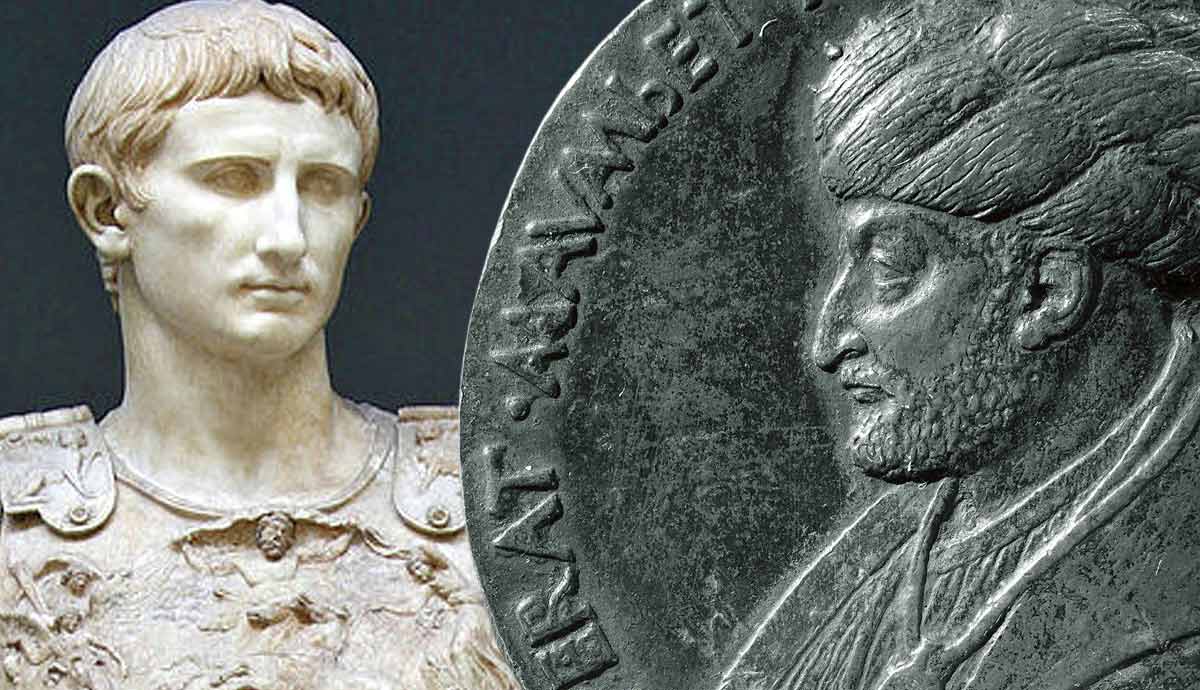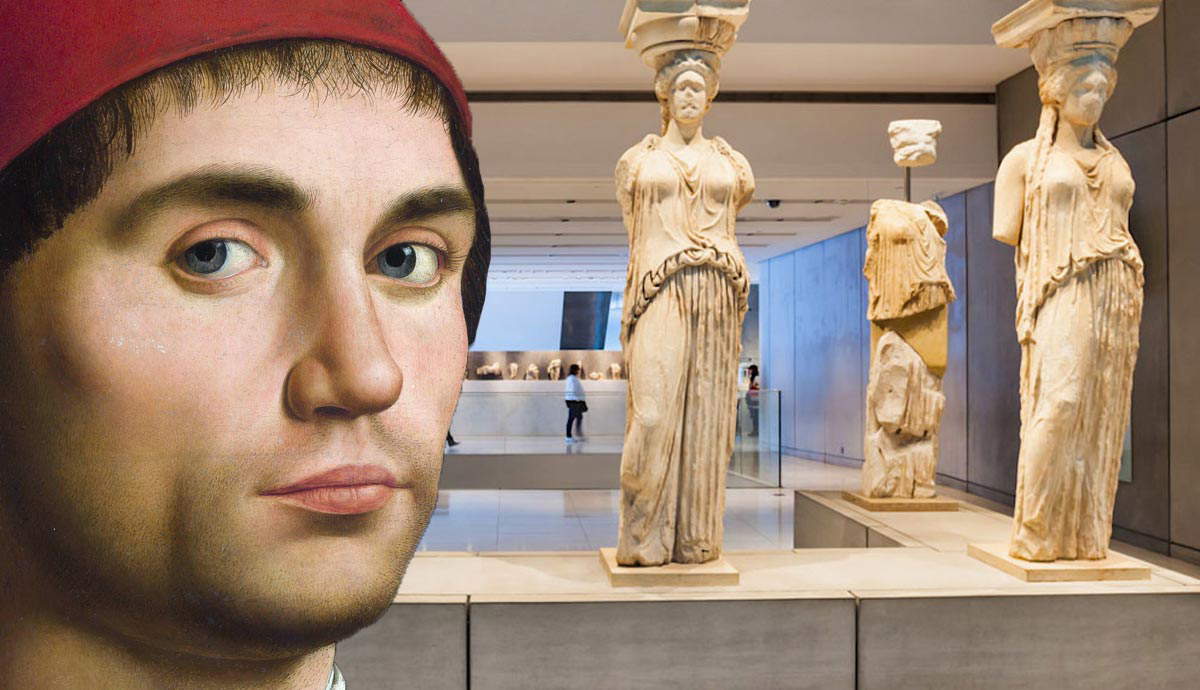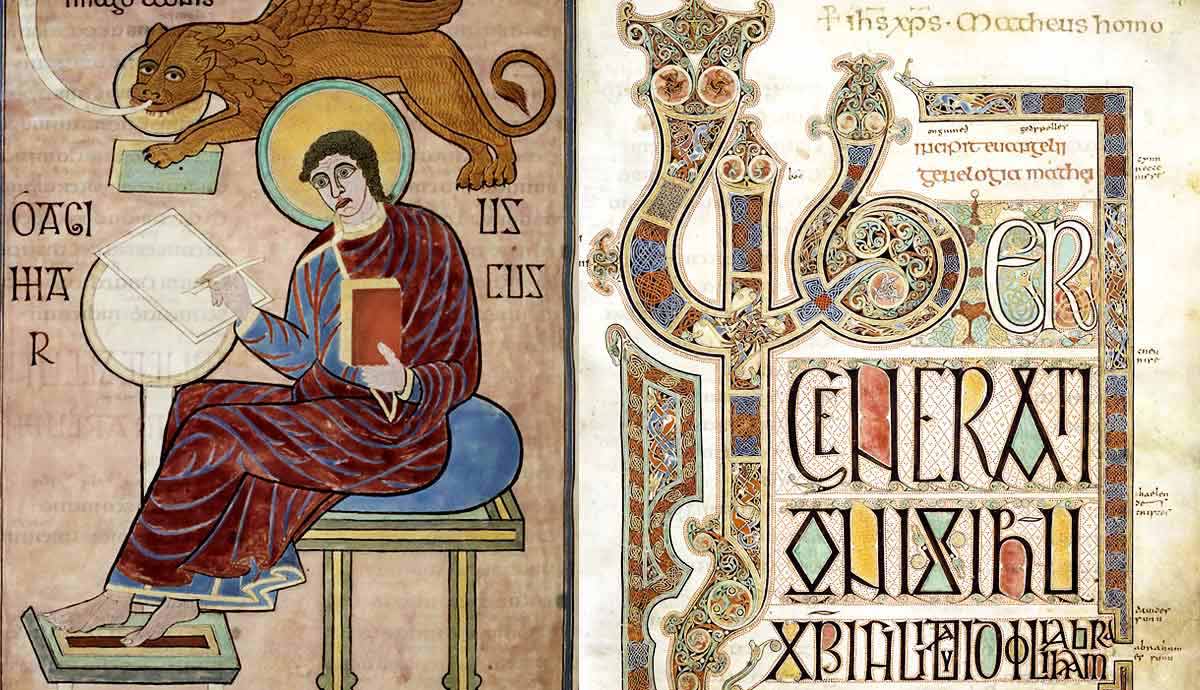

By the time of the Fall of Constantinople in 1453 at the hands of the Ottomans, the Byzantine Empire was already on its knees. Greek scholars fled the crumbling Eastern Roman Empire, bringing valuable ancient texts with them. Works by playwrights, scholars, and poets such as Homer, Thucydides, and Plutarch were translated into Latin. Access to this new way (at least to Western scholars) sparked a revolutionary movement that eventually became the Renaissance.
1. Botticelli – “The Birth of Venus”
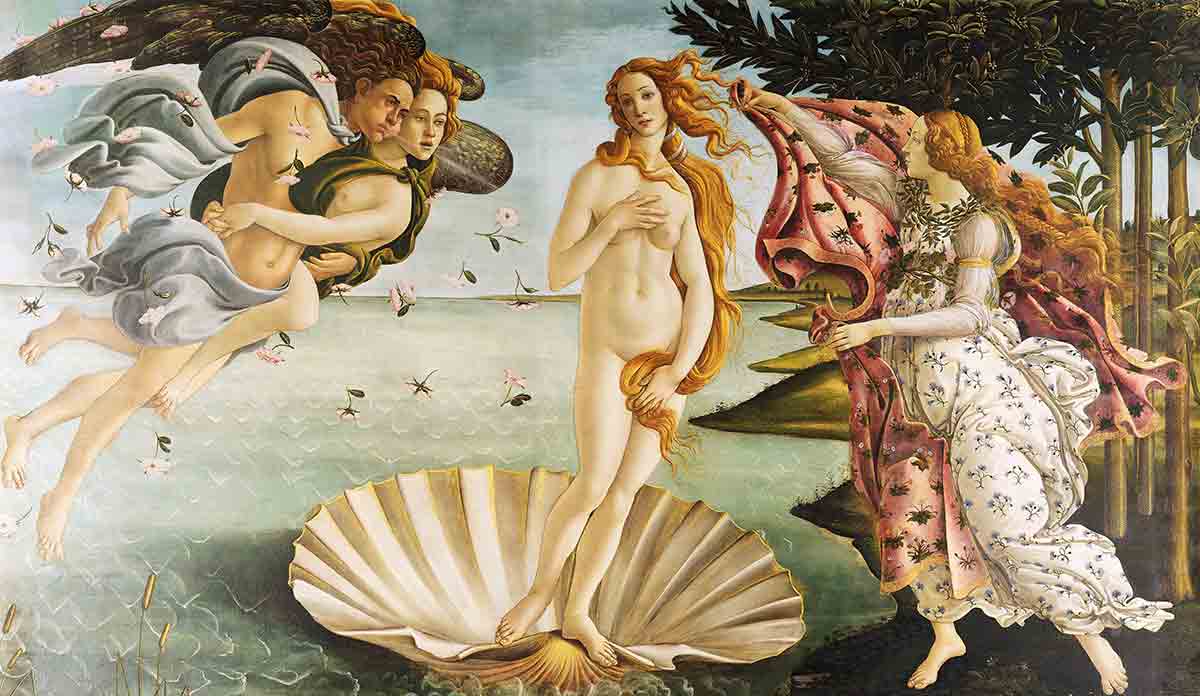
Venus (her Roman name) or Aphrodite, to use her Greek name, was one of the foremost goddesses of Greco-Roman mythology. She was portrayed as an earthly goddess representing love, desire, beauty, and prosperity. She was worshiped by prospective brides before a wedding to ensure the success of the marriage.
We do not know who commissioned the painting, but at the time of its execution, Botticelli was working primarily for the Medici. Its subject matter has led to suggestions that it is a marriage portrait. However, Botticelli may have been aware, via his involvement in the humanist Medici family, of the mention by Pliny the Elder of a lost masterpiece by ancient Greek painter Apelles Aphrodite Anadyomene, or Aphrodite rising from the sea. When interpreting The Birth of Venus, it is clear that the influence of the ancient Greco-Roman culture was at the forefront of Botticelli’s mind.
2. Botticelli – “Calumny of Apelles”
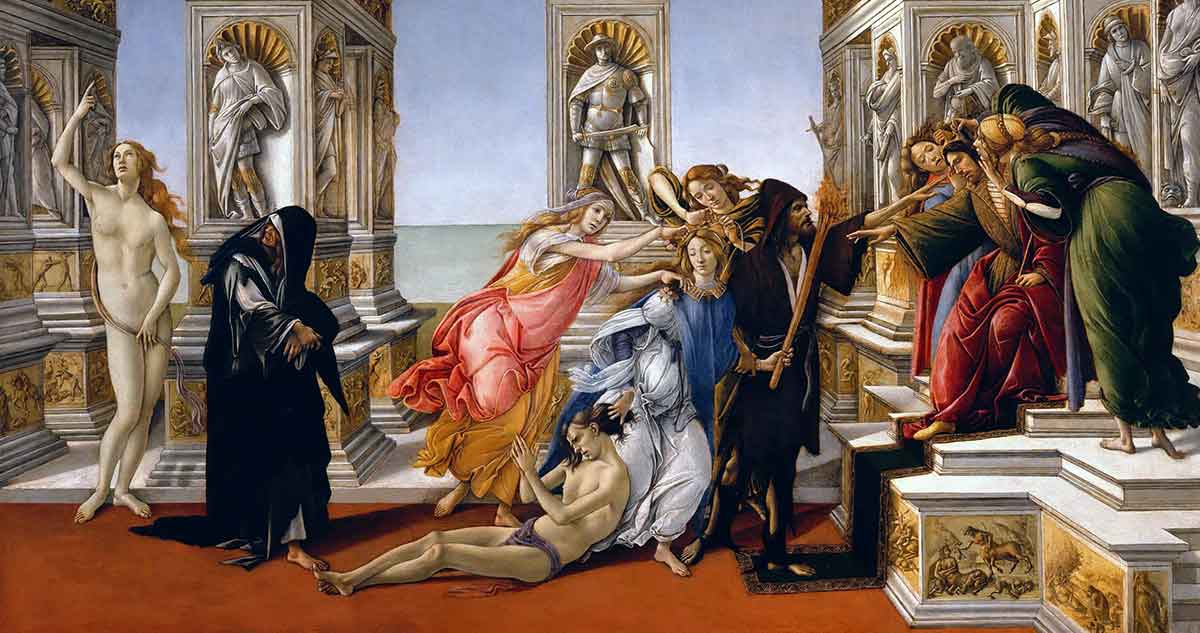
If we ever doubted Botticelli’s knowledge of the ancient world and his commitment to portraying it in his work, Calumny of Apelles dispels our misgivings. Here, Botticelli even uses the ancient Greek rhetorical device of ekphrasis, a written description of a work of art, to inform his subject matter. Based on a widely translated description by the rhetorician Lucian of a lost painting by Apelles, the work seems to depict the opposites of vice and virtue, of the powerful and the powerless. It is not known to whom the allegory depicted refers, although there have been suggestions that it might be Botticelli himself and that he painted the work for himself.
3. Mantegna – “Parnassus”
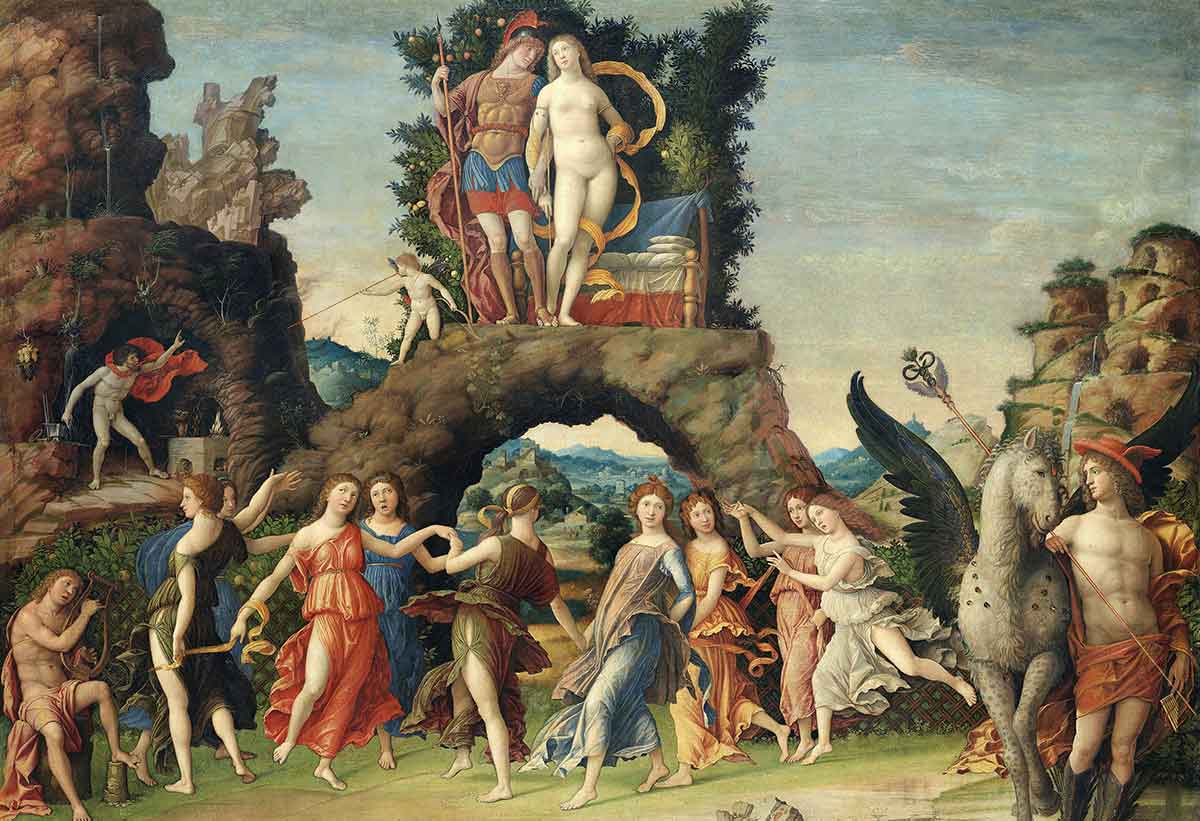
Isabella d’Este was at the peak of her powers as Marchioness of Mantua when she commissioned Mantegna to paint Parnassus, depicting Isabella and her husband, Francesco II Gonzaga, as Venus and Mars. As a wealthy, well-educated, and powerful woman, well-versed in ancient texts and an avid patron of painters such as Leonardo, Raphael, Perugino, and, of course, Mantegna, Isabella had the art world at her fingertips. This painting was intended for her studiolo (private study and library), a concept unusual for women at the time, which gained popularity with the increased interest in humanism and its focus on the individual.
Parnassus was surrounded in the studiolo by other works by artists such as Perugino, all of which were primarily influenced by ancient mythology and were revived during the Renaissance. As the greatest patron of the arts of her time, Isabella commissioned artworks that illustrate the significance of these concepts in Renaissance Italy.
4. Perugino – “The Battle Between Love and Chastity”
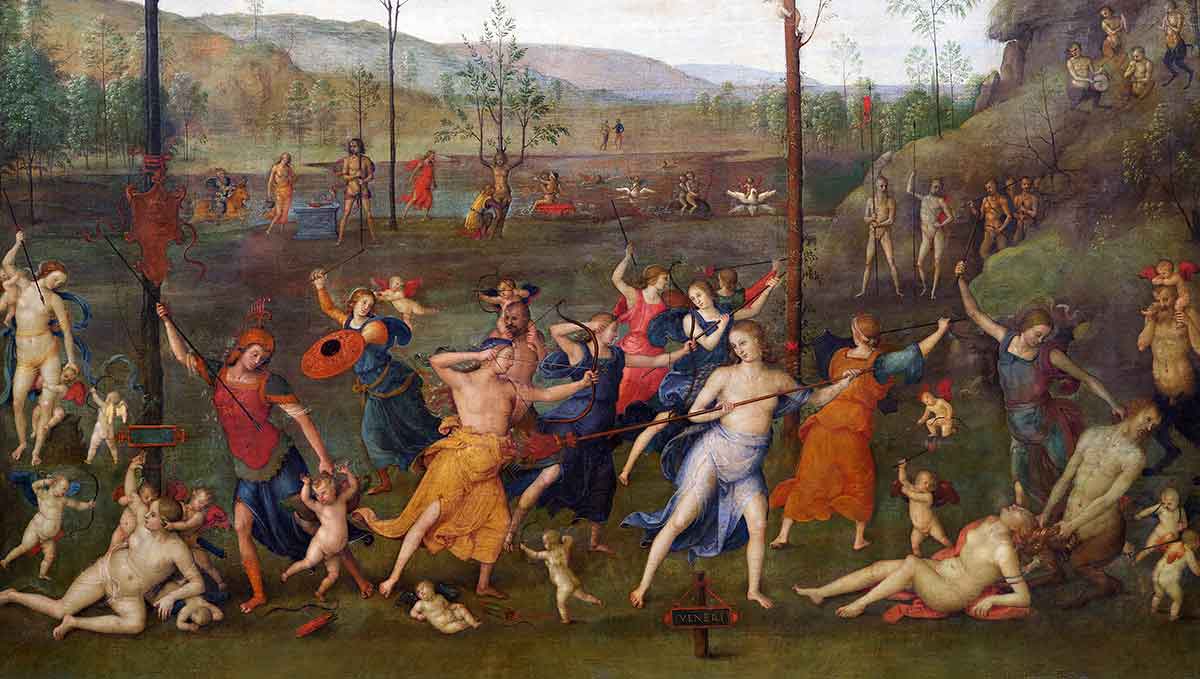
With The Battle Between Love and Chastity, the first lady of the world, as diplomat Niccolò da Correggio referred to Isabella d’Este, again graced one of the finest painters of his generation with her patronage. Painted to hang alongside Mantegna’s Parnassus in her studiolo, Perugino filled the work with figures from Greco-Roman mythology, illustrating Isabella’s supreme knowledge of ancient literature. Isabella, however, was unhappy with the painting, despite a contract existing between artist and patron. A demanding client, she had wanted oil paint rather than the somewhat antiquated tempera.
5. Michelangelo – “David”
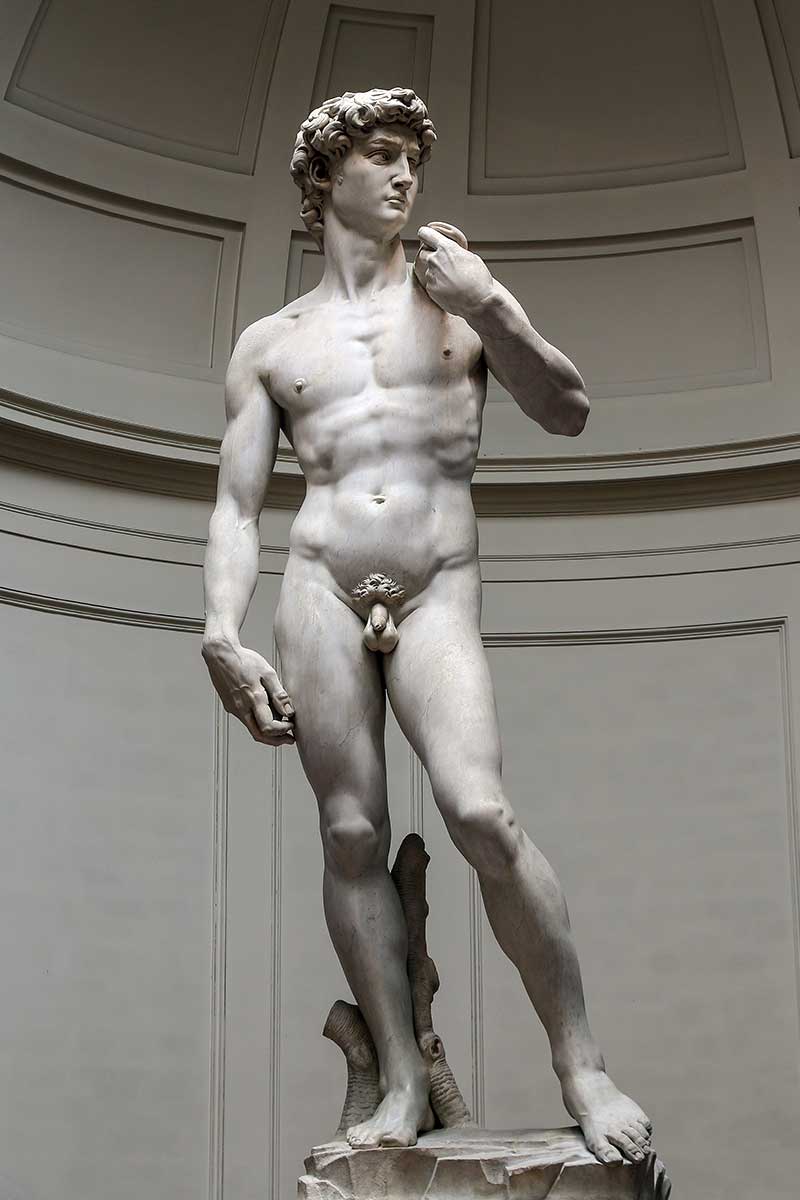
Originally positioned in the Piazza della Signoria, outside the palazzo housing the 16th-century home of the Florentine government, Michelangelo’s David did not represent a figure from Greek mythology. David, the biblical slayer of Goliath, had been previously portrayed after Goliath’s death, his bleeding severed head a common inclusion. Michelangelo, however, chose to show David before the event.
Everything about David speaks of the influence of ancient Greek sculpture on the artist. The contrapposto position of his body, with its serpentine twist, suggests dynamic tension before action. Michelangelo created his version of the heroic male nude figures of antiquity. They represented gods and demigods; David represented the might of the Florentine Republic against tyranny. David was the embodiment of the city-state’s army, colossal and fearless. His thoughtful pose suggested intelligence and contemplation. In sum, Michelangelo’s David epitomized the heroism of the ancient Greek gods, tempered by the intellectual reserve of Renaissance humanism.
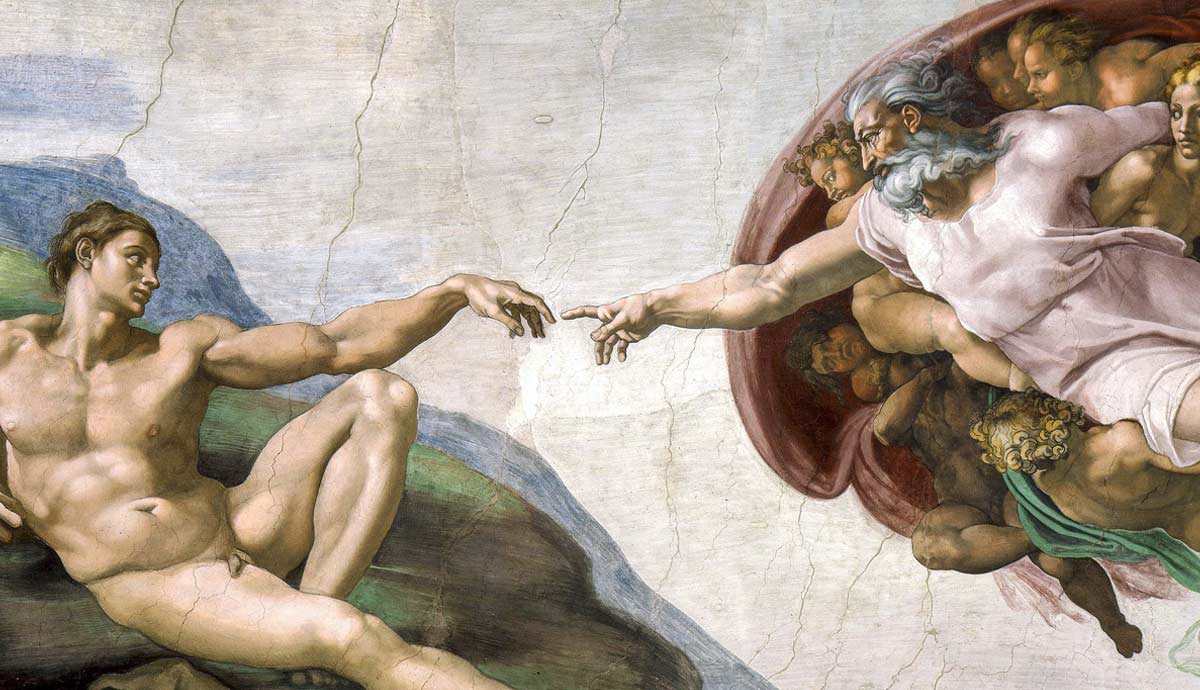
6. Michelangelo – “The Creation of Adam”
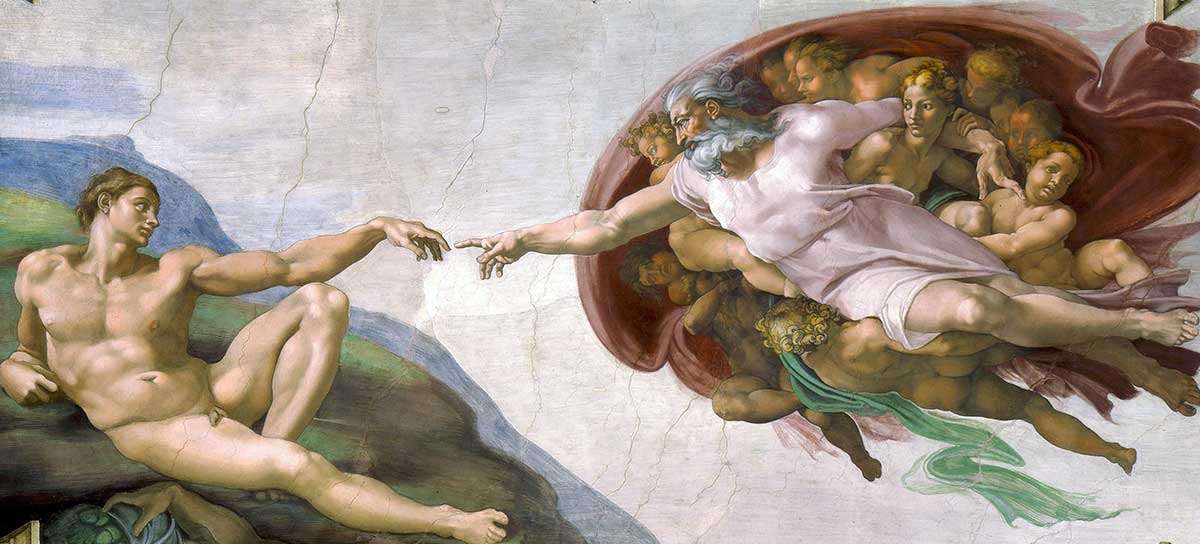
Commissioned by Pope Julius II, the painted ceiling of the Sistine Chapel in the Vatican is considered a masterpiece of biblical representation. Pope Julius II was one of the most powerful men in Renaissance Italy, and he left a legacy of patronage, including the Vatican Museums, and initiated the building of the new Saint Peter’s Basilica. His support of the arts and cultural life resulted in a collaborative fusion of humanism and Christianity. Michelangelo’s treatment of the figure of Adam in his Sistine ceiling seems to be a perfect illustration of this.
The church’s view of man as innately flawed and sinful was at odds with humanist thought, rooted in Socratic and Platonic philosophy, which held that man was a product of his own thought processes and reasoning. It has been suggested that the gap between the fingers of God and Adam in Michelangelo’s painting indicates man’s inability to embody perfection in God’s eyes. The artist, however, created Adam in the idealized form of classical beauty. While not a character from Greek mythology, Michelangelo’s Adam took the form of one.
7. Raphael – “Parnassus With Apollo and the Muses”
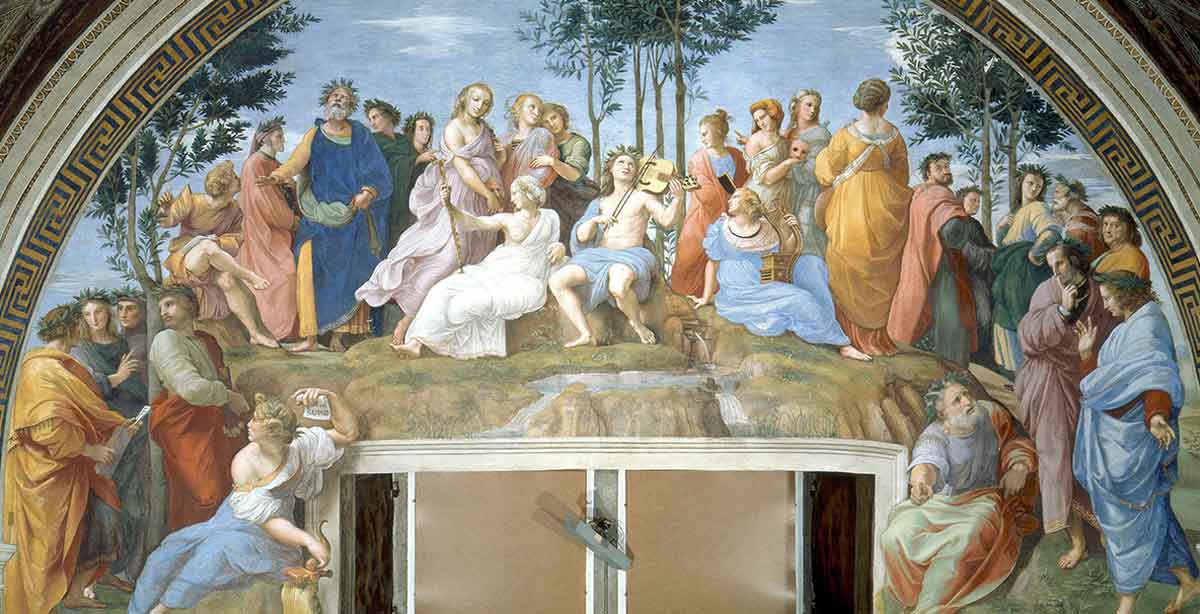
With the next two artworks in our list, we return to the Renaissance concept of the studiolo. Raphael was commissioned to paint two walls of the private study in the Vatican of the great arts patron, Pope Julius II. Parnassus with Apollo and the Muses is one of them. It shared the room with Raphael’s masterpiece, The School of Athens.
The artworks on the walls of the Room of the Segnatura (the court of the Holy See in the 16th century) each represent an area of human scholarship: poetry, law, philosophy, and religion, with this wall reflecting poetry. Raphael has depicted, alongside Apollo and the Muses, over 18 poets from antiquity through the Renaissance to illustrate his subject matter.
In the studiolo of Pope Julius II, Raphael’s portrayal of an intellectual, if fictional, grouping is yet another example of how the lore of Greek mythology and the consequent development of humanism sat alongside conventional religion in 16th-century Italian society.
8. Raphael – “The School of Athens”
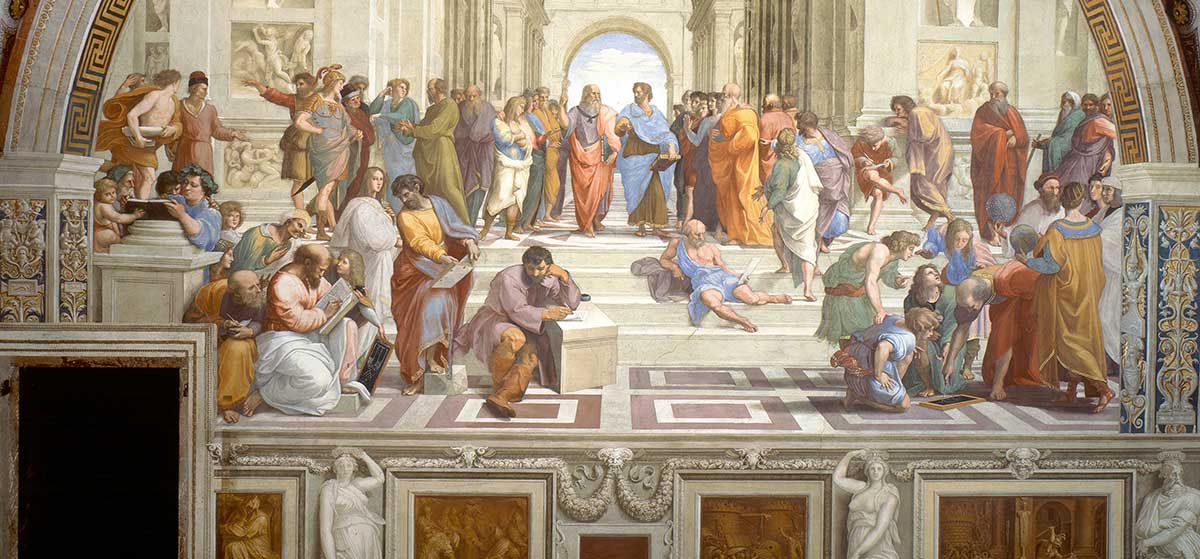
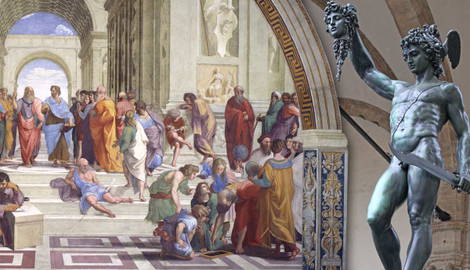
With The School of Athens, we return to the studiolo of Pope Julius II and to another area of human learning: philosophy. Raphael houses his panoply of classical philosophers in a structure based on the Greek cross, another device designed to highlight the co-existence of religion and secular thought. Plato is depicted, pointing to the heavens, while Aristotle points to the ground. Surrounding them are Socrates, Pythagoras, and Euclid, to name a few. Scholars have remained divided as to the meaning of the fresco. It seems eminently possible that Pope Julius II merely wanted a representation of Greek philosophy and learning to illustrate this aspect of human knowledge, and perhaps as an encouragement to strive toward a deeper understanding of the world. The School of Athens was being executed contemporaneously with Michelangelo’s Sistine Chapel ceiling in another part of the Vatican.
9. Raphael – “The Triumph of Galatea”
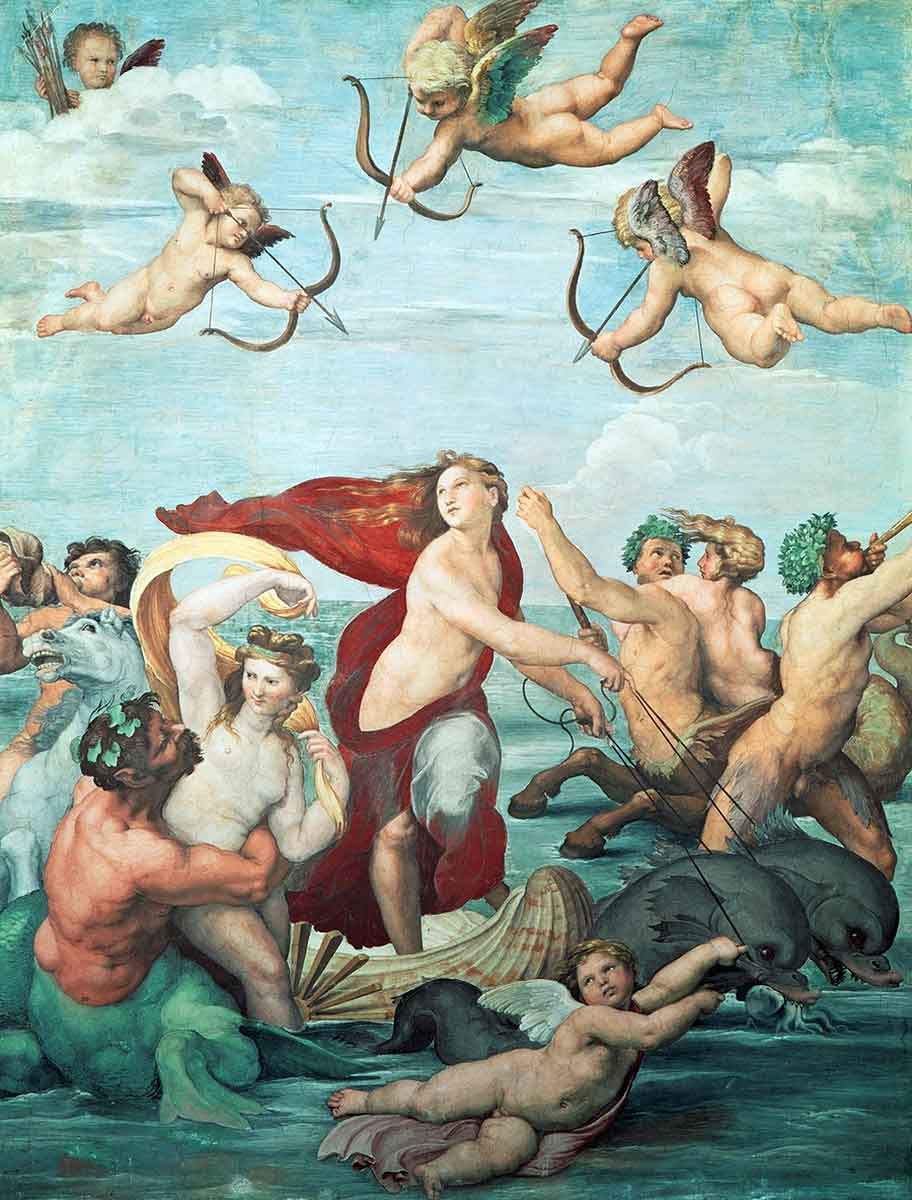
Displaying a knowledge of classical literature and thinking had become a symbol of a person’s standing in society in Renaissance Italy. Patrons such as Isabella d’Este and the Medici were feted for their association with leading thinkers and artists of the time. However, commissioning a well-known painter to decorate your home with classical Greek imagery was also an indicator of wealth.
Agostino Chigi, a successful Sienese banker to Pope Julius II, commissioned Raphael to contribute to a series of paintings for his estate, then known as the Villa Suburbana (later renamed Villa Farnesina), in Rome. Trusting Raphael, and thanks to his knowledge of the artist’s work for the Pope, Chigi allowed him free rein in subject matter. Raphael, influenced by Poliziano, a humanist and classical scholar, chose Galatea. Rather than illustrating the events of the myth, he painted Galatea as the representation of ideal beauty. His frescoes at the Villa Suburbana made it a renowned hub of art, wealth, and society.
10. Cellini – “Perseus With the Head of Medusa”
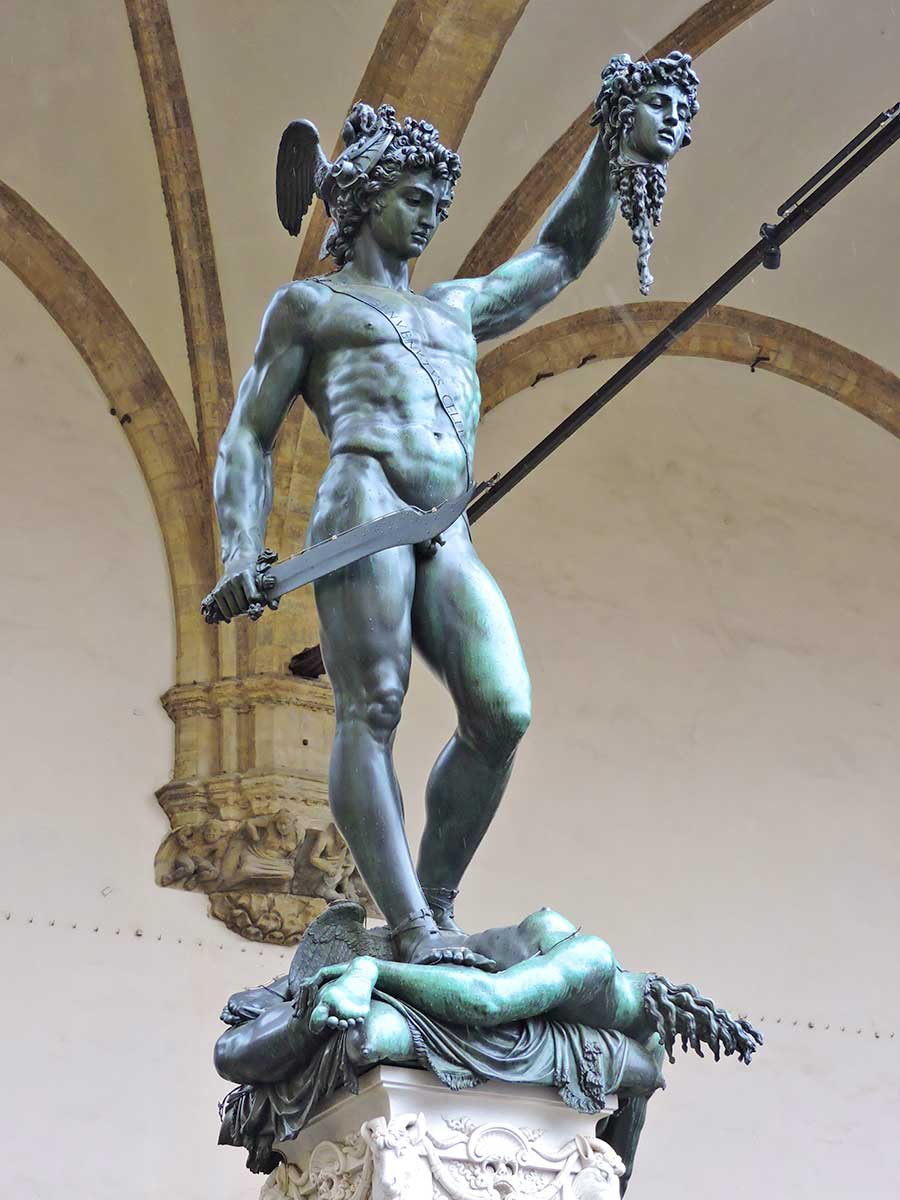
Situated in the Piazza della Signoria in Florence, facing Michelangelo’s David, one might imagine that Goliath’s slayer might overshadow Cellini’s Perseus with the Head of Medusa. Cellini saw no such diminution in his sculpture when it was positioned there in the mid-16th century. Indeed, Perseus was cast in bronze, and the surrounding statuary was in stone: could his mythological Medusa have turned the others into stone?
Cosimo I de’ Medici commissioned Cellini to make a statue of Perseus for good reason: the Medici had adopted Perseus as a symbol of their power over the Florentine people. By contrast, Medusa was the overpowered republic. The Medici, keen proponents of humanism and the new rebirth of classical study, flexed their cultural muscles with Cosimo’s commission of Perseus. Not only were they clear about what the statue represented, but they also had it placed in opposition to the great David, the embodiment of the people of Florence, challenging them to oppose the mighty Medici.
The rebirth of interest in the ancient world and its complex mythology and philosophy fired the imaginations of generations of scholars, artists, and patrons in the Renaissance. It challenged the religious status quo at times, but ultimately it drew alongside the belief systems of the Middle Ages and offered a complementary viewpoint. Used by the wealthy to show their status and education and by the powerful to emphasize their might, Greek mythology’s rediscovery enlightened both the studioli and the material world outside. The Renaissance had brought the Greek gods back to life.