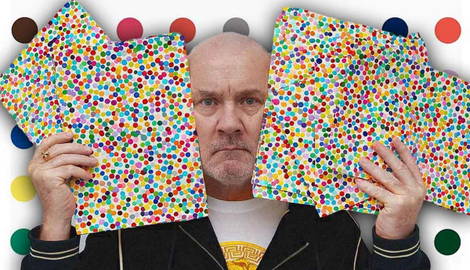

Damien Hirst is one of the world’s richest artists. His fantastic works have provoked provocative questions about life, death, beauty, conservation, and good taste. A founding member of the YBA (Young British Artists), Hirst achieved fame and fortune in the 1990s with the help of the infamous art dealer Charles Saatchi. He continues to create new work despite the checkered past that surrounds both him and his workshop. A conceptual artist at heart, Hirst has blazed new paths, sparking both curiosity and controversy over the years.
1. Damien Hirst Created the Most Expensive Artwork Ever Made
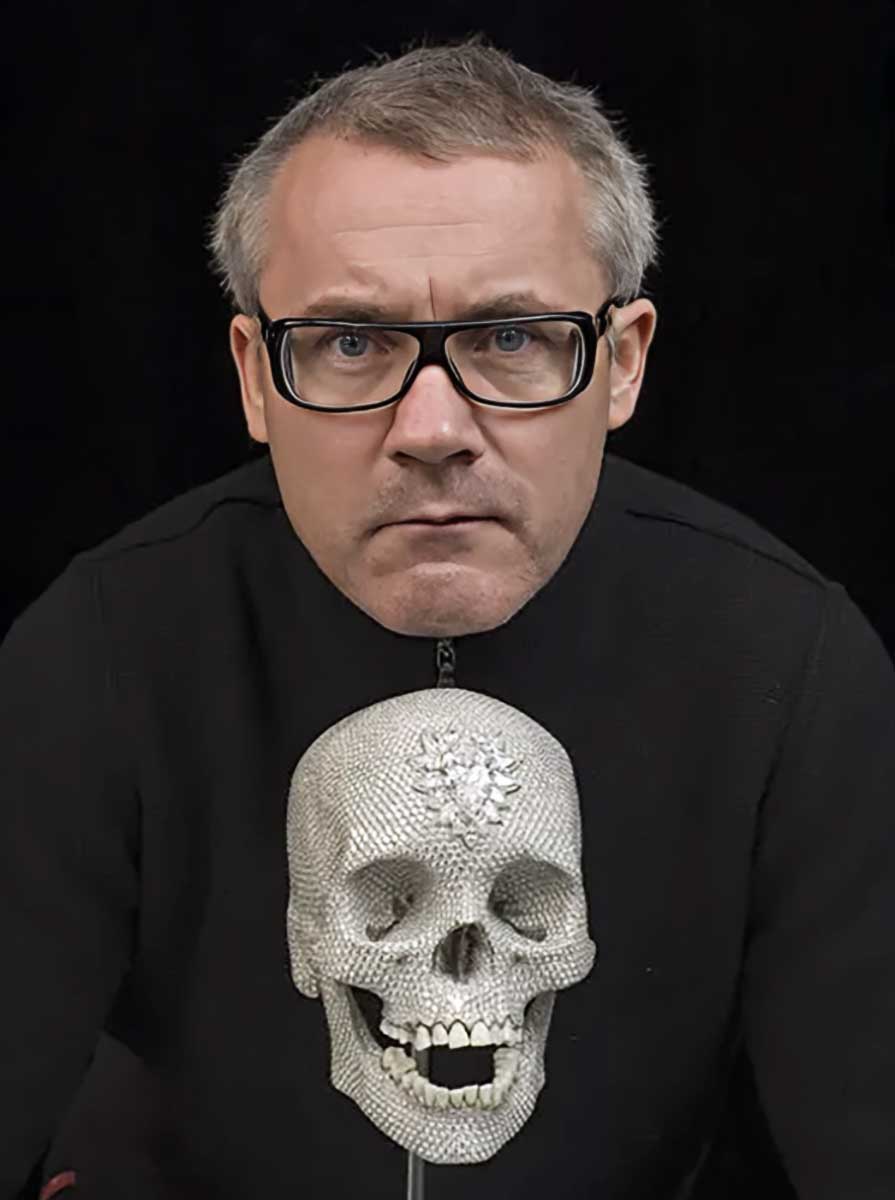
Hirst titled the work based on his mother’s ongoing question to him in his youth: “For the love of God, what are you going to do next?” Consisting of 8,601 flawless diamonds around a platinum cast of an 18th-century human skull, For the Love of God is a sculpture like no other. Hirst went all out using original teeth and a pear-shaped pink diamond center known as the Skull Star Diamond.
Considered the world’s most expensive artwork ever produced, it cost £12 million to make.
It is part of a long tradition of artworks that remind us of our mortality, which is called memento mori. Originally listed at £50 million, it seems the price tag was too steep, as Hirst has admitted the sculpture is in storage.
Although commissioned and presented by him, Hirst had nothing to do with the construction of the object. He worked with famed jewelers in London, Bentley and Skinner, who created it. He gave them a brief, and they presented him with a finely crafted, beautiful object. He found the original skull, paid for it, and he would argue, most importantly, he thought of the idea in the first place.
2. Damien Hirst Has Faced Over 15 Plagiarism Claims
Widely regarded as his breakthrough piece, the shark in 5% formaldehyde solution titled The Physical Impossibility of Death in the Mind of Someone Living, made in 1991, is just one example of an artwork Hirst created after another artist did something similar before. In this case, Eddie Saunders made a preserved shark in a case in 1989 just down the road from Hirst’s studio. To date, he has publicly faced 16 plagiarism claims against him. There are rumors of multiple more out-of-court settlements.
If you want even more stunning examples, look at John LeKay, one of Hirst’s mentors when he was young. By one account, Hirst was incredibly jealous of him, and it was LeKay who inspired Hirst in multiple ways. This includes his use of butterflies, cows, sheep, and more. While some idea nicking looks pretty damning (including pills in a case as an artwork titled Pharmacy done by Joseph Cornell, nearly 50 years before Hirst’s own pill cabinet titled Pharmacy), others seem like absurd attempts to capitalize on Hirst’s wealth and success.
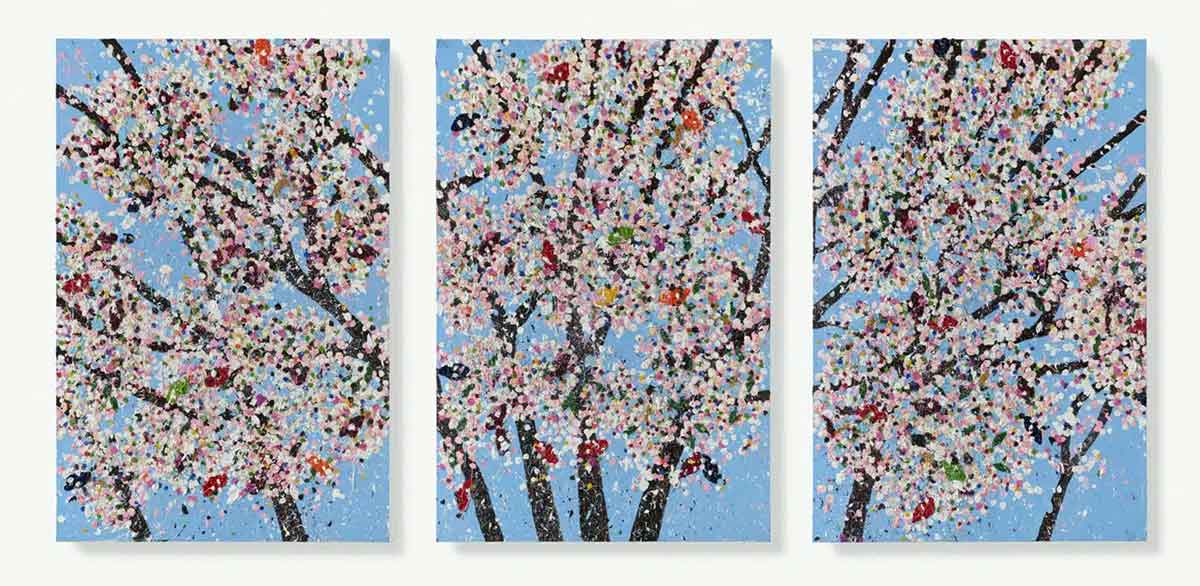
If you look at Joe Machine’s most recent claim that Hirst’s Cherry Blossoms could be his, any person would agree that Machine isn’t the first person to paint cherry blossoms. Not only that, but they really don’t look much the same. Clearly, there is more to these cases than straightforward plagiarism.
Anyhow, these cases raise important questions about what inspiration means, how far one must remove one’s work from the original to consider it one’s own, and what happens to artists when they become wildly successful financially.
3. Damien Hirst: First Artist to Sell Directly via Auction House
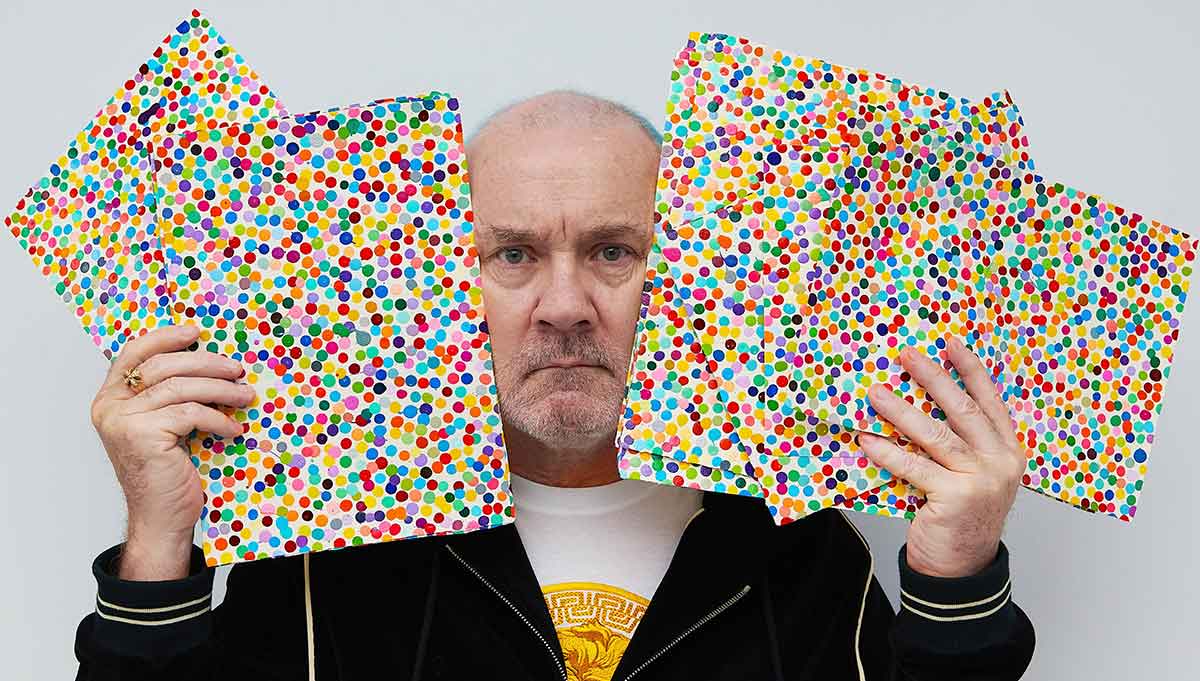
In 2008, Damien Hirst broke all the rules of the art world by bypassing the gallery (making more than a few people angry in the process) and selling his work directly to buyers through auction houses.
The move netted Hirst almost $200 million in cold, hard cash. However, it seems that the move may have been a one-time phenomenon, as all later sales have been less profitable. Rumors have also circulated that his gallerist is supporting his excessive prices by buying back works. Hirst is currently listed as one of the UK’s wealthiest artists, with a whopping net worth estimated at $400 million.
Since then, he has also moved into NFTs by taking digital images of works and then burning the original pieces. He has been accused of money grabbing. From the beginning, Hirst has pushed the boundary between money and art, decency and finance. Supported in his early career primarily by the dealer Saatchi, much of his early work was lost in a warehouse fire under Saatchi’s care, where he was investigated for criminal insurance fraud.
In 2009, after selling most of his conceptual artworks at auction, Hirst claimed that conceptual art and minimalism were total dead ends and that he always thought painting was the best thing to do. Hirst has a very influential and wealthy collector base who will make sure the works they purchase don’t devalue, no matter what Hirst does. This clear push to treat artwork as investments, with no regard for quality and a tendency toward insider trading to drive up prices, is one of the biggest criticisms of the art world in general.
4. Hirst Painted Few of His Dot Paintings
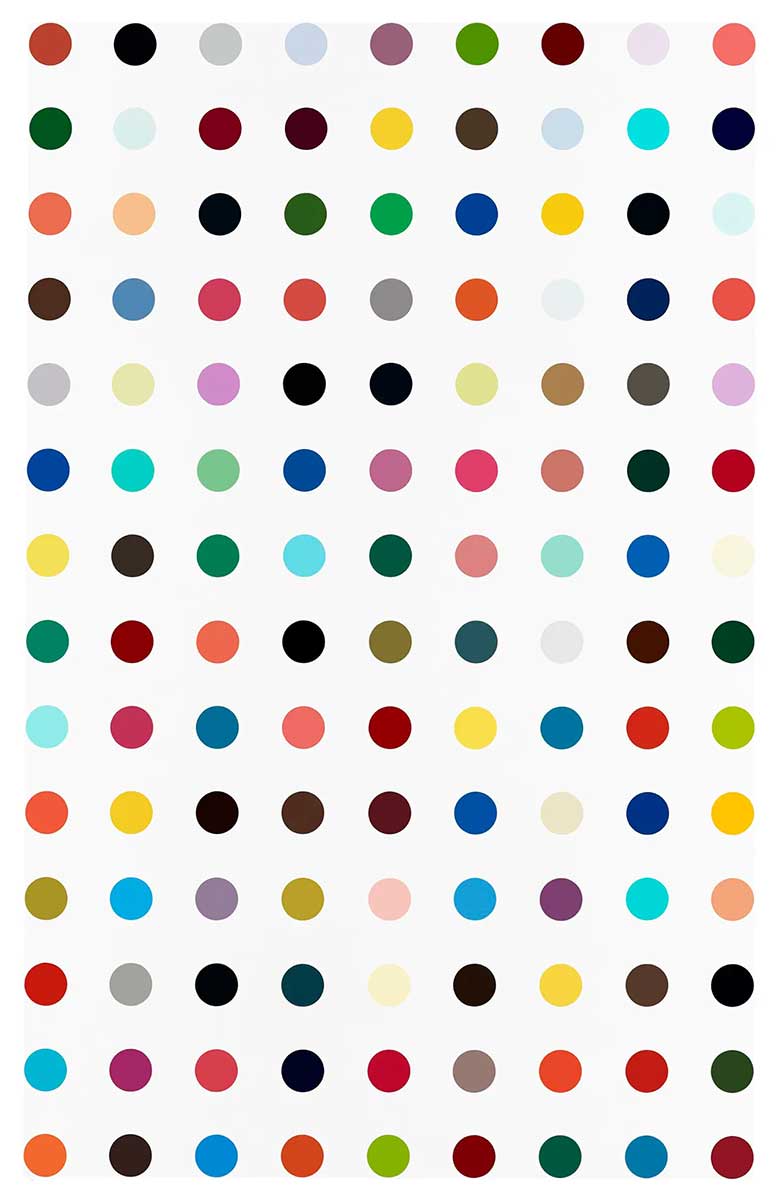
Is it easy to burn work if someone else makes it? With over 2,000 works produced since 1988, Hirst reportedly only painted 5. Hirst has said in the past, “I don’t think the hand of the artist is important on any level because you’re trying to communicate an idea.” He believes the conceptual idea is the artwork, not the final product. In the 1990s, there was a movement focusing on concepts only, led by his peers Jeff Koons and Tracey Emin.
As a contemporary conceptual artist, he combined two ideas in his spot paintings: one of discordant colors and the other to make the works appear as if they were painted by a machine, with all traces of the human hand removed. These works raise questions about artistic merit, quality, the use of workshops for mass production, and the roles of assistants and working conditions in the production process. Reducing talented artists to the idea of machines has made more than a few art technicians unhappy, yet Hirst makes no apologies about how he works. When asked about it, legendary artist David Hockney said, “It’s a little insulting to craftsmen, skillful craftsmen.”
5. He Has Used Many Dead Animals in His Artworks
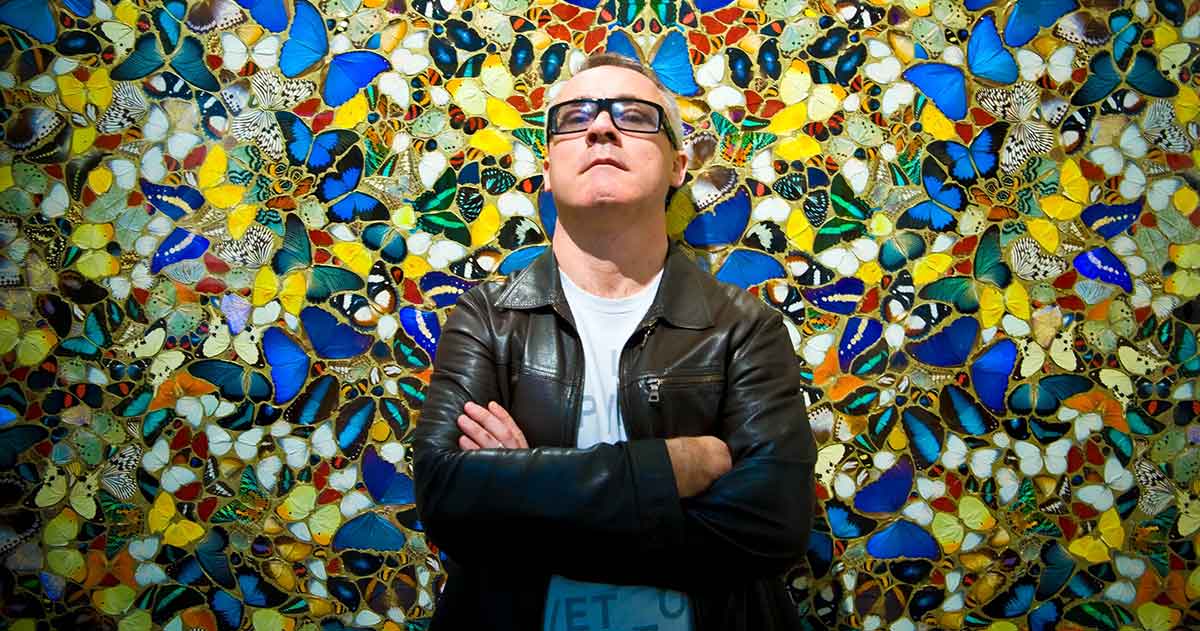
From dead birds to cows, pigs, sharks, insects, and butterflies, the idea of using dead animals as artwork stuck in Hirst’s head, and he had to play it out. Look carefully at the image above; it is actually thousands of real butterflies that have been taxidermied onto a board. In 2003, Hirst was the largest international importer of butterfly wings. He usually sources his living works from farms.
The dead animals used include 36 mammals, 685 fish and sea creatures, and a whopping 912,005 insects, butterflies, and houseflies. The inspiration for the dead animals comes from a science book called Carolina Science, gifted to Hirst by the artist John LeKay, who has also killed and used animals in his work.
6. A Severed Head Was in His First Show as a Student
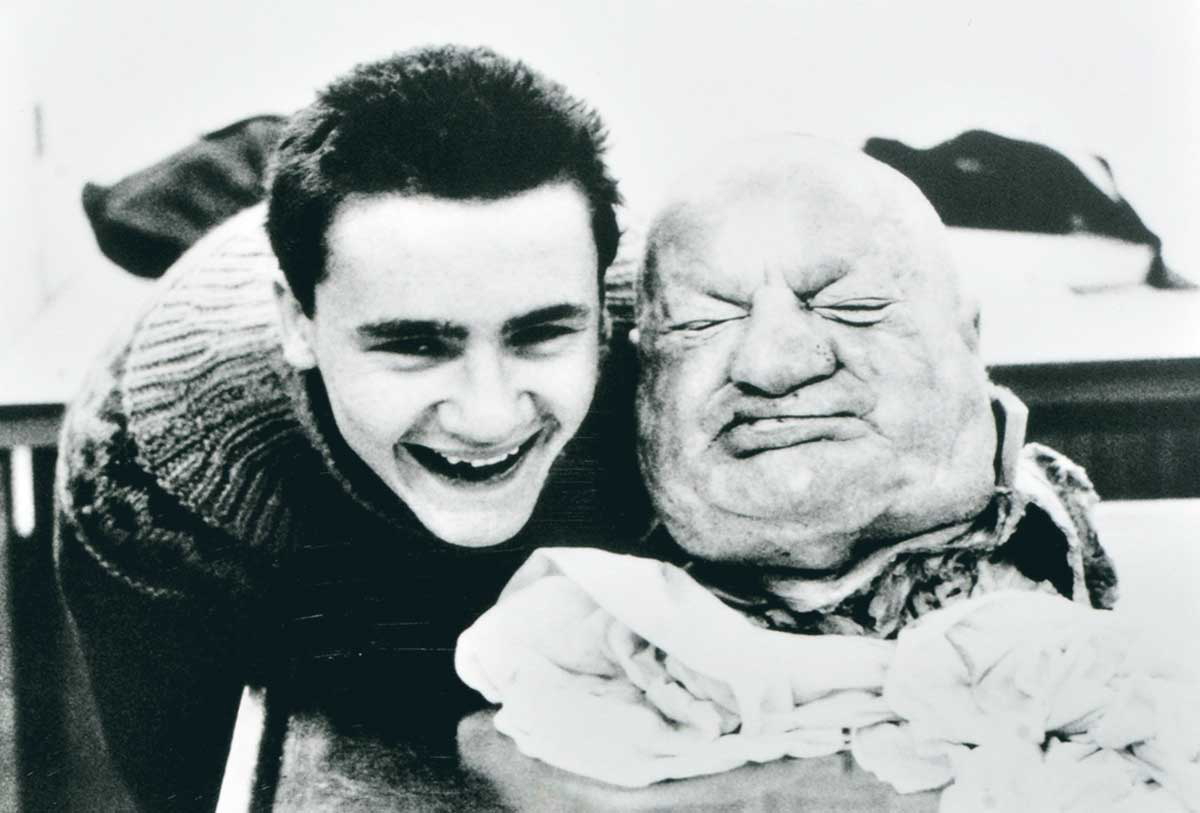
From early on, Hirst was interested in exploring the ideas related to macabre. This photo of him is from when he was only 16. It was taken in an actual mortuary where Hirst worked for some time in Leeds and it was included in his student show at Goldsmiths College of Art.
This is another one of his works related to memento mori, which translates from Latin as “remember that you must die.” Since then, his work has explored the relationship between life and death.It specifically focuses on the moment when life departs, leaving only a corpse, and the impossibility of fully comprehending this as a living person. The central idea is that we can’t imagine our own death really and truly.
7. Damien Hirst’s Works Rot
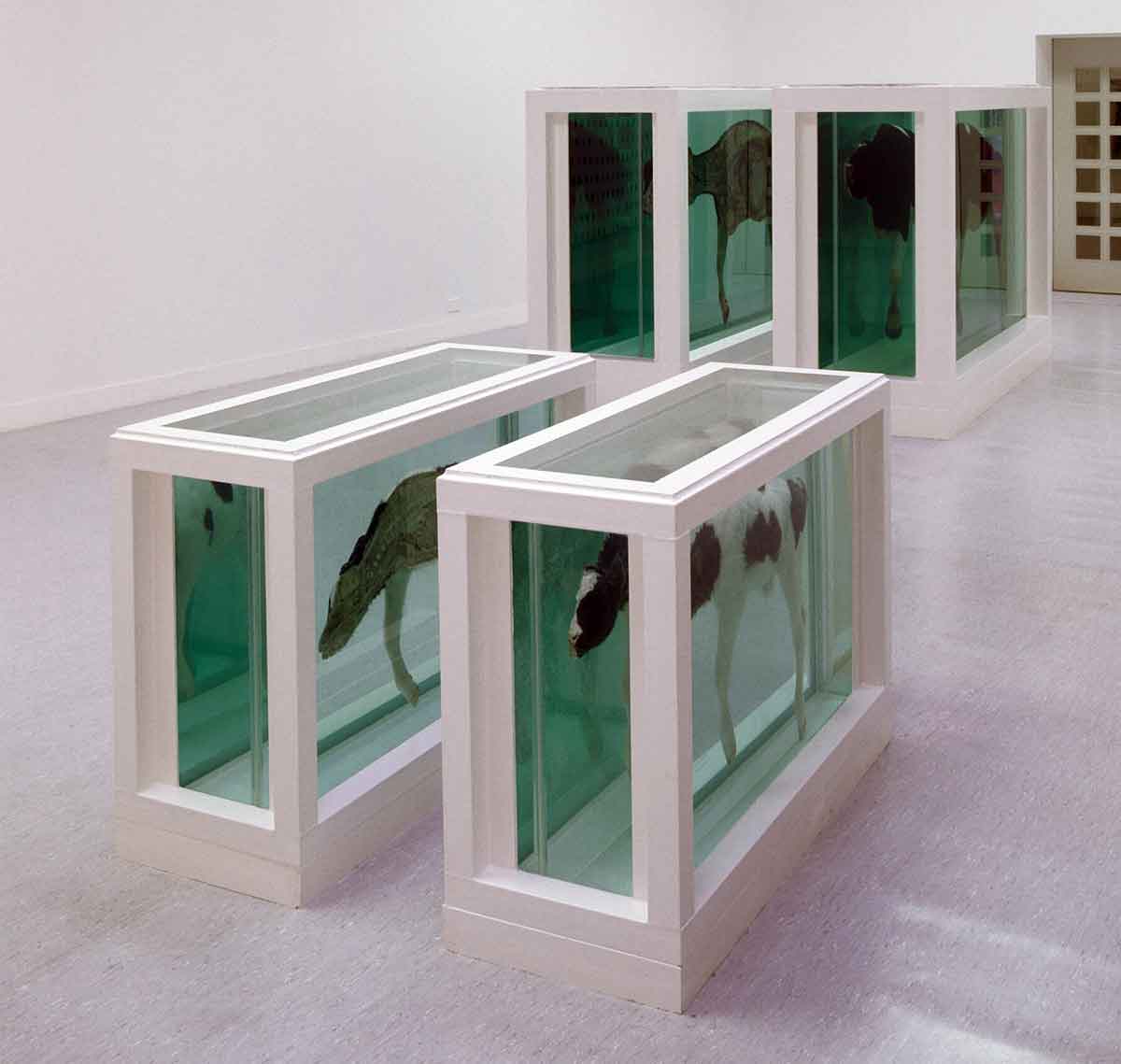
Since his first major work—a rotting cow’s head with maggots that turn into flies, only to be zapped dead—which debuted in 1990, Hirst has embraced decay in his art as a nod to mortality. In his show, In and Out of Love, he contrasted living, hatching butterflies with full ashtrays of cigarette butts.
Of course, his most famous work is his shark in formaldehyde, The Impossibility of Death in the Mind of Somebody Living. Although made at considerable cost, working with formaldehyde is tricky, and the original shark rotted and needed to be replaced.
Despite this, in 2024, that new shark was turned away from a Paris museum show due to the poor condition of the flesh, raising questions about the piece’s longevity, cost, sustainability, and decency. In a shocking discovery by the Guardian, many of Hirst’s formaldehyde works were found to have been purposefully dated incorrectly as being produced in the 1990s while actually created in 2017. Hirst defended the move, saying it refers to the “date of conception” of the works and not their execution.
For those considering the purchase of these extremely expensive works, an important question looms: what happens when Hirst himself dies? Is that part of the artwork’s concept? Hirst’s company, Science Ltd, offers to replace the animals in these works 10 years after purchase—but what about 100 years from now? Perhaps impermanence is intrinsic to the work, suggesting it was never meant to be preserved forever. There’s no clear precedent for this. If there were works made from animals in antiquity, they have long ago rotted away. It does seem like the world is moving away from conceptual and minimalist art. Perhaps Hirst’s greatest talent is his ability to keep a finger on the pulse of what’s coming next and to sell it brazenly.