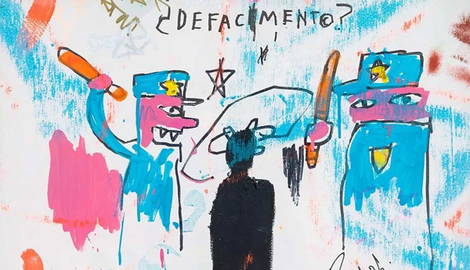

Jean-Michel Basquiat’s painting of the death of Michael Stewart arose from his grief over the death of this promising young Black artist at the hands of the NYPD, infamous for their racial profiling and brutality. This is a narrative with many contemporary parallels; Stewart’s story has been repeated many times, notably in the murders of Michael Brown, Tamir Rice, and George Floyd. In Basquiat’s immortalization of Stewart, we find a place to direct our rage and grief over the loss of these men and see how art might be used to call for change.
Who Was Jean-Michel Basquiat?
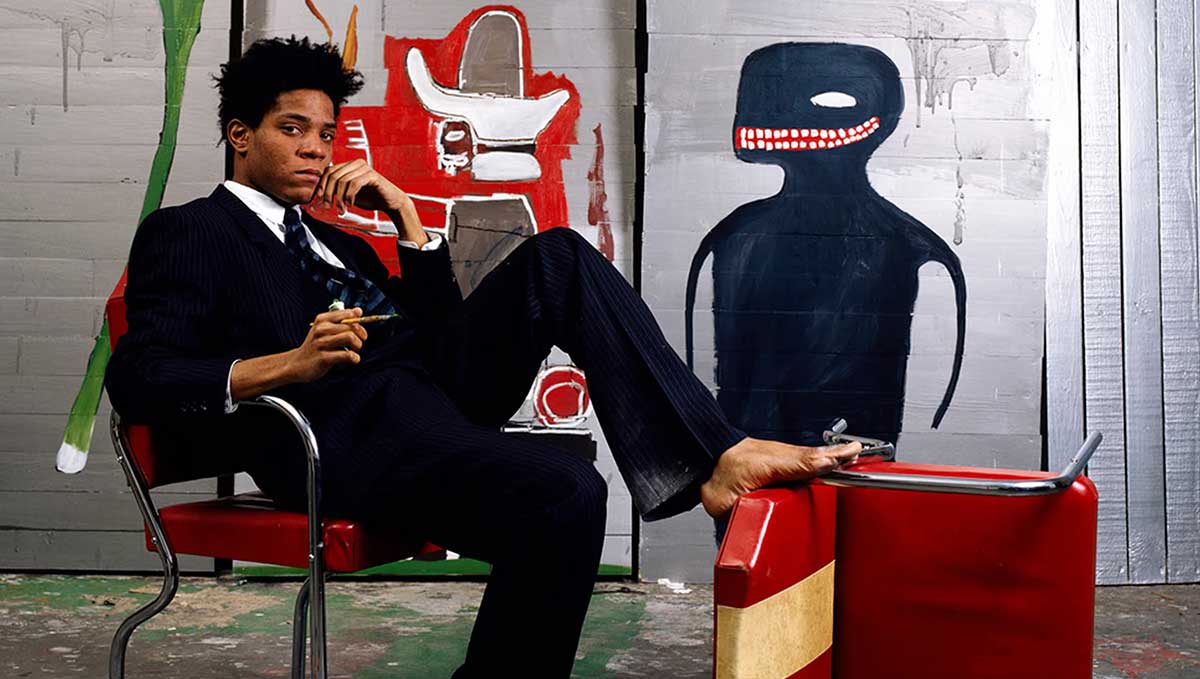
Jean-Michel Basquiat was born in Brooklyn in 1960 to Haitian and Puerto Rican parents. After a car accident, his mother gave him a copy of Gray’s Anatomy, and the anatomical forms within beguiled him and later made their way into his art. While his parents encouraged his artistic impulses (he was enrolled as a “junior member” of the Brooklyn Museum at age 6), his childhood was troubled, and he eventually ran away to Manhattan when he was a teenager to paint, play music, and join the East Village creative scene.
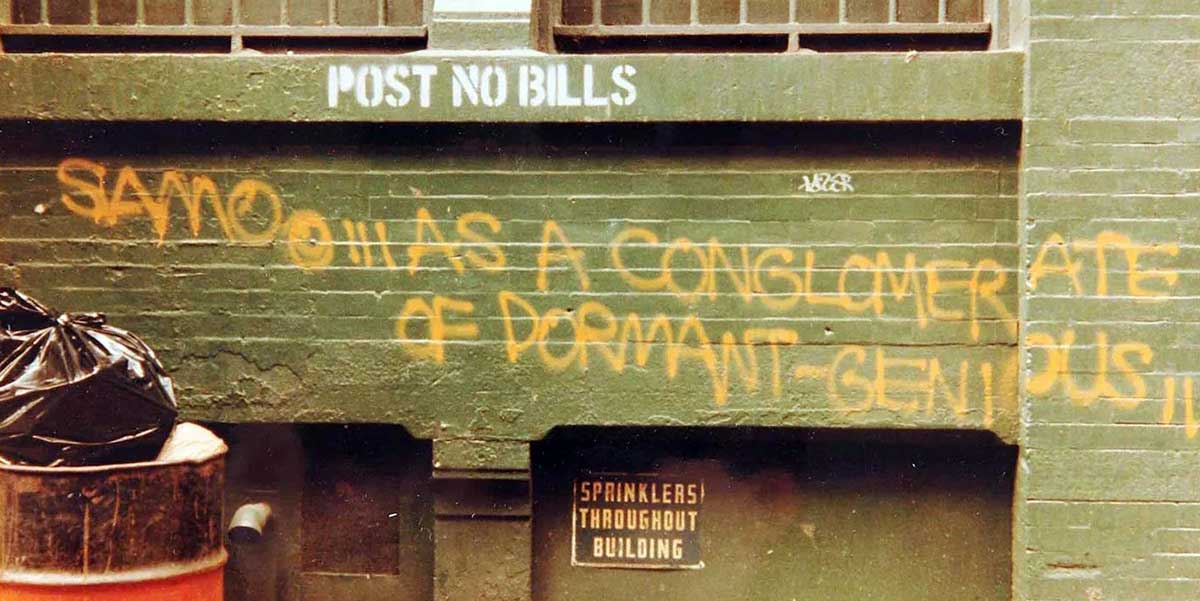
Basquiat started out as a graffiti artist using the tag “SAMO” (“same old shit”) in partnership with Al Diaz, a close friend he’d met in high school who shared his musical and artistic interests. They conceived of the idea while working on a newspaper they’d created with some friends, pretending that “SAMO” was a religion that changed people’s lives and writing fake testimonials. People’s reactions encouraged them, so they kept using the tag in their public expressions of frustration and friendship. Diaz said they were “commenting on whatever we were dissatisfied with, or thought was funny – whatever! Consumerism, religion, politics. This was all from the mind of someone who was 17 and 19-years-old – we were very young minds.”
Diaz recalled in an interview that at the time, street art wasn’t the culture it eventually became: “It wasn’t an international phenomenon, it was an inner city thing in the side boroughs, like a kind of secret organization. It was a sport. A way to be cool and different. No one had been doing it before. There had never been a phenomenon of going around writing your name on the wall as many times as you could so people would notice it.”
Diaz eventually stopped using SAMO, but Basquiat took it up more emphatically and made it his own. He eventually parlayed what he learned from street art—bold colors, gestures, and centrality of text—into paintings on canvas, this time using his own name.
In 1980, he exhibited publicly for the first time in the “Times Square Show,” and in 1981, he participated in “New York/New Wave,” which solidified his reputation as a young painter to watch. Artforum praised his work, saying, “Jean-Michel’s don’t look like the others. His don’t have that superbomb panache that is the first turn-on of the pop graffitist. Nor does his marker have that tai-chi touch. He doesn’t use spray but he’s got the dope, and right now what we need is information.”
He found fame, befriending luminaries such as Andy Warhol and Keith Haring. But the pressures of being an art world darling, as well as the frequent discussion of his work as “primitive,” felt oppressive, and he turned more and more to drugs. He died of a drug overdose at the age of 27 in 1988.
Basquiat’s Art
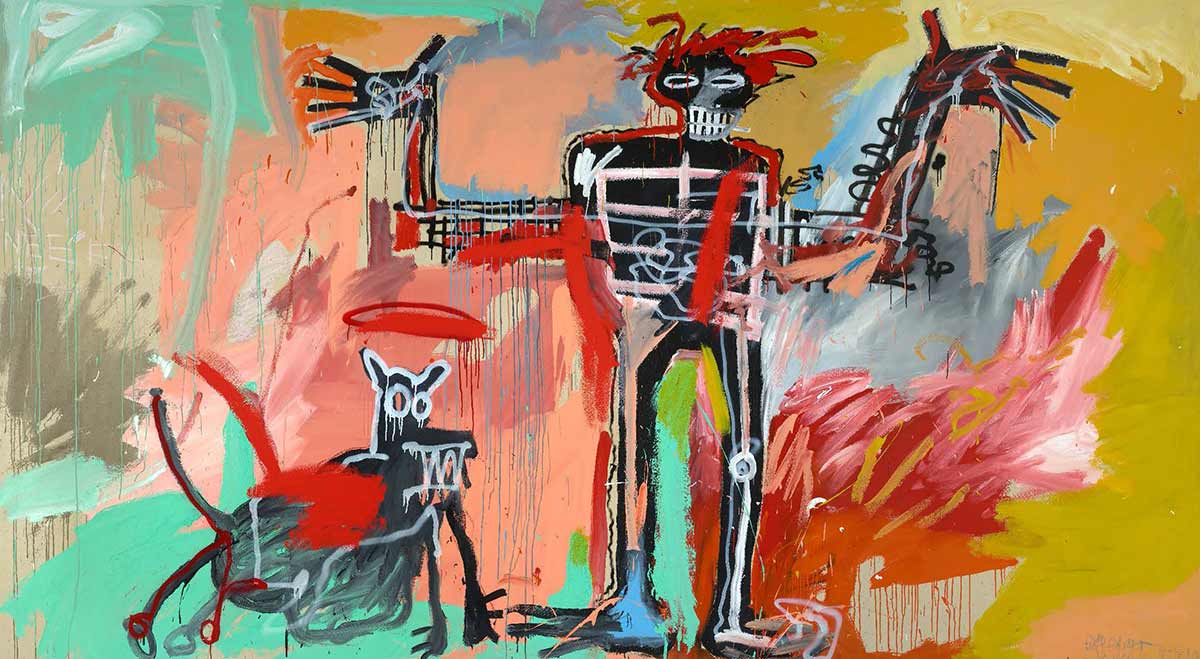
Basquiat’s canvases were riotous, dynamic, and sometimes abstruse, with words and symbols that weren’t always easy for the viewer to decode. They were often compared to jazz because they seemingly had an improvisational quality and a fervid sense of rhythm and energy. Basquiat himself said they were about “royalty, heroism, and the streets.” Fellow artist Francesco Clemente noted that one of the most frequent images in Basquiat’s work was the crown, which has three peaks for “his three royal lineages: the poet, the musician, the great boxing champion.”
The Broad Museum in Los Angeles explains that his paintings are often “reflections on Black experience against an American and global backdrop of the white supremacist legacy of slavery and colonialism” and “[celebrate] histories of Black art, music, and poetry, as well as religious and everyday traditions of Black life.”
Hollywood Africans (1983), for example, features several references to stereotypical depictions of Black people in Hollywood by writing the words “sugar cane,” “gangsterism,” and “tobacco” next to an outline of an Oscar statue, footprints, stars, and other icons of the industry.
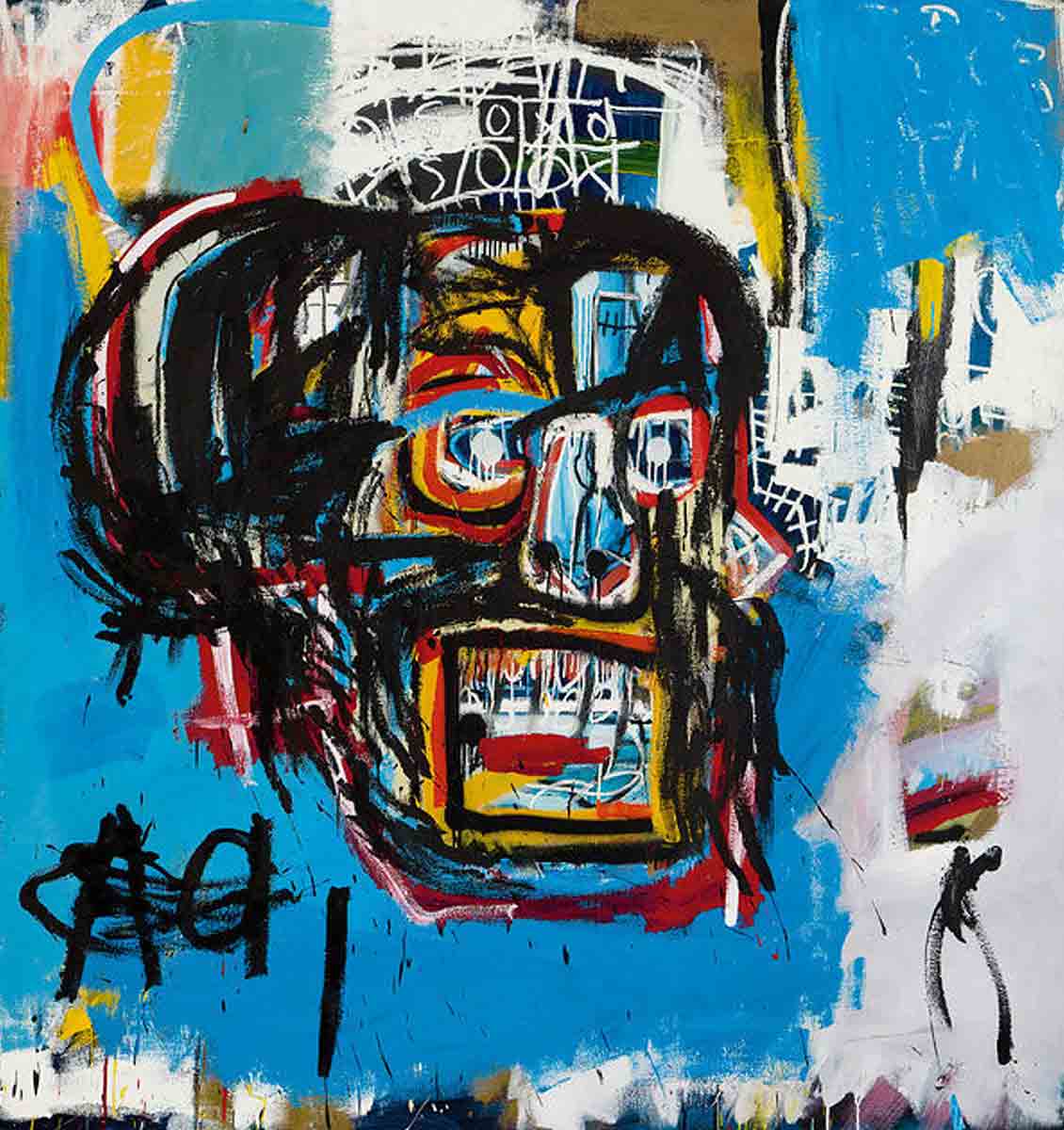
Untitled from 1982 is a powerful self-portrait, though it might not initially seem like one since it is just a massive skull that takes up nearly the whole picture plane. It takes inspiration from African masks and skulls, the skull motif, in particular, a potential reference to his father’s Haitian Vodou background. Some critics suggest “the artist’s interpretation of the mask motif perhaps speaks to his own identity as a Black artist newly navigating the commercial art world.”
The Death of Michael Stewart
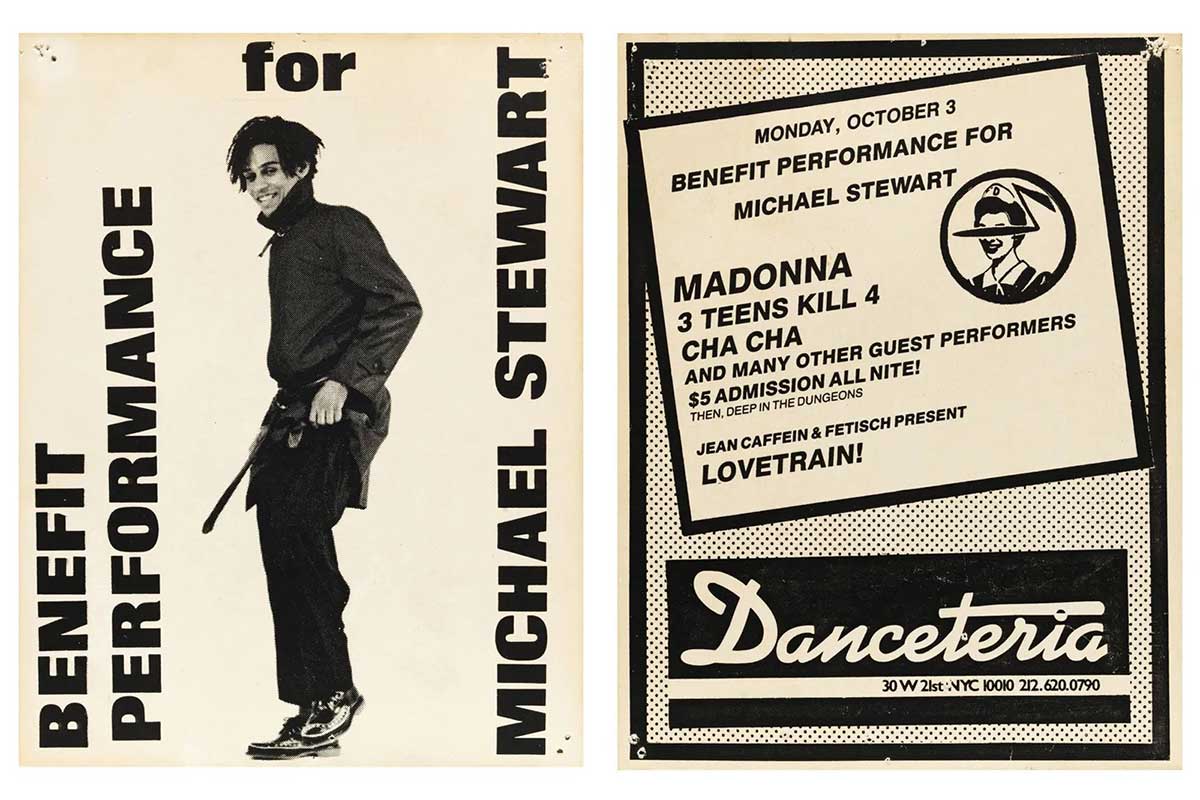
In 1983, Michael Stewart was a twenty-five-year-old art student at Pratt who often frequented the shabby but creatively booming Lower East Side and East Village neighborhoods. On the evening of September 28, he was heading home to Brooklyn and stopped to tag a wall at the First Avenue station at 14th Street. Transit police officers spotted him and gave chase after Stewart fled. The officers, all of whom were white, cuffed Stewart, who was Black, and witnesses reported the officers severely beat the young artist. Stewart was taken to Bellevue Hospital, where he lapsed into a coma and died of his injuries 13 days later. The officers were charged, but after problems securing effective witness testimonies and a compromised grand jury trial that led to a retrial, all of them were acquitted.
Though Stewart was only a minor figure in the street art scene, his contemporaries were shocked and galvanized by the egregious and clearly racially motivated police violence and lack of justice. Andy Warhol made a screen printing of a newspaper article on the episode in his “Headline” series. Keith Haring raged in his journal that “they [the police officers] know they killed him. They will never forget his screams, his face, his blood. They must live with that forever.” Warhol and Haring were only two of many artists who not only created work about Stewart but also donated to the Michael Stewart Justice Committee, an organization formed by Stewart’s girlfriend, Suzanne Mallouk.
The Work: Conception
Basquiat was extremely affected by Stewart’s death and noted grimly that it “could have been me.” He knew that the color of his skin made him different from the other artists in his scene, who were shocked “as if by a flash of lightning, [by] the persistent virulence of racism in the wider society.” Keith Haring “took to telling friends, with bitter wonderment, that he’d been arrested four times for marking, yet, as a sassy but nice white lad, he was always let go with, at worst, offhand insults to his unconcealed gayness.”
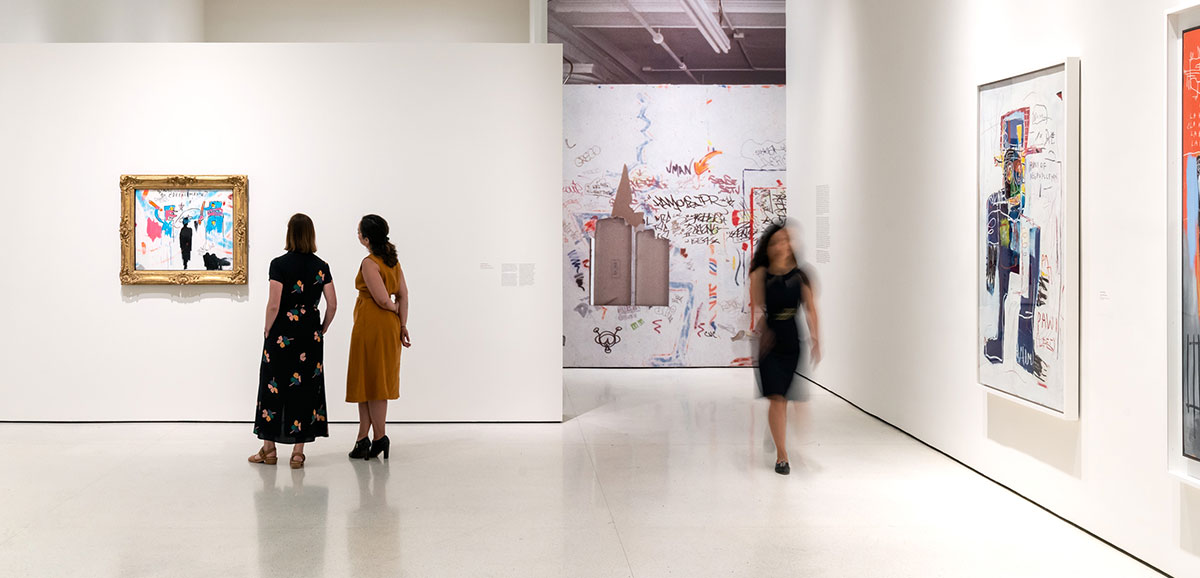
Basquiat, who did not address current events in his work prior to or after this piece, could not help doing so at this moment of tragedy. At some point in the days immediately after Stewart’s death, he visited Haring’s studio and began painting on the plasterboard wall of the studio. This work would become Defaciemento, or “defacement,” and it was never intended for public viewing; it was Haring who later preserved it by cutting it out, framing it, and then hanging it over his bed.
The Work: Execution and Legacy
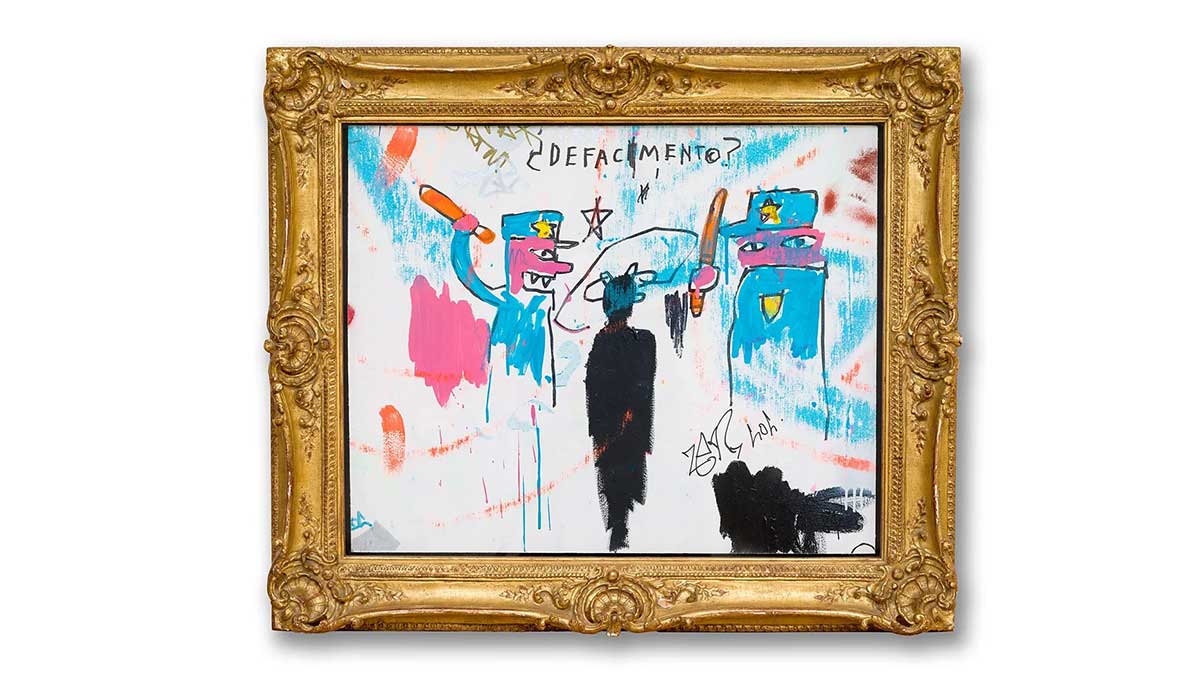
While the piece utilizes some of Basquiat’s signature elements, such as simplified figures, the inclusion of text, and bright splotches of color, it is unique in his oeuvre. He had depicted police officers in his work before, but this was different—this was a specific event, and it was personal in an entirely new way. There were also preexisting marks, such as other artists’ tags and scattered small daubs of color; it was as if the community itself was part of Basquiat’s gesture of mourning.
Yet the work is truly Basquiat’s, and as a Black man who might have been subjected to the same fate as Stewart, every mark on the wall was a reflection of his anger and anguish. The officers here are nightmarish, with menacing, empty eyes and razor-sharp teeth, and their badges and the stars on their caps gleam bright gold to further emphasize the irony of what is happening—those tasked with keeping people safe often do the exact opposite for Black and brown New Yorkers.
Stewart is a diminished silhouette, depicted as much smaller than the officers. Another dense black scribble at the bottom of the work is not identifiable as a figure but could suggest Stewart on the ground. Curator Chaédria LaBouvier says that in this piece, you ultimately “see a 22-year-old struggling with the vulnerability of the black body, the limits of assimilation, and the idea of state violence as an American heritage.”