
The Pilgrims were Separatists, believing that the church should be separate from the English Crown. Their refusal to participate in the Anglican Church, which they believed still contained too many trappings of Catholicism, made them religious outlaws. Seeking religious freedom, they set their sights on the New World. The journey was far from easy. It is a grim survival story of both a harrowing crossing on the Mayflower and harsh conditions in the new settlement. While challenging, their experience would eventually give birth to the American tradition of Thanksgiving.
Why the Radical English Separatists Fled to Holland

The Pilgrims set out for the New World because they had nowhere else to go. Following the Elizabethan Religious Settlement of 1559, the Church of England functioned as an arm of the monarch’s government. While mainstream Puritans sought to reform the Anglican Church from within by stripping away Catholic remnants like vestments, kneeling at communion, and episcopal hierarchy, a radical minority concluded that the state church was hopelessly corrupt and biblically illegitimate. Known as Separatists, they formed clandestine, covenant-based congregations where believers governed themselves outside the authority of the Crown and Anglican bishops. Under English law, this was an act of treason. Anyone over 16 could suffer imprisonment, forfeiture of property, and banishment for illegal congregation.
Around 1606, a prominent Separatist group formed around the village of Scrooby in Nottinghamshire, led by pastor John Robinson, elder William Brewster, and a young William Bradford. Royal authorities placed the Scrooby congregation under constant surveillance. Members suffered property raids, fines from ecclesiastical courts, surveillance by local informants, and imprisonment in York Castle. Because fleeing England without a royal license was also illegal, leaving the country was itself a dangerous enterprise. After a failed attempt in 1607, where a hired ship captain betrayed them to local authorities in Boston, Lincolnshire, the Scrooby group successfully slipped out in small groups in 1608, regrouping in Amsterdam.
In 1609, to escape theological infighting among other English exile groups in Amsterdam, Robinson led roughly 100 followers south to Leiden, an intellectual and industrial hub in the Dutch Republic. But after some time, the Pilgrims found that their children were adapting to the local culture more than their own, and the adults were having difficulty with the language and making a living. Moreover, they were forced into low-paying, exhausting manual labor in the textile mills. On top of this, William Brewster and Thomas Brewer operated a clandestine printing press in Leiden to publish illicit Puritan books that were smuggled back into England. English diplomats pressured the Leiden authorities and, in 1619, Dutch officers raided the press and sought Brewster’s arrest, forcing him into hiding.
In the face of these problems, North America offered an isolated territory where they could remain subjects of the English Crown, preserve their English language and identity, and govern their own church free from Anglican bishops.
The Disastrous Speedwell Failure and the Solo Mayflower Crossing

In 1619, two of these Pilgrims, Robert Cushman and John Carver, applied to the London Company for a land patent. The London Company had been granted the ability to administer territory in the areas of the so-called “New World” claimed by England, and the men were granted permission, though there would be legal issues regarding the charter.
After various logistical headaches, the Pilgrims procured passage on two ships, the Speedwell and the Mayflower. In July 1620, the Leiden contingent boarded the Speedwell at Delfshaven and sailed to Southampton, England, to meet the Mayflower and a contingent of non-Separatist passengers, whom they called “Strangers.” After the Speedwell repeatedly proved unseaworthy and had to be abandoned, 102 passengers packed aboard the solitary Mayflower, departing Plymouth, England, in September 1620 to establish what would become Plymouth Colony.
Crammed into the small ship, it was a 66-day journey at sea. The Mayflower was not a passenger liner; it was a merchant cargo ship roughly 100 feet long and 25 feet wide. The passengers were confined to the ‘tween decks, the narrow cargo space between the upper deck and the lower hold. Headroom was roughly five feet, meaning that grown adults could not stand upright. The space had no windows and only small gun ports that remained sealed against high waves. Families lived by dim lantern light and candle glow, separated only by rough cloth hangings. Sea spray and leaking seams kept clothes, bedding, and deck planks permanently damp. Vomit, chamber pots, and unwashed bodies made the hold reek, and acute seasickness crippled the majority of the passengers for weeks. Tensions between the Separatists and teh Strangers also simmered throughout the journey in the close quarters.
The ship was almost lost. The relentless flexing of the ship in heavy seas cracked a massive oak crossbeam supporting the main deck, bowing it downward. The crew feared the ship would buckle and split apart, debating whether to turn back. However, the Pilgrims had brought along a heavy iron screw, likely a mechanical screw press for printing or a construction jack. The crew and passengers cranked the jack against the keel, forced the beam back into place, and secured it with a wooden post, saving the ship. Despite the challenging conditions, only two people died during the crossing, and one child was born onboard, whom the Pilgrims named Oceanus.
The Fateful Arrival off Cape Cod and the Mayflower Compact

Master Jones steered the ship south, but quickly encountered Pollock Rip, a treacherous labyrinth of shoals, rip currents, and breaking breakers south of Chatham. Fearing shipwreck on the sandbars, Jones retreated and rounded the tip of Cape Cod, dropping anchor in the calm waters of modern-day Provincetown Harbor on November 21. After exploring various sites, they finally settled on a cleared area that previously had a native village, which was abandoned. It was in this location that the Pilgrims landed, began their settlement, and where the Plymouth Rock legend was born.
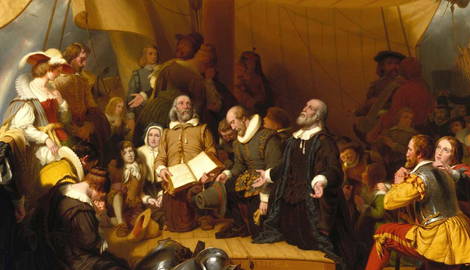
The ship’s patent from the Virginia Company had authorized settlement farther south near the mouth of the Hudson River, then considered northern Virginia. Because they had settled outside their legal jurisdiction, several “Strangers” claimed that once ashore, they were free from any legal authority. To prevent immediate mutiny and anarchy, the adult men gathered in the Mayflower’s great cabin before going ashore to draft and sign the Mayflower Compact, binding the diverse group into a single civil body politic under self-governance.
The 41 adult males onboard signed the compact, which pledged continued loyalty to the English Crown, ordered the creation of a civic body to organize the new settlement, agreed to consent-based rule of law, and to submit by collective will to those laws and the governance of their selected leaders.
The 1621 Autumn Harvest and the Real Origins of Thanksgiving

During teh first four months, the settlers were forced to live aboard the damp ship while constructing wooden common houses. Continuing to live in these damp and cramped conditions led to an outbreak of scurvy, pneumonia, and violent fevers. When they began planting, harsh winter conditions meant crop failures. By summer of 1621, 50 of the 102 passengers who had set out had died.
The local Wampanoag Confederacy of Native American tribes was in a fragile position following devastating European-introduced epidemics between 1616 and 1619, so they had reason to cooperate with the newcomers. One member, Samoset, surprised the Pilgrims by greeting them in conversational English learned from fishermen. But cooperation was mostly brokered by Tisquantum (Squanto), who had previously lived in European captivity. He instructed the Pilgrims on local corn planting and herring fertilization.
The Pilgrims were able to produce a good harvest and celebrated with the neighboring Wampanoag tribe, who contributed five freshly hunted deer to the Pilgrims’ food supply. Making it through that first harsh year, they were able to not only survive, but thrive as a community and become an integral part of American history.