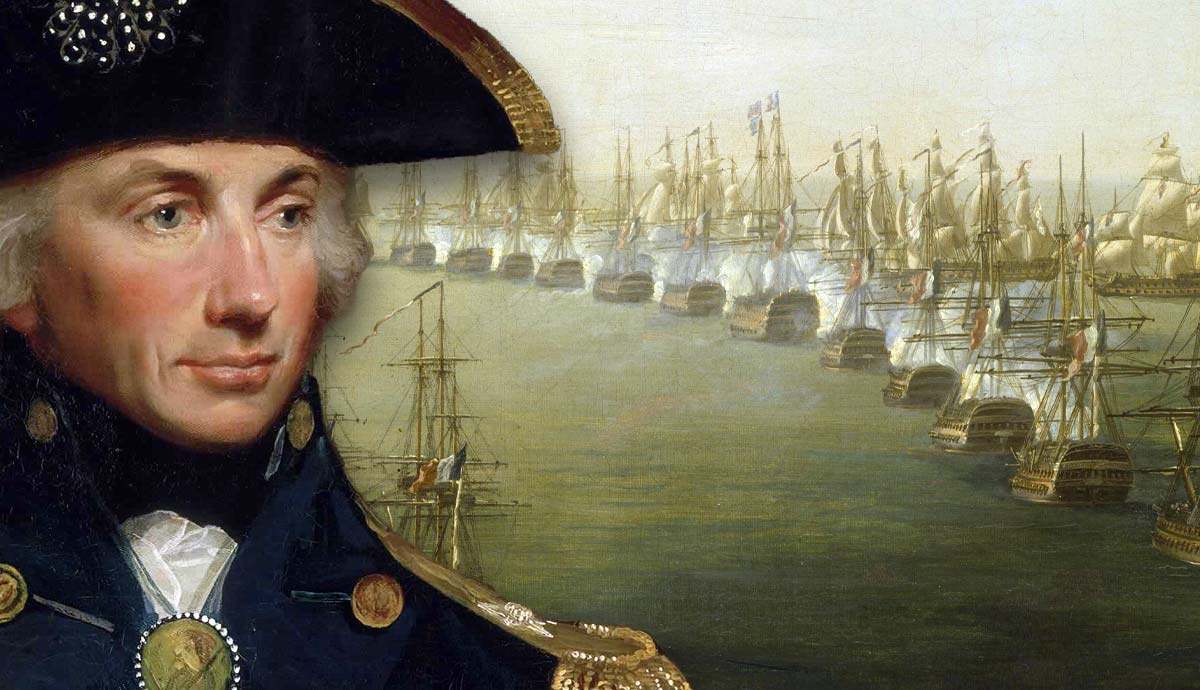

On October 21, 1805, the British Mediterranean fleet commanded by Vice-Admiral Viscount Horatio Nelson won a decisive victory over a combined Franco-Spanish fleet at Trafalgar near Cadiz. While the destruction of the French fleet undermined Napoleon’s plans to invade Britain, Nelson himself had been killed at Trafalgar. Nelson had already been a celebrated naval commander in his lifetime, but the circumstances of his death at his hour of victory created a legend that anchored British naval supremacy in the 19th century.
Nelson’s Death Aboard HMS Victory
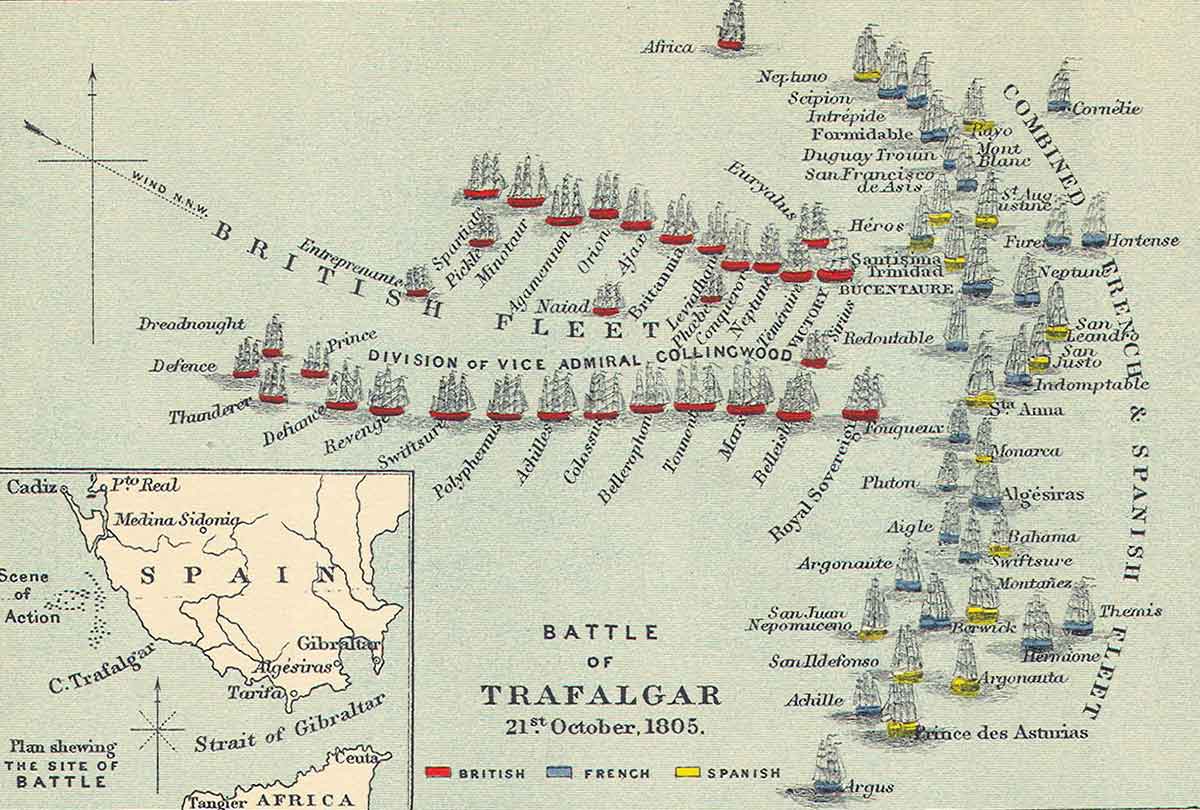
On the morning of October 21, 1805, the British fleet approached the Franco-Spanish fleet in two columns. Nelson planned to sail straight into the enemy line, trusting in the superior experience of his sailors to inflict heavy damage at close range. His confidence was expressed in his famous signal, “England expects that every man will do his duty.”
Nelson’s flagship HMS Victory led the northern column toward the Bucentaure, the flagship of French admiral Pierre-Charles Villeneuve. The Victory would bear the brunt of broadsides from the enemy and would be unable to respond for some 40 minutes until it crossed the enemy line. Before the signal flags were lost in the smoke, Nelson issued his final instruction, “Engage the enemy more closely.”
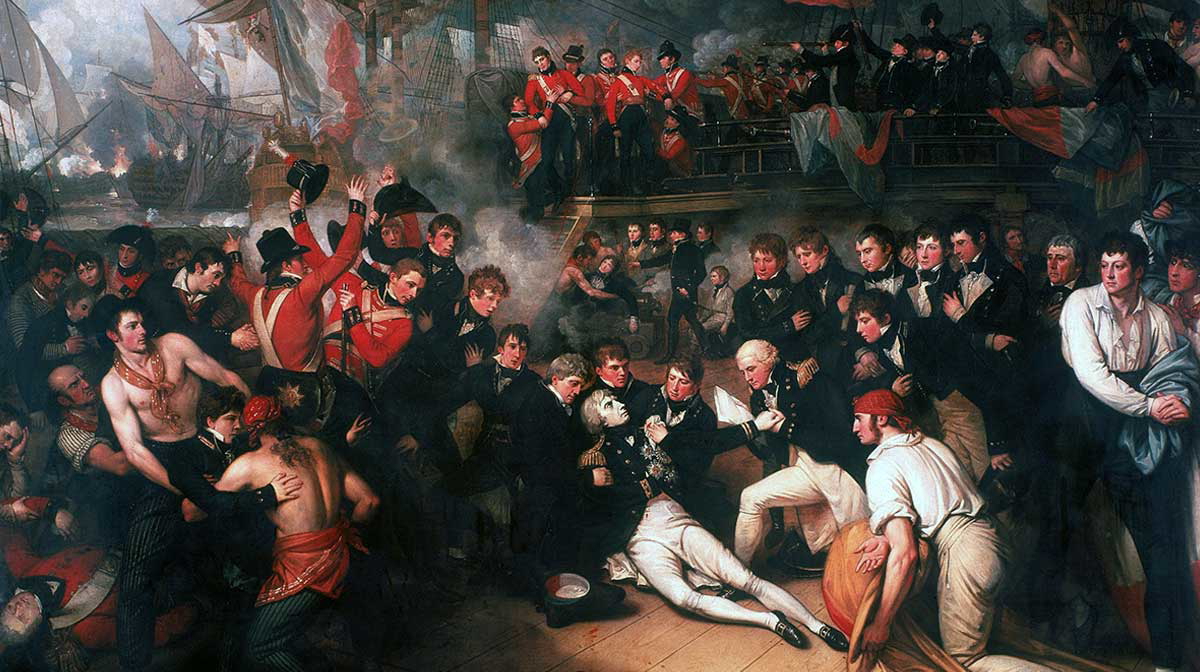
At around 12:45, Victory cut the Franco-Spanish line and engaged in close combat with the Bucentaure and Redoutable. The diminutive Nelson stood on the quarterdeck of Victory in his dress uniform embroidered with his decorations. With their rigging entangled, a French marine fired a shot from the mizzenmast of the Redoutable that struck Nelson in the shoulder and pierced his spine. Nelson collapsed and informed Victory’s Captain Thomas Hardy that “They have done for me at last.”
The admiral was taken below deck and informed the surgeon William Beatty, “Ah, Mr. Beatty! You can do nothing for me. I have but a short time to live: my back is shot through.” He continued to receive reports of enemy ships surrendering to his fleet. Altogether, 18 allied ships were lost on the day. When the dying Nelson famously asked his captain “Kiss me, Hardy,” the latter obliged by kissing him on the forehead. Nelson knew that he had won a great victory and murmured “Thank God I have done my duty” shortly before his death at 4:30 in the afternoon.
The Strategic Impact of Victory at Trafalgar
It is often claimed that the Royal Navy’s victory at Trafalgar foiled Napoleon’s plans to invade England in 1805. Since 1803, Napoleon had been preparing to invade England, and in 1805 he ordered Villeneuve to break the Royal Navy’s blockade and concentrate French naval resources on seizing control of the English Channel to allow Napoleon’s army cross the Channel and land in southern England.
Napoleon devised an elaborate plan for Villeneuve to sail to the West Indies, drawing Nelson out of the Mediterranean in pursuit, before doubling back to link up with French ships blockaded in the Atlantic ports and sailing toward the English Channel.
While Villeneuve had successfully carried out the first half of the plan, on July 22 he was intercepted by a British fleet under Vice-Admiral Robert Calder off Cape Finisterre in northern Spain. After a tactically inconclusive engagement, Villeneuve turned to Cadiz to combine with the Spanish fleet. Although Calder was court-martialed for failing to pursue Villeneuve and destroy his fleet, Napoleon was infuriated by Villeneuve’s decision to retreat. In late August, he abandoned his invasion of England and turned his army eastward to face the threat from General Mack’s Austrians in southern Germany.
At Trafalgar, Nelson accomplished what Calder failed to do by capturing a large number of French ships. This significantly reduced French naval capacity and led Napoleon to turn his attention away from Britain toward continental Europe. Nevertheless, the British remained concerned about the prospect of a French landing, and in 1810 Napoleon initiated an ambitious naval rebuilding program with a target of 100 ships of the line. The new ships were destroyed by the Allies after Napoleon’s first abdication in 1814.
The Long Journey of Nelson’s Body
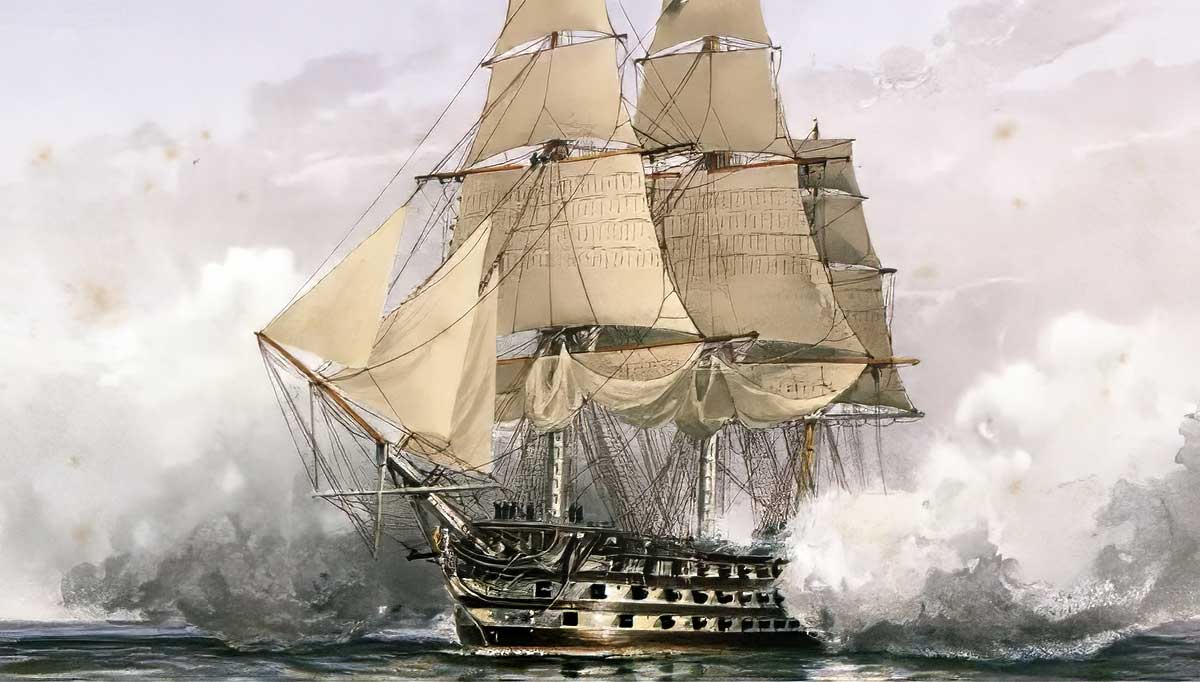
British sailors who died at sea were typically thrown overboard or buried at a nearby port. Before his death, Nelson had instructed Hardy to bring his body back to England. To prevent the late admiral’s body from deteriorating during the voyage, William Beatty decided to preserve it in a cask of brandy which had to be refilled at regular intervals.
The repatriation of Nelson’s body proved a difficult task. The damage that Victory sustained during the battle was exacerbated by a great storm that forced her to be towed to Gibraltar for repairs. HMS Victory left Gibraltar on November 3 but did not arrive at Portsmouth until December 4 due to further stormy weather.
As the Victory made its way toward London, Dr Beatty performed a thorough autopsy on the slain admiral’s body before dressing it in bandages and transferring it to a lead coffin. When the Victory reached the Thames estuary in late December, the body was placed in a wooden coffin made from the mainmast of Orient, the French flagship at the Battle of the Nile in 1798. This was placed into an elaborate outer coffin in which Nelson made his journey to London for his state funeral.
Why the British Public Embraced Nelson as a National Martyr
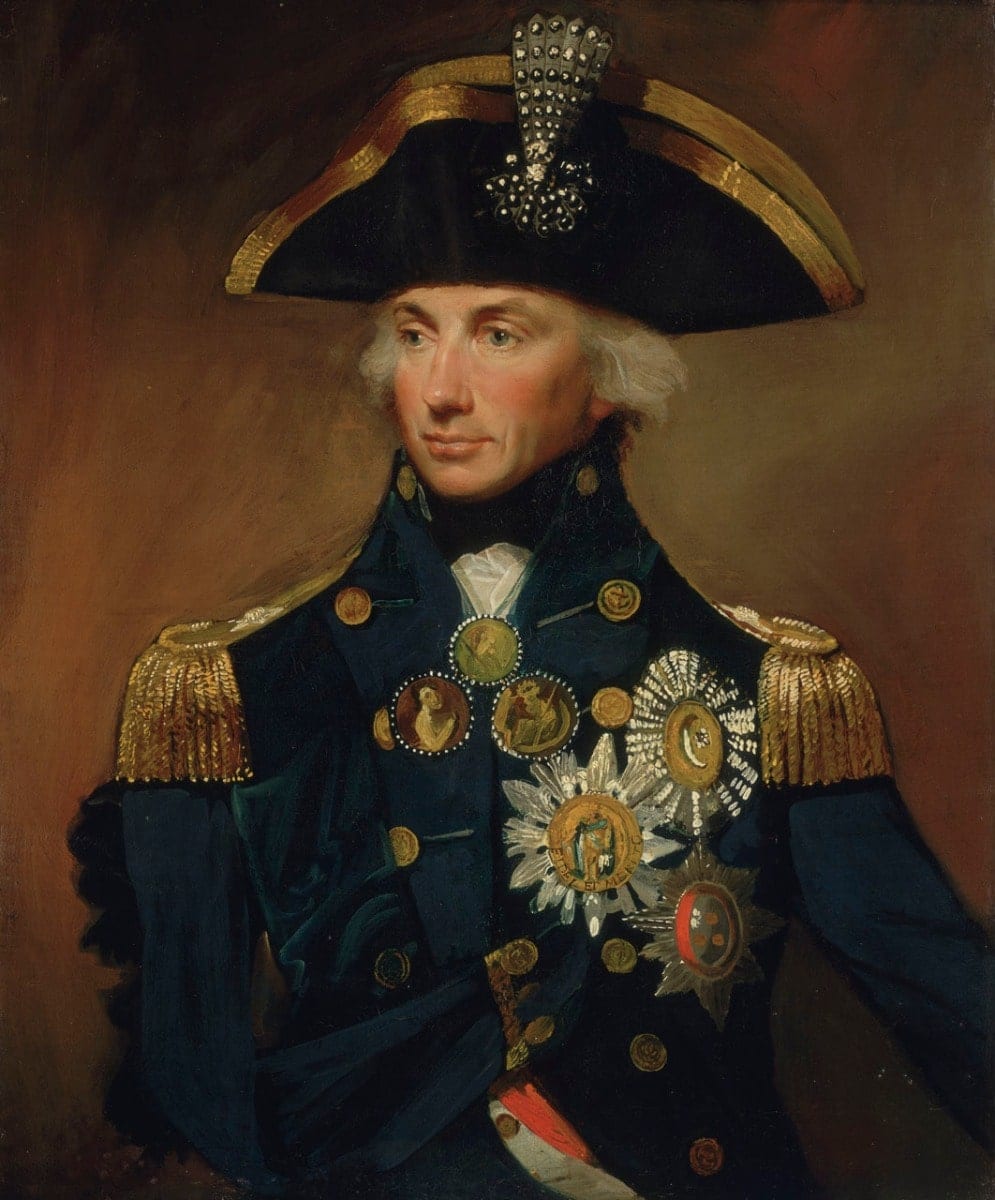
While Nelson had enjoyed a reputation as a brilliant naval commander, his life was not without controversy. In December 1798, Nelson evacuated King Ferdinand IV and Queen Maria Carolina of Naples to Sicily after French-backed revolutionaries defeated the Neapolitan army and established the Parthenopean Republic.
In 1799, Nelson’s blockade of Naples helped a counterrevolutionary army commanded by Cardinal Ruffo regain control of the city. Although the cardinal had promised clemency to the revolutionaries, Nelson arrived in Naples in June and handed over thousands of prisoners for execution. While King Ferdinand rewarded Nelson by making him Duke of Bronte in Sicily, the execution of the prisoners was one of the darkest chapters of Nelson’s career.
During his time in Naples and Sicily, Nelson befriended the British ambassador Sir William Hamilton and began an affair with his young wife, Lady Emma Hamilton. Although their relationship was later romanticized, Nelson was still married to his wife, Lady Frances Nelson. The affair scandalized polite society, particularly after Emma gave birth to a daughter named Horatia in 1801.
Nelson’s personal flaws were brushed aside following his death at Trafalgar, and the nation embraced him as a martyr who gave his life to save Britain from French invasion. Emma Hamilton was less fortune. Although she continued to be welcomed in high society, she fell into debt and died in France in January 1815 while on the run from her creditors.
The Grand State Funeral at St Paul’s Cathedral
After receiving the report of the events at Trafalgar on November 6, 1805, King George III reportedly remarked, “We have lost more than we have gained.” The British government soon began making preparations for a state funeral, the first for a non-royal figure since John Churchill, the 1st Duke of Marlborough, in 1722.
Between January 5 and January 7, Nelson’s body lay in state in a public ceremony at the Painted Hall in the Royal Hospital for Seamen at Greenwich. While the event attracted some 15,000 mourners over three days, many more had to be turned away. On the 8th, the body transferred onto the State Barge of Charles II and rowed upriver by sailors from HMS Victory. Barges representing the royal family, the Admiralty, the City of London Corporation, and the City’s livery companies also participated in the procession. Nelson’s body spent the night at the Admiralty ahead of the funeral procession the following day.
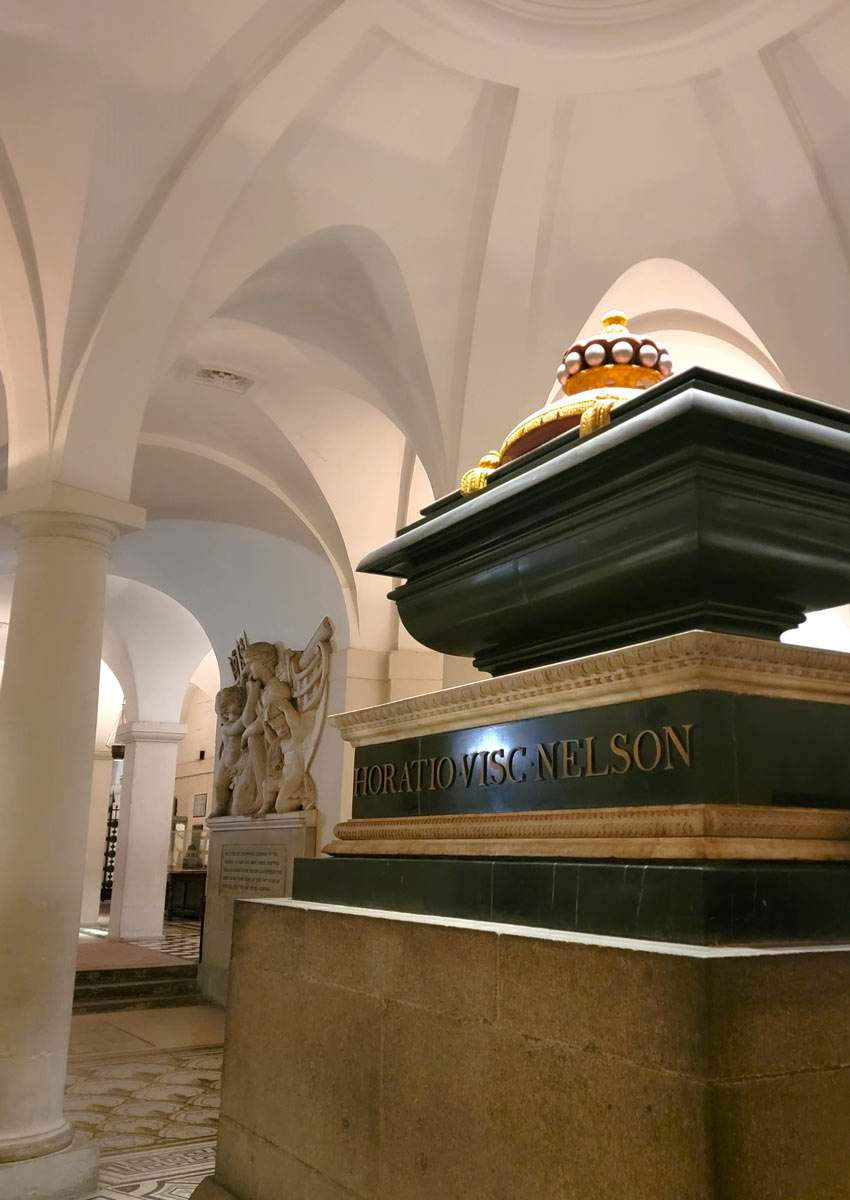
On the morning of January 9, large crowds lined the course of the procession from the Admiralty to Nelson’s final resting place at St Paul’s Cathedral. Nelson’s coffin was placed on a funeral carriage carved to resemble the bow and stern of HMS Victory. The grand procession consisting of 32 admirals, 10,000 soldiers, and 189 carriages solemnly wound its way to St Paul’s Cathedral, where Nelson was interred in the crypt following a three-hour ceremony. The admiral’s body was placed in a black marble sarcophagus originally made for Cardinal Thomas Wolsey. The sailors of the Victory were supposed to cast the flag draped over Nelson’s coffin into the vault but instead tore up the flag to keep as souvenirs.
Constructing the Imperial Myth in Victorian Art
The Napoleonic Wars continued for a decade after Nelson’s death. Although the Duke of Wellington struck the final blow against Napoleon at Waterloo, Nelson continued to be hailed as Britain’s foremost military hero during the 19th century. Since Britain’s global hegemony was based on its naval power, Nelson was a more appropriate symbol of British military prowess than a general such as Wellington.
Nelson was a popular figure in art and sculpture following his death. The American-born painter Benjamin West portrayed the admiral’s final moments in his 1806 work The Death of Nelson, completed within six months of the battle. West had previously been acclaimed for his 1770 painting The Death of General Wolfe, commemorating the death of General James Wolfe during his victory at the Battle of Quebec in the Seven Years’ War. West depicts the fatally wounded Nelson on the deck of HMS Victory surrounded by sailors and soldiers paying their respects in serene contrast to the chaos of the wider battle.
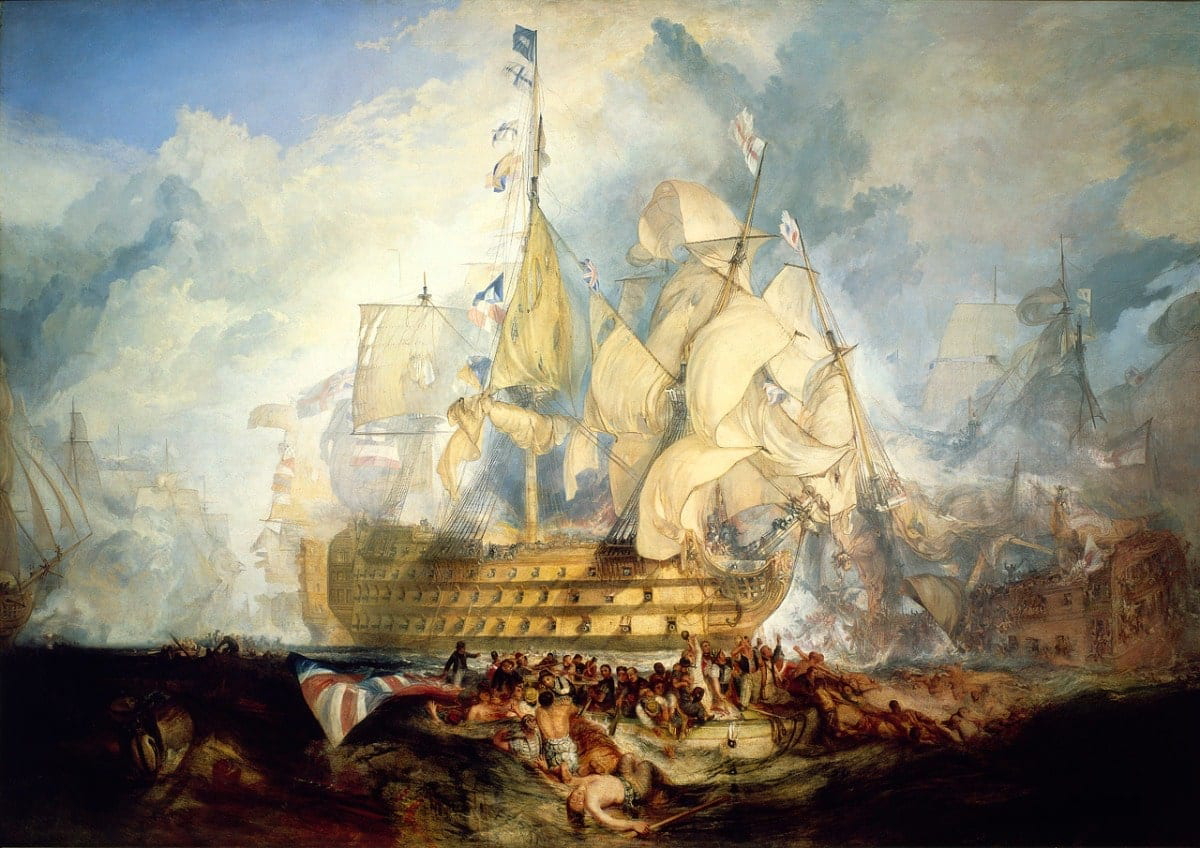
The Battle of Trafalgar was also the subject of an 1824 painting by J.M.W. Turner, Britain’s most famous maritime artist. Turner’s canvas is dominated by HMS Victory at the center of the action. While the scale of the painting meant that Turner could not depict the dying Nelson on Victory’s deck, Turner alludes to the admiral’s death via a falling mast.
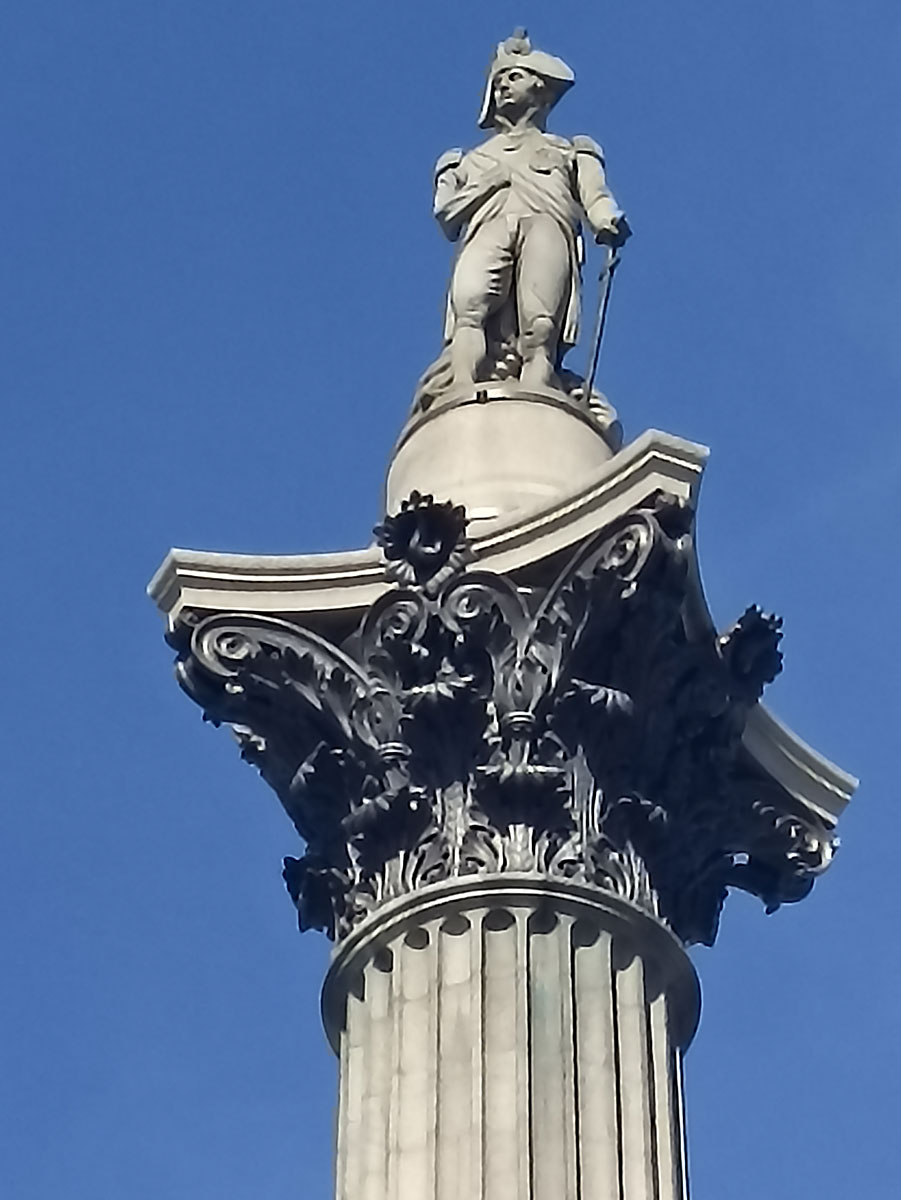
In the years after Nelson’s death, statues and memorials were erected in his honor throughout Britain. The first of these was set up in Birmingham in 1809. The most famous monument is Nelson’s Column, a 46-meter tall Corinthian column topped by a 5-meter statue of the admiral. The monument completed between 1840 and 1843 as the centerpiece of Trafalgar Square, created during the redevelopment of Charing Cross in the 1830s. Nelson’s Column and Trafalgar Square continue to be among the most prominent landmarks in London.
Nelson continues to be remembered fondly in the Royal Navy. Every year on October 21, the Navy hosts Trafalgar Night dinners across the country where toasts are given “To the Immortal Memory of Lord Nelson and those who fell with him.”