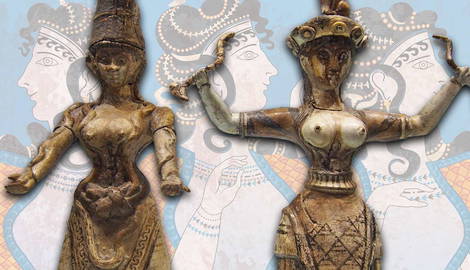
When Sir Arthur Evans discovered the Minoan civilization on the island of Crete in 1900, he knew he had found a culture a millennium older than the Greeks. Ethnically similar, but socially distinct, they spoke a different language, had unique customs, and worshiped local deities. Evans believed their religion focused on a so-called Great Goddess, but modern historians now believe they worshiped multiple complex goddesses. Meet some of the enigmatic goddesses of the Minoan world, and a few male deities too.
A Single Great Goddess or Many?
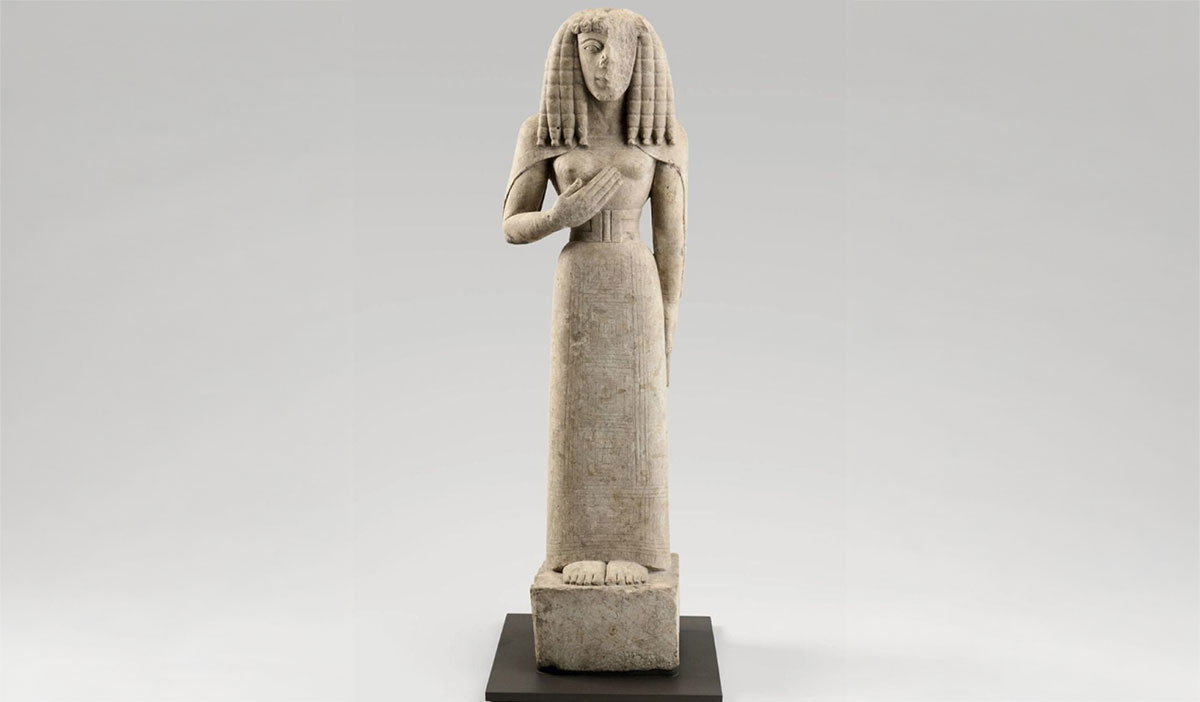
Many early archaeologists, including Evans, favored the Great Mother Goddess theory regarding Minoan religion. Whether under the influence of Near Eastern cultures with great goddesses—like Inanna, Ishtar, Isis, Hathor, Astarte, and Cybele—or based on Evans’ questionable belief that Aegean cultures were matriarchal, the consensus favored the sacred feminine. However, Evans believed Minoan religion was essentially monotheistic, with the focus on a single Mother Goddess.
The thousands of tablets found at Knossos include many texts in Linear B, an early form of Mycenaean Greek. These were based on texts in the earlier, undeciphered Minoan script, Linear A. Many of these texts include titles referring to deities, though their names in the original Minoan language are long lost. Several translations of names survive.
Mistress of the Grain: Fertility Goddess
Some of these goddesses have clear Greek parallels. For example, po-ti-ni-ja si-to, transcribed as the Potnia Sito or Mistress of the Grain, is certainly a reference to an early form of the Greek goddess Demeter, whose name means “grain mother” or “house mother.”
In later Greek myth, Demeter was one of the most powerful goddesses, even capable of defying Zeus’ will when her daughter, Persephone, was kidnapped by Hades. In Demeter’s sorrow, she allowed crops and fields to die off, starving all life on earth. When Zeus ordered her to bring life back to the world, she refused until Zeus intervened to return Persephone for at least part of the year. Whether Demeter served as the “head of the pantheon” in Minoan religion or was the underlying mother goddess is impossible to know, yet Crete is the site of a very early cult to Demeter. Her Cretan worship may have influenced her later worship at Eleusis, the site of the famed Eleusinian Mysteries.
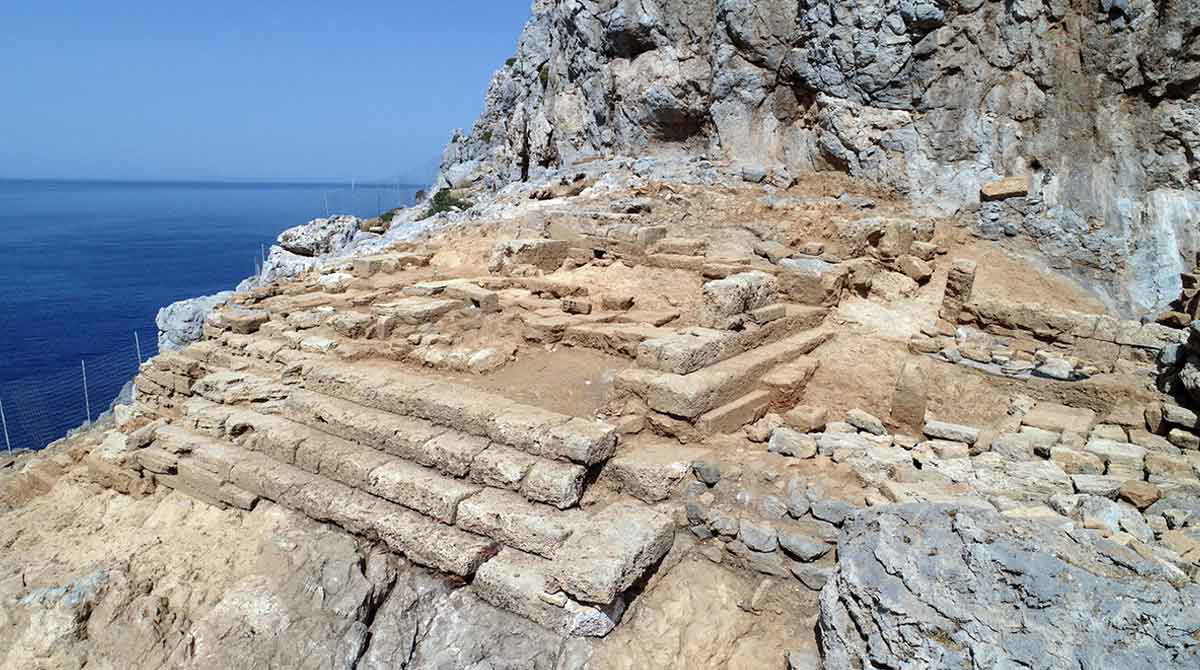
Recently, archaeologists discovered prehistoric remains of ritual offerings at the Temple of Demeter in Phalasarna, Crete. While specific votives bearing the name of the goddess only appear around the Archaic Period (c. 750 BCE), earlier Minoan era pottery, and even earlier Neolithic stone, obsidian, and bone artifacts, have been found at the site. This shows a continued religious presence from around 3500 BCE. It seems likely that the role of the goddess was the same, regardless of her name.
The consensus is now that, while this “pre-Demeter” was an important figure, she was probably part of a broader pantheon rather than a single monotheistic mother goddess. The other goddesses on the list are probably distinct deities, rather than aspects of a single great goddess.
The Poppy Goddess: Deity of Death
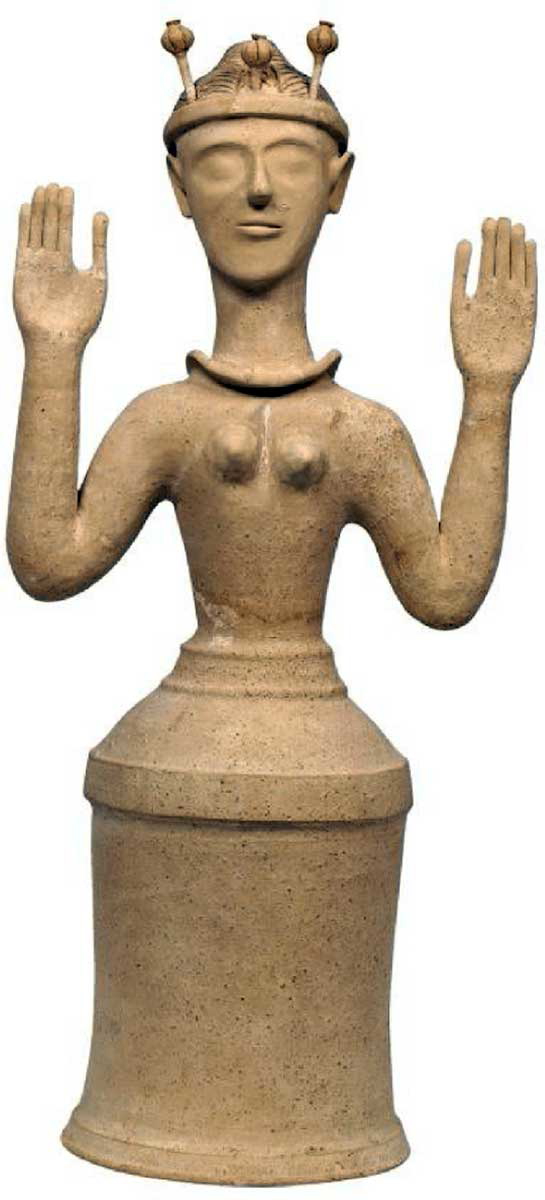
Another nature deity is colloquially called the Poppy Goddess, after the poppy seeds that protrude from the diadem on her head. Several statues of this figure have been found in sanctuaries across Crete, depicted with raised hands and bare breasts. Whether this pose represents a priestess engaged in worship or the goddess herself blessing followers is unclear. Nevertheless, the consensus is that the figure depicts a goddess due to the bare breasts, crown-like piece, and idealized depiction.
It is unclear whether this Poppy Goddess was equivalent to the Mistress of the Grain, but Greek writers also connected her with Eleusis. It is possible that the Minoan goddesses reflected different aspects of Demeter, who was both a fertility and a chthonic deity. The Hungarian mythographer Karl Kerenyi believed she reflected death in the religion, connecting her to Persephone, and both Kerenyi and British scholar Jane Ellen Harrison argued the Poppy Goddess might have been the actual Minoan goddess of death.
Mistress of Animals: Goddess of the Hunt
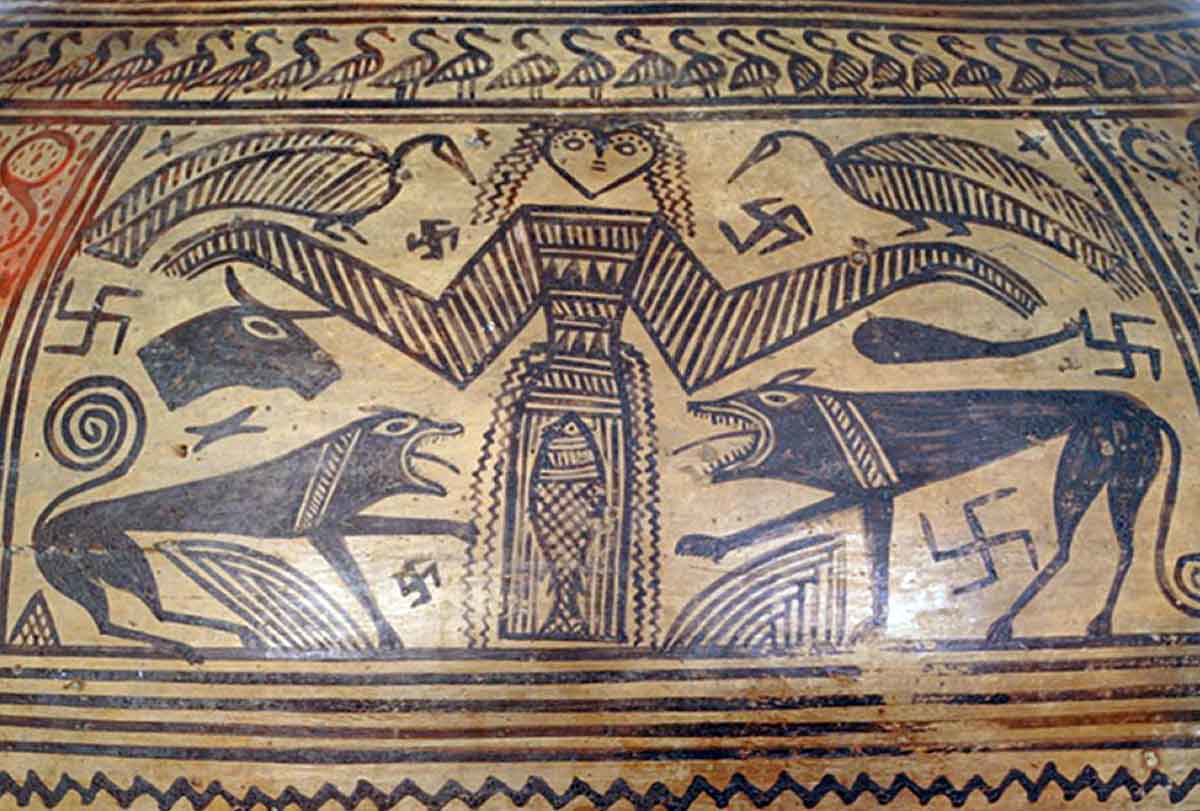
The Mistress of the Animals is one of the most interesting Minoan goddesses due to her varied roles, the confusion over whether she was one of many goddesses, and her connections to the Greek goddess Artemis. The German scholar Walter Burkert, who wrote extensively on Greek religion, noted that Artemis was frequently referred to as Potnia Theron, Mistress of the Animals, in later cultic worship. Indeed, Homer even used the epithet in Book 21 of the Iliad, writing only a few hundred years after the Linear B tablets.
Prior to the name Artemis, the goddess may have been called Britomartis. Evidently a native name, the Greeks claimed it originated in the Cretan dialect and was translated as “sweet maiden.” Artemis was certainly worshiped as a maiden goddess and was always associated with animals. Furthermore, the Greeks asserted that Britomartis was worshiped as a goddess of hunting, though this is based on her identification with Artemis rather than first-hand knowledge of actual Minoan beliefs.
Further connection to Artemis can be found in late Hellenistic myths that claimed Britomartis was originally a Cretan nymph pursued by King Minos. Running from his advances, she fell from a mountain into the sea and drowned in fishing nets, later becoming a goddess of nets. Another version claimed Artemis rescued her from the nets and made her a goddess. This version would certainly align with the widespread practice of Greeks interpreting foreign deities within the context of their own mythology.
Mother of Mountains: Mount Ida
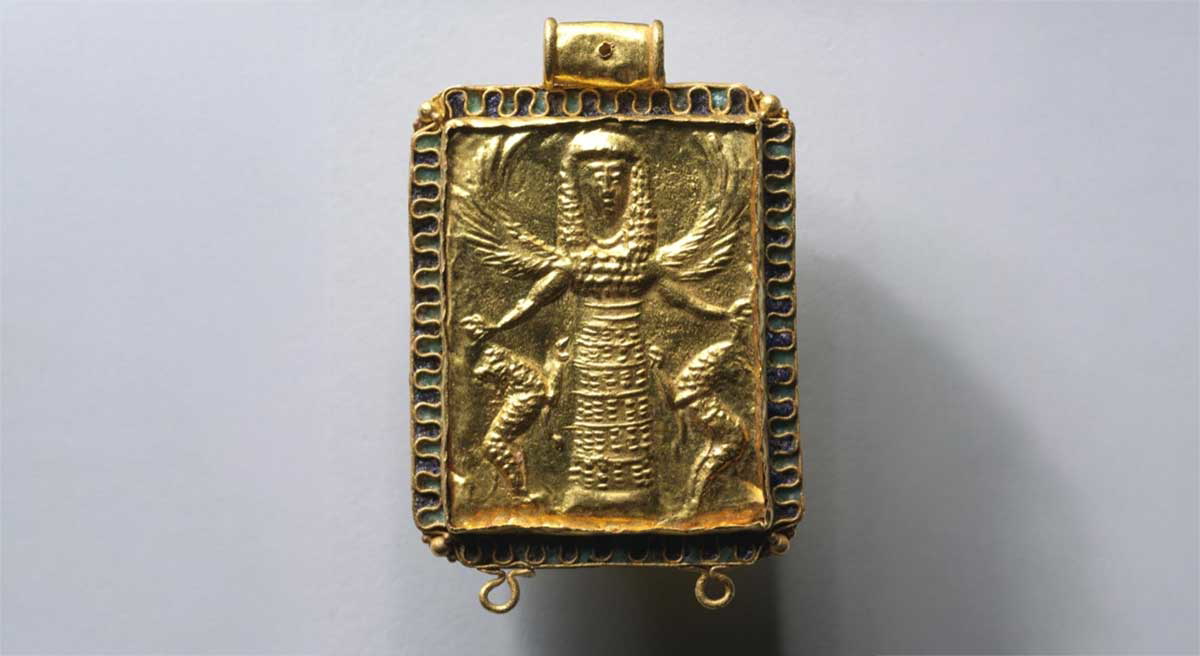
The Mother of the Mountains may be the same figure as the Mistress of Animals, but they could also be distinct. Clay impressions of a Mother of the Mountains were discovered by archaeologists excavating in Knossos. These images depict a female in the pose of a goddess, standing on a mountain, holding a scepter, surrounded by lions. This is a similar pose to the Potnia Theron, whether in a mountain scene or not.
To compound the confusion, according to the classicist Gregory Nagy, the figure is referred to as i-da-ma-te in inscriptions, likely a reference to Mount Ida, the highest mountain in Crete. Thus, the translation could be Mother of Mount Ida. Yet if we accept da-ma-te as an early form of Demeter, does that indicate the Mother of the Mountains is also Demeter, the Mistress of the Grain, meaning they are both the same goddess? Or could it refer to the goddess Rhea, Demeter’s mother, considering Mount Ida was sacred to her?
To further complicate matters, Britomartis may have been equivalent to another goddess, Diktynna, associated with the Dikti Mountains in Crete. Both Mt. Ida and the Diktaion cave were seen as the possible location for the birth and rearing of Zeus. Thus, perhaps this mountain goddess began as Rhea, mother of Zeus, before being identified with Demeter, sister of Zeus, and finally demoted to an assistant of Artemis, daughter of Zeus.
Eileithyia: Mother of Childbirth
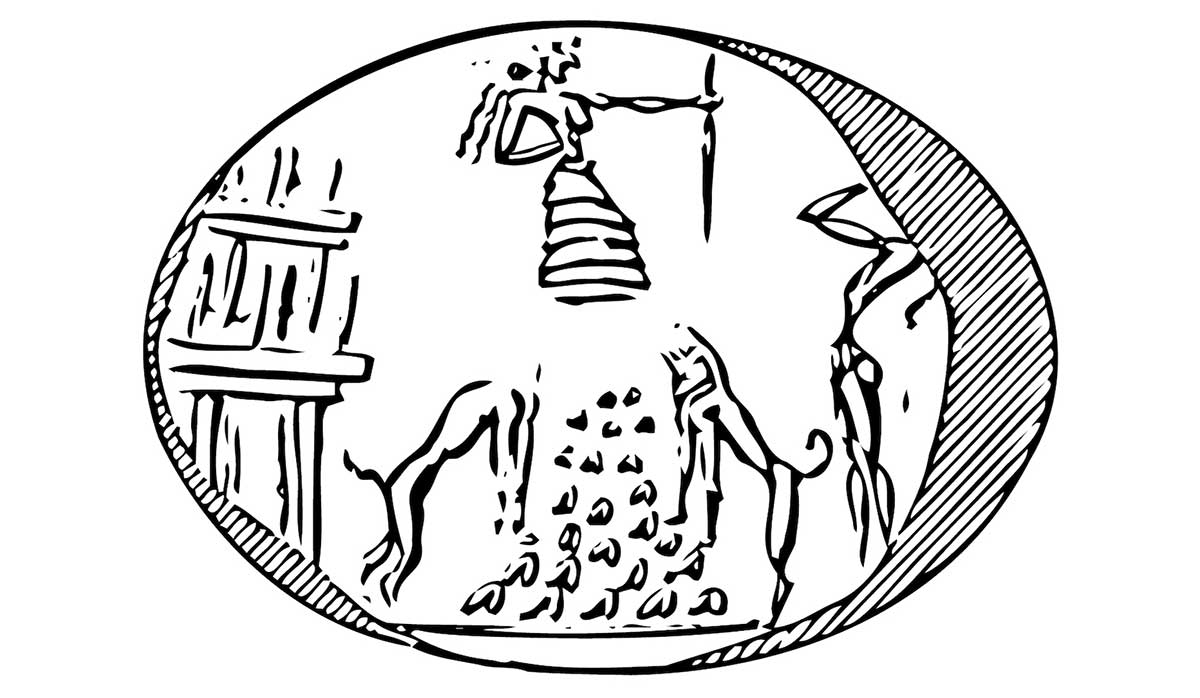
Further complications include the mythological half-sister to Artemis, Eileithyia, who was associated with childbirth, as was Artemis, despite being a virgin goddess. Most archaeologists believe she originated in Minoan Crete; her name is possibly pre-Greek, though other linguists suggest it derives from the Greek “to bring” or “to relieve.”
The name Eileithyia is frequently attested in the Linear B tablets and was associated with sacred caves, symbols of the womb, across Crete. Interestingly, the goddess was mythologically the daughter of Zeus and Hera. Eileithyia is typically present at the births of other gods, whether chronologically they make sense or not, indicating that the Greeks recognized her early presence and simply tried to fit her into their timeline as best they could.
A Domestic Deity: The Snake Goddess
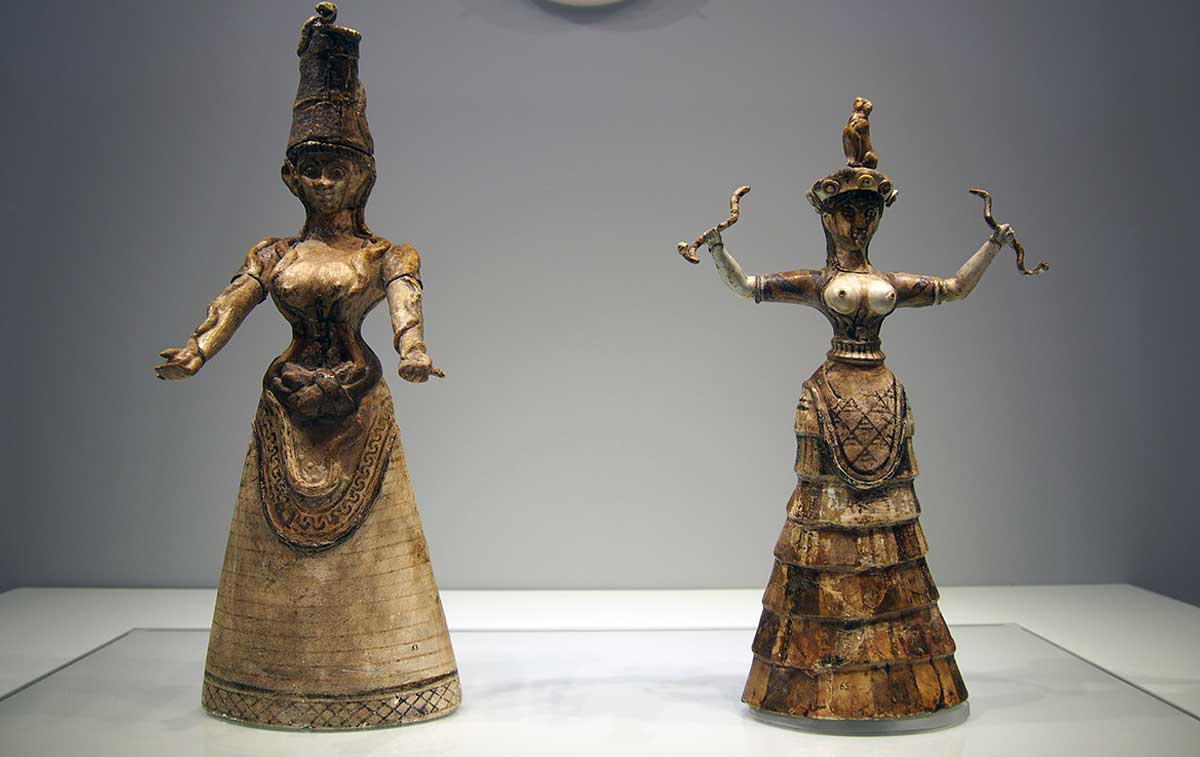
Perhaps the most famous Minoan deity is the so-called Snake Goddess, named after two statues discovered by Evans at the Palace of Knossos in 1903. The statues are partially reconstructed, and their true nature has been debated, with arguments over whether the figures hold snakes. Evans actually considered the larger statue to be a goddess and called the smaller statue the Snake Priestess.
Leaving the snake debate to one side, the Snake Goddess may also be the Mistress of the Labyrinth, inscribed as po-ti-ni-ja da-pa-rit-o-jo in Linear B texts. The connection is tenuous, but the idea is that the goddess was a household protector. Classicist Barry Powell thinks the Mistress of the Labyrinth could be Ariadne, the daughter of King Minos, who protected the hero Theseus by assisting him in slaying the Minotaur within the confines of the labyrinth.
The name Ariadne might be another pre-Greek name originating in Minoan Crete, meaning “very holy one.” This would make Ariadne originally a fertility goddess, as her statues clearly have fertility aspects, such as bare breasts. Ariadne’s relationship to fertility is not immediately clear, but Greek myth claims she was later brought to Olympus by Dionysos, the fertility god of wine, and was later worshiped with her own cult. Karl Kerenyi also believes Ariadne is connected to the goddess, holding that her name is merely an epithet and that she was the equivalent of Persephone, queen of the underworld. As a further complication, in Orphic religion, Persephone is the mother of Dionysos in his alternate form of Zagreus.
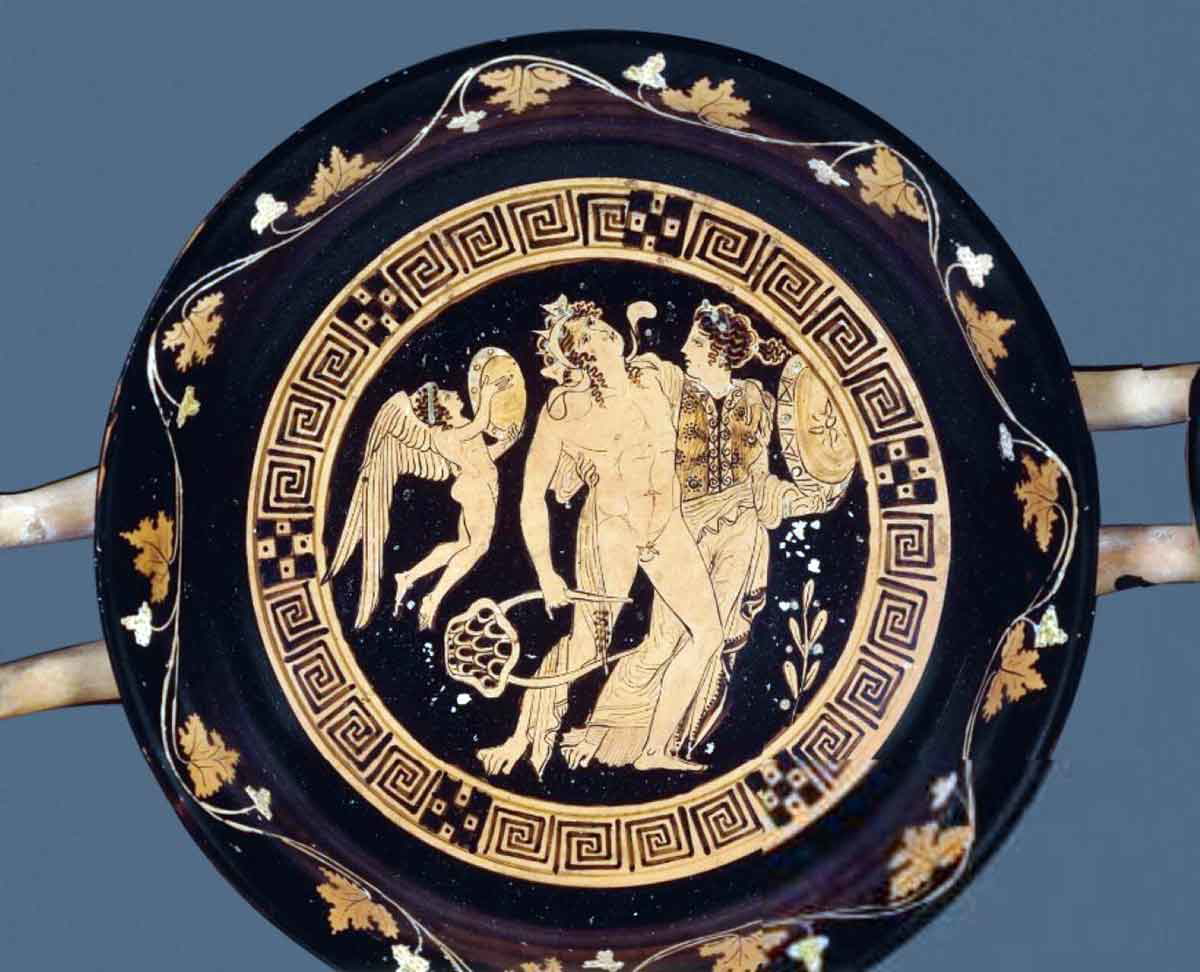
But not all scholars agree. Walter Burkert believed the Snake Goddess might have been an early form of Athena, who is attested in other Linear B tablets as po-ti-ni-ja a-ta-na, the Mistress Athena. While this deity is clearly Athena in the most general sense, whether it literally translates to “Mistress Athena” or the “Mistress of Athens” is unknown. It is most likely that Athena, the goddess, was named after the city of Athens, though exactly when is unclear. According to Greek myth, Perseus slew the Gorgon, the snake-haired Medusa, and gave her head to Athena as an offering. Perhaps this story preserves an ancient serpentine connection.
Male Gods in Minoan Crete
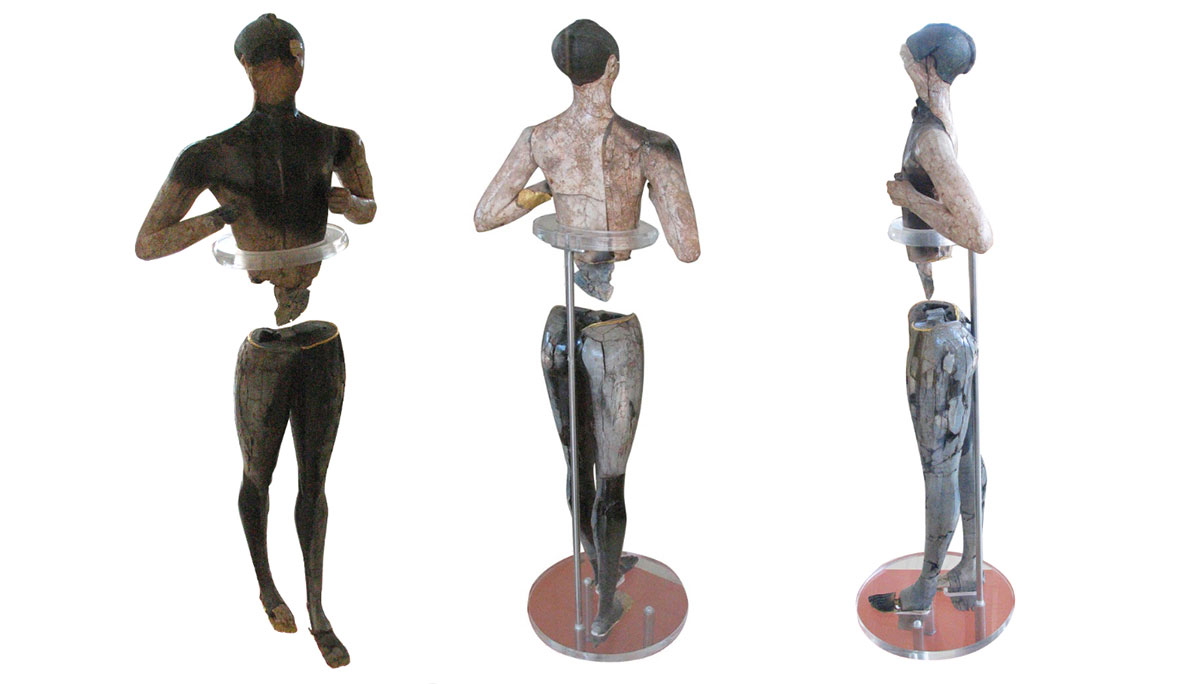
While images of male deities are far less common in Minoan art, there are some important examples, including representations of the “young god,” who reflected the role of death and rebirth of vegetation in the yearly cycle. He was united in a hieros gamos (sacred marriage) with his consort, one of the many female deities.
He may be depicted in the so-called Palaikastro Kouros. Standing about 50 cm high, it is the largest Minoan sculpture found, made from serpentine (a greenish-brown stone), ivory, and gold. The fact that it is so large, comparatively speaking, with other Minoan sculptures, and that it was made from such high-quality materials, led archaeologists to believe it represented a god, although there is no way to be sure.
Archaeologist J.A. MacGillavray noted that the statue’s pose, with hands raised to the chest, is identical to that of a Minoan seal depicting a male figure standing between the horns of consecration and flanked by griffins. It may even be an early depiction of Zeus, as the site of Palaikastro lies below a peak sanctuary where offering tables held Linear A tablets inscribed with di-ki-te, referring to the Dikti mountains, again, the birthplace of Zeus. Ancient Greek writers sometimes claimed the Minoans called the young god Velchanos, but it was also transcribed as Gelchanos and Telchanos, possibly related to the bronze man of Crete, Talos, who was defeated by the Argonauts.
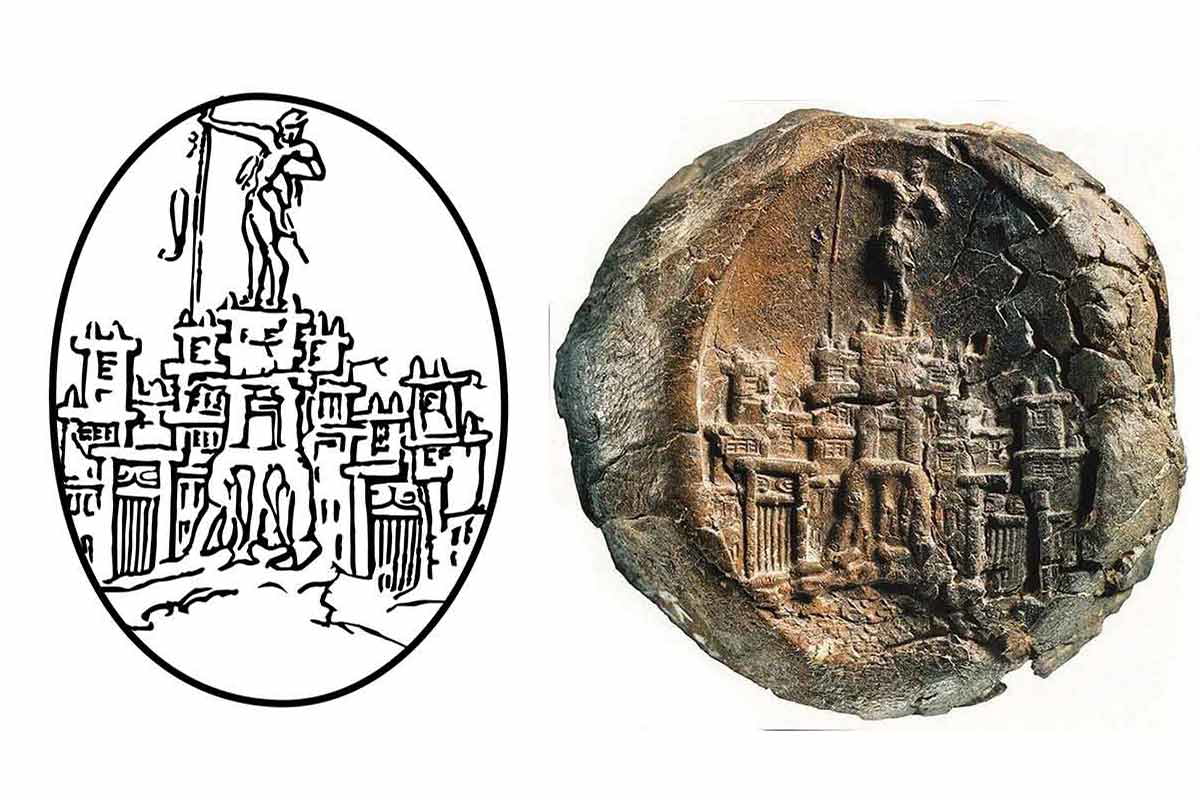
Another depiction of a male god-like figure can be found in the Master’s Impression, a seal impression on a small clay token from a now-lost Minoan ring. The image depicts a lone male figure, standing on a mountain, holding a scepter, with a city in the background. Does this represent a male god reaching out his scepter to bless the inhabitants of the city? Does it rather depict a king, lording over his town? Or does it illustrate a worshiper going up the mountain to pray to the gods, as many kings and prophets have been portrayed? It is impossible to know, but as the pose is identical to the Mistress of the Mountains impression, minus the griffins flanking the figure, many scholars argue it could be a god. However, it is just as likely a priest-king, perhaps mimicking the gesture of the goddess to ensure beneficence for his people.
Scholars face an ongoing challenge to piece together fragments of evidence to try and create a clearer picture of the spiritual beliefs that underpinned Minoan society.