
On August 15, 1944, Franco-American forces landed in the Riviera to expel German forces from southern France. They had remarkable success against weakened German units and managed to get to the German border quickly. However, their advance stalled due to a lack of supplies and contradictory orders, meaning that the operation did not prove decisive for the war effort.
Planning Dragoon
During the Second World War, Allied military planners debated the quickest way to defeat the Axis. The British hoped to strike through Italy and the Balkans, believing that such an attack would avoid the defenses of the Atlantic Wall. American and Soviet leadership opposed such an approach, arguing that a general assault on German positions in France offered the shortest way to Berlin. The numerical and material superiority of the Allies meant that both options could be taken. In 1943, Sicily was invaded, and after its seizure, the American 5th and British 8th Armies landed in mainland Italy, resulting in the fall of Mussolini.
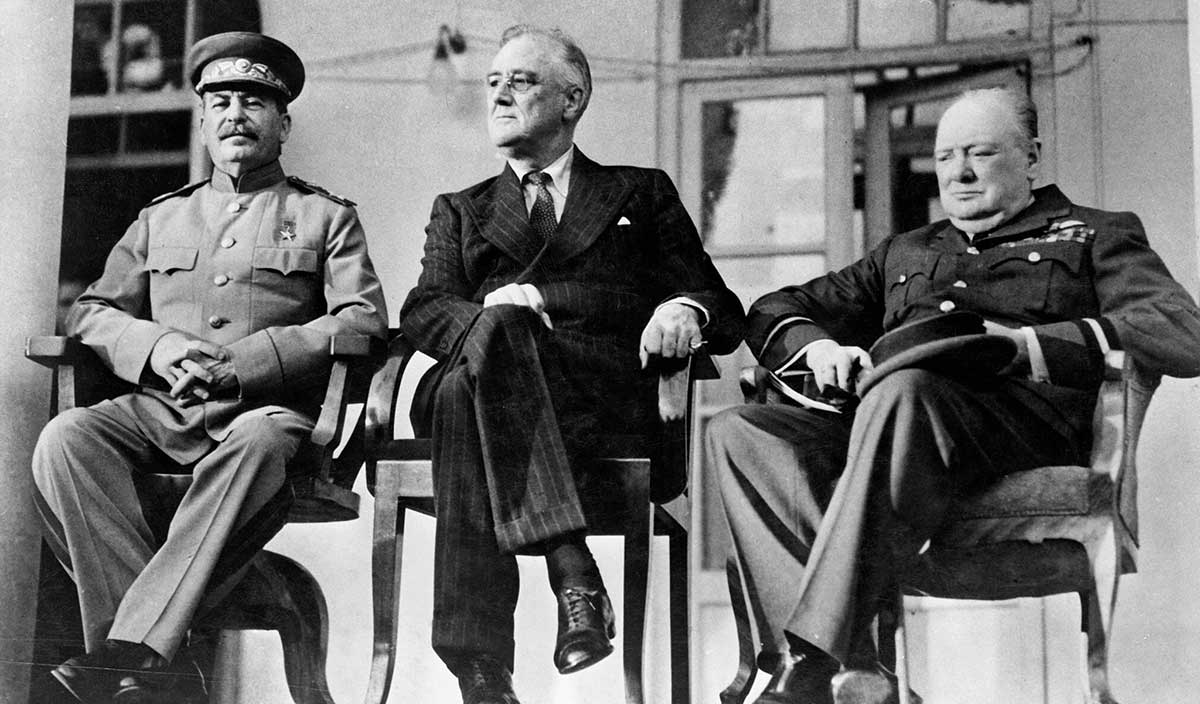
As early as 1942, Chairman of the Joint Chiefs George Marshall advocated an assault on German positions in southern France. This idea was promoted by the Americans and Soviets again at the Tehran Conference. The rationale was twofold: an assault on the Riviera could bypass the strongest defenses of the Atlantic Wall and the Soviets opposed major Allied operations in the Balkans. Winston Churchill saw it as a diversion of resources and opposed major British involvement in the operation, and British commanders were absent from planning meetings.
In Britain’s absence, Charles De Gaulle’s Free French forces took a major role in the planning of Dragoon. The main objectives of the landings in southern France were the ports of Toulon and Marseille. After both were liberated, Allied forces would drive northward and aim for the Alsace-Lorraine region and the Vosges Mountains. This offensive also reduced pressure on Allied forces involved in Operation Overlord.
Opposing Forces
By pulling available units from Italy and mobilizing reinforcements from the United States, the Allies put together a formidable force to attack southern France. The US Navy’s 8th Fleet, commanded by Vice Admiral Kent Hewitt, was the fleet assigned to land the American 7th Army under Major General Alexander Patch and the French 1st Army of Général Jean de Lattre de Tassigny. The 8th Fleet contained dozens of cruisers and destroyers, 9 escort carriers, several battleships, and thousands of landing boats.
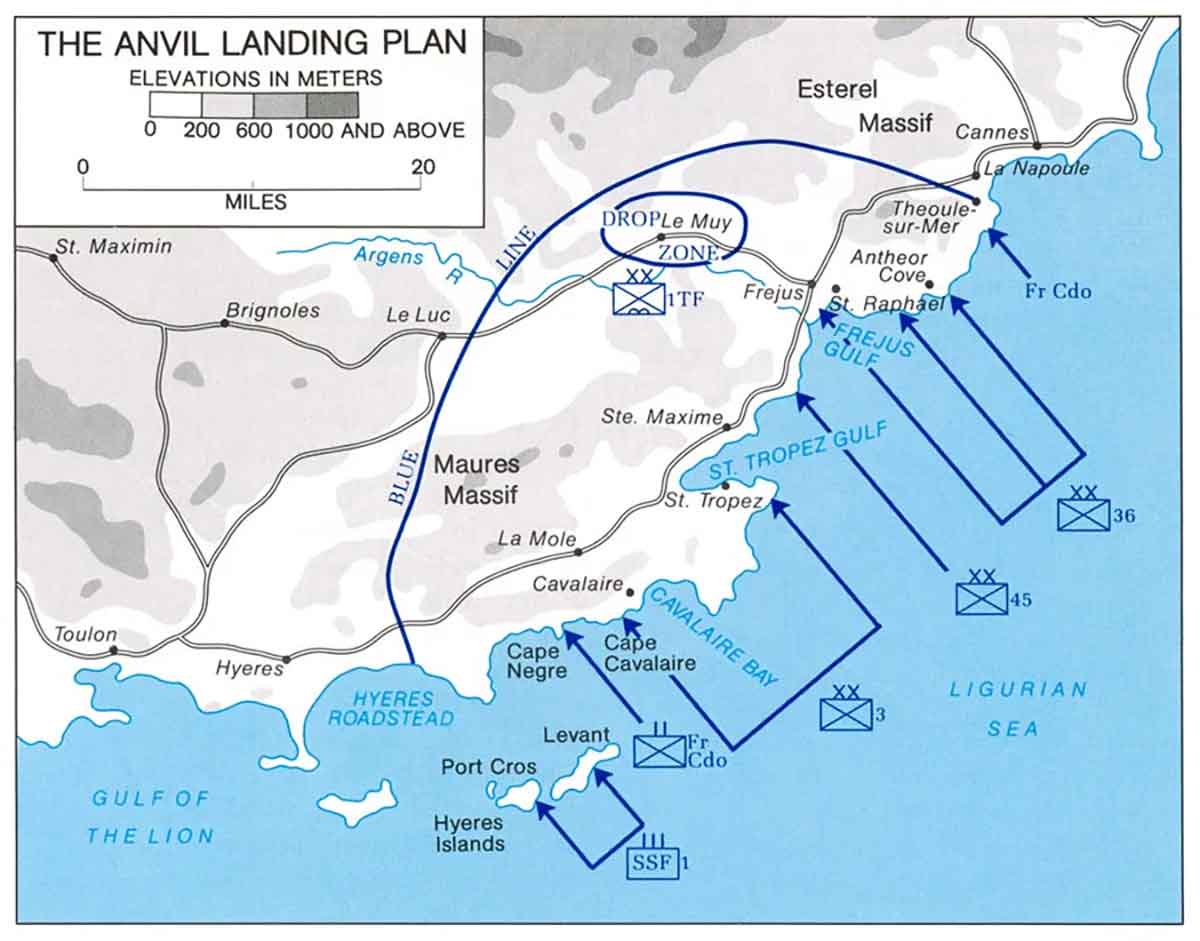
Patch’s forces would land on August 15 in the gulfs of St. Tropez and Fréjus, supported by Allied commando raids. The 3rd, 36th, and 45th Infantry Divisions served as the vanguard of this force. Preceding the landings was an airborne assault by the 517th Parachute Infantry Regiment and the British 2nd Airborne Brigade, the only British unit involved in the operation. Once the initial three divisions landed, additional Allied units were to come ashore and sustain the operational momentum.
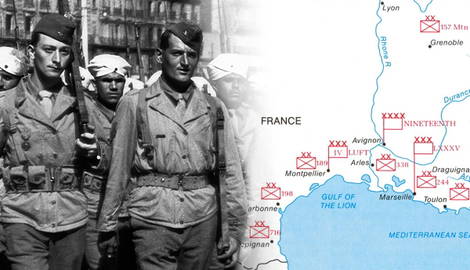
French forces in Dragoon consisted of two elements: Armée B or the First Army, and the French Forces of the Interior. The First Army initially consisted of the 1st Infantry Division, the 1st Armored Division, the 3rd Algerian Division, and the 9th Colonial Division. Other units were attached to its headquarters later on. Many of its troops were from France’s colonies; it was common to see First Army troops in traditional North African garb, and even some Vietnamese soldiers served in the First Army. They were supposed to land after the 7th Army and assault the fortifications around Marseille and Toulon. Waiting for the Allies were the French Forces of the Interior (FFI). Tens of thousands of partisans waged an insurgency against the Germans and provided vital intelligence to Allied planners. They were supported by Allied special forces, such as the American OSS and British SOE.
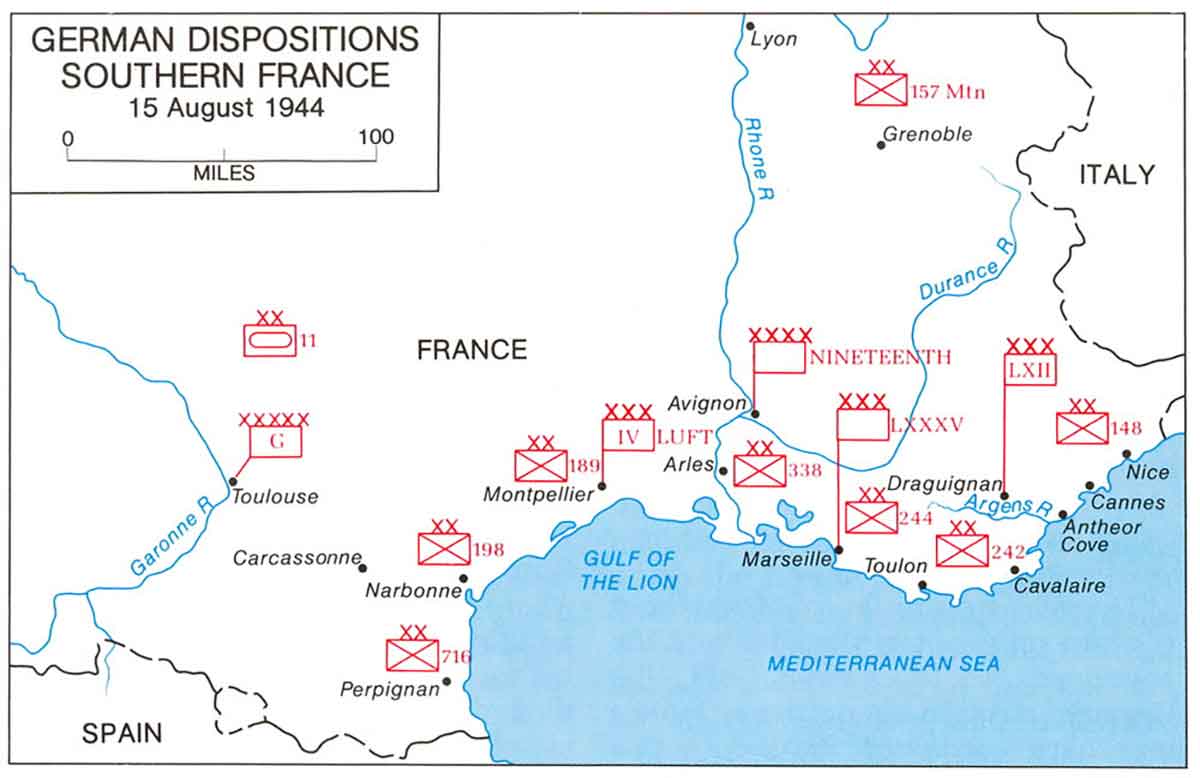
Owing to competing demands by German commanders in the Eastern Front, Normandy, and Italy, German defenses in southern France were very weak. Army Group G, under General Johannes Blaskowitz, was the dominant Wehrmacht headquarters in southern France. At its disposal was just one army, the 19th Army, under General Frederich Wiese. Several of its divisions had been sent north after the Normandy landings, rendering the command understrength.
The 19th Army had the LXII, LXIV, LXXXV Infantry Corps and the Luftwaffe IV Field Corps, along with several unattached divisions in reserve. The Luftwaffe had around 200 planes available in the region, which played a negligible role in the coming battle. Additionally, the Kriegsmarine had 45 small ships and boats in local harbors to combat the Allied fleet.
Most German divisions were understrength and composed of poorly armed and unmotivated troops. Some had battalions of conscripted Soviet and Polish POWs, others had units of men with poor health records. Only the 11th Panzer Division was considered combat capable and some of its tanks had been sent north after Overlord. Many Wehrmacht troops had only fought French Partisans and were not prepared to take on the formidable Allied forces that were going to land in their sector.
The Landings
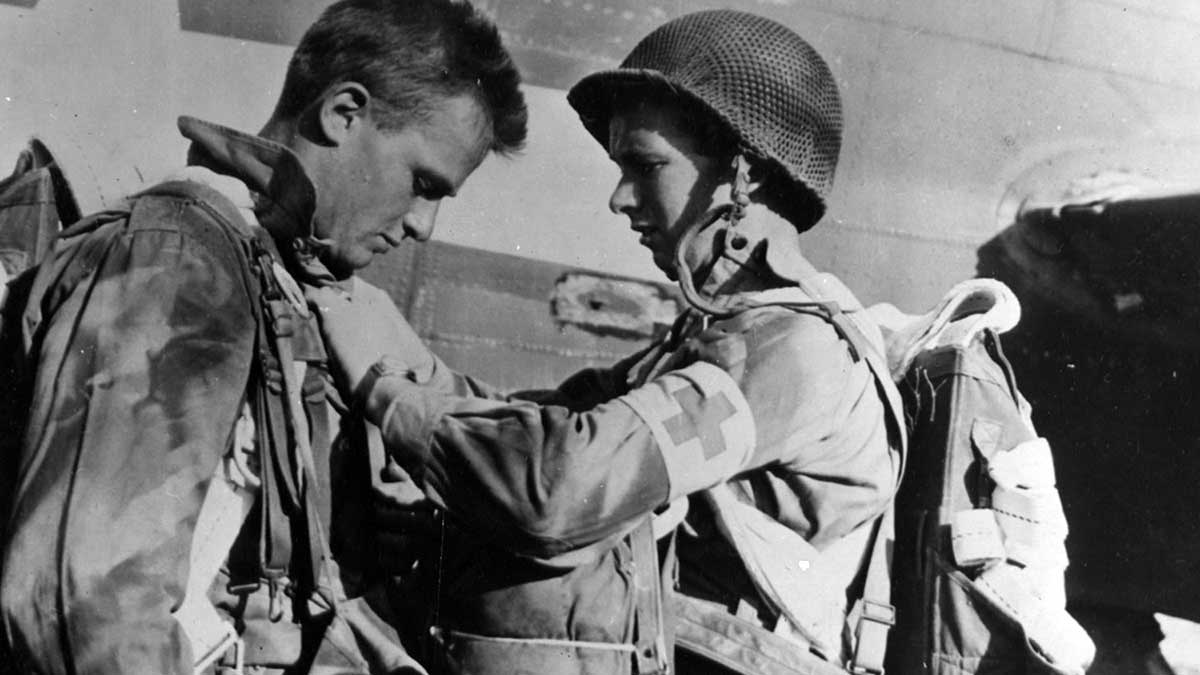
In the early hours of August 15, the 1st Airborne Task Force began dropping paratroopers over several drop zones in the vicinity of Le Muys. After the 517th PIR hit the ground and began securing its objectives, glider-borne troops began landing to reinforce the paratroopers. At the same time, British paratroopers from the 2nd Brigade dropped in adjacent drop zones to join the encirclement of the German garrison at Le Muys. A weakened Luftwaffe presence ensured that the drops went smoother than the Overlord drops. Once they began securing their objectives, they prepared to assist the 7th Army in its landing.
Heavy fog meant that many paratroopers and glider-borne troops were scattered throughout the area. However, German forces were ill-prepared for them and struggled to pin down the task force. The Wehrmacht held onto Le Muys for a night and repelled the initial Allied attacks. By the next day, the American paratroopers entered the town and began linking up with the 7th Army that was coming ashore.
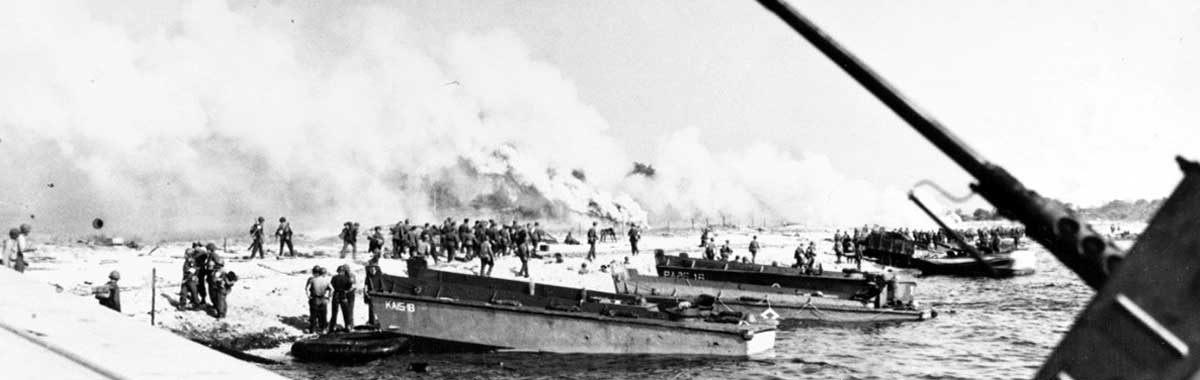
Before the main landings took place, French, Canadian, and American commandos secured the flanks of VI Corps. They neutralized several German gun emplacements and cleared some of the minefields laid by German forces. At the same time, 1,300 Allied bombers began launching major air strikes against German positions. This, combined with the 8th Fleet’s bombardment, devastated German positions opposite the landing force. The landings themselves went very smoothly and the VI Corps proceeded to assault its objectives on schedule. Fewer than 100 Allied soldiers were killed when landing on the main beaches.
General Ferdinand Neuling’s LXII Corps faced both the seaborne and airborne assaults with several ill-prepared battalions. Many German troops facing the VI Corps were composed of conscripted Soviet POWs who surrendered immediately. Neuling ordered the 148th and 189th Infantry Divisions to counterattack, however, they failed to impede the Allied advance. Once it became clear that the Wehrmacht could not hold, Hitler allowed Army Group G to withdraw north towards the German border. From then on, the Germans had to conduct a fighting withdrawal with the Allies on their tail.
Marseille and Toulon
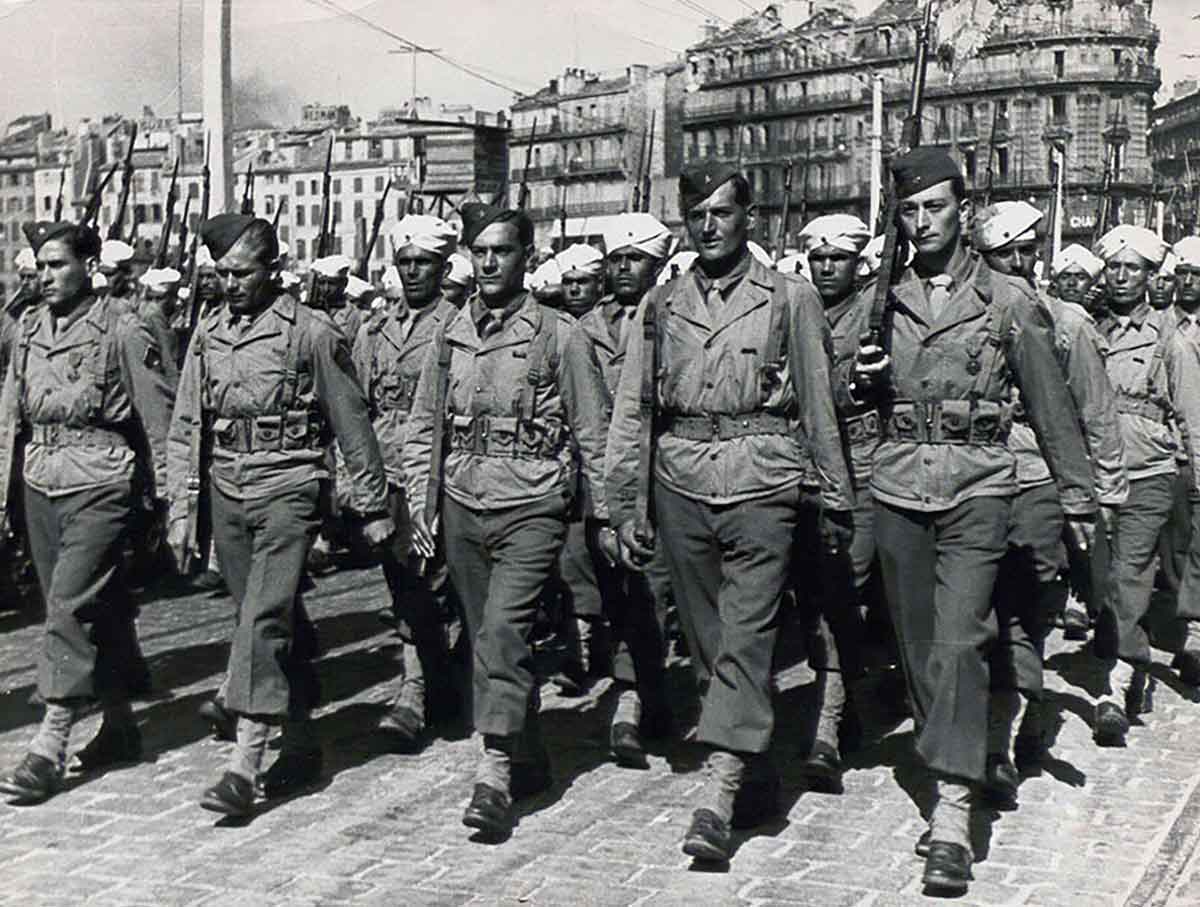
General de Lattre’s First Army moved inland immediately after landing behind the 7th Army and pushed to seize Marseille and Toulon at the same time. The 3rd Algerian Infantry Division, experienced veterans from the Italian campaign, pushed towards Marseille to link up with FFI units that had begun to attack the German garrison. Waiting in the city were General Hans Schäfer’s 244th Infantry Division and Kriegsmarine sailors. Before the French forces began to assault the city limits, German engineers destroyed much of the port facilities and several ships docked there. FFI teams tried in vain to stop the demolitions.
Heavy fighting engulfed Marseille from August 15-29. French losses here were heavy because of the intense street fighting. FFI units, including members of the French Communist resistance, helped the Algerian Tirailleurs clear many of the strongest German defenses. At the same time, the 8th Fleet forced German garrisons on the outlying islands to surrender.
In the meantime, the French 1st Infantry Division and 9th Colonial Division stormed Toulon. The Wehrmacht’s 242nd Infantry Division was ordered to hold the city for as long as possible, and it defended its positions fiercely. By August 24, the city center was taken, and on September 13th, the last German position at the naval base surrendered. The seizure of both cities was critical for the Allies to sustain their advance, and engineers worked to clear the damage from both harbors. The French performed better than expected; they expected to take at least 40 days to seize both cities.
The Allied Advance
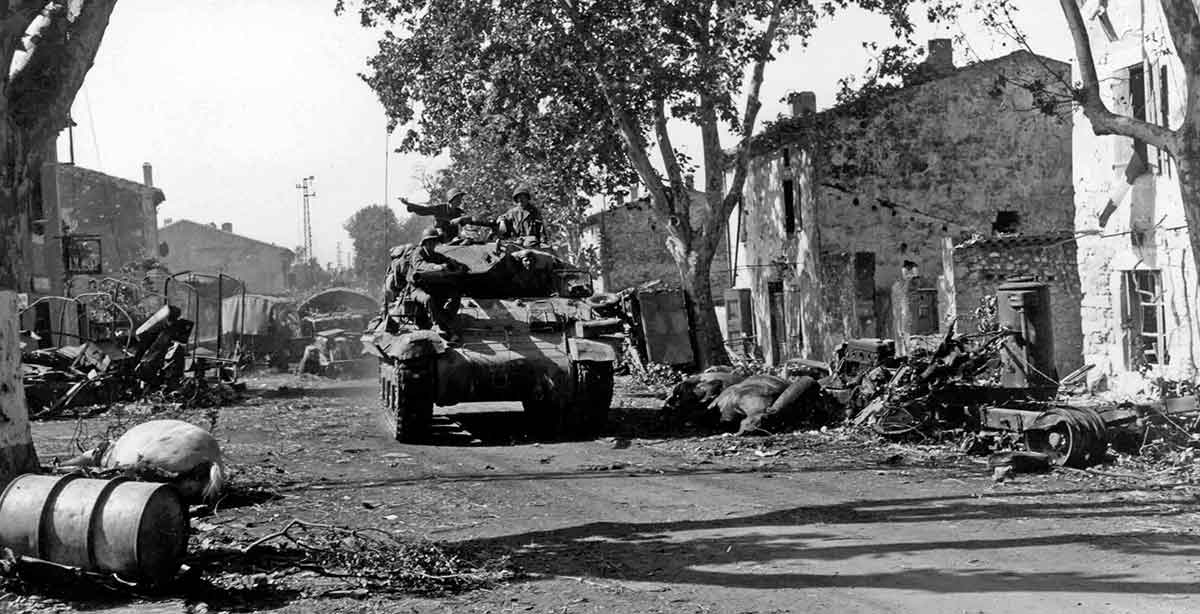
The German withdrawal from southern France was chaotic. Several Wehrmacht divisions lost large numbers of men to FFI ambushes and desertion. Only aggressive counterattacks by the 11th Panzer Division allowed for the 19th Army to withdraw without being totally destroyed. As Allied forces moved from the beaches to the Rhône River, they sought to catch the Germans as they retreated up the Rhône valley towards the German border.
Task Force Butler, the 36th Infantry Division, and several French formations moved parallel to the retreating Germans. General Lucian Truscott hoped that these forces would get ahead of the 19th Army and cut them off, leading to its destruction. TF Butler managed to reach the town of Montélimar and seized the high ground overlooking the German line of retreat. If this force could hold on until reinforced, then the Germans would be caught in a pocket and defeated in detail.
However, the Allies were slow to reinforce TF Butler, and the Germans launched several assaults to open the route. The 11th Panzer and 198th Infantry Divisions assaulted the Allied positions overlooking Montélimar and, after heavy fighting, opened the way. Even though the Allies captured the town and inflicted heavy losses, General Truscott’s plan to create a cauldron for German forces failed. In his anger, he briefly relieved the commander of the 36th Infantry Division, then reinstated him when he saw the battleground. Supply difficulties caused problems for Allied units in the vanguard of the advance. Generals de Lattre and Patch vowed to march on and catch the Germans again.
The End of the Campaign
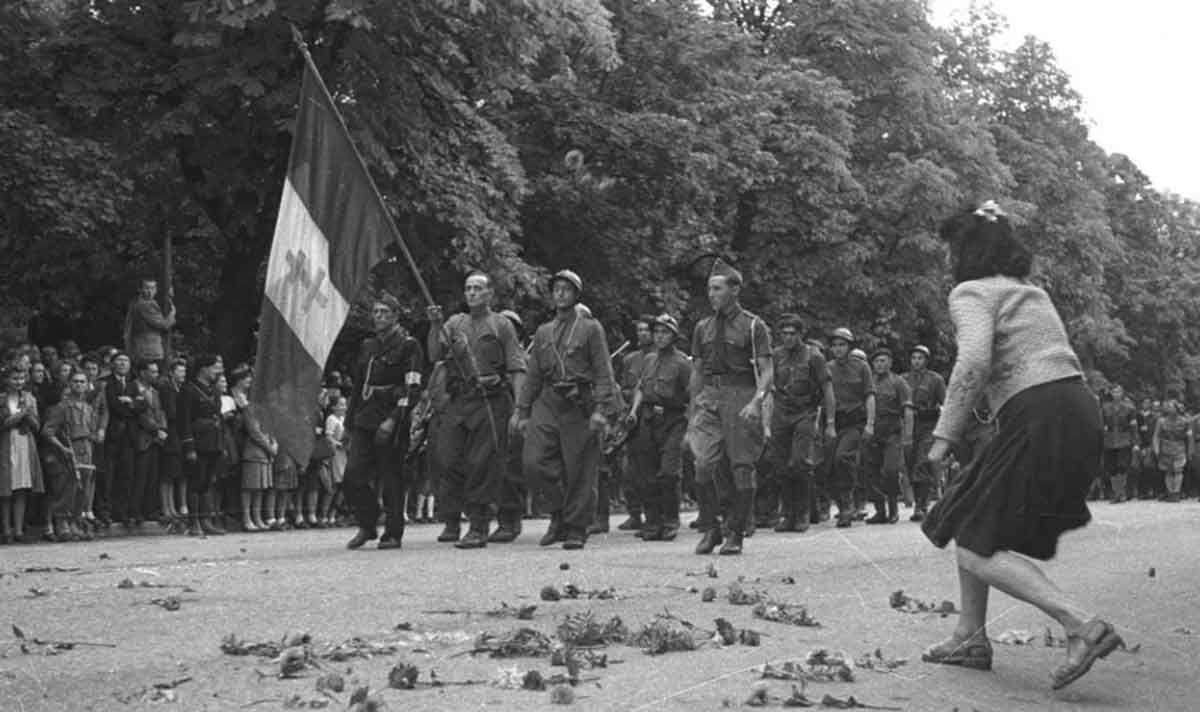
The Allies attempted to encircle the German forces again at the city of Lyon to the north of Montélimar. However, the 11th Panzer Division managed to keep the 45th Infantry Division and the French II Corps at bay while shepherding the rest of the 19th Army northwards.
At Lyon, the Allies and Axis troops found that the FFI had launched an uprising and were clashing with French collaborator units called the Milice. Lyon had been the site of gruesome German atrocities against French resistance members and the FFI took a violent revenge. Once the city was liberated, the Allies celebrated with the locals for two days before pushing northeast.
Over the next several weeks, Allied units continued to skirmish with German and Milice units. However, logistics problems and the quickness of the German retreat meant that the French and Americans were unable to encircle the Germans. By September, the 7th Army linked up with George Patton’s Third Army and turned eastward.
General Truscott hoped to enter the Belfort Gap and drive onto the Rhine River, but he was ordered to halt by Allied High Command (SHAEF). As a result, the Germans were able to regroup and set up defensive positions in the Vosges Mountains. Other units of the German 1st Army managed to escape southern France too, meaning that they lived to fight another day.
Dragoon proved wildly successful in liberating large parts of southern France. It also demonstrated the combat prowess of the French army and resistance units, who played a crucial role. However, the failure to completely annihilate the Germans meant that the Allies had to fight them again. Additionally, SHAEF’s unwillingness to allow for a push towards the Rhine meant that the campaign would continue well into 1945. Dragoon proved to be a well-managed operation but was beset by Allied hesitancy to defeat the Germans in detail.