
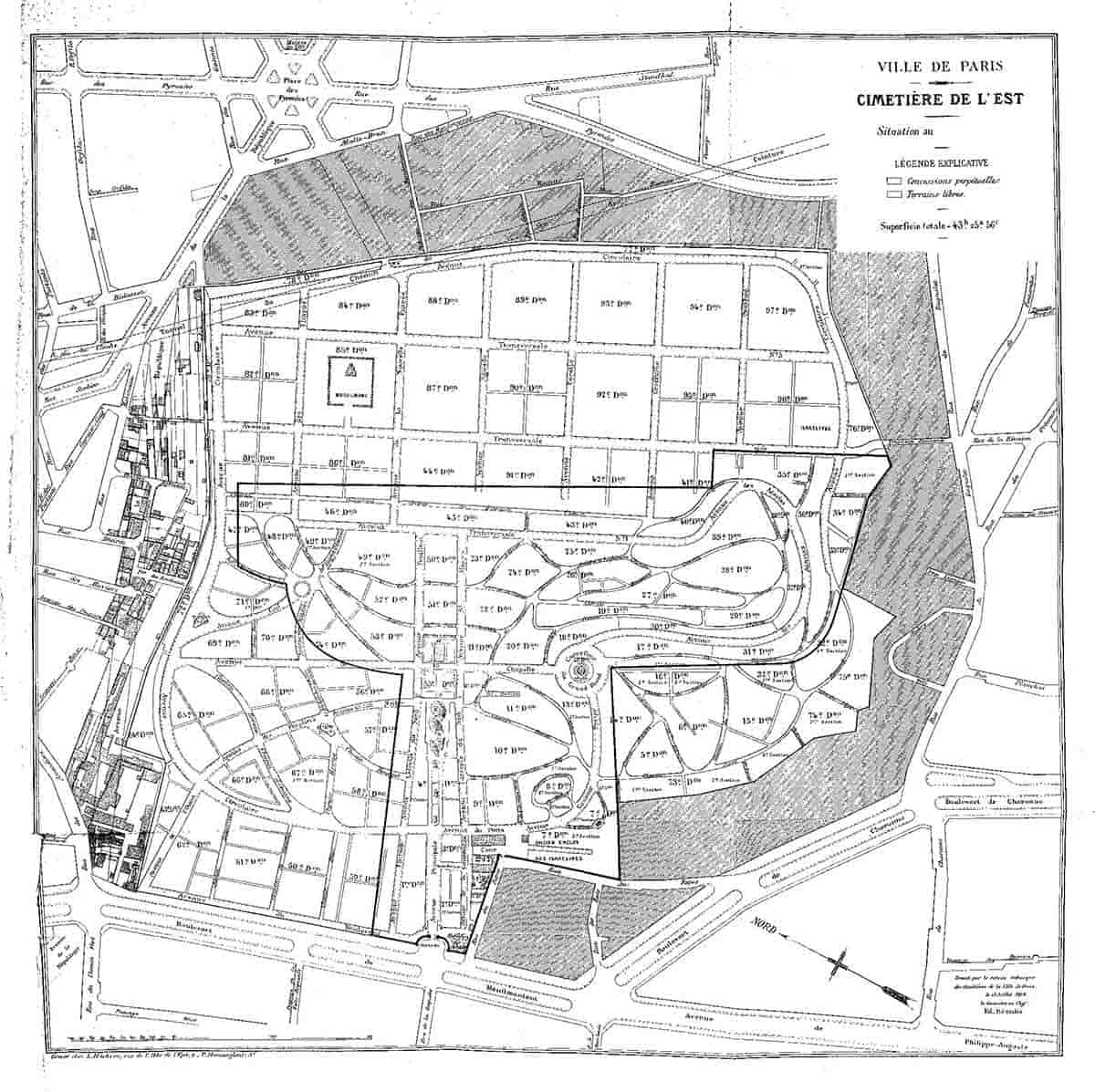
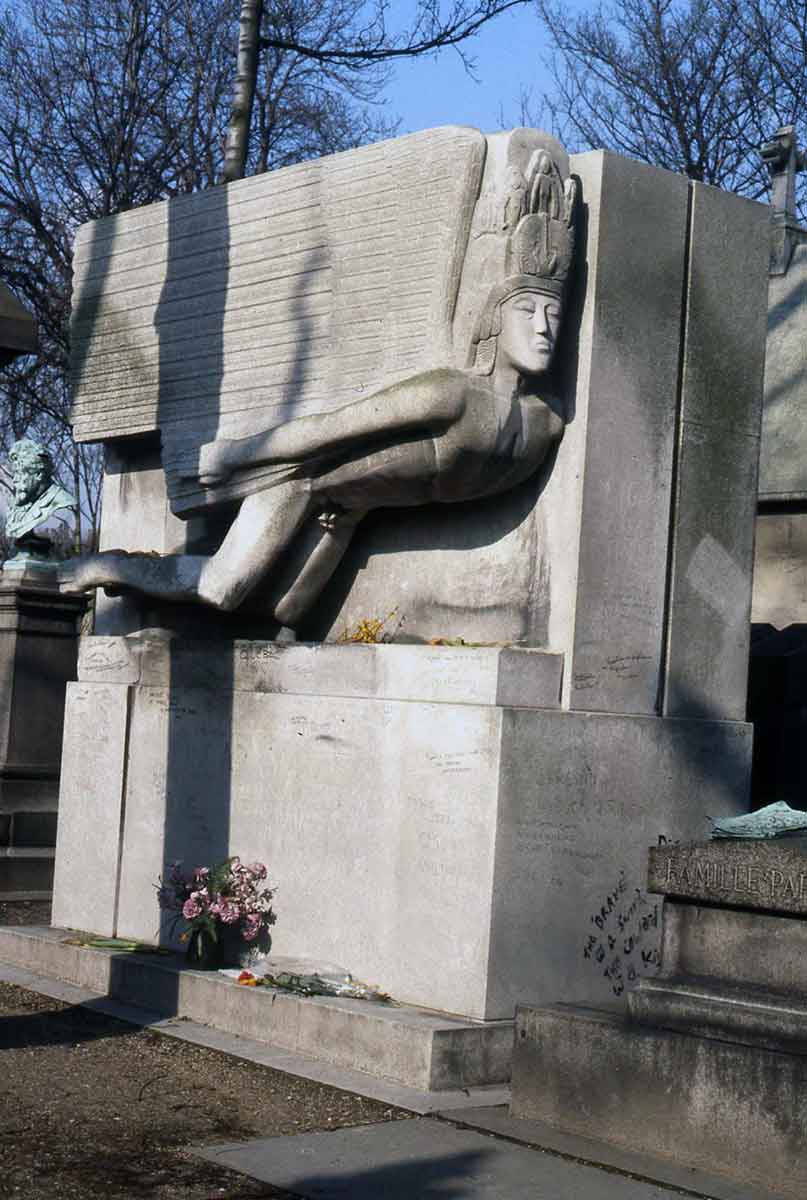
Today, Oscar Wilde’s tomb is the main attraction at Paris’s Père Lachaise cemetery, drawing crowds who, since they are no longer allowed to kiss the stone, take selfies in front of it instead as they listen to tour guides recounting Wilde’s witticisms. The discreet glass screen around the sculpture, a marble sphinx, which is one of the cemetery’s more bizarre monuments, bespeaks its checkered history. We may think of tombs as unchanging, a symbol for the silence and stillness of the grave—yet Wilde’s tomb has been anything but silent.
The Last Days of Oscar Wilde
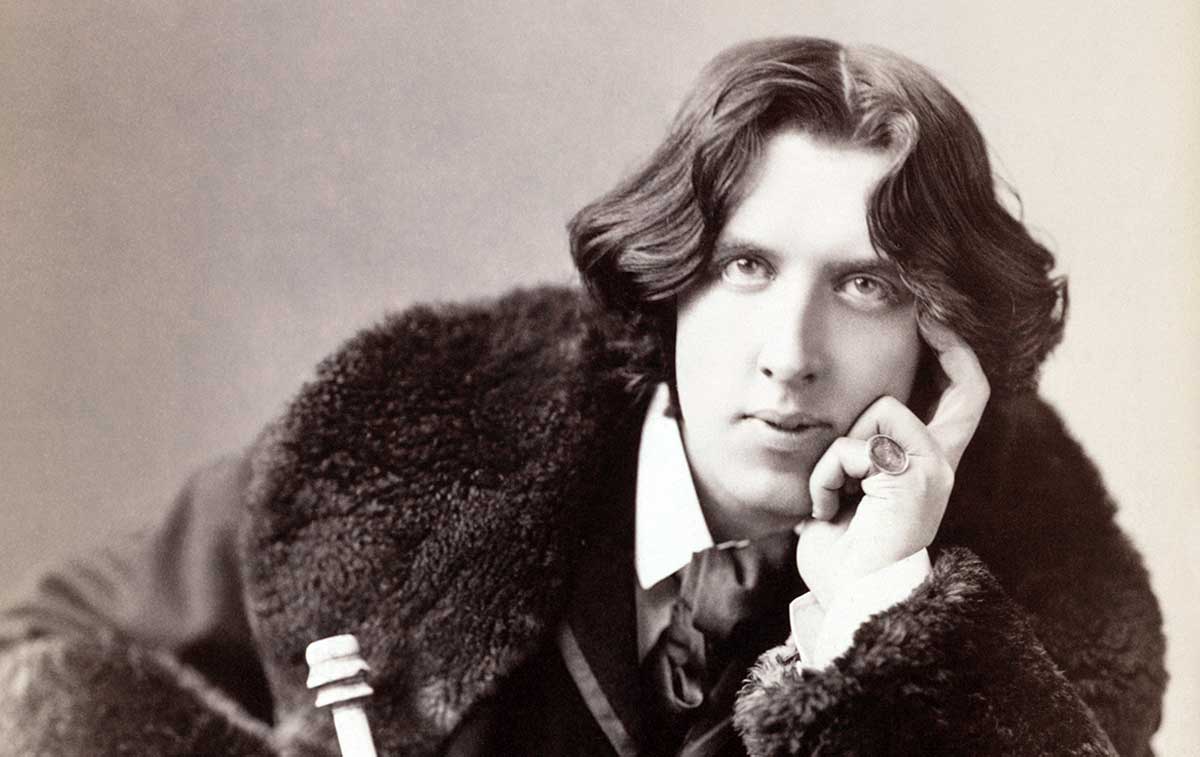
When Oscar Wilde died in Paris on November 30, 1900, aged 46, he was one of the most notorious figures in Europe. Five years earlier, in London, he had endured three highly public trials for “gross indecency” that had transformed him from a fêted playwright into a pariah.
Resisting his friends’ advice following his arrest to flee and find refuge in Paris, Wilde had taken to the stand in the Old Bailey and defended what his prosecutors called (taking a phrase from a poem by Wilde’s lover, Lord Alfred Douglas) “the love that dare not speak its name.” Sentenced to two years’ hard labor, Wilde was physically and artistically broken on his release in 1897. He spent the remainder of his life in exile on the Continent, making his way at last to the French capital, a haven where men like Wilde were not ostracized for their proclivities.
Although his supporters hoped Wilde might be moved by this kindlier, more artistic atmosphere into returning to writing—in prison, he had outlined some vague plans for future writings on aesthetics and on the life of Jesus Christ, as well as writing an epistle to Douglas now known under the title De Profundis—he found that he had “lost the joy of writing.”
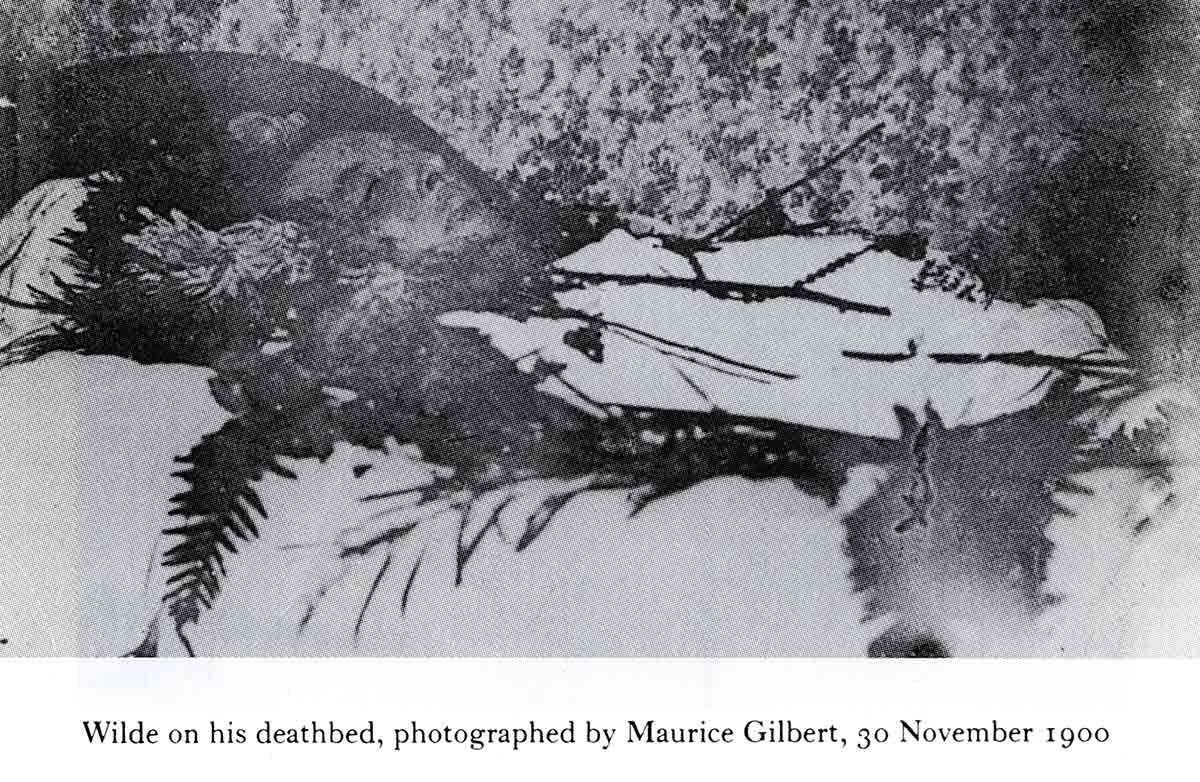
He fell ill with meningitis in late 1900 and, confined to his hotel room in Saint-Germain-des-Prés, is supposed to have uttered the last of his infamous quips: “My wallpaper and I are fighting a duel to the death. One of us has got to go.” His dutiful friend, former lover, and literary executor Robbie Ross was present when Wilde died, along with a Catholic priest who administered the last sacraments. The great outsider who, for a brief, brilliant spell, was the cream of British society was buried outside the walls of Paris in the Cimetière de Bagneux.
There, his remains lay until 1909, when Wilde’s supporters began to make plans to have them reinterred beneath a singular piece of sculpture.
Finding a Sculptor for the Tomb
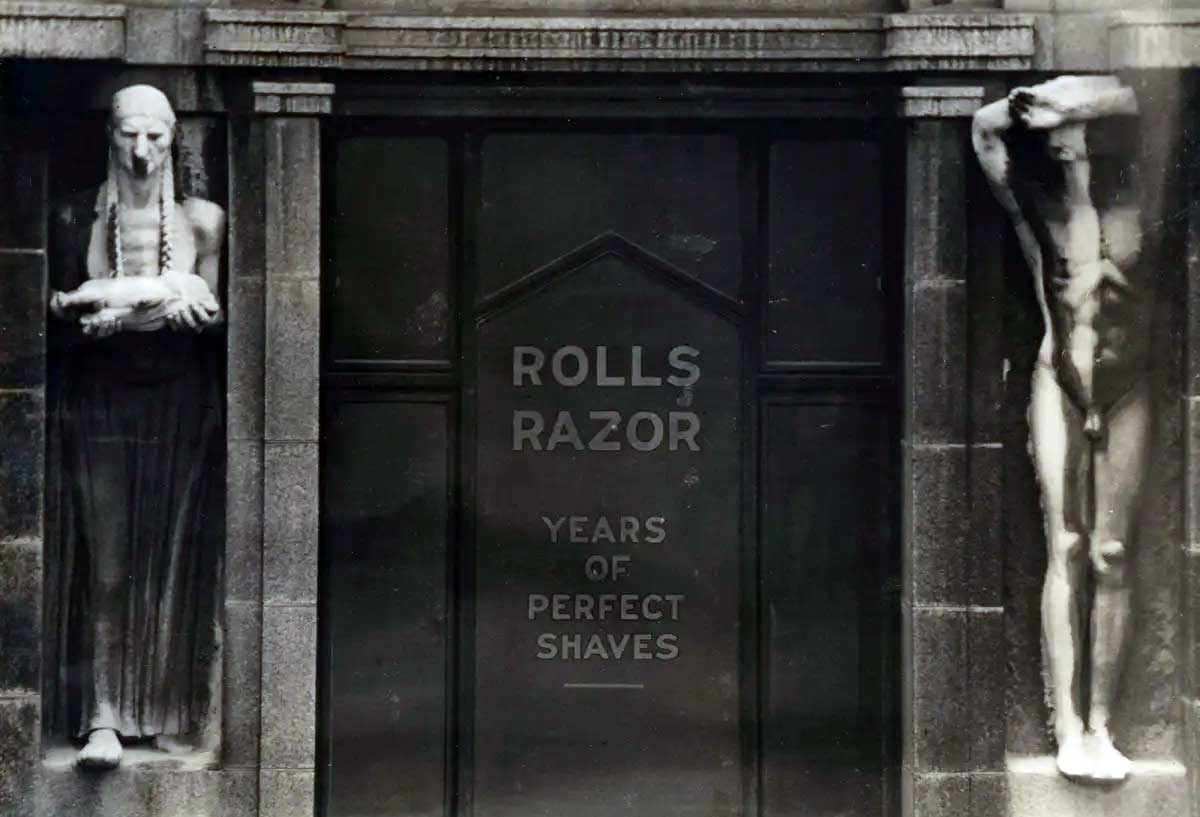
For the sculpture adorning Wilde’s final resting place in Père Lachaise, Ross chose Jacob Epstein, who would go on to produce war memorials at Coventry Cathedral and the Trade Union Congress and the bust of William Blake in Westminster Abbey.
When he got the commission from Ross, though, Epstein was in his late twenties, making a name for himself in London for revolutionizing sculpture through his avant-garde vision and apparent disregard for classical beauty. Like his peer, Eric Gill, Epstein did not shy away from representing nude bodies, often contorted in uncomfortable-looking ways. By the time Ross announced him as the sculptor of Wilde’s tomb, Epstein had already courted controversy with a series of sculptures designed to adorn the facade of the British Medical Association building on the Strand in London.
It was perhaps Epstein’s willingness to create figures, including a pregnant woman and (more importantly) male nudes, and to weather the storm that this brought upon him that made Ross select the sculptor to design and build the monument to Wilde. Like the departed playwright, the sculptor was devoted to innovating new forms in his chosen art and unafraid to face the consequences these innovations might incur.
For what was only his second commission as a sculptor, Epstein began a design based on a subject that would have pleased many of Wilde’s remaining supporters: Narcissus, a character from Greek legend who falls in love with his own reflections, and about whom Wilde had written what he called a “poem in prose.” As a handsome young man entranced by male beauty (even if it is his own), Narcissus was an iconic figure for many men who loved men in the late 19th century, especially those who, like Wilde, looked upon ancient Greece as an ideal civilization which not only tolerated, but celebrated, relationships between men.
Making the Sphinx
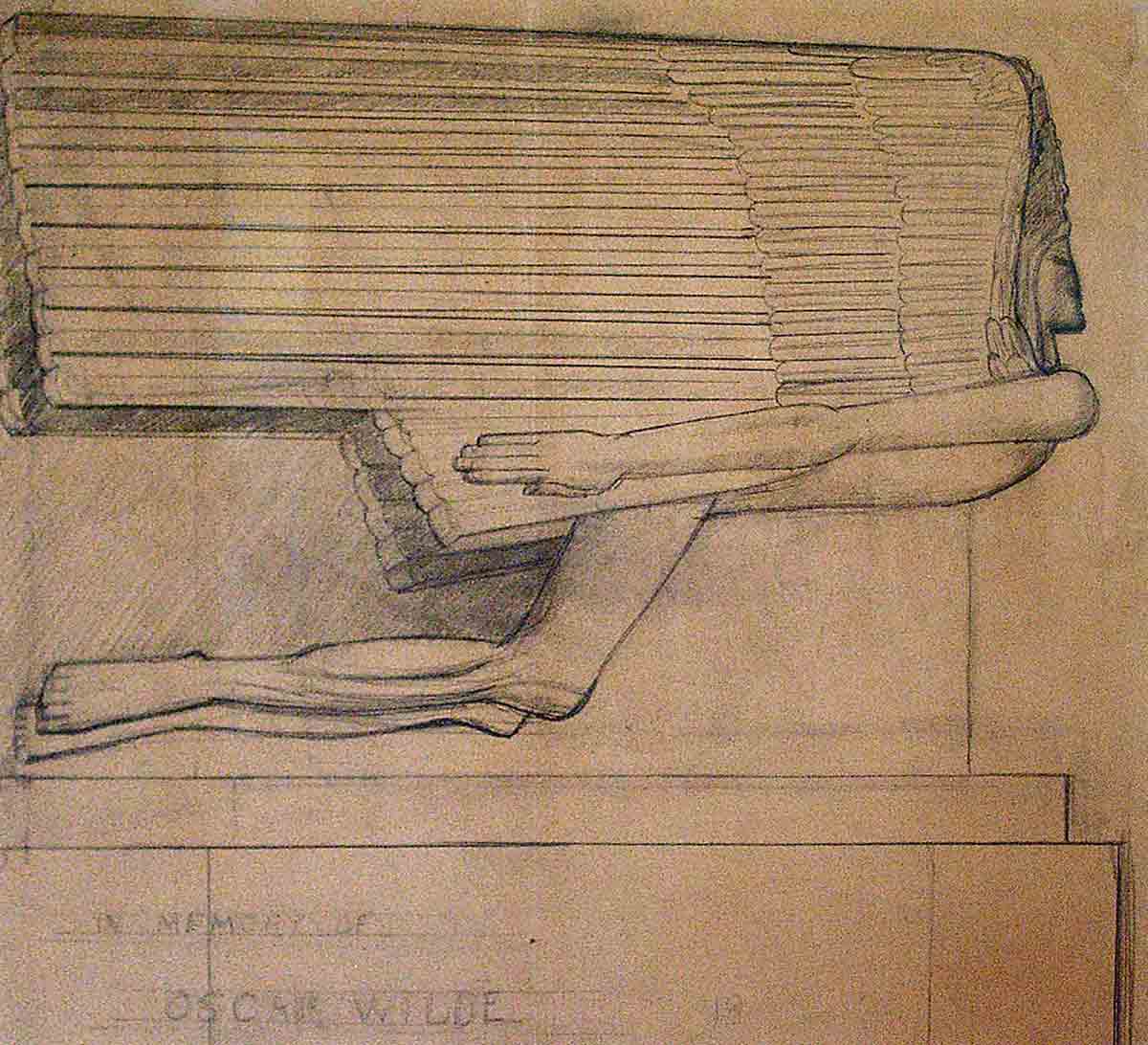
However, Epstein soon abandoned the Narcissus design, turning away from ancient Greece to favor a design influenced by ancient Egypt and Assyria. Epstein and his fellow sculptor Gill were interested in the art and sculpture of ancient Egypt as they explored a primitivist approach to their work (contemporaries such as Pablo Picasso and Amedeo Modigliani were similarly beginning to take an interest in so-called primitive art and sculpture).
Egypt was also, though, a particularly apt choice to honor Wilde, who was often seen wearing a large, Egyptian-style scarab ring and was fascinated by what he saw as a more exotic, permissive way of life in Northern Africa at this time, having traveled to Algiers with Douglas in 1895.
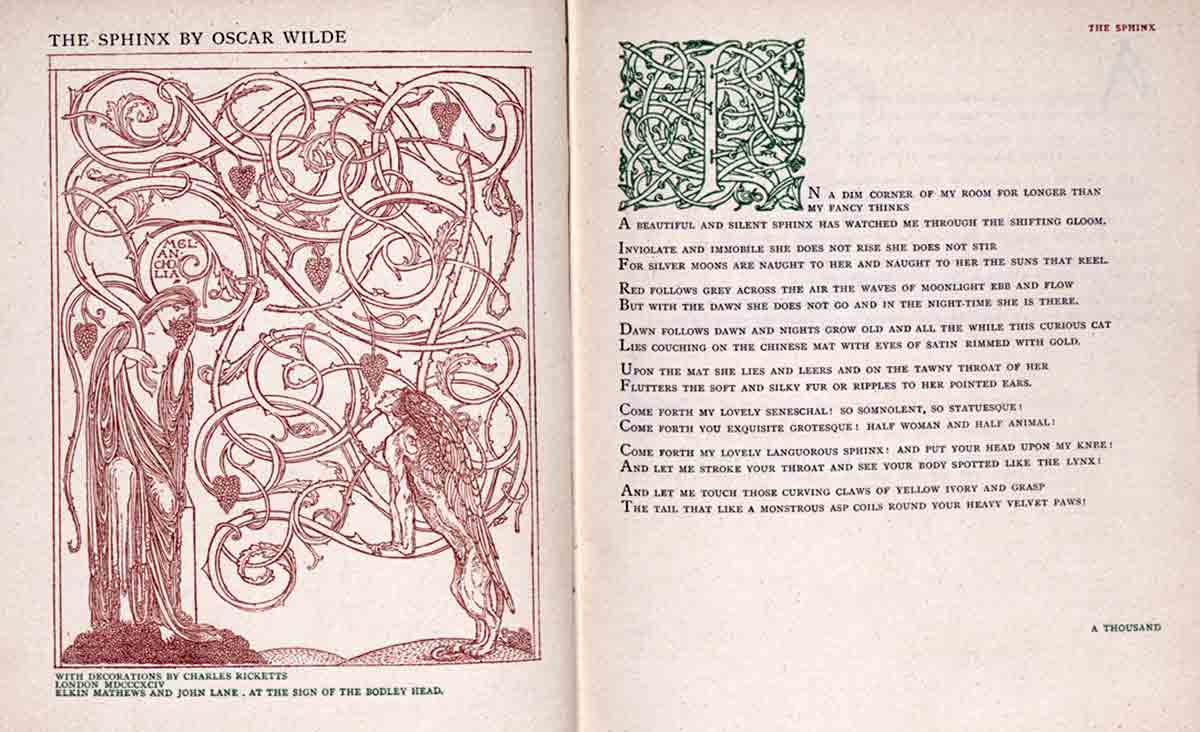
Epstein’s design for the winged figure on the tomb, which seems to lean forward like a carving of a woman on a ship’s prow, also references a poem by Wilde, written over several years and finally published in 1894, called The Sphinx. In the poem, Wilde revises the tradition of the Sphinx demanding a riddle from any passing travelers. Instead, Wilde’s speaker asks the Sphinx a series of questions, finding her silence inscrutable and frustrating. Making lurid conjectures about the Sphinx’s past, in “foul dreams of sensual life,” Wilde’s speaker muses on the Sphinx’s strange, composite body.
Although Epstein’s sketch for the monument is somewhat ambiguous on this score, the sculptor conceived of the Sphinx’s body as being made up not only of multiple species but also of male and female parts. Despite its feminine facial features and the curve of its breasts, and despite the addressee in Wilde’s poem being identified—traditionally for a Sphinx—as female, Epstein also sculpted a penis and testicles for his Sphinx.
These hermaphroditic aspects would attract attention to Wilde’s tomb before it was even installed in Père Lachaise. It was perhaps inevitable, with a bold young sculptor who had already caused outcry creating a monument to a man who had died in such disgrace that, for decades, many in England did not dare even to utter his name.
The Tomb Is Unveiled—And Soon Re-veiled
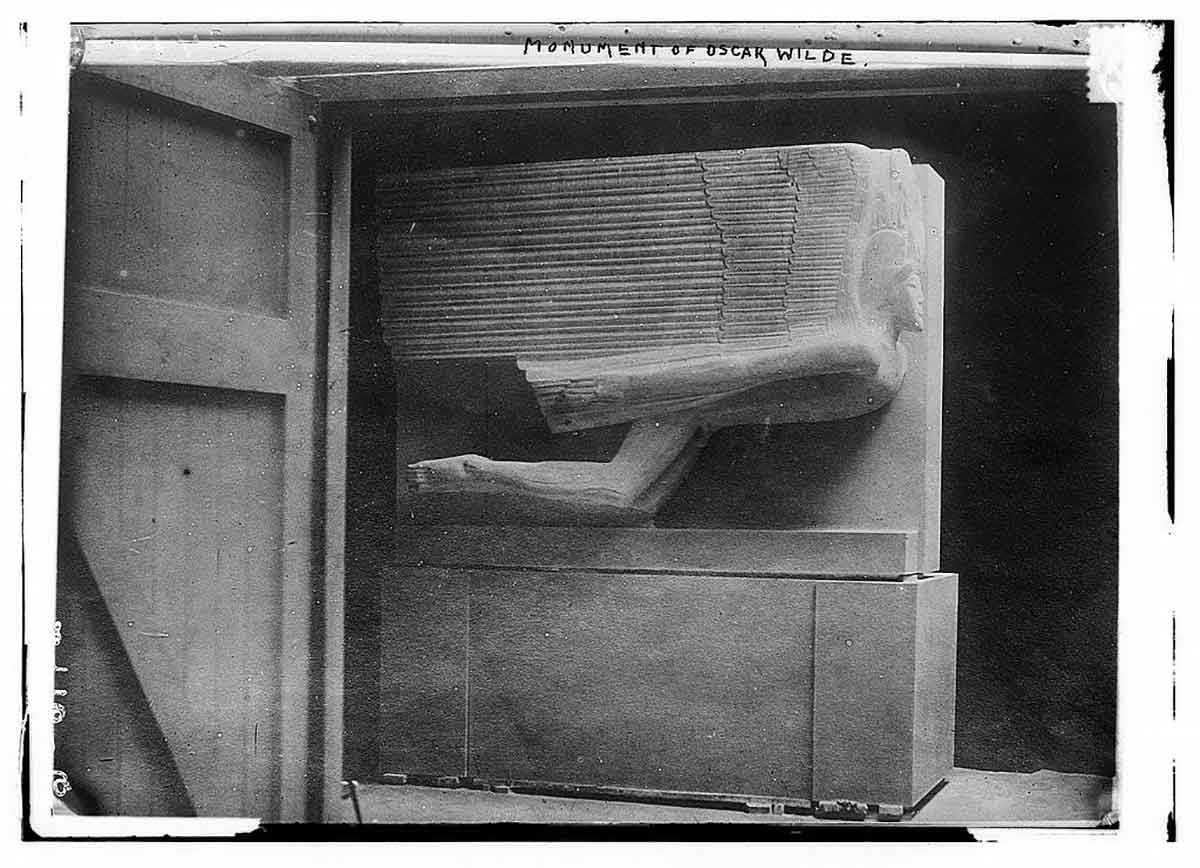
From 1909 to 1912, Epstein worked on the marble sculpture for Oscar Wilde’s tomb. Having settled on the Sphinx concept, he retained the Assyrian influences. At the same time, he tinkered with various details such as a smaller winged figure—an angel or trumpeting messenger—behind the ear of the main figure, and personifications of Fame, Intellectual Pride, and Luxury around its head.
Before transporting it to Paris, Epstein exhibited the sculpture in his London studio, and the press praised it as a great work of art. French customs officials did not agree. Refusing to recognize that Epstein’s sculpture was a piece of art and therefore worthy of a reduced import fee, they classed the Sphinx as merely a block of marble and calculated the import duty accordingly. Robbie Ross, Wilde’s executor, was forced to pay £120 just for the sculpture to enter France.
There were further troubles ahead once the sculpture arrived in Père Lachaise. Deeming the Sphinx offensive to look at because of its male appendage, Parisian authorities requested that Epstein modify the sculpture: remove the penis and testicles or cover them up somehow. In the meantime, they placed a tarpaulin over the entire monument.
A game of back-and-forth between artists and authorities followed, with Epstein removing the tarpaulin, and the officials at Père Lachaise replacing it. On occasion, Epstein was accompanied in these undercover rescue missions by Welsh artist Nina Hamnett, who was a mutual friend of Modigliani and fellow sculptor Constantin Brancusi.
Soon, the tomb was placed under constant surveillance, and Epstein resorted to bribing the officer to look away so that he might slip into the cemetery and restore his sculpture to its former glory. Not only was it being routinely covered up, but plaster had been applied to the Sphinx’s nether regions to reduce the apparent size of its testicles, which the authorities considered too large. Epstein was aghast at the modification made to his work of art—which customs officials had failed to even acknowledge as art—against his will.
The case attracted the attention of various Bohemian figures from the worlds of art, literature, and even occultism inhabiting Paris at the time.
The Tomb Is Unveiled Again—Enter Aleister Crowley
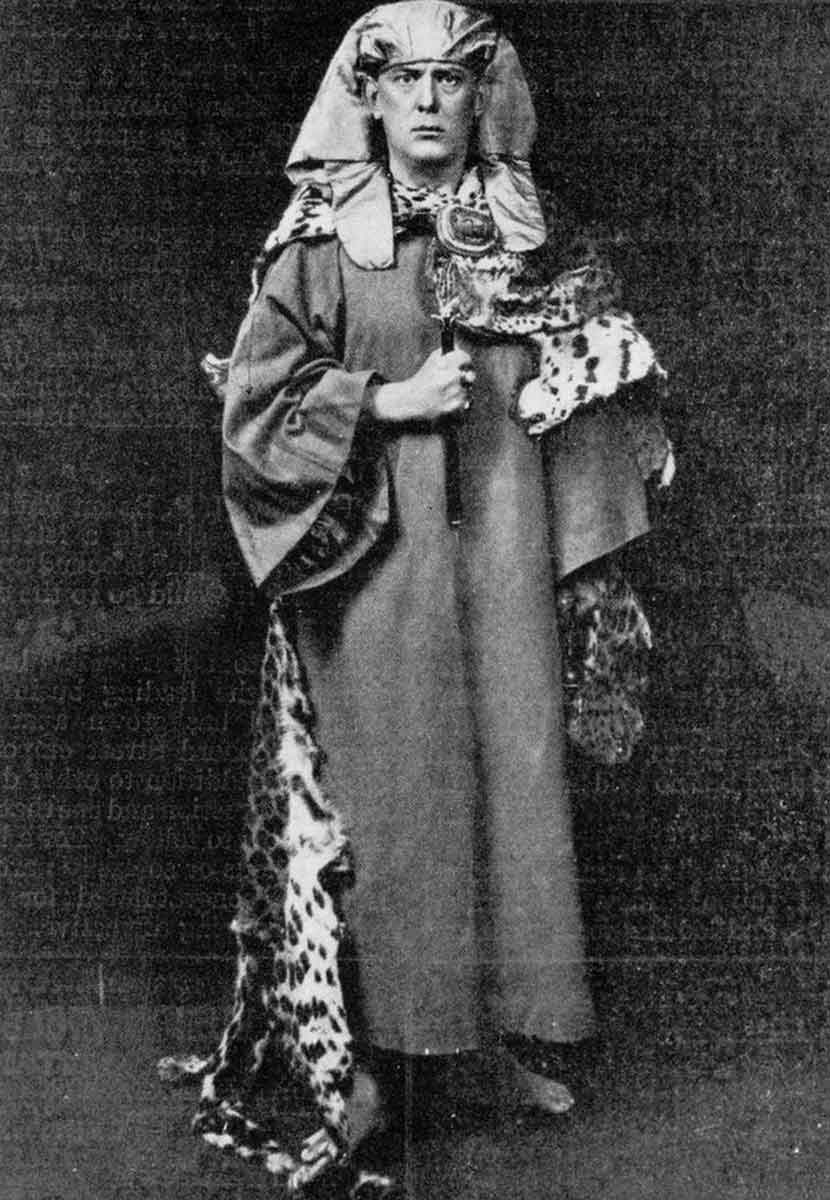
One Bohemian denizen of Paris who felt strongly about the censorship of Epstein’s sculpture was Aleister Crowley, founder of the occult league the Order of the Golden Dawn. In 1913, Crowley placed a notice in Parisian newspapers announcing his intention, “in the name of the liberty of art,” (Churton, 2022, p. 240) to rid the monument of its tarpaulin once and for all.
Calling on any sympathizers to join him in protesting “against the prudish and pornophile tyranny of the bourgeois,” (Churton, 2022, p. 241) he devised an elaborate plan to stay late at Père Lachaise the evening prior to the protest, hook up the tarpaulin with fine wires, and station an accomplice in a nearby tree, who would, while Crowley made his triumphant speech the following day, pull the tarpaulin away and unveil the sculpture in all its glory. Amazingly, the arrest that Crowley anticipated—and must have hoped for—did not take place. A crowd of supporters turned up, but the cemetery officials allowed the ceremony to go ahead.
Worst of all for Crowley, Epstein was not terribly impressed with his display of heroic anti-censorship action. A few days later, the sculptor wrote to the London Times to make it publicly known that Crowley had acted without his approval. Although he was sure Crowley and his supporters must have had a “jolly occasion” in liberating the Sphinx, Epstein himself now felt that the sculpture ought to have remained covered until the authorities agreed to have the additional plaster covering the Sphinx’s testicles removed.
The Tomb Is Altered—And Crowley Returns
What had been meant as an unerring tribute to the genius of Oscar Wilde was instead giving rise to constant squabbling and subterfuge, and by 1914, Robbie Ross recognized that the situation was untenable. Again without consulting Epstein, Ross arranged for another artist to create a bronze plaque shaped like a butterfly, which would act as a “cache-sexe,” preserving the Sphinx’s modesty.
Although this finally placated the Parisian authorities, who now permitted an official unveiling of the monument, Epstein did not attend the ceremony. Not only was his work displayed in a form fundamentally different from his intention, but there was an irony in the choice of the butterfly, as this had been the emblem of James McNeill Whistler, who had had a series of well-publicized verbal sparring matches with Wilde in the 1880s.
The tomb in its present form now seemed to tell a tale of artistic intentions which could never quite be realized due to prudery and cowardice, rather than commemorating the wit and bravery of a man who had published a volume of essays called Intentions which revealed his ability to realize his own artistic intentions exactly as he wished.
That is, until the butterfly plaque disappeared. In another attempt to épater les bourgeois and right the wrong done unto the up-and-coming genius sculptor, Crowley had struck again. He approached Epstein one day in London, wearing around his neck a bronze butterfly. Finally, the sculpture could be seen as Epstein had wished it. So the situation remained until 1961 when the Sphinx’s testicles themselves disappeared. Their whereabouts remain unknown.
In 2000, the artist Leon Johnson staged a performance at the tomb titled “(Re)membering Wilde,” which included readings of De Profundis, Wilde’s prison letter to Douglas, and the temporary attachment of a silver prosthetic to the now shattered crotch of the Sphinx.
The Afterlife of Oscar Wilde’s Tomb
By the second half of the 20th century, attitudes towards Wilde were changing. Amid the decriminalization of sex between men in Britain, his trials and imprisonment were now seen as a national outrage, and he became emblematic as a victim of state-perpetrated prejudice. Audiences rediscovered his novel The Picture of Dorian Gray, plays such as The Importance of Being Earnest, and reveled in his pithy epigrams (even those he might not have actually said).
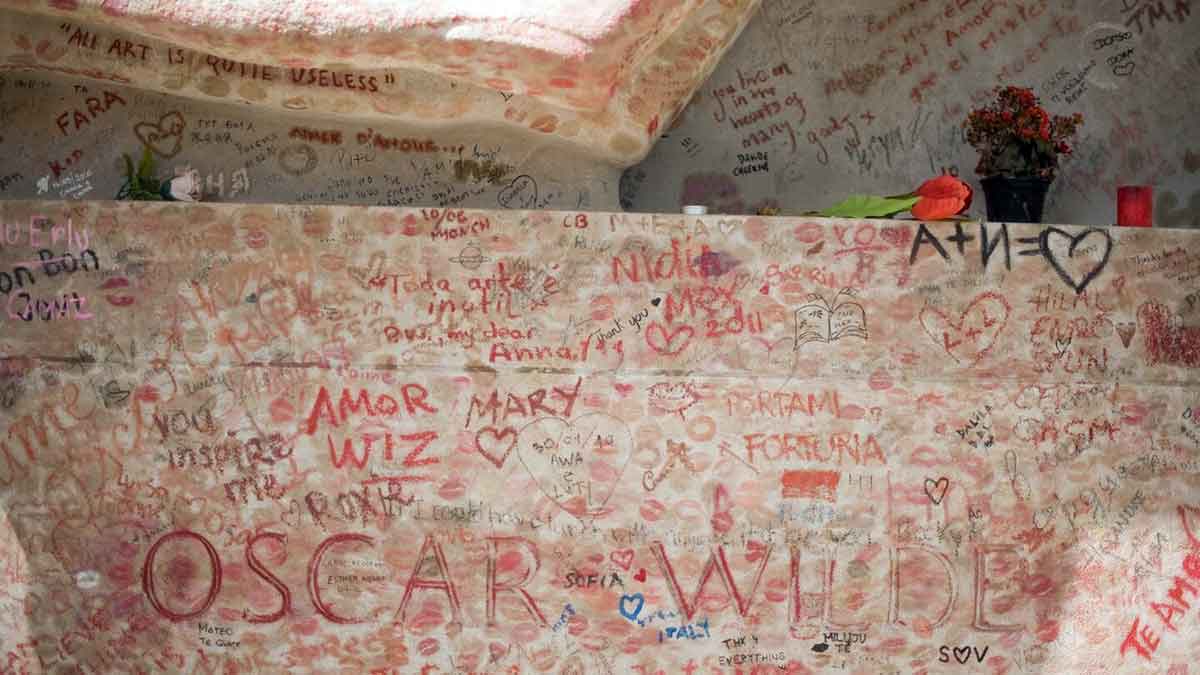
As Wilde assumed his place in the pantheon, the guardians of his tomb at Père Lachaise found themselves, yet again, having to intervene. Fans were flocking to the cemetery, leaving tributes of various kinds: flowers, handwritten notes, pages torn from editions of his books, and—most troubling for those responsible for the tomb’s upkeep—lipstick kisses.
In 2000, anticipating an influx of devotees marking the 100th anniversary of Wilde’s death, Wilde’s grandson Merlin Holland issued a public plea for the practice of kissing the tomb to stop. (By this time, Robbie Ross’s ashes had also been interred in the grave to rest with the remains of his revered friend.) Attempts to clean off the lipstick over the years were causing the stone to deteriorate, and in a final attempt to protect the tomb, in 2011, authorities installed a glass barrier around the lower half.
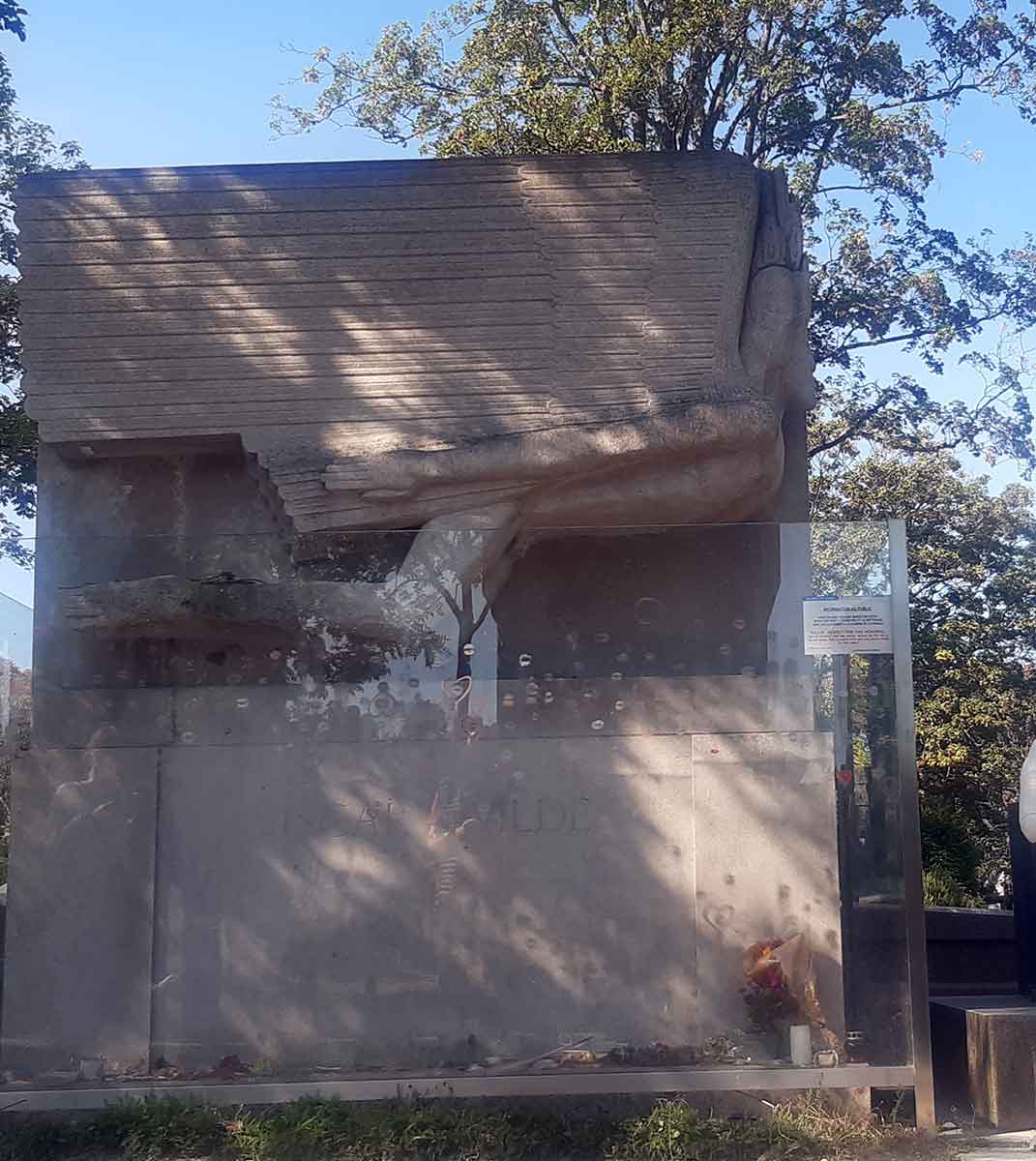
Of course, visitors remain determined to leave visible tributes, and the glass barrier is, itself, covered in lipstick kisses. These can be wiped away and replaced ad infinitum, while the stone remains untouched. This compromise seems the best conclusion to the story of this tomb, which was conceived as a definitive statement for posterity of art’s fearlessness and defiance, and which was nevertheless subject to the mundane vagaries of bureaucracy and prudishness. The tomb now represents exactly the paradox that Wilde recognized in the art of others and promoted in his own: that art may be both timeless and ever-changing at the same time.
Bibliography
Churton, Tobias (2022). Aleister Crowley in Paris: Sex, Art, and Magick in the City of Light. Inner Traditions.
Ellmann, Richard (1988). Oscar Wilde. Penguin.
Pennington, Michael (1987). An Angel for a Martyr – Jacob Epstein’s tomb for Oscar Wilde. Whitenights Press.
Rose, June (2002). Demons and Angels: A Life of Jacob Epstein. Carroll & Graf Publishers.