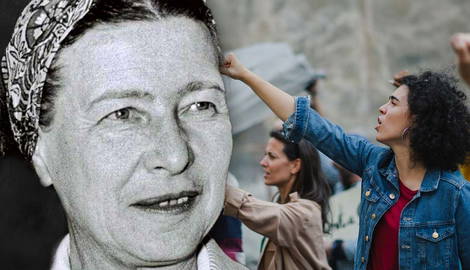

Simone de Beauvoir lived in an age when women were still actively fighting for their rights and their position in society. Apart from being a public activist, she completely changed our understanding of femininity. We mostly can see Beauvoir’s ideas in her famous work, The Second Sex. Here, she tried to show everyone that women are not a determined “type of being.” They’re shaped by the society they live in. We still live in fourth-wave feminism. And it is an era of digital activism that is not afraid to show its voice and change everything that women do not like. But does Beauvoir’s thinking have a place here?
Who Was Simone de Beauvoir?
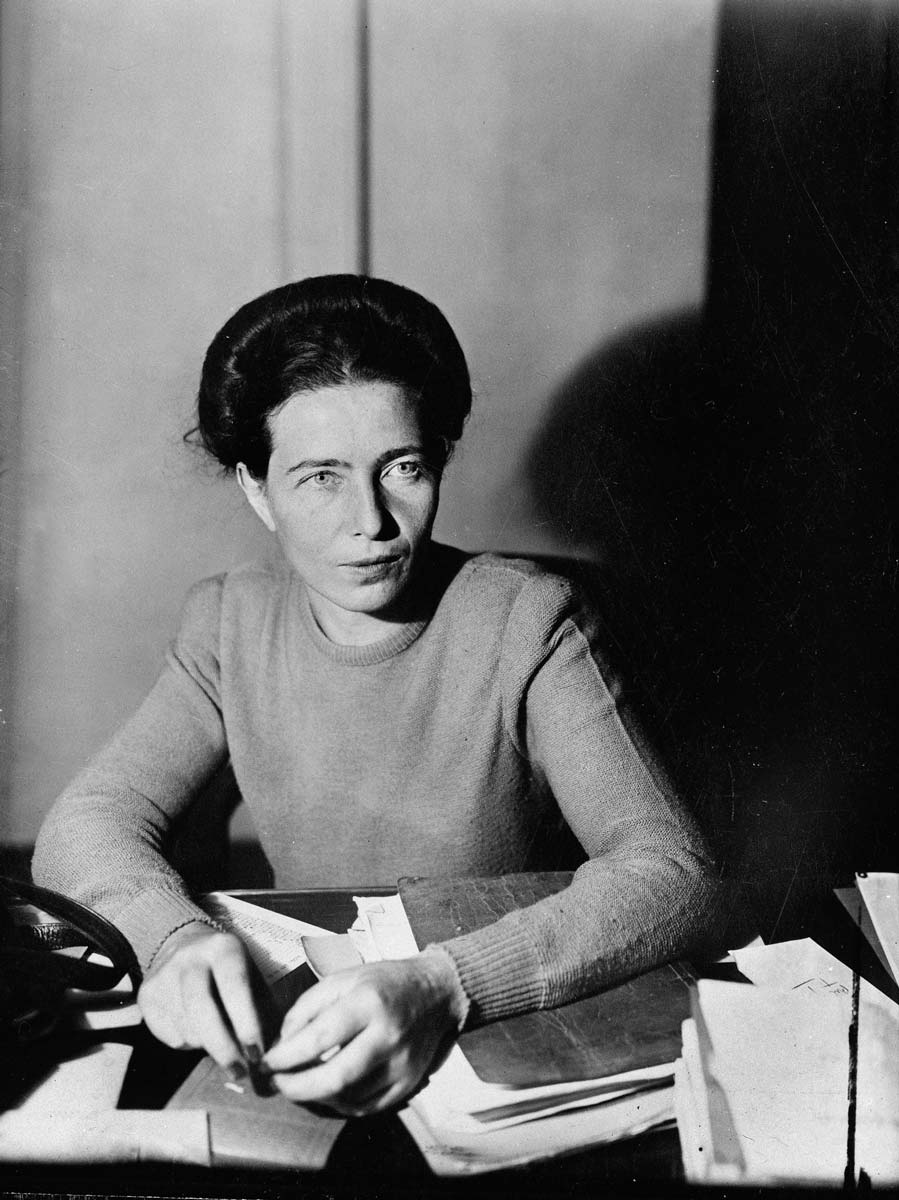
To start with, Simone de Beauvoir (1908) was born in France. Apart from being a feminist, she was a popular book author and philosopher. Her areas of interest included studies about womanhood, freedom, and humanity in all spheres, not only in relation to women.
Most of us may know her as Jean-Paul Sartre’s partner, since she spent most of her life with him. But, in fact, she created herself on her own. What is quite interesting is that she became France’s youngest graduate in philosophy from the Sorbonne.
De Beauvoir gained the greatest recognition with the publication of The Second Sex (1949). The main message we can get from this book is that girls are not born feminine. They transform into women and behave in a manner considered feminine.
Why was this book a breakthrough? Because at that time, everyone who was thinking about humans in general, about their rights and opportunities, were automatically thinking about men, not women. And that sparked a lot of discussion, particularly about the roles of men and women in society.
The Second Sex was a “hidden force” that started the women’s liberation movement in the 1960s and 1970s. And it is mainly based on existentialism.
This philosophy attracted Beauvoir since it was based on individual freedom to choose one’s roles in life. She simply changed philosophical boundaries and said that women should be the writers of their own fate.
Beauvoir was a free woman. She was pushing boundaries, all the boundaries in life. She lived like no woman in this age. She was dictating her relationships with men, politics, and philosophy. And these actions present a question for us now: “Are her works and views still relevant today?”
“One Is Not Born, but Becomes a Woman”: The Core of Beauvoir’s Philosophy

We have already touched on Simone de Beauvoir’s philosophy, but here we can dive deeper. And we can do so by analyzing her famous statement: “One is not born, but becomes a woman.”
What does this quote mean? In fact, it is simply about the fact that being female is not about biology, but about how society views and shapes you since you are born.
So, what can we say about the women of that time? They were told how to dress. They were told how to behave. They were told that men were better and wiser than they were. They were told…everything. But this is not “natural” behavior. We act as if it were due to conditioning.
Beauvoir totally disagreed with biologically essentialist feminists. The latter ones believed that behavior was programmed into boys and girls at birth.
Instead, she drew on existentialist ideas and argued that people create their own lives. They are not born with “roles.” You don’t just have a body. You are your body. And everything you experience goes into making up yourself each moment.
But what about the current fourth wave of feminism? We can say that Beauvoir’s words are very up-to-date. Gender is not fixed: it is fluid; it is non-binary; it is self-defined. No one can dominate, and you have the power to choose who you are and who you want to be.
So, this idea of being a woman is that you can choose who you want to be. It is not that nature says that you are a woman. It is because you decided so. And you can resist society if you do not like something.
Existential Freedom and the Right to Choose
As was already mentioned, existentialism was like a starting point for everything for Beauvoir. She built her philosophy around existentialist teachings, and this was not by chance. This is because she was a “fan” of freedom.
But Beauvoir believed that true freedom is not only about doing what you want when you want. It is more about taking responsibility and choosing for yourself who you want to be in life.
Still, she saw a big problem here. Women were frequently treated as if they were objects at that time. Like they do not have any rights or human will. Society viewed them like mothers, housemaids, and so on…They couldn’t be a lawyer, a doctor, or a politician. They should just follow orders.
Beauvoir said, “Stop.” Women are not objects. They are not “The Other.” They are as men, active agents of society. They have their own life story, with control over their own fates. And we can say this concept remains quite sound in fourth-wave feminism.
Women today can make choices, and they cannot live without this ability. They choose their own clothes, even if some people do not like them. They can even refuse to become mothers. And that is their right, that is totally OK.
Beauvoir’s words are still quite relevant: “Freedom cannot be bestowed; it must be achieved.” Every choice we make reflects our exercise of freedom. When any woman acts on her own, she is like following Beauvoir’s footsteps. She shows that she has the freedom to be whoever she wants.
The Digital Mirror: Visibility, Surveillance, and Liberation
Once again, Simone de Beauvoir was the greatest women’s freedom activist and feminist. And in the age of social media, Instagram hashtags, and online feminist communities, her ideas thrive. Just remember #MeToo or #TimesUp campaigns. They helped women share their stories with the world and fight injustice.
In fact, such visibility may create a new type of freedom. But Beauvoir would likely have found both delight and despair in this situation.
Yes, women are speaking up. They are not afraid to do so. But this situation shows that males are still dominating women and society. They do what they want, see females as objects—often sexual—and manipulate them with it.
From one perspective, social media allows women to speak out. And we can say even louder. But at the same time, it can be pretty judgmental. Beauvoir would want us to be aware of this.
Sure, we’re able to be seen (is that making us freer?). But maybe we’re just being watched more closely than ever before.
This philosophical question needs a detailed analysis, including from an ethical standpoint. But still, fourth-wave feminists are following Beauvoir’s lead. They are using every available digital tool to demonstrate their power and ask tough questions.
Intersectionality: What Beauvoir Missed and What Feminism Learned
Beauvoir’s The Second Sex was groundbreaking. It changed the minds of many people, even males. But it had one big con. It mainly reflected the lives of white middle-class women in Europe.
The author did not show what it means to be a black woman. She did not show how to live with disabilities or belong to the lower class. So, we cannot say for sure that her ideas were and are for all women.
This is why we need intersectionality. This term was developed by Kimberlé Crenshaw, a law professor. In simple terms, it means that people are facing lots of different types of disadvantages in their lives. This can be racism, sexism, and even ableism.
Fourth-wave feminists really liked that idea. Now, when expressing their ideas, they want to hear all the voices. For example, they want to hear from women of color, lesbians, bisexual women, and trans women. And they want to hear from disabled women since they also have their voice.
But what about Beauvoir, then? Should her framework be expanded? In fact, yes. Some believe that her ideas are quite important. They form the basis for further work. We can start with white middle-class women’s rights and then go deeper.
But others believe that we should create a new theory, completely different. And it should be based on the voices she left out.
Still, one thing is clear: feminism has developed. It is now more complicated. It includes more things. And it has a greater diversity than at any time in its history.
From Existential Angst to Collective Action: Solidarity in the Fourth Wave

As was mentioned throughout the article, Simone de Beauvoir emphasized individual freedom. Like existentialists, she said that people (in fact, women) are responsible for their lives. They have the freedom to choose who they want to be and how they want to act.
But such empowerment could bring about feelings of isolation. And fourth-wave feminists take this critique onboard. Personal freedom is quite important, but so is working together with others for change.
That is the case with global campaigns spreading across social media. Let’s analyze #MeToo. It demonstrated how the lone voice achieved justice. The same applies to other broad-based movements. These can include movements for equal pay, reproductive rights, or gender-affirming healthcare.
There is always a contradiction between “my path” and “our movement.” Beauvoir wanted women to break out of objecthood and become subjects. And fourth-wave feminism did it well. It says, “Let’s do this together.” Everyone should be involved, only if they wish.
Paulo Freire, for example, is another famous philosopher (though not a feminist) who wrote about freedom through community. And today’s fourth wave is about welcoming it.
The new feminism is about constructing bridges rather than climbing ladders. Here, freedom is not something individual. It is something collective, or even communal. And when we lift in unison, we go farther.
Is Beauvoir Still Relevant in 2025?

Even though Simone de Beauvoir wrote The Second Sex in 1949, her words are still very up-to-date. Her central idea was that it is not biology but society that shapes gender, and it is still true. She was a fighter for women’s rights, saying that women can define themselves however they want, without any male approval.
Still, there are some things that she did not predict. For example, Beauvoir couldn’t even imagine the scope of social media. Today, all the messages can move at the speed of thought.
So, if one woman shares a story of being disrespected by men, tomorrow this news can reach even the president. Social media allows us to share the truth about everything, even about authoritative figures; there are no frames.
In any case, her work provides an excellent foundation for us. Her philosophy encourages us to continue asking who we are as women.
Yes, feminism has changed. And as it has changed, so too have the discussions surrounding Beauvoir’s writing. We don’t just study her anymore. We argue with her, and expand on her thoughts.