
The Art Nouveau movement was an international style of art and architecture that celebrated natural forms and decorative excess. One of the main inspirations of Art Nouveau was American dancer Loïe Fuller, who developed a new dance style that relied not only on choreography but on stage light and set design. Read on to learn more about Art Nouveau artists inspired by dancers and their movement.
Art Nouveau and Dance
The refined style of Art Nouveau became popular in the 1890s and defined an entire cultural era with its ornate excess and a long list of inspirations. In contrast to the rigid academic standards that promoted order and harmony, Art Nouveau was loud, maximalist, and dynamic, with naturally curved lines, ornamentation, and details.
Some historians believe that the development of the Art Nouveau style, with its deliberate irrationality and free-flowing forms, was partially provoked by the philosophical ideas of Henri Bergson and his followers. Bergson opposed the overwhelming and rigid belief in rationalism and presented intuition as a legitimate form of cognition and learning. The interest in irrational forms of knowledge stimulated new forms and canon of art.
Another key influence was the growing prominence of Japanese and Egyptian art, expressed by the newly established contact with Japan and the ongoing archaeological research in Egypt. New forms and expressive categories were added to the tired Western artistic canon, calling artists to experiment with decorations and meanings.
The development of modern dance styles and practices also contributed to the movement’s growth, although more in terms of plastic language than ideology. The classical ballet dancing, which was the accepted form of dance, was deemed outdated and too limited to express the full range of human emotion. Moreover, thanks to Edgar Degas’ input, ballet dancers became associated with the Impressionist movement, which, by the turn of the century, already lost its progressive fleur and felt dated and insufficient. To inspire forms and aesthetics, Art Nouveau had to find its own form of dynamic movement.
The Transformation of Modern Dance
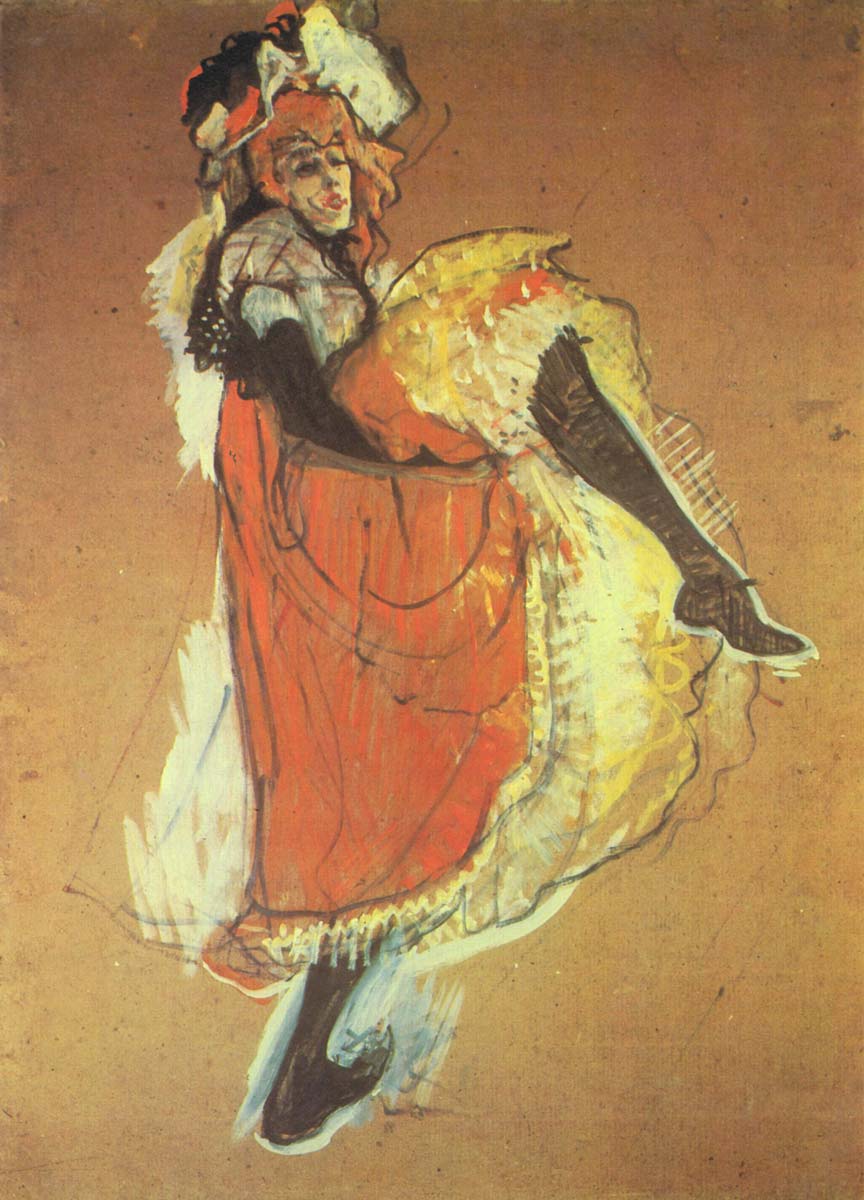
By the end of the 19th century, ballet schools served not as developers of the choreographic tradition but as rigid keepers of it. Although such schools had a dubious reputation (in Degas’ time, ballet companies were akin to elite brothels), the true artistic innovation in the domain of dance was happening in places that were even more morally questionable. Cabarets and vaudevilles, as unserious and frivolous forms of dance, were free to experiment with styles and settings. Due to the rising popularity and variety of performances, full-time dancers began to earn significant amounts of money.
One of the most scandalous and revolutionary forms of dance was can-can, an energetic dance that was based on high kicks and acrobatic elements, accompanied by the movement of multi-layered heavy skirts. These skirts, as well as the undergarments (or lack thereof) under them, created an erotic sensation and also added visual complexity to otherwise unsophisticated movements.
The idea of manipulating not only the dancer’s body but their costume was further developed in the so-called skirt dances—routines performed in long layered skirts. Dancers would move the skirt layers to make the fabric move with their bodies, creating a dynamic effect. These curved swirling lines would be adapted by Art Nouveau artists thanks to the involvement of one particular dancer named Loïe Fuller.
Who Was Loïe Fuller, the Dancing Muse of Art Nouveau?
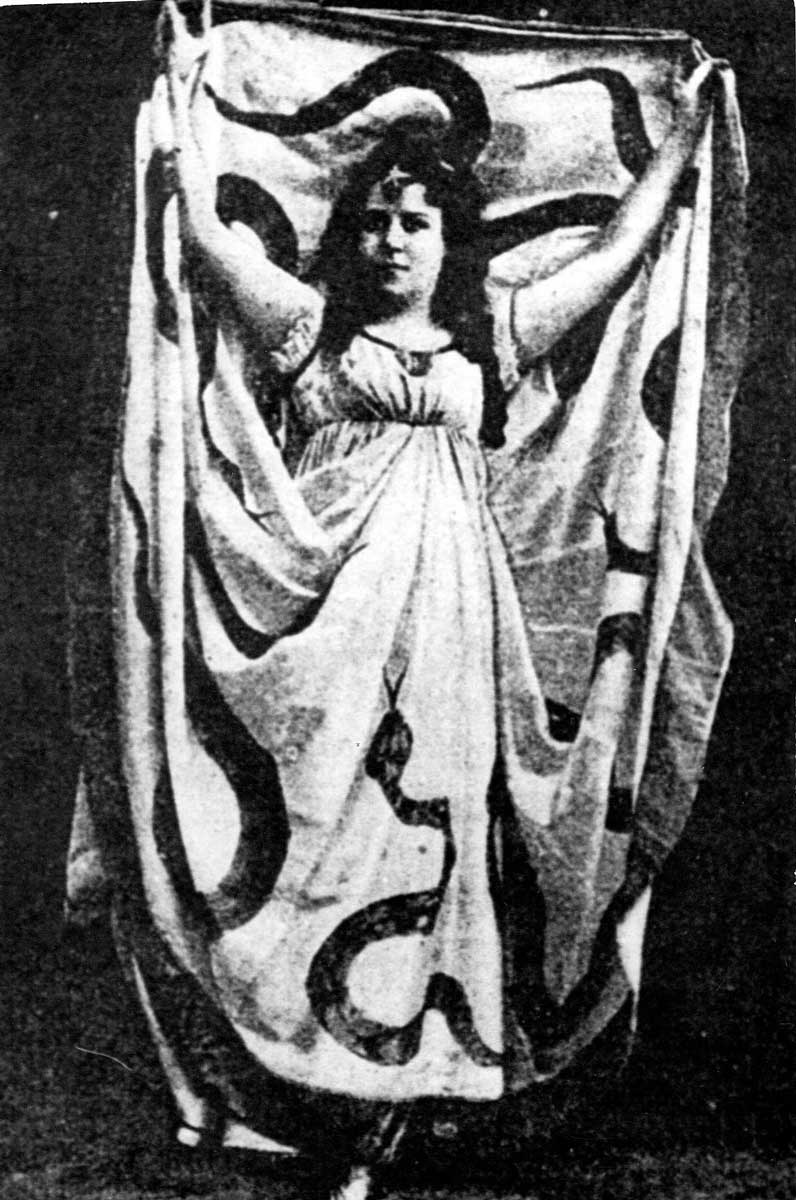
Loïe Fuller was born in the Chicago suburbs in 1862 and began performing at the age of 4. Her childhood consisted of endless rehearsals, performances, and tours, earning her a name at quite an early age. However, as Fuller grew up, she realized she had ambitions for her own production and moved to London to stage a play. Ultimately, the project failed, and Fuller had to take a regular dancer’s job at a local skirt dance theater. Her encounter with this specific type of dance shaped her entire career and made her one of the most famous performers of her era. Fuller’s career lasted for more than thirty years, with her accomplishments including not just performing but running a dance school and ballet company.
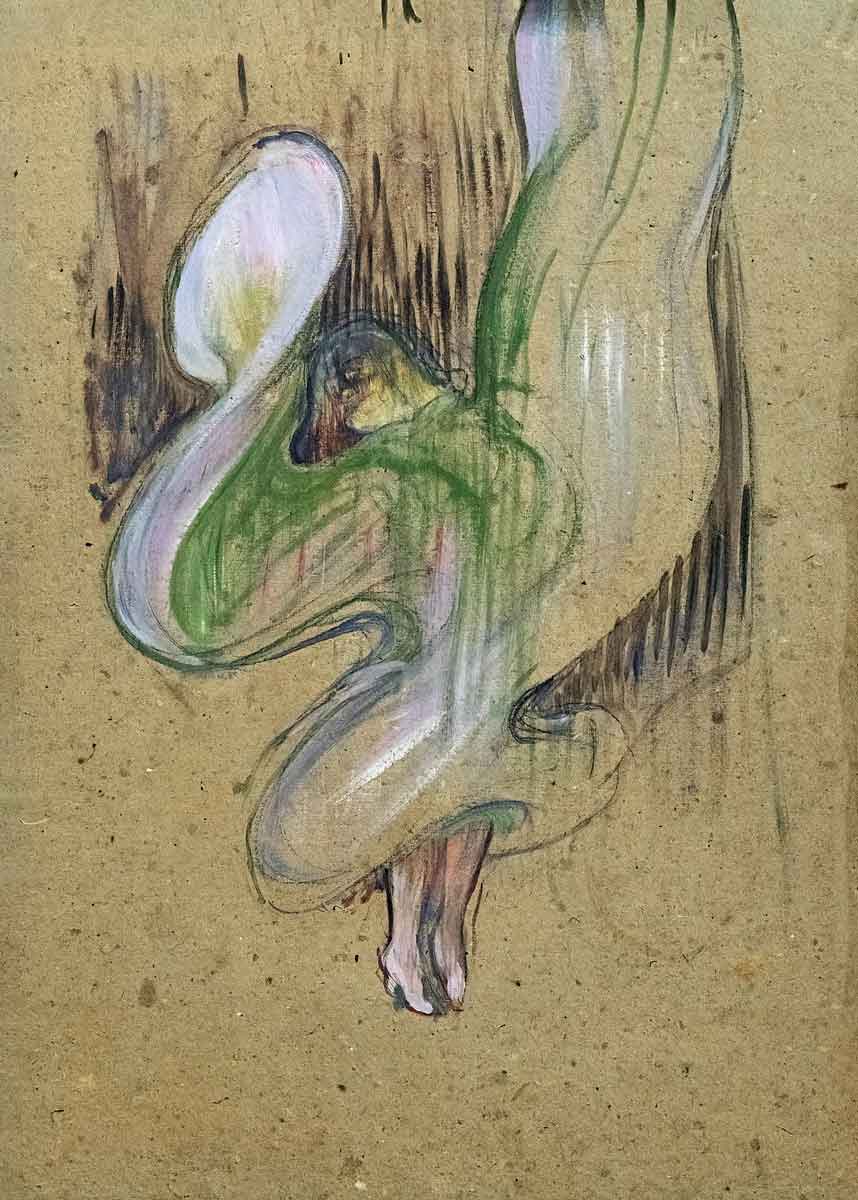
Fuller’s appearance and figure were far removed from the long and slim Art Nouveau ideal, but her skill at self-presentation, inventiveness, and talent made her a living embodiment of the movement aesthetic. She was a celebrity and a friend of many famous artists like Franz von Stuck, Henri de Toulouse-Lautrec, and Maurice Denis. Her keen interest in science resulted in her friendship with Marie Curie and membership in the French Astronomical Society.
The Serpentine Dance
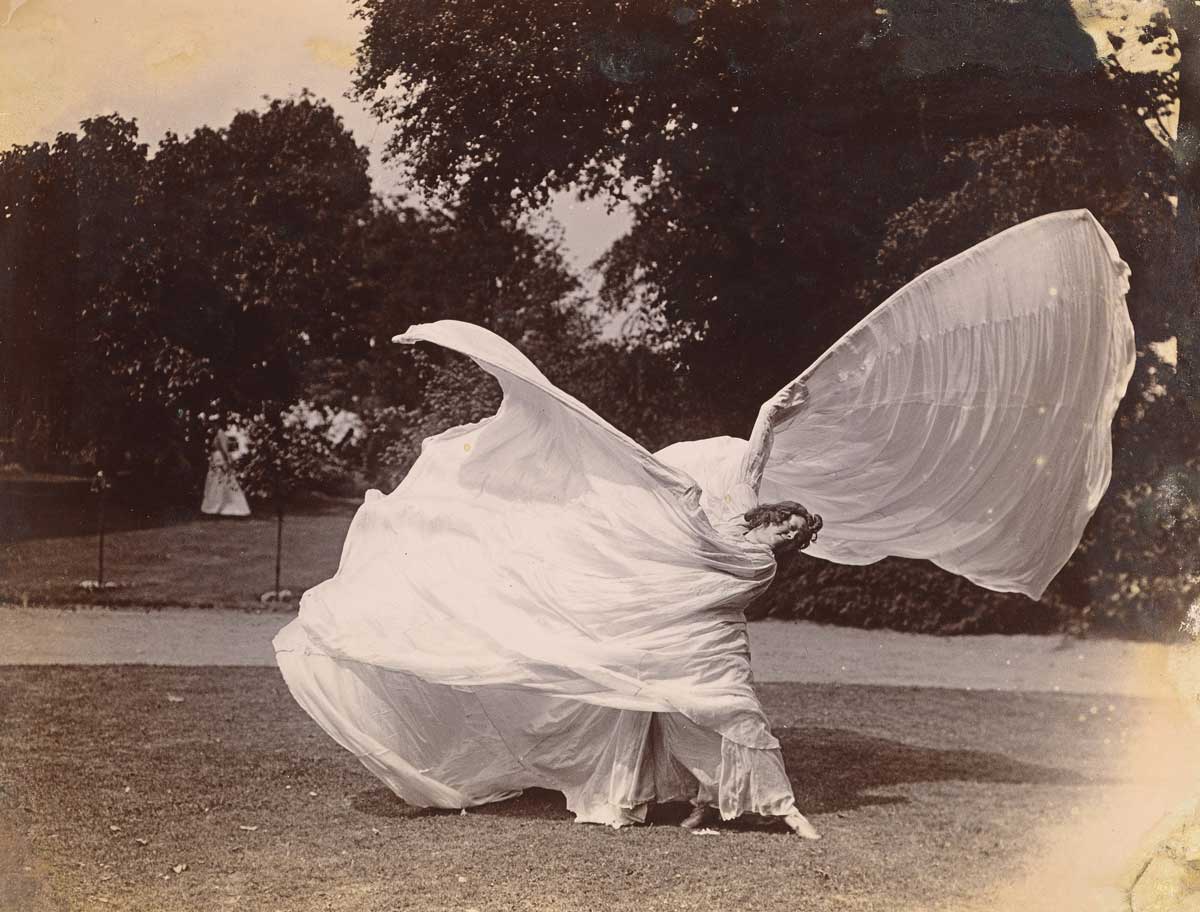
The invention that made Loïe Fuller famous and shaped the aesthetic of Art Nouveau was the Serpentine Dance. Fuller took the best from the skirt dances she performed in London and developed it into a new dance form. She specifically designed a stage dress, sewing silk and inserting bamboo rods into her sleeves, allowing her to manipulate the fabric more easily. She discarded traditionally demanded corsetry in favor of natural unrestricted movement.
Apart from costume design, Fuller understood the need for set manipulations. Impressed by Paris city illumination, she came up with specific light effects that contributed to the effect of her performances. She invented and patterned several stage light technologies, including colored gelatin plates that would project brightly colored rays onto her dress. Thus, she swirled on stage as a burning flame, a flowing stream, or a blooming flower, in constant movement that was further enhanced by light effects and occasional gusts of air directed by her assistants through a system of manholes on stage.
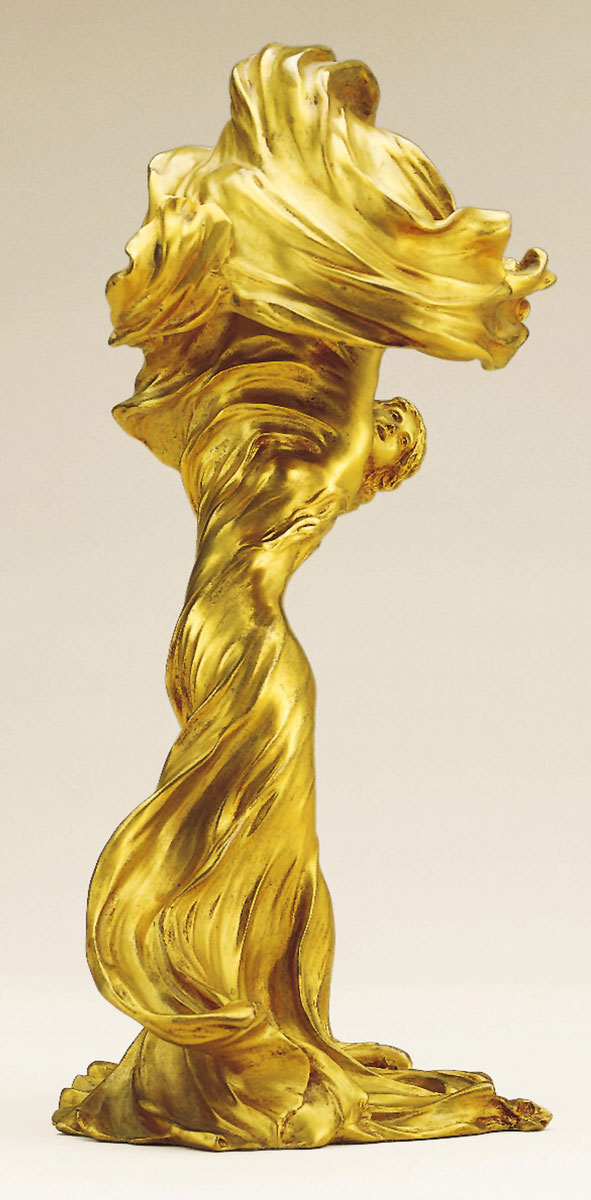
Loïe Fuller made a sensation during the 1900 Universal Exposition, where she was the only woman performer with her own pavilion. Part of her worldwide success was provided by modern-era technology, as she was frequently photographed and even filmed. Her hypnotizing and well-directed acts recorded on film acted both as her promotion and the demonstration of the camera’s possibilities.
The ability to capture a moment of movement in a photograph greatly helped artists collect references and find new angles for their work. The complex and aesthetically appealing drapes of her dress were soon translated into the language of paint, porcelain, and glass. Sculptures, paintings, vases, lamps, and other objects featuring Fuller’s swirling figure became a trend, and the long curved lines derived from it turned into an Art Nouveau staple. Soon, Serpentine Dance was performed by both self-made imitators and followers trained personally by Fuller, turning into a major obsession both in Europe and the US.
Dance by Alphonse Mucha
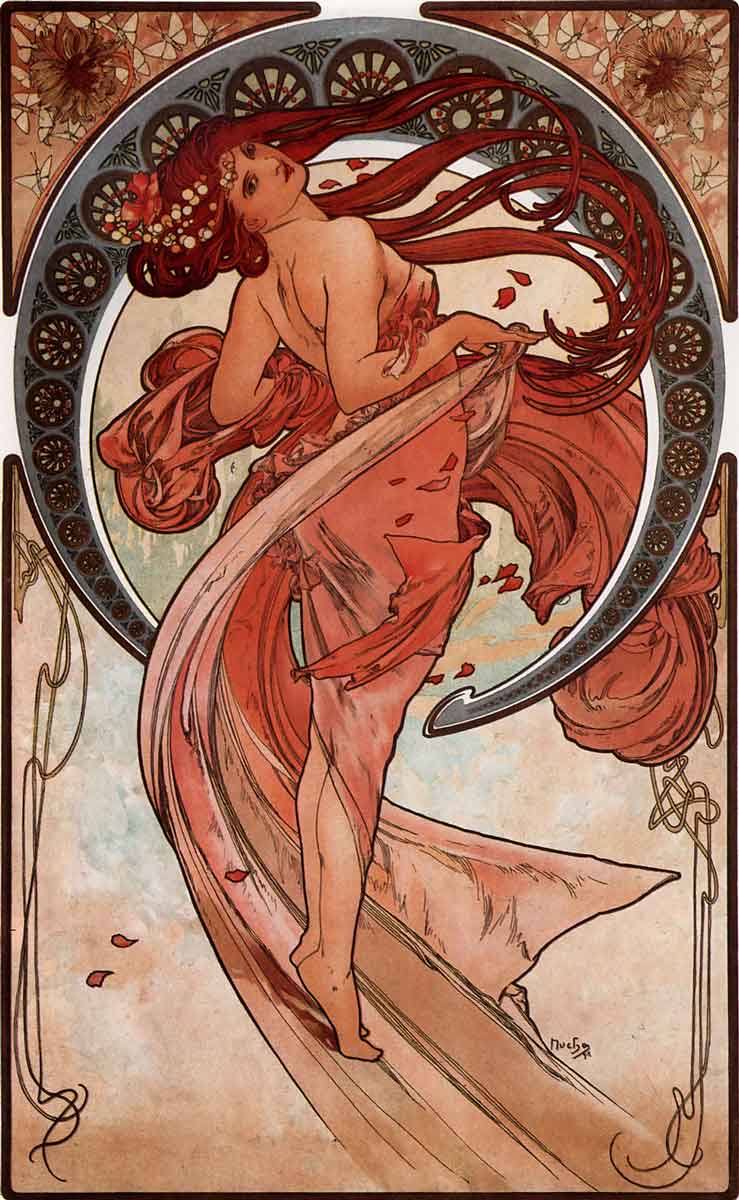
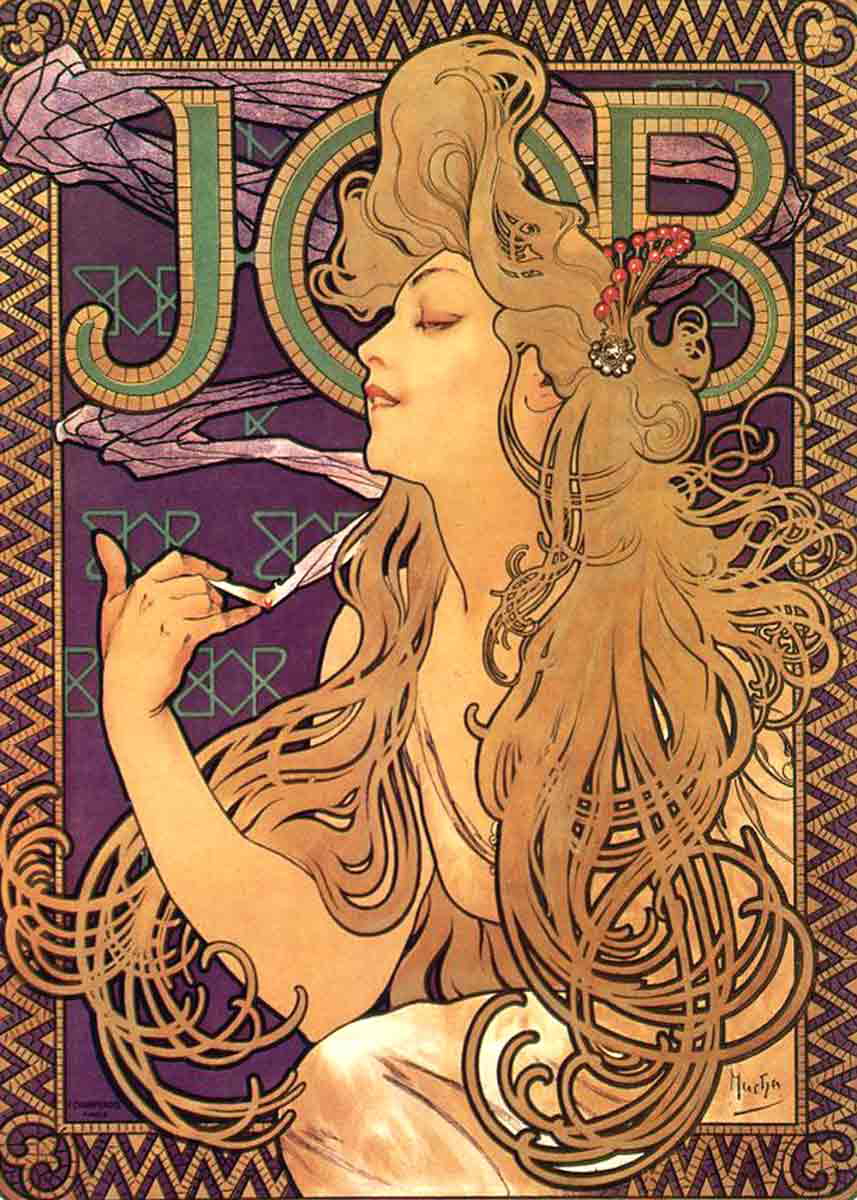
Czech-born Alphonse Mucha was the most famous of Art Nouveau masters who rose to fame almost by accident. As an immigrant in Paris, he struggled to find a well-paid design job. Chance brought him to Sarah Bernhardt, the famous actress who urgently needed a poster for her new show. Impressed by the result, Bernhards offered Mucha a six-year contract, almost immediately making him famous.
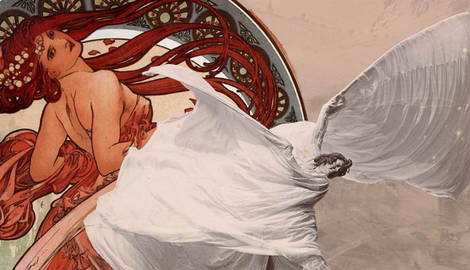
In 1898, Mucha created a series of lithographs, The Arts, dedicated to four different forms of art: Painting, Poetry, Music, and Dance. Instead of demonstrating connection through traditional attributes like brushes or musical instruments, Mucha expressed the essence of each form through dynamism and links to the forces of nature. Dance was the most dynamic of all figures, blown by a gust of wind and twirling among fallen leaves. The moving draperies of the dancer’s dress are reminiscent of those of Loïe Fuller and are present through many of Mucha’s works. The artist usually worked with photographic references for his works and was aware of a sensation made by Fuller and many of her imitators.
Gustav Klimt’s Dancer: Art Nouveau Painting Inspired by a Tragedy
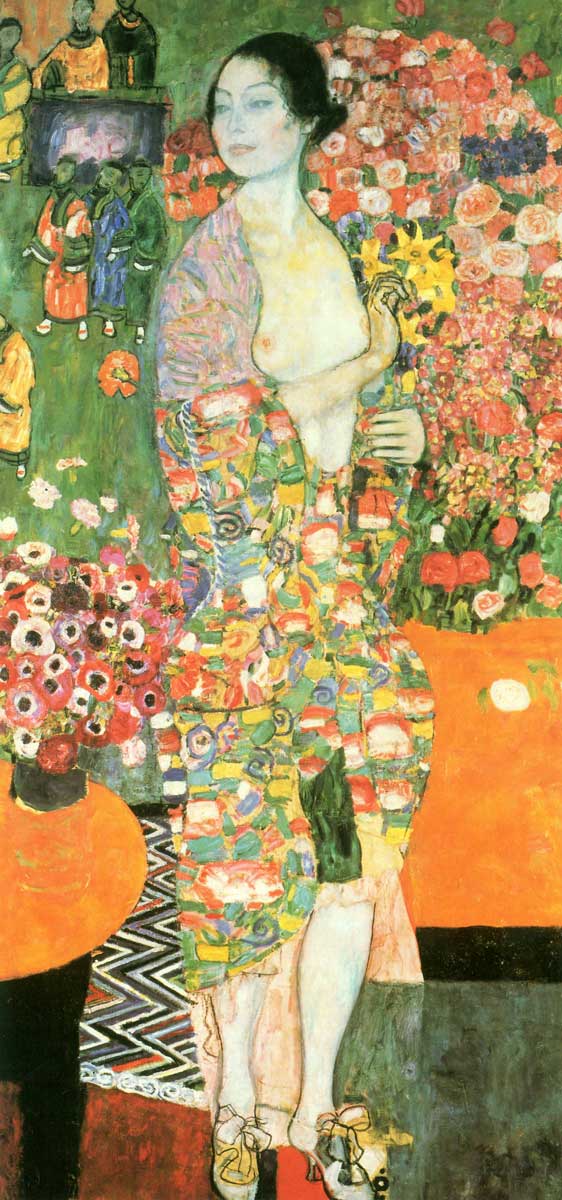
Another famous dance-related Art Nouveau painting was Gustav Klimt’s Dancer—a tragic tribute to a lost life. Dancer was one of three paintings Klimt created on the commission of his patron, Alexander Munk. Munk’s daughter Ria committed suicide after her fiance broke off their engagement. The first painting of three, which depicts Ria on her deathbed, was rejected by her mother, as she believed it was too realistic. Dancer was the second work that was also not accepted, as Klimt struggled to remember Ria’s face accurately. Still content with the composition, he decided not to waste the almost finished work and repainted the figure’s face to resemble Johanna Jusl, Klimt’s model and the Vienna State Opera dancer. In that context, the figure’s partial nudity that symbolized the tragedy (Ria shot herself in the chest) turned into an emblem of sensuality.