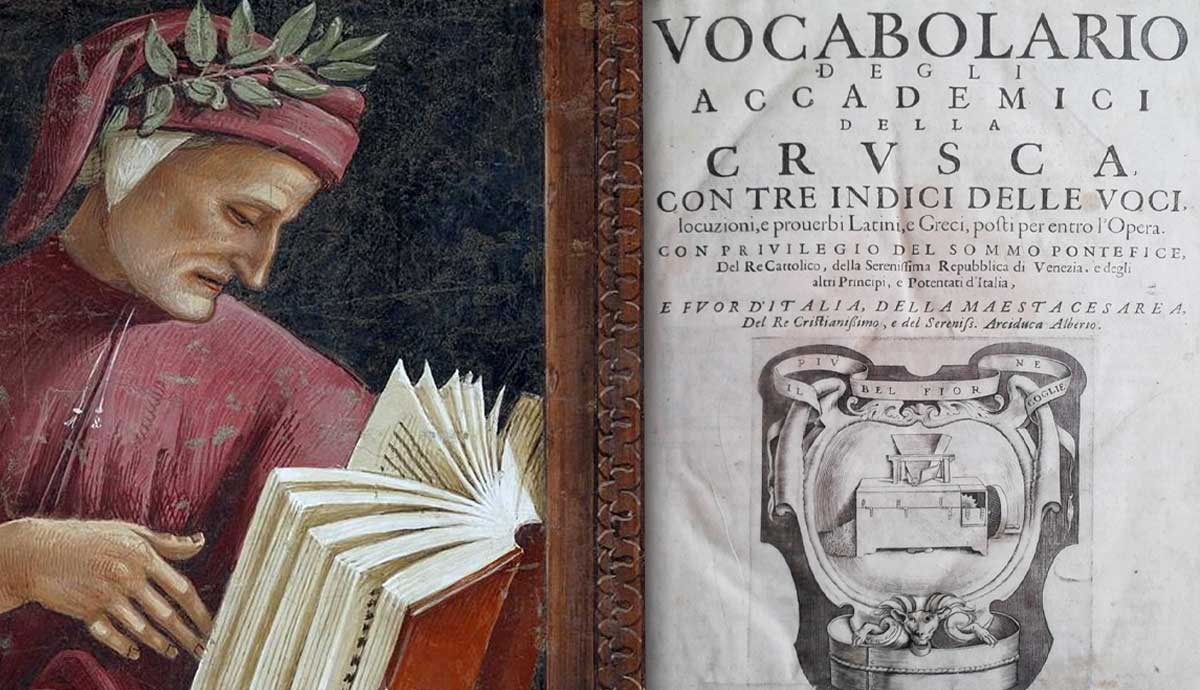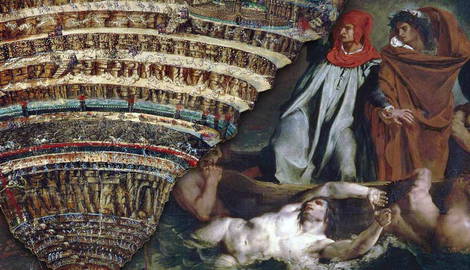

“All Hope Abandon, Ye Who Enter Here,” is not exactly the warmest greeting, but it is what the damned see as they enter through the gates of Hell. At least, according to Dante Alighieri, the author of the Divine Comedy, in which he gives a taxonomy of sin and the structure of the damnation that awaits them. “Published” around 1320, Dante’s work was highly influential on Western beliefs surrounding the netherworld and the eternal future that awaited all those who sin against God without repenting. The work doesn’t just describe a terrifying landscape, but acts as a philosophical and moral commentary. Led by his guide, the Roman poet Virgil, Dante describes his descent through the 9 circles of Hell…
Descent Into Hell
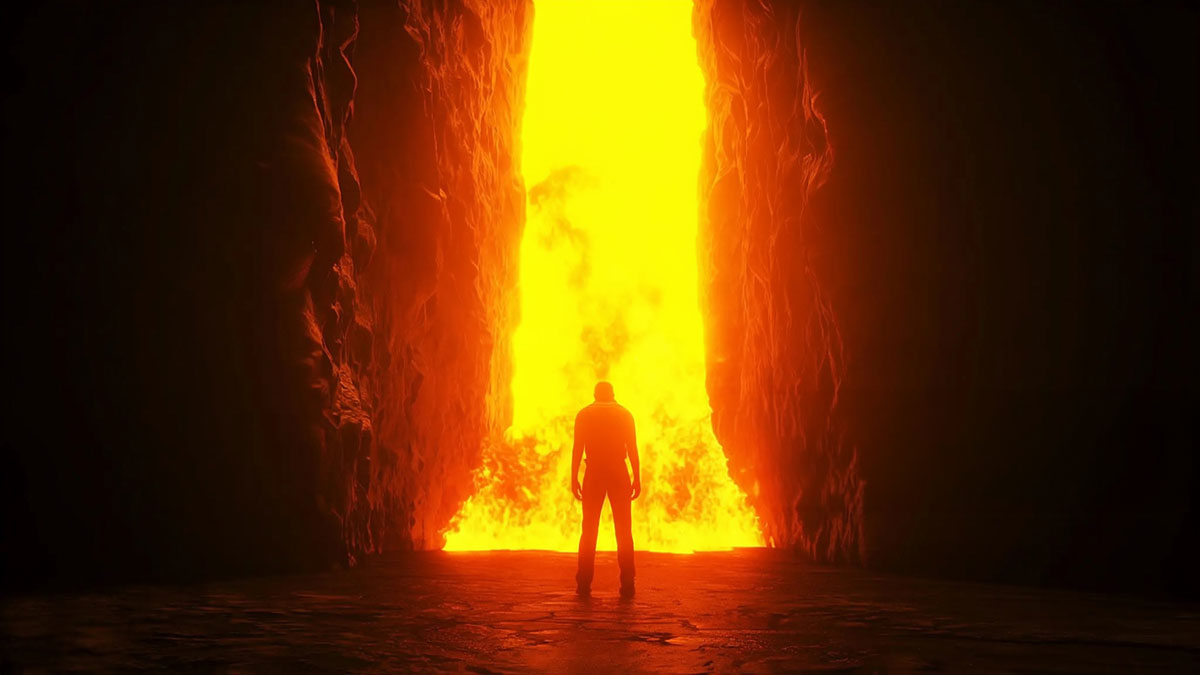
The Hell of Dante’s Inferno is not just a description of the physical geography, but moral geography as well. As one approaches the center, the sins of the victims become more offensive to God and are based on premeditation and malice rather than uncontrollable urges or character flaws (incontinence). The punishment is determined by Minos, the King of Crete in Greek mythology, as he serves as the judicial figure responsible for the eternal fate of Hell’s inhabitants. He is a monstrous figure with a serpentine tail, which he wraps around his body the number of times equal to the level of Hell that the doomed soul is condemned to.
He resides in the Second Circle, where the real punishment begins, for the first level of Hell is Limbo, a place reserved for the unbaptized and for those who lived before the time of Christ, who have otherwise led good lives. Limbo is the largest (by circumference) of the circles and exists as a place where the souls within live in sorrow, separated from God and Heaven.
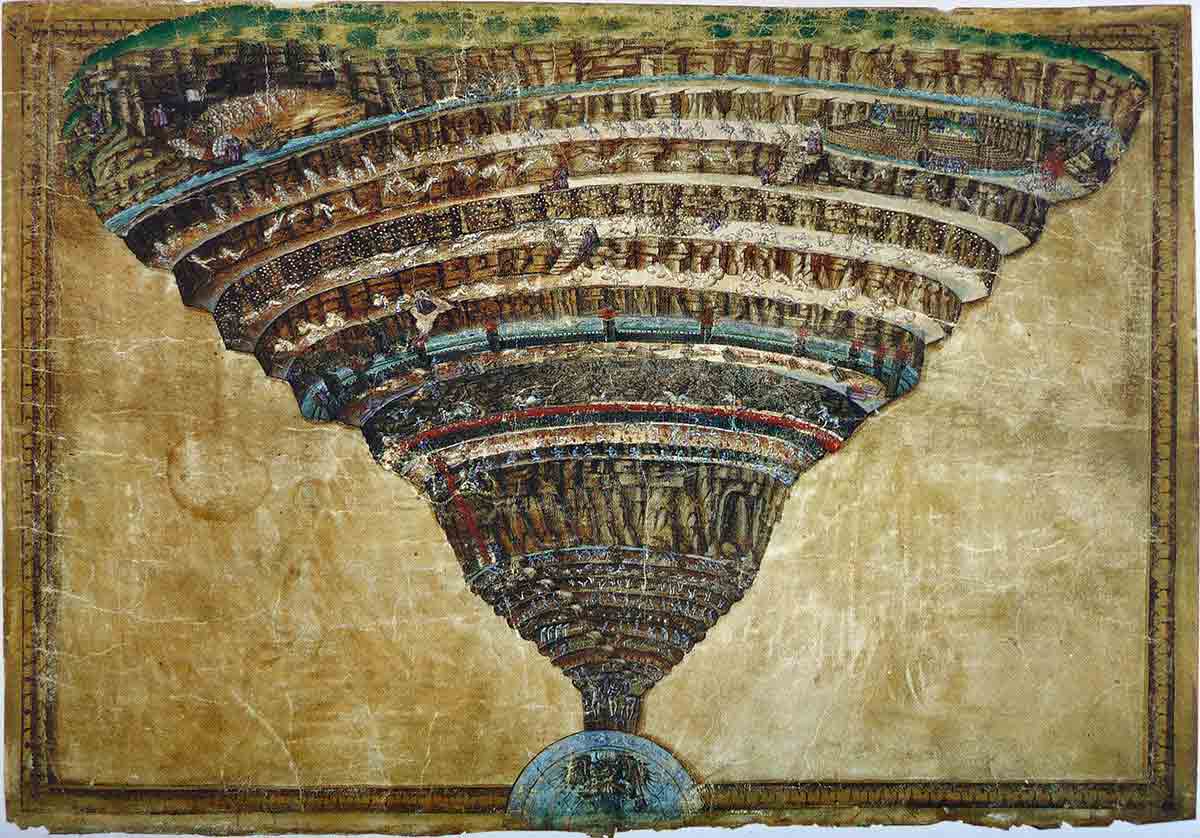
Virgil takes Dante through this circle, and they enter a great castle where noble souls such as Hector and Julius Caesar reside, along with the great Greek philosophers of Classical antiquity.
After traveling through the first circle, the real horror begins.
The Second Circle: Lust
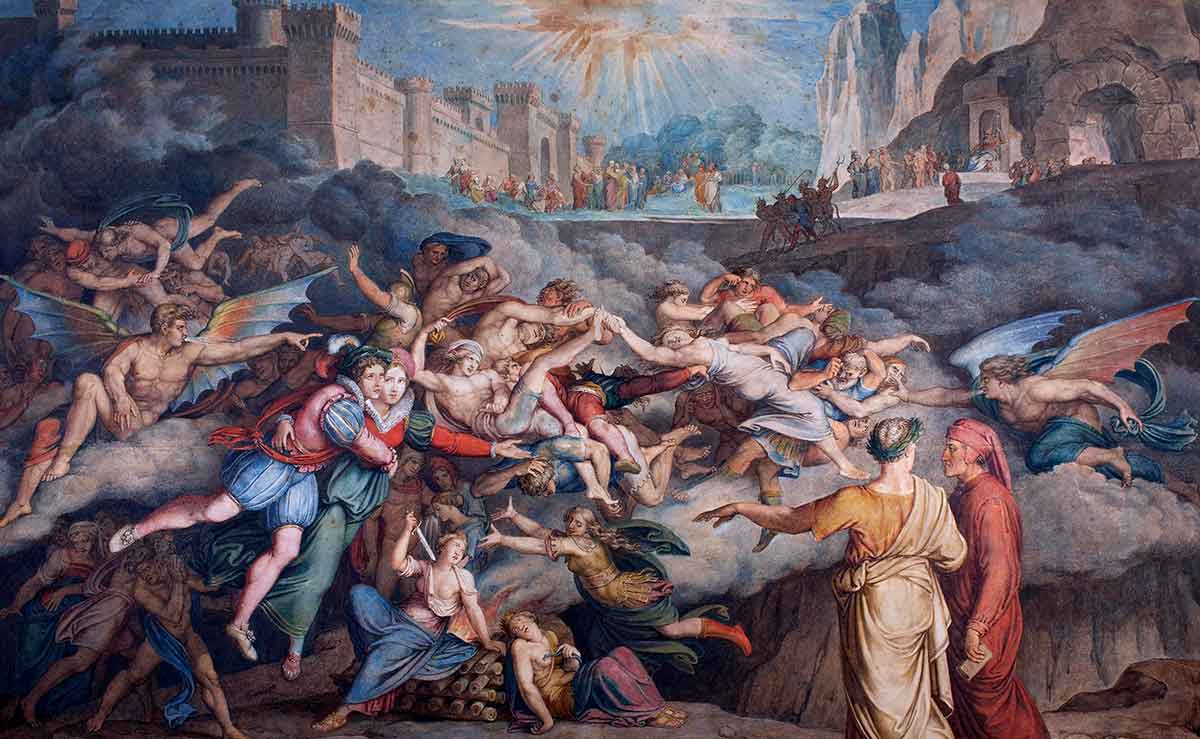
The Second Circle of Hell is the final destination for all those guilty of the sin of lust. In this dark and stormy realm, Dante finds Helen of Troy, Achilles, Paris, and Cleopatra, along with the Carthaginian queen, Dido, and the Lydian ruler, Semiramis. They, like the other inhabitants of this realm, were driven by the unreasoning restlessness of instinct, and their punishment is to be buffeted about in a ceaseless hurricane. Like their sin, this wind is unreasoning and restless.
Dante discovers Francesca da Rimini and her lover Paolo Malatesta, figures of a prominent scandal several decades before Dante wrote his work. Da Rimini shares with Dante the story of the adultery that condemned her and her lover to eternal torment.
Overcome with pity, Dante faints and wakes to find he has entered the Third Circle of Hell, a place reserved for the sin of gluttony.
The Third Circle: Gluttony
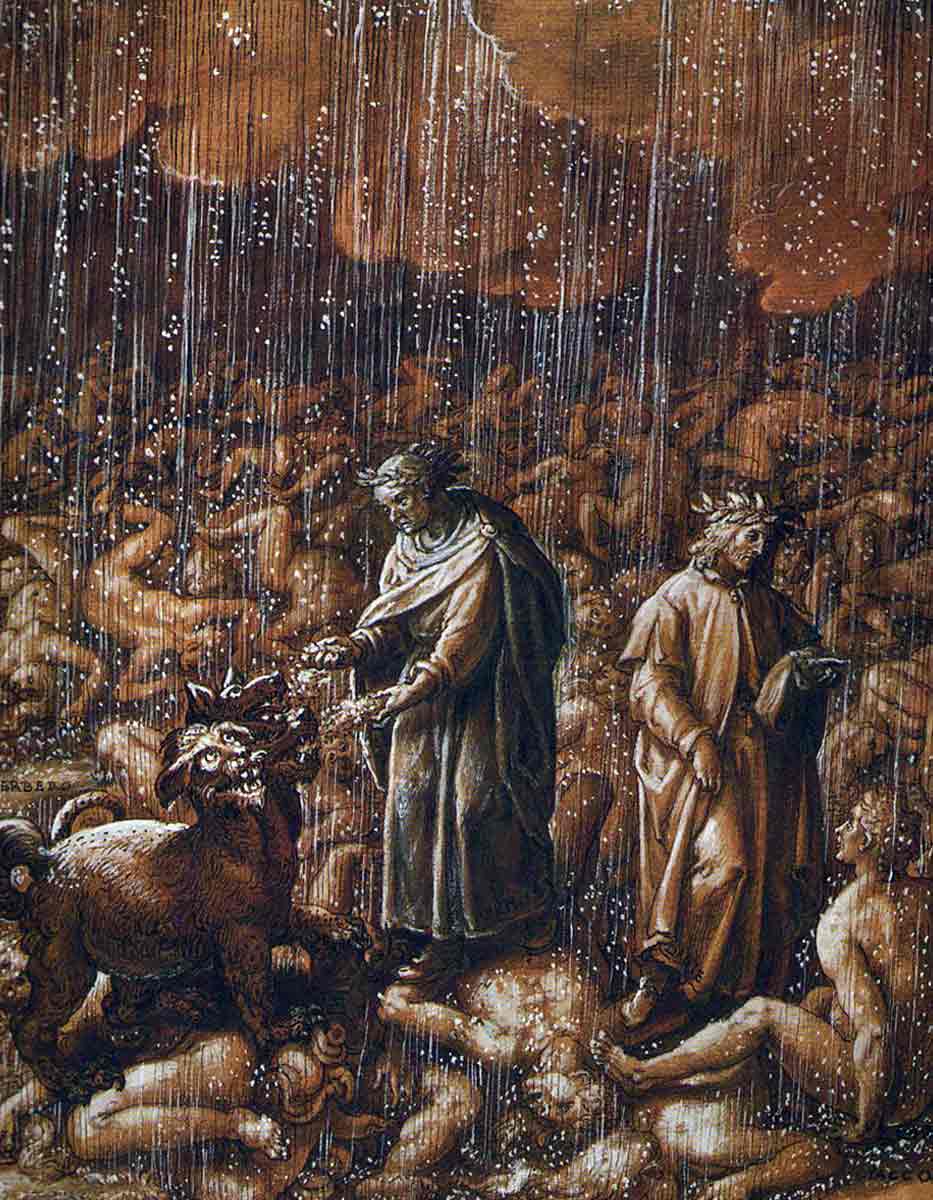
Guarding the gate to the Third Circle is Cerberus, the beastly three-headed dog with a swollen belly. Cerberus devours the dirt that Virgil throws at him, exemplifying the sin of the victims contained within.
Thick, dark, and full of icy hail and stinking mud, the rain in the Third Circle of Hell is an unceasing torrent of torment to the gluttonous souls who spend their days until the Last Judgment writhing in the swampy ground. Adding to their suffering is the ravenous Cerberus, who rips them to shreds. This is an example of the theme of contrapasso, which is prevalent throughout the 9 circles, and is defined as the punishment being a reflection of the sin. For the damned, the comfort of gluttony is rewarded with the discomfort of the mud and sleet.
As Virgil and Dante traverse this circle, they step on the prostrate bodies, one of whom is Ciacco, a man Dante knew in Florence. After a brief conversation with the tortured soul about the politics of the city, Virgil and Dante continue their journey.
The Fourth Circle: Greed
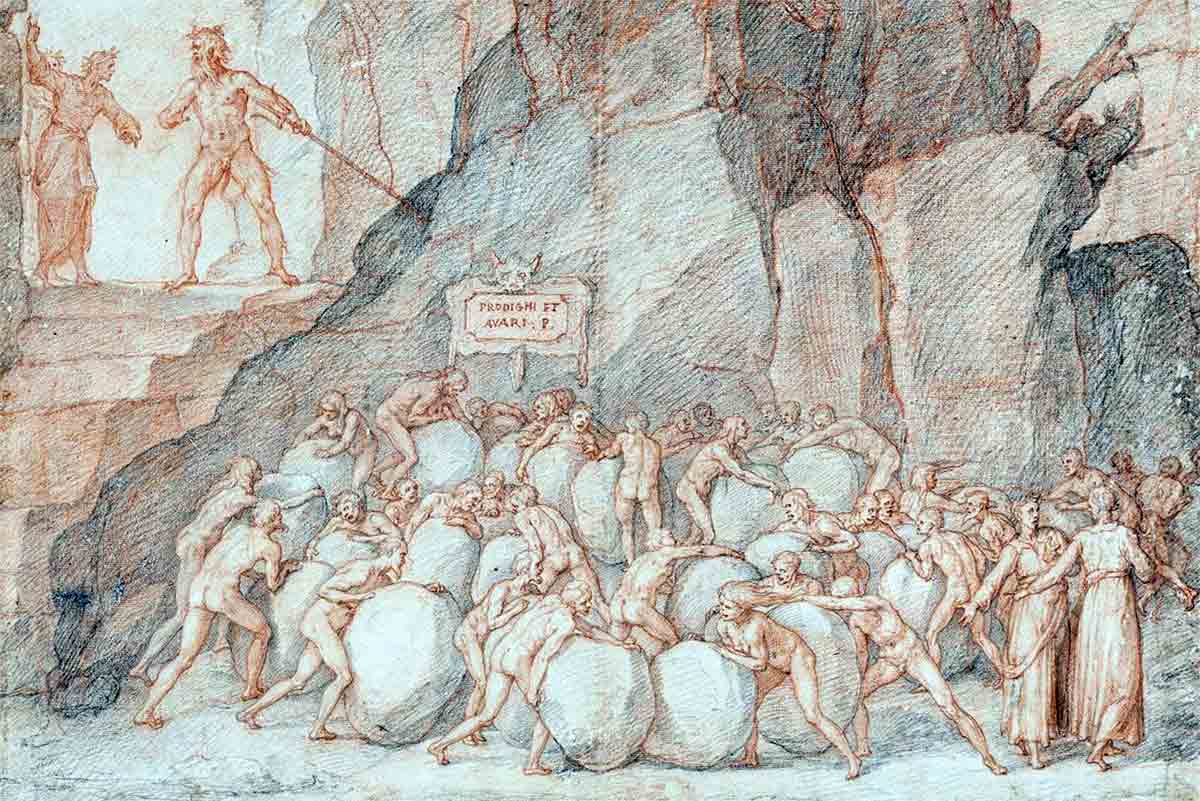
Guarding the Fourth Circle is Plutus, the mythological god of greed and avarice. Upon encountering Virgil and Dante, he shouts “Pape Satàn, pape Satàn aleppe!” a cryptic phrase that goes untranslated. Virgil chastises the god, and the pair continue through to the Fourth Circle.
There, Dante witnesses the fate of hoarders and wasters who spend their time pushing heavy weights against each other in a pointless struggle. They scream at each other as they clash, and then drag their weights back, only to repeat the process in an endless cycle. Here, the lesson is that all the gold in the world cannot buy a moment of rest.
The Fifth Circle: Wrath
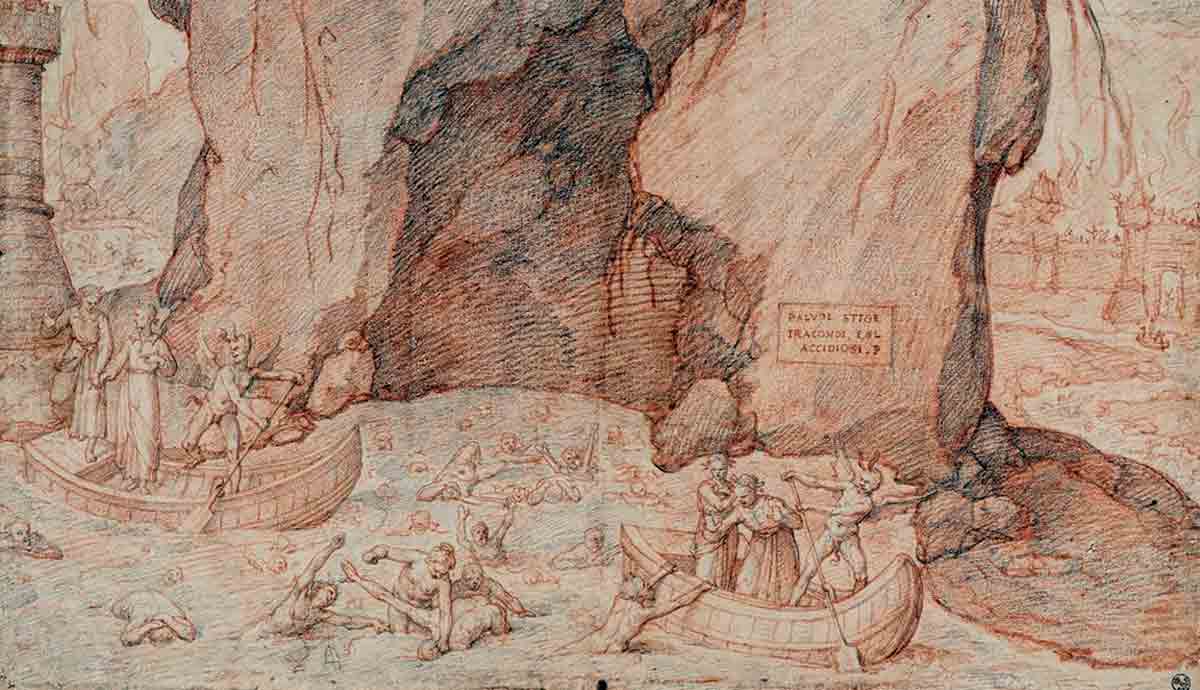
Dante and Virgil reach the swampy waters of the Styx and are transported across by Phlegyas, king of the Lapiths, in a small boat. The river is home to the actively wrathful and the sullen (passively wrathful). While the former snarl at each other and fight viciously, the latter lie below the surface, gurgling and choking on rage that they cannot express.
As they proceed across the river, their boat is accosted by an arrogant Florentine, Filippo Argenti, who is known to Dante. Virgil shoves him back into the waters, where Filippo is attacked by the other wrathful damned. The trio reaches the shore of the Styx, and Dante and Virgil continue towards the city of Dis.
The City of Dis
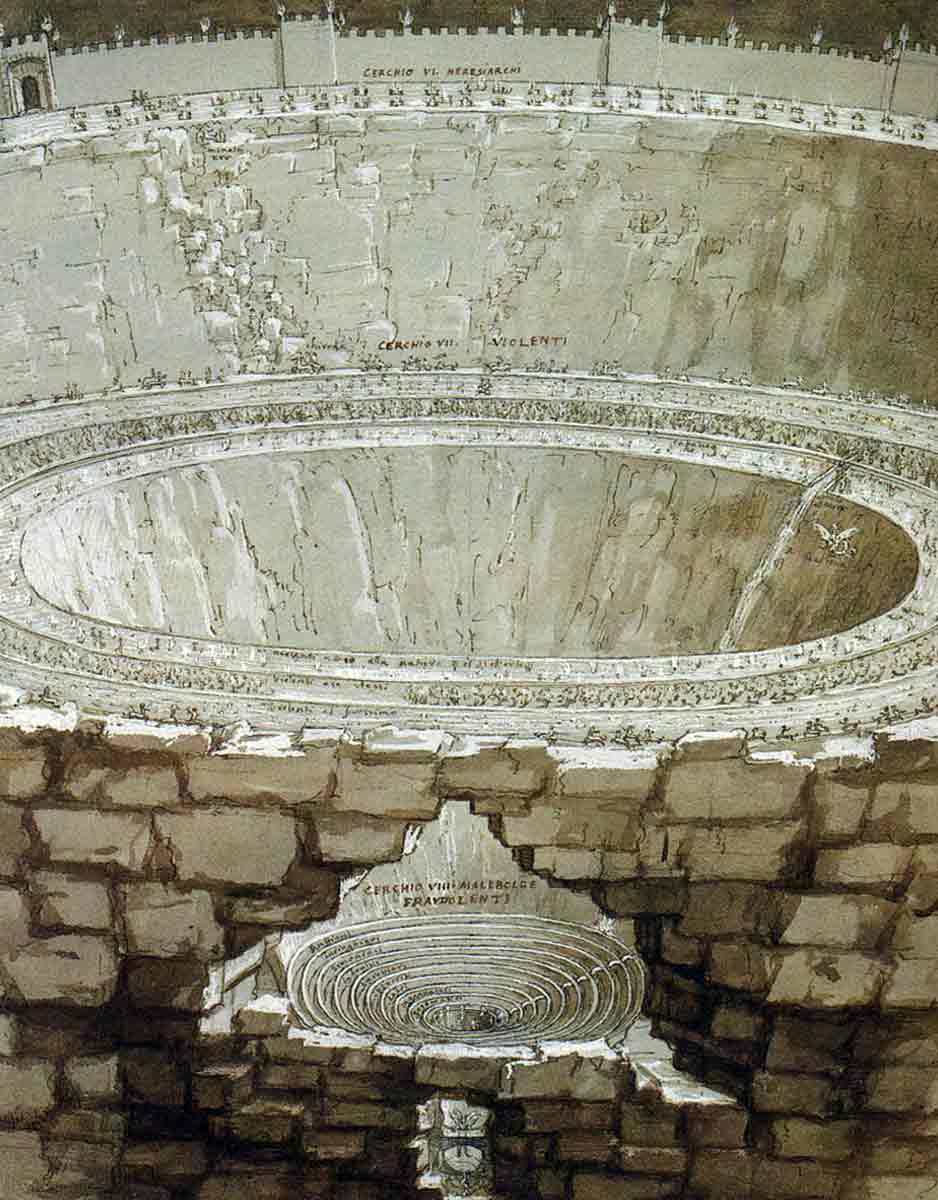
Structured as a massive ring, the fortified city of Dis encloses the lower region of Hell. Its iron walls are dotted with towers, gates, and bridges, and it is guarded by fallen angels, Furies (goddesses of vengeance), and Medusa. In this great city, the sins of “incontinence” give way to the sins of malice, which require intellect and will.
Outside the gate to Dis, Dante and Virgil are confronted with a host of a thousand fallen angels, who deny the travelers’ entry into the city of the damned. However, an angel descends from Heaven to help Dante and Virgil and opens the gate by touching it with a wand.
The Sixth Circle: Heresy
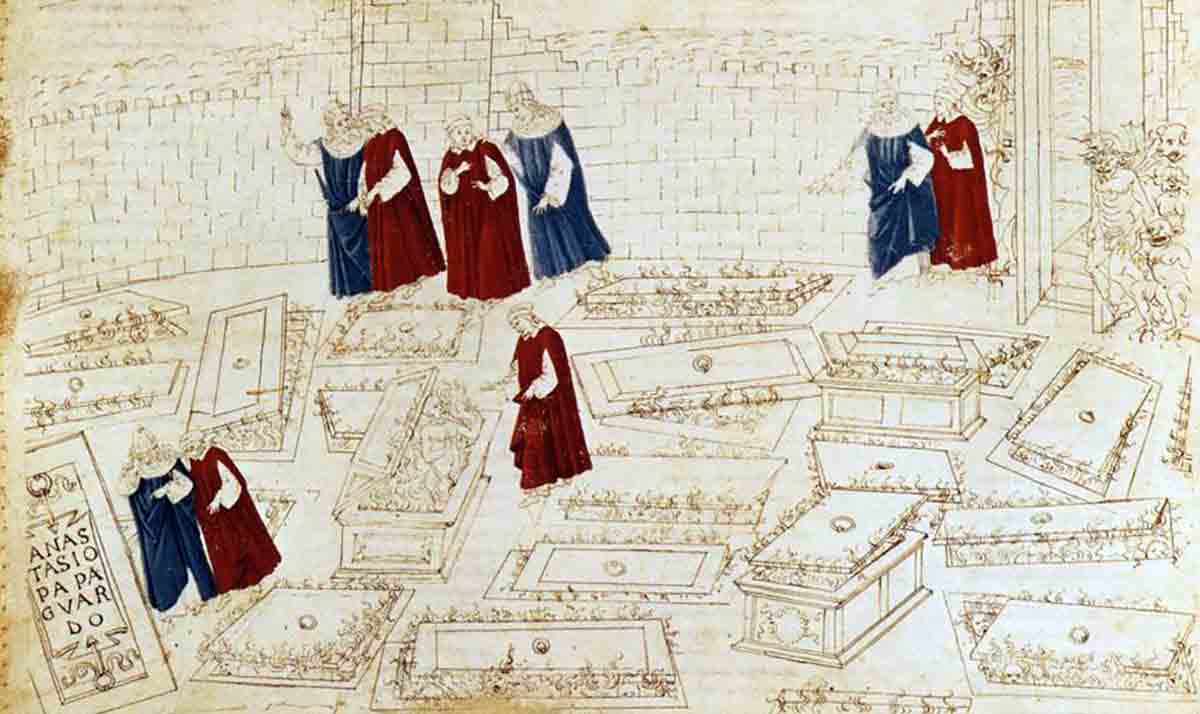
In the city of Dis, Dante and Virgil encounter those doomed for the sin of heresy, who suffer being trapped in flaming tombs. Here, Dante meets Epicureans, those who believe in the teachings of the Greek philosopher Epicurus, and his theory that the soul dies with the body. Thus, the Epicureans represent a place akin to atheists in medieval thought.
Dante reads the inscriptions on some of the tombs and finds the names of the Holy Roman Emperor, Frederick II, as well as Cardinal Ottaviano degli Ubaldini, who is claimed to have said, “I can say, if I had a soul, I lost it for the Ghibellines.” This phrase doomed him in Dante’s prose, and thus he endures the fate of a heretic.
As Dante and Virgil continue their journey, Virgil explains what they will find in the Seventh Circle of Hell.
The Seventh Circle: Violence
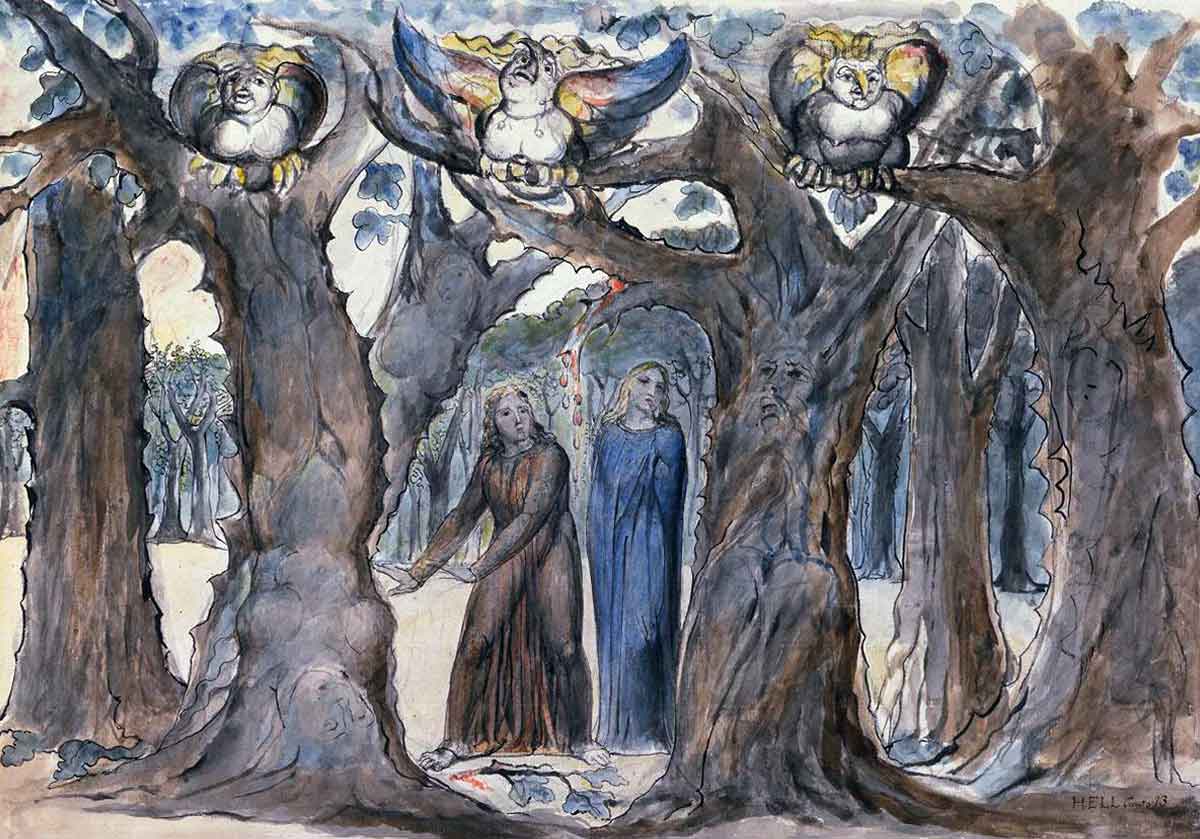
Split into three circles itself, the Seventh Circle of Hell is reserved for all those who commit the sin of violence. Centaurs guard the outer ring and shoot its residents with arrows. While this ring is reserved for those who are violent against their neighbors, the middle ring is reserved for those who are violent against themselves. This is the Wood of the Self-Murderers, where those who killed themselves have been turned into thorny trees and are plagued by harpies tearing at their leaves.
The inner ring of the Seventh Circle is for blasphemers, sodomites, and usurers. They dwell on the Plain of Burning Sand, through which flows the Phlegethon, a river of boiling blood that runs through the Wood of the Self-Murderers to the third ring. Blasphemers (the violent against God) lie on their backs, while Sodomites (the violent against nature) are forced to run in circles. Usurers, considered to be violent against art, crouch and weep. All the while, these sufferers are subjected to a slow descent of flecks of flame.
The Eighth Circle: Fraud
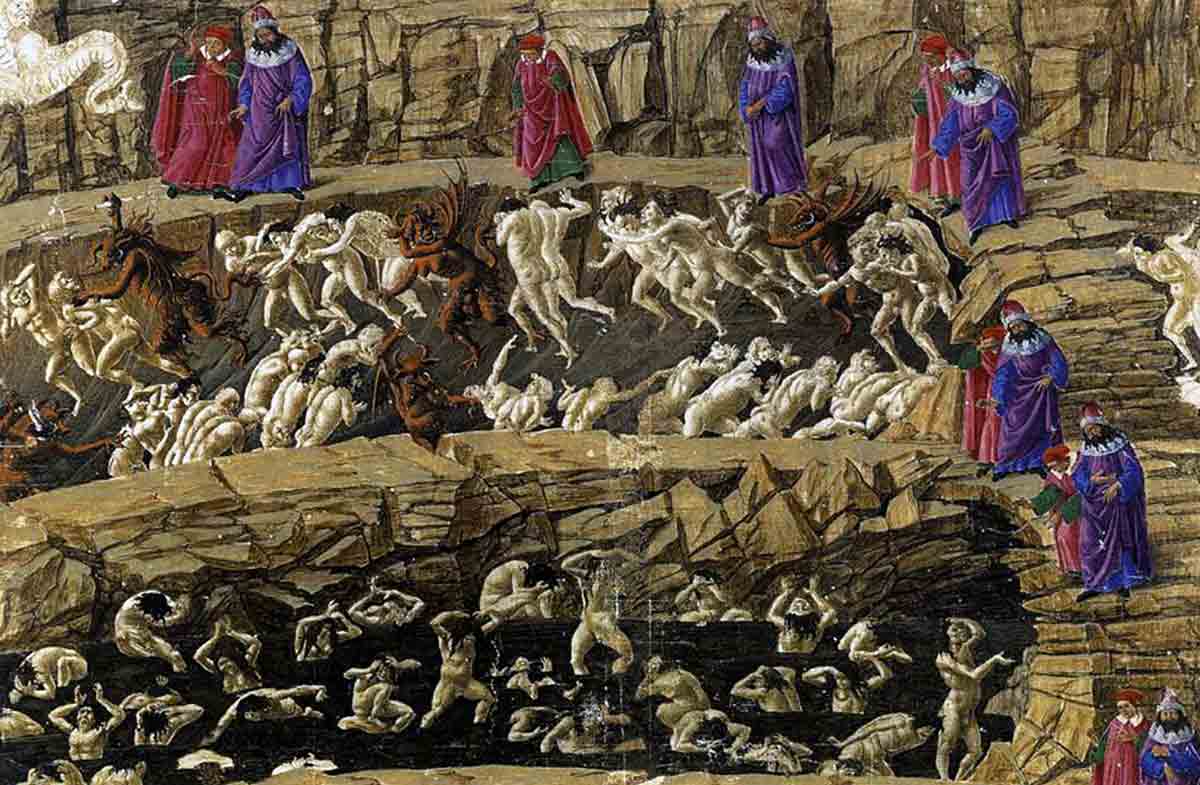
The Eighth Circle is named “Malebolge” (Evil Ditches) and is reserved for ten different kinds of fraudsters, each suffering their specific torment in their designated “bolgia.” In this circle, panderers and seducers are whipped for all eternity in the First Bolgia. In the Second Bolgia, flatterers are covered in excrement, while in the Third, simoniacs (people who sell ecclesiastical favors) are forced head down into a hole, and their feet are scorched with flames.
The Fourth Bolgia contains sorcerers such as diviners, fortune-tellers, false prophets, and astrologers. They have their heads twisted on their shoulders and are forced to walk backward. The Fifth Bolgia houses corrupt politicians who spend eternity in a lake of boiling pitch.
Hypocrites are in the Sixth Bolgia, where they are outfitted with leaden robes and forced to ceaselessly wander a narrow track, while in the Seventh Bolgia, thieves are chased and attacked by reptiles. The Eighth Bolgia houses those who counsel others to engage in fraud. Here, each individual is encased in flames, representing the evil tongues the sinners had in life.
In the Ninth Bolgia, sowers of discord have their bodies rent to pieces by a large demon wielding a sword. The souls must drag their bodies around the pit, only to be reincorporated and mutilated again. Thus, their punishment reflects the disunity they wrought in life. In the Tenth and final bolgia, falsifiers who acted as a “disease” on society are in turn afflicted by stinking, leprous diseases in the afterlife.
The Ninth Circle: Treachery
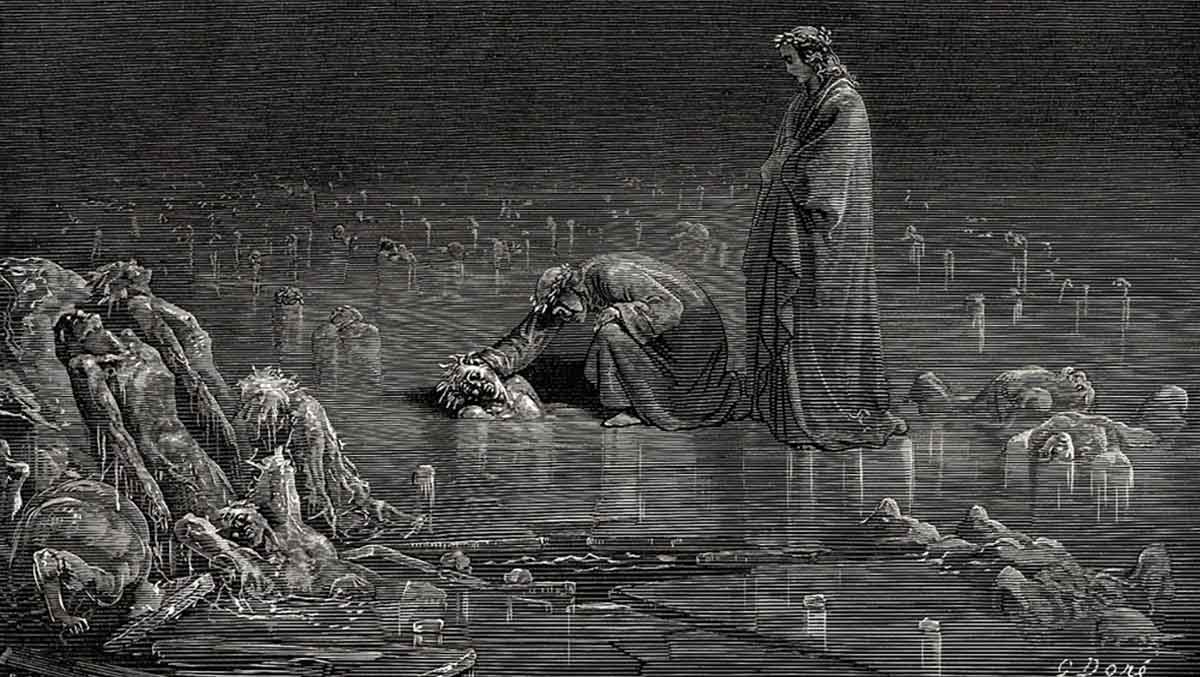
At the center of Malebolge, Dante and Virgil come to a large well in which biblical giants are trapped, with their legs embedded in the Ninth Circle. Here, the giant, Antaeus, takes the travelers in the palm of his hand and lowers them into the Ninth Circle.
What greets them at the bottom is the frozen lake of Cocytos. This, the final circle, is divided into four rounds. The first is Caina, named after the biblical figure who murdered his brother. This is where traitors to their kin are trapped in the ice, with only their faces above the surface.
The second round is Antenora, named after the Trojan prince Antenor, whom Dante viewed as a traitor for plotting against his homeland. Antenora is reserved for traitors against their nation or their political party. Here, the victims have their heads above the ice, facing upwards, with their necks frozen in place.
The third round is Ptolomaea, named after Ptolemy, who is mentioned in the book of Maccabees in the Bible. He invited his father-in-law and his sons to a banquet and killed them, thus becoming a traitor to guests. This round is reserved for souls like him, who are punished by lying on their backs in the ice. Their tears freeze in their eyes, denying them the comfort of weeping.
The fourth round is Judecca, named after Judas Iscariot, and is reserved for traitors to their lords. Sinners here are completely encased in ice and are immobile from head to toe.
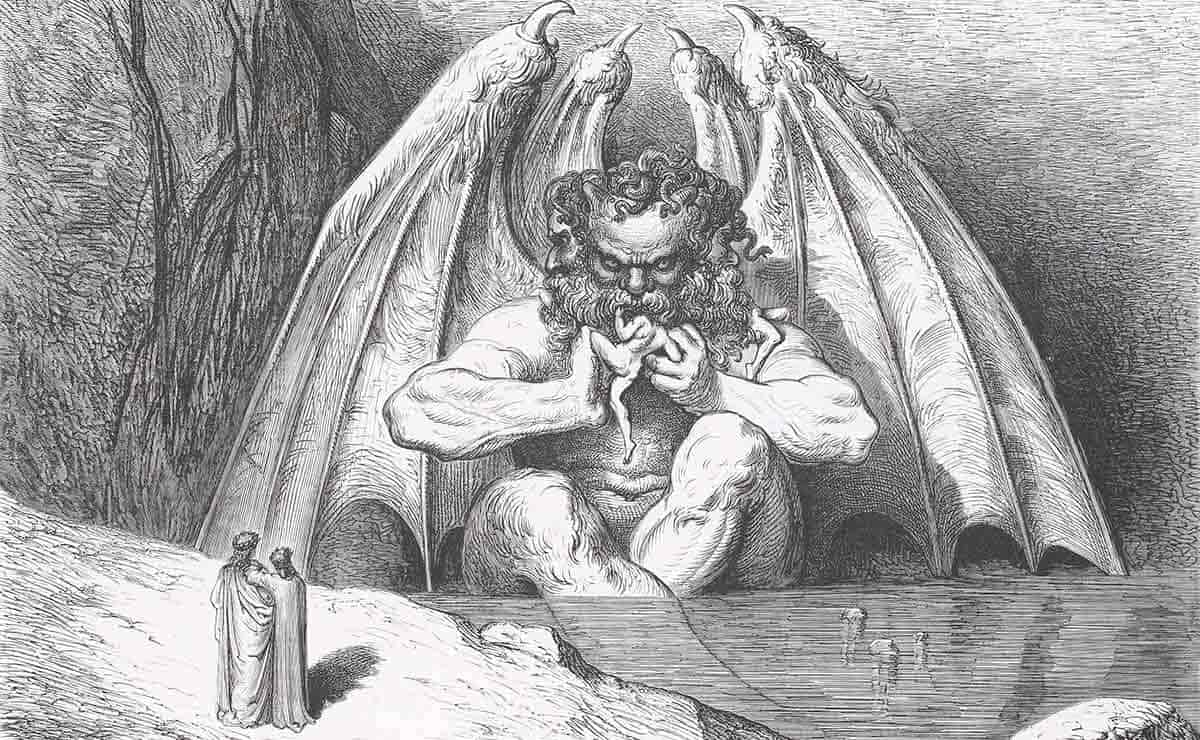
At the very center of Hell is Satan, who committed the ultimate sin of betrayal against God. Here, the monstrous being is trapped from the mid-chest in the ice, while his upper chest and his arms are left free. His six wings are bat-like and impotent, unable to lift him from his torment. Upon his head are three faces. From his six eyes, he weeps and his tears freeze, mixing with bloody froth from his mouth(s). In his central mouth hangs Judas, his head being chewed upon all eternity, while his back is clawed upon by Satan’s grotesque hands.
Dante and Virgil make their escape through a dark and winding tunnel by Satan’s legs. When they reach his hips, gravity flips, as they pass through the center of the earth, and instead of climbing down, they are now climbing up, reaching Mount Purgatory at the polar opposite of Jerusalem.
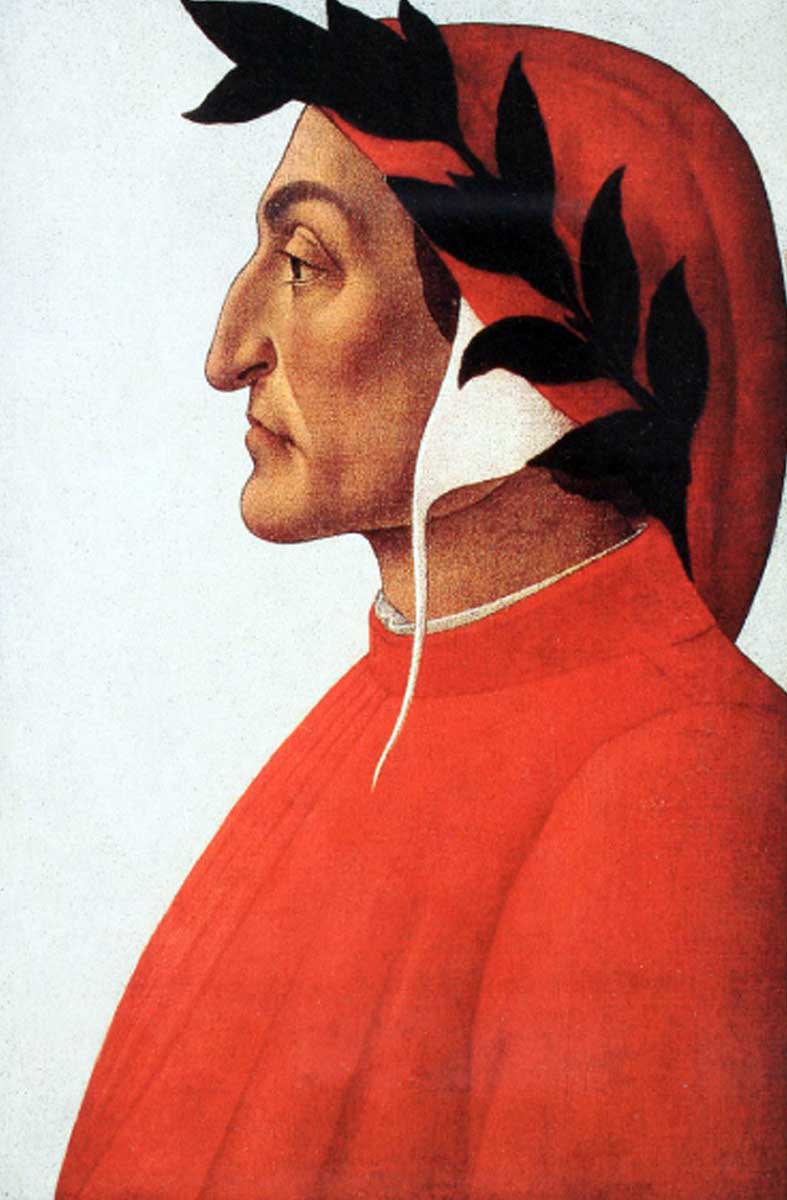
Dante’s Inferno had a lasting impact on religious thought, as well as literature and art. The author’s ideas of Hell are ones that endure in the mind to this day and formed the basis of how we picture damnation. His punishments were not random, but fitted the crime, and helped the reader understand the nature of evil and how it relates to those who commit it and the suffering they cause others.