
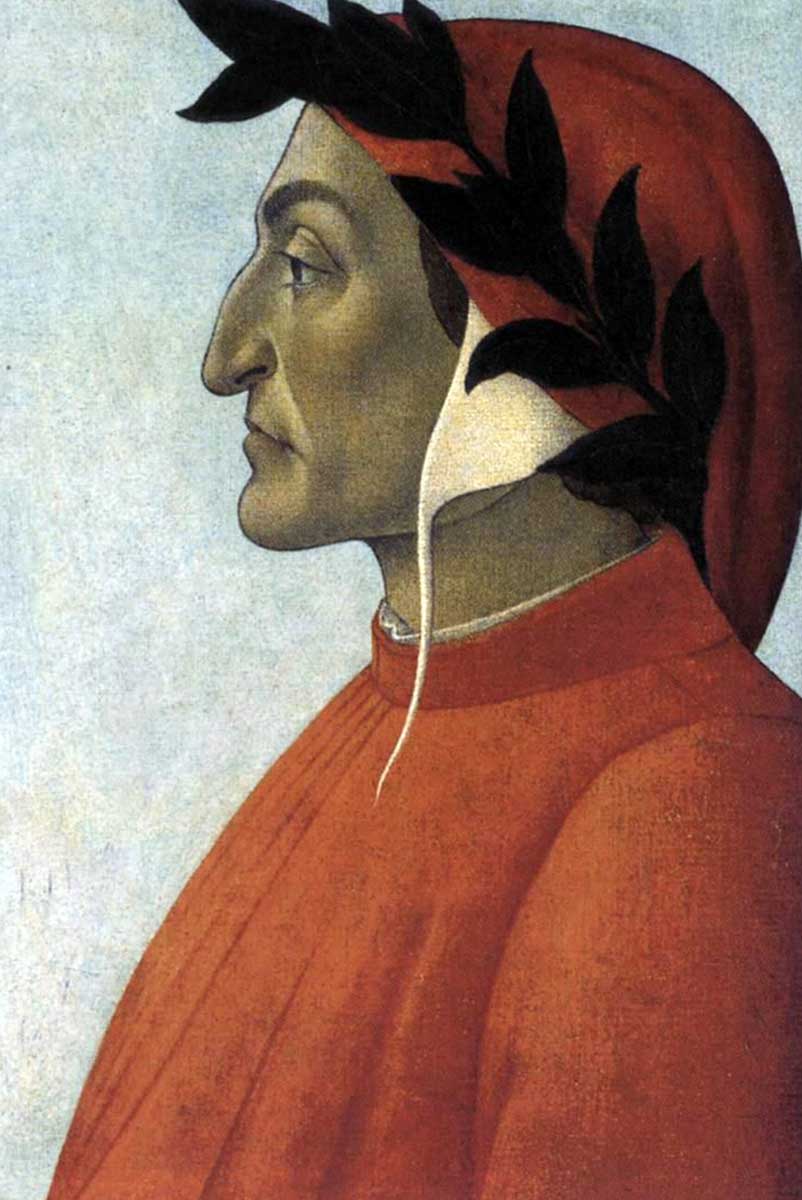
After his trek through Hell (Inferno), guided by Virgil, Dante comments, relieved: “we emerged, to see—once more—the stars.” The poet, however, will need to journey through Purgatory, where sins are cleansed, before reaching Paradise. Here, guided by his beloved Beatrice, Dante will tackle a series of increasingly complex theological issues, from the coexistence of unity and multitude to the mystery of incarnation. The ineffability of his last supernatural journey repeatedly challenges Dante’s poetic skills, making the Paradiso the Divine Comedy’s most difficult canto. Here is a brief guide to help readers make sense of Dante’s mystical experience.
Dante’s Guide in Paradiso: Who Is Beatrice?
At the beginning of the Divine Comedy, when Dante, having lost the diretta via (the path that does not stray), finds himself in a selva oscura (shadowed forest), a special guide appears to help him: Virgil. The Roman poet explains that he will lead Dante through the nine circles of Hell up to the mountain of Purgatory.
However, as a follower of the pagan religion and unbaptized, Virgil won’t be able to accompany Dante in the final leg of his supernatural journey, where the Florentine poet will reach the beate genti (blessed people) residing in Heaven. “If you would then ascend as high as these,” says Virgil, “a soul more worthy than I am will guide you; I’ll leave you in her care when I depart.”
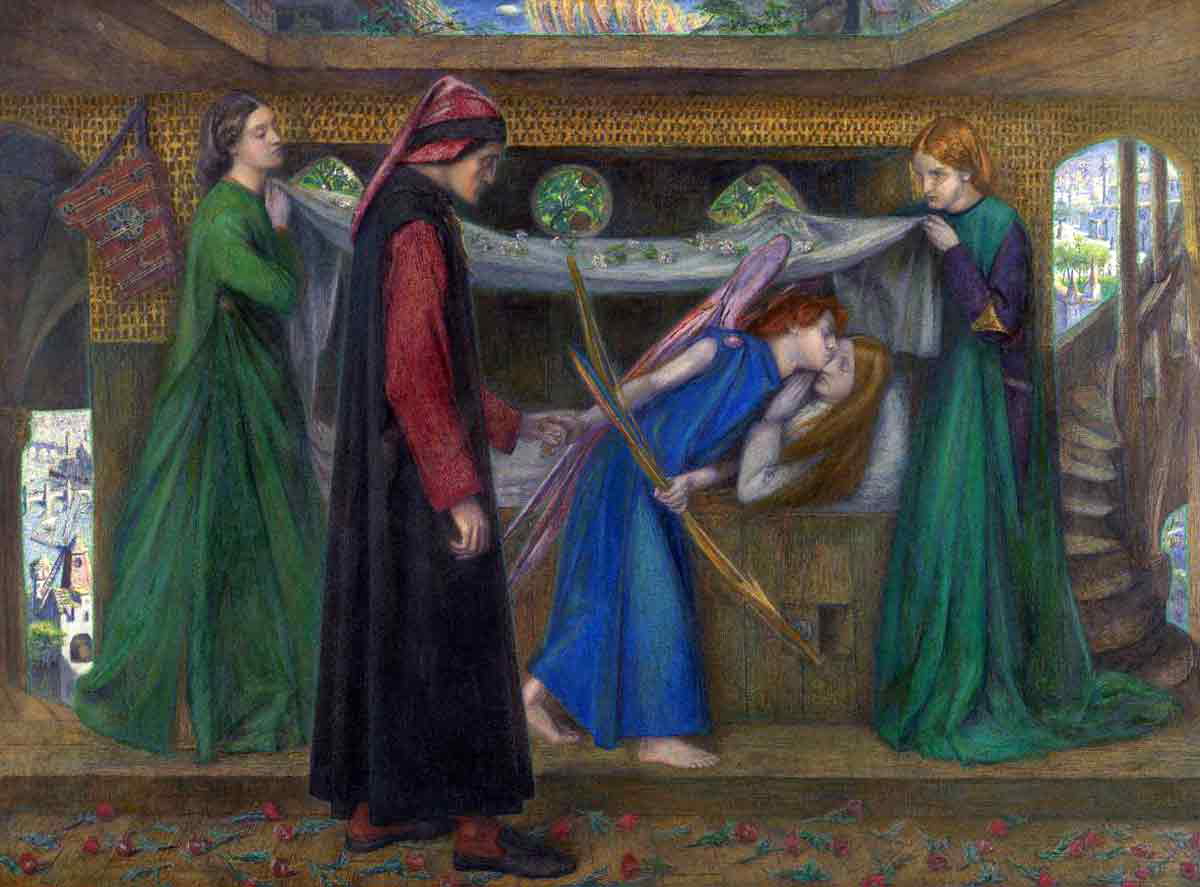
The new guide appears when Dante climbs to the top of Mount Purgatory, the location of Earthly Paradise. There, Virgil is replaced by Beatrice, the Italian poet’s dead beloved. After rebuking him for straying from the rightful path, thus betraying her memory, Beatrice exhorts Dante to drink from the rivers Lethe and Eunoè to confront and atone for his sins. Then, as the poet is “remade, as new trees are renewed when they bring forth new boughs,” he and Beatrice can finally “climb unto the stars.”
Dante introduced Beatrice in his La vita nuova (The New Life), a 1239 work in which he chronicles his love for and relationship with Beatrice, from the first sight of his beloved at nine years old to his deep mourning after her death. In the last chapter, Dante vows to write in the future about who came to be his ideal woman “that which has never been written of any woman.”
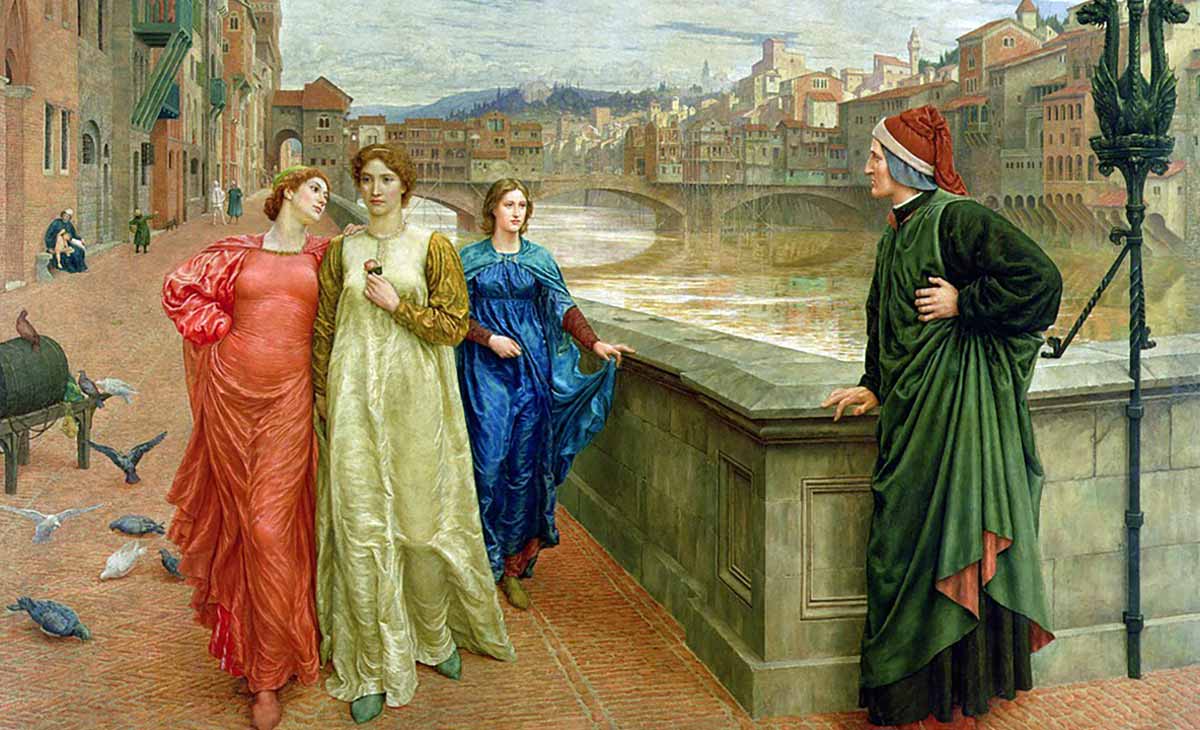
The poet fulfils his promise about 40 years later with his Divine Comedy, where Beatrice serves as both his guide and teacher, helping him address some of the most complex theological issues in Christianity. In the Paradiso, Beatrice, usually identified as Beatrice Portinari, retains her individuality while also being presented as an allegory of divine love and theology.
Indeed, the Divine Comedy, like most works of medieval literature, features different levels of interpretation. As a result, each historical figure with whom Dante interacts is both a “real,” earthly person and an allegory of something else. Moreover, in Dante’s worldview, where everything unfolds according to a divine plan, history and historical figures serve to anticipate future events. In this case, the Beatrice Dante meets in the afterlife is the fulfillment of her earthly qualities: spiritualized love.
Dante’s Cosmology: The Nine Heavens
The first canto of Paradiso begins when Dante is still physically at the top of Mountain Purgatory. Aware that he is about to write about topics that usually elude human understanding, the poet asks Apollo and the godly force for help to “show the shadow of the blessed realm inscribed within my mind.”
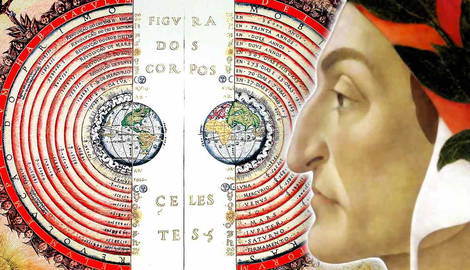
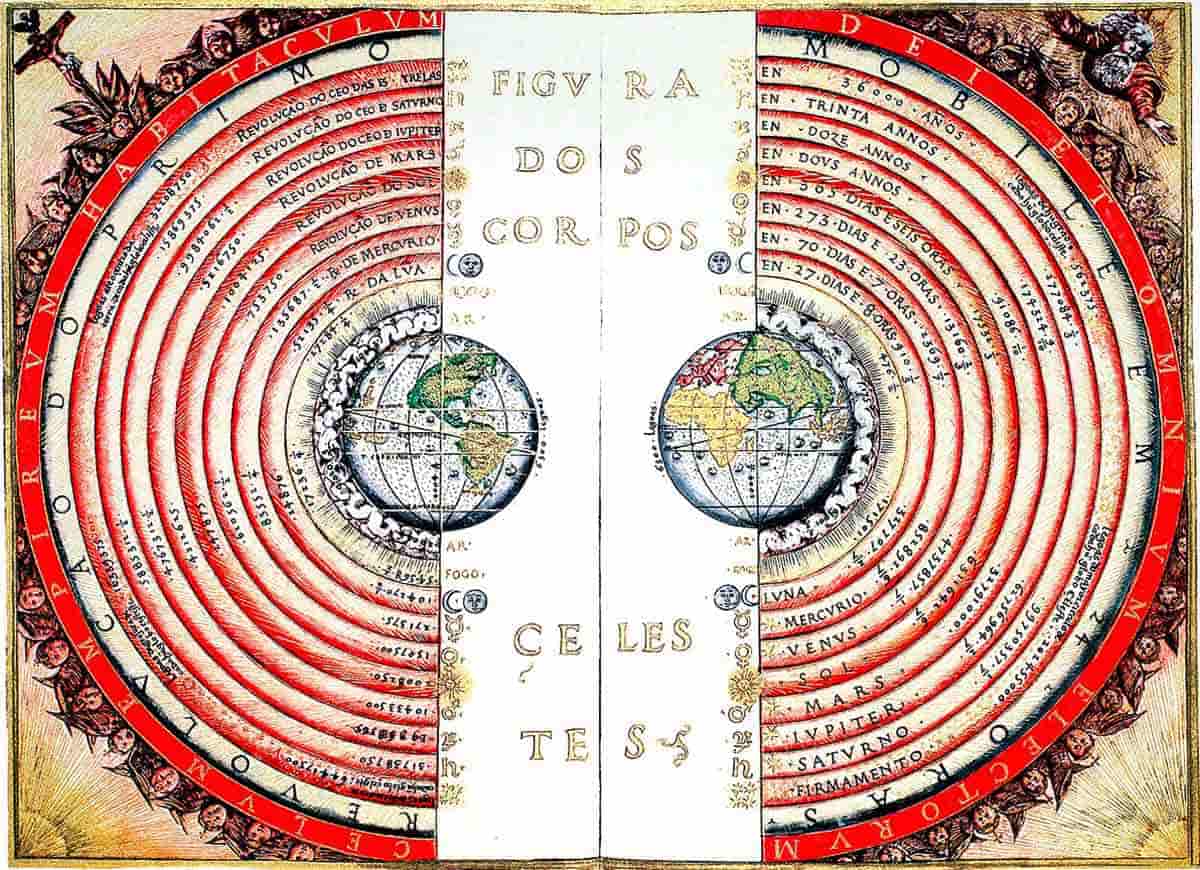
Moreover, Dante himself needs trasumanar (pass beyond the human) to enter the divine realm, an experience that “cannot be worded.” In the Divine Comedy, God’s realm is composed of nine heavens and the Empyrean, the immaterial region where God resides. Following the Ptolemaic understanding of the universe, Dante places the earth at the center of his cosmos.
Surrounded by spheres of air and fire, the planet is part of the so-called “sublunar world,” subject to change. The nine concentric celestial spheres, on the other hand, are immune to corruption. The first sphere, the Heaven of the Moon, is home to the souls of those who failed to fulfill their vows. From there, Dante travels to the Heaven of Mercury, where he encounters those who lived with too much ambition. In the third celestial sphere, the Heaven of Venus, reside those who loved with too much ardor.
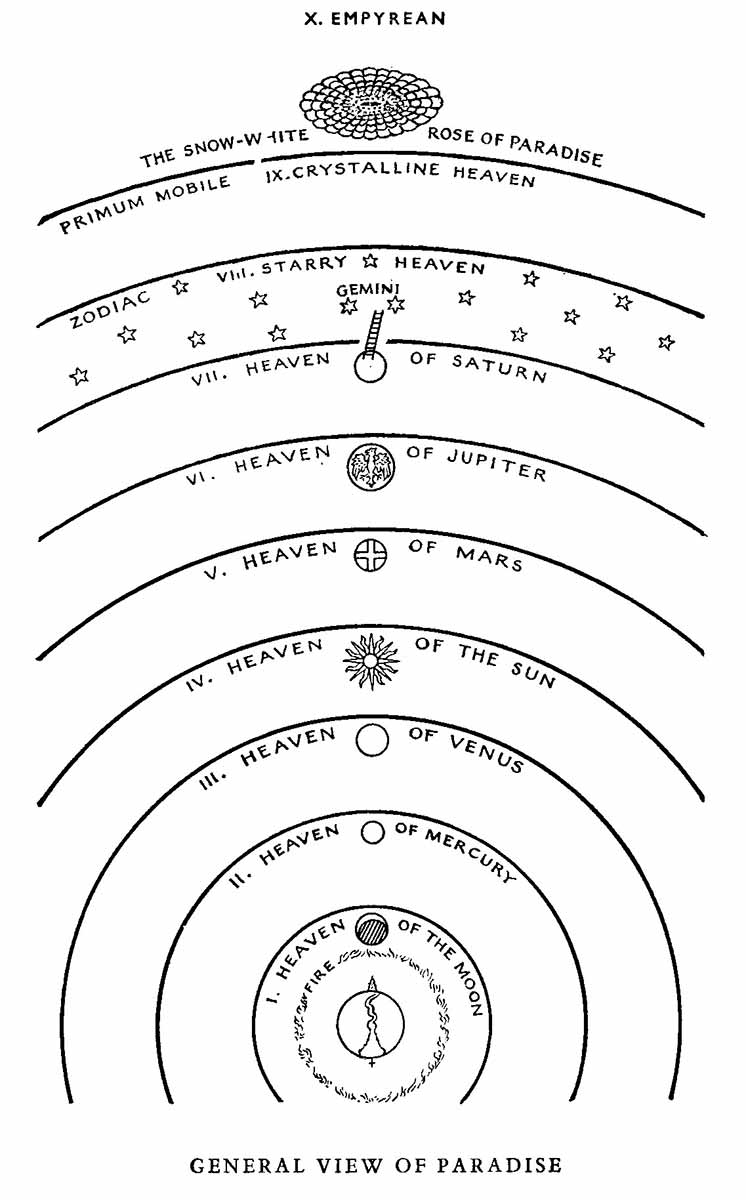
The fourth heaven, the Heaven of the Sun, is past the earth’s shadow. As a result, its souls are described in positive terms. There, Dante meets the wise. In the fifth sphere, the Heaven of Mars, reside the warriors of faith. The Heaven of Jupiter, the sixth celestial circle, is home to the just rulers. The souls of contemplative thinkers reside in the Heaven of Saturn. In the eighth sphere, the Heaven of the Fixed Stars, Dante witnesses the triumph of Jesus and the Virgin Mary.
From there, Dante and Beatrice move to the Primum Mobile, home of the angels, where the poet learns a new kind of world geography (more on that later). Beyond the ninth heaven is the Empyrean, the final leg of Dante’s supernatural journey.
A Divine Order
In Dante’s (medieval) worldview, every element of the universe (including Paradise) is part of a divine order, created according to God’s plan. “All things, among themselves, possess an order; and this order is the form that makes the universe like God,” explains Beatrice in the first canto of Paradiso.
The relationship of one part of the universe to another, as well as the relation of all things to their divine creator, is the great theme underlying the last cantica of the Comedy. As its 33 cantos offer an exploration of the harmonic structure of creation—and the truth about reality and humanity—the Paradiso has often been referred to as Dante’s most “mystical” work.
Influenced by Scholasticism, the leading philosophical system of the Middle Ages and, especially, by St. Thomas of Aquinas, Dante aims to encompass reality as a whole in his poem. More importantly, believing that the world can be (rationally) explained through a harmonic conceptual system, the Florentine poet sees the Comedy as a means to restore the right order (diritta via), lost amid the political (and spiritual) turmoil of his time.
Endowed with intelligence and free will, human beings are the only creatures able to stray from the right track. On the other hand, their yearning for knowledge makes them the only created being capable of discerning the divine truth, the ultimate meaning of the universe.
“The Great Sea of Being”: The One and the Many
Dante presents the idea of the universe as a harmonic creation of God in the opening verses of the Paradiso, where he states: “the glory of the One who moves all things permeates the universe.” However, the celebration of the “oneness” of all things with their creator is immediately followed by a paradox: God’s glory “glows in one part more and in another less.”
The coexistence of unity and diversity is one of the central themes of the Paradiso. While everything that exists is created and sustained by God (the existence itself), some parts of the universe receive a lesser amount of divine light.
To explain the paradox of “the One and the Many,” the same paradox captured by the Christian concept of the Trinity, Dante resorts to an ontological metaphor: lo gran mar de l’essere (the great sea of being). While all things derive and tend to the same end (God), “every nature has its bent, according to a different station, nearer or less near to its origin. Therefore, these natures move to different ports across the mighty sea of being, each given the impulse that will bear it on.”
In the third canto of the Paradiso, Dante returns to the relationship between oneness and multiplicity, asking Piccarda Donati (more on her later) whether the souls of the outer heavens envy those nearer to God. In her answer, Piccarda explains how Paradise is the place where souls are at one with God and all desires are always satisfied. Going back to the sea metaphor, Piccarda tells Dante: “And in His will there is our peace: that sea to which all beings move—the beings He creates or nature makes—such is His will.”
In The Undivine Comedy, Teodolinda Barolini notes that Dante “does not so much attempt to resolve as hold up for scrutiny” the paradox of unity and diversity, adding that “our poet seems more to revel in it than to want to cover it over.”
Key Encounters in the Paradiso
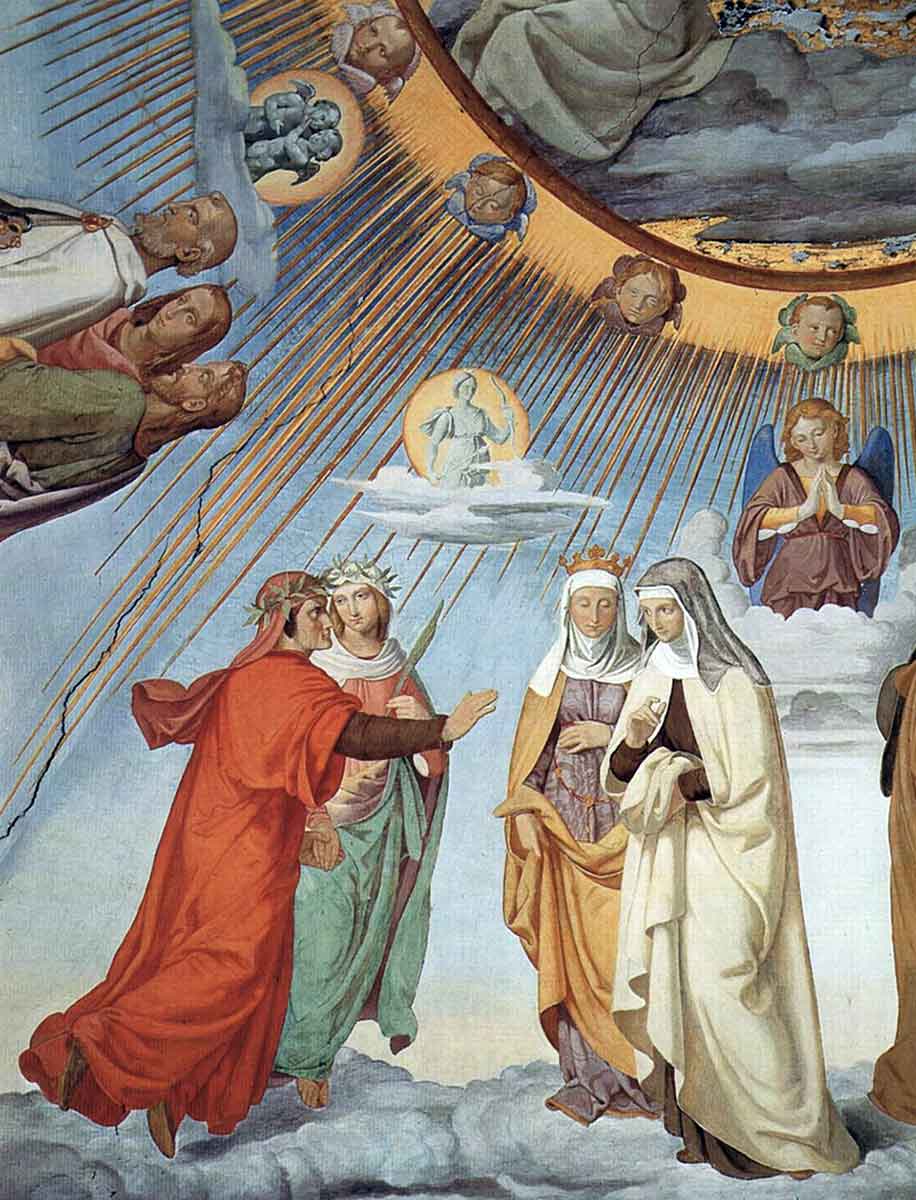
During his encounter with Piccarda, Dante not only reflects on the ontological challenges within the “sea of being,” but he also addresses Florence’s history of political violence. Indeed, the Divine Comedy, which the poet started during his exile, is both an allegory of humankind’s hope for redemption and a commentary (and solution) on Italy’s 14th-century political crisis.
The sister of Forense Donati, whom Dante met in Purgatory, Donata was kidnapped from the cloister on the order of her other brother, Corso Donati. Corso was the leader of the Guelfi Neri (Black Guelphs), the faction opposing Dante’s political group, the White Guelphs. It was the Black faction that condemned Dante to death in absentia in 1302.
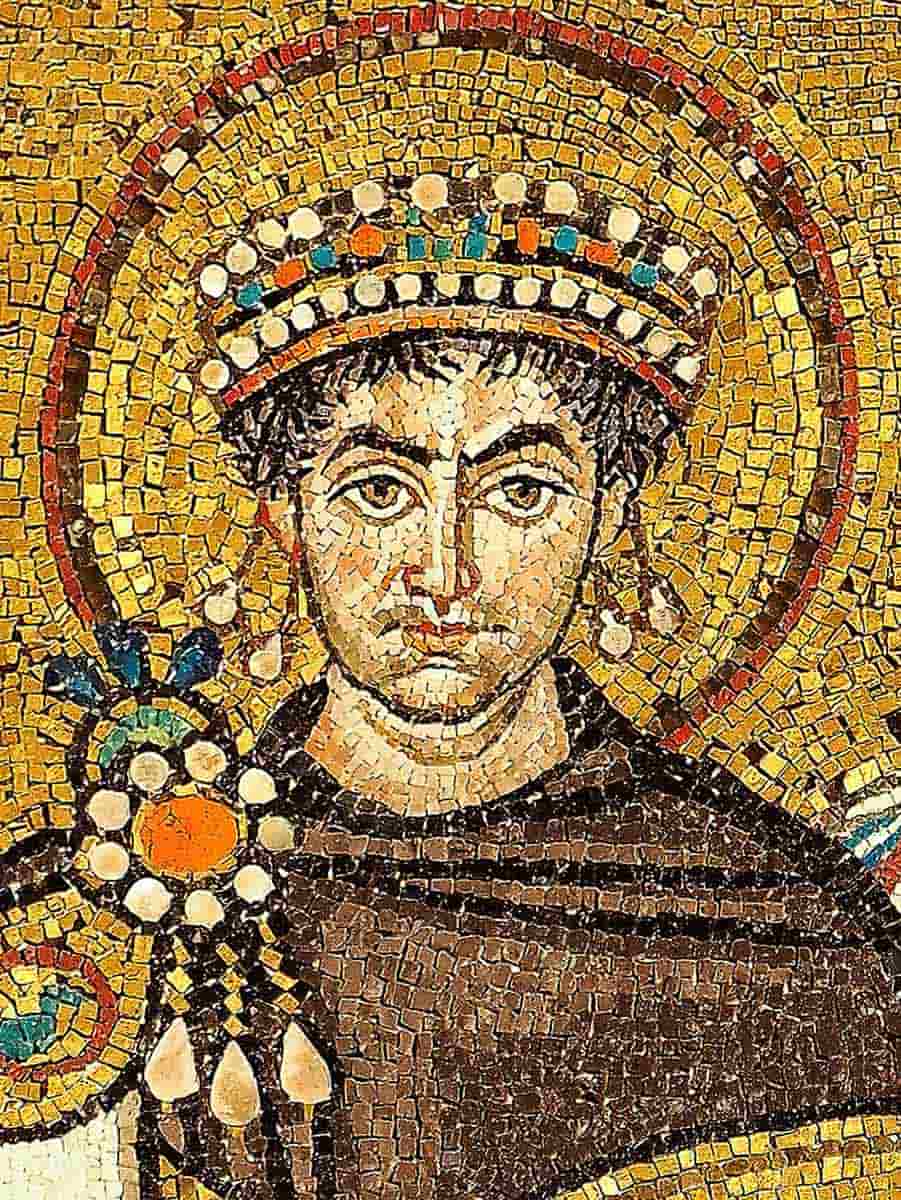
History and politics are also at the center of the sixth canto. (The sixth canto of each section deals with politics as seen from an increasingly broader perspective, from Florence to the empire.) There, in the Heaven of Mercury, Dante speaks with the Byzantine Emperor Justinian. A complex narrative, the meeting with Justinian frames the Roman Empire (seen as a preparation for the coming of Jesus) within Christian providential history. At the same time, the canto condemns the weakness of the contemporary empire, a pawn in the bloody rivalry between Guelphs and Ghibellines.
In the Heaven of Mars, Dante then delves into his family history during his conversation with Cacciaguida, his great-great-grandfather. In addition to explaining to the poet the origins of his family name, Cacciaguida bemoans the decay and corruption of Dante’s Florence, recalling the idyllic old times, when the city, “sober and chaste, lived in tranquility.” In a show of medieval rhetoric, Dante puts Cacciaguida, a knight killed in the Second Crusade, among the warriors of faith.
The conversation becomes theological once again when Dante meets St. Thomas of Aquinas (Heaven of the Sun) and the first human, Adam. Justinian had already explained how the crucifixion of Jesus was the just punishment for humankind’s original sin. Now, Dante gets to know the true cause of this offense: the trespassing of the boundary placed by God on humankind.
The End of the Journey & the Vision of God
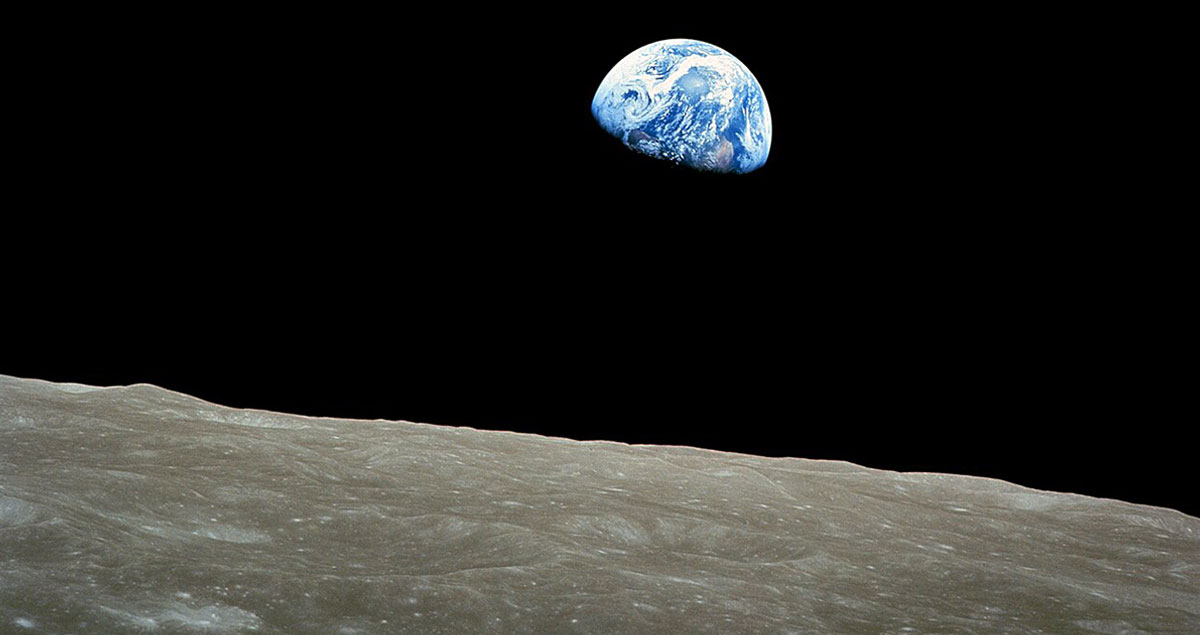
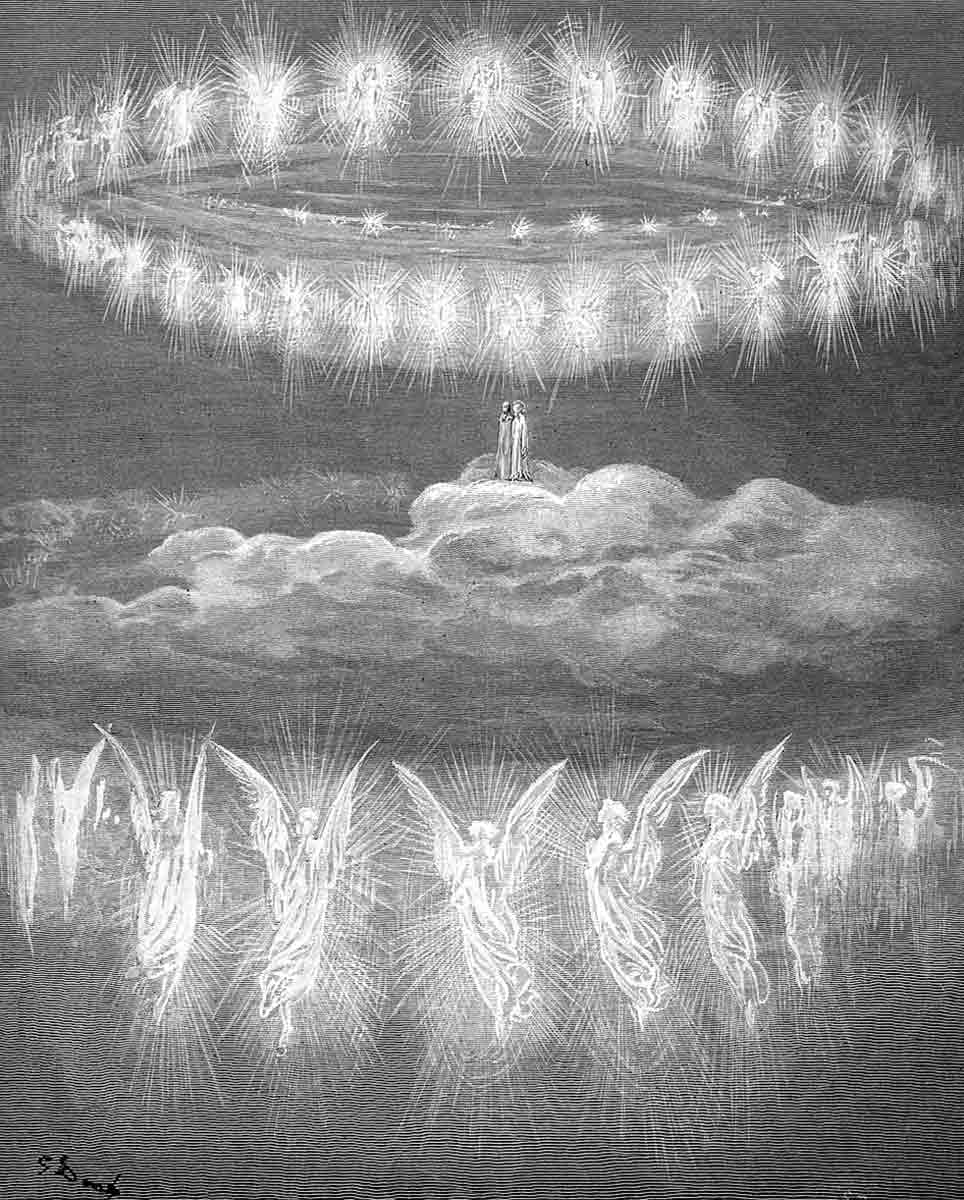
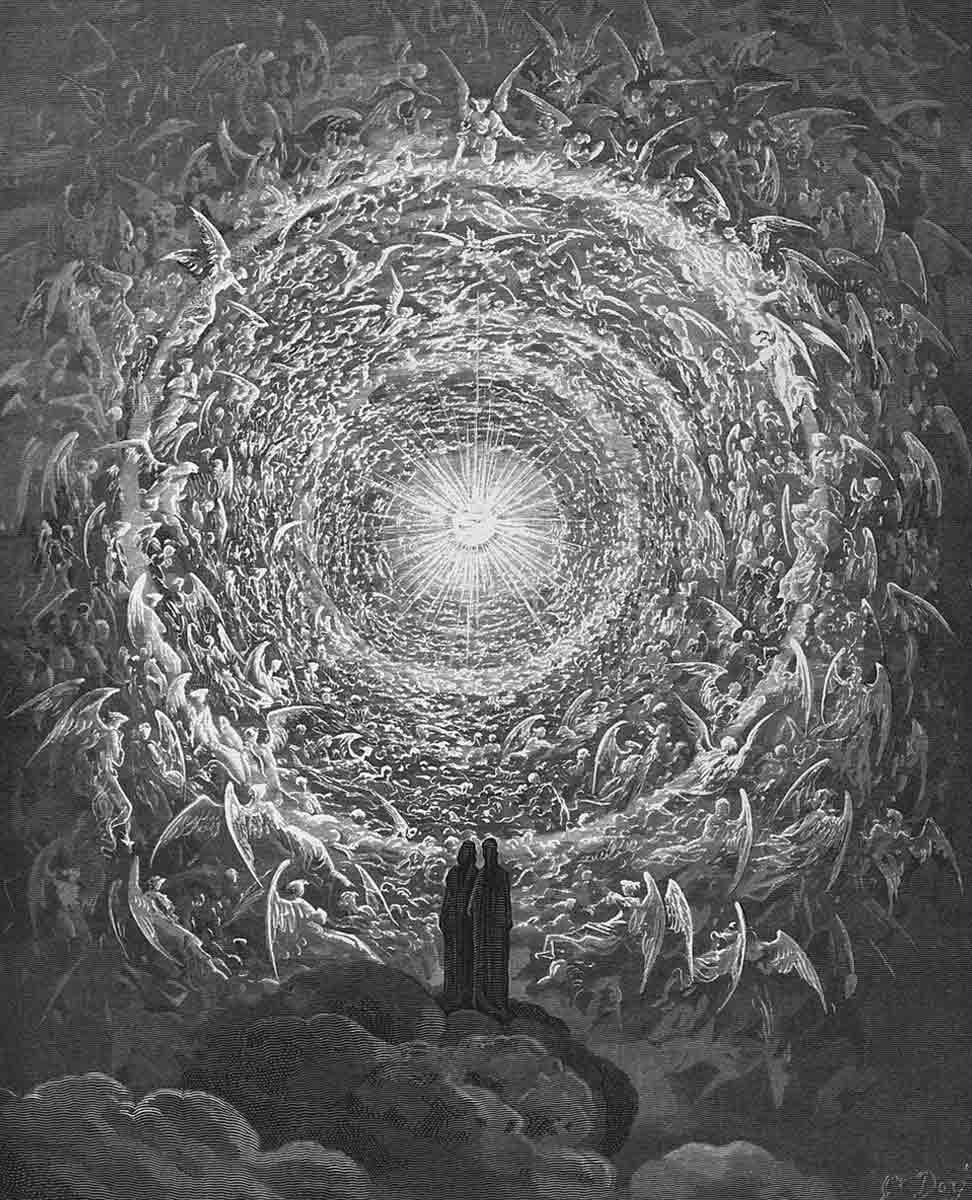
As Dante journeys through the heavenly spheres, he turns his attention to increasingly complex theological issues. In the Primum Mobile, he is even confronted with an alternative perspective of the universe. As in 1968, the crew of Apollo 8 was amazed by the sight of the Earth rising above the lunar horizon, so Dante is granted a unique vision: the image of the universe with God as a luminous point at its center.
After witnessing the angelic hierarchies circling around the center of the universe, Dante and Beatrice enter the Empyrean, the “heaven that is pure light.” In a series of “phantasmagoric visions,” the poet recalls his tour of the inner heavenly realm: a river of light turns into a circle, which then acquires the shape of a hillside and a rose. Finally, the rose turns into a city, the celestial Jerusalem, with an empty throne at the center. The imperial seat awaits Henry VII, the emperor who, in Dante’s political vision, “shall show Italy the righteous way-but when she is unready.”
At the end of the tour of the Rose of the Blessed, Beatrice is replaced by the medieval mystic St. Bernard of Clairvaux, Dante’s guide for the last leg of his journey. St. Bernard urges the poet to pray to the Virgin Mary before directing his gaze to the primo amore (Primal Love), the divine principle holding the universe together.
Lamenting the difficulty to recount his visions, Dante, nevertheless, tries to verbalize his experience: “I saw—ingathered and bound by love into one single volume—what, in the universe, seems separate, scattered: substances, accidents, and dispositions as if conjoined.”
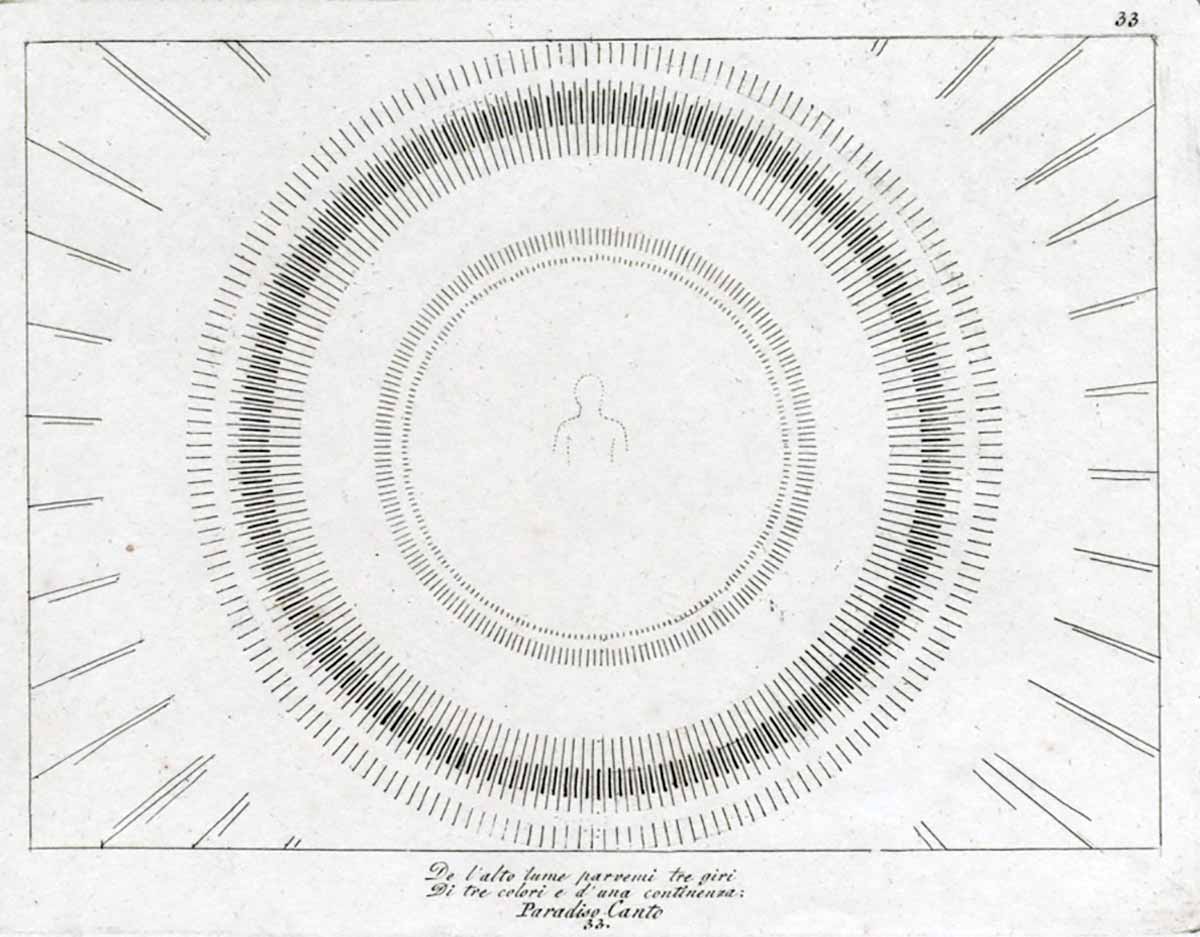
While gazing at the center of the divine light, the poet experiences the true nature of the Trinity: a series of three circles of three different colors, with the third appearing as “fire breathed equally by those two circles.” Then, Dante witnesses a human image appearing within the second circle (the Son), representing the mystery of the incarnation.
Finally, in the final verses of the Paradiso, Dante reaches his goal, the vision of God: “Here force failed my high fantasy; but my desire and will were moved already—like a wheel revolving uniformly—by the Love that moves the sun and the other stars.”