
Émile Bernard was born in 1868 in Lille, northern France, as the son of a textile merchant. The artist created his first drawings and paintings when he was 14 years old and two years later, he joined the studio of Fernand Cormon in Paris. Cormon’s studio was well-known among Parisian artists and was attended by Henri Toulouse-Lautrec, Louis Anquitin and even Van Gogh. Here, Bernard practiced sketching plaster casts and working with live models. He also developed a friendship with Toulouse-Lautrec and Anquitin.
Émile Bernard as a Young Artist in Paris
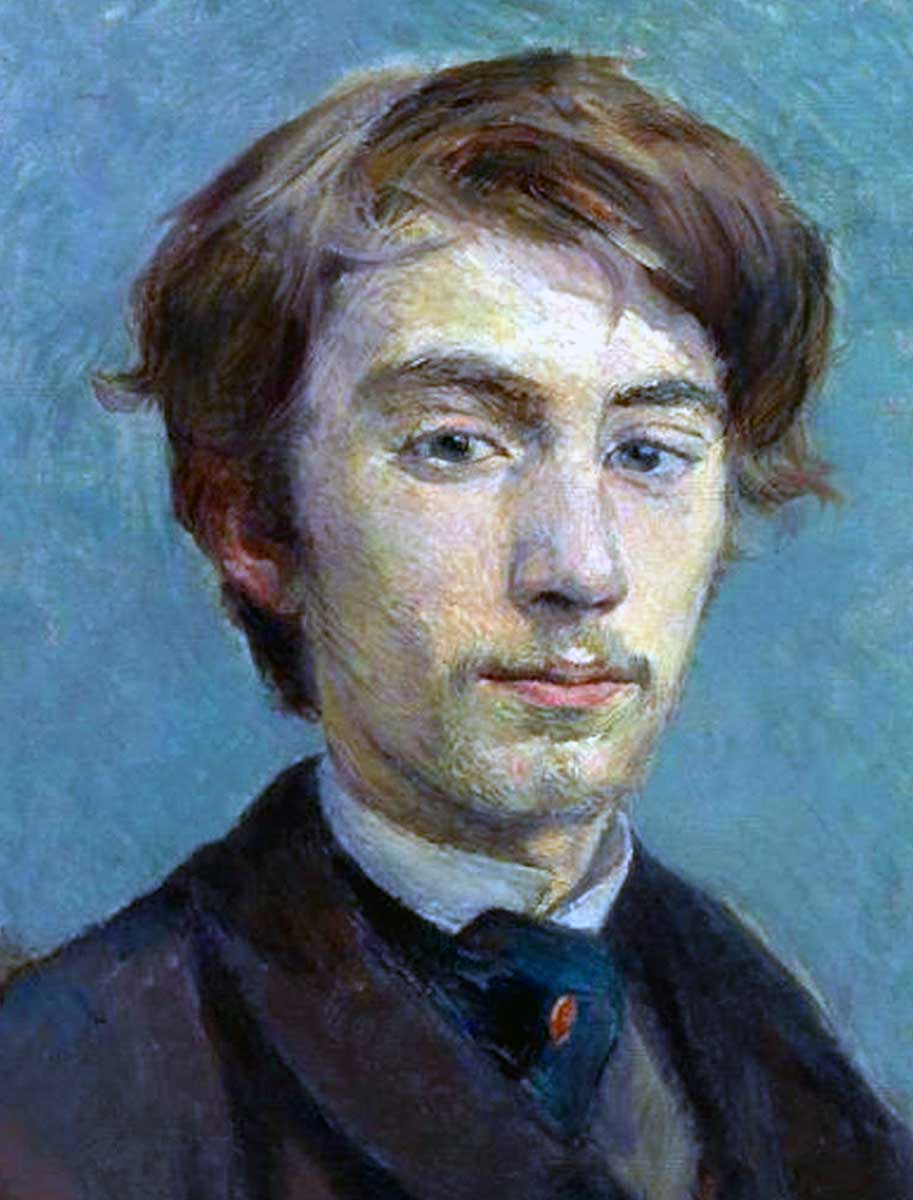
Bernard was one of the artists of the Petit Boulevard in Paris, as Van Gogh named the younger generation of French artists in the city, including Georges Seurat, Anquetin, Toulouse-Lautrec, Paul Signac, and a few others. Bernard was fairly young when he joined this group but soon became an important part of this community. He met Van Gogh in Paris in 1886-87, and the two artists soon developed a professional relationship, learning from each other. It was during this time that Bernard, along with Anquetin, started experimenting with flat forms and using pure color. Apart from Japanese prints, their inspiration lay in stained-glass windows and medieval enamels. These stylistic experiments soon developed into Cloisonnism.
The Cloisonnist Style
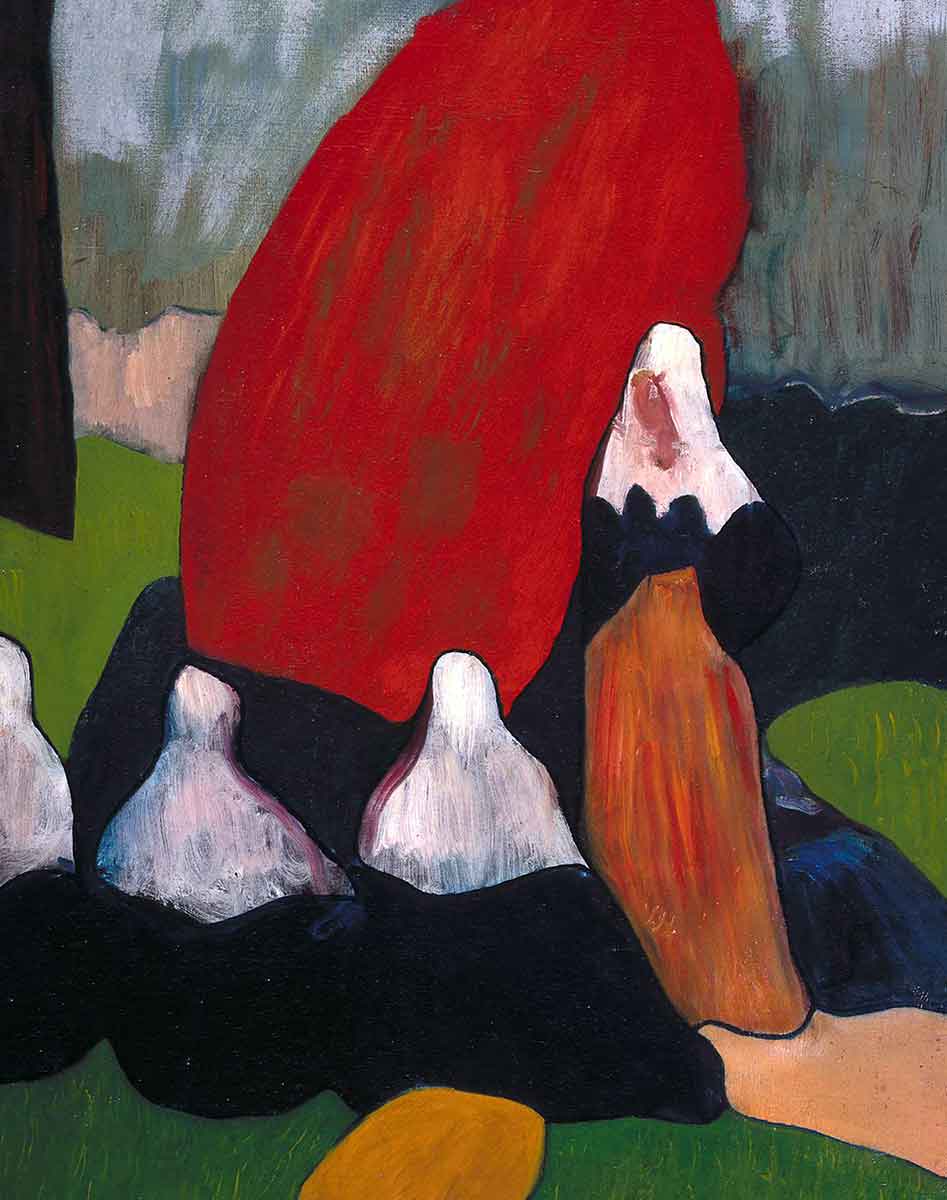
Cloison in French translates to sections or partitions. The Cloissonist style was, therefore, characterized by thick, bold lines that create partitions on the painting surface, which are then filled with pure, unmixed colors. Traditional pictorial perspective was left behind in this style, creating a simplified and flat composition where forceful lines and saturated color impart intensity and a decorative effect to the painting. An important feature of Bernard’s works was a lack of details and shadows, which, on the contrary, was the cornerstone of realism. His paintings prioritized highlighting the essential aspects of the subject to convey its essence, which included the major forms, lines, and colors. He boiled down the subject to its primary properties and painted highly simplified figures. To summarize, Bernard focused on subtracting over adding; that is, his Cloisonnist works were composed of lesser details and colors to focus on what was significant and essential without the interruption of a myriad of components.
The Birth of Symbolist Painting
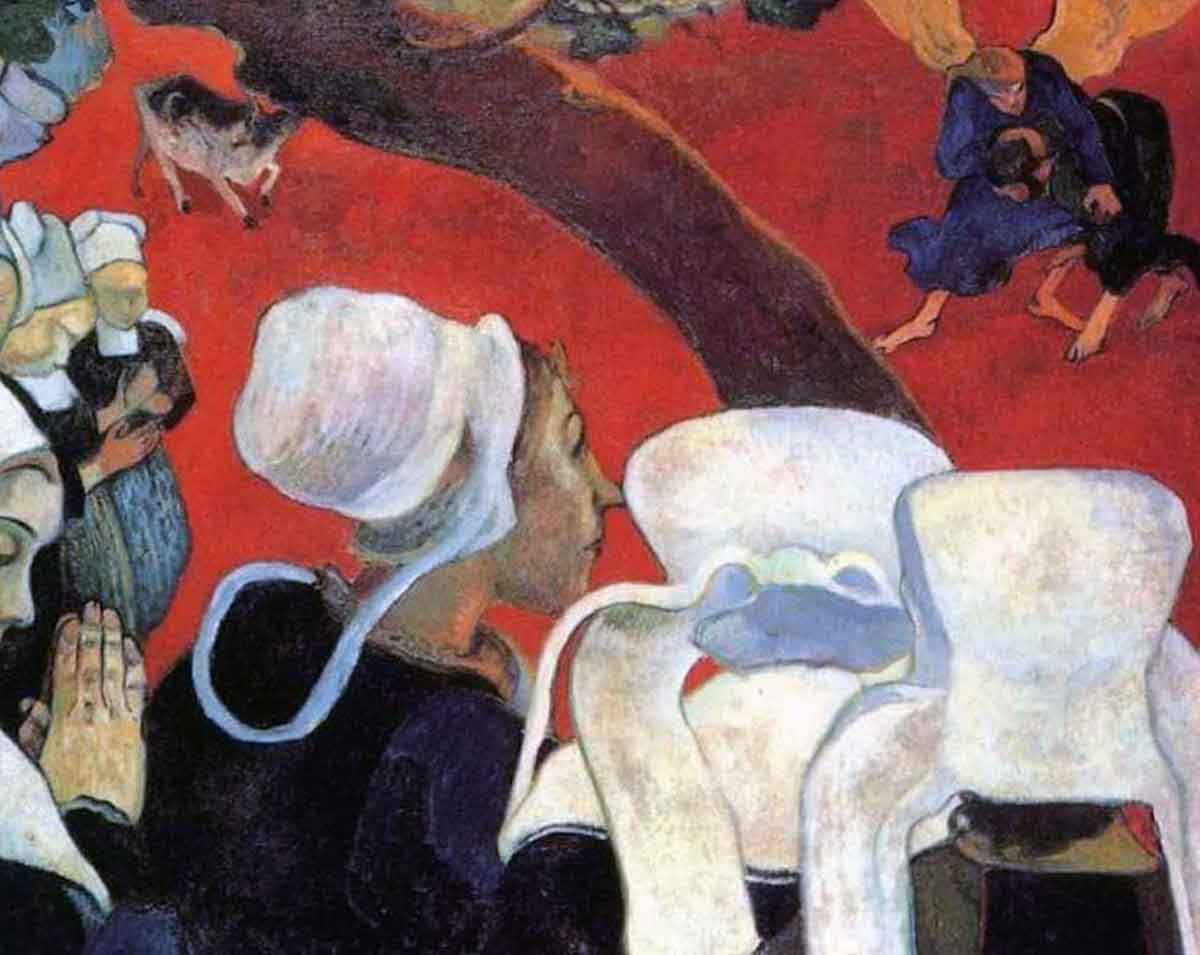
Bernard took off from Paris in January 1888 for Pont-Aven in Brittany. He had spent around two months in the village in 1886, where he became acquainted with Gauguin, but it was only in 1888 that their friendship developed. The two artists worked together and experimented with a style that was to become the beginning of Symbolism in painting, the ideology wherein artistic expression was linked to the artist’s subjectivity. Here, form, line, and color are simplified for emotional expression.
In Pont-Aven, Bernard created a painting titled Breton Women in the Meadow, and around the same time, Gauguin painted Vision After the Sermon. These paintings were instrumental in the development of Symbolism—the scenes were painted from memory or the imagination, only concentrating on their essential aspects through a simplification of pictorial elements. However, these paintings were also a factor in the rift that emerged between the two artists. Despite being painted around the same time, only Gauguin’s work was recognized as the origin of Symbolism in art by Symbolist critic and poet Albert Aurier in 1891. Bernard was offended and claimed that his work preceded Gauguin’s, but there is no consensus in art historical research regarding this issue. The artists had their last contact that year.
After the break with Gauguin, along with Van Gogh’s death in 1890, the young Bernard’s productivity declined. Nevertheless, he was an important member of the avant-garde artists in late 19th-century Paris and created some exceptional works, making a significant contribution to modern art.
1. Breton Women in the Meadow (1888)
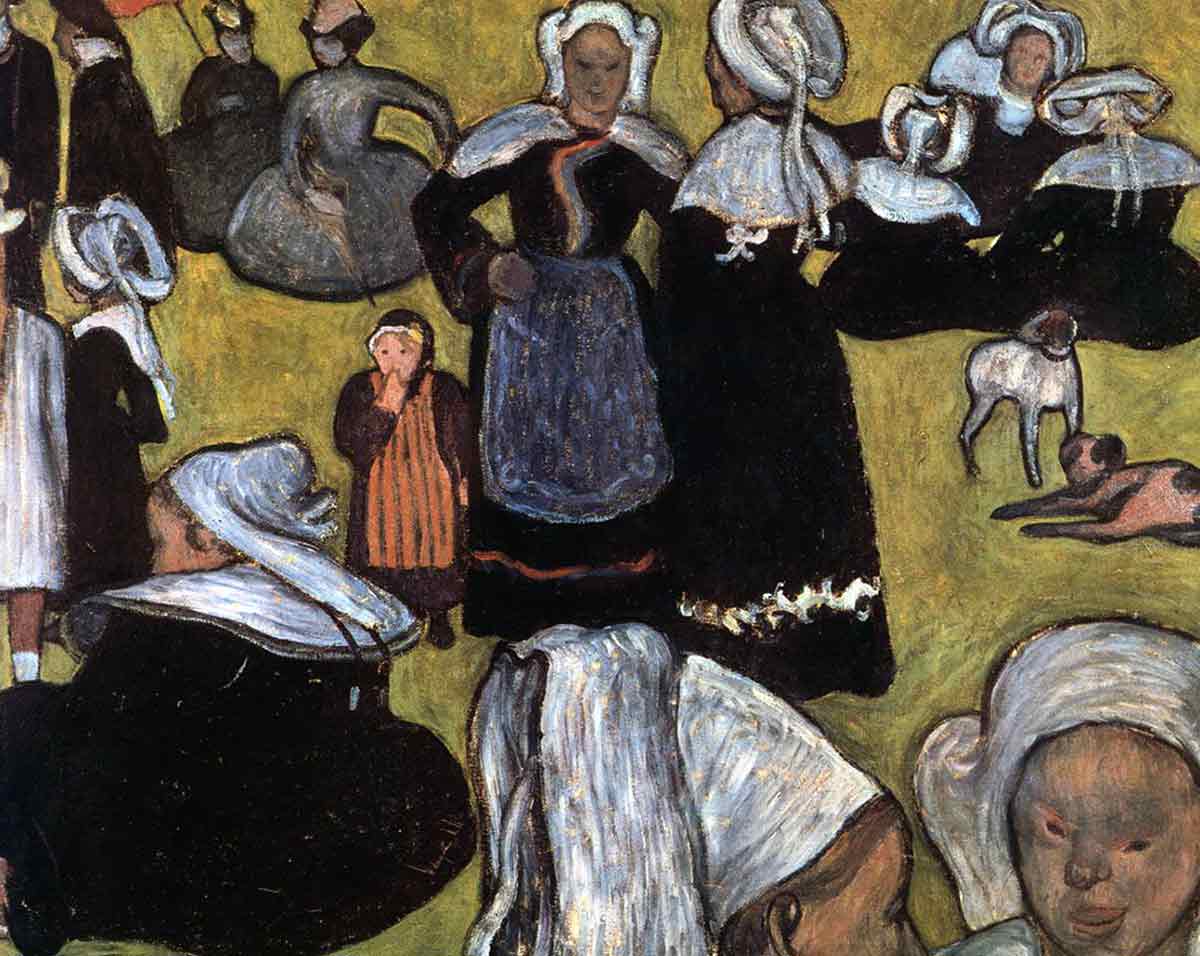
In the summer of 1888, Bernard was experimenting with the Cloisonnist style in Pont-Aven, Brittany. Breton Women in the Meadow was one of the results of this experiment and is one of Bernard’s most famous works. Dominated with yellow-green and black, this composition is a great example of Bernard’s Cloisonnist style. The composition lacks traditional perspective with the lack of shadows or a horizon, making it completely flat. The artist’s free treatment of line in this work creates an undulating effect, and Bernard keeps the overall composition simplified.
As mentioned above, Bernard was a religious man, and Breton Women in the Meadow has Christian undertones. The painting depicts a scene of a pardon in Pont-Aven, which was a religious occasion during which people gathered to participate in devotional practices. While there has been disagreement among scholars regarding the painting’s depiction of a Pardon due to the lack of any recognizable Christian iconography, it is highly possible that Bernard chose to focus on the social aspect of the religious occasion by presenting a gathering of women and children. Today, the painting is in the collection of Musée d’Orsay, Paris, and is titled Le Pardon by the museum.
2. Vase of Flowers & Cup (1887-88)
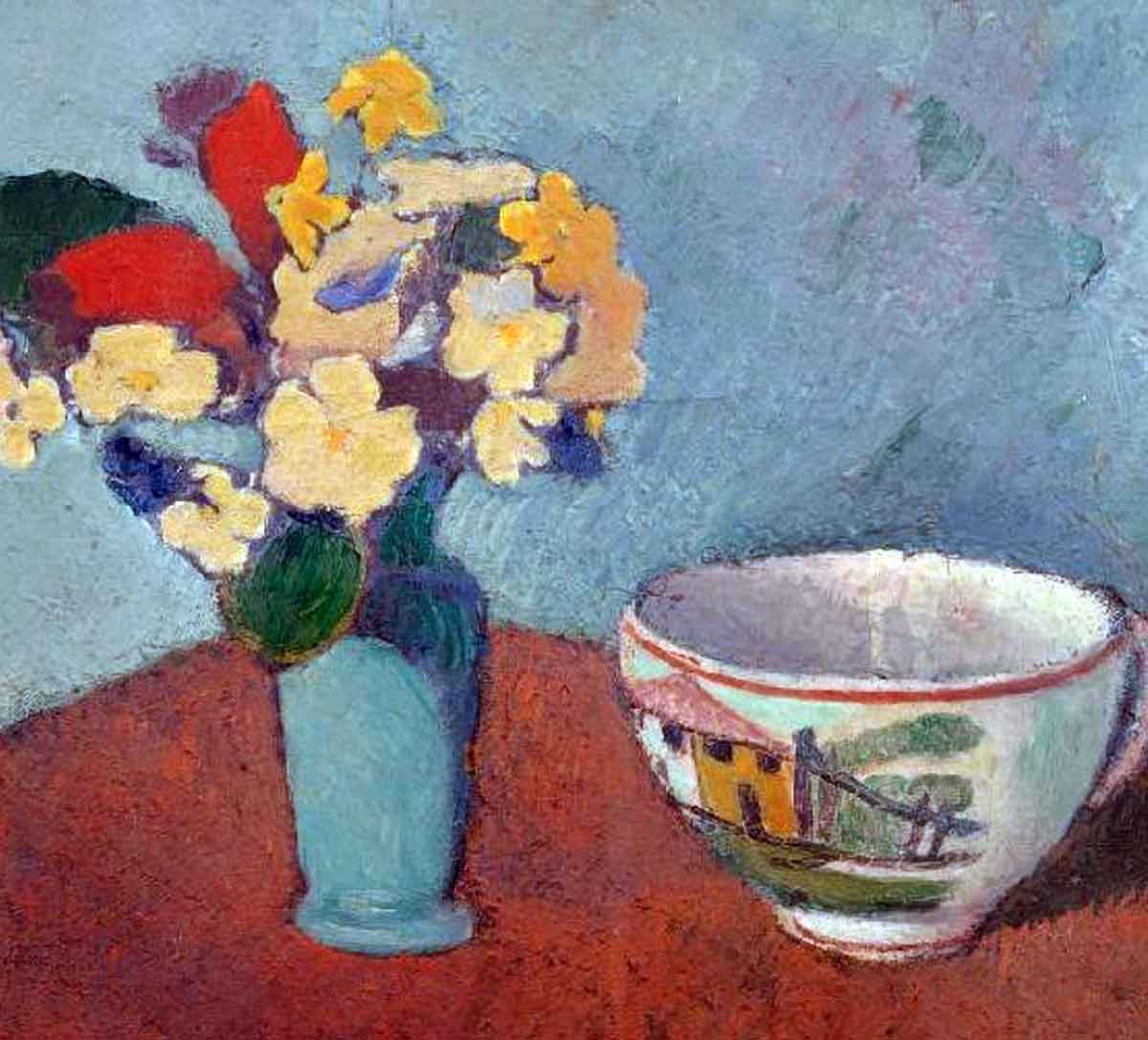
Vase of Flowers & Cup is one of nineteen known still-lifes painted by Bernard in 1887-88. As can be seen in this composition, Bernard painted highly simplified forms of the objects depicted without any realistic detailing. The background wall, as well as the table on which the vase and cup are placed, are painted with broad, almost invisible brushstrokes forming large areas of unsaturated color. The figures of the flowers, the vase, the cup, and the decoration on the cup are distinguishable through thick outlines.
As mentioned before, Bernard sought the essential qualities of the subjects he depicted by simplifying forms and colors. He believed that simplification paved the way for understanding the essence of the subject, which he held to be in higher regard than a realistic reproduction. This is proved even further in Vase of Flowers & Cup when we discover that the blue background was an overpainting. Bernard had originally planned to paint a window on the right side of the composition but decided to leave it plain. While there is no explicit explanation from the artist for this decision, it can be taken as an attempt at simplicity. Today, this painting sits in the Van Gogh Museum collection in Amsterdam.
3. Self-Portrait With Portrait of Gauguin (1888)
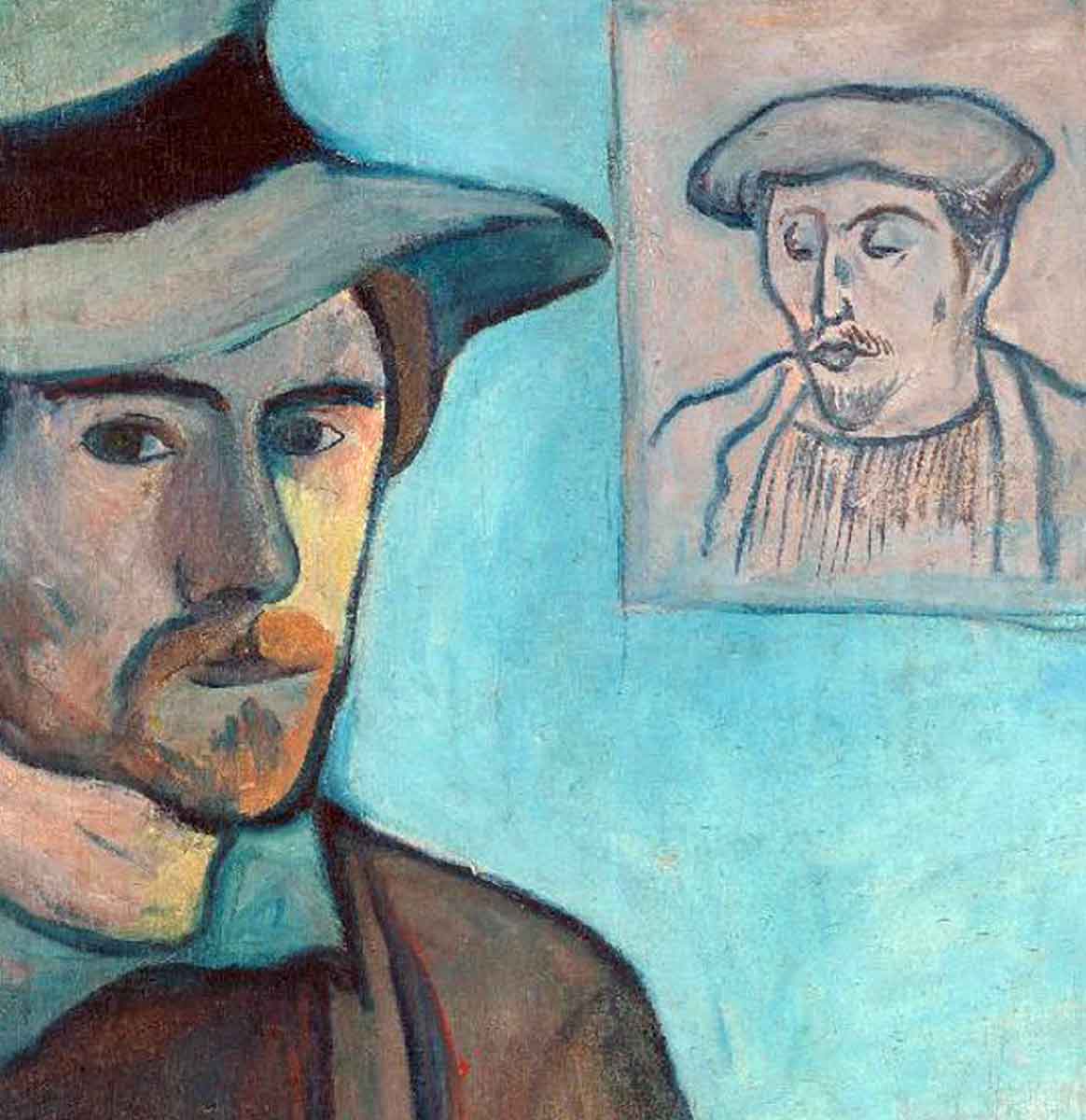
This self-portrait by Bernard hearing a hat with a portrait of Gauguin hanging on the background wall was painted at the request of Van Gogh. The Dutch artist had originally urged Bernard and Gauguin to paint portraits of each other while they were working together in Pont-Aven. However, Bernard, a much younger artist, was hesitant to paint Gauguin, who was 20 years older. On Van Gogh’s further persuasion by invoking the practice of painting portraits among Japanese artists, the two French artists sent him their self-portraits with a portrait of the other in the background.
As can be seen in the composition, the actual portrait of Gauguin is nothing more than a sketch, while the self-portrait is painted with much more attention, with thick lines contouring Bernard’s figure. Yet, Gauguin’s portrait is placed in the center of the composition, and Bernard’s face is cut off in the corner—almost as if he is making an appearance in the composition dedicated to Gauguin. On the top right of the canvas, there is an inscription dedicating this painting to Van Gogh, who was very fond of this self-portrait. This painting was saved by Van Gogh and is today kept as a symbol of the friendship between these artists in the Van Gogh Museum.
4. The Buckwheat Harvesters (1888)
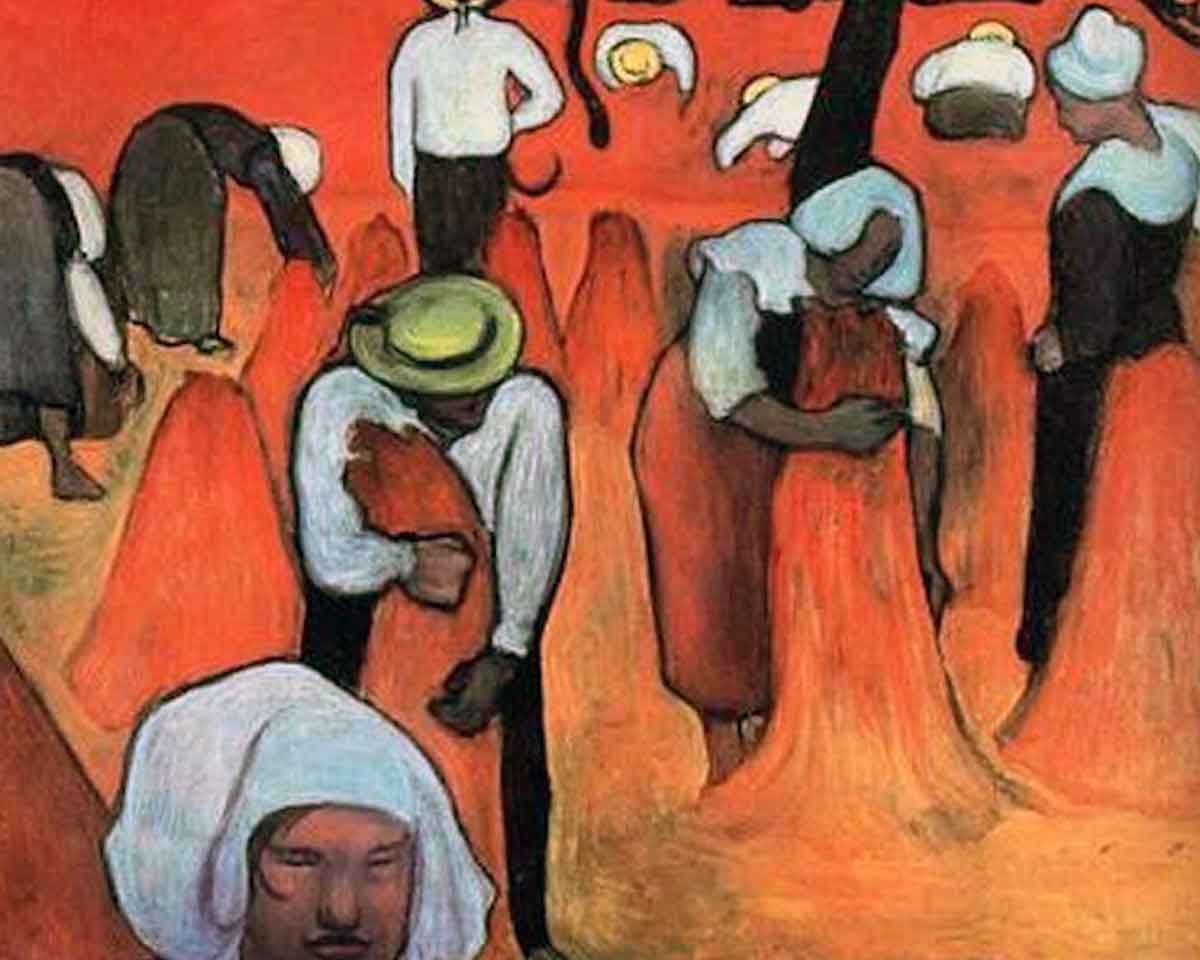
For this work, Bernard chose to depict harvesters, which are a common theme in realist paintings but portrayed them as stock figures through silhouettes without recognizable features. All we see are human laborers performing the necessary act of harvesting a crop. The Buckwheat Harvesters was painted in Brittany, where buckwheat was grown in abundance. The dominating vermillion in the painting gives a fiery impression but is meant to represent the buckwheat crop, which turns this color in the fall.
Bernard considered this work a counterpart to the first painting in this list, Breton Women in a Meadow. These paintings were displayed together in two different exhibitions—the Volpini Exhibition of 1889 and the 1892 Salon des Independants exhibition. Both paintings are easily distinguishable as works from Brittany due to the traditional clothing of Breton women. The works show Bernard’s Cloisonnist achievements through flat compositions and a strong use of line. Further, both paintings have contrasting color schemes, which suggests that Bernard had planned for them to be a pair. However, The Buckwheat Harvesters today sits in a private collection, and the two paintings are no longer displayed together.
5. Émile Bernard’s Brothel Scene (1888)
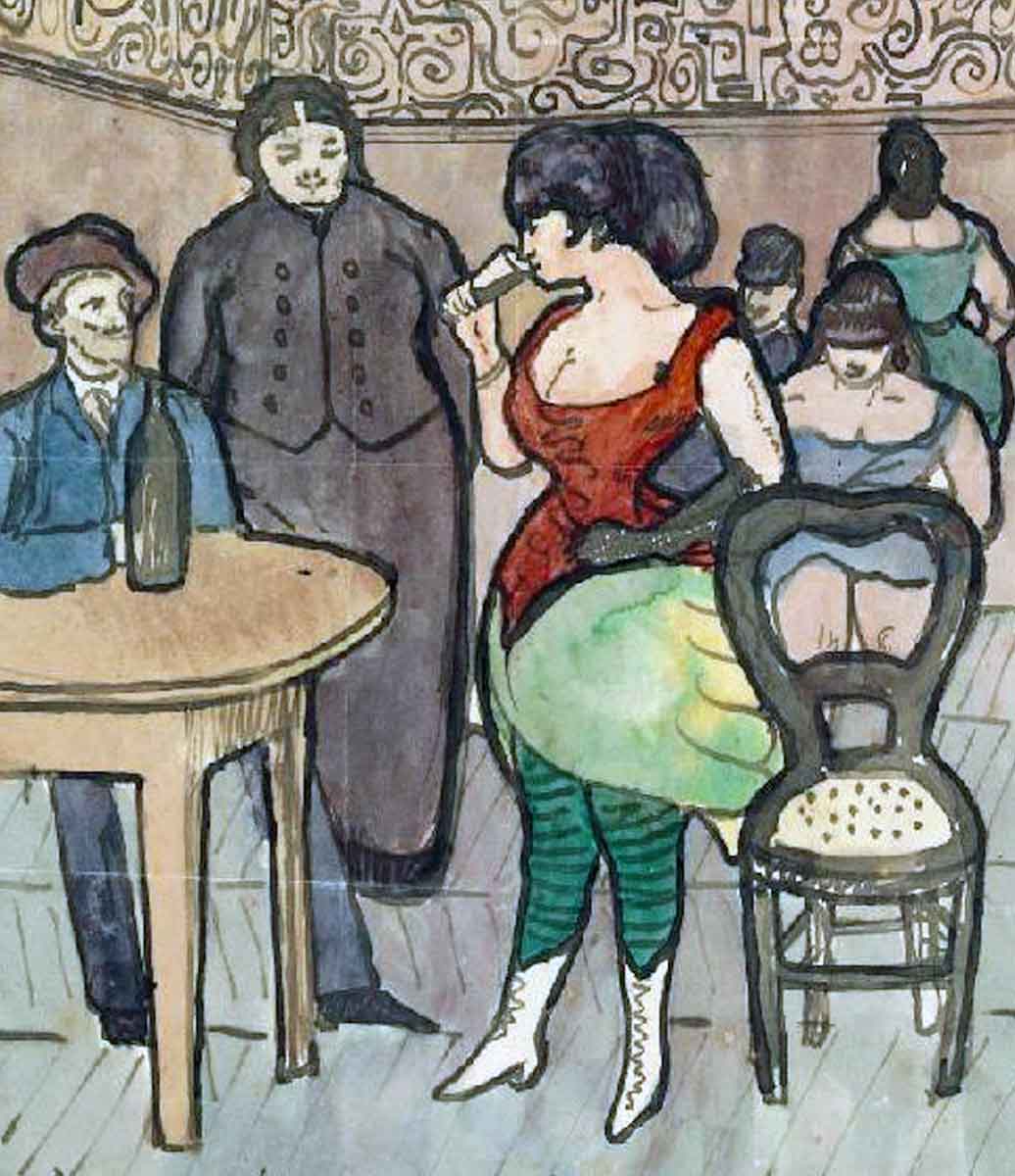
Several artists, including Henri Toulouse-Lautrec, adopted the theme of prostitution in the late 19th century. Sex work had become an essential aspect of modern Parisian life and was of interest to young artists who connected their artistic theories to their social environment. The central subject of Brothel Scene seems to be the woman in red seducing the man on her right sitting at the table. Behind him stands another woman, the owner of the brothel, watching over the prostitute.
Currently in the Van Gogh Museum in Amsterdam, Brothel Scene creates an interesting contrast in Bernard’s oeuvre while also exemplifying the artist’s ability to capture the essence of his subjects and themes. He chose brothels as a contemporary subject to depict city life in Paris, while his Breton works personify the countryside through harvesters and landscapes. Apart from the above watercolor, Bernard painted numerous brothel scenes as brothels were common in Montmartre, the Parisian street that was a meeting point for artists. These works are either sketches or watercolors and were often accompanied by a poem that acted as a verbal commentary on prostitution.