
The longstanding popularity of The Ambassadors is probably owing to its mysterious character. The double portrait raises more questions than it answers. At first glance, Holbein presents a dazzling display of wealth, diplomacy, humanistic knowledge, and artistic bravado. Yet the painting constantly undermines its own confidence. The monumental double portrait juggles themes of worldly achievement against ideas about mortality and spiritual uncertainty. Nearly five centuries later, historians still debate the meaning of its objects, the intended viewing angle of the skull, and even the effects of its modern restoration.
1. Hans Holbein’s “The Ambassadors” Is Quite Big
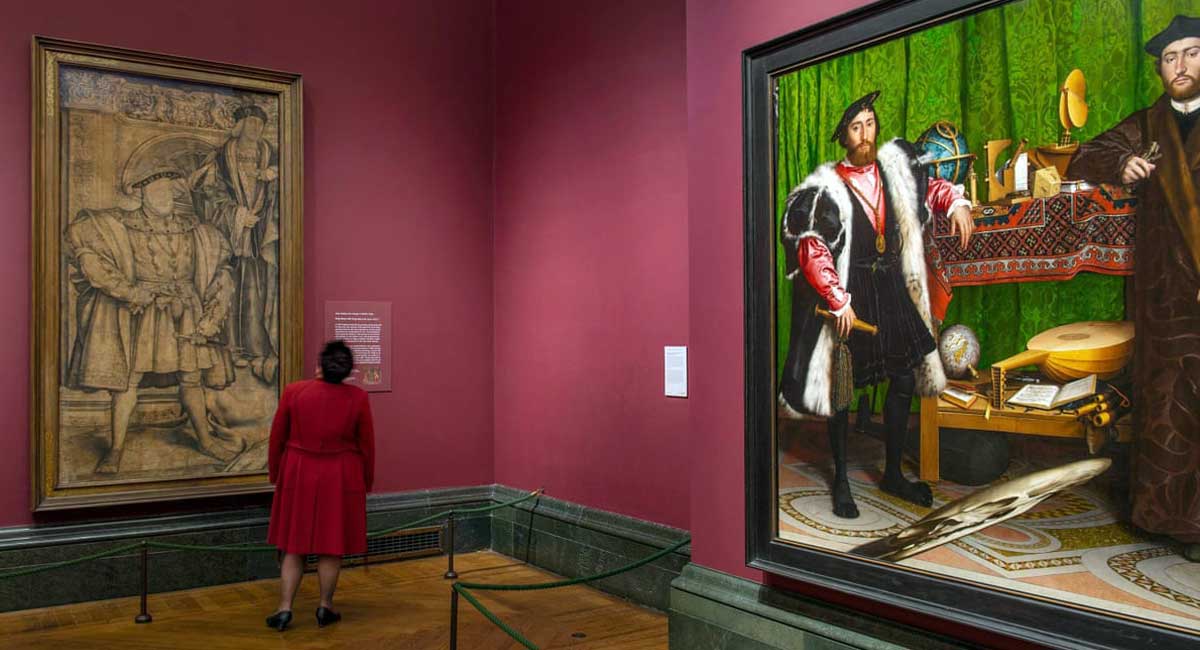
If you visit the National Gallery in London today, one of the most eye-catching paintings is certainly Hans Holbein the Younger’s (1497/98-1543) The Ambassadors. That’s not only because of its allure, but also because of the sheer size of the portrait. Making viewers feel like they were in the same room as the depicted figures was not yet a common feature of Renaissance portraiture. Holbein himself painted very few full-length portraits.
Painted on an oak panel, the double portrait is 81 inches wide and 82 inches tall. Size-wise, it’s Holbein’s largest production. Advanced technical reports show that despite its size, the painting was executed faster than previously believed.
The project itself appears to have started in mid-April and was completed by June 4, 1533. For a Renaissance portrait with the complexity and stylistic prowess of The Ambassadors, both the scale and iconographical detail are highly unusual.
2. The Sitters Were Some 20-Something Friends
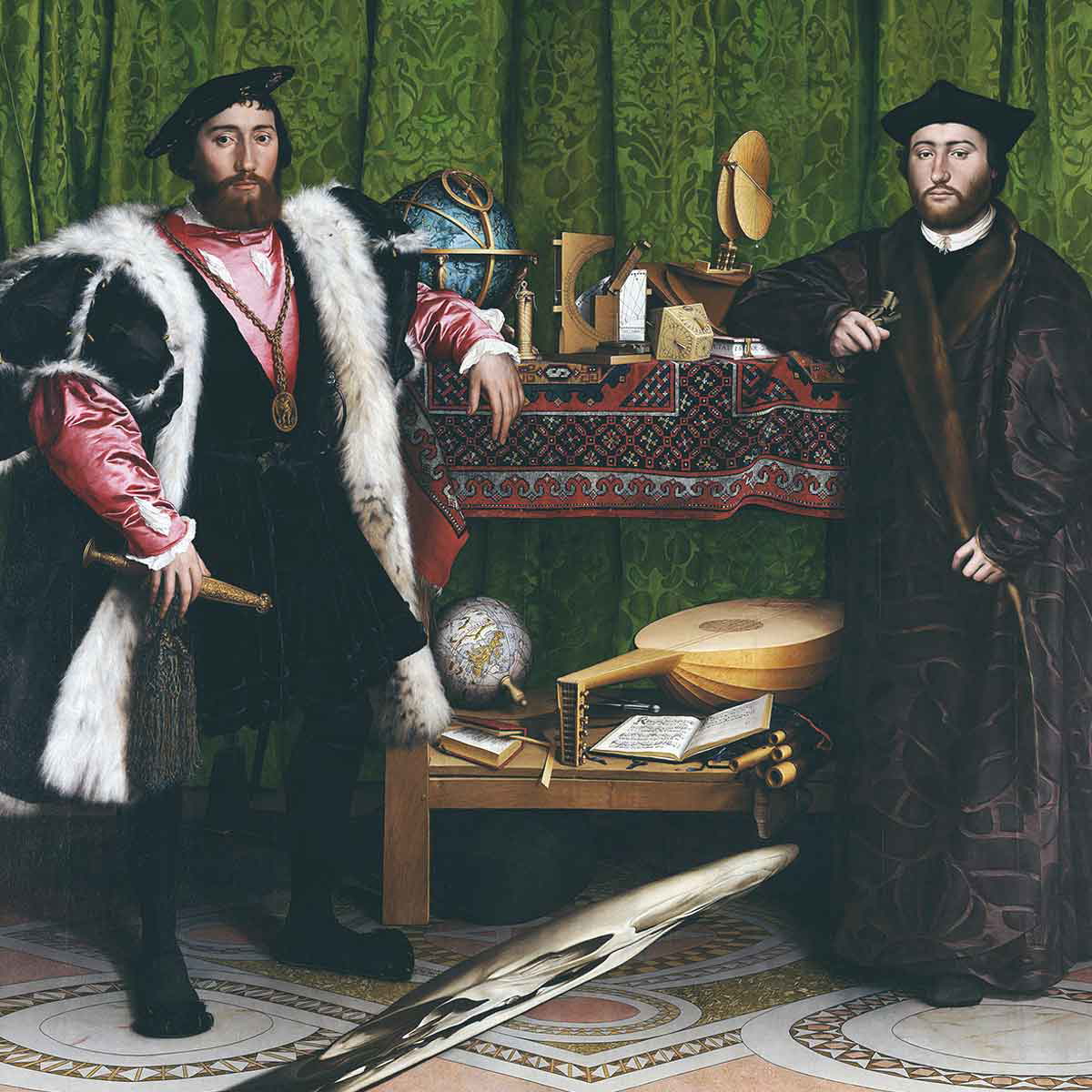
It is widely accepted by art historians that the identities of the sitters are Jean de Dinteville, Francis I’s ambassador to England, and his fellow diplomat and close friend, Georges de Selve, the French ambassador to the Venetian Republic. In 1533, when the portrait was executed, Henry VIII married his second wife, Anne Boleyn. In order to do so, he went against Papal authority, which would not grant him a divorce from Catherine of Aragon.
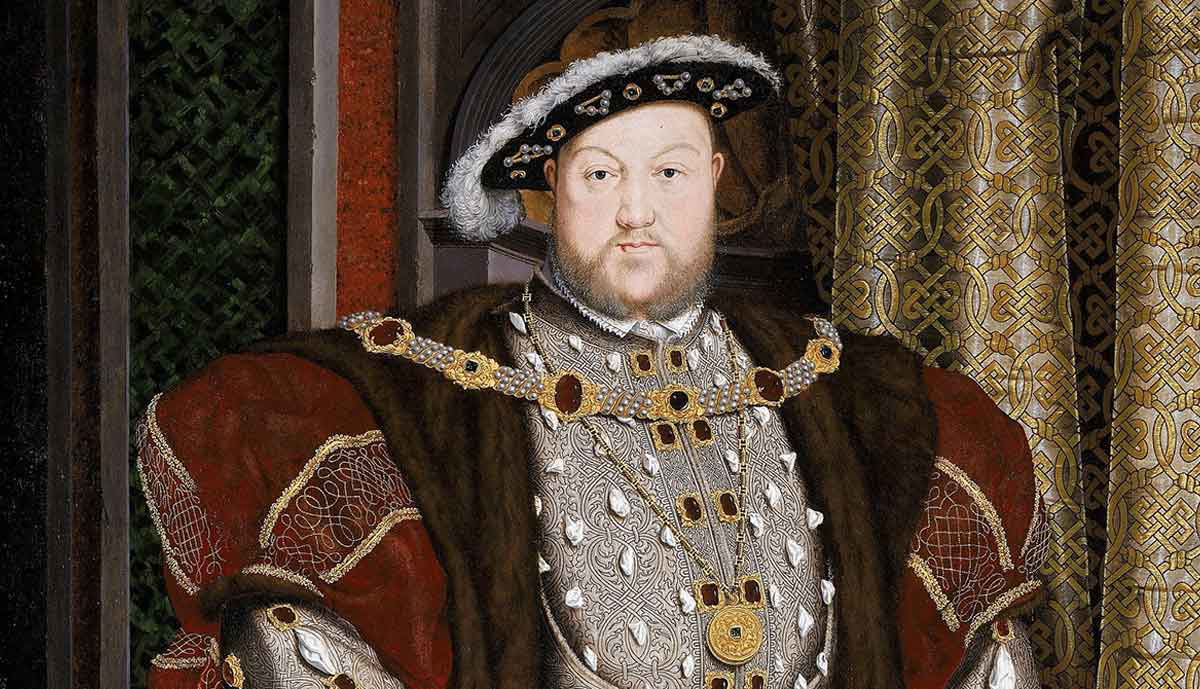
This led to a dramatic break in political and religious ties with Catholic Europe and established the independence of the Church of England. Considering this political rupture, the King of France wanted one of his closest courtiers to serve as ambassador in London. Dinteville was sent to attend Henry VIII’s wedding on Francis I’s behalf. His visit extended long after the ceremony, and his emotional state in London was dreadful. In his letters, he described himself as the most melancholy, weary, and wearisome ambassador that was ever seen. That’s when the other sitter comes in: Georges de Selve, Bishop of Lavaur and close friend of Dinteville. Georges visited London for several weeks, which comforted the weary ambassador. To celebrate their reunion, the two friends commissioned Hans Holbein to capture their time together. In 1533, Dinteville was 29 and Georges only 25.
3. It Was Painted Fast, but With Netherlandish Precision
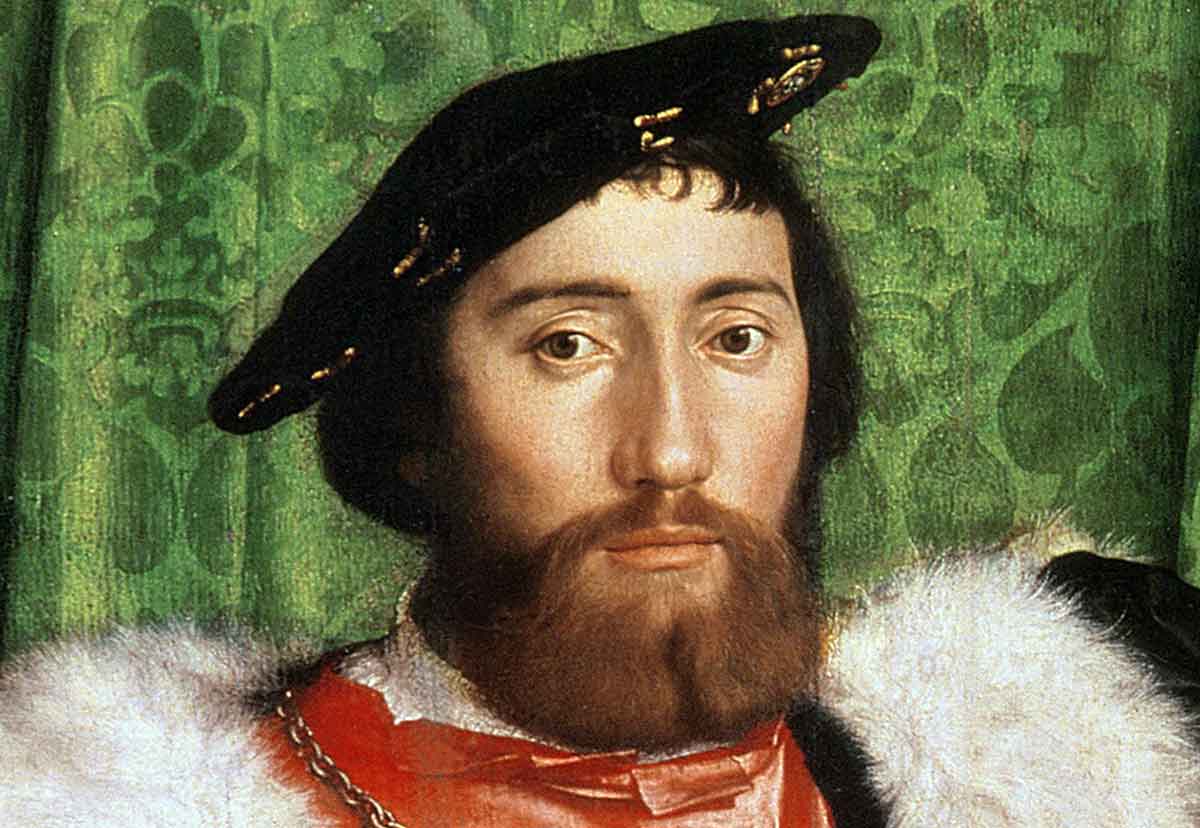
Hans Holbein was a German-born artist who later developed his career in England. Yet stylistically, he remained deeply rooted in the Netherlandish painting tradition. Holbein used oil paint, and his attention to detail borders on hyperrealism; his depiction of textures such as fur, satin, metal, and carpet brings him close to artists like Jan van Eyck and Rogier van der Weyden. Moreover, the jewel tones and heightened color contrasts that lend the painting a photographic clarity bring it close to fifteenth-century Netherlandish painting.
One would imagine that this style entailed a lengthy process of production. Not for Holbein. Upon closer inspection, traces of his rapid execution become visible; some areas are merely sketched out, while other surfaces are painted with only one thin layer of pigment. Holbein even used an innovative technique to accelerate the drying properties of oil paint. By adding heat-bodied linseed oil mixed with pine resin, the artist thickened the paint so he could move on as fast as possible. His talent brought him many patrons, and satisfying commissions with both skill and promptitude ensured a prosperous career in England. Holbein was working on at least four other projects in 1533.
4. It Shows a Renaissance Cabinet of Curiosities
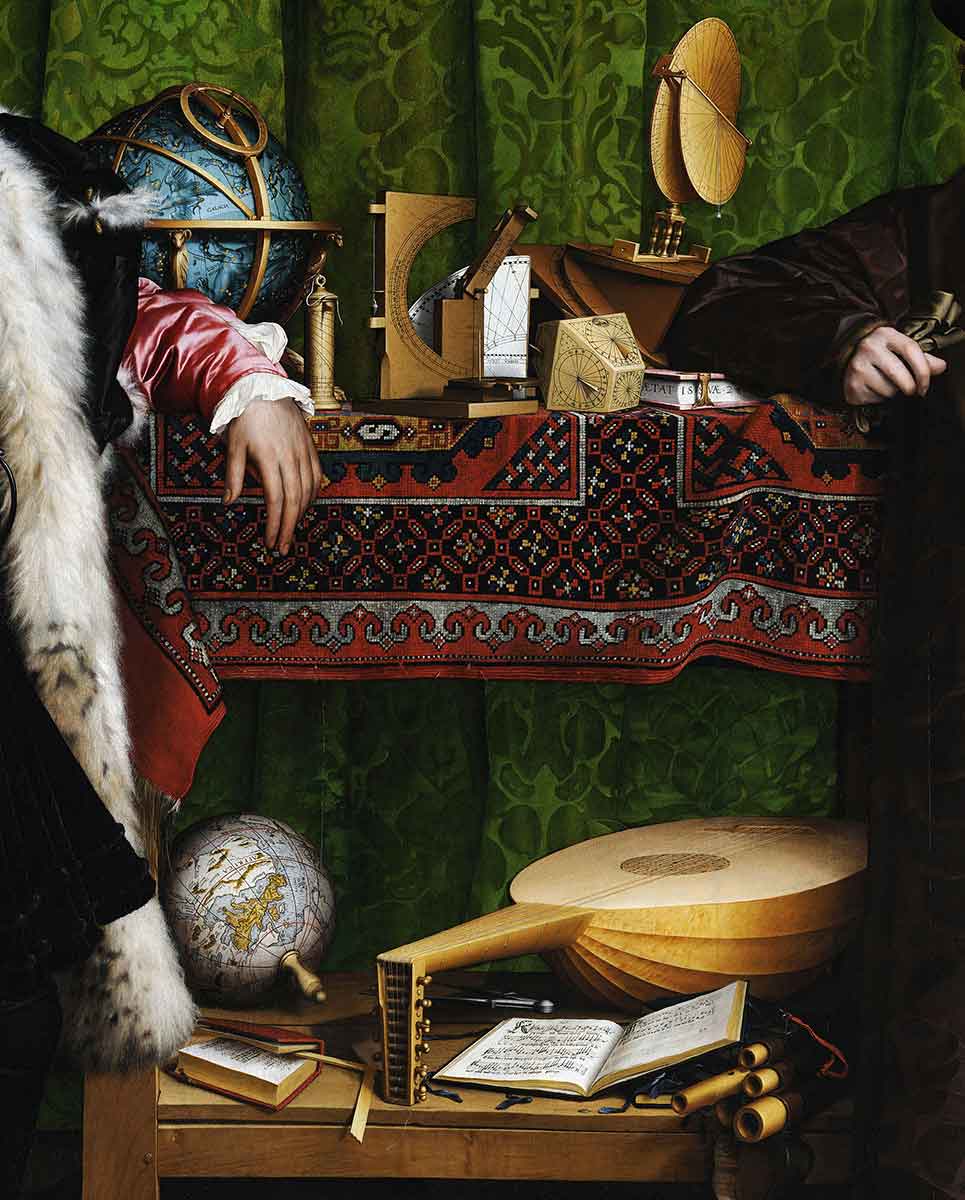
Despite adhering to the genre of portraiture, the painting is also a repository of objects one would often find in a cabinet of curiosities.
Traditionally, objects inside portraits elaborated on the sitter’s personality, hobbies, or intellect. In the case of The Ambassadors, the quantity of objects and their interactions have given art historians plenty of room for debate and interpretation. On the most basic level, the objects may simply represent pieces that Jean de Dinteville and Georges de Selve owned, or wished to own.
Their allegorical meaning is often read in terms of spiritual versus worldly power and tells us much about the preoccupations of Dinteville and de Selve. Altogether, the painting showcases the many faces of humanist learning. On the top shelf, we see instruments used for timekeeping, measuring altitude, and observing the stars, alongside a celestial globe. Holbein was intimately familiar with such objects because he painted the portrait of the astronomer who designed the sundial depicted here. Nicholas Kratzer was Henry VIII’s royal astronomer, and Holbein was well-connected within this network of patrons.
The lower shelf is mostly dedicated to music, showcasing a lute with one broken string in the foreground. The arithmetic book glosses over mathematical division, while the flutes sit beside a Lutheran hymn book. The carpet embellishing the upper shelf is of Ottoman origin, more precisely a luxurious weave from Anatolia. Ottoman carpets were highly sought-after status objects that demonstrated both wealth and global connections. Holbein depicted this type of carpet so frequently that historians eventually named the style after him. This particular example, decorated with geometric squares and octagons, is known as a Large-Pattern Holbein.
5. There’s a Political Undertone
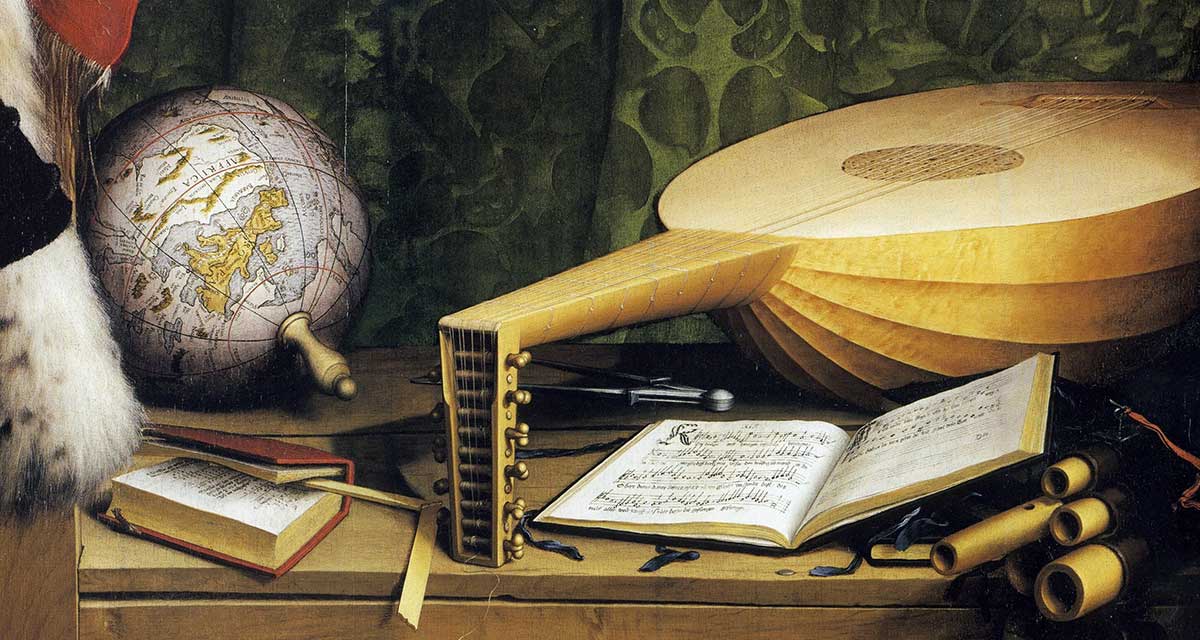
The variety and positioning of the objects invite interpretation, since no item seems to be placed at random. Together, they are often seen as a visual commentary on the religious and political turmoil of sixteenth-century Europe. Henry VIII’s divorce from both his first wife and the Catholic Church was only one such turbulent event.
The shelf containing the musical instruments, hymn book, globe, and arithmetic text is the central point of speculation over the political undertones hidden in the painting. The objects together form the core of this interpretation: the lute has a broken string; the set of flutes is missing one, signaling disharmony; and the hymn book displays texts promoting Christian unity. The presence of flutes, generally associated with war, points toward conflict between the worlds of the two sitters. The Lutheran hymn book, placed next to two orthodox French Catholics, is equally controversial. It comments on the implosion the Protestant Reformation caused within Christian Europe.
6. There’s a Skull That Only Works From the Side
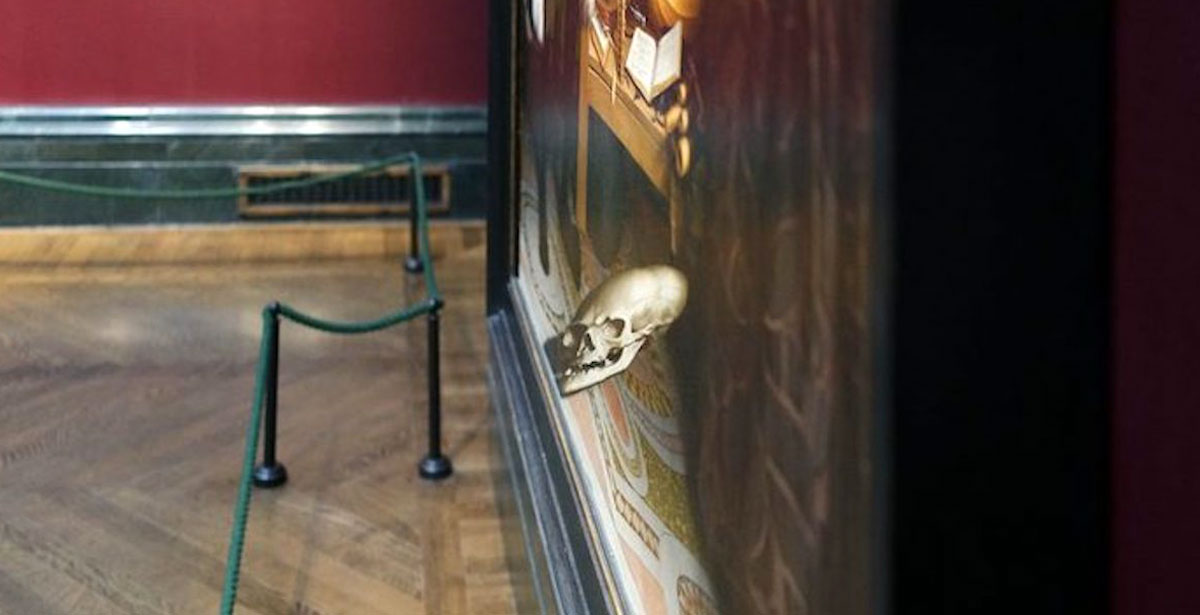
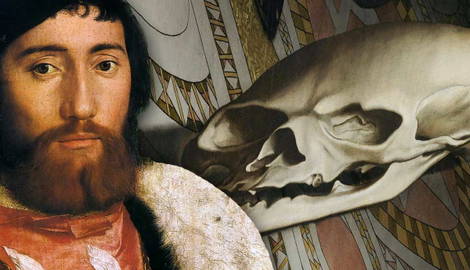
The most bizarre detail of the portrait is undoubtedly the anamorphic skull situated in the foreground. But what is anamorphosis? This Renaissance technique, popular among intellectuals and humanists, is a sophisticated optical illusion. Viewed head-on, the skull looks like a strange smear of paint. Seen from the right angle, however, it snaps into focus and becomes a proportional human skull.
Nowadays, museum visitors see the painting from the front and at eye level. There are many scholarly debates over the intended angle Holbein had in mind. The most plausible theory is that the portrait was originally placed on a staircase. With such a spatial arrangement in mind, viewers walking up or down the stairs would suddenly witness the optical transformation embedded in the painting.
Seen this way, the portrait becomes a sort of sixteenth-century jump scare that reminds viewers, through sheer visual shock, that life is fleeting. In other words, Holbein transformed the traditional memento mori into a visual trick. By doing so, he showcased his unparalleled skill in perspective distortion while adding another layer of meaning to the painting.
7. The Strange Hollow Glass Tube Experiment
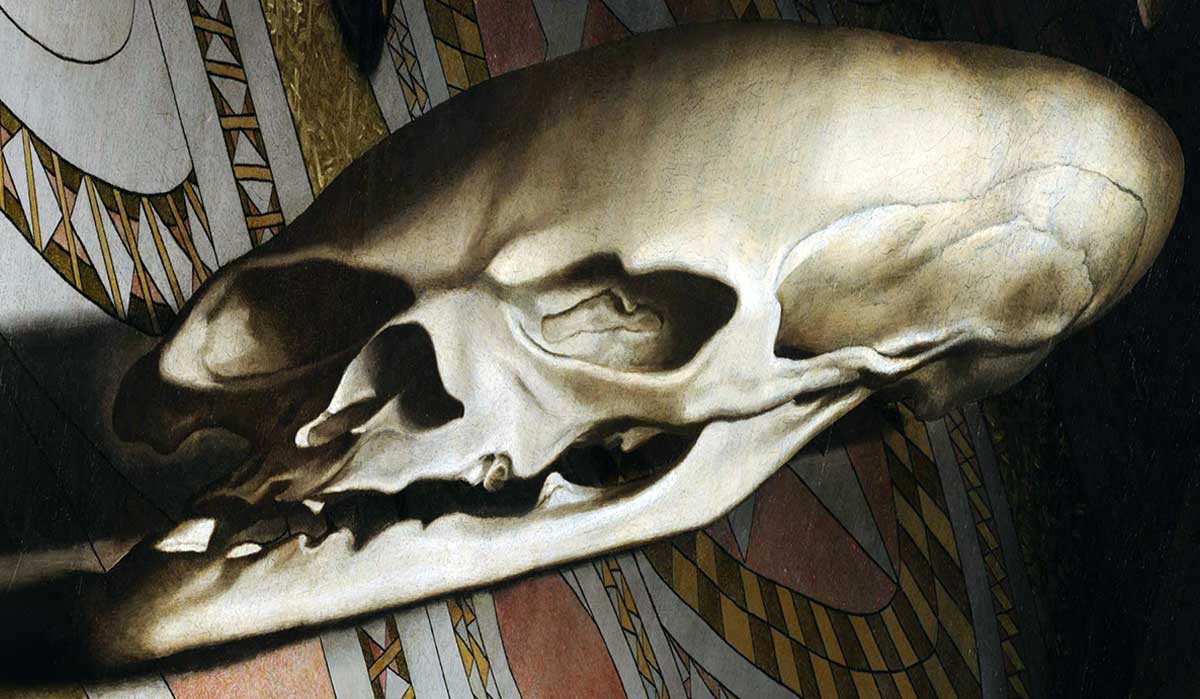
Historically, the painting may have been viewed from the side, as the staircase theory suggests. However, in the 1960s, optical experiments were carried out by Edgar Samuel in collaboration with the Warburg Institute and the British Optical Association. The experiments attempted to determine whether Holbein designed another way of experiencing the anamorphic skull through the use of an optical instrument.
The examination began with intricate devices, but eventually identified a surprisingly simple object that generated the desired visual result: a hollow glass tube. In Samuel’s reading, the composition of the painting is altered for the better, since the skull, globe, and surrounding objects become optically aligned. If held at the correct angle, the tube restores the skull to its natural proportions and visually points toward Dinteville, making him the center of the composition.
8. Hans Holbein’s “The Ambassadors” Restoration Controversy of 1997
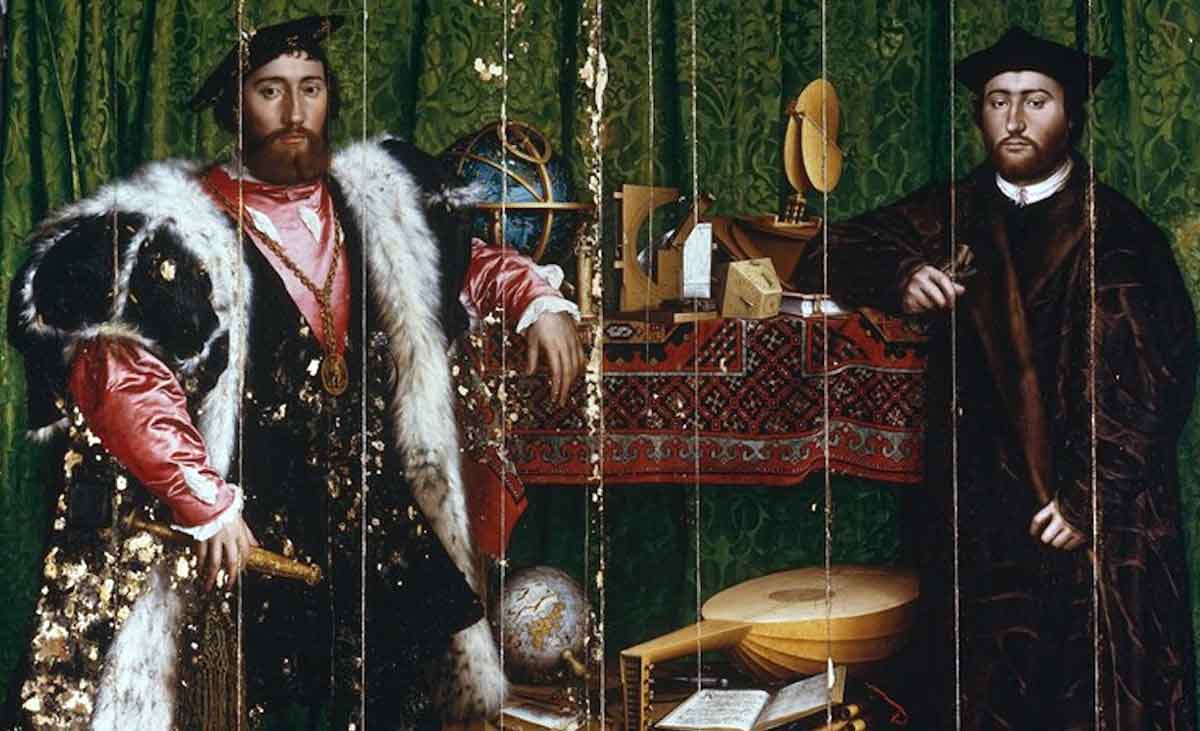
In 1997, the National Gallery performed an ambitious restoration. The area around the skull had undergone significant damage and therefore required a more interventionist treatment. Many critics considered the result a case of over-restoration that altered both the color balance and details of the optical illusion. This dilemma happens every time a painting has sizable damage. The controversy remains one of the most significant debates in the history of modern conservation ethics.