
Hans Holbein’s The Ambassadors is an imposing double portrait from the Tudor period. It doesn’t take long before the viewer catches on to the presence of hidden symbolism. The numerous objects on the shelf between the two figures, like scattered books and instruments, and a prominent, distorted object in the foreground, imbue this painting with a sense of mystery. What do these symbols mean?
Holbein’s The Ambassadors: Who Painted It and When?
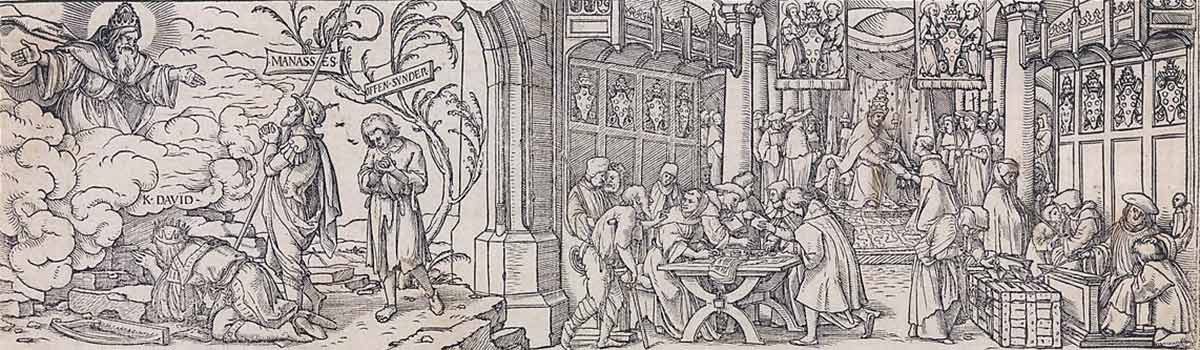
Hans Holbein was born in Augsburg, Germany, in 1497 or 1498. His father was Hans Holbein the Elder, a distinguished painter, known for his colorful religious paintings. Hans Holbein the Younger followed in his father’s footsteps, becoming a painter in his own right. He and his brother, Ambrosius, worked in Basel, Switzerland. Together with his father, Holbein also painted in Lucerne.
In the 1520s, the Protestant Reformation was rapidly overtaking Switzerland and Germany, resulting in a decreasing demand for religious paintings. It’s unclear how involved Holbein had been in the new religious movement. What is certain, however, is that Holbein had to eventually move to England, seeking new patrons.
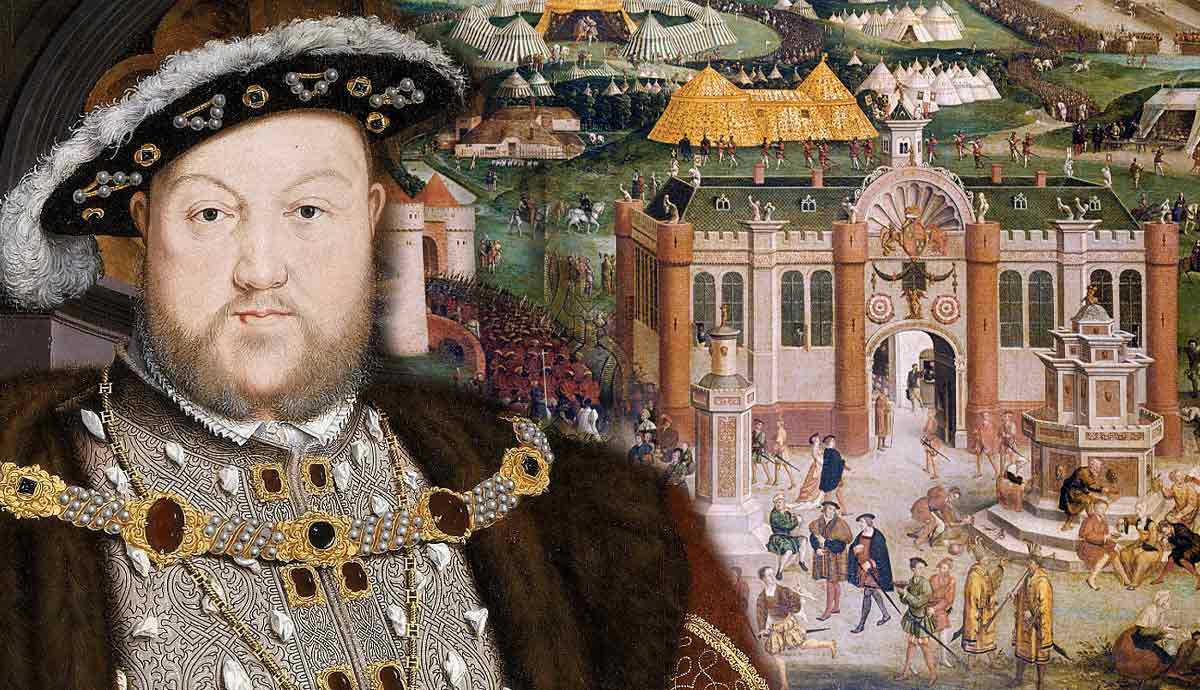
Hans Holbein is famous for his portraits of the leading Humanists of the day, like Erasmus of Rotterdam and Sir Thomas More, of German merchants working in England, as well as for his depictions of the most important people at the Tudor court in England. In 1536, Holbein became the court painter of King Henry VIII, who is best remembered for his six wives.
The Double Portrait: Friends or Successful Professionals?
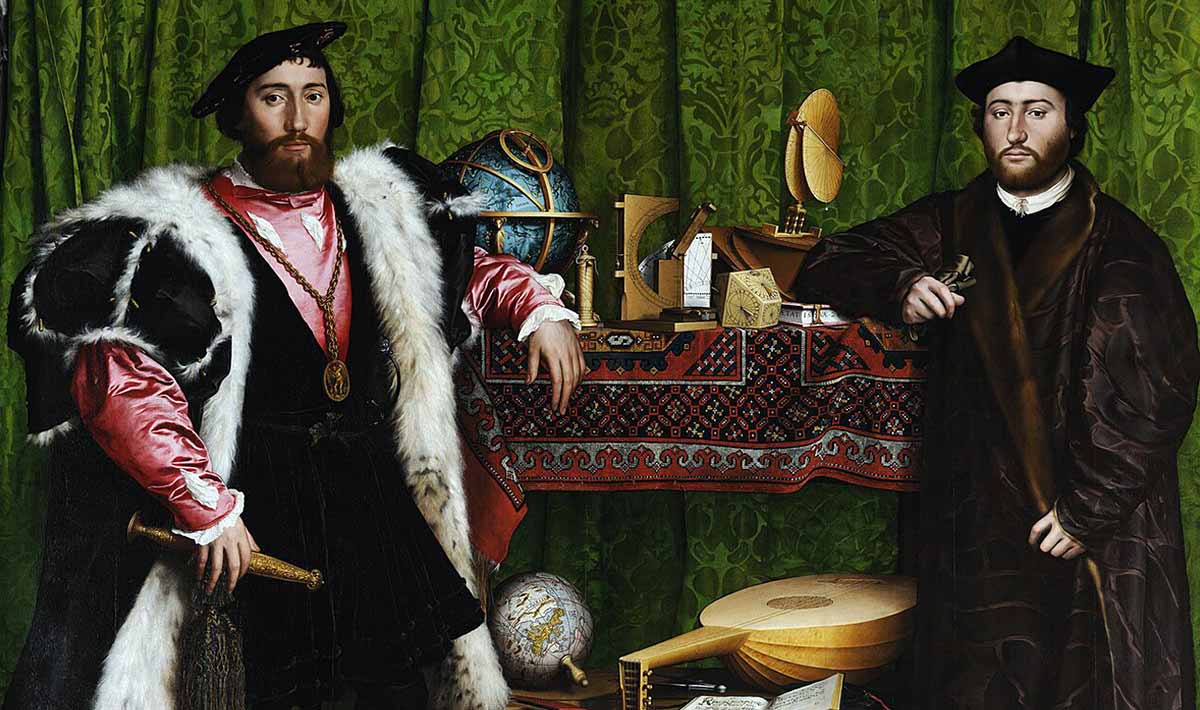
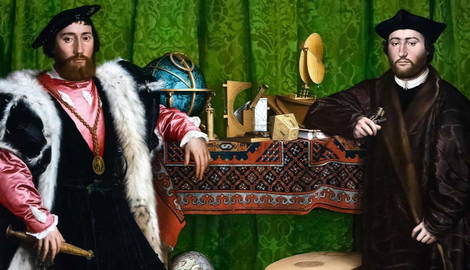
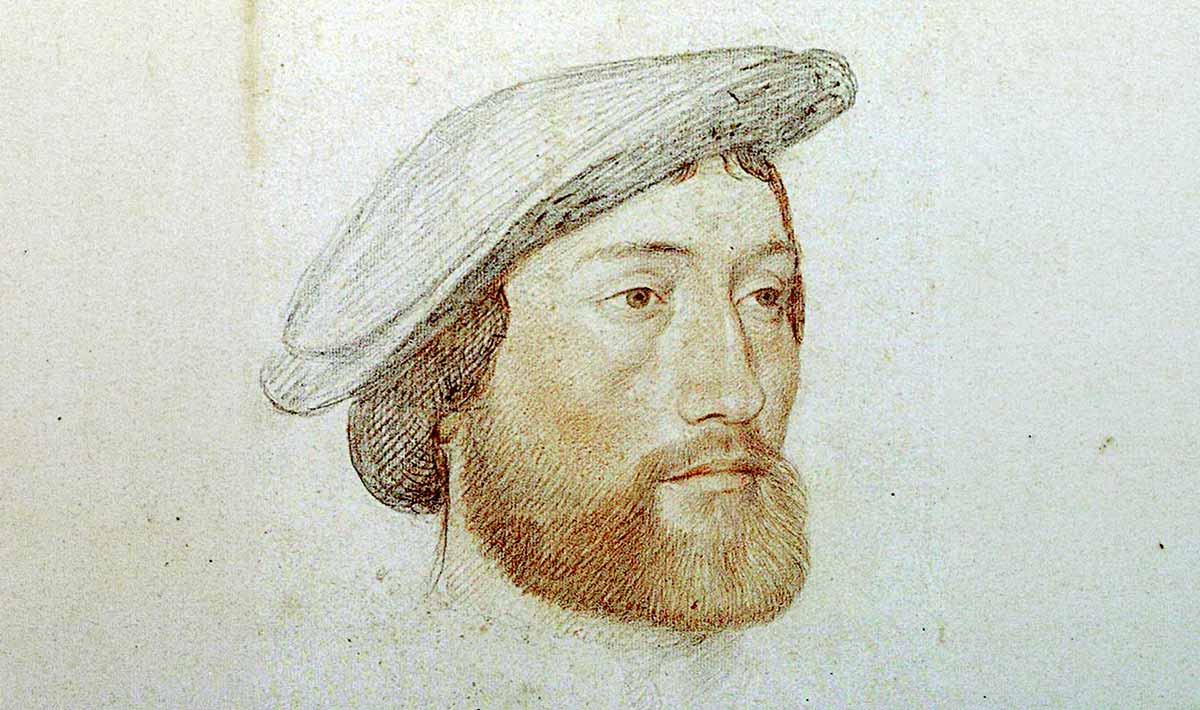
The full-length double portrait is nearly square in format and shows two figures standing to the left and right of a shelf littered with musical and astronomical instruments and books. The man on the left is Jean de Dinteville (1504-1555), and the one on the right is Georges de Selve, Bishop of Lavaur (1508-1541).
The two young men are portrayed in their finest official attire. Holbein’s portrait records the ages of the sitters. Jean de Dinteville is 29, as it says on his dagger, whereas his friend, Georges de Selve, is 25 (his age is noted on the book under his elbow).
Both look directly at the viewer, conscious of their high positions at court, one holding a dagger and the other a pair of gloves. The two friends are shown as members of the nobility (Dinteville) and the clergy (de Selve).
Both young sitters were diplomats. Jean de Dinteville was the French ambassador in England, while Georges de Selve was a diplomat to Rome and Venice. In 1533, Georges visited his friend in London, where Jean commissioned this portrait from Holbein.
The double portrait’s meaning remains unclear. Because of its rich symbolism, it is likely to have been a form of visual message, clear to both friends. However, the exact nature of the message is steeped in mystery.
On one hand, the scientific instruments and symbols of knowledge highlight the cultural level and sophistication of the two friends, hinting at a status portrait. On the other hand, double portraits were often used to commemorate a friendship or bond of some kind. The two young diplomats could have intended to immortalize a moment of personal triumph, as both had attained prestigious positions at the French court quite early in life. Last but not least, there are elements that hint at a religious or political interpretation.
Symbolism in Holbein’s The Ambassadors
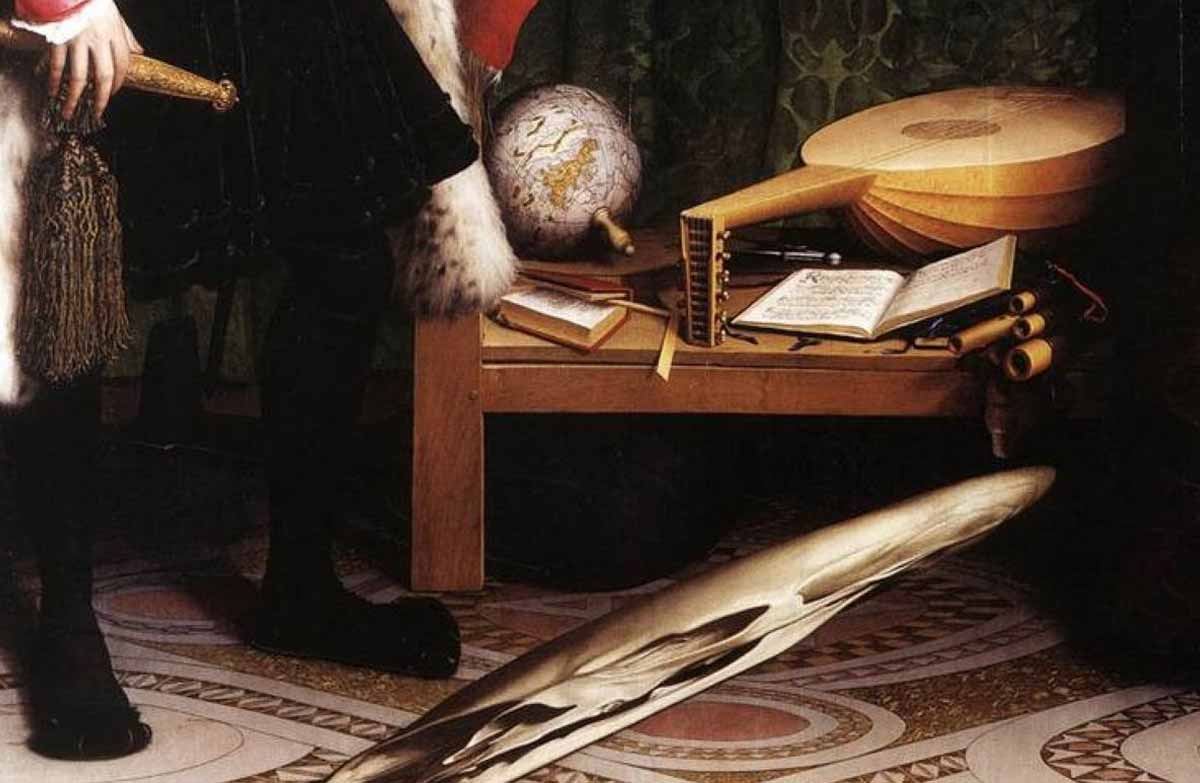
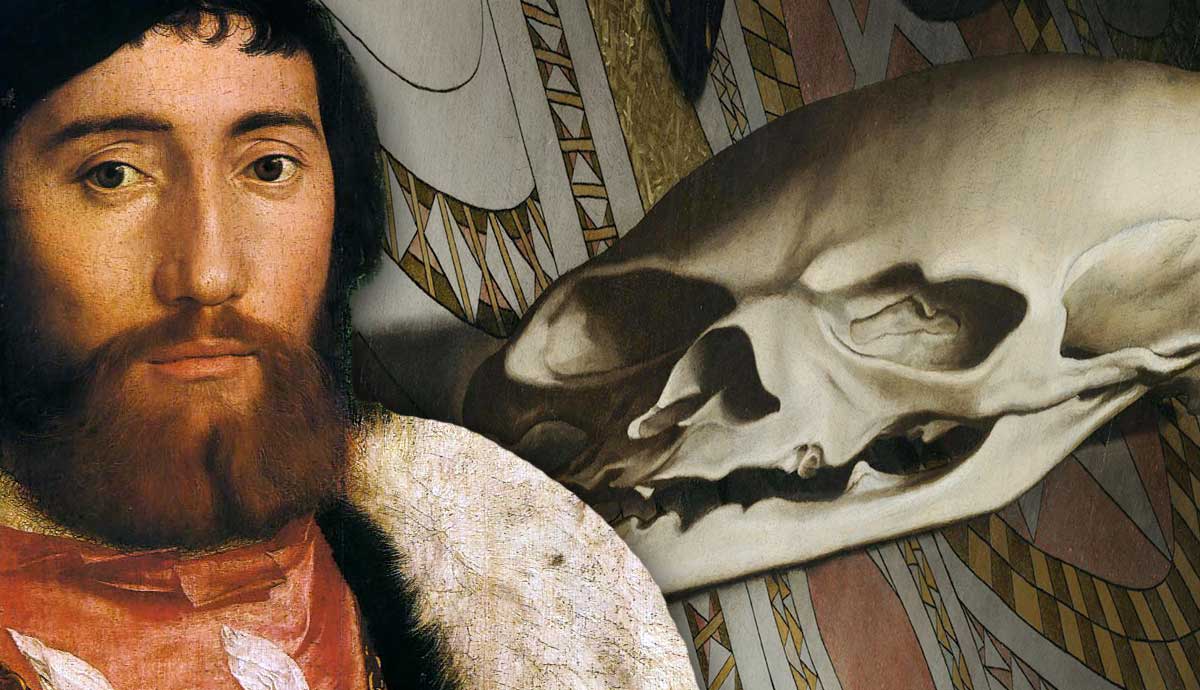
The most obvious symbol is found in the painting’s foreground: a mysterious object that crosses the lower part of the painting at a diagonal. If seen from the right angle, it can be recognized as a human skull, a universal symbol of death and the frailty of human life.
Jean de Dinteville’s personal motto was Memento mori, which roughly translates as “Remember death.” A skull emblem appears on the badge on Dinteville’s hat, echoing the message of the skull in the foreground. In this sense, the painting takes on the significance of a vanitas painting. Vanitas paintings reminded viewers of death and of the need to be prepared for it, emphasizing the fleeting nature of life’s pleasures, wealth, and victories.
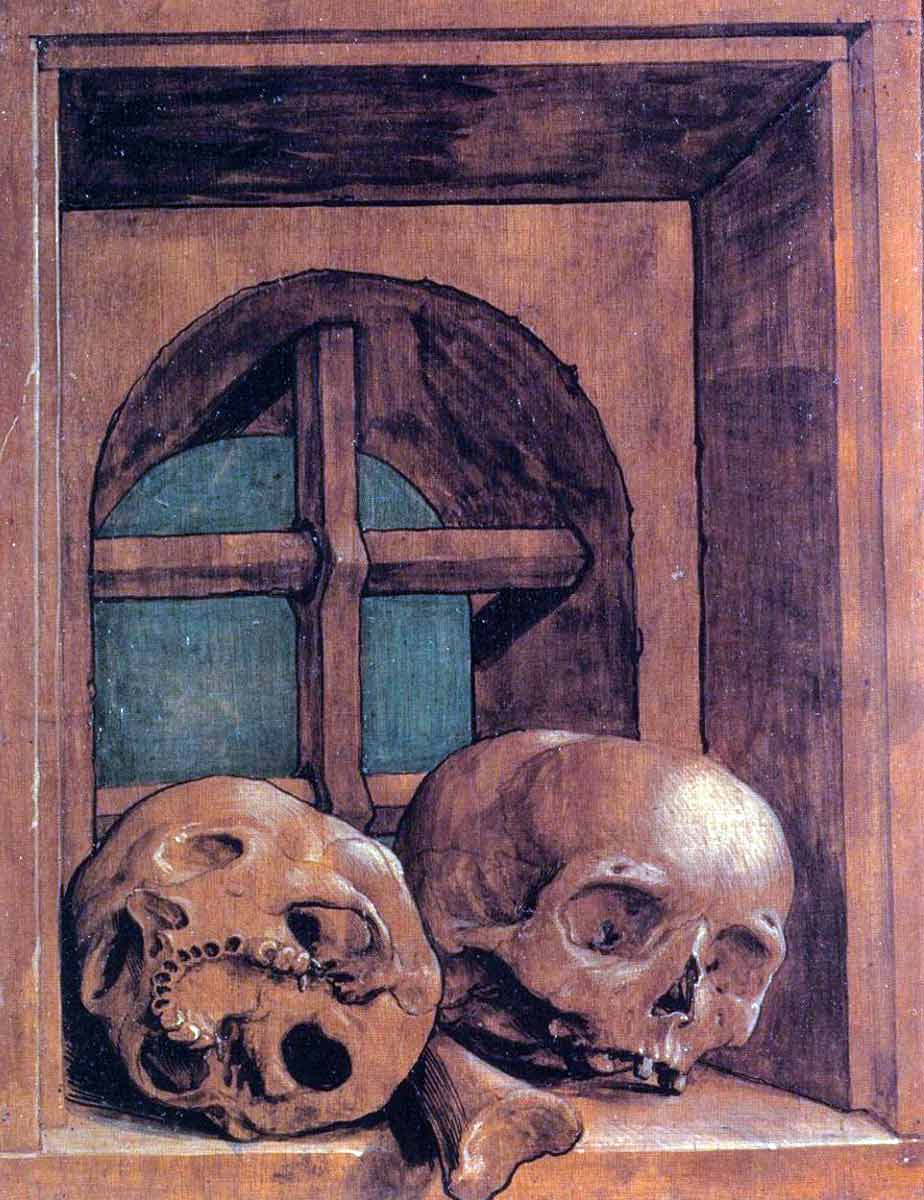
It wasn’t the first depiction of skulls in Holbein’s art. There’s an early work by Holbein, depicting two skulls in a window niche, currently in the museum in Basel. The skull in The Ambassadors, however, is different because it cannot be deciphered when looking at the painting frontally.
This kind of anamorphic painting, a distorted image that assumes its shape only when viewed from the right perspective, was a device found in Northern Renaissance art. A variety of puzzle pictures (Vexierbilder) were popular in Germany and the Netherlands, becoming famous in the works of artists like Giuseppe Arcimboldo, who is best known for his portraits composed of fruit, vegetables, and other objects.
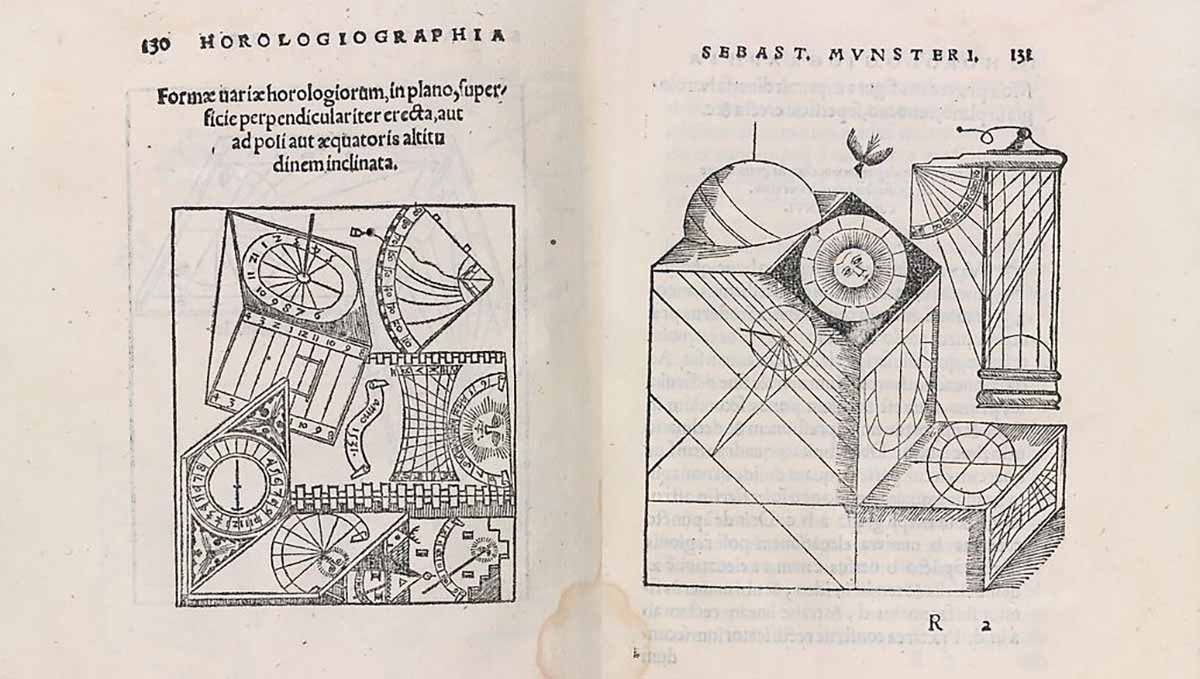
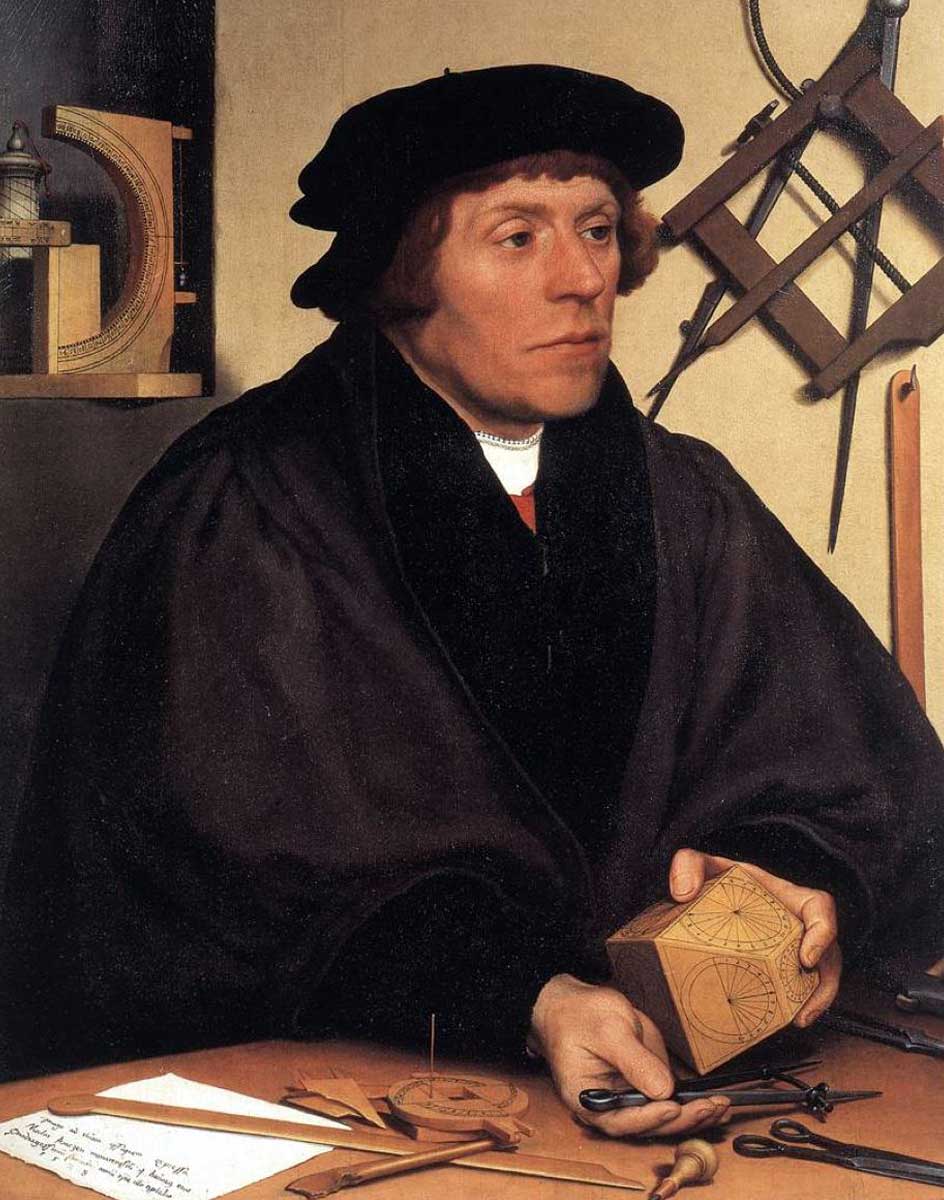
The other set of symbols shows scientific tools, books, and musical instruments grouped in the center of the painting. The objects shown are instruments used in music, arithmetic, geometry, and astronomy, symbolizing worldly knowledge. Similar instruments appear in several of Holbein’s drawings and portraits.
There’s a terrestrial globe positioned to show France and England. One of the places marked on the globe is Polisy, France: the chateau of the Dinteville family and the place where the painting was meant to hang once completed.
The other spherical instrument is a celestial globe, which shows a variety of constellations, including Pegasus, Cassiopeia, and Andromeda. It resembles a celestial globe by Schöner, a famous German Renaissance maker of scientific instruments. Other instruments include a cylindrical sundial (or shepherd’s dial), a quadrant, and a device called a torquetum, which was used for calculating the positions of the heavenly bodies.
The symbolic objects around the two ambassadors seem to fall into three different categories: there’s a heavenly sphere symbolized by the astrolabe and celestial globe, another sphere connected to the earthly sphere, where both men currently stand, surrounded by symbols of power, education, and possessions, and a third sphere, representing death, which is symbolized by the skull.
The Message Behind Holbein’s The Ambassadors
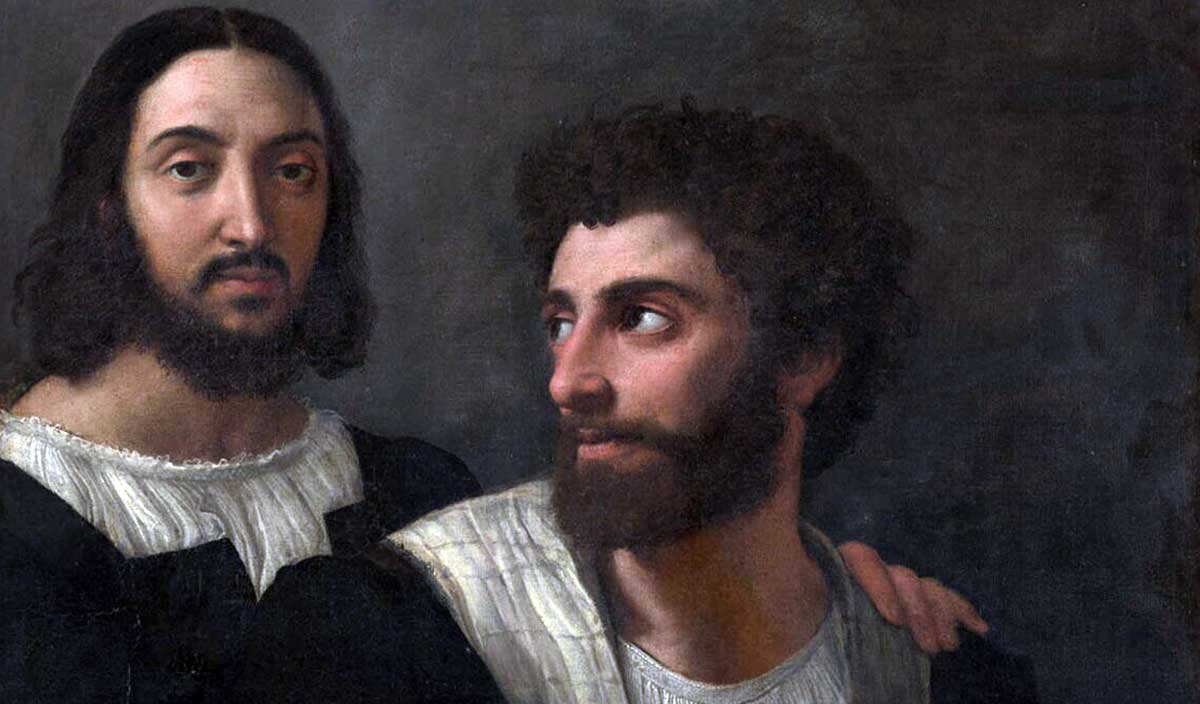
Double portraits or friendship portraits were a subgenre of portrait paintings during the Renaissance, with quite a few surviving examples by the most famous Renaissance artists like Raphael and Pontormo. One notable example is Raphael’s Self-portrait with a Friend.
Because of the format, it’s possible that the two young diplomats were paying tribute to their friendship. Both were serving France, occupying distinguished diplomatic positions. The two friends may have wanted to acknowledge the honor and responsibility of their missions or to highlight their extraordinary achievements.
Jean de Dinteville was sent to England in connection with the English king’s scandalous divorce from his first wife, Catherine of Aragon, and marriage to the former queen’s lady-in-waiting, Anne Boleyn. The European world of monarchic alliances and refined diplomacy was poised on the threshold of a massive scandal.
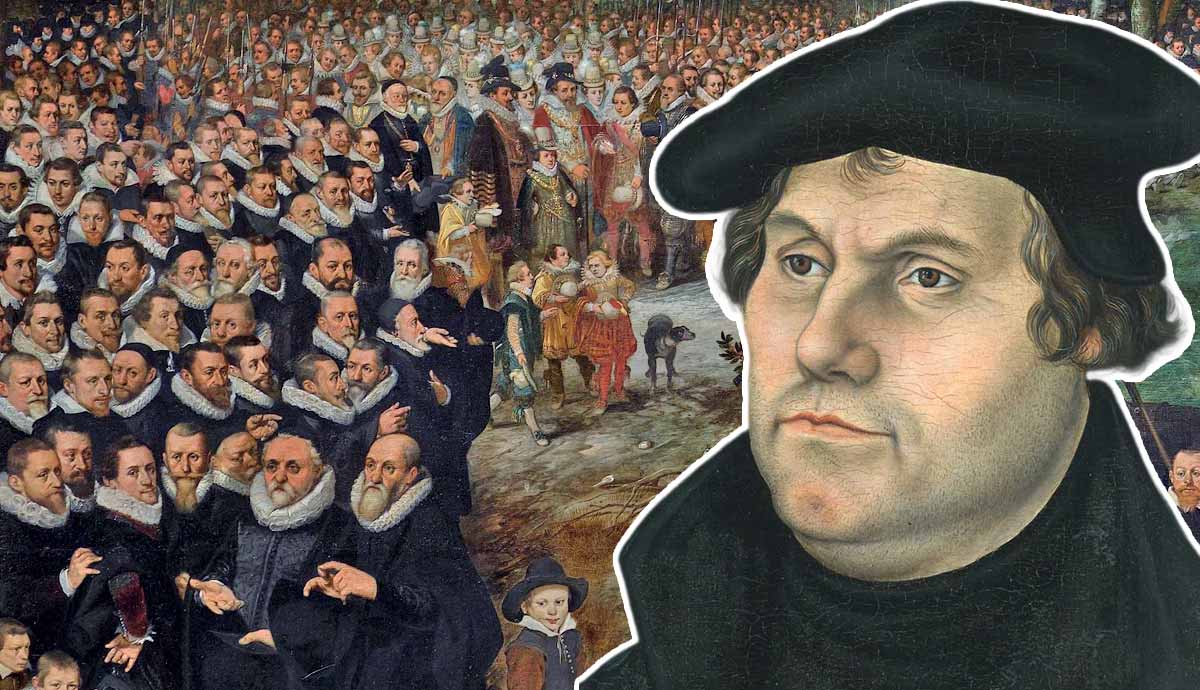
By the time of Dinteville’s embassy, the Pope had refused to annul the English king’s marriage to Catherine. In response, Henry VIII was contemplating an unprecedented solution: a break with the Catholic Church. This was particularly worrisome to the rest of the European monarchs because it coincided with the Protestant Reformation. Led by Martin Luther, the new religious movement challenged the power of the Pope. Among other things, Protestantism questioned the need for Rome’s intercession between men and God, as well as the Pope’s right to get involved in political conflicts.
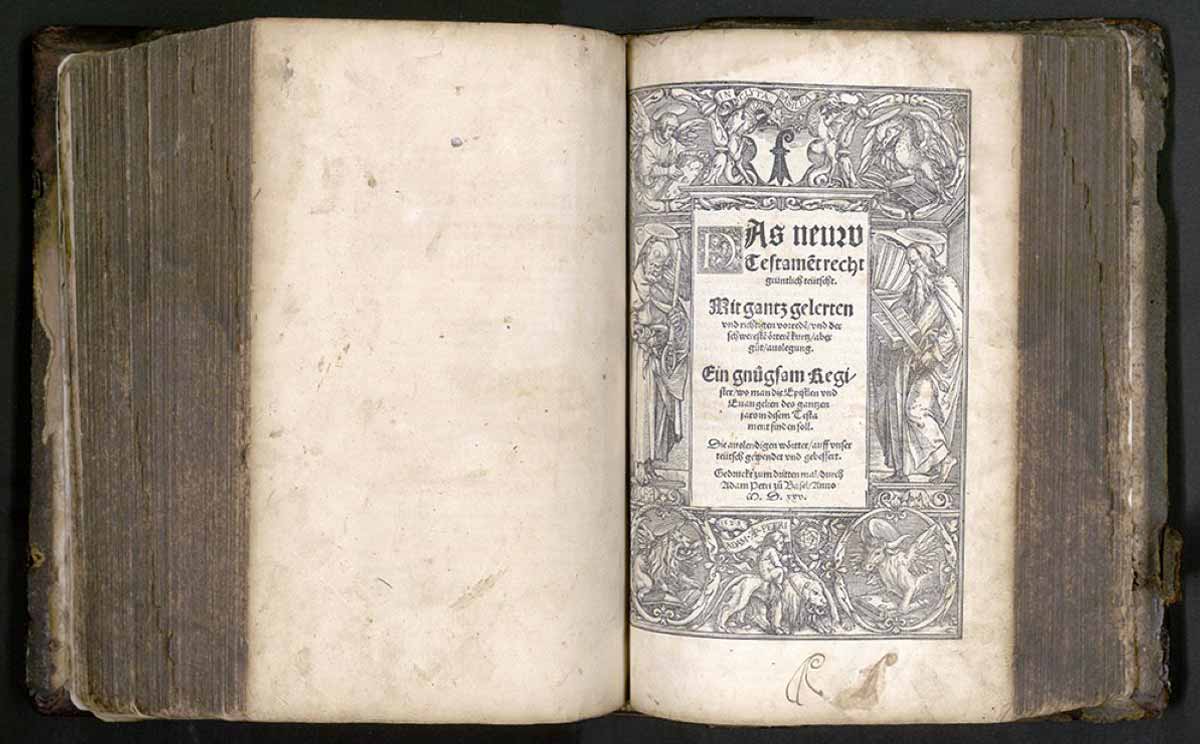
The uncertainty and upheaval of a rapidly changing world are reflected in the symbolism of Holbein’s painting. The objects on the shelf between the two diplomats contain elements of discord and conflict: the lute has a broken string, the looming skull is a reminder of death, and there are several probable direct references to Martin Luther. The lute may be a pun on Luther’s surname, with the broken string symbolizing discord. There’s also a Protestant hymnal among the books. It seems that the portrait was taking stock of the situation in the Christian world at the moment of its painting, with all its conflicts and uncertainties.
Another, more positive interpretation could be that the portrait was meant not only to reveal the turbulence and shifting beliefs of the Christian world but also to offer hope. The date of this double portrait gives a clue to its possible message. The year 1533 marked 1,500 years after the Resurrection. And many scholars agree that the markings on the scientific instruments point to Good Friday in 1533. It’s possible that the portrait with its intricate message was inspired by this important anniversary, especially considering that one of the sitters was a clergyman.
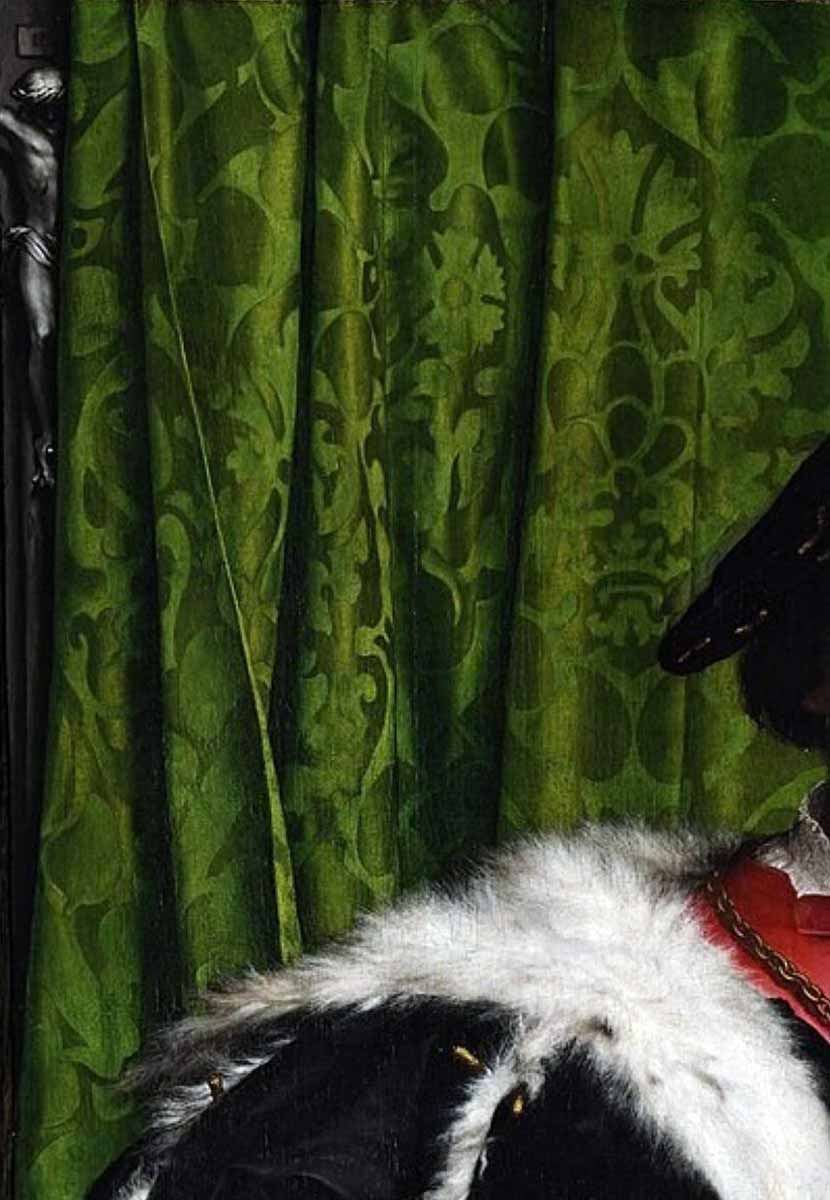
There’s a small crucifix, barely visible but obviously important once seen, behind the green curtain on the left. The crucifix is a direct reference to Christ’s death and resurrection, which provides hope in an otherwise bleak message of worldwide confusion and division.
While The Ambassadors is unanimously considered one of Holbein’s most important works, scholars’ opinions still vary on the meaning behind this masterful double portrait. In addition to his skilled portrayal of the two young diplomats, the highly detailed depictions of the rich materials, and the precise rendering of scientific instruments, Holbein managed to create a mysterious and powerful image that unites all the knowledge spheres of the Renaissance and contrasts it with the hidden symbolism of the skull, the ultimate symbol of life’s brevity.