El Castillo is an ancient Mayan Temple situated in the Chichen Itza complex, in the Yucatan peninsula. Its name means “The Castle” in Spanish, and it is also often known as “The Pyramid of Kukulcan.” The entire site of Chichen Itza is one of the modern seven wonders of the world, and the fascinating stepped pyramid temple of El Castillo in its center has played an important role in its popularity, attracting millions of tourists every year. But what is it about this ancient architectural monument that draws so many people from near and far?
A Colossal Ancient Temple Dominating the Skyline

The sheer scale of El Castillo is a sight to behold, standing at 25 meters (80 feet), and it is one of the key reasons why so many tourists make the trek to Chichen Itza to marvel at its monumental impact. Although El Castillo is not the tallest pyramid built by the ancient Mayans—that title belongs to Nohoch Mul in Coba, which is 42 meters (138 feet) high—it is one of the best-preserved, and its location, in the middle of a flat, grassy plaza, makes it stand out from its surroundings.
El Castillo is one of the oldest known temples in the “New World.” It was built by Mayans from around 700-1300 AD throughout the Classic and Post-Classic eras, although some researchers suspect early parts of the temple might have been constructed as far back as 550 AD. Based in part on the pyramid’s carved snake heads, historians believe the Mayans built it in honor of their feathered serpent deity, and so it is also known as the Temple of Kukulkan. It was the Spanish conquistadors who named the pyramid El Castillo (the Castle) after uncovering the abandoned ancient city.
The Sacred Engineering of the Feathered Serpent

Amazingly, El Castillo’s structure is designed to produce the illusion of a giant serpent during every spring and autumn equinox. On the North side of the pyramid, two stone snakeheads sit at the base, while stairs leading towards them are positioned in line with the sun. The shadows cast by the tiered pyramid create the illusion of a wavy, slithering serpent’s body leading down the steps. Thousands trek here every year to witness this rare and spectacular event, which demonstrates how the Mayans’ lives were closely attuned to the natural world.
Another unique architectural phenomenon has also been observed: standing at the base of the pyramid and clapping will create an echo that sounds quite similar to the call of the quetzal, a bird sacred to the Maya. While often dismissed as a coincidence, most scholars believe it’s the result of careful architectural planning on the part of the Maya.
A Giant Calendar Carved in Stone

The Mayans painstakingly designed the structure of El Castillo to resemble a huge, larger-than-life calendar, which offers a fascinating glimpse into the Mayan understanding of the world. The pyramid has four sides, each with a total of 91 steps. These, when added together with the top step of the pyramid, equal a total of 365, meaning a step for each day of the year. In addition, there are nine tiers, which, when split by staircases, total 18, the number of months per year in the Mayan solar calendar. Finally, 52 decorative panels adorn each side of the pyramid, denoting the number of years in the Mayan calendar round.
The Nested Pyramid Hidden Beneath the Outer Shell

Underneath its carved stone exterior, El Castillo hides some pretty remarkable surprises. In 2016, archaeologists discovered another smaller pyramid under its outer surface, revealing that the Mayans built a larger pyramid over a smaller one to create a strange layering effect. Even more surprisingly, many suspect there may be even more pyramids under these two layers.
Within the smaller central pyramid, a series of rare treasures were found, including a carved stone sculpture of a Mayan figure, known as a chacmool, and a red jaguar throne adorned with eyes made from jade stone.
A Mysterious Cenote Lies Beneath
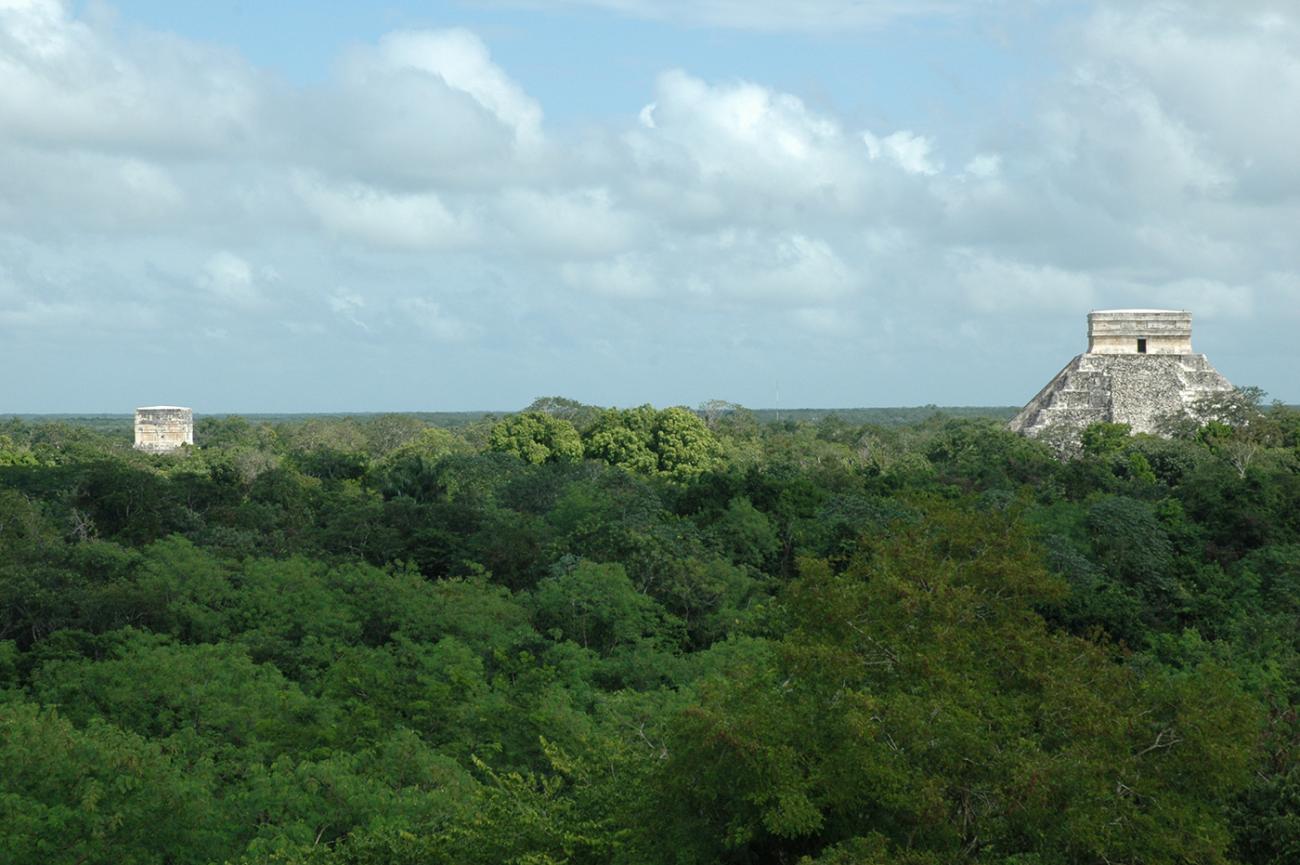
One of El Castillo’s biggest secrets was just uncovered a decade ago: it was built on top of a cenote, a water-filled underground cave. Cenotes were often sacred to the Maya and other Mesoamerican cultures, and several other cenotes appear at the Chichen Itza site. Researchers trying to reach the cave beneath El Castillo followed several passageways inside the temple, but found that the entrances to the cenote were sealed off centuries ago by the Maya themselves.