
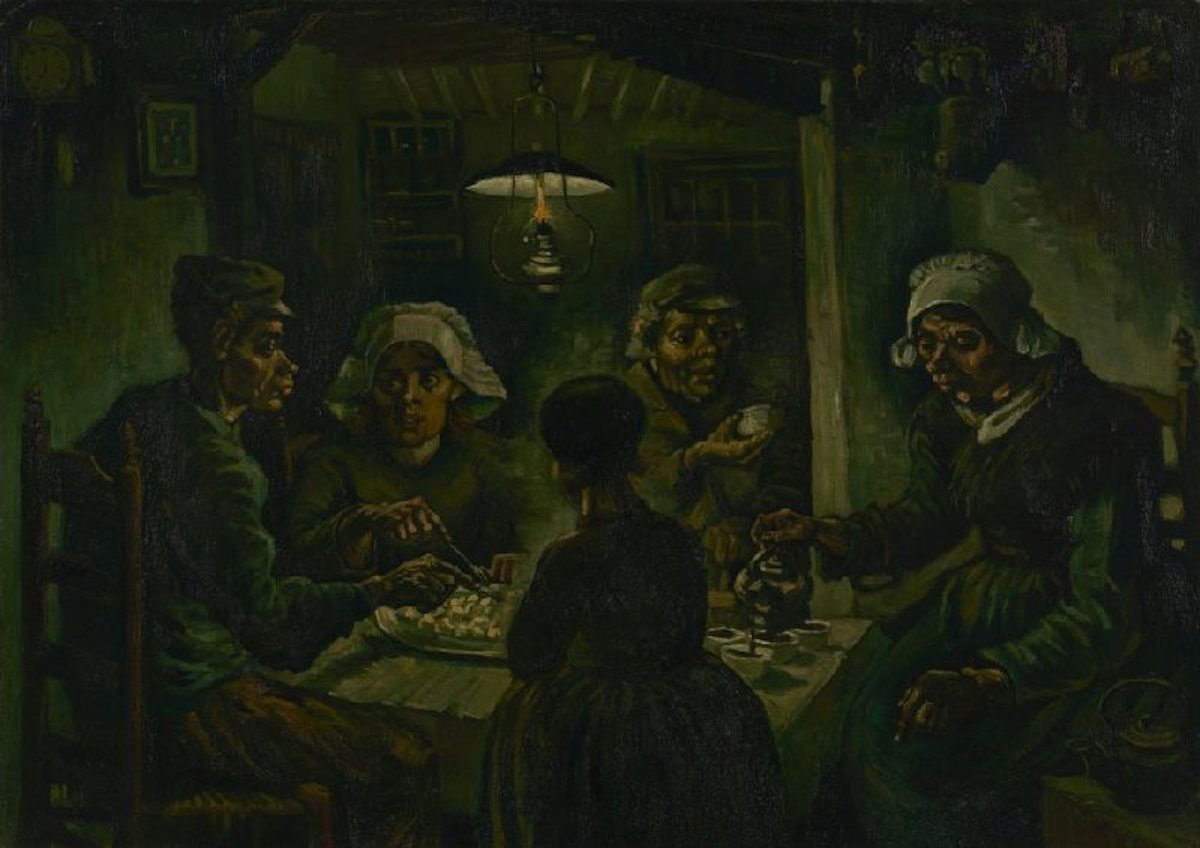
Before Van Gogh embraced a vibrant and lively color palette, he sought his inspiration from European realism. In 1885, while living in the village of Nuenen at his parents’ house, he painted The Potato Eaters. Artists like Rembrandt van Rijn and Jean Francois Millet were his biggest inspirations, and he aimed to produce paintings in a similar style. Van Gogh’s The Potato Eaters was a major milestone in his career, and the artist himself called the work a masterpiece.
Van Gogh’s “Potato Eaters” and His Life in Nuenen
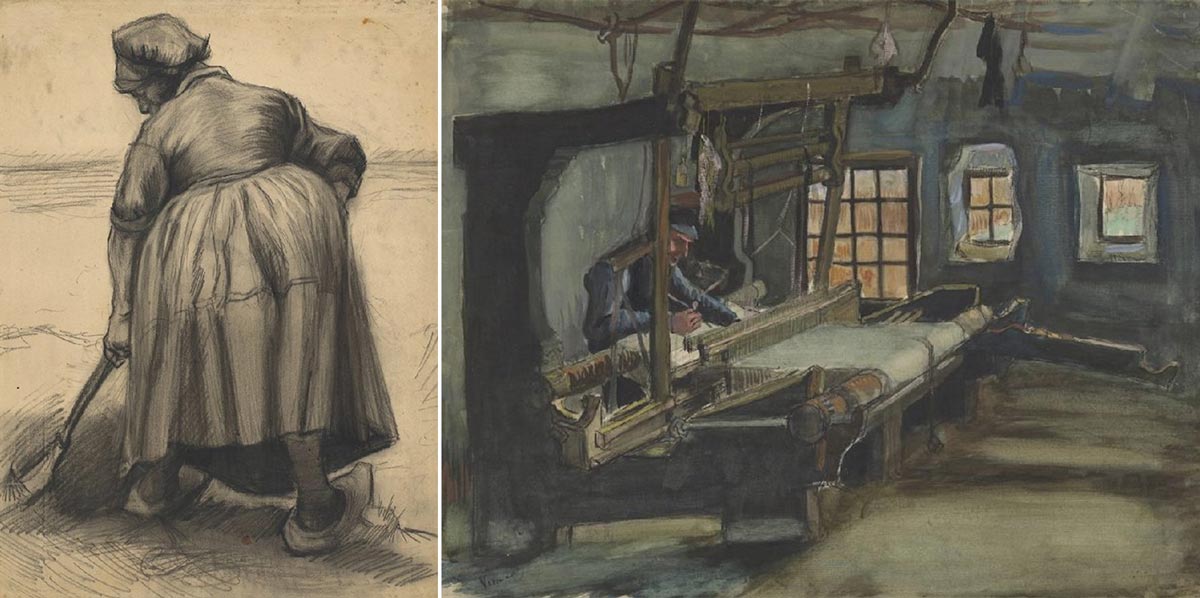
Van Gogh moved to Nuenen, a village in North Brabant in the Netherlands, in December 1883. He lived at his parents’ house and worked in a small studio next to the house. Nuenen offered him a chance to hone himself as a peasant painter—the quaint village was full of peasants, weavers, and workers. Van Gogh would go out into the village and spend his days sketching and studying the working figures. However, the artist’s relationship with his parents was tense as they were unhappy with their eldest son moving back into their house.
While Nuenen served as a source of inspiration for Van Gogh, his impatience to sell his works grew daily, driven especially by the pressure to earn money. He was aware of the flourishing art world in Paris and aimed to sell his paintings in the city. To achieve this, Van Gogh decided to make a painting for the Paris Salon, which was an annual exhibition organized by the Académie Beaux-des Arts. Being accepted to this exhibition was the highest achievement for an artist in Europe at the time. He decided to create a painting with careful planning and practice, aiming for it to be one of his best works yet. This set in motion the process of creating The Potato Eaters.
Choosing the Subject: De Groot-Van Rooij Family
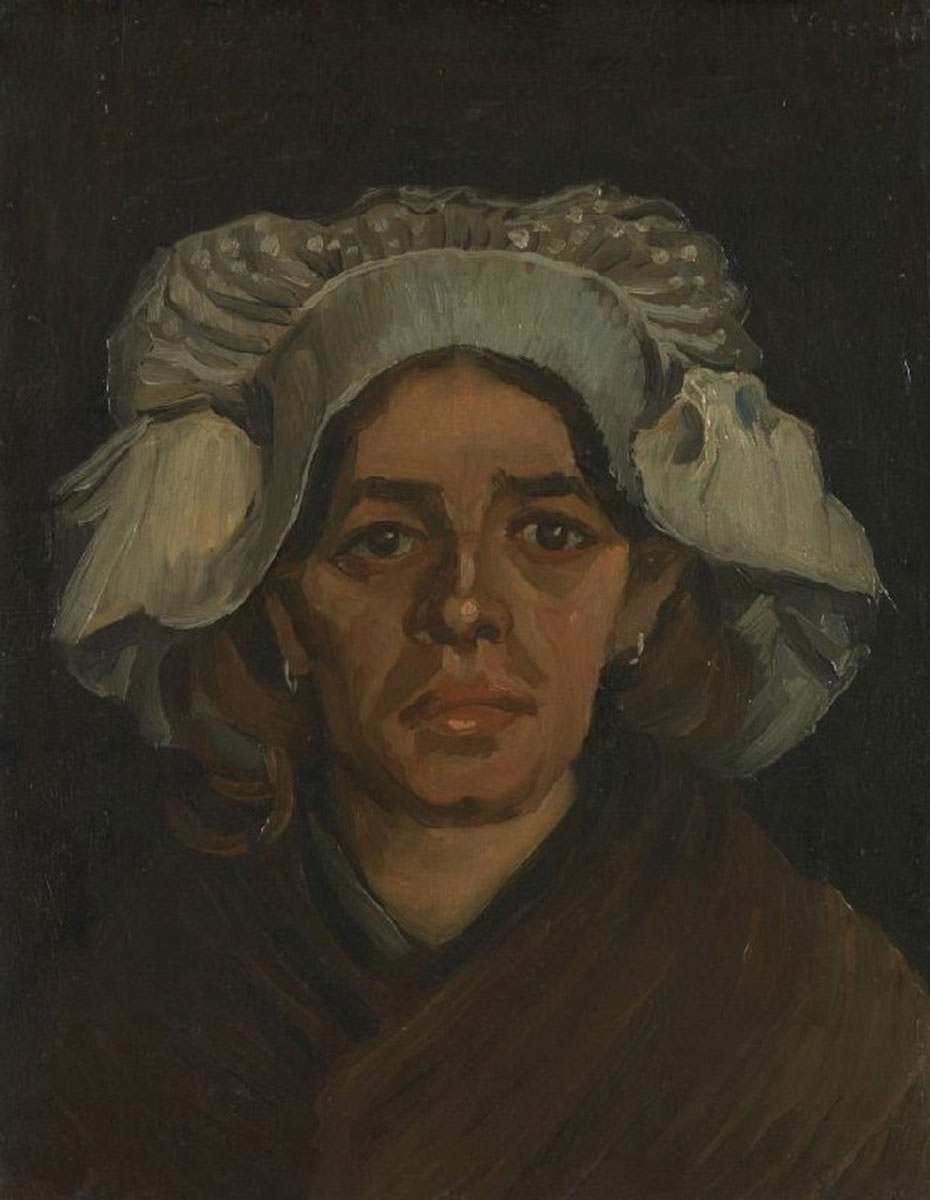
To showcase his skill, Van Gogh strategically decided to depict the human form in his work, which he believed would spread his name in the Parisian art world. Due to its difficulty, figure painting traditionally ranked higher than other genres, such as landscapes and still-life paintings in European art. This is why he chose the De Groot-Van Rooij family, a family of peasants in Nuenen, as his subject. This family consisted of the mother, Cornelia de Groot, her three children Hendrik, Peter, and Gordina, and Gordina’s son, Cornelis. Van Gogh had already made two portraits featuring Gordina (Head of a Woman) before painting The Potato Eaters. He wanted this work to showcase his skills in figure painting, particularly in painting the head. This is why The Potato Eaters only depicts the upper half of the workers’ bodies.
The Process of Making The Potato Eaters
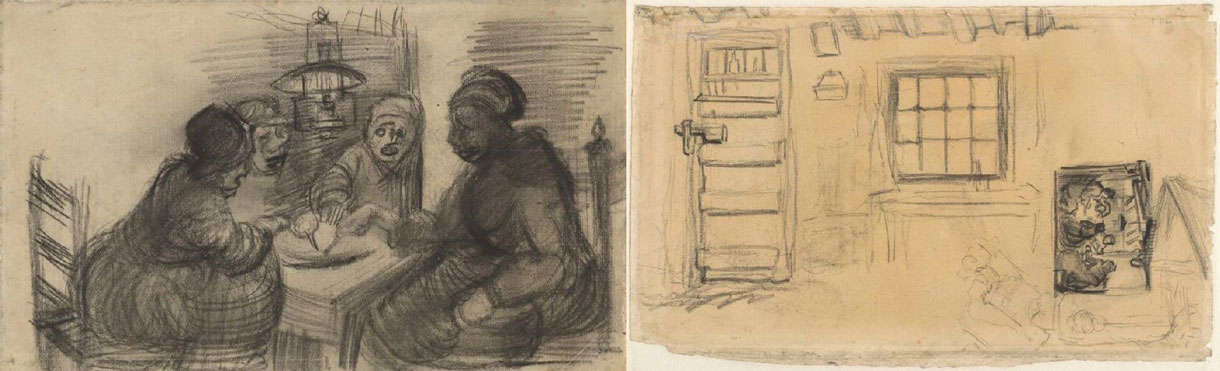
As this was to be a major project that Van Gogh was about to undertake, it required meticulous planning and extensive preparation. Painting The Potato Eaters was to become a turning point in his career and make him a successful artist. Everything had to be right: the interplay of light and shadows, the values and shades of colors, and the details of the human form. The artist studied his subjects carefully before putting brush to canvas as he wanted to do justice to the formal intricacies as well as the rural character of his subjects.
Van Gogh decided to create sketches of the interior, paint studies of his subjects, and work on the final piece in his studio rather than observing directly from reality. Before embarking on the final version of The Potato Eaters, he painted two studies of the composition. These studies served to establish foundational elements such as the lighting and the placement of subjects and objects within the frame. Neither study is highly detailed, as Van Gogh focused on refining these overarching characteristics during the process.
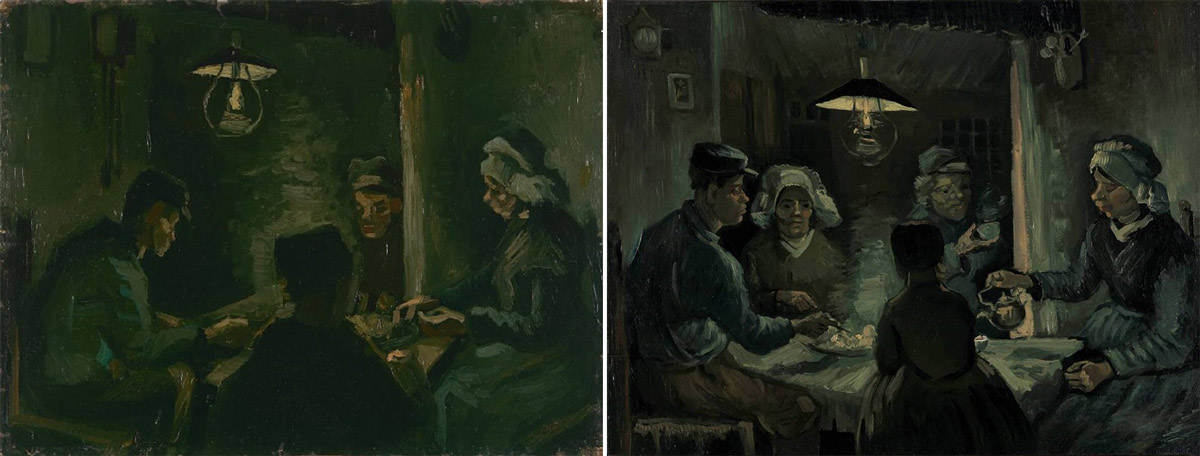
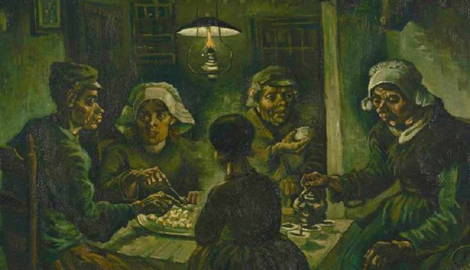
The final painting shows five people—two men and three women—sitting around a small table, eating a meal of boiled potatoes and coffee. The only light source in the composition is a small oil lamp above the table in the cottage. The man on the right is holding a cup of coffee to the woman on his left. The younger woman facing the viewer looks towards the man on her right, but their eyes don’t meet. In the background, there are two windows, a container with utensils hung on the wall, and a clock showing seven o’clock. The atmosphere of the painting is quiet, resembling the physical exhaustion of the workers after a hard day’s work.
Experiments With Color Theory
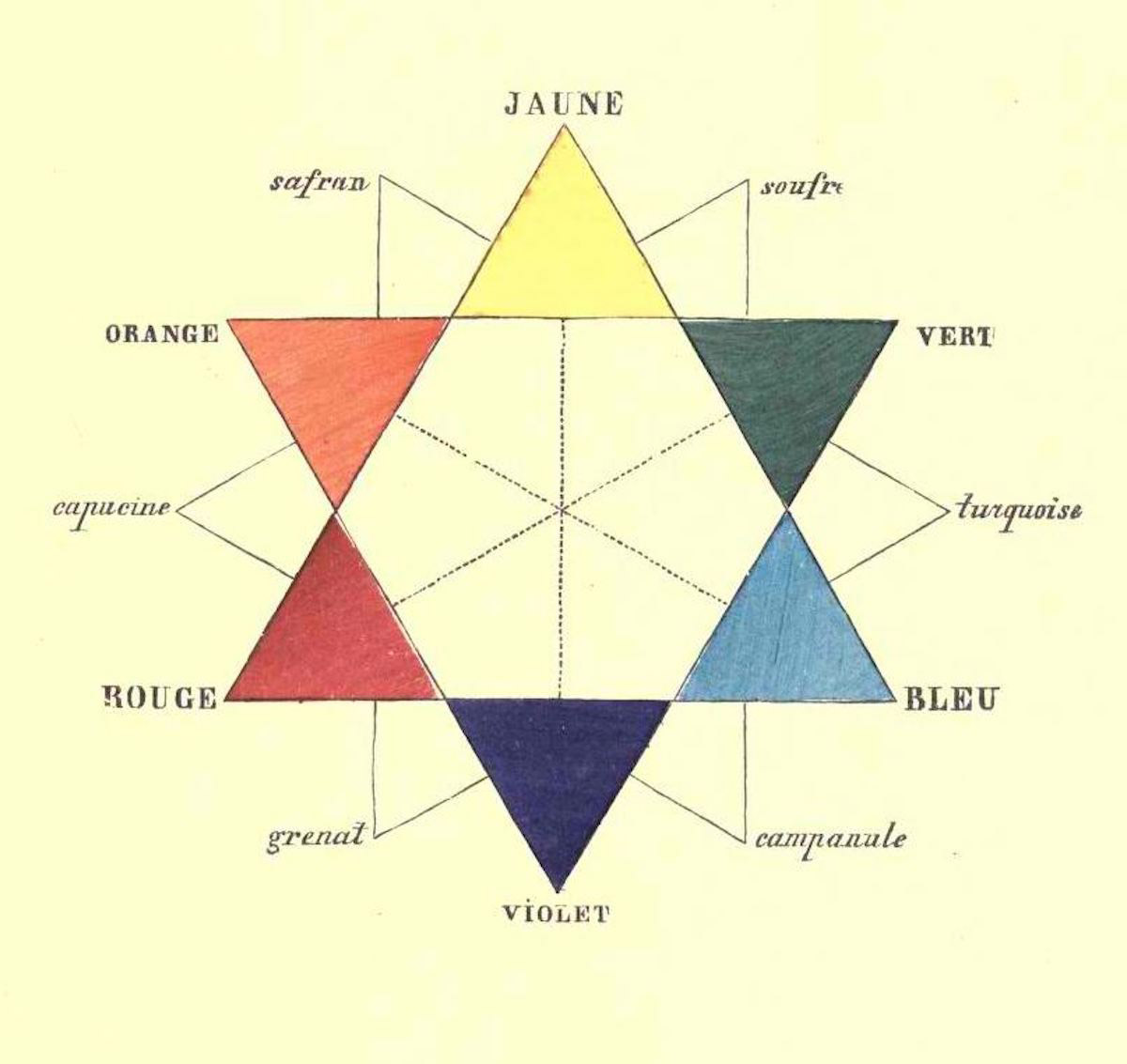
The colors of The Potato Eaters are much more layered and complex than they appear. While working on the painting, Van Gogh was already familiar with texts like Les Artistes de Mon Temps by Charles Blanc that talked about color theory. The basis of this theory was that the perception of one color relied upon the colors surrounding it. The colors opposite to each other in the color wheel, such as orange and blue, intensify each other when placed together. These are called complementary colors. Van Gogh wanted to apply this knowledge of complementary colors in The Potato Eaters to add chromatic complexity to the painting.
The use of color theory in The Potato Eaters may not be prominent at first, as the composition is largely dark green, brown, and grey. However, Van Gogh achieved the grey-green shades in the painting by mixing complementary colors. The lighter areas in the painting that appear white, such as the inside of the lamp, the headdress of the women, and the coffee cups, are also a result of a light grey shade created by mixing blue, red, and yellow.
Van Gogh: A Peasant Painter
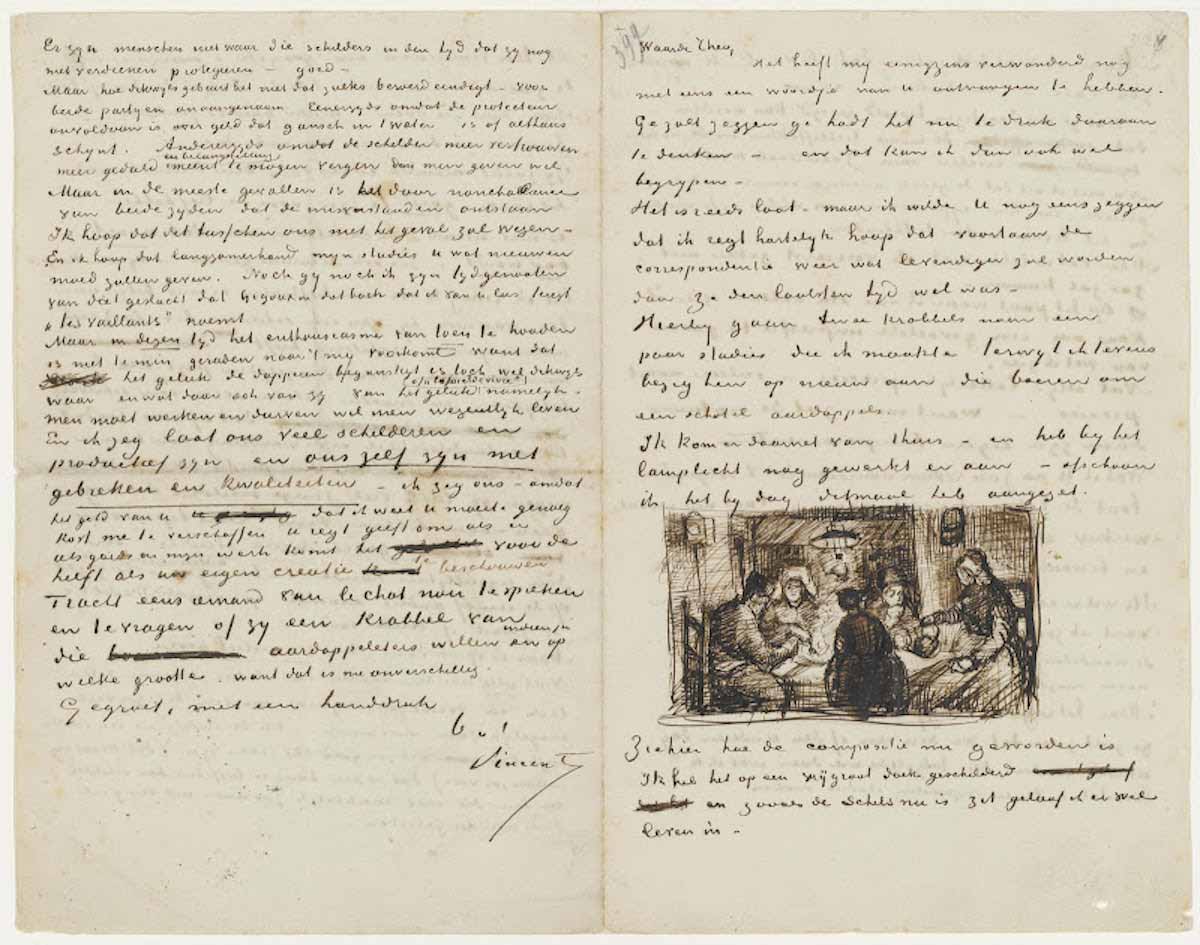
While achieving good technique was important to Van Gogh for The Potato Eaters, the meaning of the painting held more value. The artist wanted to depict the simple life of rural workers. Van Gogh wanted to capture the human form while also depicting the simplicity of the countryside. He was inspired by Millet and just like the French artist, Van Gogh wanted to be the painter of the peasants. This is what he wrote to Theo to explain his intentions with The Potato Eaters:
“You see, I really have wanted to make it so that people get the idea that these folk, who are eating their potatoes by the light of their little lamp, have tilled the earth themselves with these hands they are putting in the dish, and so it speaks of manual labour and — that they have thus honestly earned their food.”
Selecting potatoes as the dish of choice in this painting makes this work a great example of Dutch rural life. Van Gogh connected the identity of the De Groot family with the potatoes they grew themselves and are eating in the painting. Van Gogh did not decide to capture the family in the process of performing manual labor as Millet does in paintings like The Gleaners, but in the act of sharing a meal with each other after a hard day’s work, reaping the rewards of their efforts. The small, dark room, the modest clothing of the family members, and the simple meal of boiled potatoes with coffee, eaten at a small table under the glow of a lamp, form the image of rural life that Van Gogh portrays in The Potato Eaters.
Van Gogh’s Potato Eaters: A Personal Achievement

Van Gogh was proud of The Potato Eaters. He had high hopes for the painting and was excited to share this with his brother Theo. Unfortunately, his painting was not selected for the Salon. In late 19th-century Paris, avant-garde art was gaining popularity, particularly works that used vibrant colors. The somber tones of The Potato Eaters could not compete with that.
Van Gogh also received negative feedback from his friend Anthon van Rappard, a Dutch artist himself, who criticized the technicalities of the painting. He further wrote, “And with such a manner of working you dare to invoke the names of Millet and Breton? Come on! Art is too important, it seems to me, to be treated so cavalierly.” Van Gogh was shocked at this amount of criticism and returned Van Rappard’s letter after reading it. The Potato Eaters still held a special space in Van Gogh’s heart. In 1888, when the artist was living in Arles, he made a painting called The Night Café that he considered the “equivalent, though different of the potato eaters.” He did not explain this comparison further, but The Potato Eaters clearly remained a memorable painting for Van Gogh that he used as a frame of reference during his mature years.
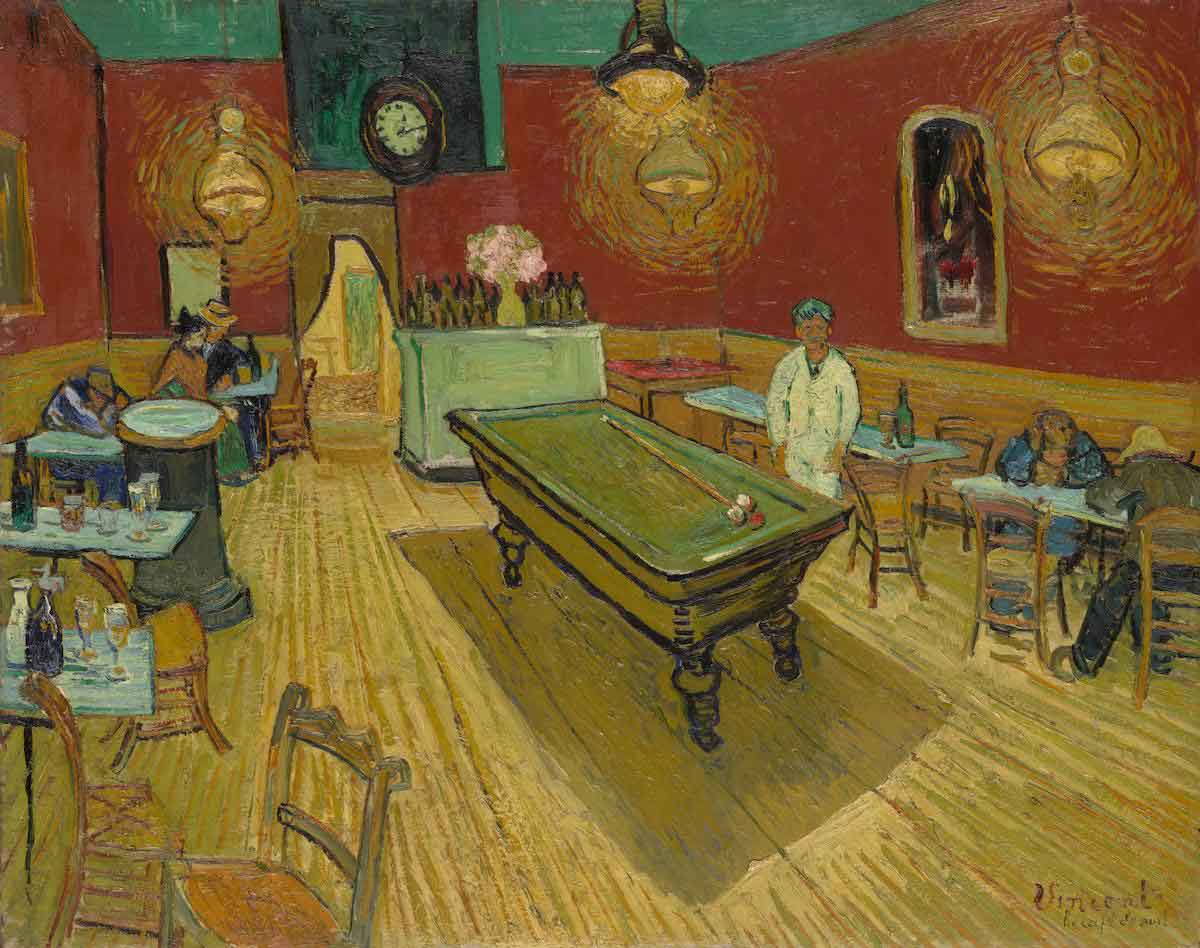
The central reason for his consideration of this painting as a masterpiece was the real and honest depiction of peasant life and the sense of community among workers that the painting showed. Van Gogh was not concerned with depicting the superficial beauty of the bourgeoisie but the earthly work and life of peasants. The artist’s intention with his work was not to create a perfect or idealized imitation of a traditionally beautiful subject but to instill character in what he painted in order to come as close to the feeling or essence of the subject. This quest to capture the essence of a subject persisted in Van Gogh’s work throughout his career, which is one of the reasons why he is considered a Post-Impressionist.
The Potato Eaters was Van Gogh’s first masterpiece, featuring depth in both the subject and technical aspects of painting. It was a major step in his artistic development, and it paved the way for his style to progress over the years. The care and attention the artist gave to creating a work full of character and authenticity over an idealized view of beauty is what makes Van Gogh’s art unique.