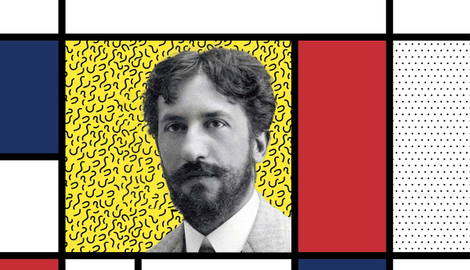

Piet Mondrian was a famous Dutch painter and abstract pioneer. He began as a provincial landscape painter but, after moving to Amsterdam and Paris, discovered new ideas and created a uniquely modern abstract style. His artistic revolution was closely related to his studies of Theosophy—a philosophical teaching aimed at unlocking humanity’s spiritual potential. Read on to learn more about Piet Mondrian and the influence of Theosophy on his abstract art.
Piet Mondrian’s Early Exposure to the Spiritual
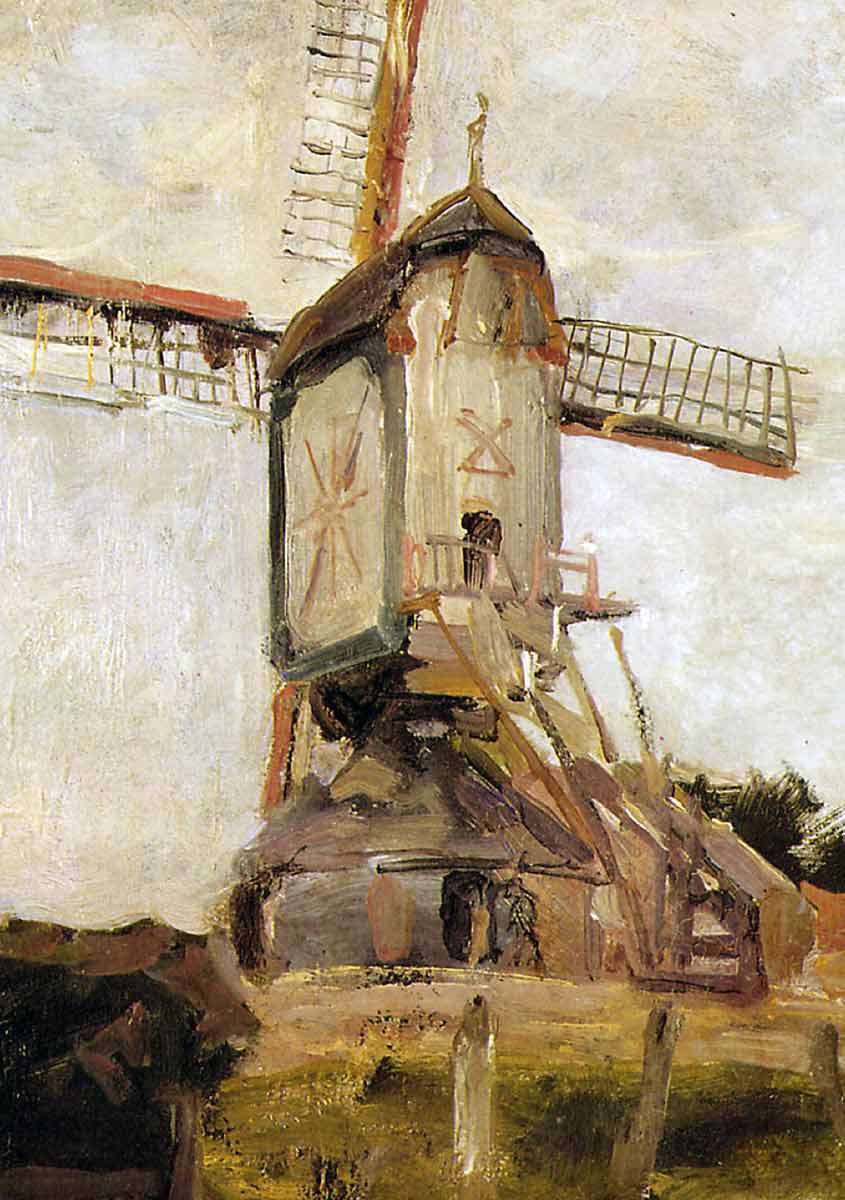
Piet Mondrian began his career as an artist closely related to the Dutch branch of the Symbolist artistic movement. Symbolism varied in style and subject matter but was always intrinsically linked to mysticism of various sorts. While some artists, led by a French mystic and writer Josephin Peladan, rediscovered Rosicrucianism and explored Christian occultism, other creatives turned their gazes towards the East.
In the late 19th century, the newly opened borders of Japan provoked an upsurge of interest in all things Asian, including spiritual and religious thought. As primary sources remained largely unavailable due to the language barrier, loose translations and adaptations began circulating in Europe. Concepts and ideas gradually became Westernized as they were removed from their actual contexts. Thus, despite the opening borders and newly available knowledge, the West nonetheless constructed an artificial version of the East. This fantasy found its way into art and artistic mythologies, popular amongst Western creatives.
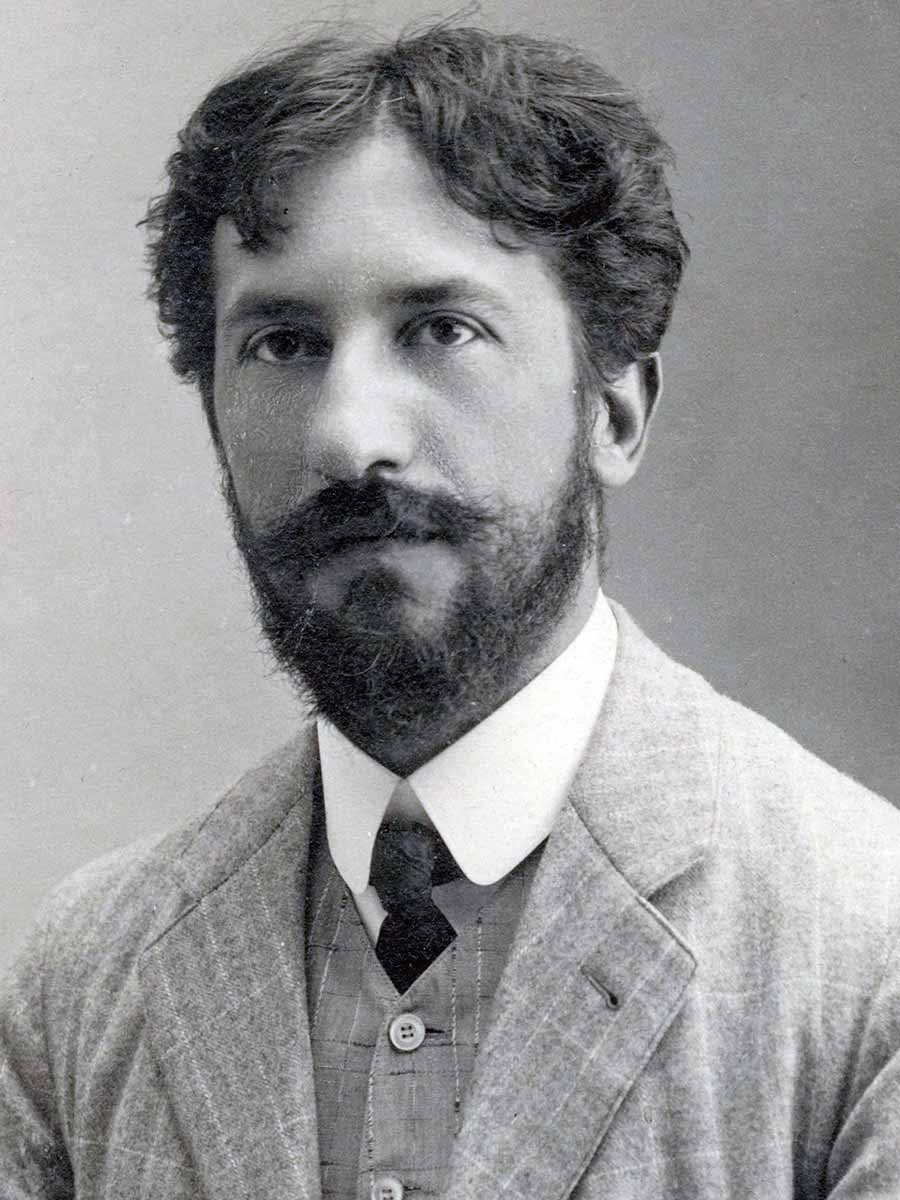
The Dutch art scene of that era was largely provincial and underdeveloped compared to other Western European countries. Young artists were deeply upset by it and sought ways to revive and revolutionize the visual culture of the land, previously famous for its outstanding paintings. Rather quickly, they decided that the key to such transformation was hidden not in the technical innovation but in the conceptual and spiritual approach. Symbolist ideas of constructing immaterial realities from archetypes and symbolic figures perfectly fit that purpose. Their art began moving away from conventional realism and even the trendy Impressionism, instead experimenting with expressive stylized figures and unexpected colors.

One of the most influential and innovative Dutch artists of the time was the Indonesian-born Jan Toorop. Toorop frequently explored the conflict between the material and the spiritual, with the inevitable superiority of the latter. He was amongst the forerunners but certainly was not the only Dutch artist experimenting with religious symbolism and immaterial subject matter.
As a young artist studying in Amsterdam, Piet Mondrian was exposed to all these ideas. Growing up in a conservative Protestant family, he was clearly excited and interested in finding various alternatives to his familiar worldview. Although traditional religion gradually lost its position, young artists still needed a spiritual revival. Yet, this revival had to happen outside the walls of churches and without the mediation of priests.
What Is Theosophy?

Theosophy is a philosophical teaching founded in 1875 in New York by the Russian writer Helena Blavatsky and American Colonel Henry Olcott. Blavatsky emphasized protesting the dogmatism of the traditional church and exploring the spiritual and scientific laws of the universe. She was a controversial figure, and many accused her of forging alleged ancient spiritual texts she used to strengthen her philosophy.
The ideological core of Theosophy developed by Blavatsky relied on reducing the basic principles of most world religions into a collection of universal truths that were hard to doubt. She heavily relied on Eastern religious philosophy and claimed to contact the “Masters of Spiritual Wisdom” during her alleged trips to Tibet. She preached the need to establish a human brotherhood that would go beyond the differences in race and gender and work together to reach a new level of spiritual consciousness.

Another advantage that contributed to the growing popularity of Theosophy was that it embraced the discoveries of modern science instead of rejecting them and eagerly incorporated ideas like Charles Darwin’s Theory of Evolution. They reinterpreted these ideas by applying them to the spiritual plane and the physical, yet still attracted educated young people with their open-mindedness and modernity. Theosophy was immensely popular among the artists and thinkers of the time. Apart from Mondrian, the list of affiliated artists included Hilma af Klint, Wassily Kandinsky, Frantisek Kupka, Max Beckmann, and many others.
Theosophy & Abstraction
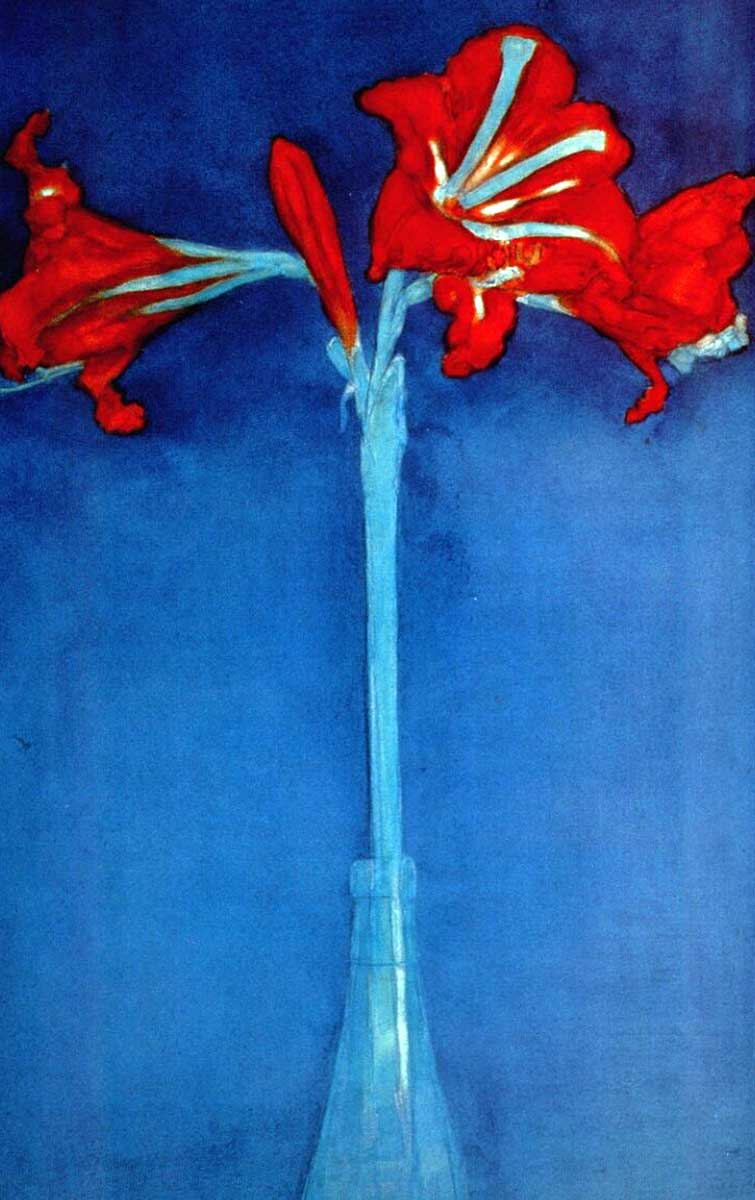
Theosophy soon became immensely popular among artists and creatives of all sorts. It offered new ways of thinking and seeing, as well as a new library of symbols and meanings, both practical and spiritual. Particularly in the Netherlands, Theosophical ideas became prominent in architecture, thus linking the philosophical and spiritual doctrine to the domain of precise calculations.
Mondrian joined the Dutch branch of the Theosophical Society in 1909, almost a decade after it struck his initial interest. From the early 1900s, he studied religions and occult philosophies and began incorporating their symbols into their works. By the end of the decade, he earned a reputation as an educated mystic and an outstanding artist whose works “radiated fire.” From pleasing yet completely regular landscape painting of his early years, he moved towards more complex and spiritually charged images. Yet, he rarely worked with occult symbols directly, as he believed it would be more correct to introduce the ideas of spiritual revolution to the public through more familiar images. He painted dying flowers as symbols of spiritual evolution, for which weaker beings had to die to bring more advanced ones into the world.
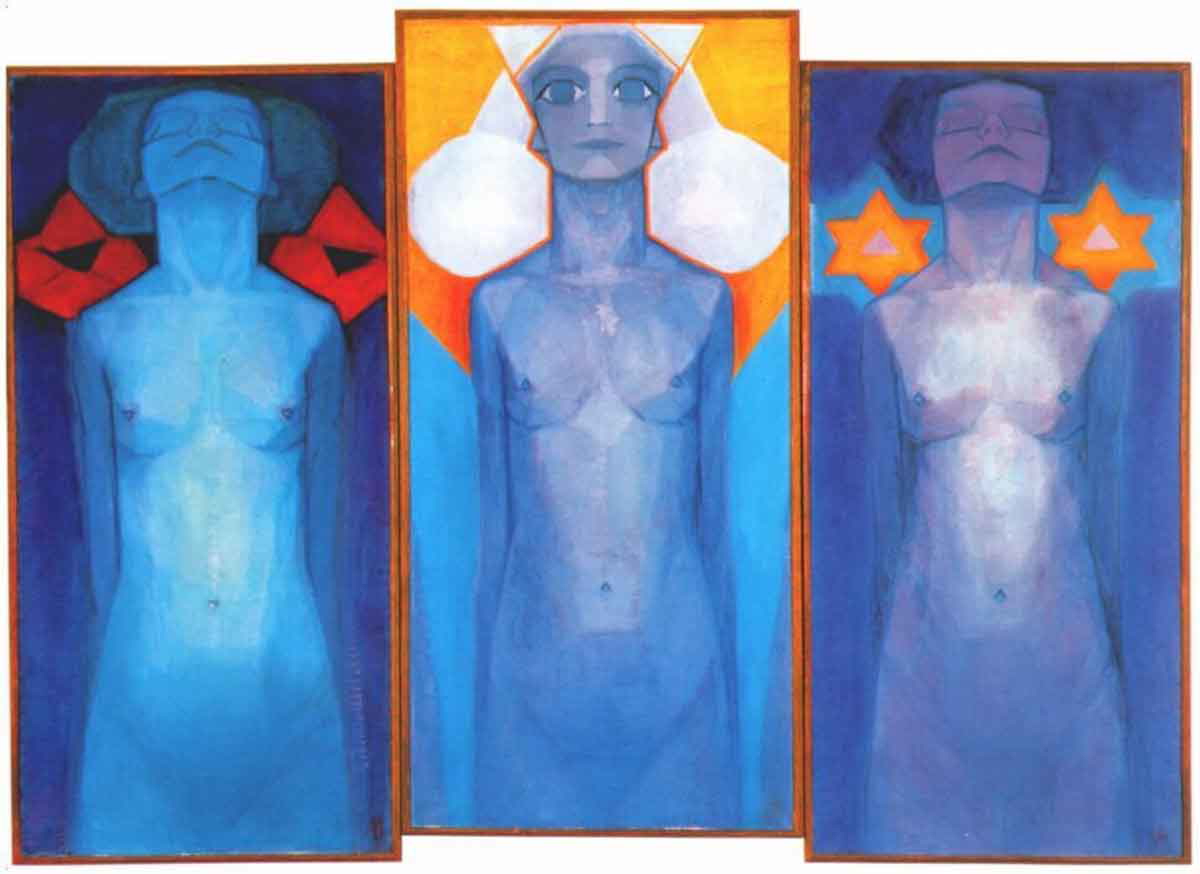
However, one of the most famous works of his pre-abstract Theosophical period was Evolution, a three-paneled work that represented the transformation of a human being from their low materialistic form into an enlightened spiritually conscious self. The triptych was supposed to be read, moving from the left image to the right and then to central. Subtle changes in color and body position of the figure indicated its developing consciousness. In Evolution, one could already see the movement toward geometric abstraction that would soon make Mondrian one of the abstract pioneers. While discussing his later work with a fellow abstract artist, Theo van Doesburg, Mondrian stated that he got all the information he needed from the book The Secret Doctrine by Helena Blavatsky, one of the key works in Theosophy.
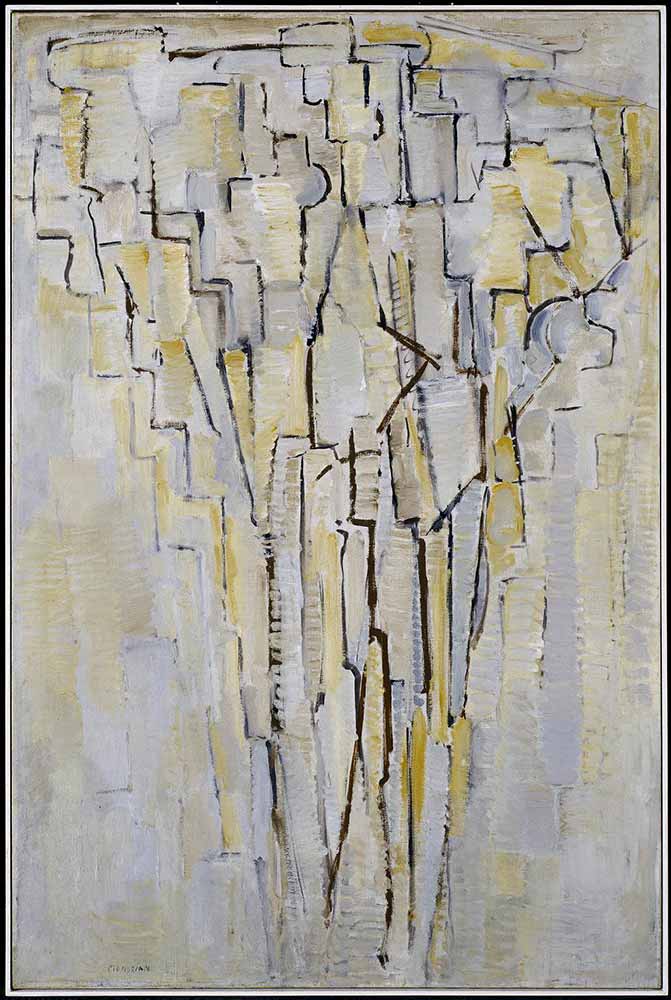
Mondrian came to abstraction not only through spiritualist influences but also through a brief yet meaningful interest in Cubism. In 1911, he moved to Paris and temporarily rented a room from local Theosophists. In the works of Pablo Picasso and Georges Braque, he found the ideal way to dematerialize a painter’s subject matter by distilling it into a collection of overlapping geometric planes. The constant visual analysis of objects, typical for Cubism, later manifested in Mondrian’s theory of Neoplasticism.
Neoplasticism was based on the idea of the purification of art and its reduction to horizontals and verticals, creating shapes at their intersection. By filling some of these shapes with a limited palette of primary colors, Mondrian based his compositions on clear and concise visual rhythms. In his view, vertical lines stood for the masculine energy, and horizontal for the feminine one. To create rhythms, he used black, blue, yellow, and red tones, rejecting green altogether. Art historians still debate why exactly he avoided that color. Some believe it was due to some spiritual significance, as Theosophists attributed symbolic meanings to colors and forms, while others insist that the truth was much more banal—it is possible that Mondrian was colorblind and simply could not distinguish some colors.
Piet Mondrian & Rudolf Steiner
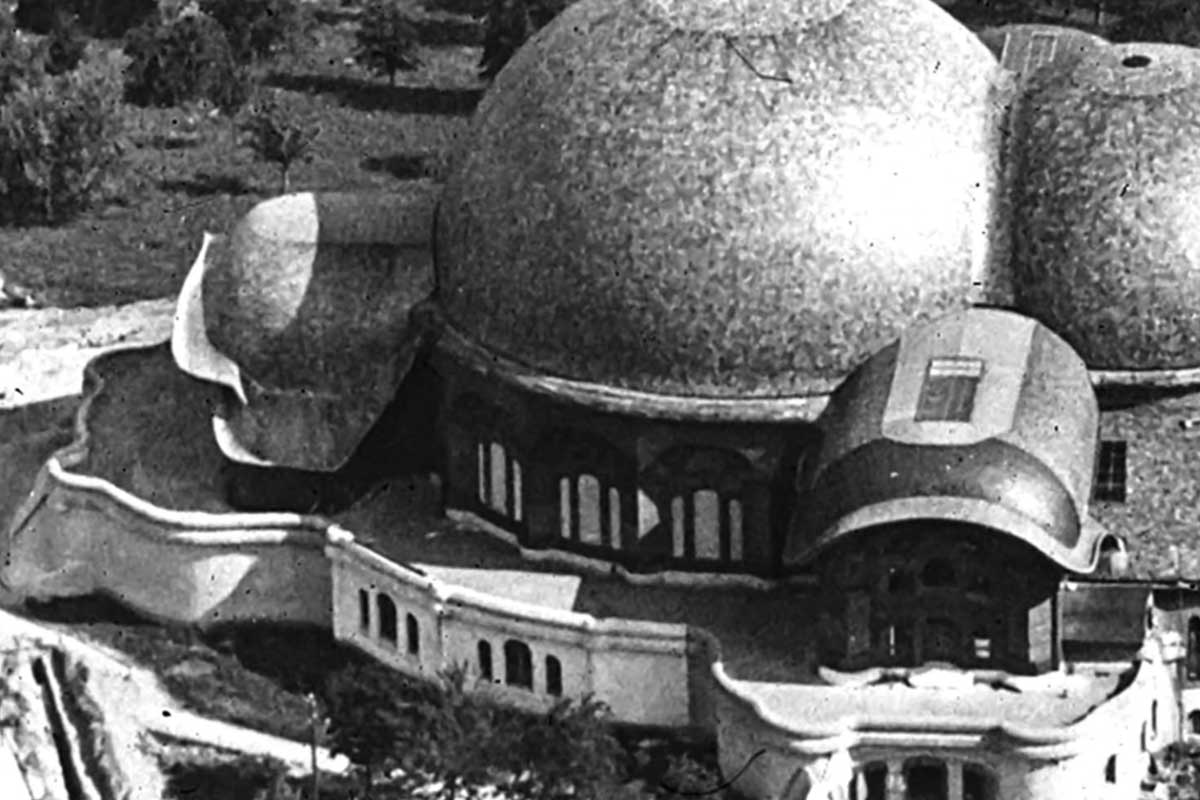
Another contemporary philosopher who was important to Mondrian was Rudolf Steiner, whom he met several times. For several years, he was a prominent figure among the Theosophists as a theorist and supposed clairvoyant. In 1908, Steiner visited the Netherlands to give a series of lectures on Theosophy and spiritual knowledge. At the time, Steiner was already in conflict with other leaders of the movement but still remained associated with it until 1912.
Steiner’s principal issue was the focus of major Theosophists on Buddhism and Hinduism as sources of spiritual knowledge. Steiner believed Christianity was more important for Western culture and that the answers to the quest for spiritual evolution could be found there. Moreover, he insisted on the need to invest in natural science and balance spiritual principles with empirical and theoretical knowledge. In 1912, Steiner finally broke all ties with the Theosophists and founded his own Anthroposophical society, which still functions today in Dornach, Switzerland.

Mondrian visited Steiner’s early lectures in the Netherlands. He still regarded Neoplasticism as a purely Theosophical art movement, yet he was appalled by Steiner’s rejection and the odd transformations of both societies, especially from an artistic point of view. After the death of Helena Blavatsky, some Theosophists moved to more bizarre explorations, including the study of colored “auras” surrounding every object and being.