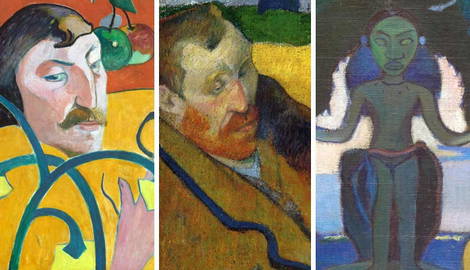

French artist Paul Gauguin was a prominent participant in the Post-Impressionist movement in late 19th-century France. He initially worked as a stockbroker until he decided to focus solely on his art after an economic crisis in 1884. Gauguin’s contributions to the art world of the 19th and 20th centuries ranged from painting to sculpture, ceramics, printmaking, and woodcarving. Today, he is largely famous for his paintings and his influence on the new generation of artists in the 20th century, such as Henri Matisse and Pablo Picasso.
Paul Gauguin’s Evolution in Style
At the beginning of his career, Gauguin was influenced by the Impressionist painters who had become quite famous in their days, such as Claude Monet and Camille Pissarro. Gauguin started painting mainly in the Impressionist style, featuring multiple short brushstrokes in varied colors to create a vibrant composition. However, in the 1880s, the artist wished to move in a different direction. He started experimenting with new stylistic methods to create paintings that expressed the depth of his emotional and spiritual self. These works featured a style completely different from Impressionism, characterized by broad sections of individual colors applied in a flat layer instead of a melody of colors applied with short brushstrokes.
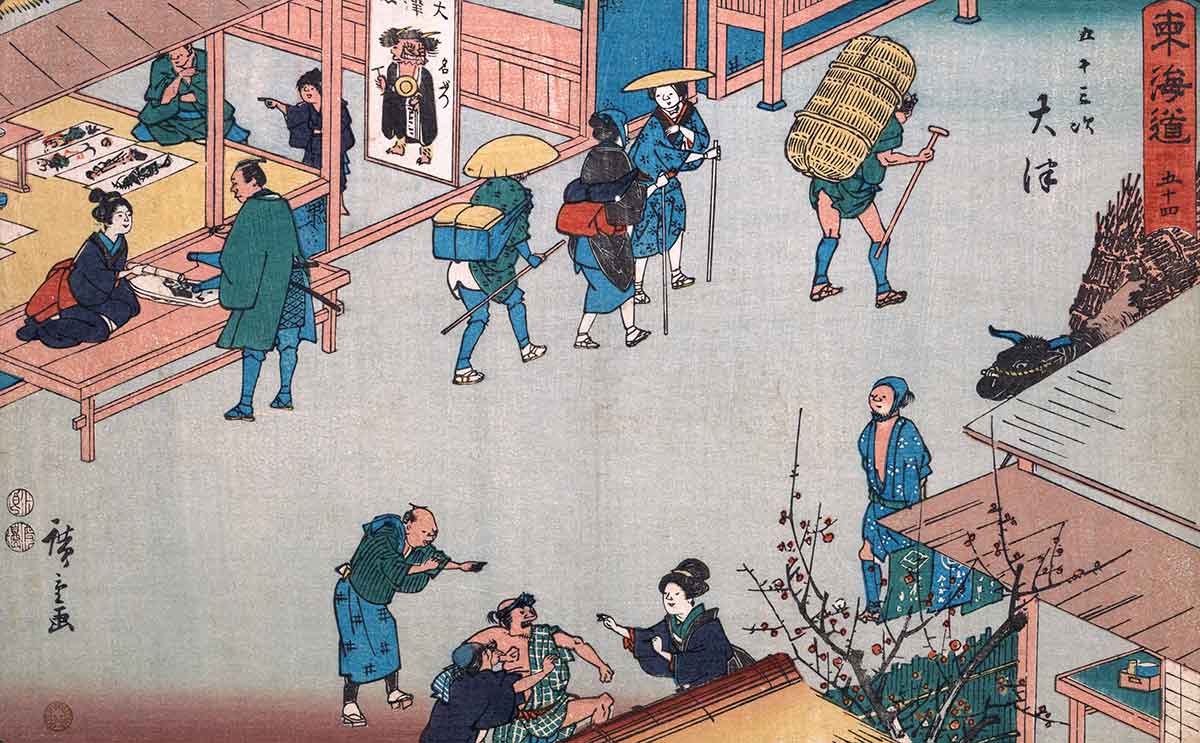
Further, the perspective in Gauguin’s paintings also changed—instead of employing the traditional European three-dimensional perspective, he used a very specific two-dimensional perspective that was mainly found in Japanese woodblock prints. These prints were called ukiyo-e and gained popularity in 19th-century Europe, influencing artists like Mary Cassatt, Édouard Manet, Edgar Degas, and Vincent van Gogh. Gauguin termed his innovative style Synthetism, distinguished by flat compositions influenced by Japanese perspectives, simplified forms, and bold lines, aiming to express the artist’s psyche.

The core idea of synthetism was to express the artist’s spiritual and emotional perception of the subject in a visually pleasing manner. This resulted in the creation of highly decorative works by Gauguin and the artist later went on to inspire the Nabis in their endeavors to create Symbolist and decorative art. The decision to express dreams or visions through the medium of visual art also led Gauguin to make a fundamental change in his creative process. While the Impressionists and his contemporaries painted everyday scenes by observing reality, Gauguin decided to paint from the imagination or the memory to bestow a mysterious quality in his works. He argued that painting from memory allows the artist to express the spiritual self by detaching from material reality. Gauguin’s synthetist manner of painting reached its peak during the mature years that he spent on the island of Tahiti in French Polynesia. The artist created a number of remarkable paintings throughout his career, five of which are listed below.
1. Self-Portrait with Halo and Snake, 1889
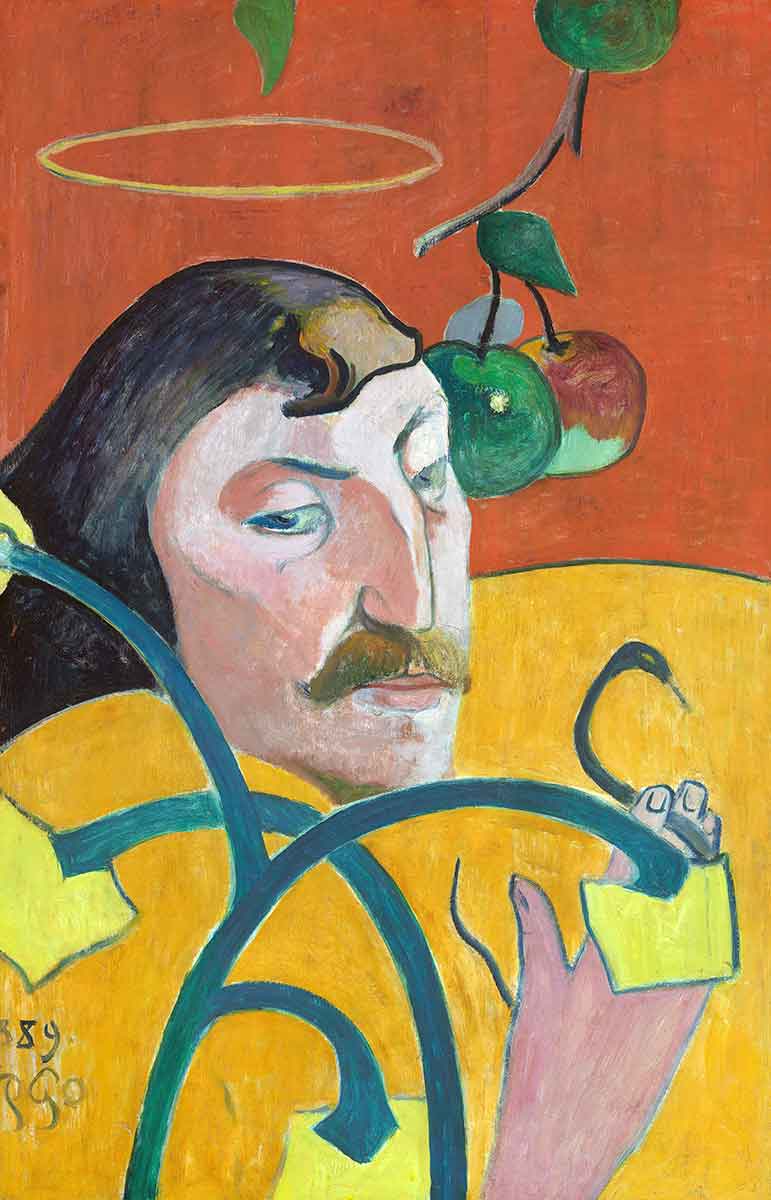
Gauguin’s self-portrait is unlike a simple representation of himself. Instead of following the traditional rules of a self-portrait, the artist brings an intriguing perspective to this work by showing two different versions of himself in the top and bottom half of the painting. With a red background, the top half depicts a halo over his head and an apple tree behind him. The apple is ready for picking but the artist is looking in the other direction, thus ignoring it. This half of the portrait shows the artist as a saint who does not pick the forbidden fruit from the Biblical story of Adam and Eve in the Garden of Eden.
However, the bottom half of the work depicts the artist as a sinner. In front of a yellow background, the artist holds a snake between his fingers, symbolic of the snake that tempted Eve to eat the forbidden fruit and commit humanity’s first sin. By using religious iconography in this work, Gauguin comments on the black-and-white perception of morality in 19th-century France and suggests that the modern artist has abandoned this idea.
This self-portrait was not painted on a canvas but on the door of a wooden cupboard from an inn in Brittany. It shows the development of Gauguin’s decorative style in the late 19th century with the flat application of saturated color and imposing use of lines. Each element of the painting appears disconnected but contributes to the whole of the composition.
2. The Painter of Sunflowers, 1888
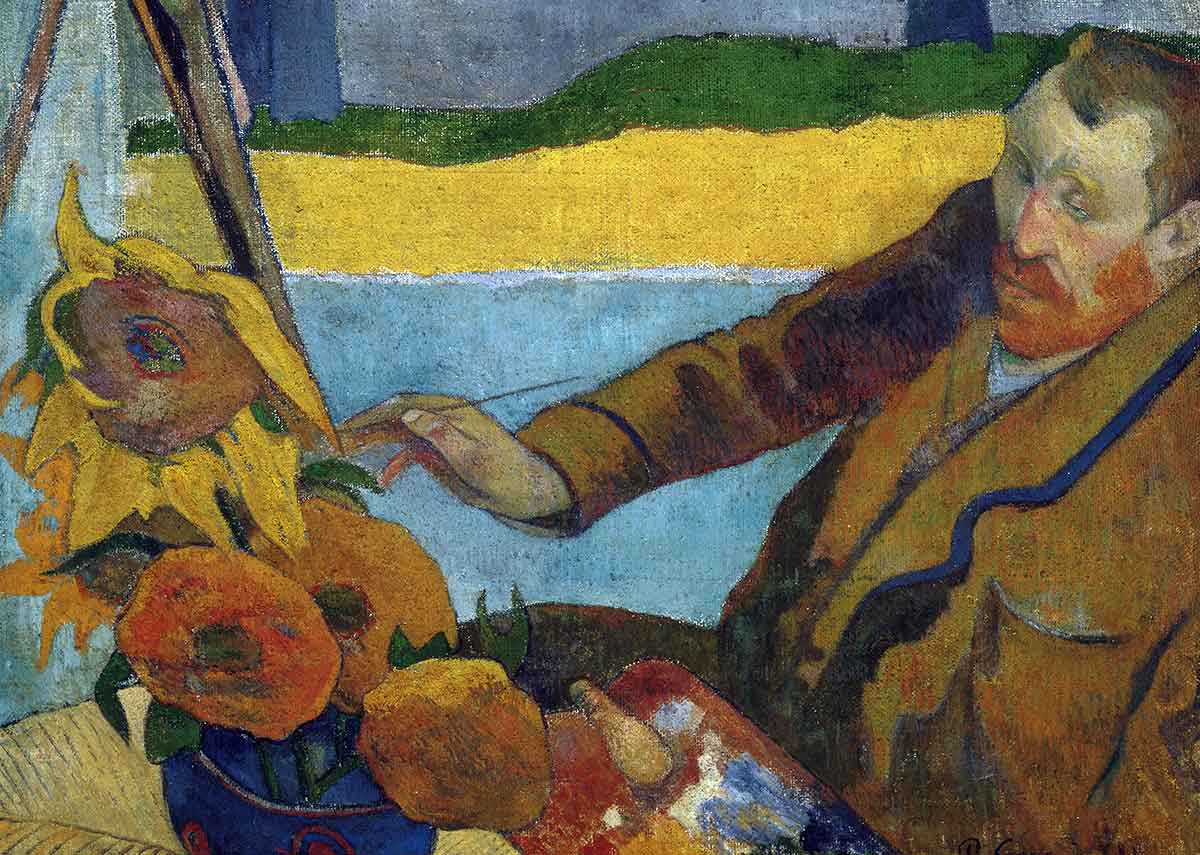
This painting by Gauguin depicts Vincent van Gogh in the act of painting one of his famous Sunflowers. This work alludes to the brief cohabitation of Gauguin and Van Gogh in Arles in 1888 where the latter wished to set up a colony for avant-garde artists in his Yellow House. One of the seven Sunflowers that Van Gogh painted was hung in Gauguin’s room. Impressed by the quality of that work, Gauguin acknowledged that the sunflower motif belonged to Van Gogh, hence the title of the above painting. However, the two artists clashed on many aspects of painting, and The Painter of Sunflowers hints at their rivalry.
While Gauguin emphasized the importance of painting from the imagination and detaching from material reality, Van Gogh sought his inspiration from nature and disagreed with Gauguin’s method. In order to mock Van Gogh as an imitator of nature, Gauguin placed a vase of sunflowers in front of Van Gogh in The Painter of Sunflowers. Although Van Gogh had modeled some of his sunflower paintings after an actual vase of flowers, the particular version he is supposed to be painting in Gauguin’s painting was painted from memory as a copy of an earlier version. Gauguin’s deliberate invention of a vase of sunflowers in his painting shows the intensity of their disagreements over this artistic issue.
3. The Seed of the Areoi, 1892
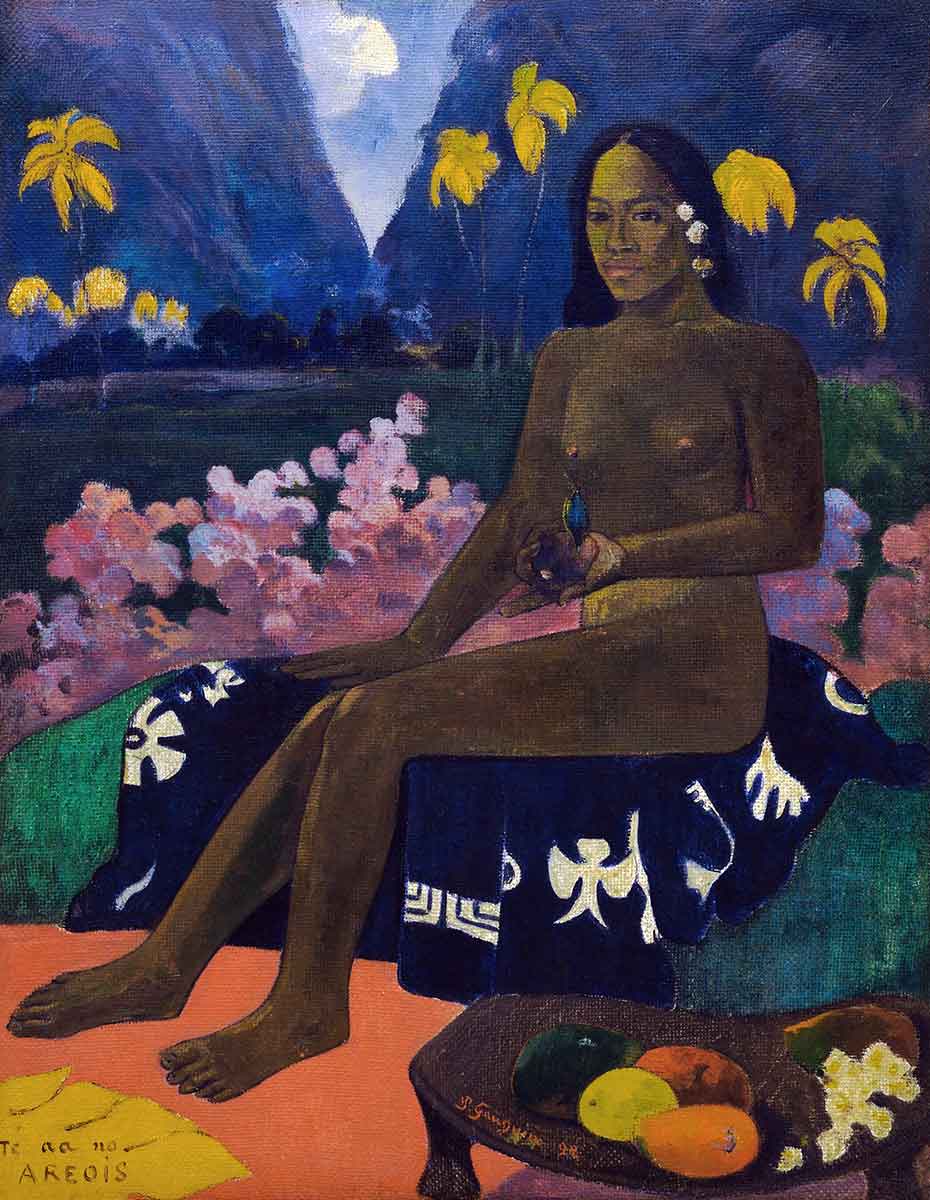
This painting is based on the mythological story of the Polynesian Areoi society that follows the creation of a new race of people. In this story, the sun god mates with an exceptionally beautiful woman named Vairaumati. Gauguin modeled Vairaumati after his own lover, a girl named Tehura, who is shown seated on a patterned cloth in the center of the frame, completely nude. The painting features a decorative style with vivid colors and highly simplified forms of the seated woman and the tropical landscape in the background.
This view of Tahiti is an idealized one. As Gauguin often painted remembered or imagined scenes, he created a perfect version of Tahiti as a primitive and exotic land by deriving his subject from a myth for this painting. His escape to Tahiti was also a result of his dissatisfaction with the growing industrialization of European society. However, the island of Tahiti was far from ideal as it had become a poor region festered with diseases due to French colonization. While this painting is a creative success, it has a problematic context. It is alleged that Gauguin’s lover, Tehura, was only 13 years old when the artist was 43. They had a relationship of around 18 months after marrying in Tahiti. Tehura appears in several of Gauguin’s works from his Tahitian period, which are considered a result of his artistic genius. However, looking at these paintings critically brings up their controversial history.
4. Cows at Rest, 1885
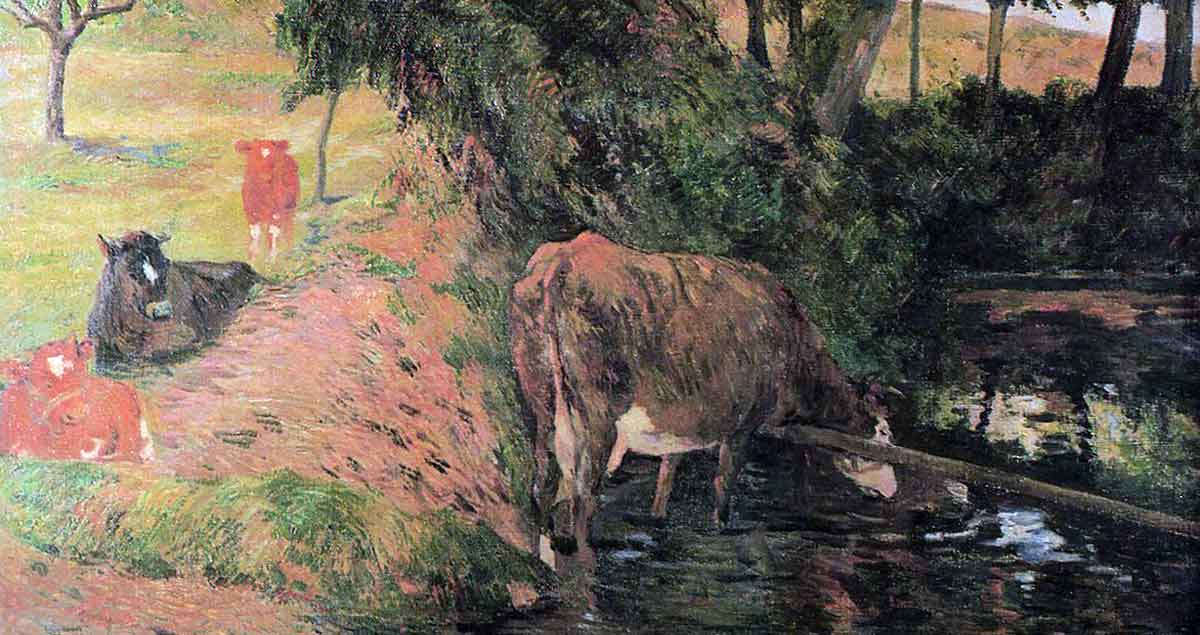
This is an early work by Gauguin, which was created just one year after he decided to leave his day job and fully commit to art. Gauguin still followed the Impressionist rules of painting with this work, as can be seen from the arrangement of short brushstrokes loaded with varied colors throughout the composition. This represents the changing effects of sunlight on the scene, particularly on the water. The subject of the painting is also very typically Impressionist—it depicts a simple, everyday rural scene without a complex narrative. The cows rest among the foliage on a sunny day, and the overall character of the scene is tranquil.
Cows at Rest, currently in the Museum Boijmans van Beuningen in The Netherlands, is a testament to Gauguin’s artistic range. It lives up to the quintessential character of Impressionist works with its simplicity of subject and emphasis on the use of color to capture the transient nature of light. In his later years, Gauguin abandoned the Impressionist technique and subject matter to paint in the synthetist manner, creating works with a completely different character and stylistic elements.
5. Mahana no atua (Day of the God), 1894
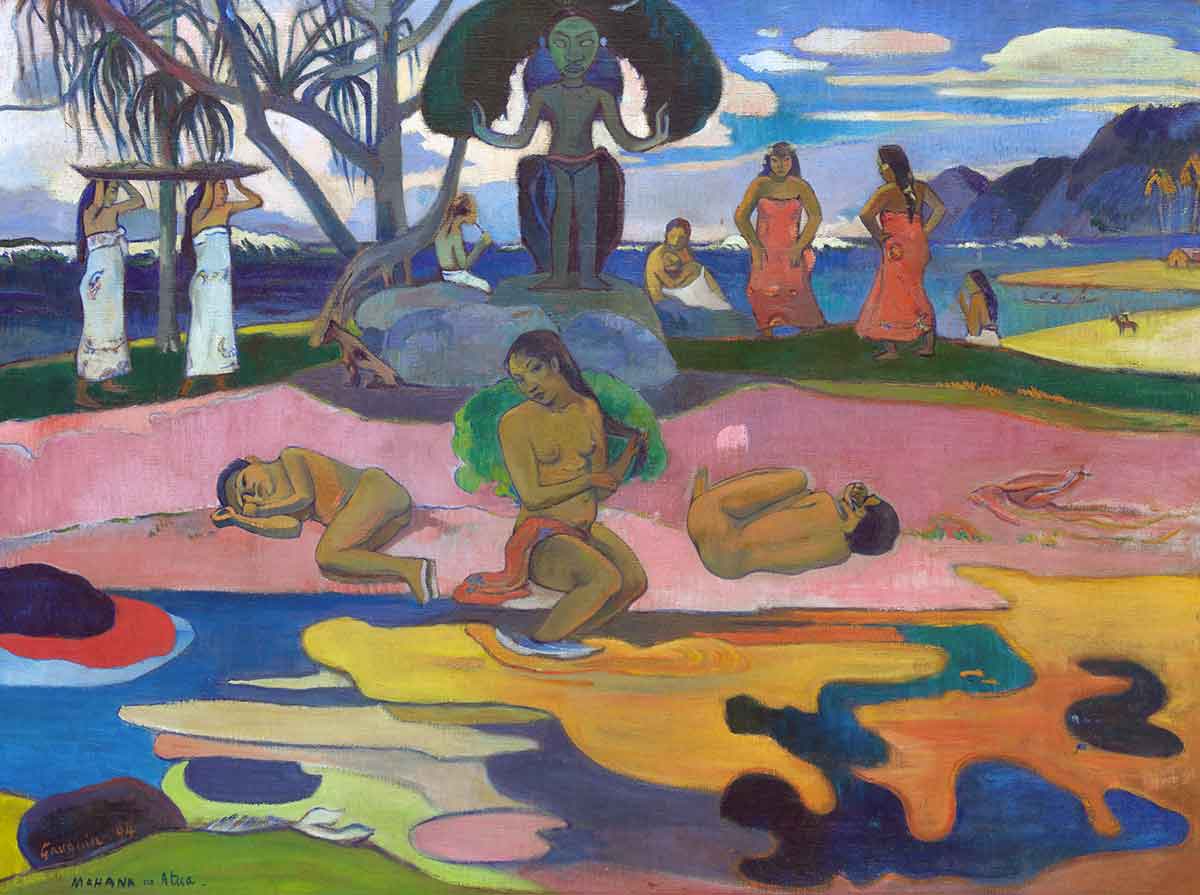
This painting, made almost ten years after the previous one, shows a complete shift in Gauguin’s style. Day of the Gods is an imagined scene wherein several women are dancing, working, or lying down by a body of water which is colored in bright blue, yellow, green, and orange sections. The characters in this work are overseen by a deity, the goddess Hina, who stands on top of a rock. In the background, the sea can be seen under a vibrant, cloudy blue sky. In the central foreground, a woman is bathing, surrounded by two figures resting on each side.
The overall composition has an enigmatic character due to the manipulation of form and color as well as the subject matter. This mystery is also due to the fact that Gauguin painted this work set in Tahiti from memory in Paris. It is interesting to compare and contrast Cows at Rest from 1885 and Day of the God from 1894 in terms of stylistic evolution and change in the approach to subject matter. While Impressionism had already shaken the foundation of traditional painting in the second half of the 19th century, Gauguin’s mature style pushed even further to leave the restrictions of Impressionism behind.