
Vincent van Gogh is often recognized as a mad genius artist. The boldness and intensity of his paintings are frequently associated with his psychological problems, but this passionate artistic vision was present from his very early days as an artist. In fact, Van Gogh’s mental problems often hindered him from working on his art, but he managed to persevere nonetheless. In 1889, the artist was hospitalized due to his worsening condition, and he spent a year making artworks within the bounds of the hospital.
Why Was Van Gogh Hospitalized?
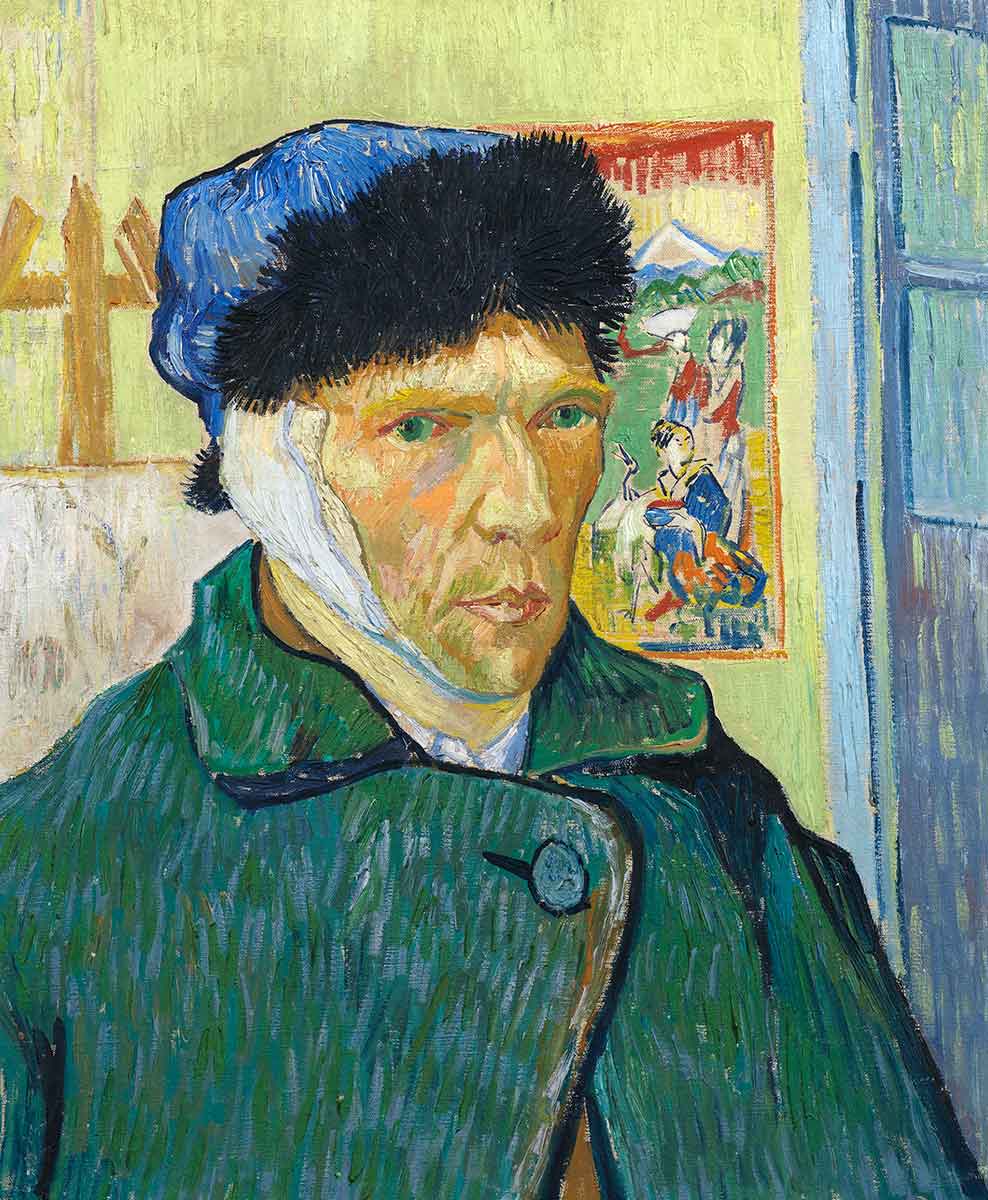
Van Gogh’s psychological problems became apparent in December 1888 when he cut off a portion of his ear after an intense argument with fellow artist Paul Gauguin. He spent a few days in a hospital in Arles recovering from the damage to his ear, but was released shortly after. He continued painting in his Yellow House for a few months, but his problems were far from over. He suffered from four serious attacks in the first half of 1889 and was hospitalized multiple times.
During these incidents, the artist would lose control of his actions and be unable to recall them once he recovered. Both Vincent and his brother Theo considered it a good idea for the artist to be admitted to a psychiatric hospital for a while in order to receive constant care and supervision from professionals. Van Gogh wrote in April 1889, “And for the time being I wish to remain confined, as much for my own tranquillity as for that of others.”
And so, on May 8th, Van Gogh left Arles for Saint-Rémy-de-Provence. The hospital he stayed at was called Saint-Paul-de-Mausole and lay just outside Saint-Rémy. He would spend his good days painting and drawing the garden of the hospital, but remained confined to his room during his attacks. Van Gogh was also allowed to use an extra room in the hospital as a studio where he worked frequently, producing around 150 paintings, including a few well-known masterpieces.
1. The Starry Night
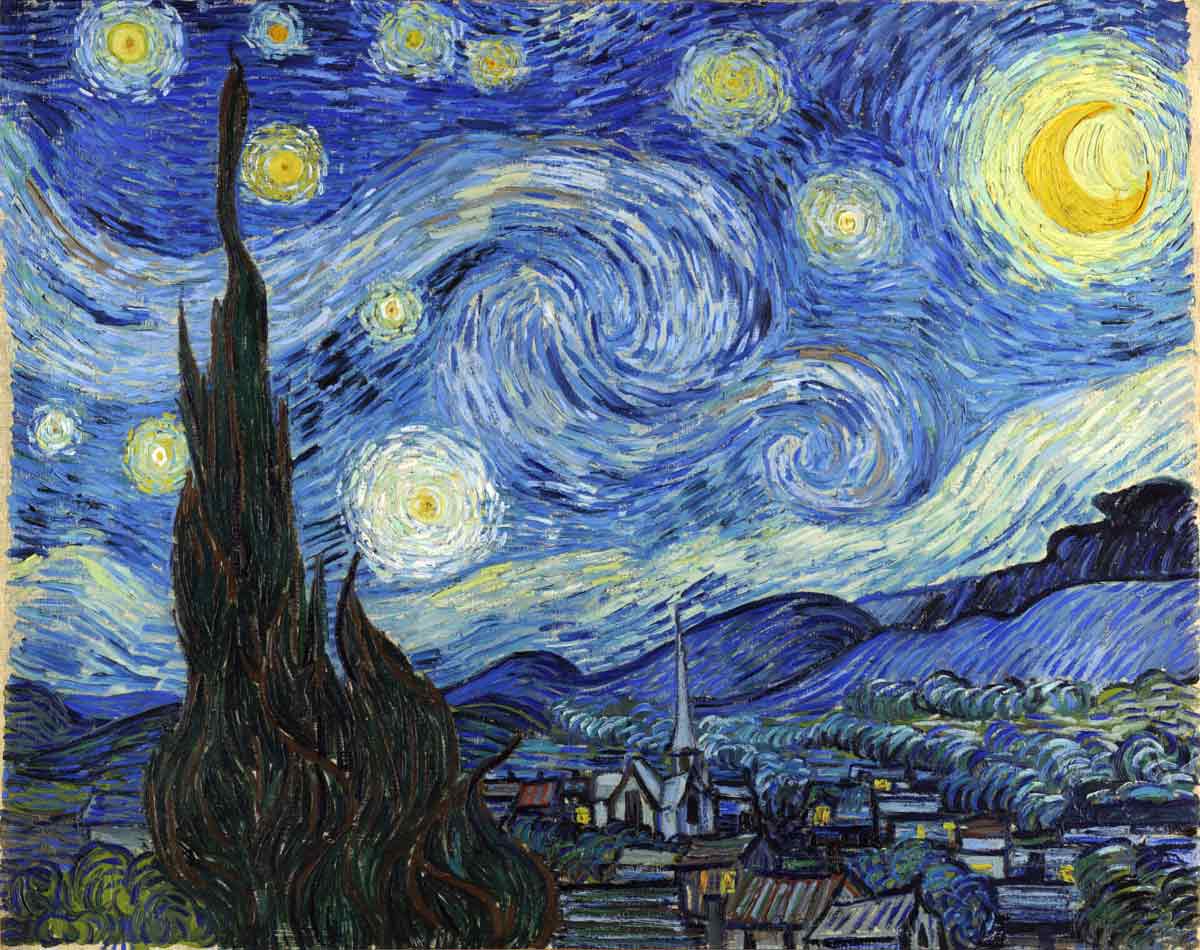
Perhaps the most widely known painting by Vincent van Gogh, The Starry Night, was made in June 1889, around a month after the artist was admitted into the psychiatric hospital. It depicts a view of a village at night with a tall cypress in the foreground under a starry sky and a radiant crescent moon painted with swirling lines.
The Starry Night is Van Gogh’s most famous masterpiece, and yet the artist never made a significant mention of it in his letters, referring to it as the “night effect” and “night study.” Before painting The Starry Night, Van Gogh had made two more night paintings: Starry Night over the Rhône and Café Terrace at Night. The former was a cherished work, and the artist was very specific about painting night scenes on the spot rather than in the studio to capture the mood of the scene in the moment.
However, as he was confined to the hospital premises in 1889, the artist was not allotted this luxury when painting The Starry Night. The work was painted in his studio during the day in June, around a month after his arrival at the hospital. Van Gogh was inspired by the view of the night sky from his window, and this painting was his attempt to capture it with his brush. While the sky was inspired by these observations, the view of the village in the background is a collage of his previous observations of village views both in France and the Netherlands. For example, the church spire in the village resembles Dutch architecture, while the cypress tree is typical of the Provençal landscape.
2. Cypresses
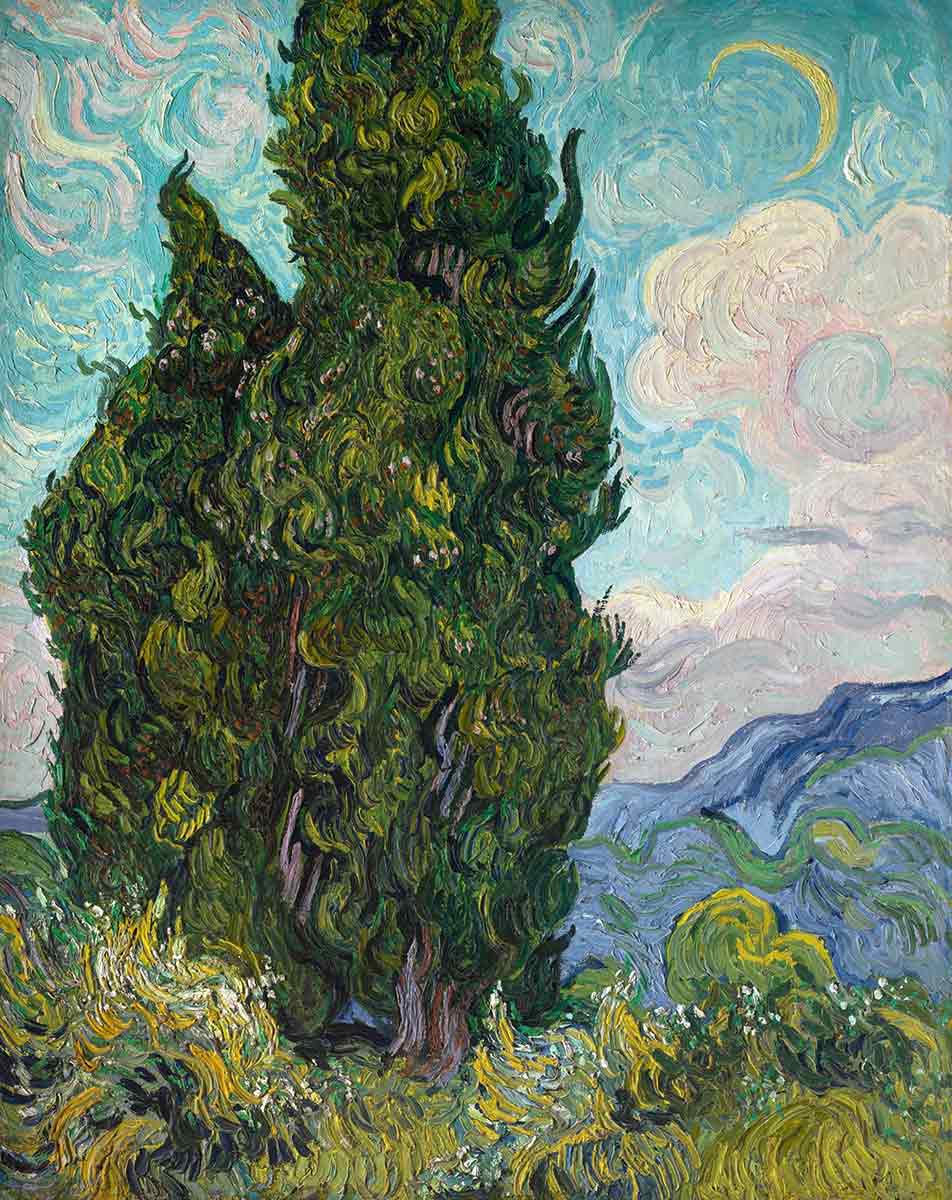
Van Gogh was fascinated by the cypress trees that were abundant in Provence. He considered these towering, slender, dark trees to have a strong presence that contrasted with the bright and sunny Provençal landscape. Although he was already familiar with the tree in Arles, it was only after he moved to Saint-Rémy that he fully appreciated its complexity and beauty. He made a series of paintings depicting cypresses during his stay at the hospital because the tree offered great potential as a subject, as he wrote in a letter, “It’s beautiful as regards lines and proportions, like an Egyptian obelisk. And the green has such a distinguished quality.”
This particular painting, made in June 1889, depicts two cypress trees composed of sinuous lines of dark green and black with hints of yellow, giving them a flame-like appearance. A similar style was used to paint the sky and the clouds, the hills in the background, as well as the shrubbery on the ground that features thick impasto. The top-right corner of the composition depicts a thin crescent moon that merges into the swirls of the light blue sky. This was one of the first paintings by Van Gogh where the cypress tree appeared as the central subject instead of a background element to the landscape.
3. Self-Portrait
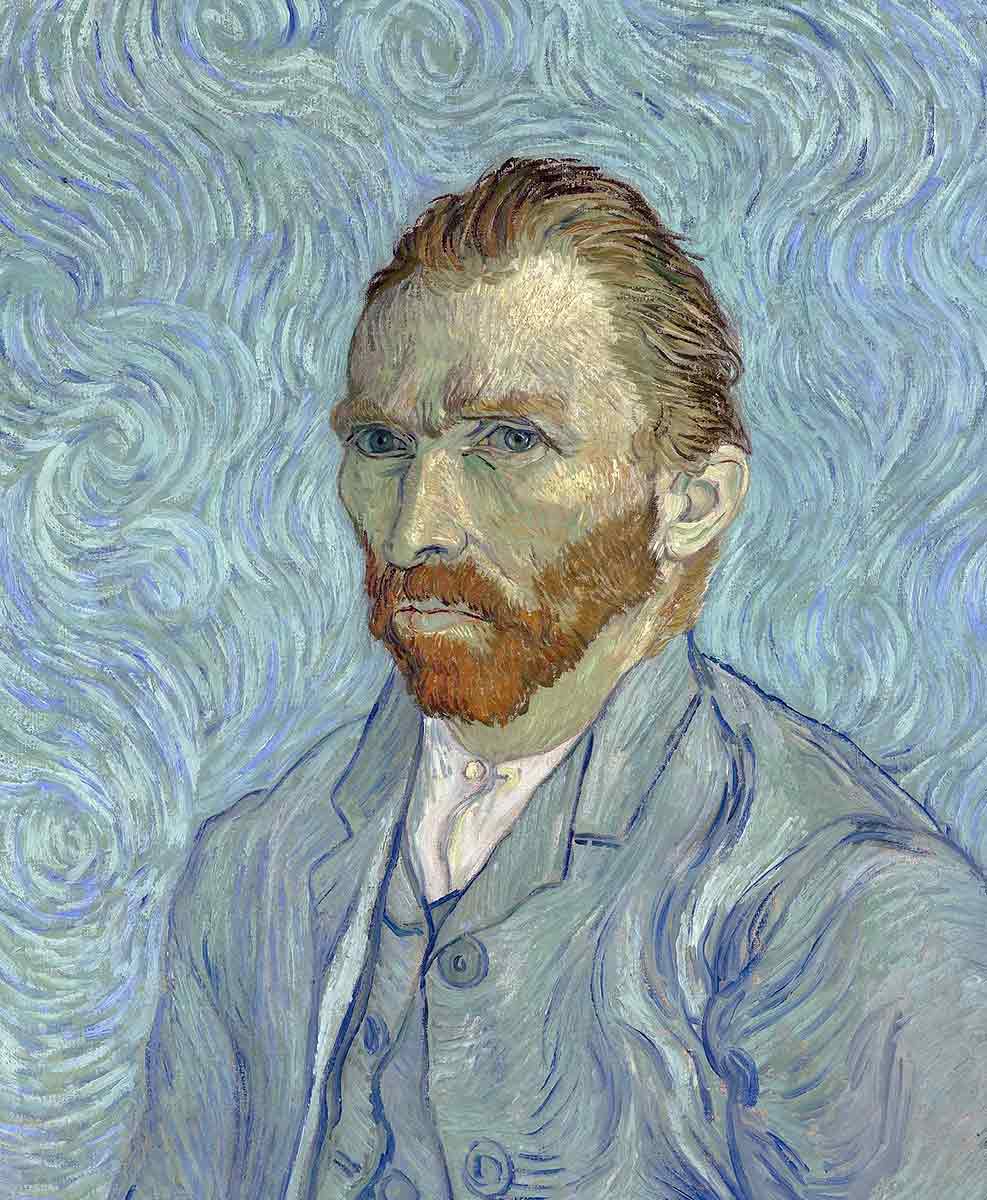
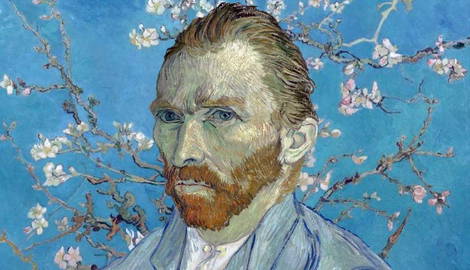
This mesmerizing self-portrait depicting Van Gogh in front of a light blue background with swirling lines was made in August or September 1889. His figure blends into the background except for the reddish-orange of his beard and hair that stand out against the blue. This was one of two self-portraits made by the artist during these months, as he was not eager to go outside his room and paint nature. He had suffered from an attack that lasted for more than a month and drained his energy. But painting, even while being confined to his room, lifted his spirits.
While he did not write much about this particular self-portrait, only describing it as depicting “three-quarter length on a light background,” the color effects and hypnotizing brushwork of the composition have made it one of Van Gogh’s most famous self-portraits today. This self-portrait was also a favorite of Doctor Paul Gachet, who looked after Van Gogh in Auvers after his stay at the hospital. The artist painted a portrait of the doctor “in the same sentiment” as his self-portrait, since Gachet was “absolutely fanatical” about the original work and requested a portrait of himself in a similar style.
4. Window in the Studio
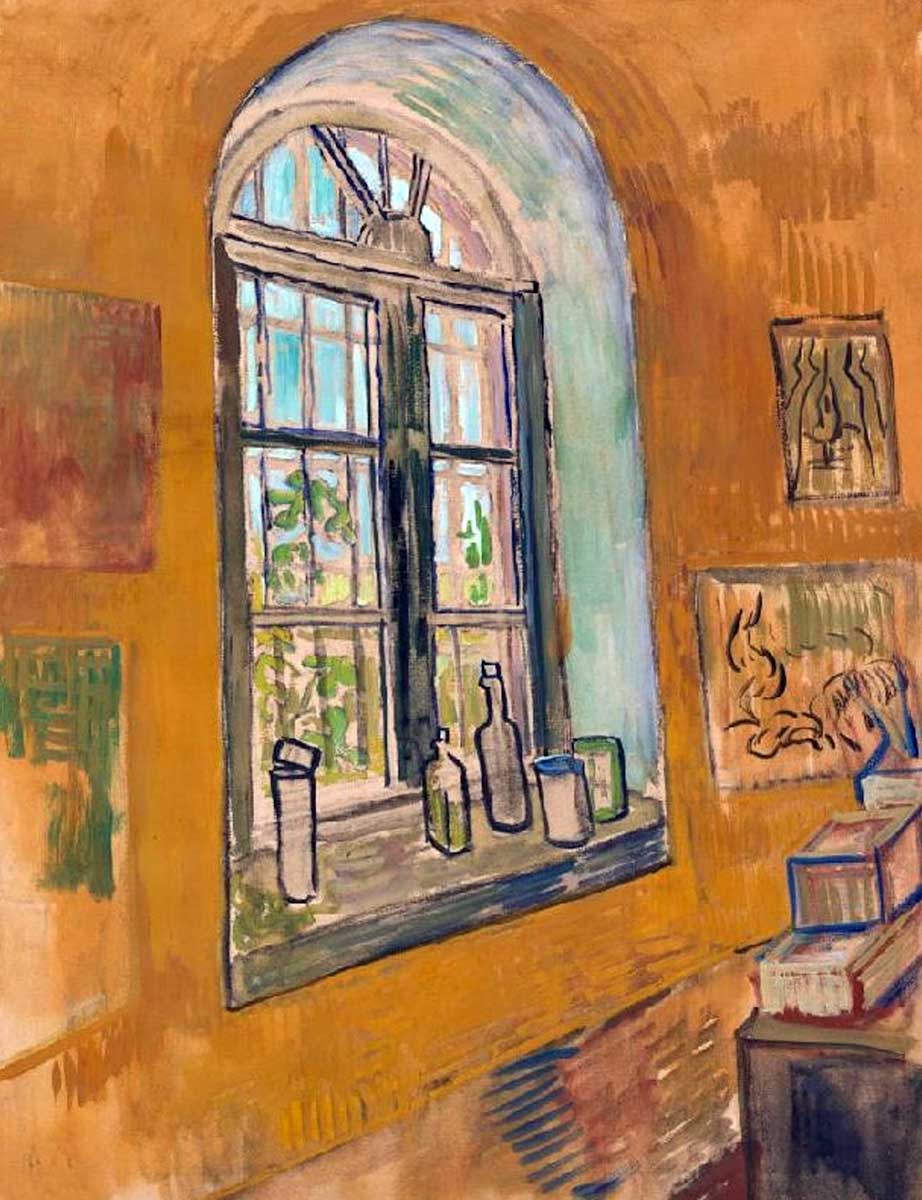
Van Gogh spent a lot of his time inside the hospital walls, which naturally resulted in works of the interior. Since he was allowed to use one extra room as a studio, he set up his easel, supplies, and books there. Made between September and October 1889, this watercolor and chalk drawing of the windowsill of his studio gives a glimpse into how he arranged the room. As can be seen in the image, he hung a few of his own works on the walls, one of which can be identified as featuring a cypress tree.
This window looked out to the walled garden of the asylum that was the subject of many of Van Gogh’s paintings from the Saint-Rémy period. In a letter to Theo from his early days in the hospital, the artist commented on the deteriorating aspect of the asylum building but found the countryside of Saint-Rémy to have completely contrasting traits. While the interiors were old and lacking in character, the view from his window and the larger landscape of Saint-Rémy were ripe with wheatfields, cypresses, olive orchards, and flowering bushes. Perhaps hanging pictures of beautiful landscapes on the plain walls of his studio was his attempt to bring some of this natural beauty and vibrant color inside the asylum.
5. Hospital at Saint-Rémy
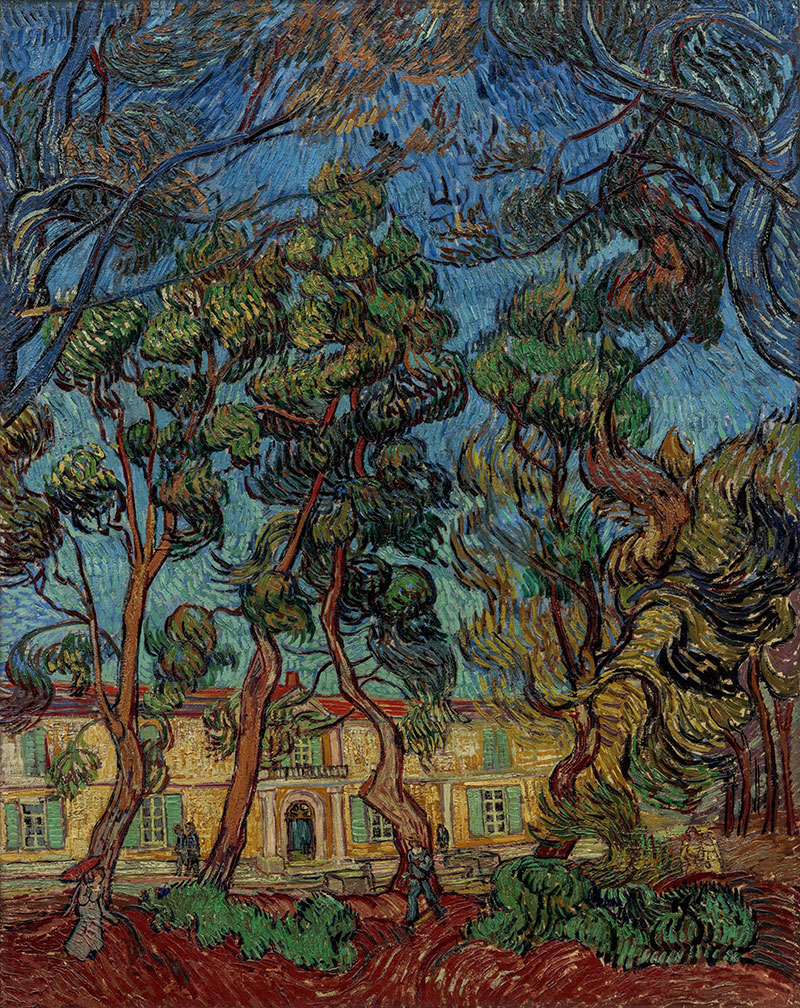
Being admitted into the hospital did not lessen Van Gogh’s drive to paint, especially as he had a good amount of subject matter readily available in the asylum’s walled garden. Being surrounded by natural beauty lifted his spirits, and he made a series of works featuring this garden. This painting, called Hospital at Saint-Rémy, depicts Van Gogh’s own perception of the hospital that enhances the role of nature in the scene. He allots a dominating position to the pine trees that tower over the composition, with the façade of the hospital hidden behind the tree trunks.
The entire scene rests under a bright, clear blue sky. Van Gogh described taking these creative liberties to Theo in a letter from October 1889: “I tried to reconstruct the thing as it may have been by simplifying and accentuating the proud, unchanging nature of the pines and the cedar bushes against the blue.” It is clear from this that the artist focused on the beautiful and relaxing nature, especially due to his addition of a woman with a red parasol strolling in the garden, which is reminiscent of his portrait called The Arlésienne from 1888. In the center of the composition, there is a figure wearing a yellow hat that is believed to be Van Gogh’s insertion of himself in the scene.
6. Almond Blossom
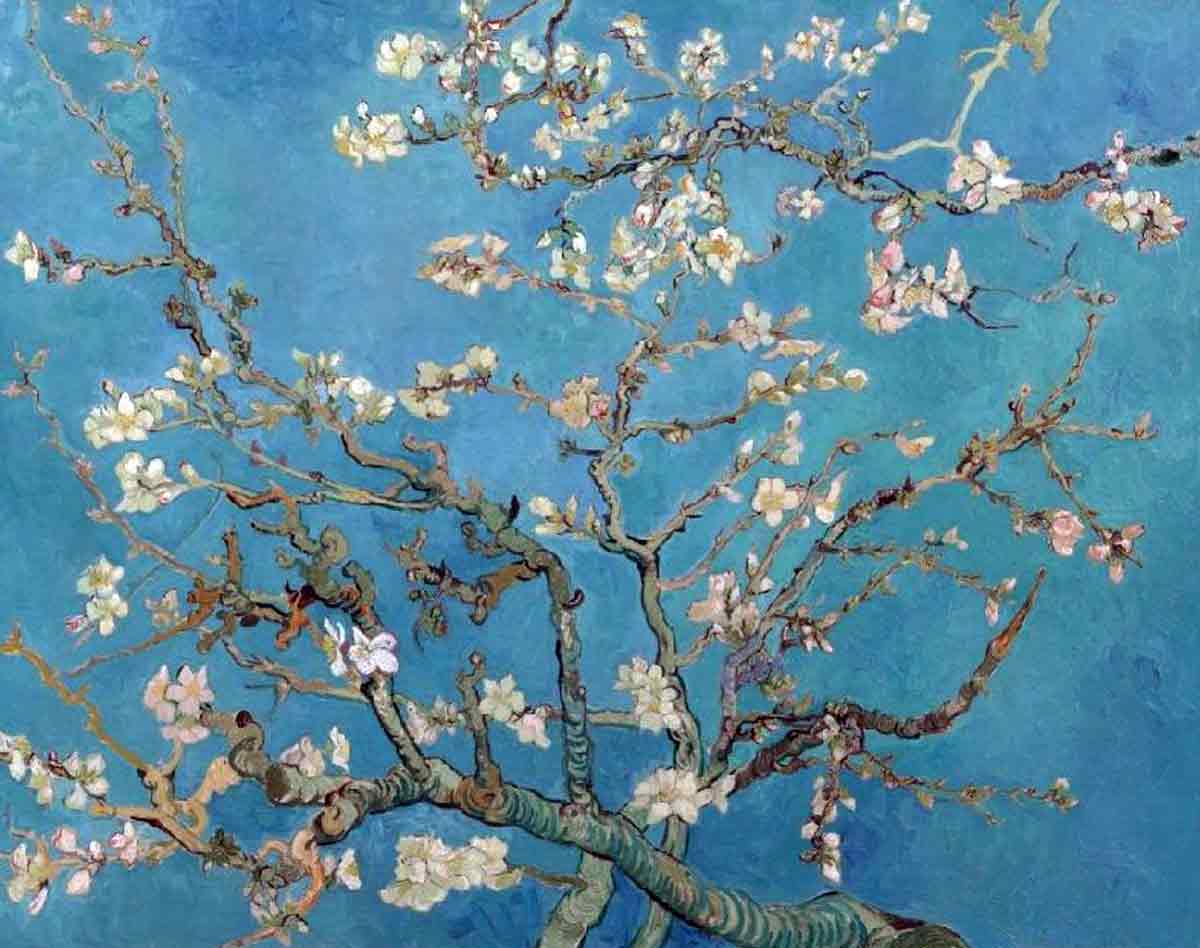
While Van Gogh was spending his days at the hospital, Theo and his wife Johanna had a baby in January 1890. Van Gogh was delighted by the news, especially after Theo conveyed that the baby would be named Vincent, after his uncle. Van Gogh started making Almond Blossom as soon as he received the news, wishing for the painting to be hung in the baby’s bedroom. He described it as “white almond blossoms – big branches on a sky-blue background,” emphasizing the onset of spring that was to signify the start of a new life. With a flat picture plane and simplified forms, this particularly large canvas is composed in a similar style to the Japanese woodblock prints admired by the artist.
Despite being admitted to a hospital due to his mental distress, the artist remained hopeful and productive, resulting in one of his most important works that was cherished by the entire Van Gogh family for generations. It was never put up for sale.
Theo and Jo’s son inherited the collection of his uncle’s paintings. In 1969, the entire collection became the official property of the Vincent van Gogh Foundation, and the plans for a museum dedicated to Van Gogh were set in motion. The Van Gogh Museum opened in Amsterdam in 1973, and Almond Blossom was given a special spot on the walls.
7. Van Gogh’s Reminiscence of Brabant
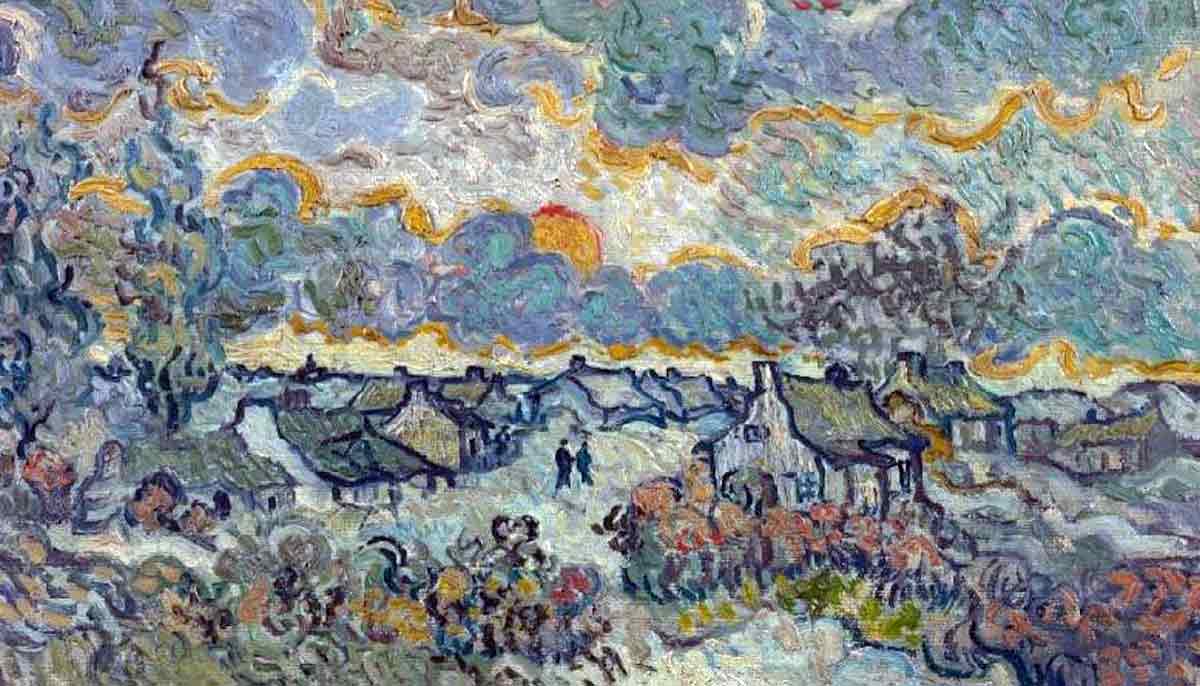
Being confined to the hospital grounds, Van Gogh focused his efforts on the subjects available in his immediate surroundings, particularly the hospital interiors, the views from his window, as well as the walled garden of the asylum. Unable to explore Saint-Rémy to seek out new subjects, he resorted to painting from imagination and memory. Ironically, Van Gogh had frequently argued with Paul Gauguin about this method of working, and it was the anxiety resulting from an argument with Gauguin that led to Van Gogh’s first major mental breakdown. But he was never fully against Gauguin’s method of painting. Van Gogh even tried his hand at painting from imagination in Arles with the work Garden at Etten (Ladies of Arles). In Saint-Rémy, this method resulted in Reminiscence of Brabant.
Van Gogh was a native of the Brabant region in the Netherlands and spent many years in the province with his family, first during his childhood in Zundert, then in Etten-Leur, and finally in Nuenen. This painting was made between March and April 1890, which was a particularly difficult period for the artist. He was suffering from another attack that lasted for a lot longer than usual, hindering him from even replying to any letters for a month. When he finally wrote back to his mother at the end of April, he described his efforts to continue painting: “And while my illness was at its worst, I still painted, among other things a reminiscence of Brabant, cottages with mossy roofs and beech hedges on an autumn evening with a stormy sky, the sun setting red in reddish clouds.”