
Rene Magritte was one of the most prominent Belgian artists of the modern era, closely associated with the Surrealist movement. Although he opposed being categorized as a Surrealist, he nonetheless shared the movement’s profound interest in language and text. However, Magritte saw it as something ephemeral and conditional. In his paintings, Magritte often left written notes or commentary that did not always make immediate sense. Read on to learn more about Rene Magritte’s use of text in his art.
Surrealism & Text: Divorcing Words From Their Meanings Before Rene Magritte
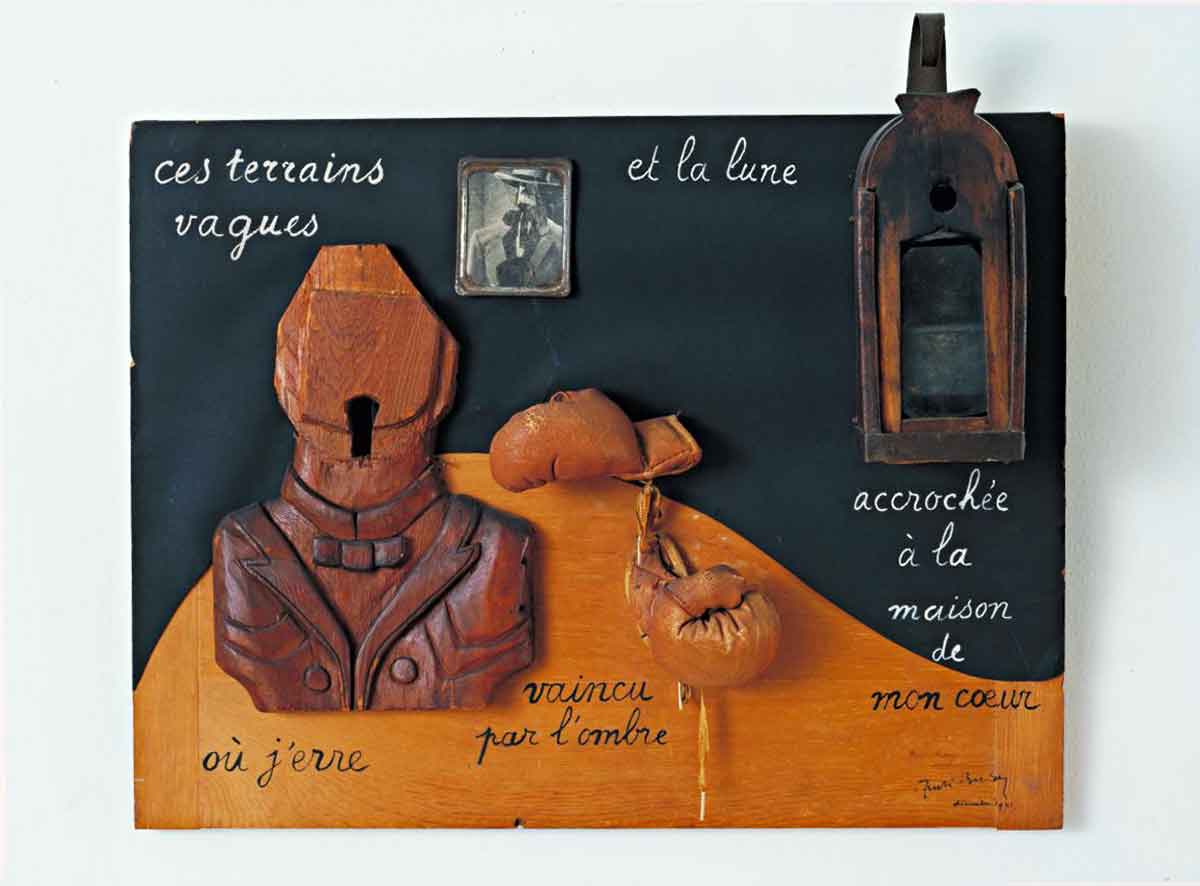
Surrealism started primarily as a literary movement that would gradually expand its principles to painting, sculpture, photography, and film. Andre Breton, the ideological leader of the movement and the author of its manifestos, was a poet and thus was aware of the intricacies of language and its questionable adequacy to the described concepts. He sensed deep and transformative changes in the language of modernity. Little by little, as he wrote, authors began to distrust words, realizing that the boundaries of language were too narrow to grasp the depth of human feeling and expression.
Breton cited Symbolist poet Arthur Rimbaud, who attributed colors to vowels, as the first poet to think of liberating words from their meanings. In his opinion, the duty to signify should be replaced with the poetry of words themselves and the reaction of one word to another. In other words, prescribed meanings were inherently inferior to the rhythm of language and constructed meanings. To construct them, one had to abandon control over words and turn off their reason.
To experiment, Surrealists studied trance, hypnosis, meditation, rituals, and chemical ways to alter one’s consciousness. They were also interested in spiritualism and mediums, yet never believed in their possibility of contacting the dead. Rather, the Surrealists believed it was one of the options to open the door to the unconscious thought processes and desires unbound by rules and morals. The state of trance, just like drugs or alcohol, often provoked irrational and chaotic speech that was radically different from the normative one.
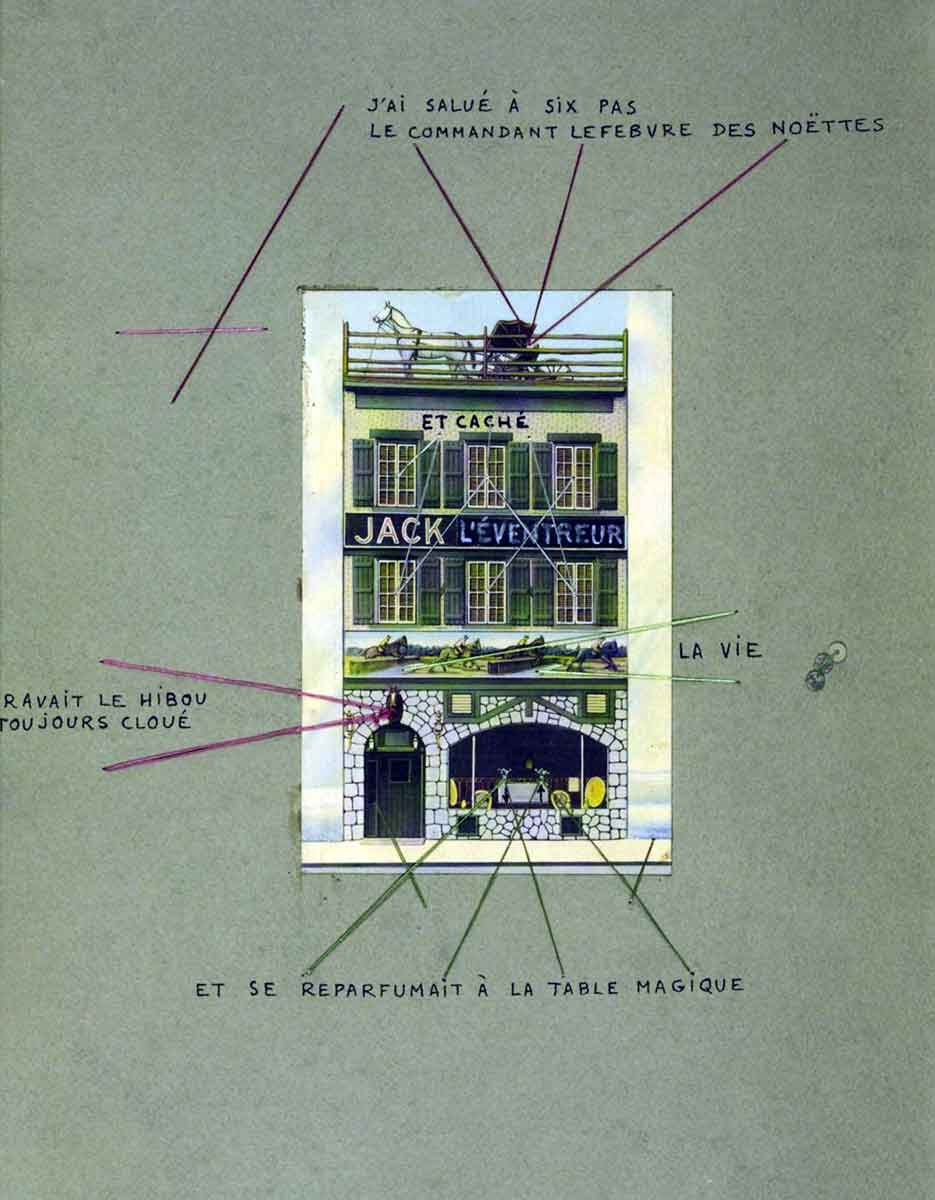
Surrealist studies of verbal and written language were partially fueled by their interest in Eastern cultures and religions. Upon encountering philosophical and cultural systems so radically different from the West, they realized how different systems of meaning could be and how imperfect all of them were.
In visual art, Surrealist exploration of text manifested itself in seemingly nonsensical titles divorced from the work’s visuals. The connection was either cryptic or related to the rhythms of letters, sounds, and brushstrokes. The malfunctioning titles provoked the viewer to search for a clue on their own, interpreting the work according to their own traumas and experiences.
Rene Magritte: Words and Images, 1929
Rene Magritte is perhaps the most famous modern artist from Belgium. His clearly recognizable style and set of symbols are familiar even to those who rarely visit museums. Like many others from his generation, Magritte started his artistic career as an Impressionist before moving on to more progressive and daring forms of art.
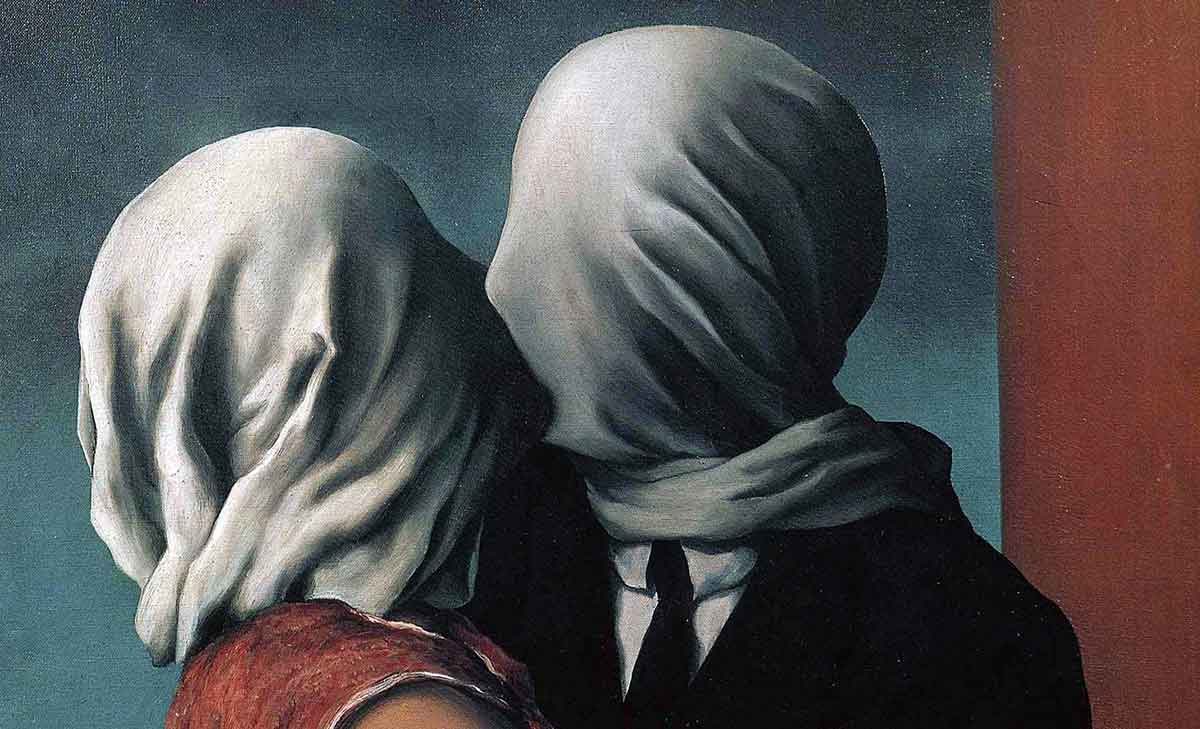
Many professionals attribute the strange recurring shapes and elements in his art to his personal experiences. For instance, the recurring motif of a human face completely concealed by fabric is sometimes interpreted as a memory of Magritte’s mother’s suicide. After she threw herself into a river, her body was found with her dress covering her face. Most historians believe that Magritte never actually saw his mother’s body and relied on the words of the artist’s nurse. Still, the impact of his mother’s death on Magritte was harsh enough to settle some images in his mind.
Magritte himself was a highly educated and opinionated artist who did not limit himself solely to painting practice. For quite a while, his writings were overlooked, but now, more and more art historians and lovers turn to them. Lumped together with other Surrealists, Magritte actually opposed the title. He never truly accepted the ideology of Andre Breton, although he sometimes operated within its framework. In his writings, he rejected Breton’s obsession with automatism, claiming that automatic writing and drawing was a matter for psychologists rather than artists.
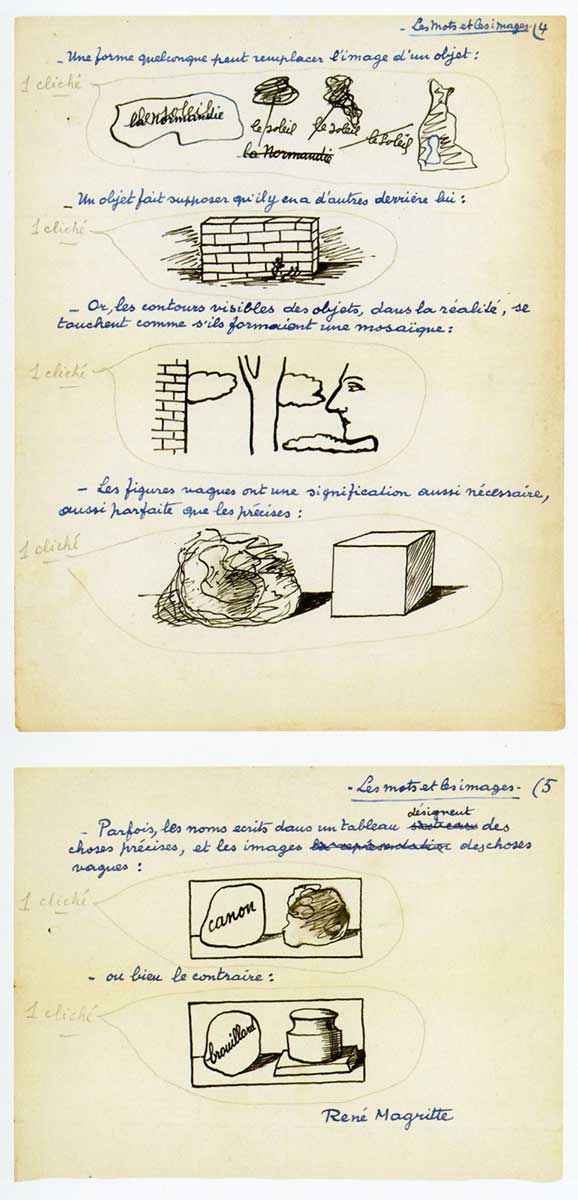
In 1929, Rene Magritte published a work titled Words and Images. This, however, was not a drawing or a painting but an essay that blended written language with pictorial one. Magritte designed 18 panels that explored the relationship between text, drawing, and the physical world these instruments were supposed to reflect. He mentions that some objects can exist without names, and some assume names that already exist, such as the French word le canon, which refers both to an artillery cannon and the accepted standard of any sort. In some cases, an image of an object can replace the word for it in the text, and a word can substitute (although inaccurately) the actual object. Moreover, the purpose of an object is never the same as the purpose of its image or the word for it: you cannot ride a painted horse and cannot eat a description of a restaurant dish.
The Interpretation of Dreams, 1930s
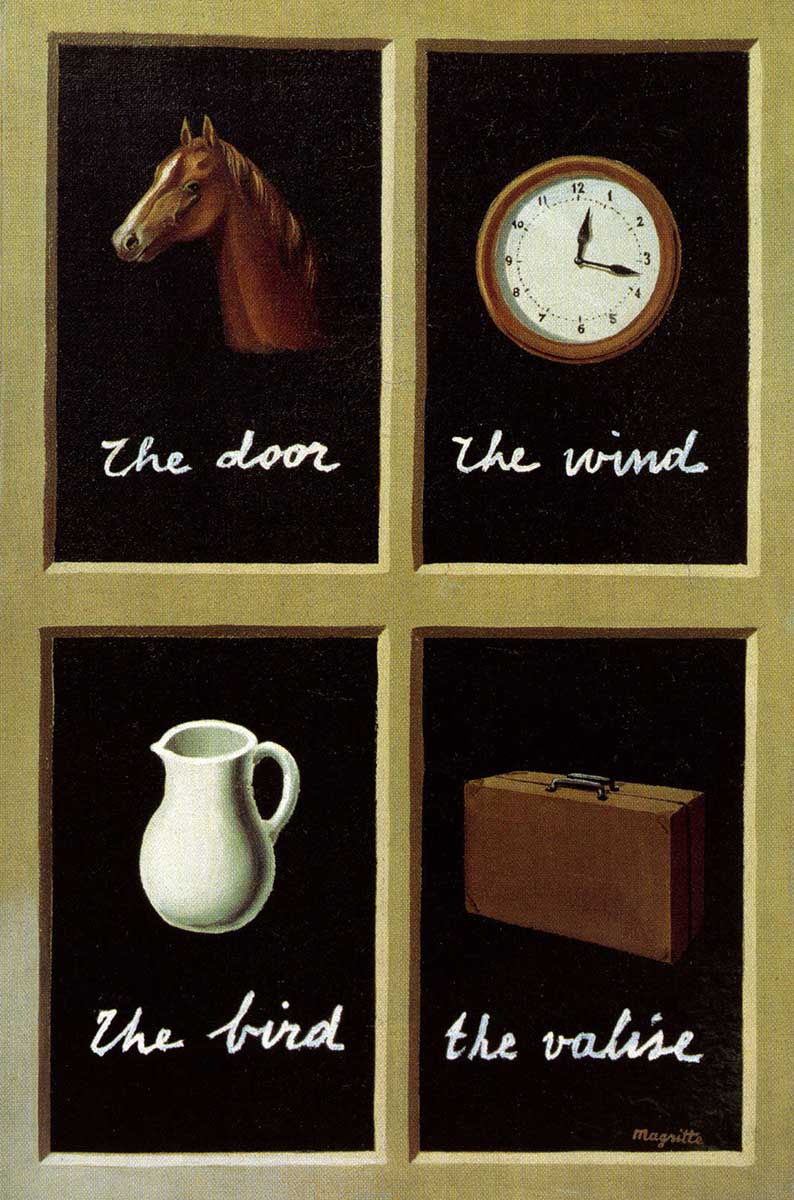
In his paintings from the late 1920s, Magritte deliberately replaced the names for their objects with something unexpected and unusual, aiming to trigger a chain of associations and provoke confusion. Magritte’s first work directly built around the relationship between visuals and text was a series. Titled The Interpretation of Dreams, it was a collection of realistically painted images with nonsensical titles—a horse was labeled as the door, a knife as the bird, and so on. Deliberately mismatched words and images forced the viewer to think about the absurd conventionality of language and how words on themselves mean nothing without a collective agreement to indicate something.
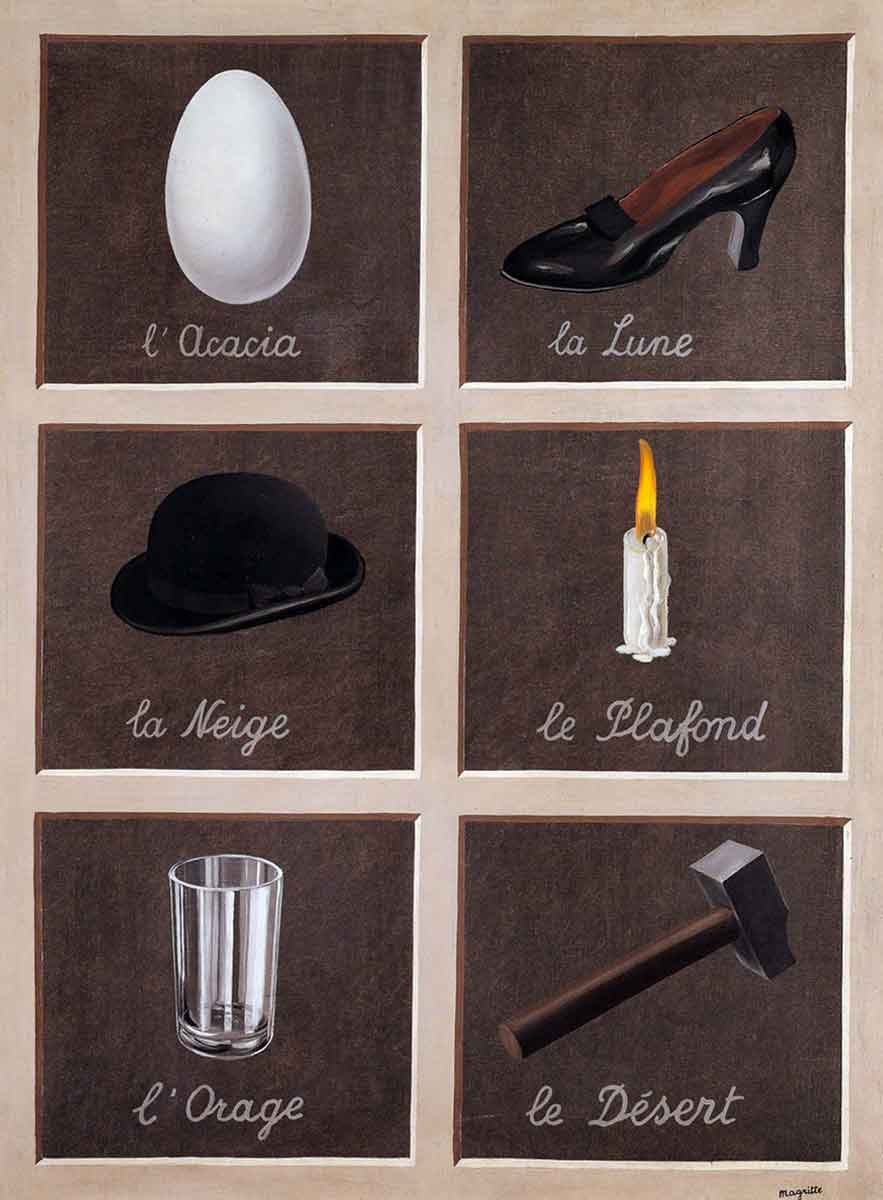
Another significant trait of Magritte’s works was their background. The artist made the canvas look like a typical school blackboard. The choice was hardly merely stylistic. By using the universally recognized image, Magritte brought his audience back to the time when they just started to learn the peculiarities of written and spoken language and to study the connection between them. Children are taught to accept the rules of the game without asking questions. In the Surrealist mind, however, childish perception, with the purity of its experiences, was the key to the unconscious. Childhood was a mythical concept and a condition between the material and metaphysical world, holding within itself endless intellectual and spiritual resources.
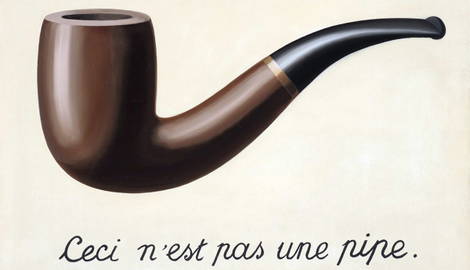
The Treachery of Images, 1929
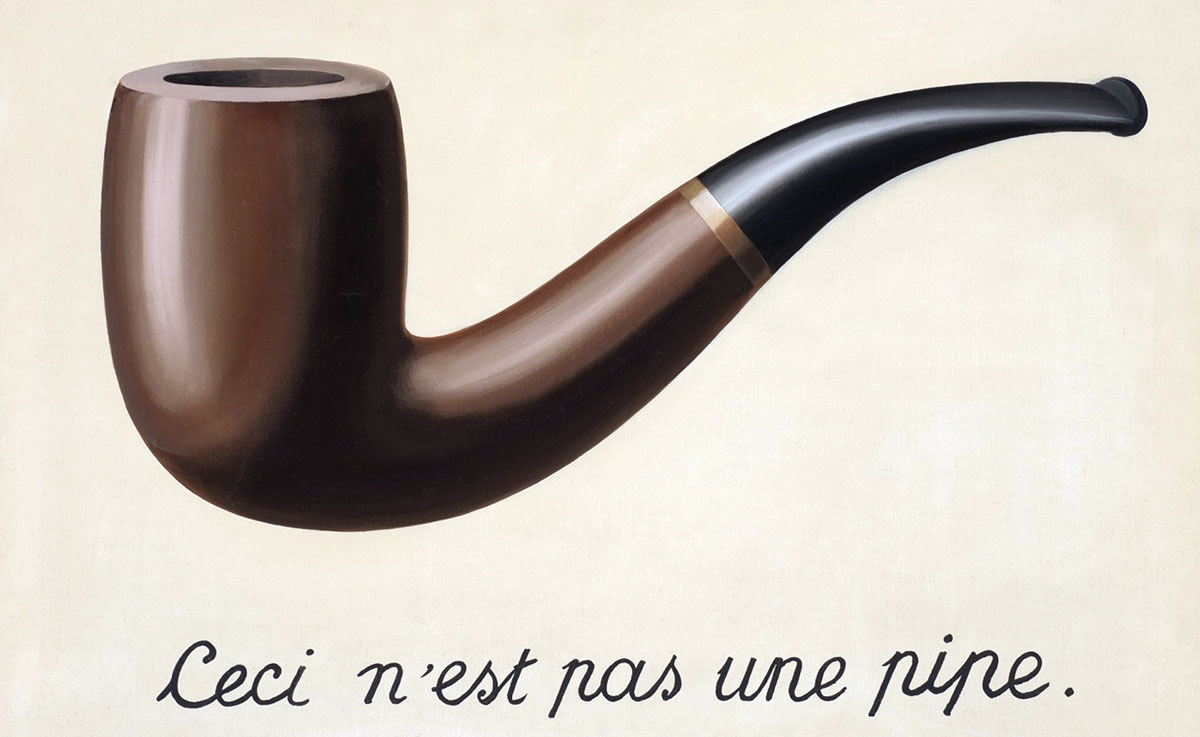
Magritte’s obsession with the dissonance between the real, the painted, and the textual further revealed itself in one of his most famous works. The Treachery of Images represented a rather simple illustration painting of a pipe with a handwritten commentary that this was not, in fact, a pipe. Although the image provokes initial confusion, the viewer soon comes to the conclusion that the artist was right. You can neither smoke this pipe nor hold it in your hands. Thus, the image effectively gets divorced from the experience of an actual pipe and represents nothing but a dysfunctional symbol.
This image was reportedly inspired by a commentary by a gallery visitor who claimed that what he saw was not art. By treating words in this way, Magritte presented language as conditional and unsubstantial, highlighting its inherent inferiority to the world of real physical objects. The same applies to visual language, which is capable of convincing illusions and manipulation but not of directly altering reality.
Rene Magritte and The Living Mirror
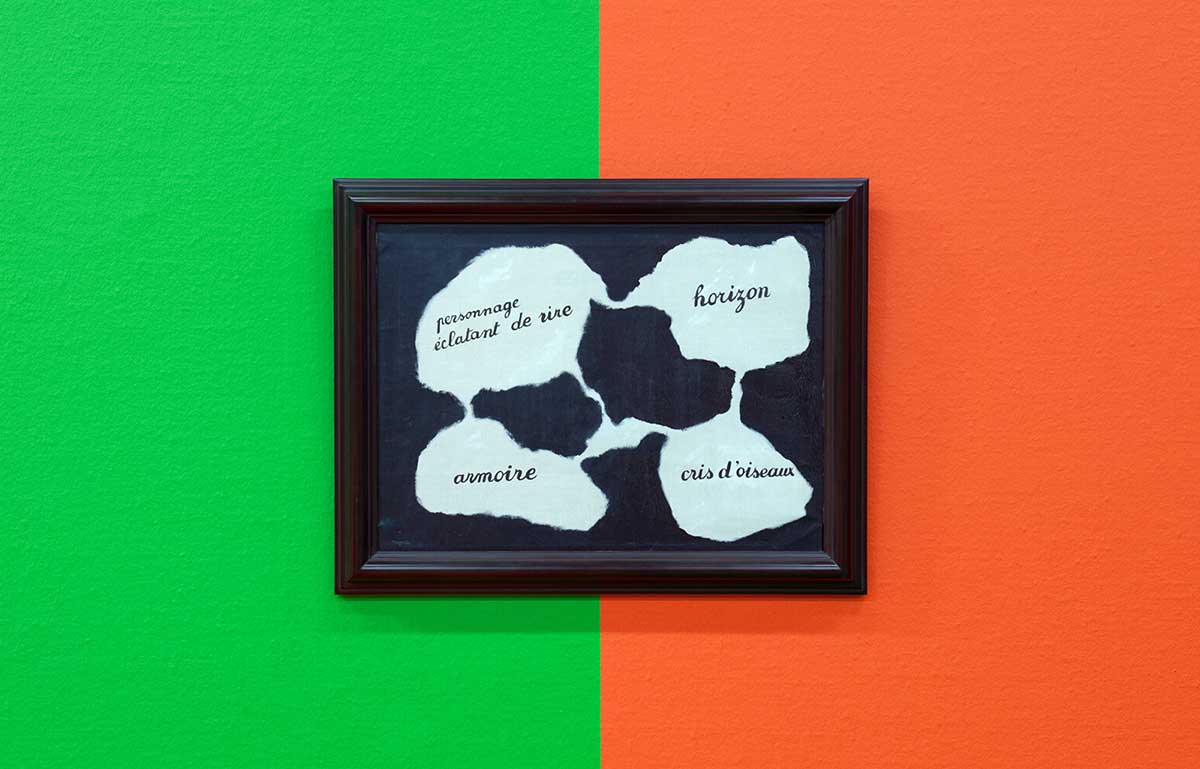
A sequel to Magritte’s other works on visual and textual symbols, The Living Mirror exploited an approach we would now call conceptual. Instead of actually painting the image conceived in his mind, Magritte described it in white bubbles on a black background—a person laughing, birds singing, a closet cabinet, and a horizon line.
By using text, Magritte managed to incorporate many more effects than he could cram into a painting. He was able to address not only our eyes but also our hearing (the cries of birds), spatial perception (horizon), emotion (a person laughing), and even some tactile senses (a closet cabinet and personal associations with it). Each viewer’s mind is doing the work on their own based on personal experiences. No version of The Living Mirror would be the same, and each one of them would have equal rights to exist. Thus, language seems to be universal but lacks precision, and that, perhaps, is both its flaw and advantage.