

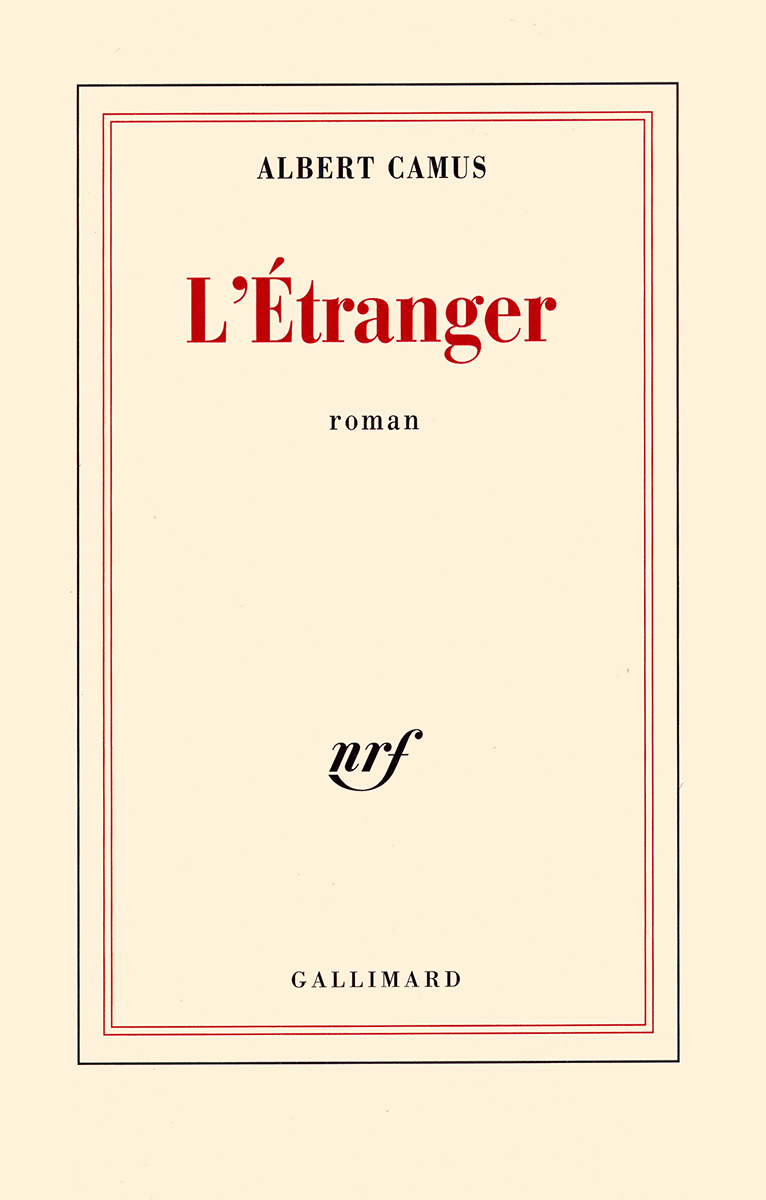
In the UK, Camus’s novel L’Étranger is published under the title The Outsider. In the US, it is published as The Stranger. In this article, I first address the pros and cons of each rendering and how the use of each title has influenced the reception of Camus’s text. I then move on to the major translations available in English and discuss the substantial differences among the texts when they are read side-by-side. Finally, I offer my opinion on which translation could be considered the “best.”
How Translations Can Be Different
Consider the difference between Stuart Gilbert’s and Sandra Smith’s translations when Meursault is in prison. He talks to a guard about how difficult it is without access to women. In Gilbert’s translation, we read the following: “The jailer nodded. ‘Yes, you’re different, you can use your brains. The others can’t. Still, those fellows find a way out; they do it by themselves.’ With which remark the jailer left my cell. Next day I did like the others.”
We see what the jailer and Meursault are alluding to and what he ends up doing. However, this is absent in Smith’s version, which translates the scene as follows: “‘That’s right; at least you understand how things are. The others don’t. But they all end up finding ways to relieve their frustrations.’ Then the guard left.”
For commentators looking to see how intelligent and sympathetic to the human condition Meursault is, these different translations of the original text will make a big difference.
Does the Title Matter?

So far, we have only seen a few slight differences among the English translations of Camus’s novel. One might still ask if it really makes a significant difference and how someone could claim one translation is better than another if it is only a matter of a few different words here and there. To answer this question, we could begin with the title of the novel, which in French is L’Étranger.
In the UK, Camus’s novel is published under the title The Outsider, whereas in the US it is published under the title The Stranger. Which is better? It all depends on your understanding of the central character and narrator, Meursault.
The French title L’Étranger can mean: the stranger, the outsider, or the foreigner. It is up to the translator to decide which is the best English rendering of the title. How do they go about doing this? The answer is that they look into Camus’s wider work and into the novel itself and decide for themselves which translation to go with. In other words, the translator will decide which is the most appropriate English word based on their reading of Camus and his philosophy.
Matthew Ward, whose translation is best known to US readers, went with The Stranger, but Stuart Gilbert and Sandra Smith chose The Outsider. Is Meursault best captured by the idea of a stranger or an outsider?
Ultimately, there is no correct answer to this. Meursault is certainly odd. Anyone who reads the novel can see this, but both a stranger and an outsider would be odd. The difficulty in seeing him as an outsider is that he is so well-liked and respected by everyone he meets in the novel. If he were truly an outsider, then why would people seek his advice, consider him a “man of the world,” or offer him a prestigious promotion at work? However, the same question applies to him being, in some way, a stranger. That is, how is Meursault some kind of stranger when he is so well integrated into his society?
It might be tempting to say that Meursault is not an outsider because he is well integrated into his community by the time of the murder, halfway through the novel. However, isn’t it his reaction after the murder that shows Meursault to be an outsider within his community? The very fact that he does not do everything he can to get himself the most lenient sentence (express great remorse and beg forgiveness) shows that his way of thinking is outside the norm.
The Influence of the Translator

For a long while, the only English translation of L’Étranger available was Stuart Gilbert’s. In the UK, this was supplanted by Joseph Laredo’s. Readers owning two copies of The Outsider, one by Gilbert and the other by Laredo, could tell by looking at the spines which was which. Already a short novel, 100 pages or so, Gilbert’s would be around 20 percent thicker than Laredo’s. The latter seems to emulate Camus’s spare style in a different language. The question is whether their different translations affect English readers’ understanding of Camus’s novel.
There are always little differences that can change a close reader’s view and understanding of a character. For example, let us compare Laredo with Smith and other translators. From the first lines of the novel, we read:
Laredo: “Mother died today. Or maybe yesterday, I don’t know.”
Smith: “My mother died today. Or maybe yesterday, I don’t know.”
Gilbert: “Mother died today. Or, maybe, yesterday: I can’t be sure.”
Ward: “Maman died today. Or yesterday maybe, I don’t know.”
We can see from these slightly different translations a world of different meanings. Laredo’s is the most spare. Here, Meursault seems the least affected by his mother’s death. Smith adds the possessive pronoun “my,” which suggests more feeling between Meursault and his mother. Gilbert, however, diverts focus onto the telegram Meursault has received from the nursing home after his mother’s death. Ward chooses to give Meursault’s mother a more informal, affectionate name. In his translation, “maman” suggests a far closer and more affectionate relationship than “mother” as is used in the other translations. Someone close-reading an English version of Camus’s novel must be affected by these differences that appear slight yet are significantly different in meaning.
Why Do Translators Make Such Different Choices?

But why would one person go with a particular translation over another? The answer is that translators, like the rest of us, use the scholarly literature in order to understand a text. That is, to understand, say, Meursault and translate what he has to say from French into English, translators often read the secondary literature to better understand the character.
For example, Ward tells us in his translator’s preface that he opted for “Maman died today,” for the iconic first lines of Camus’s novel because Sartre goes out of his way, in his explication of The Stranger, to point out Meursault’s “childish” use of the word “maman.” Thinking, then, of a close-reading scholar reading Ward’s translation, we can see that this scholar will be heavily influenced by a Sartrean reading of L’Étranger simply because the translator was heavily influenced by Sartre.
Consider this scene from Gilbert’s translation. Meursault is in prison and observing the other prisoners during visiting time. He sees a young male prisoner visiting with his mother and says: “His eyes, I noticed, were fixed on the little old woman opposite him, and she returned his gaze with a sort of hungry passion.” Ward translates this scene as: “I noticed he was across from the little old lady and that they were staring intently at each other.” Smith also goes with “staring at each other intently.” There is a big difference between a mother and son staring at each other intently and with “a sort of hungry passion.” Where does Gilbert get this from?
In the original French, Camus writes that they both look at each other with intensity (“et que tous les deux se regardaient avec intensité“). This is somewhat charged for a mother and son, but still a way off from staring at each other with “hungry passion” as Gilbert has it. It seems that he has incorporated his reading of Camus’s complex mother/son relationship from elsewhere into his translation of the novel. Gilbert also ramps up the passion when Meursault first meets Marie. Camus, Ward, and Smith all say that Meursault rests his head on Marie’s stomach; Gilbert says it is on her lap.
Obviously, for Gilbert, Meursault is a far more sensuous and worldly-wise character than that depicted by Ward and Smith. But consider this: is Meursault not described by other characters in the novel as a “man of the world,” that is, worldly-wise? Perhaps Gilbert captures the real Meursault better when he puts his head in Marie’s lap rather than on her stomach. Indeed, Ward also suggests something more erotic than Camus when he says that Meursault feels Marie’s heartbeat on the back of his neck.
So, Which Translation Should You Read?

To answer the question of which is the best translation of Camus’s L’Étranger, one must say whose interpretation of the novel is the best. As we have seen, all translators attempt to capture what they believe to be the best interpretation of the novel. This they do by not only reading the actual source material but also Camus’s other works and the scholarly literature. How well a translator does will ultimately depend on your own reading of Camus’s text and your opinion of Meursault and Camus’s overall project. However, this does not mean that no recommendations can be given.
For UK readers, Sandra Smith’s translation is very close to Camus’s original and contains none of Gilbert’s extra flourishes. She also avoids the trap that Laredo perhaps falls into, in that she manages to reproduce Camus’s spare language without having to cut actual sections of the text.
Matthew Ward’s interpretation is older than Smith’s but is, in my opinion, every bit as good as hers. For readers wishing to contribute to Camus Studies in English, Ward’s text remains the international standard.
Of course, Camus’s original French text is the best version of L’Étranger to study; however, for those wishing to read and study his most important novel in English, either Smith’s or Ward’s translations will do fine.