
Filling the canvas with exotic scenes from snake-charmers and veiled women to sultans and camel-riding raiders, Orientalists captured their dreams of the East and presented them to European audiences, evoking the senses of mystery, beauty, and wonder.
From a modern perspective, it is easy to identify problematic themes and stereotyping in Orientalist paintings. Nevertheless, in this genre were a host of skilled painters and stunning artworks that speak not just to fantastical colonial visions, but to a genuine fascination with cultures so different from their own, and a desire to capture the atmosphere of foreign lands.
Here are 10 of the most famous Orientalist paintings (in no particular order).
1. The Death of Sardanapalus by Eugène Delacroix (1827)
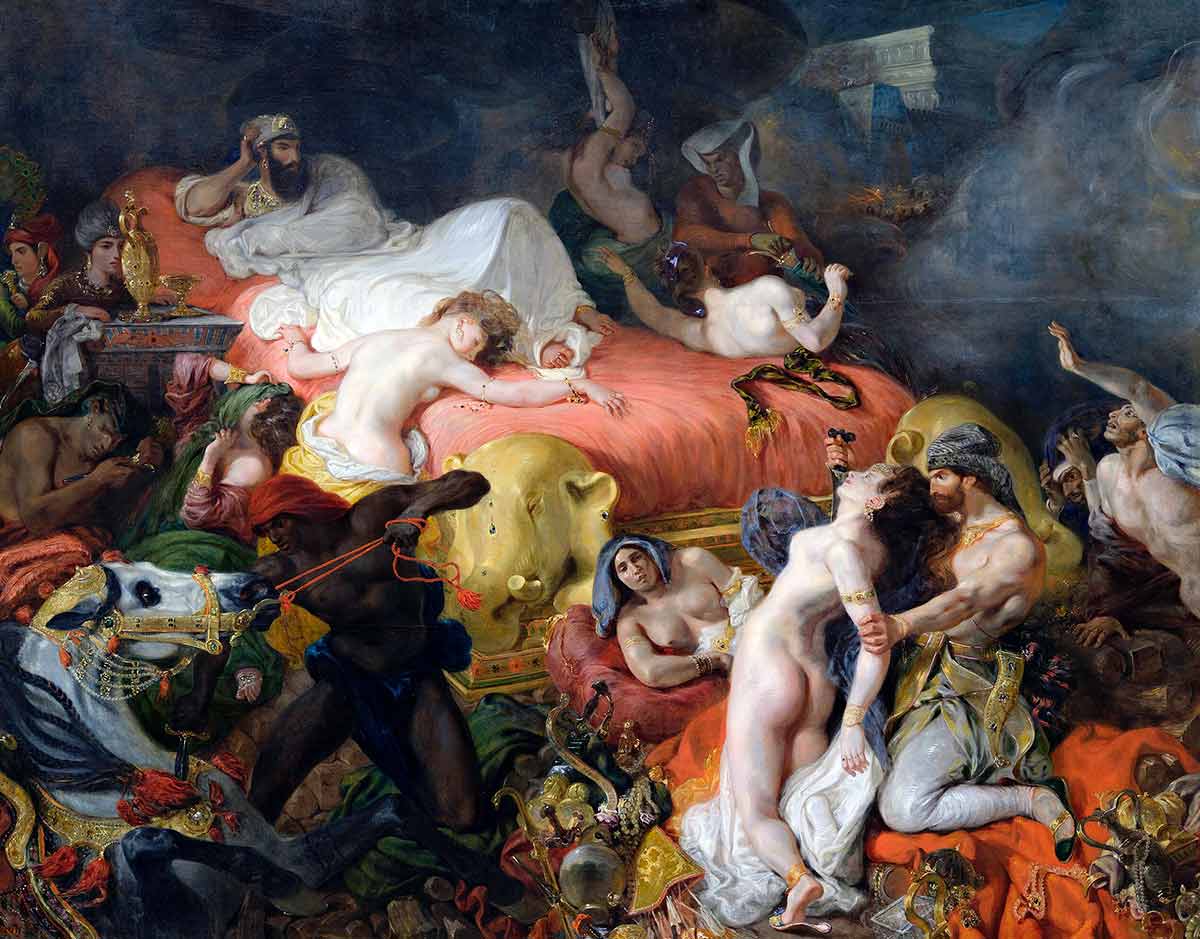
A romantic vision of chaos and violence, Eugène Delacroix’s Death of Sardanapalus is a work of broad brushstrokes and vivid colors that depicts a horrific scene of death with swirling forms full of compositional brilliance.
Influenced by Byron’s 1821 play Sardanapalus, the story behind the imagery is the legend of Sardanapalus, a decadent Assyrian ruler, who, ashamed of military defeat, ordered the death of his slaves, concubines, and horses. Above it all, Sardanapalus watches calmly as the gory events unfold. Delacroix’s harrowing scene, completed and presented in 1827, shocked contemporary society, but the work was later hailed as a masterpiece.
2. The Snake Charmer by Jean-Léon Gérôme (c. 1879)
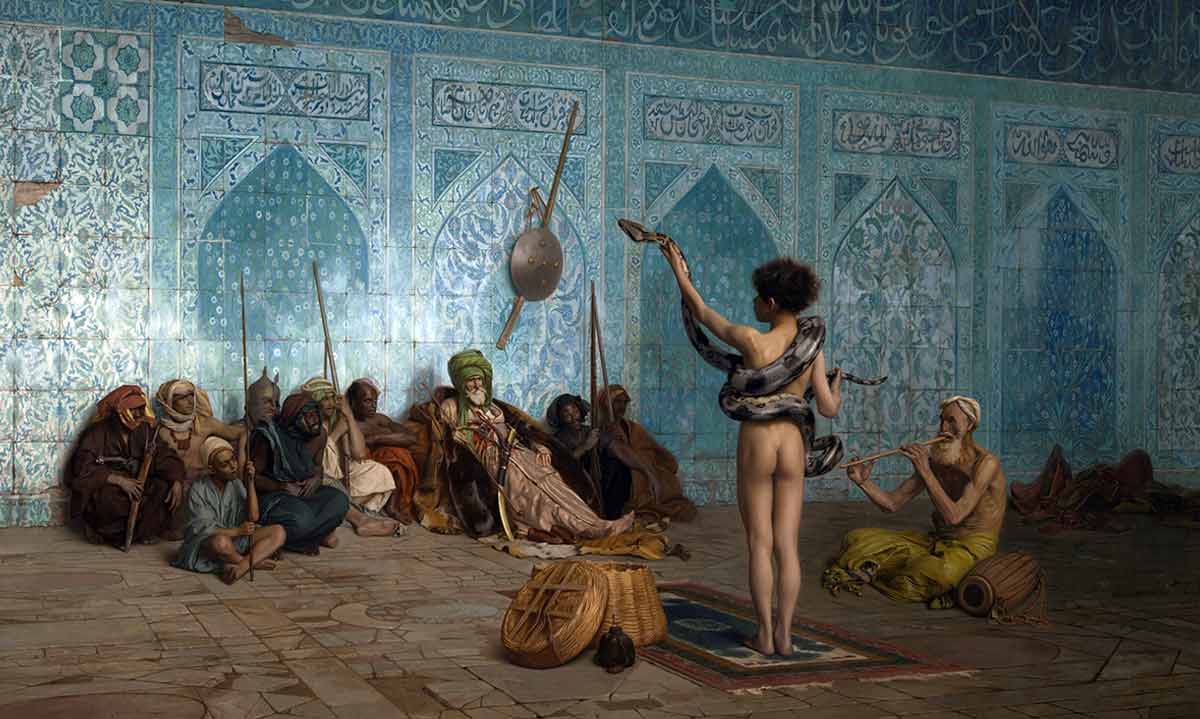
Jean-Léon Gérôme was undoubtedly one of the Orientalist style’s greatest painters, and his work, The Snake Charmer, is a testament to his masterful skill and imagination. It depicts a naked boy displaying a large constrictor to a group of old men. Surrounding them is unmistakable Islamic architecture with a stone floor and a blue-tiled wall decorated with Arabic inscriptions.
Used as a cover for Edward Said’s book, Orientalism, the work has drawn criticism as a prime example of stereotypical depictions of the Middle East in 19th-century art. Through the visuals, the artist suggests the scene is taking place in a palace or possibly even a mosque; a detail which speaks to the bizarrely fantastical (and offensive) nature of Orientalist imagination. It is, however, generally accepted to be a fictionalized palatial setting. Nevertheless, the art exists as a masterclass in precise detail and lighting that exemplify Gérôme’s style of theatrical realism.
3. The Palace Guard by Ludwig Deutsch (1892)
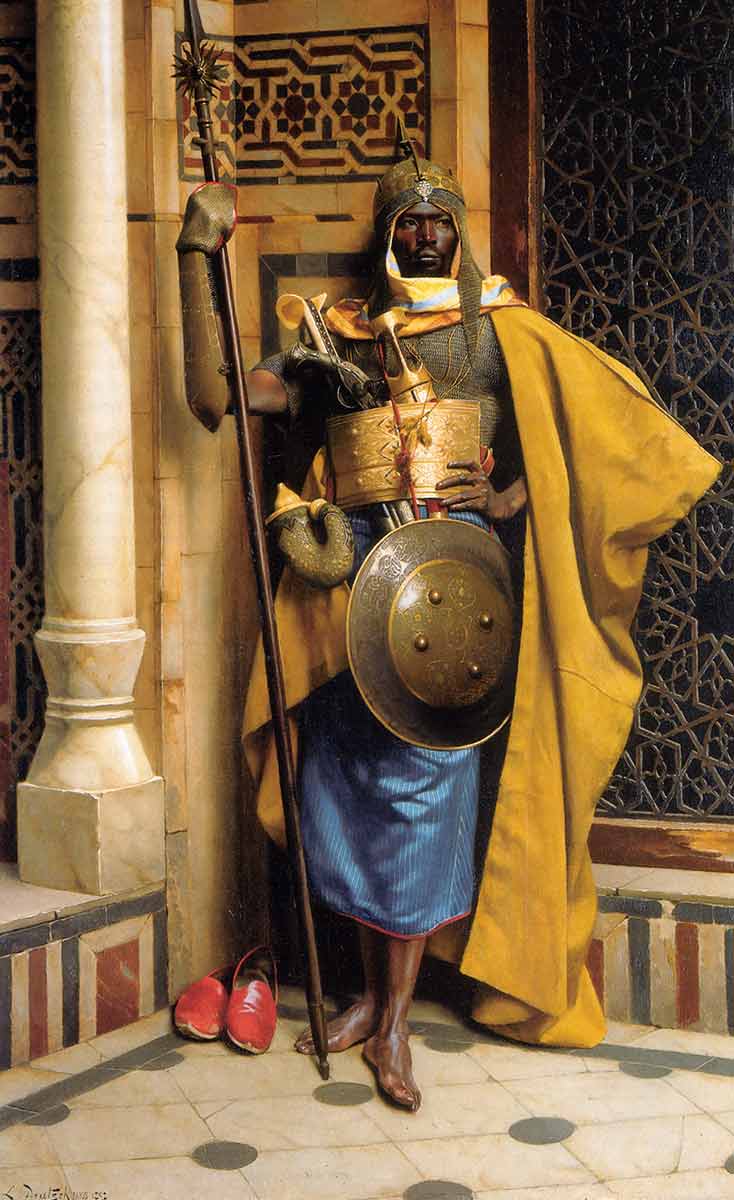
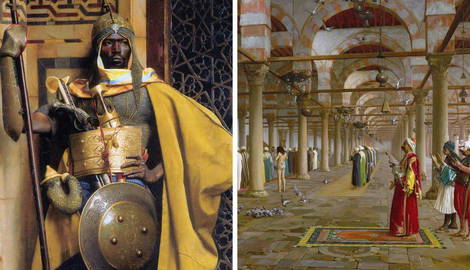
While not as well known as those of Gérôme or Delacroix, the works of Ludwig Deutsch are certainly deserving of respect in the same company. Although many art historians may claim The Scribe as Deutsch’s most famous painting, The Palace Guard, painted in 1892, is possibly more widely seen, being a favorite of print companies and reproduction services.
The iconic image displays a Nubian warrior guarding a royal sanctuary, and is rendered in exquisite detail and saturated with vibrant colors. The subject is stern and dangerous, yet in an almost relaxed pose, and covered in beautifully realized cloth and metal.
Unlike many other Orientalist painters, Deutsch actually spent much time in the Middle East, specifically Egypt, where he developed his love for the Orientalist genre.
4. Grande Odalisque by Jean-Auguste-Dominique Ingres (1814)
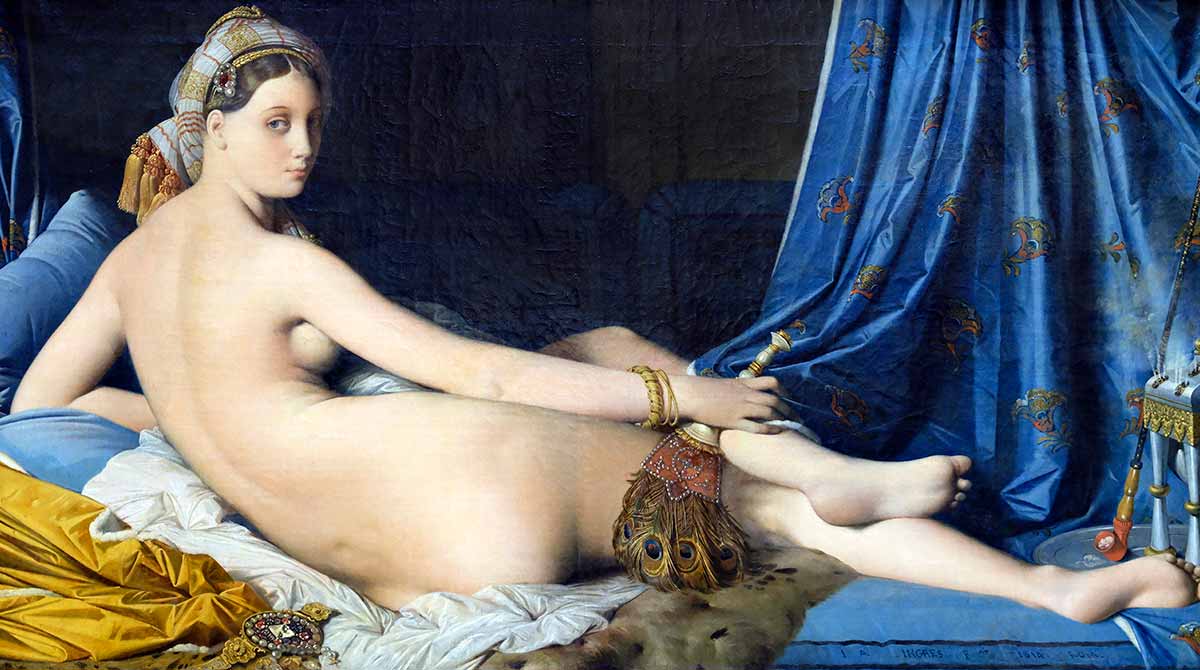
A work indicating a shift from Neoclassicism towards exotic (and erotic) Romanticism, Grande Odalisque depicts a reclining nude. Known as odalisques, they were enslaved concubines of the Ottoman sultan. Jean-Auguste-Dominique Ingres finished the painting in 1814 as a commission from Queen Caroline Murat of Naples, Napoleon Bonaparte’s sister.
Displaying a mix of styles, the figure has elongated limbs, a small head, and distorted proportions, intended to convey sensuality and feminine idealization, a strategy that drew criticism from those who championed anatomical realism. Drawing on Near Eastern motifs, the Odalisque is adorned with elements common to Orientalist imaginings, such as a turban, peacock feathers, and a hookah pipe (on the far right).
5. The Reception (also called A Lady Receiving Visitors) by John Frederick Lewis (1873)
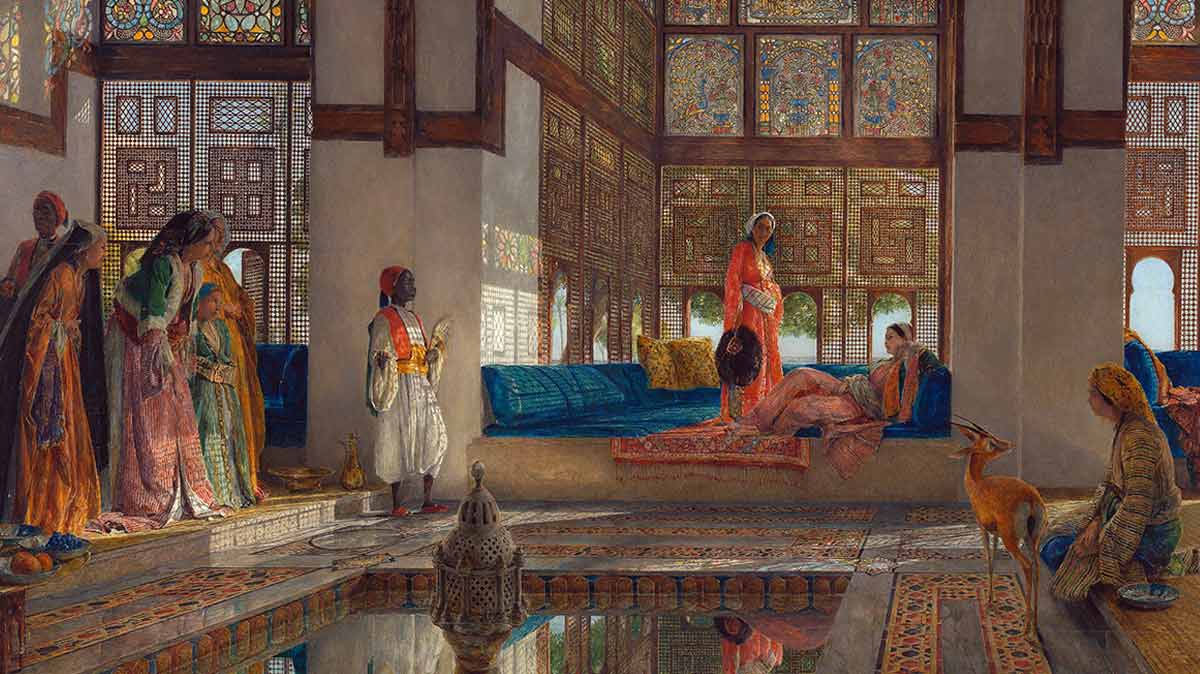
John Frederick Lewis was well-versed in the Islamic culture of North Africa, having lived in Cairo for a decade. His works were seen as more truthful than the fantastical stereotypes brought forth by many other artists depicting subjects of Orientalism. Nevertheless, many of his works were ambiguous.
The Reception is one such painting which depicts a mandarah, the lower-floor reception area of an Egyptian house. Typically, a space forbidden to women, the setting of Lewis’ painting clearly depicts a relaxed woman, thereby raising questions of authenticity that the artist never answered. It may have been an attempt to undermine stereotypes of the treatment of women in Muslim culture; some of which persist to the present. That said, it also undermines the actual local tradition by placing women in a forbidden space.
Whatever the reason, the painting is presented as documentation, with its attention to the surrounding detail, offering a glimpse into the mysterious colors and culture of 19th-century Egyptian life in a way that draws the viewer into the atmosphere of a foreign land.
6. Bonaparte Visiting the Plague Victims of Jaffa by Antoine-Jean Gros (1804)
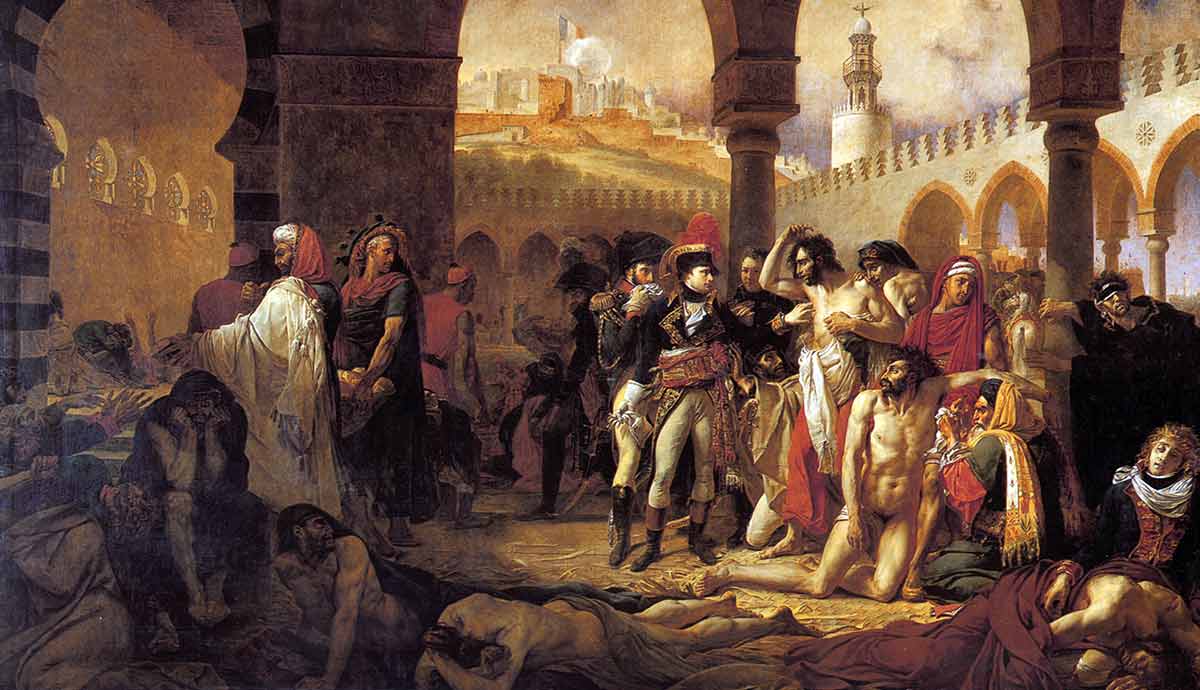
During and after Napoleon’s invasion of Egypt and Syria in 1798, the French were subject to accusations of committing atrocities, especially during the siege of Jaffa in 1799. Napoleon commissioned a piece of propaganda to counter this narrative and to aid in the creation of his mythology. Antoine-Jean Gros’ work entitled Bonaparte Visiting the Plague Victims of Jaffa was the result of this endeavor, and depicts Napoleon visiting sick French soldiers in the Saint Nicholas Monastery. As such, the painting is a perfect example of art being intertwined with politics.
The scene shows Napoleon touching a plague victim while an officer attempts to intervene. Thus, the French emperor is presented as courageous and compassionate, a conqueror and a benevolent, heroic figure willing to endure hardships with his men. In the background, a large French flag flies over the burning city of Jaffa, connecting the scene to victory and patriotism.
7. The Turkish Bath by Jean-Auguste-Dominique Ingres (1862)
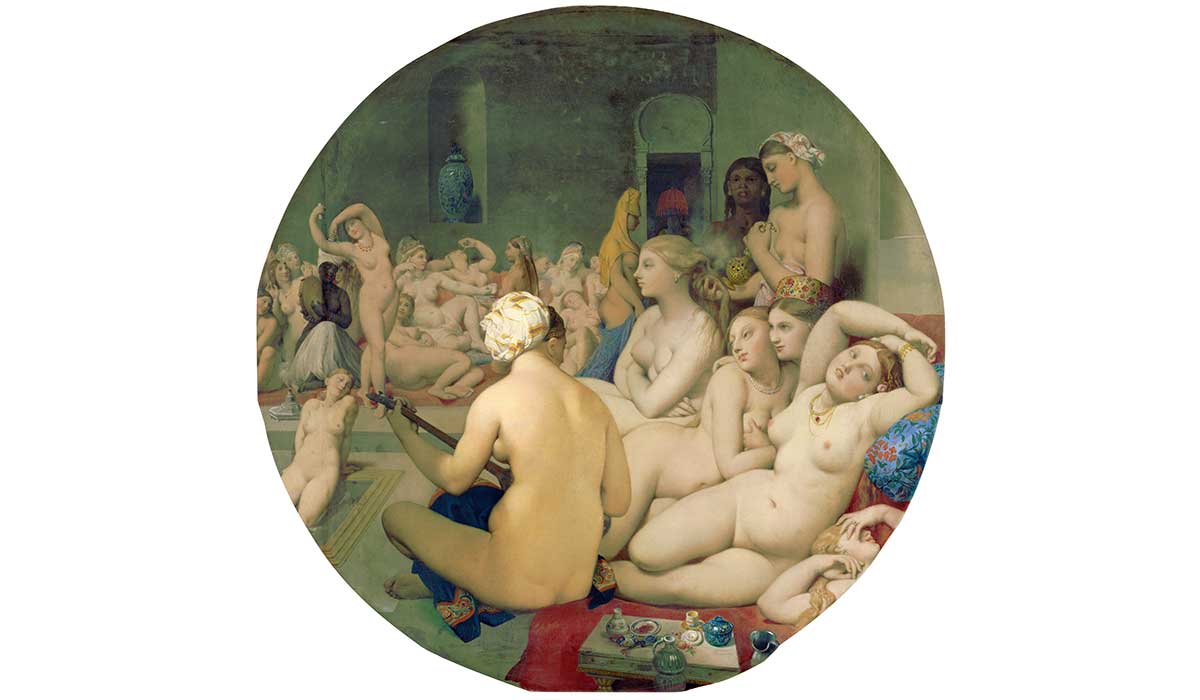
An example of Ingres’ erotic Orientalist fantasy, The Turkish Bath depicts a group of nude women relaxing by a pool in a harem. Completed when Ingres was 82, it represents the culmination of the artist’s Orientalist themes with a dreamlike quality, bursting with sensuality from edge to edge. The decision to use a tondo (as opposed to the usual rectangular format) heightens the painting’s eroticism by eliminating sharp corners and giving the viewer a sense of voyeurism, as if looking at the scene through an oculus.
Despite the title, the image itself bears little in the way of Orientalist themes. A musical instrument and a few trinkets nod to the East, but the figures are pale, idealized forms of European beauty. The theme may simply have been an excuse for Ingres to paint nude women.
The painting accrued significant fame during the 20th century as modern artists referenced it and used it as an influence for their own works. This included Pablo Picasso‘s Les Demoiselles d’Avignon and Robert Ballagh’s The Turkish Bath after Ingres, the latter being an example of pop art. Feminist artist Sylvia Sleigh painted her own version of The Turkish Bath as a response to the male gaze, filling her version with nude male subjects.
8. The Slave Market by Jean-Léon Gérôme (1866)
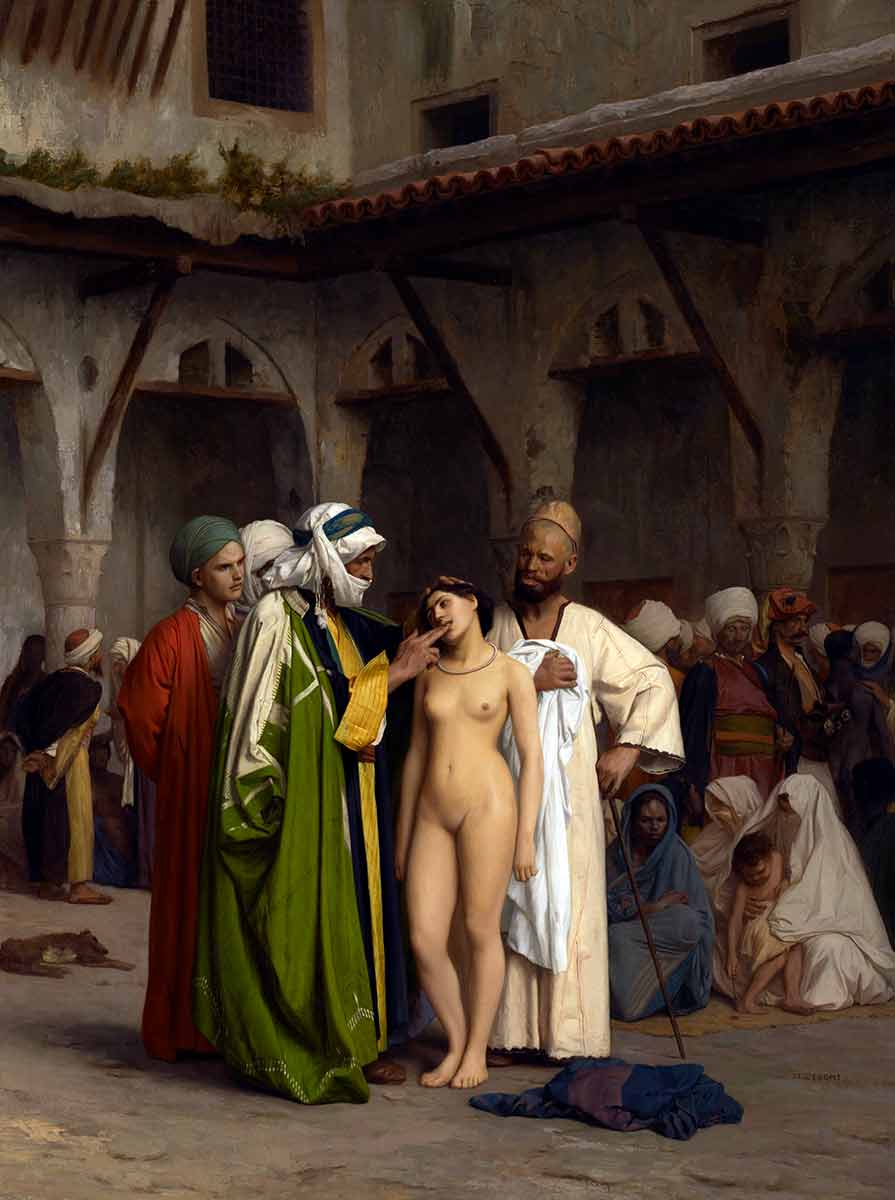
A disturbing scene of a woman, stripped of her dignity, being examined by slavers, is the subject of The Slave Market by Jean-Léon Gérôme, painted in 1866. While the painting deals with a problematic subject in a rather brutal fashion, it does convey the reality of slavery well, with a potential buyer checking the quality of the woman’s teeth as one would a horse. Such a visceral depiction of dehumanization was not unfamiliar to Gérôme, as slavery and slave markets were common themes in his work.
The painting is beautifully rendered in Gérôme’s trademark style, characterized by meticulous detail, decorative elements, vibrant colors, and a masterfully realized atmospheric softness achieved through intense tonal gradation.
The Slave Market was contentious when it was first displayed and continues to draw controversy in the present. While Gérôme possibly intended the piece as a critique of human nature, it was sadly used by the far-right Alternative für Deutschland, who appropriated the image for an advert warning against immigration, noting that the slavers were dark-skinned and the victim was light-skinned. Such a misuse is another striking example of the weaponization of art for political purposes.
9. Women of Algiers in Their Apartment by Eugène Delacroix (1834)
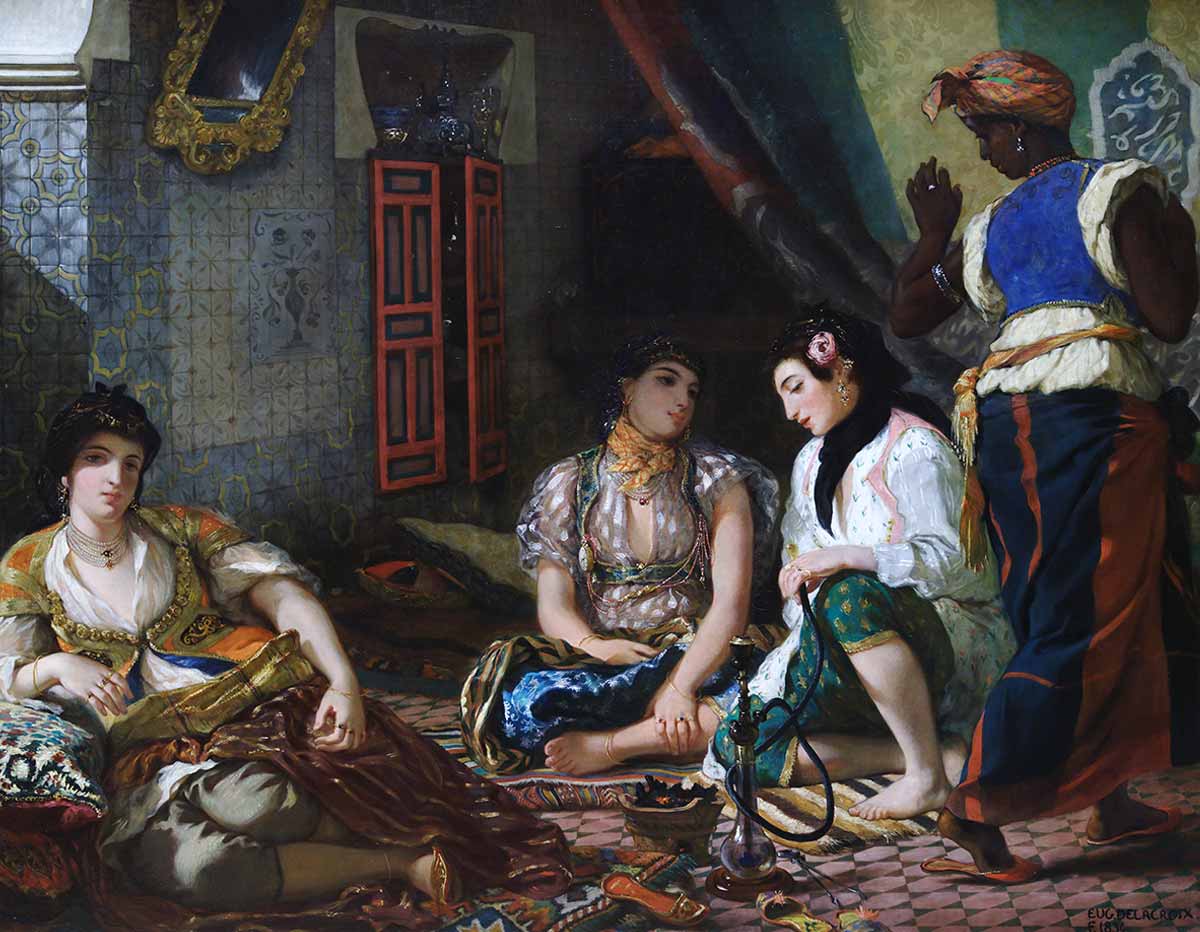
Delacroix created two paintings titled Women of Algiers in Their Apartment, both depicting four women in an indoor setting (unsurprisingly, given the work’s title). The first, painted in 1834, is by far the most famous of the two, and currently resides in the Louvre, where it underwent restoration work in 2021, further bringing it to public attention. It was displayed in the Paris Salon of 1834, purchased by King Louis Philippe, and gifted to the Musée du Luxembourg.
The image is of three women lounging while a fourth woman, an African slave, exits the room, looking over her left shoulder. Such a depiction stands out amongst other Orientalist works in that it displays women in a less eroticized fashion.
Despite the realism, from a style perspective as well as from a less figurative sense, the scene represents guesswork from a European male into the lives of Algerian women. Although part of a diplomatic mission in 1832, where Delacroix is documented as gaining limited and supervised access to a harem, his knowledge of the subject would likely have only been informed by a few hours of controlled observation.
10. Prayer in the Mosque by Jean-Léon Gérôme (by 1874)
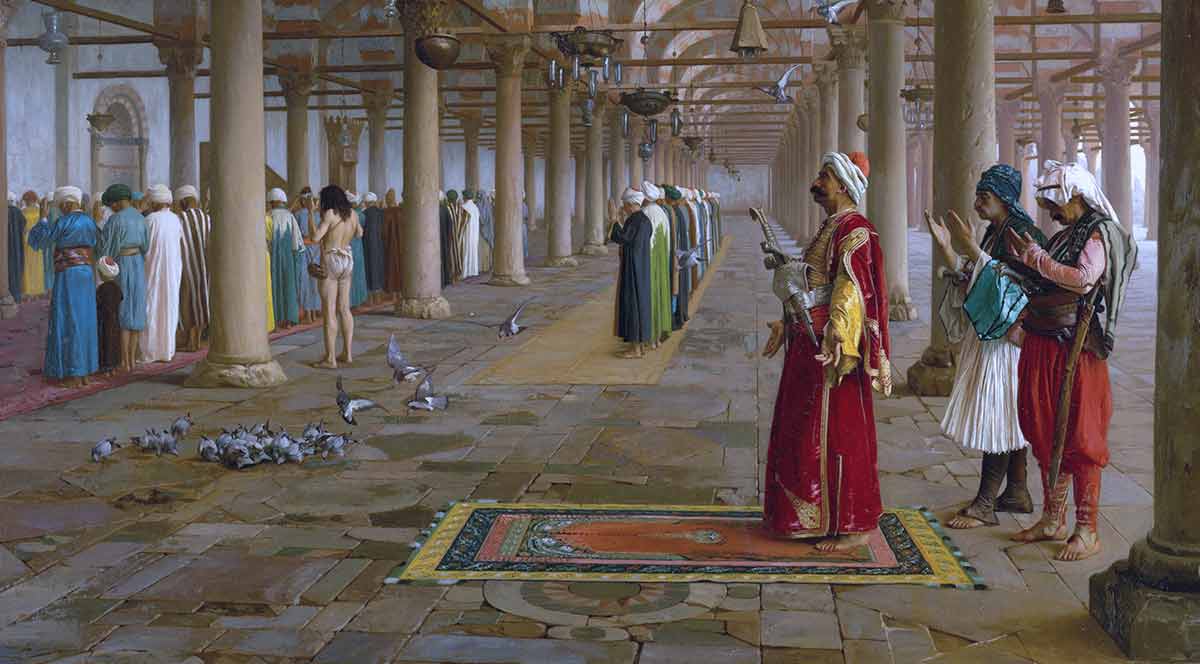
One of Gérôme’s greatest works, Prayer in a Mosque, depicts rows of worshipers in the ‘Amr mosque in Cairo, facing towards Mecca during one of the five daily prayers.
Having traveled extensively throughout the Middle East, Gérôme was well versed in Islamic culture, more so than many of his contemporaries. This adds to the authoritativeness of his work to a European audience. Nevertheless, his works were not entirely truthful, containing imaginative renderings informed by reality. By the time Gérôme visited Egypt in 1868, the ‘Amr mosque had already fallen into disuse. Nevertheless, it provides a plausible backdrop to Islamic cultural practice, characterized by Gérôme’s masterful use of color and lighting.
The painting currently resides in the Metropolitan Museum of Art in New York.