
Ever wondered why Albrecht Dürer painted himself in a fur robe or why Vincent van Gogh chose to portray himself wearing a winter coat indoors? Artists use different modes of self-fashioning to claim an outward identity or appearance that is often different from their lived reality. A simple black dress, straw hat, or leather jacket is never just that. Rather, each item functions as a carefully calculated performance. The following eight self-portraits show how most artists play dress-up, using fashion to perform a constructed or idealized self.
1. Albrecht Dürer’s Self-Portrait with Fur-Trimmed Robe
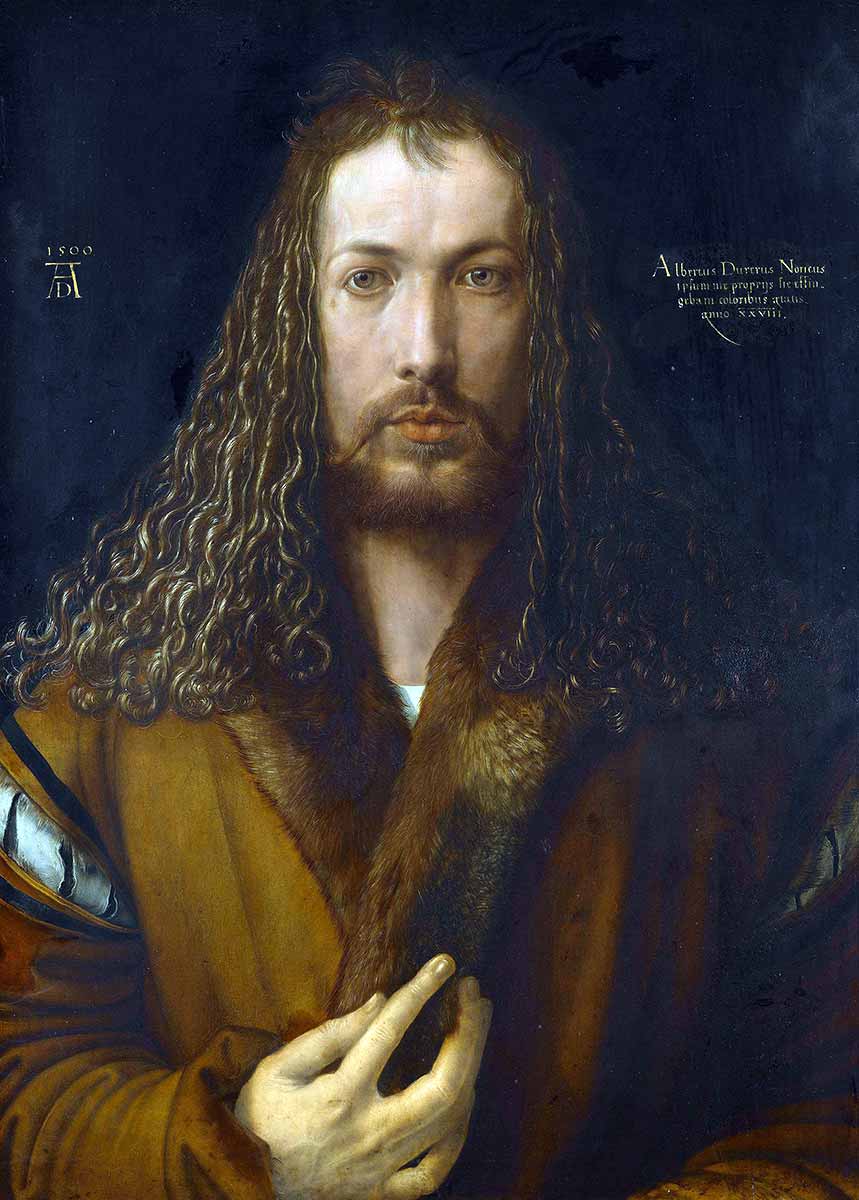
At the age of 28, Dürer painted his Self-Portrait with Fur-Trimmed Robe (1500), setting the scene for the skillful use of costume in self-portraiture. As the title suggests, Dürer is wrapped in a richly textured, earthy-brown coat with distinct fur trim. His discerning gaze is symmetrically framed by long curly hair in a golden-brown hue and accentuated by a deliberate frontal pose that resembles traditional iconography of Jesus Christ.
The likeness is a deliberate choice to imbue his self-image with a sense of grandeur and opulence, elevating his social status from mere craftsman to divine genius. Dürer’s right hand rests upon the fur trim of his coat, daringly inviting the viewer to gaze upon the luxury material. Notably, sumptuary laws of the Holy Roman Empire restricted the adornment of luxury items such as opulent fabrics and jewelry to the aristocracy. In Self-Portrait with Fur-Trimmed Robe, Dürer defiantly uses clothing, such as luxury fur, to project an image of nobility and higher status that was not afforded to working artists. The divine likeness of the portrait and the precise rendering of the fur showcase Dürer’s virtuosity and his attempt to intellectualize his craft.
2. Sofonisba Anguissola’s Austere Black Dresses
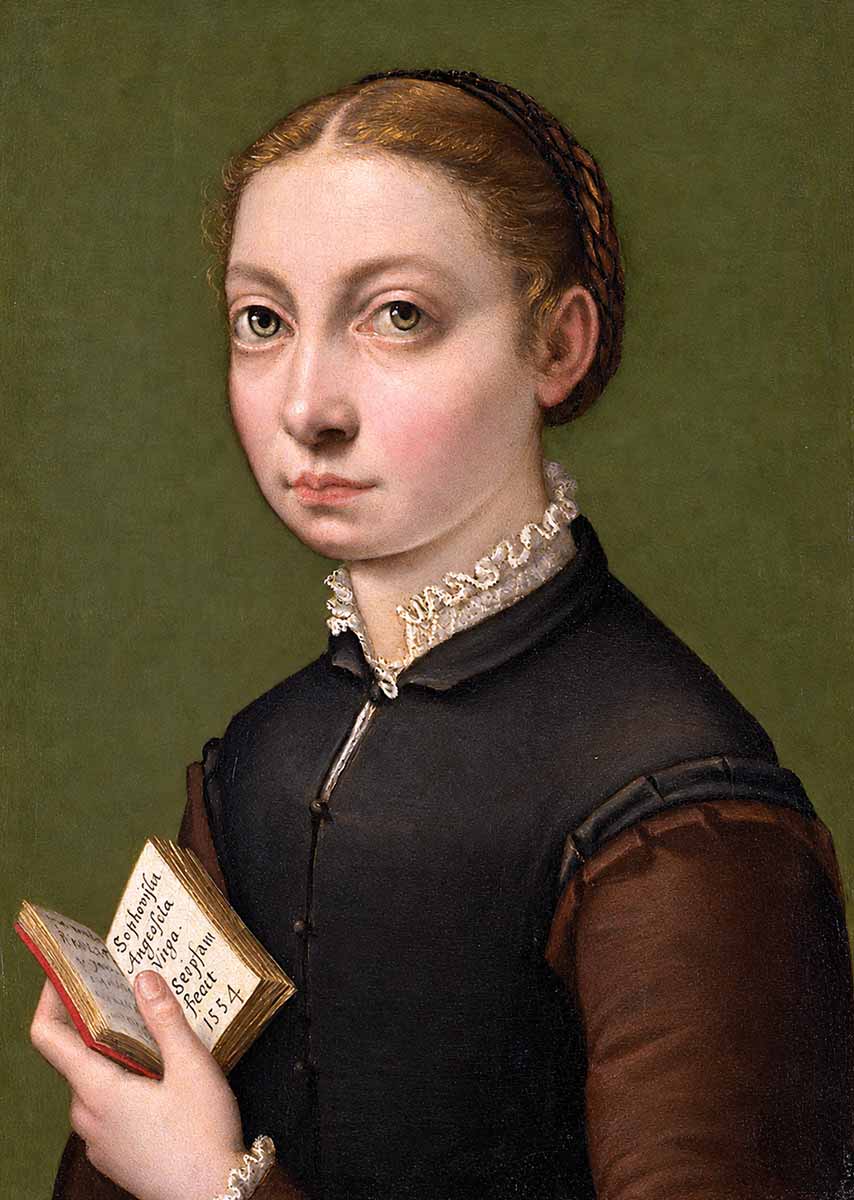
Anguissola’s self-portraits, on the other hand, project a much more demure and restrained image than that of her contemporaries. In several of her self-portraits, such as the one from 1554, Anguissola is fashioned in austere, high-necked black dresses with white lace collars beneath. Her hair is neatly parted in the middle and pulled away from her face. Notably, her self-image is devoid of any adornment such as earrings or a necklace which would have been customary for women’s fashion and portraiture at the time. She boldly defies the feminine signifiers that would tie her image to vanity and instead adopts a style of independence. She consistently portrayed herself in black dresses to uphold this autonomous, stern image and project herself as a virtuous woman.
The Spanish court of the 16th century designated the color black to members of the nobility and was predominantly worn by noblemen. Anguissola adopts the signifiers of the male courtier, donning somber black clothing to align herself and her artistic pursuits with noble status. In Anguissola’s Self-Portrait of 1554, she projects an image of self-assurance by pointing at her name in the book she is holding. The book symbolizes her intellectual ambition and serious demeanor toward her craft, firmly positioning herself in the male-dominated field she occupies. Both Dürer and Anguissola draw attention to their hands in their respective self-portraits, emphasizing their capability as artists.
3. Rembrandt van Rijn as a Renaissance Gentleman
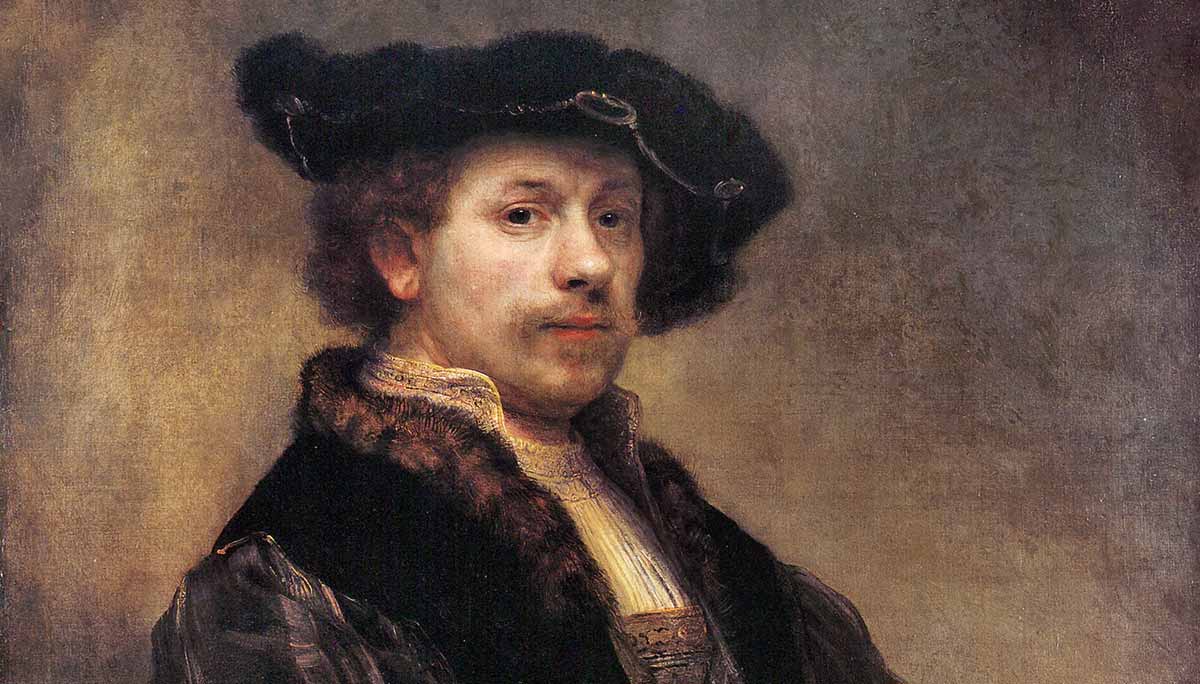
Rembrandt’s Self-Portrait at the Age of 34 was painted in 1640, yet the Dutchman is clothed in a lavish garment fit for a Renaissance gentleman. The nod to the 1520s is further emphasized by Rembrandt’s self-assured pose that is reminiscent of Dürer, in addition to his use of a warm-brown color palette. Taking a closer look at Rembrandt’s attire, he is seen wearing a hat brimmed with jewels, an opulent brown cloak with a fur trim, and a white linen shirt underneath. The rich velvet and fur textures add a heaviness to the painting, emphasized by the curved sleeve of the garment that billows toward the viewer. In donning the fashion and pose of Renaissance masters such as Dürer, Titian, and Raphael, Rembrandt counts himself among the greats.
His extravagant lifestyle is reflected here, as Rembrandt was fond of collecting beautiful objects and fabrics. The portrayal of Rembrandt as a fashionable gentleman functions in part as a form of advertisement, to show his prospective clients his success as an artist. The careful choice of velvet and fur displayed in this portrait establishes Rembrandt’s reputation as a recognizable artist and cements his evergreen success.
4. Élisabeth Louise Vigée Le Brun’s Straw Hat and White Chemise Dress
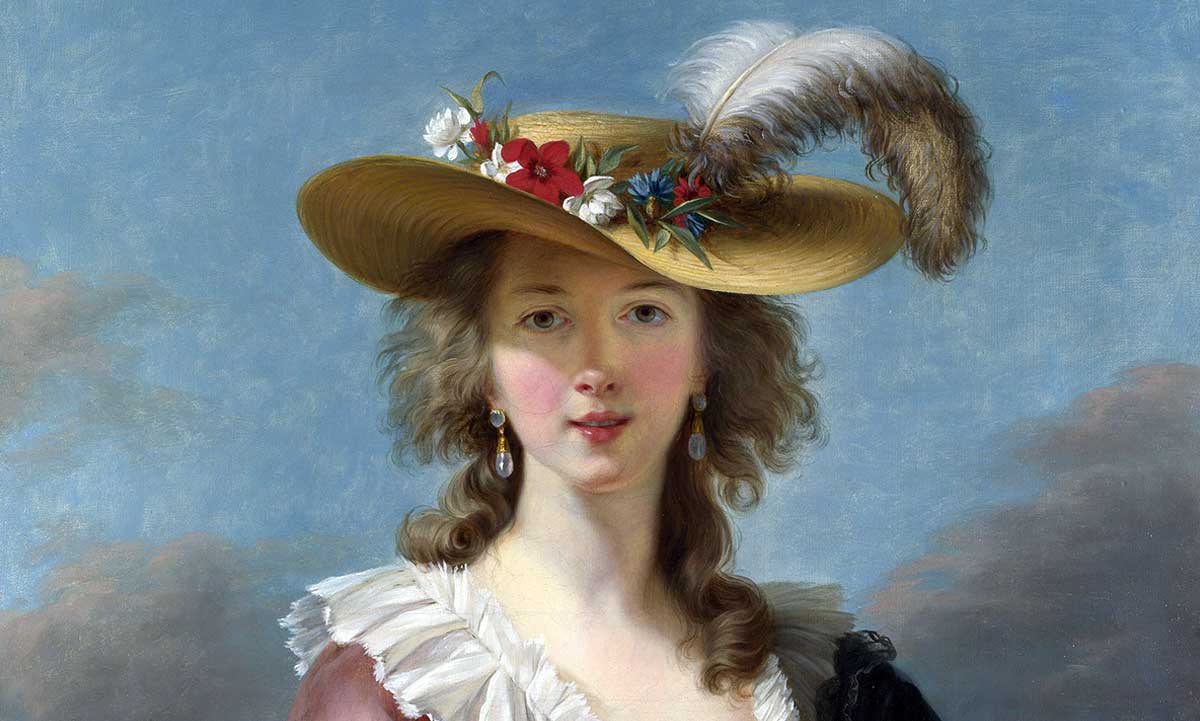
Vigée Le Brun’s Self-Portrait in a Straw Hat (1782) ushers in the pastoral style favored by her patron, Marie Antoinette, Queen of France. In the portrait, Vigée Le Brun greets the viewer’s gaze with assurance, wearing a white ruffled chemise dress, loosely fitted, with a black gauzy shawl draped around her shoulders. An ostrich feather sprouts from her straw hat, brimmed with fresh flowers, while her hair is natural and unpowdered. Elegant teardrop earrings adorn her natural visage.
Vigée Le Brun based her self-portrait on Peter Paul Rubens’ Portrait of Susanna Lunden (1622-5), inspired by his use of light. The sitter in Rubens’ portrait is similarly fashioned with a feathered hat and low-cut dress. However, Vigée Le Brun departs from corseted fashion and accentuated décolletage, instead accessorizing with the materials of her craft: paintbrushes and a palette. In doing so, she claims her profession and presents herself as a professional artist. Moreover, through her fashion, she likens herself to great masters such as Rubens and ties herself to royalty such as Marie Antoinette, elevating her social status.
5. Vincent van Gogh’s Green Winter Coat

In Self-Portrait with Bandaged Ear (1889), Van Gogh is pictured indoors, in the Yellow House in Arles, wearing a green winter coat fastened with a single button, a brown undershirt peeking out, and a cap with black fur trim. The left side of his face is wrapped in a white bandage, covering his ear, which he mutilated in an act of desperation weeks before painting the portrait. Van Gogh seems to have carefully curated his wardrobe to project a sense of practicality. The fur cap is used to keep the bandage in place as well as to keep warm. On the other hand, the winter coat acts as protective armor, not just against the cold, but as a protective layer against society’s judgment of him as a “madman.”
This style choice is in contrast to the bourgeois style of earlier self-portraits, which often depicted Van Gogh fashioned in stylish suit jackets or a felt hat and pipe. The shift in fashion and self-representation is perhaps indicative of Van Gogh’s mental health struggles at the time. This is apparent as the winter coat is the most prominent element in the self-portrait and seems oversized in comparison to the rest of the composition. It seems to create a wall between him and the viewer. Although Van Gogh presents himself in a vulnerable state, he also takes a resilient and shameless stance as he deliberately turns his bandaged ear toward the viewer’s gaze. In doing so, he asserts himself as a hardy working artist with his easel and canvas pictured behind him. The warm palette of his yellow-walled studio suggests a sense of hope and optimism and shows Van Gogh seeking comfort and protection in his studio.
6. Frida Kahlo’s Oversized Men’s Suit

In Self-Portrait with Cropped Hair from 1940, Kahlo is seen sitting in a chair, wearing a bulky dark-gray men’s suit, buttoned shirt, and sporting a short hairstyle. It appears that Kahlo just cut off her hair, as she is holding a pair of scissors in her hand and a severed braid, while locks of hair are strewn all around her. The androgynous style in the portrait is starkly different from the feminine fashion that Kahlo is known for, such as her Tehuana dresses, flowing skirts and blouses, or colorful flowers in her hair. Her self-presentation is stripped of most traditional feminine markers, except for a single hanging earring and heeled shoes. Her famous rouged lips are still present in this portrait.
Kahlo painted this portrait after her divorce from her famous artist husband, Diego Rivera. References to this past relationship are present in the men’s suit and hairstyle reminiscent of Rivera’s own style. The masculine clothing and hairstyle symbolize Kahlo cutting ties with her past relationship and with the feminine attributes that a patriarchal society, or Rivera himself, would find desirable. This is apparent from the Mexican song lyrics shown at the top of the portrait, reading: “Look, if I loved you it was because of your hair. Now that you are without hair, I don’t love you anymore.” Through her defiant clothing and bold, direct gaze, Kahlo asserts her autonomy and presents herself as an independent woman and artist.
7. Cindy Sherman’s Vintage Fashion

In Untitled Film Stills (1977-1980), a series of 70 black-and-white photographs, Sherman dresses up as different female film characters, imitating film publicity stills from the 1950s and 1960s. The series sees Sherman perform the role of the dutiful housewife, the city girl, or the damsel in distress, fashioned in ultra-feminine clothing and deliberately posed. The clothing signals the type of woman Sherman portrays, whether she dons a headscarf, a two-piece ensemble, or a pointed white collared shirt, as seen in Untitled Film Still #21 (1978). Notably, the clothing pieces that Sherman wears are thrifted and add to the anti-glamor aesthetic of the images, underscored by the grainy texture that the images display.

The self-portraits of stock characters are instantly recognizable, in part, because of Sherman’s curated wardrobe and selected props. Take, for example, Untitled Film Still #3 (1977), where Sherman plays the unhappy housewife clad in an apron and standing over the kitchen sink. She is surrounded by recognizable kitchenware such as a bottle of dish soap and empty containers, while the handle of a stovetop pot peeks out from the corner of the image. The sharp and ominous edge of the pot handle adds an unexpected suspense to the image, reminiscent of the knife used in the iconic shower scene from Alfred Hitchcock’s 1960 film Psycho. The unease of the image is further emphasized by Sherman’s body language as she wraps her arm around her waist and peers over her shoulder from underneath her blond wig.
Rather than meeting the viewer’s gaze, as in traditional self-portraiture, Sherman never directly looks at the viewer. Instead, her gaze and attention are occupied by a presence outside of the frame, unknown to the viewer. In addition, Sherman is not the subject of the portrait, as she uses costume to erase her identity. Considering this, one might question whether these images belong in the category of self-portraiture, seeing that MoMA does not classify these as self-portraits. Yet, Sherman makes the quintessential argument for self-portraiture as performance or disguise. The performance is a means to show the artificiality of feminine identity, echoing Simone de Beauvoir’s statement that “one is not born, but rather becomes, a woman.” Sherman is in a constant state of becoming by showing how women put on a face to fit into predetermined societal roles. The women in the portraits seem to be perfectly made up, but their expressions reveal a sense of weariness that shows the cracks in the constructed veneer.
8. Robert Mapplethorpe’s Bad-Boy Self-Portrait
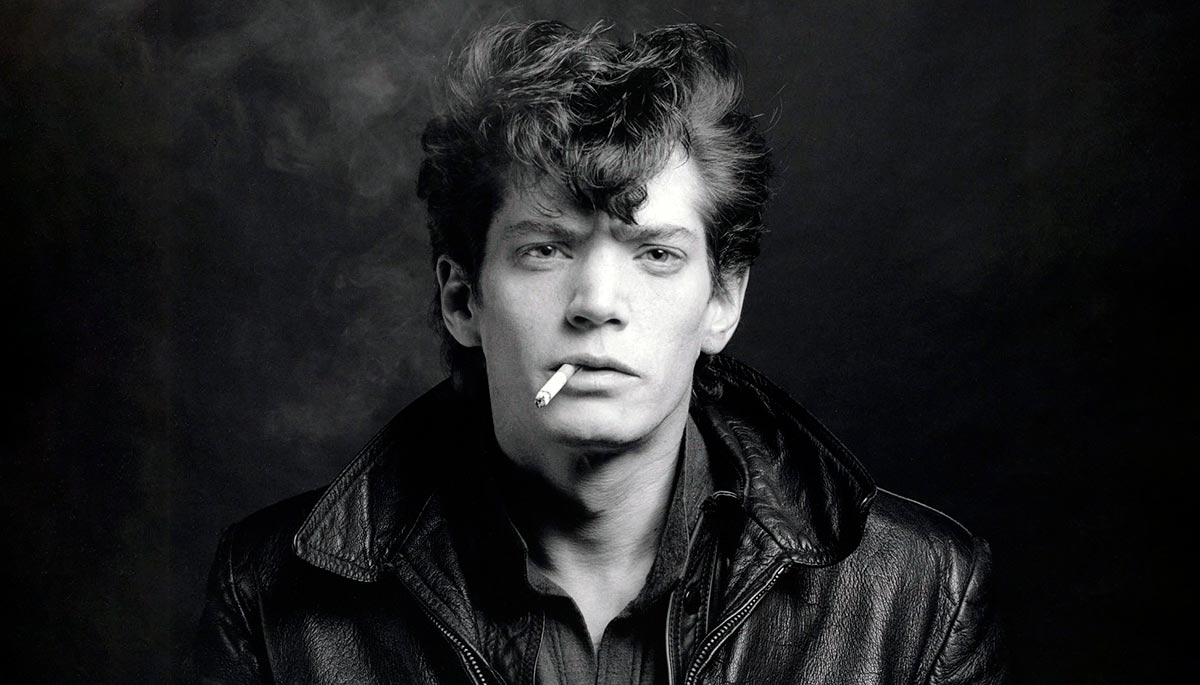
In Self-Portrait (1980), Mapplethorpe presents a hyper-masculine image, fashioned in an all-black ensemble with a dangling cigarette in the corner of his mouth. He has a furrowed brow and a 1950s pompadour hairstyle, reminiscent of James Dean in Rebel Without a Cause (1955) or John Travolta in Grease (1978). Mapplethorpe takes on a masculine frontal pose, holding the gaze of the viewer, and projecting a sense of cool confidence. The leather jacket and cigarette align Mapplethorpe with counterculture and an air of defiance, perhaps intended to defy or bend the parameters of traditional gender identity. It is worth noting that Mapplethorpe took another self-portrait in 1980, wearing partial drag, with his lips and eyes made up with makeup. The two self-portraits create a striking juxtaposition, highlighting the fluidity of male and female identity.
Similar to Sherman’s use of costume, Mapplethorpe uses the leather jacket to construct his identity as an archetypal bad boy and simultaneously to expose its inherent constructedness. In addition, both artists mine familiar visual archives to perform different personas or particular masculine or feminine identities. It becomes clear that fashion and the items the artists choose to wear are deliberate in order to convey a constructed selfhood.
Self-portraiture is often equated with authenticity, allowing the artist to act as a quasi-documentarian. Yet, in these self-portraits, clothing is used as a signifier to perform the role of a nobleman, an independent woman, or a confident rebel. Fashion is used to express how the artists want to be seen in their self-portraits and in real life rather than how they should be seen according to societal expectations.