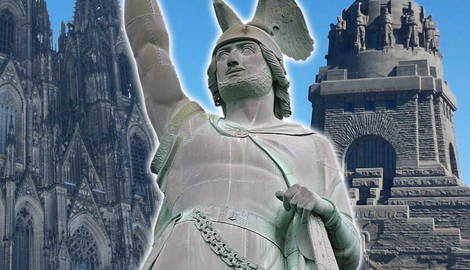

What does a victory over Rome more than two thousand years ago and a bronze warrior raising a sword toward France have to do with modern pride and national shame? More than you might expect. To truly step inside Germany’s turbulent past, you must look closely at its physical landscape. From imposing medieval castles to sobering memorials dedicated to victims of totalitarian regimes, the country’s stone and bronze monuments serve as a physical timeline of division, triumph, and renewal.
By tracing the hidden narratives behind 11 of Germany’s most iconic monuments, we can discover how a fractured patchwork of ancient tribes evolved into a medieval empire, endured catastrophic twentieth-century horrors, and ultimately rebuilt itself into a unified democratic powerhouse.
| Monument Name | Location | Key Historical Significance |
|---|---|---|
| Hermann Monument | Detmold | Symbol of Germanic resistance against Rome and, later, anti-French nationalism. |
| Aachen Cathedral | Aachen | Seat of Charlemagne; coronation site for 30 German kings. |
| Imperial Palace | Goslar | Center of the Salian dynasty; restored to connect Prussian power to the medieval past. |
| Wartburg Castle | Eisenach | Site of Martin Luther’s Bible translation; symbol of the Reformation and German cultural unity. |
| Cologne Cathedral | Cologne | Iconic Gothic cathedral; celebrated as a symbol of national triumph in the Second Reich. |
| Sanssouci Palace | Potsdam | Designed by Frederick the Great; embodies the rise of Prussia as a European power. |
| St. Paul’s Church | Frankfurt am Main | Birthplace of modern German political identity and the 1848 national constitution. |
| Walhalla Memorial | Donaustauf | Hall of fame for “Germans” built to preserve national identity against Napoleonic influence. |
| Monument to the Battle of the Nations | Leipzig | Commemorates the 1813 defeat of Napoleon and the rise of German nationalism. |
| Buchenwald Memorial | Weimar | Former concentration camp; serves as a memorial to the victims of Nazi brutality. |
| Reichstag Building | Berlin | Home of the German Parliament; symbol of democratic tradition and German unification. |
1. Hermann Monument in Detmold
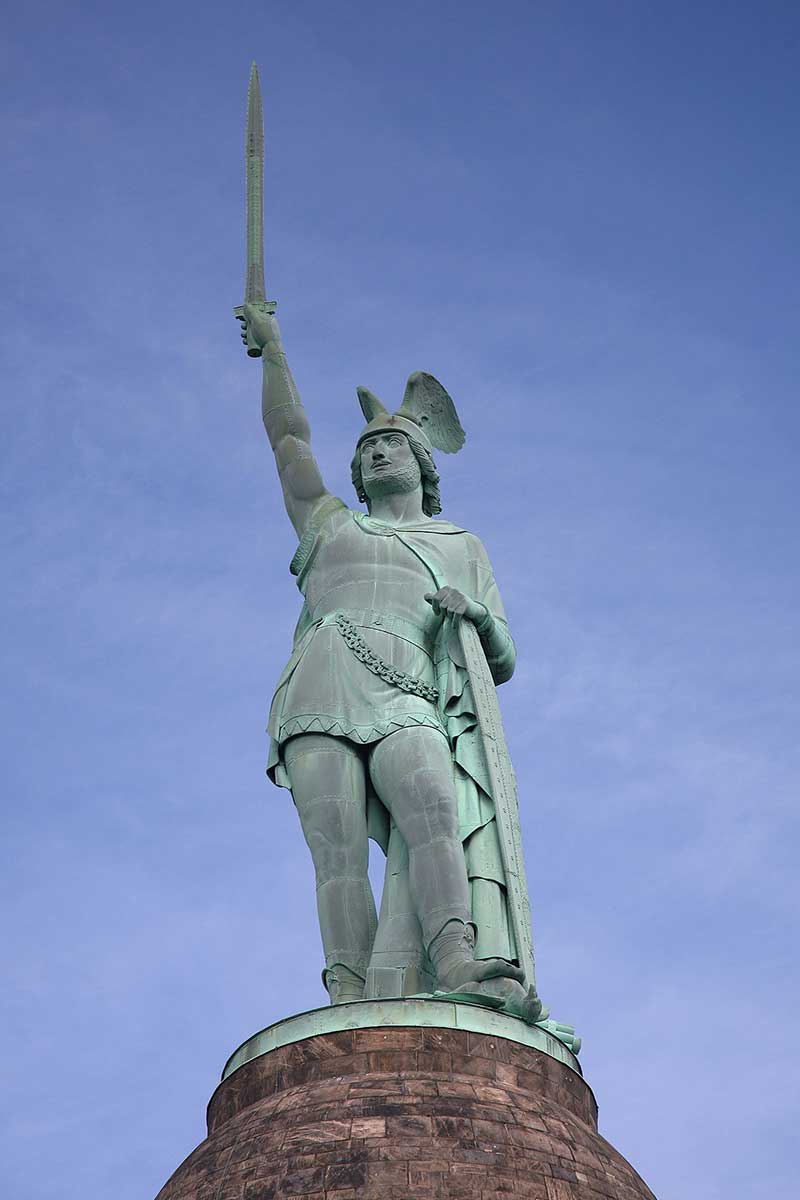
The bloody rivalry with France and Franco-German cultural interactions are recurring themes in Germany’s history. The Hermann or Arminius Monument in the Teutoburg Forest near Detmold perfectly captures this part of Germany’s story.
The historical Hermann led an alliance of German tribes in a stunning victory over the Roman Empire in this same Teutoburg Forest in 9 AD. Hermann (or Arminius) became a powerful symbol of Germanness and resistance.
For example, historian Jeremy Black notes that Ulrich von Hutten’s 1519 work Arminius portrayed his hero as the leader of German resistance to Rome, while the author also supported Martin Luther in his struggle against the papacy during the Protestant Reformation (2022, 17).
German nationalists later connected Hermann’s exploits to their rivalry with France. Historian Neil MacGregor explains that nationalist anti-French symbols, such as Hermann’s victory, appeared in literature and art, including the Brothers Grimm fairy tales, during the Napoleonic Wars (2016, 114).
Indeed, it is no accident that the bronze Hermann crowning the monument raises his sword in the direction of France. MacGregor explains that construction began in the wake of Napoleon’s defeat and was completed in 1875, a few years after the Prussian victory over France (2016, 126).
According to MacGregor, more than 100,000 people visit the monument annually. However, many Germans are ashamed of the nationalist uses of the monument since the Nazis appropriated the Teutoburg Forest for propaganda purposes (2016, 126).
2. Aachen Cathedral in Aachen
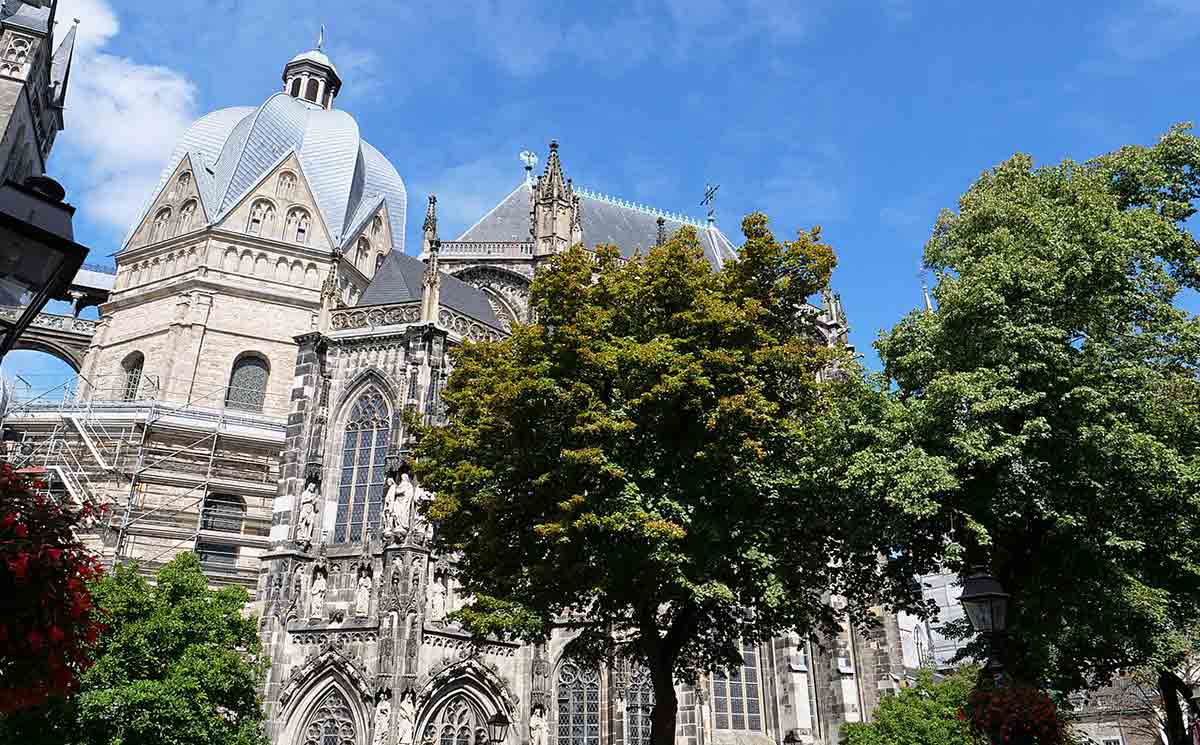
Aachen’s cathedral is one of the oldest in Europe, and historian Neil MacGregor explains that, for centuries, it was the tallest building north of the Alps (2016, 196).
The cathedral began as the palace cathedral of one Karl der Grosse (Charles the Great), King of the Franks, better known in French and around the world as Charlemagne.
Charlemagne’s Carolingian dynasty emerged from the aftermath of the Western Roman Empire’s collapse. Germany at the time was populated by various tribes with shifting allegiances and alliance systems, though the Franks were long the dominant group (Black, 2022, 25-26).
The dynasty reached its peak in 800 CE, when Charlemagne was crowned Emperor by Pope Leo III in Rome. He ruled over present-day France and Germany, as well as much of Italy. For a time, Neil MacGregor points out, it appeared that the Western Roman Empire had been restored (2016, 196).
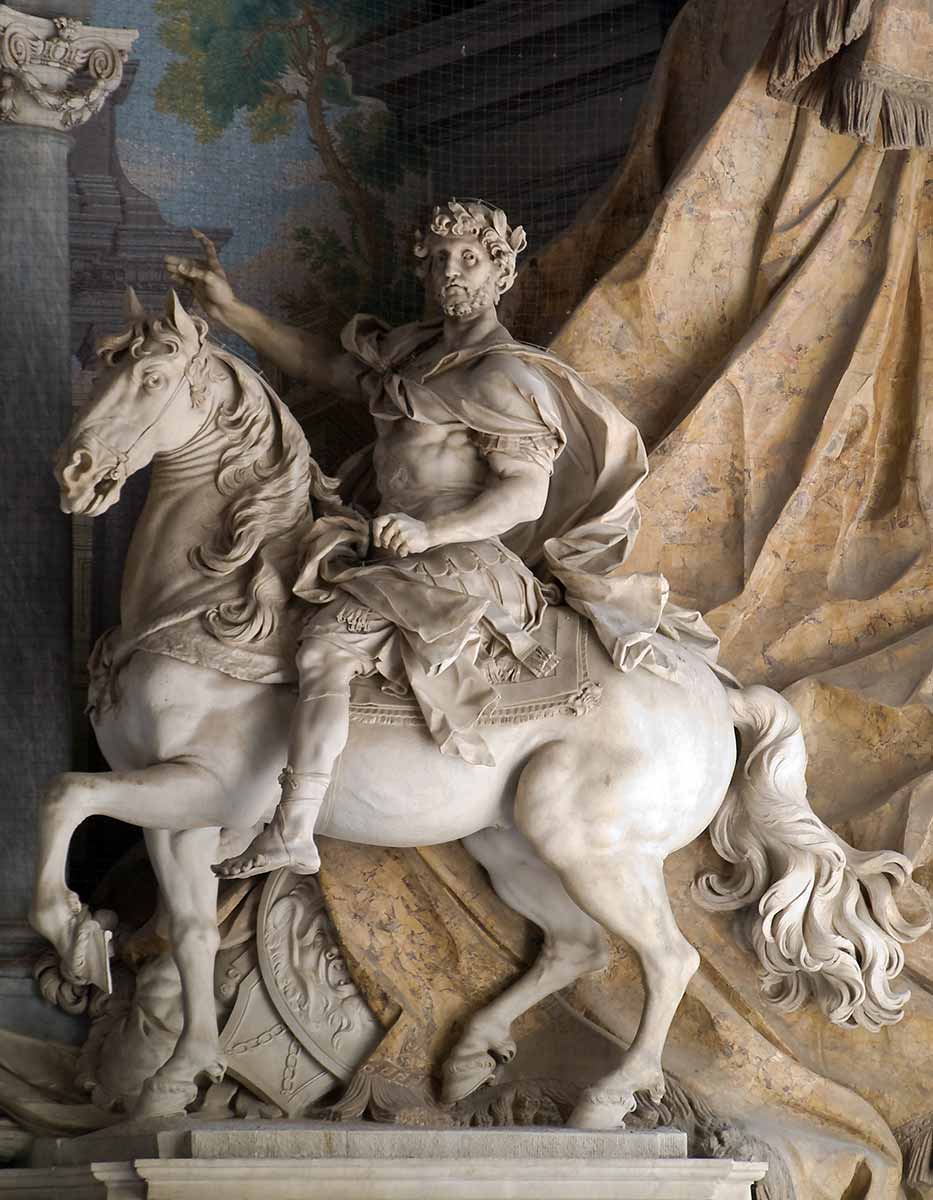
But that was not to be. Charlemagne’s death in 814 and the split between his three grandsons in 843 divided the empire’s territory and led to conflict between the rulers of what constitutes much of present-day France and Germany.
MacGregor notes that over 600 years, between 936 and 1531, 30 German kings were crowned at the Aachen Cathedral (2016, 198).
3. Imperial Palace of Goslar
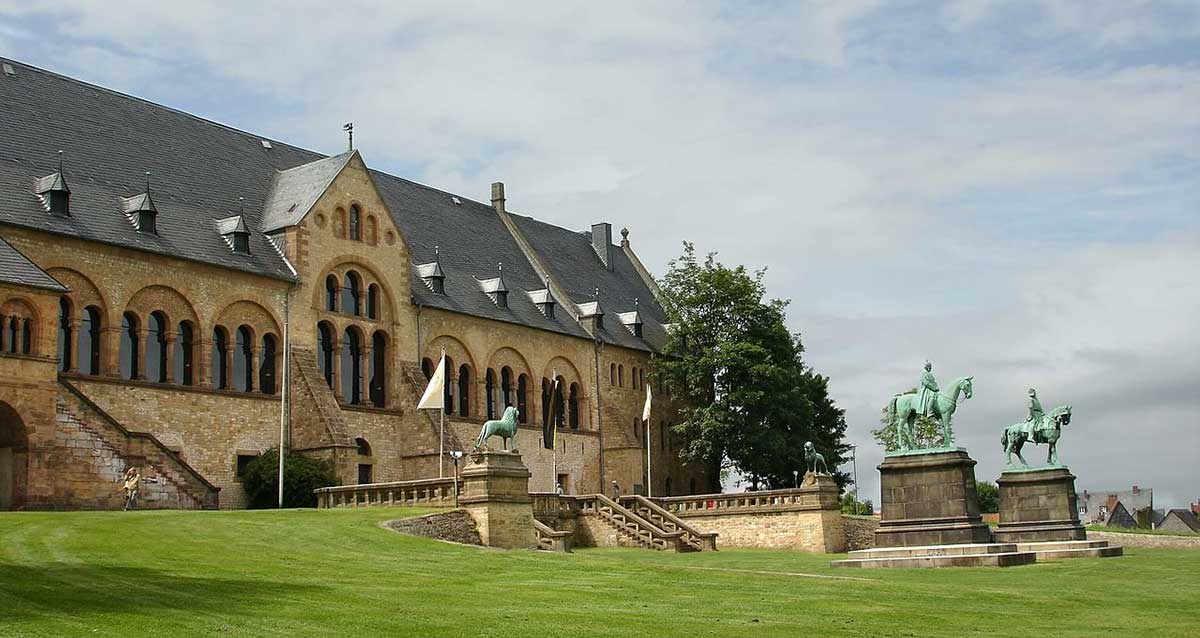
This palace was a favorite of Germany’s rulers from the Salian (or Salic) dynasty (1024-1125). Located outside of Goslar near the Harz Mountains in central Germany, it is now part of a UNESCO World Heritage site.
Goslar’s imperial palace complex was derelict for centuries as the last ruler to live there died in the mid-13th century.
The main imperial residence of the palace complex was restored in the 19th century as part of a project to link the Prussian Hohenzollern dynasty with Germany’s past following German Unification.
According to historian Jeremy Black, Kaiser Wilhelm I encouraged the restoration to link his reign with that of Henry III (King of Germany, 1028-1056, Holy Roman Emperor, 1046-1056). In 1879, the project resulted in massive historical paintings depicting the Salian emperors and bronze statues of Frederick Barbarossa (2022, 153).
4. Wartburg Castle in Eisenach
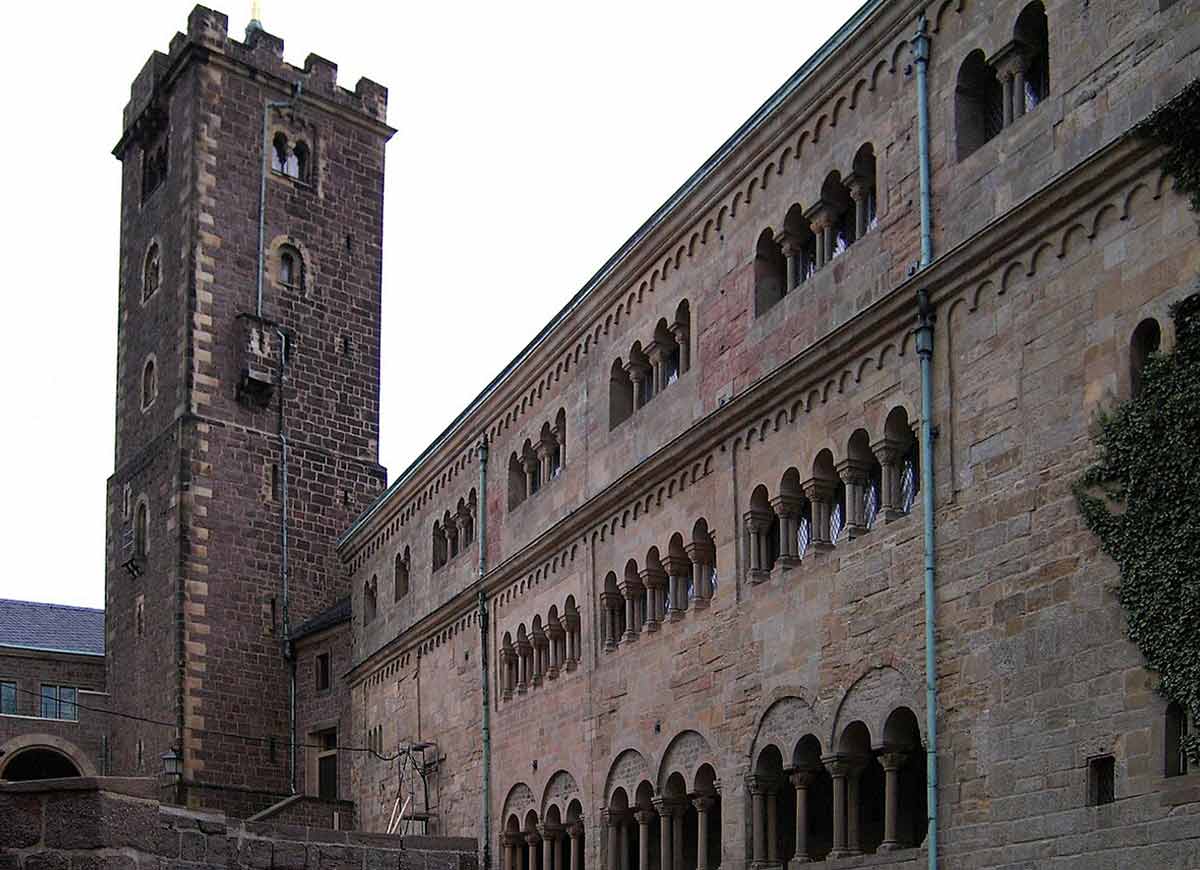
The Wartburg Castle is closely linked to Martin Luther and the Protestant Reformation.
Sixteenth-century Germany was, as Neil MacGregor points out, a confusing patchwork of states of varying sizes, governed by kings, electors, dukes, prince-bishops, margraves, and a host of other minor nobles (2016, 95). In other words, there was very little unity in Germany.
So, it might seem odd to focus on the Protestant Reformation as a moment of new unity, since it is often seen as another chapter marked by division and conflict.
Although bitter religious disputes continued to divide Germans, Martin Luther provided a common reference through his innovations to the German language. After running afoul of the Church at the Diet of Worms in 1521, Frederick III, Elector of Saxony, spirited Luther to safety at Wartburg Castle.
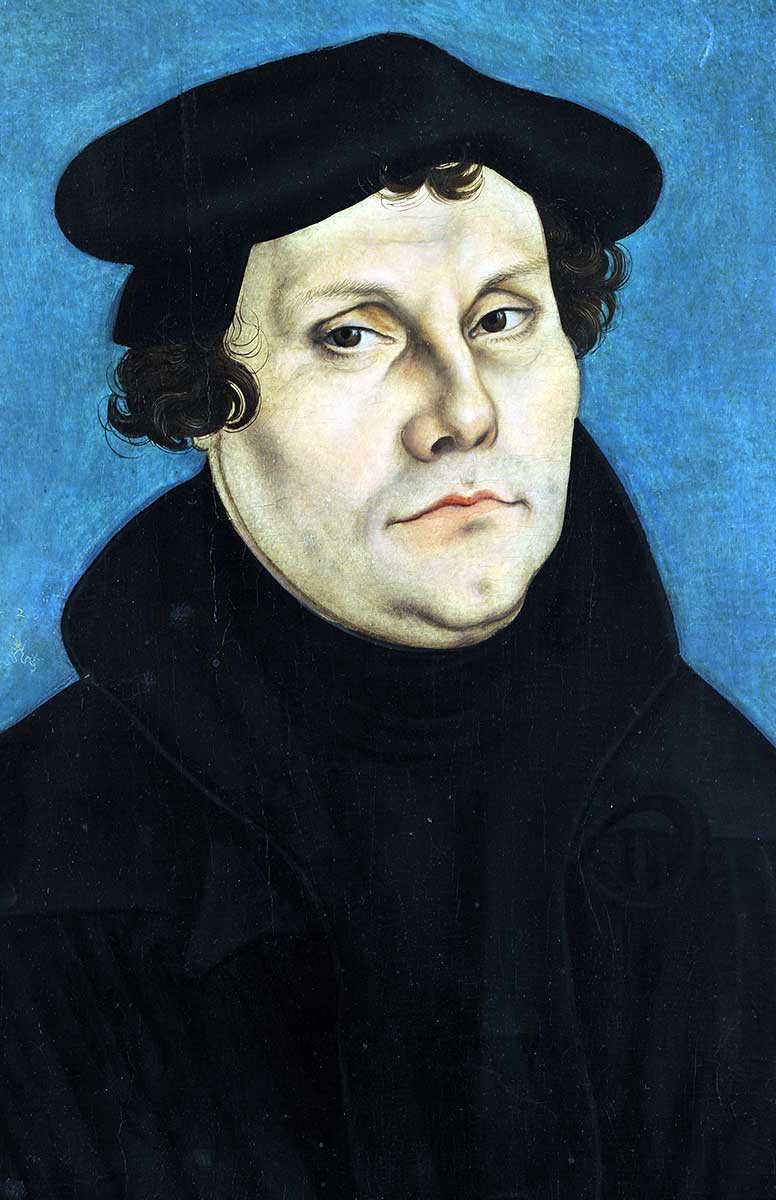
From the safety of Wartburg Castle, Luther translated the New Testament into German. But, as Neil MacGregor notes, Luther did more than translate; he invented a new German language that could be understood across the patchwork of states (2016, 104). Germans, both for and against Luther’s ideas, were soon using the language he crafted to express their views.
Romanticism captivated many young German nationalists in the first decades of the 19th century. The castle served as the backdrop for the nationalist political rally, the Wartburg Festival of 1817, held to mark the 300th anniversary of the Protestant Reformation and the fourth anniversary of Napoleon’s defeat at Leipzig.
5. Cologne Cathedral in Cologne
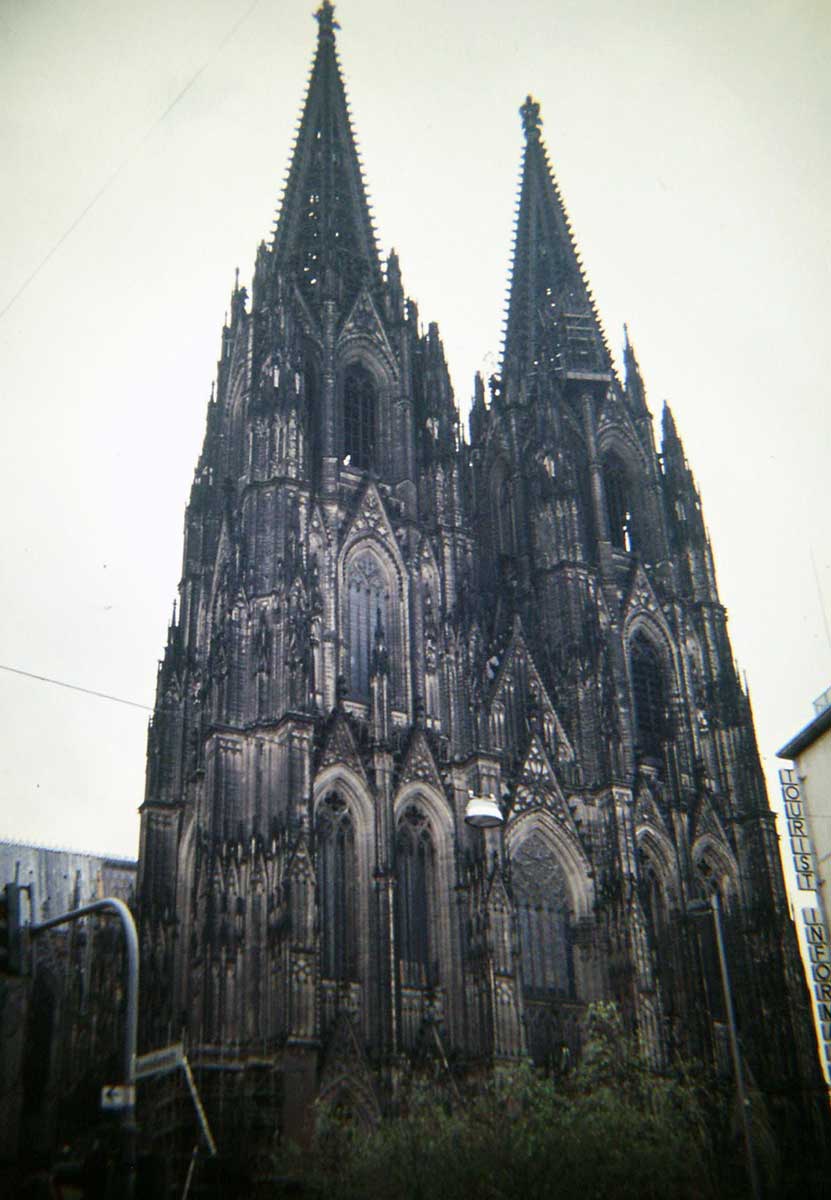
Cologne Cathedral is the seat of the Catholic Archbishop of Cologne. It is an iconic example of Gothic architecture.
As a frequent visitor to Cologne, I never fail to be impressed by my first glimpse of the cathedral from the neighboring main train station. The cathedral dates to 1248 and holds many records. For example, it is Germany’s most visited tourist attraction.
Although construction began in the 13th century, it was not completed according to its original design until the end of the 19th century. The newly unified Germany under Otto von Bismarck and the Prussian Hohenzollern dynasty celebrated the completion of the Cologne Cathedral in 1880 as a national triumph.
Indeed, like the former imperial palace at Goslar, Cologne’s iconic cathedral became an important monument in the Second German Reich (1871-1918). Neil MacGregor notes that prints featuring the newly completed Cologne Cathedral and Strasbourg’s Cathedral (incorporated into Germany after the Franco-Prussian War of 1870-71) became popular patriotic symbols (2016, 72).
Cologne and its cathedral became frequent targets for Allied air assaults during World War II. Historian Jeremy Black points out that a British attack in May 1942 killed over 460 people, mostly civilians (2022, 204). The cathedral was struck more than a dozen times during the war.
Reconstruction and restorative work on the cathedral began shortly after the war. It continues to this day.
6. Sanssouci Palace in Potsdam
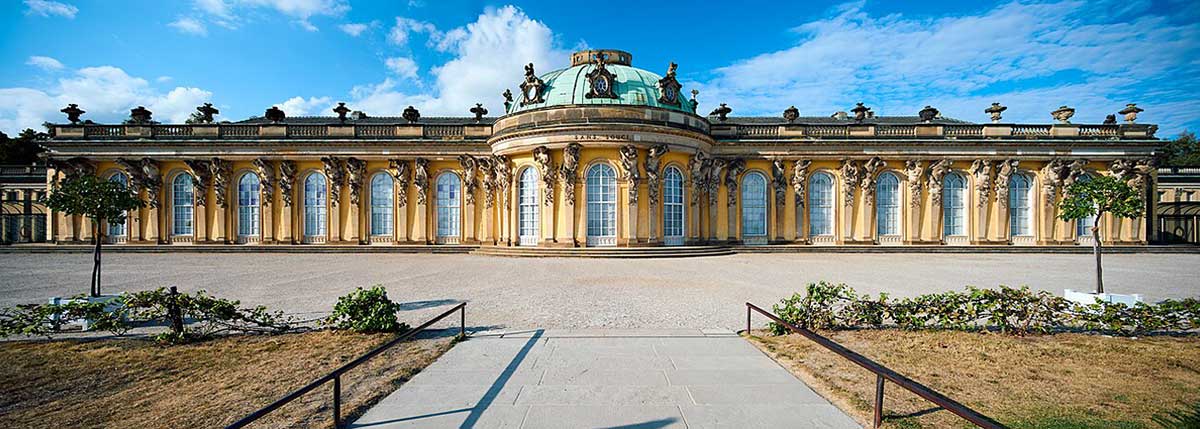
King Frederick II, known as the Great, raised Prussia to the status of a major European power in the mid-18th century.
Frederick personally designed the Sanssouci Palace in Potsdam, outside Berlin. According to historian Tim Blanning, the palace was built between 1745 and 1747. While not as massive as other palaces and public buildings constructed in Germany in this period, Blanning says Sanssouci boasted the most original design (2015, 163).
One feature that made Sanssouci a unique palace was its location. As Tim Blanning points out, Sanssouci was not built on an elevated base to create imposing views as one might expect from a royal palace. According to Blanning, Frederick only cared about the palace’s interior, not about following established norms for demonstrating royal power (2015, 164).
Why should we be interested in a Prussian royal palace when exploring modern German history?
Sanssouci embodied much of Frederick the Great’s personality and ambitions for Prussia. By the time of his death in 1786, Frederick had transformed Prussia from a minor German state within the Holy Roman Empire into a European power. The Prussian state Frederick entrusted to his successors took the lead in forging a unified Germany.
Frederick the Great’s military leadership served as an inspiration for later generations of German nationalists. However, as historian Christopher Clark (2006) notes, the Nazis later co-opted many symbols of Prussia’s earlier military tradition to legitimize the regime in the context of German history.
7. St. Paul’s Church in Frankfurt am Main
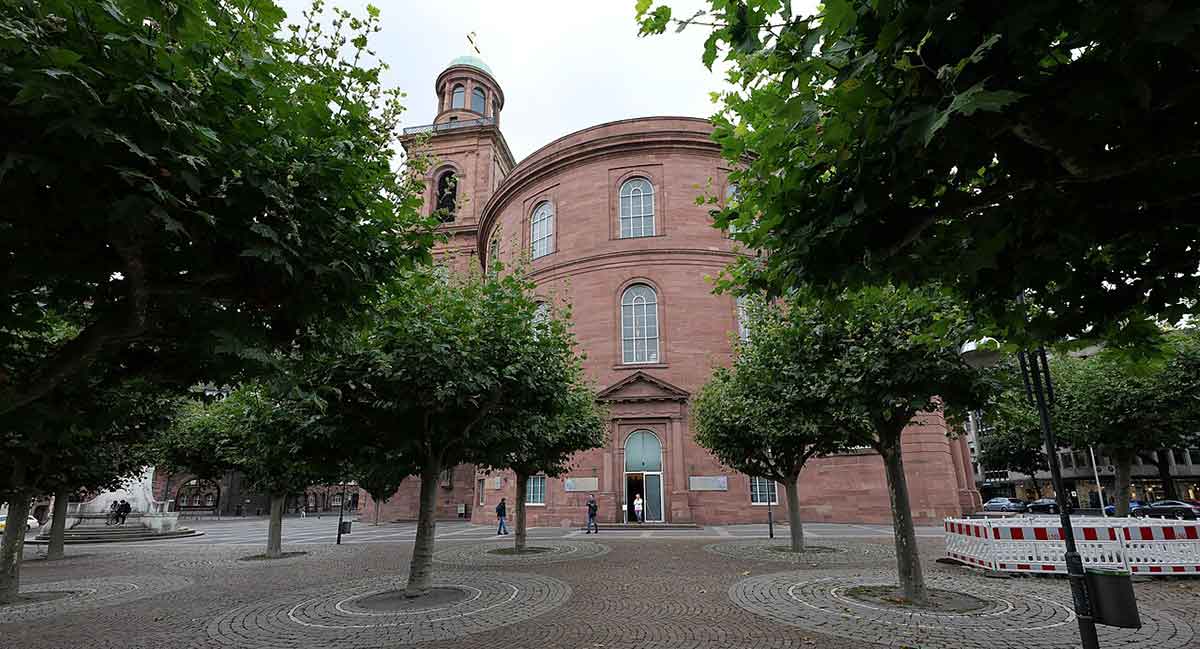
St. Paul’s Church (Paulskirche) in Frankfurt am Main is certainly one of the contenders for the title of the birthplace of modern Germany’s political identity.
The year 1848 was marked by revolution across Europe. Metternich’s conservative order, forged after Napoleon’s defeat, faced challenges throughout the continent, including in German lands.
In 1848, Neil MacGregor explains that a National Assembly met at St. Paul’s Church in Frankfurt and declared the existence of a united Germany, operating under a constitution and using the black, red, and gold flag as its emblem (2016, 267).
However, the desired leadership of Prussia under this constitution did not materialize, and the Frankfurt National Assembly was crushed by force in 1849.
Nevertheless, what took place at St. Paul’s Church had a lasting impact on Germany’s later emergence as a unified nation. Its significance is clear: it was the first building rebuilt in Frankfurt after its destruction in World War II. The nearby Imperial Frankfurt Cathedral (Kaiserdom) was also destroyed in 1944 and later rebuilt.
8. Walhalla Memorial in Donaustauf
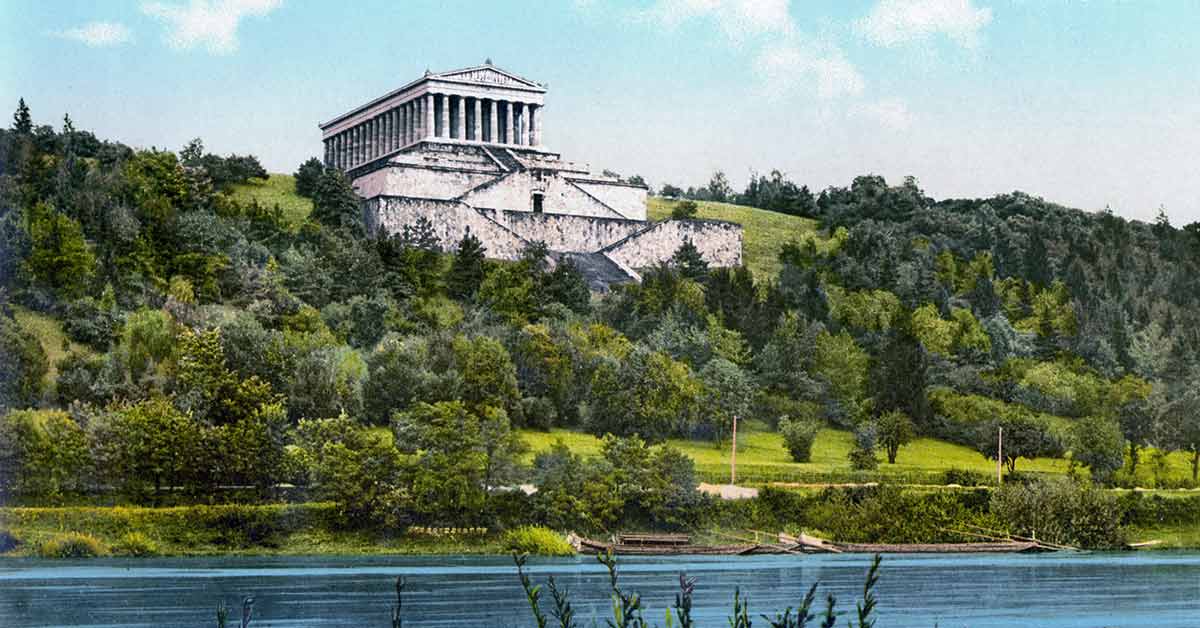
What motivated a Bavarian royal to dream of creating a hall of fame dedicated to celebrated “Germans”? Like many developments in 19th-century Europe, the answer lies in the impact of the French Revolution and Napoleonic Wars.
By 1807, Napoleon dominated present-day Germany and many other areas that had formerly been part of the Holy Roman Empire, which had ceased to exist the previous year.
Although Bavaria at the time was a loyal French ally, the future King Ludwig I did not wish to see Germans fall under complete French control and cultural influence.
Ludwig thus envisioned a tribute to Germanness designed to inspire German patriots to keep their shared histories, language, and culture alive in the face of Napoleon’s efforts to reshape the former Holy Roman Empire.
As historian Neil MacGregor notes, Walhalla in Norse mythology refers to the majestic hall where the Valkyries carried the heroic dead to join their predecessors (2016, 154).
Ludwig and his architect, Leo von Klenze, chose a secluded spot along the Danube near Regensburg for this temple dedicated to German heroes.
The Walhalla Temple opened in 1842. Its design was inspired by the architecture of Ancient Greece, namely the Parthenon in Athens. Ludwig’s interest in connecting Walhalla’s design to Greece was not coincidental. His second son, Otto, became king of the newly independent Greek state in 1832 (MacGregor, 2016, 158).
Enshrinees include historical figures from a broad definition of “German” lands. Today, Bavaria’s state government oversees and determines eligibility.
9. Monument to the Battle of the Nations in Leipzig
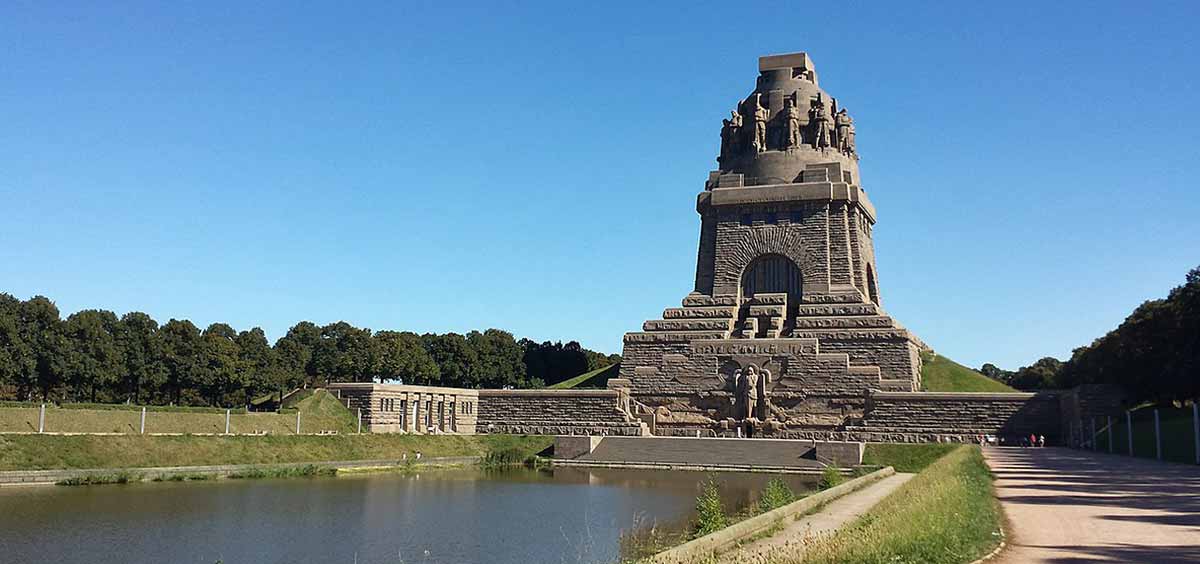
In October 1813, over half a million troops clashed at Leipzig in the “Battle of the Nations.” As historian J.P. Riley notes, it certainly involved many European nations. On one side, Napoleon’s imperial French army faced off against a coalition of rivals, including Austria, Britain, Prussia, Russia, Sweden, and smaller German states (2000, 163).
The opposing armies fought a massive five-day battle, resulting in a crushing defeat for Napoleon and French interests in Germany. Historian Peter Hofschröer explains that the Battle of Leipzig was the largest in Europe until World War I (1993, 6).
Leipzig became a popular symbol of German unity and nationalism because the battle occurred during the so-called War of Liberation. This Prussian-led German uprising against Napoleonic domination in 1813 inspired generations of German nationalists as they struggled to unify the various German states. However, as Riley points out, the War of Liberation was primarily anti-French and anti-Napoleon rather than explicitly pro-German unification (2000, 56).
Nevertheless, German participation in the Battle of Leipzig and Napoleon’s defeat in 1814-1815 became focal points in German nationalist narratives. For example, a massive monument was dedicated to the battle’s centennial in October 1913.
By the battle’s centennial, Germany was a unified imperial power in Europe under the Hohenzollern dynasty of Prussia. However, less than a year later, in August 1914, World War I broke out.
Imperial Germany collapsed four years later, in November 1918, with the end of the war.
10. Buchenwald Memorial in Weimar
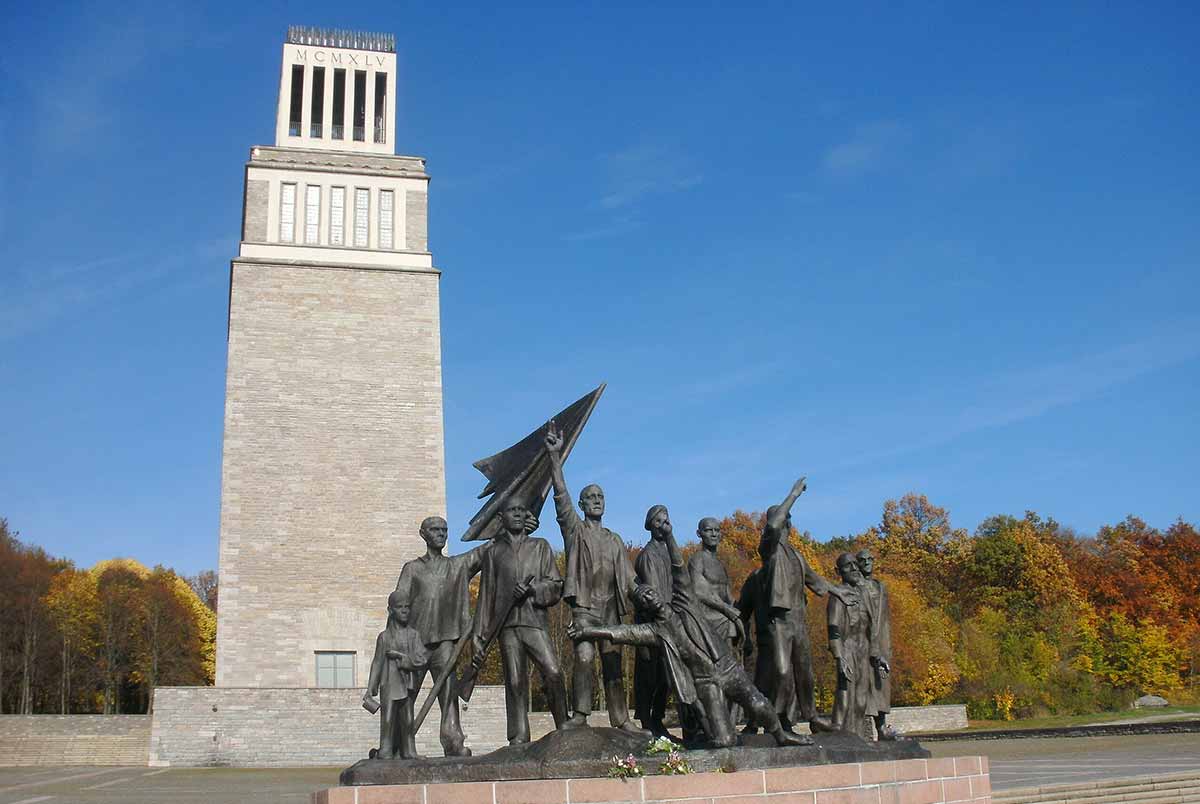
As historian Mary Fulbrook observes, the Nazi regime’s grip on power was always rooted in terror and murder. Organized mass murder policies began in 1930s Germany before expanding during World War II (2014, 119-120).
The concentration camp at Buchenwald epitomizes the regime’s brutality and the horrors endured by those labeled enemies by the Nazis. As historian Jeremy Black notes, Buchenwald opened in 1937 as a camp to detain the regime’s opponents (2022, 186-187).
Although the Nazis launched murderous antisemitic policies from early on in Hitler’s dictatorship, historian Joseph Bendersky explains that conditions created by Germany’s early successes in World War II established the groundwork for the genocidal “Final Solution” to the “Jewish problem” (2013, 214).
Buchenwald was part of, as historian Mark Mazower explains, a “concentration camp universe” of more than 10,000 camps across Europe by the war’s end (1998, 174).
While not the first nor the most brutal concentration camp, Buchenwald housed all the different categories of victims who were at any point incarcerated or exterminated across the network of camps (MacGregor, 2016, 465).
Buchenwald’s location also makes the camp’s story particularly notorious in German history. As MacGregor notes, the same idyllic forest where Goethe enjoyed walking became the home of a camp connected to mass murder (2016, 461).
Just months after the war’s end in 1945, the Soviets used Buchenwald as a prison. Buchenwald officially became part of the gulag system in the Soviet satellite GDR in 1948 (MacGregor, 2016, 470).
11. Reichstag Building in Berlin
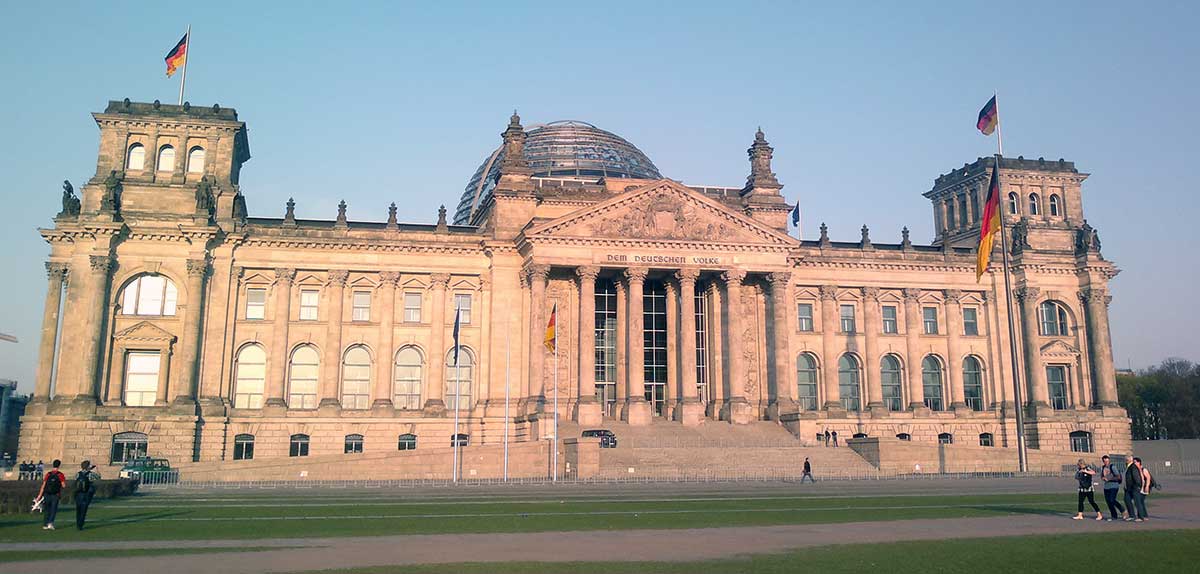
Located in the heart of Berlin, the restored Reichstag is the home of Germany’s Parliament. Between 1961 and the fall of the Berlin Wall in late 1989, it stood close to the border between East and West Berlin.
The Reichstag was originally built in the early 1880s to house the parliament of a newly united German Empire. Neil MacGregor explains that it was built with money raised through the victory over France in 1871. Kaiser Wilhelm II opposed the inscription on the façade reading “Dem Deutschen Volke” or “For the German People,” believing it was an attack on his authority (2016, 547).
Although that phrase remained inscribed on the building, much changed over the course of the 20th century. The Reichstag Fire of February 1933 became Hitler’s vehicle to destroy democratic government in Germany.
After World War II, the badly damaged Reichstag was displaced as the home of representative government in Germany. Neil MacGregor explains that West Germany’s government relocated to Bonn. In 1990, the Treaty of Reunification resolved to return the seat of the united Germany’s government to the Reichstag (2016, 551).
As historian Norman Davies notes, British architect Norman Foster replaced the former heavy stone dome with a lighter, airier glass version in 1999 (2012, 389).
Several monuments in Germany reflect the country’s renewal in the aftermath of the horrors of Nazism, war, and Cold War-era division. However, few boast the history and symbolism of a united Germany and a commitment to democratic traditions as the restored Reichstag.
Sources
- Bendersky, J.W. (2013). A Concise History of Nazi Germany. Rowman & Littlefield.
- Black, J. (2022). A Brief History of Germany. Robinson.
- Blanning, T. (2015). Frederick the Great: King of Prussia. Penguin.
- Clark, C. (2006). Iron Kingdom: The Rise and Downfall of Prussia, 1600-1947. Allen Lane.
- Davies, N. (2012). Vanished Kingdoms: The History of Half-Forgotten Europe. Penguin.
- Fulbrook, M. (2014). A History of Germany 1918-2014: The Divided Nation. Wiley.
- Hofschröer, P. (1993). Leipzig 1813: The Battle of the Nations. Osprey.
- MacGregor, N. (2016). Germany: Memories of a Nation. Penguin.
- Mazower, M. (1998). Dark Continent: Europe’s Twentieth Century. Vintage.
- Riley, J. (2000). Napoleon and the World War of 1813: Lessons in Coalition Warfighting. Cass.