
Wars and battles are not won by armies and their commanders alone. A key aspect of the art of war involves identifying how natural features such as mountains, hills, rivers, and forests can be used to improve the odds of military victory, particularly when facing a numerically superior enemy. Some of the most famous military engagements in history were determined by geography, whether on a strategic, operational, or tactical level. While armies and weapons have changed considerably over thousands of years, terrain remains a major factor in modern warfare.
Water: A Barrier and a Lifeline

Water is a necessity of human survival. In a military context, water is a double-edged sword. Depending on circumstances, rivers and seas can either serve as vital lifelines for reinforcements and supplies, or death traps that restrict the movements of both advancing and retreating armies.
Alexander the Great is best known for his battlefield victories that enabled the conquest of the Persian Empire. While Alexander defeated large Persian armies with ease, he faced one of his greatest challenges in 332 BC with the Siege of Tyre. The heavily fortified Phoenician island city was out of range of Alexander’s siege engines.
When Alexander attempted to build a causeway to approach the island by land, the Tyrian fleet easily disrupted his efforts. It was only after Alexander secured the assistance of the navies of nearby Sidon and Cyprus that he could stifle the Tyrian fleet and force Tyre to surrender after a seven-month siege. The causeway that Alexander built has survived over the centuries and is now part of the fabric of modern-day Tyre, the fifth-largest city in Lebanon.
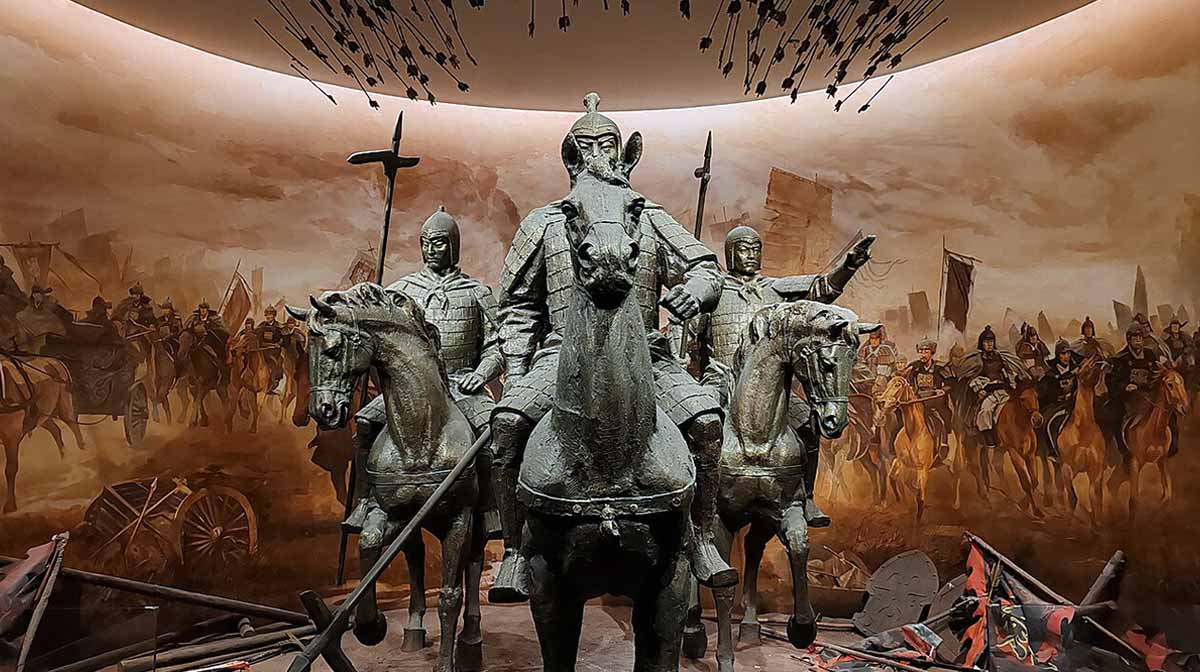
Rivers are natural defensive barriers that often determine where a major battle will take place. Typically, a commanding general will deploy his army behind a river. Any advancing enemy would be exposed to casualties crossing the river. Deploying an army in front of a river is almost always considered a mistake, since it cuts off an army’s lines of supply and retreat.
On rare occasions, a general may choose to fight in front of a river on purpose. Amidst the collapse of the Qin Empire, in late 208 BC the southern warlord Xiang Yu led around 70,000 men across the Yellow River to confront the Qin general Zhang Han. Xiang Yu ordered his men to destroy most of their supplies, leaving only three days’ worth, and to sink their boats. By purposely cutting off his line of retreat, Xiang Yu let his men know that their only path to survival was to defeat the enemy. Despite being outnumbered three-to-one, Xiang Yu duly won a famous victory that brought an end to the famous Qin state and enabled him to wield hegemonic power over China until he was defeated by Liu Bang, the founder of the Han Dynasty.
Mountain Passes and Strategic Chokepoints
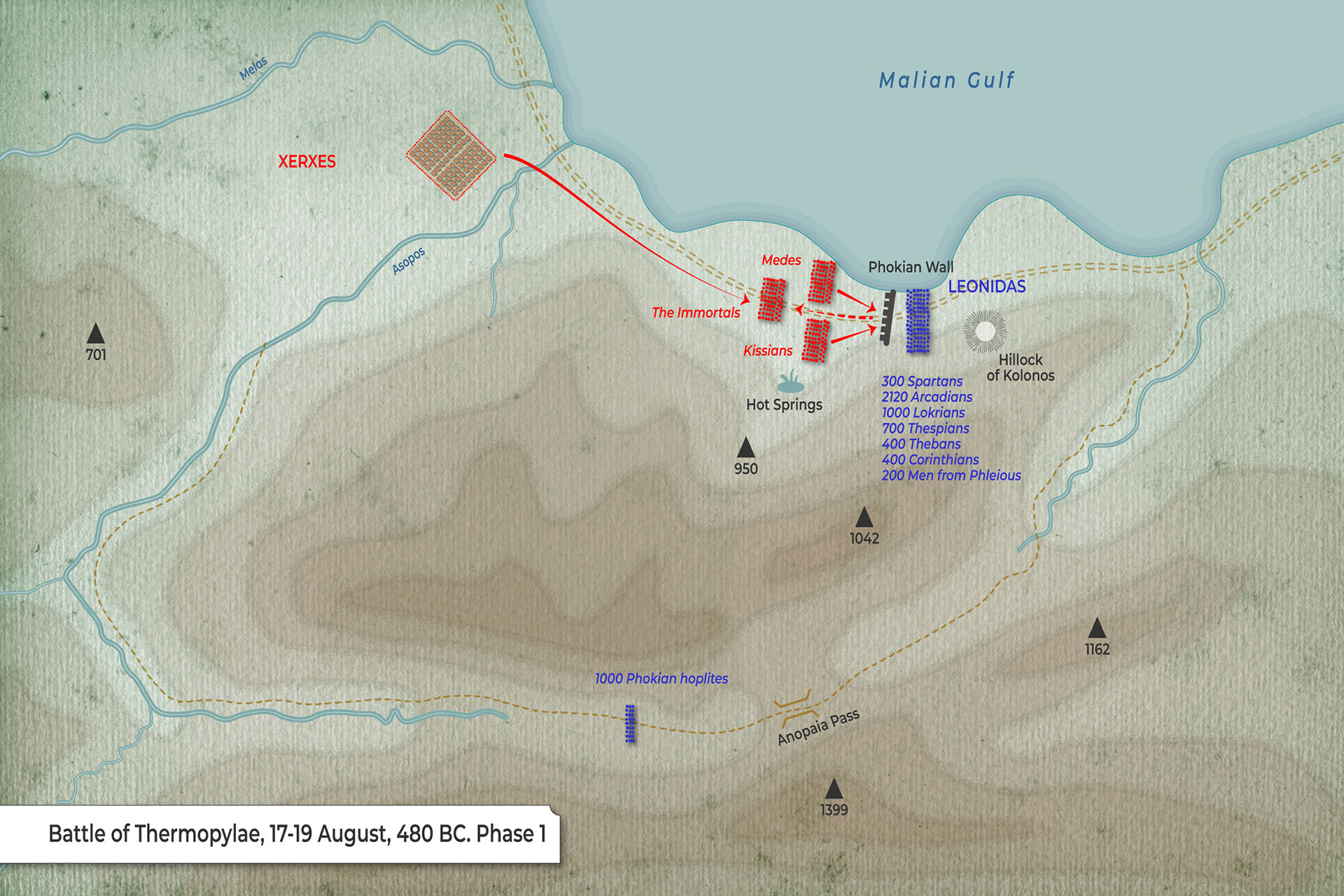
The Battle of Thermopylae is one of the most famous battles in antiquity. Known literally as the “Hot Gates,” Thermopylae was a narrow pass on the main road into southern Greece with mountains on one side and the sea on the other. It was an obvious spot for King Leonidas of Sparta’s outnumbered force to fight a delaying action against King Xerxes of Persia.
The narrow confines of the pass negated the numerical advantage of the Persian army and forced them into costly frontal assaults. While the Persians eventually managed to circumvent the formidable position on the third day of battle, their casualties were much higher than those of the Greek force.
Control of strategic mountain passes could bring lasting advantages over a much longer period. More than two thousand years of Chinese imperial history began in 221 BC when Qinshihuang completed his conquest of the rival warring states to complete the unification of China. The success of the Qin owed much to its geographical advantages.
The heartland of the Qin state was the Wei River valley in Shaanxi province. This area was also known as Guanzhong or “Between the Passes,” since the valley was protected by mountains on all sides. During the 4th century BC, while the rival warring states were struggling for power in the Central Plains of China, the Qin gathered its strength in Guanzhong behind the Hangu Pass until it was ready to break out of the pass.
With its major rivals to the east, in the 310s BC Qin armies conquered the Shu and Ba kingdoms to the southwest (around present-day Sichuan and Chongqing). These fertile and wealthy regions brought vital manpower and resources for the methodical campaigns east of the Hangu Pass over four decades between the 260s and 220s.
Occupying and Exploiting High Ground

An army that occupies the high ground is widely understood to enjoy an advantage in battle. Hills and ridges enable an army to have greater visibility of approaching enemies, artillery is more effectively deployed, and it is easier for both men and horses to fight downhill than uphill.
At the Battle of Hastings in 1066, King Harold Godwinson’s Anglo-Saxons took up an imposing defensive position on Senlac Hill, forming a shield wall that held firm against repeated attacks by the Duke of Normandy. Had the Anglo-Saxons maintained their cohesion on top of the hill, the last thousand years of English history may have been very different. Instead, either by design or by chance, the retreat of the Bretons on the Norman left flank encouraged the Anglo-Saxon warriors to pour down the hill, exposing their vulnerability to Norman cavalry and sealing the fate of Anglo-Saxon England.
On an otherwise level plain, high ground does not have to be very high. In late 1805, as Napoleon prepared for an ultimate clash with the Austro-Russian coalition army in Moravia, he occupied the gently sloping Pratzen Heights southeast of Brno. In order to entice the coalition army to attack him, Napoleon purposely abandoned the high ground to the enemy, feigning weakness and leaving his right flank seemingly undefended.
The ensuing Battle of Austerlitz was Napoleon’s tactical masterpiece. As Allied columns streamed down the Pratzen Heights to attack his right on the morning of December 2, Marshal Soult’s IV Corps emerged from the mist in the valley below to take control of the heights. With the coalition army split into two, Napoleon sent reinforcements onto the Pratzen to defeat both halves in detail and gain a decisive victory.
The Engineering of Terrain

Civilizations throughout history have often enhanced the defensive capabilities of the natural terrain with human engineering. The Great Wall of China is one of the most famous manmade defensive structures in the world. Often credited to Qinshihuang and his general Meng Tian in the 210s BC, the Great Wall describes several different walls in northern China built by successive dynasties over the centuries.
Regardless of its precise location and date of construction, the builders of the Great Wall often exploited natural features such as rivers and mountain ridges. The wall was more than a defensive barrier, it was a network of fortified outposts and camps that enabled Chinese armies to project power beyond the northern frontier and deter raids from the Xiongnu or the Mongols. Beyond its military purpose, the wall also served to regulate diplomacy and trade in peacetime.
Another famous set of walls from antiquity are the Walls of Constantinople. The city of Constantinople, present-day Istanbul, is surrounded by water from three sides. The city’s founder, Emperor Constantine the Great protected the city with a circuit of walls consisting of the Sea Walls and the Constantinian Wall on land. With subsequent expansion of the city, Emperor Theodosius II constructed the Theodosian Walls in the first half of the 5th century AD. This formidable fortification consisted of two circuits of walls defended by a moat and contributed to the city’s reputation as an impregnable fortress capable of withstanding sieges indefinitely.
In addition to the Sea Walls, Constantinople would prevent enemy ships from entering the Golden Horn by deploying the Great Iron Chain across the waterway. The device proved effective on countless occasions but was famously circumvented in 1453 when Ottoman Sultan Mehmed II brought his ships over land via the Galata district to assist in the conquest of Constantinople.
Why Terrain Still Defines Modern Warfare
Although warfare has changed significantly since the days of Alexander the Great and Qinshihuang, geography and physical terrain remains an unavoidable factor of military conflict in the modern age. Despite a massive firepower advantage, American forces were unable to defeat Vietnamese guerrillas who retreated into the jungle during the Vietnam War. In more recent memory, both the Soviets and US-led forces struggled to negotiate the mountainous landscape of Afghanistan, ultimately leading to ignominious withdrawal and the collapse of friendly regimes.
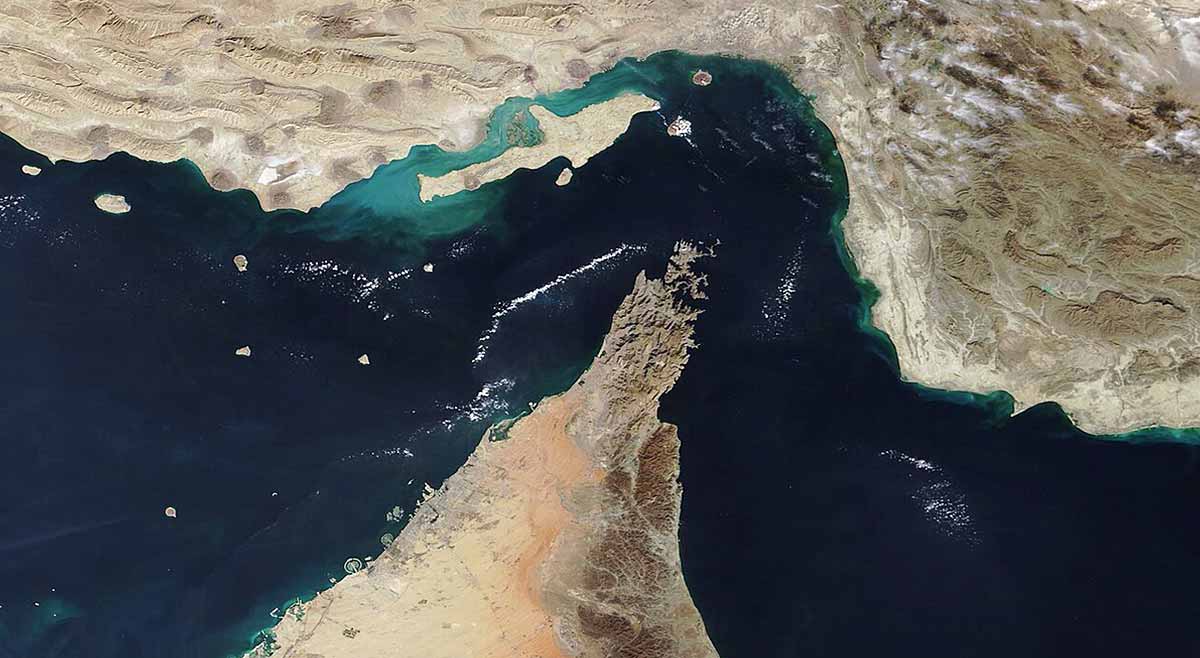
Globalization in the 21st century has only increased the strategic importance of key waterways that carry vital commodities from oil and gas to fertilizer and grains. Blockades of the Strait of Hormuz or the Suez Canal, whether intentional or accidental, have the effect of increasing the prices of goods all over the world. While the nature of warfare will undoubtedly continue to evolve, successful strategists and commanders still have to take geography into consideration in future conflicts.